Course 06 · Lesson 3 of 7 · Reading the growing season
Active growth and difficult weather
Heat, drought, wind, and long rain each ask for a different response, and shade is only one of them. Learn to change your checks and your tree's exposure for the weather you have, and to change them back when it passes.
The question
What should change when the weather turns difficult?
By the end of this lesson, you will be able to:
- Adjust what you check, and how often, during heat, drought, wind, persistent rain, and changing light.
- Choose protection that fits the stress, and explain what it costs the tree.
- Acclimate a tree gradually when its light changes, and return it to its usual place when the weather passes.
About 18 minutes to read and explore
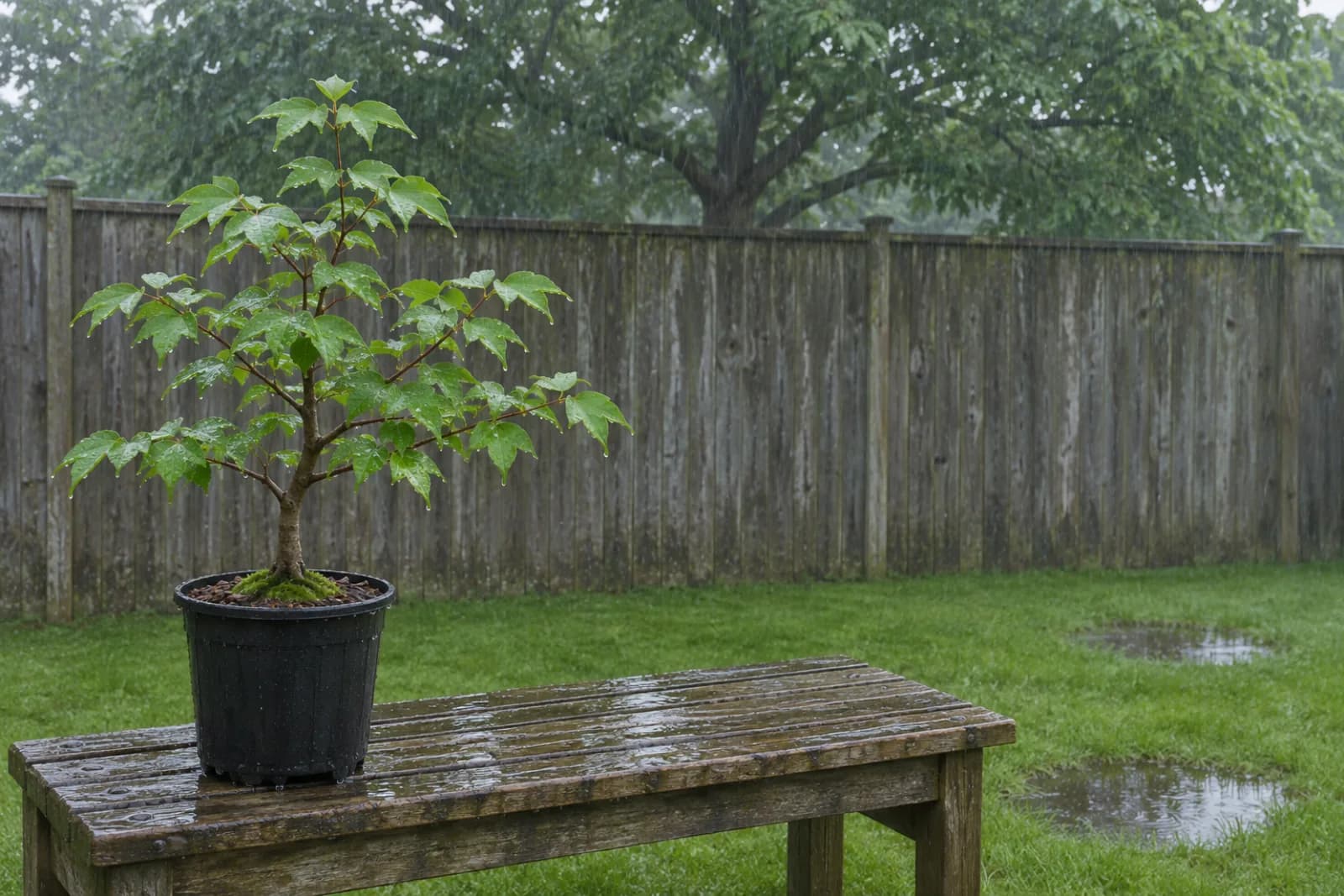
The small backyard in the second week of June this year. Like every case in this course, it is an instructional example, set in one temperate Northern Hemisphere city at about 40° N (USDA zone 7a). It has rained on most days for a week, the afternoons have stayed at 17 to 20 °C (63 to 68 °F), and the lawn is soaked. The household's trident maple (Acer buergerianum), in its fourth year in an 18 cm (7 in) black nursery pot of the nursery's bark-based mix, stands on its bench in the western third of the yard, open to the sky, and every morning its pot is heavy, as if just watered. One of the two adults wonders whether a week of this is rotting its roots; the other, whether the morning watering should go on as usual.
Five weeks later the same yard has had no rain since July 2. The household is home from its two weeks away, as every July, and the forecast shows five days near 36 °C (97 °F), from July 14 to 18, the last two with a hot, dry west wind.
Across the city, in the courtyard, the owner's older trident stands on the display bench, the one spot in the courtyard that the summer sun reaches into the afternoon. For the heat wave the helper hangs shade cloth on a light frame over the bench, which is right for a trident's leaves on those afternoons. By the third week of August the cloth is still there, the tree under it has grown long shoots with large, thin leaves, and nobody has asked what the cloth is costing.
One summer, three kinds of difficult weather: rain that will not stop, heat in a month without rain, and protection left in place long after the weather that called for it. For each, what is running short or building up, and what is the smallest change that answers it? This lesson shows how to name what the weather is doing to a tree, match the response to it, and undo that response when the weather passes.
Name what the weather is doing to the tree
By early summer a trident's first flushA burst of new shoot growth, with leaves expanding together, that happens once or several times a year depending on the tree and conditions. Between flushes, shoots stop extending and mature.Open the glossary has shoot hardeningThe firming of new growth after it stops extending: the leaves reach full size, darken, and turn firm, and the new stem turns woody from its base. It is not the same as cold acclimation, which makes tissues able to survive freezing, or hardening off, which is moving a tree into sun and wind in steps.Open the glossary, and its full-size leaves are building this year's wood and roots and refilling the reservesCarbohydrates, mostly starch, stored in living cells of the roots, trunk, branches, and bark for later use. Reserves fuel early spring growth before new leaves can supply sugar, and they help a tree recover after losing foliage or roots. A seed carries reserves of its own, such as starch, oils, and proteins, that fuel the embryo's first growth.Open the glossary that open next spring's buds (Lesson 1). Difficult weather interrupts that work, and so can the answers to it.
Weather acts on particular parts of a tree and its pot, and each response works only on the part it reaches, so the first step is to name what is running short or building up. Four things cover nearly every summer case: water in the pot, air at the roots, light on the leaves, and heat, at a sunlit pot wall or on leaves that scorch. Course 03 settled the watering side of a single rain, heat wave, or windy day: rain changes which pot you check first, heat and wind change how often, and none of them changes how you decide (Course 03, Lesson 5). This lesson adds weather that lasts for weeks, and changes to where a tree stands and what covers it.
Three of this course's exposure responses belong to summer. Leave it where it is means the tree's own place already answers the weather, and only the checks change. Shade the pot means keeping direct sun off the pot wall, with a board, a neighboring pot, or a pale sleeve, while the leaves keep their light (Course 02, Lesson 5). Put it back means undoing every protective change once the weather passes, in steps wherever the light increases. The other two, Protect it tonight and Protect the roots, answer frost and cold (Lesson 2 and Lesson 5). Anything else, from shade cloth to a screen against the wind, is a change for a spell, with a cost and a day to undo it.
| The weather | What runs short or builds up | First response | What it costs, and when it is undone |
|---|---|---|---|
| A heat wave | Water, by afternoon; heat at a sunlit pot wall and on leaves that scorch | An afternoon check; Shade the pot; cloth over scorch-prone leaves on the hottest afternoons | Pot shade, almost nothing, off when the sun leaves the wall; cloth costs light, down when the heat breaks |
| A dry spell with wind | Water, a little faster each day | An afternoon check; Water thoroughly now at Drying or drier; pots grouped | Little; each pot goes back to its place when the rain returns |
| Days of rain | Air at the roots of a pot that stays Saturated | Lift and chopstick first; Not yet: check again later while it reads Wet | Under cover, a slow pot is checked like any sheltered pot; back out when the rain stops |
| Strong wind | Water, from leaves and pot; the footing of tall pots | An afternoon check; Leave it where it is if it is tied on and sheltered | Little; Put it back if it was moved |
| Light changing over the summer | Light, as nearby trees leaf out; sun on a pot wall an overhang once shaded | A fresh count of the hours of sun; Shade the pot where a lower sun reaches it | A moved tree may lose its shelter; check the spot again in autumn |
Read across any row and the same order appears. First change the checks, which cost nothing and catch every other problem in time. Then deal with what the weather acts on: a pot wall, a drainage hole, a tray, the wind. Change the tree's own light last, only for the spell, and only for the trees that need it, because light is what a tree grows on (Course 01, Lesson 4). Then Put it back, and write the date of each change in the watering logA dated record of each check of a tree's root zone, usually one short line per pot: the weather, what each check found, the decision, and the reason for it. Read over weeks, it shows how fast each pot dries in different weather, whether the decisions worked, and patterns no single check can show, such as a pot that keeps drying fast even as the weather cools.Open the glossary, so that a change made for five days does not quietly last five weeks.
Heat: the pot, the leaves, and the water
A heat waveA run of days much hotter than is usual for the place and the season. Where summer afternoons are usually about 30 to 33 °C (86 to 91 °F), for example, a run of days near 36 °C (97 °F) is one, and an ordinary hot week is not. Many trees stop growing until it passes while their pots dry faster than usual, so checks are added and elective work and feeding wait.Open the glossary is a run of days much hotter than is usual for the place and the season. In the example city, July afternoons are often 30 to 33 °C (86 to 91 °F), and a heat wave means days near 36 °C (97 °F). This year's came from July 14 to 18, in a July with no rain from the 2nd to the 24th. Its routine is already set: checks morning and afternoon, pot walls shaded, shade clothAn open-weave fabric hung on a frame over plants to cut part of the sun. It lowers the heat on leaves at the cost of light, so it is used on the days and over the trees that need it, such as scorch-prone leaves in a heat wave, and taken down afterward. Left up for weeks, it leaves the tree growing long, thin shoots whose large, thin leaves burn when the cloth comes off at once.Open the glossary, an open-weave fabric that cuts part of the sun, over the trident on the hottest afternoons, and the sun-loving junipers left in the sun (Course 03, Lesson 5). A heat wave changes the pace, not the decision; what follows is why the pot wall comes first.
A root zone's heat comes mostly from the sun on the pot wall. Researchers who measured black plastic nursery containers in full sun found that sunlight striking the container's side, not the temperature of the air, drove the heat in the root zone, and that wind and humidity made little difference (Reducing Heat Stress to Container-Grown Plants, University of Kentucky Extension HO-119). fine rootOne of the many thin, branching roots, often pale when young, that do most of a tree's absorbing of water and mineral nutrients. Fine roots live a relatively short time and are constantly replaced, so they depend on a root zone that holds both water and air.Open the glossary are generally more easily injured by heat than leaves, and a dry root zone heats faster than a moist one (Course 02, Lesson 5). So in a heat wave the first change to a tree's exposure is Shade the pot: a board, a pale sleeve, or a neighboring pot on the sunny side, and the pot lifted off hot paving, with its reflected heatExtra heat a tree receives from sunlit surfaces nearby, such as paving, walls, and glass: sunlight bounced off them, plus the heat they give off once warm, which can continue after sunset. It makes spots beside hard surfaces hotter and drier than the air temperature suggests.Open the glossary, onto a slatted bench. It protects the roots and takes nothing from the leaves.
The hot side moves. Through a day it follows the sun, from the east side of a pot in the morning to the south side at midday and the west side in the afternoon. Through a summer it moves too: in the same Kentucky measurements, the hottest root zones came from late August into early October, after the air had cooled, because a lower sun strikes the side of a pot more squarely. A pot that its neighbors or an overhang kept in shade in July can stand in direct sun in September. So Shade the pot is not only a July answer, and the air's temperature alone is the wrong gauge for a pot in the sun.
Water in heat because the tree needs water, not to cool the pot. A thorough watering when a check reads Drying or drier keeps the leaves supplied, and their own transpirationThe evaporation of water from inside a plant and its escape as vapor, mostly through the stomata of leaves. As water evaporates, more is pulled up from the roots through the xylem; most of the water a tree absorbs is lost this way.Open the glossary is what keeps them cool (Course 01, Lesson 8). A splash or a misting does not cool a root zone, and a pot watered every afternoon to cool it is on its way to overwateringKeeping a root zone wet so constantly, or letting it drain so poorly, that air never gets back into its pores and the roots run short of oxygen. It is about how often a pot is watered and how well it drains, not how much is poured at once: a thorough watering of a pot that drains, given when the root zone is drying, is not overwatering.Open the glossary. A trident that droops at 6 pm over a moist root zone and has firmed by dusk is showing temporary wiltingDrooping of leaves or soft shoots on a hot, bright, or windy afternoon, over a moist root zone, that recovers by evening as demand falls and uptake catches up. Wilting that lasts overnight is a different matter, and wilting that returns most afternoons still costs growth (Course 01, Lesson 8).Open the glossary, not asking for water (Course 03, Lesson 4).
Growth pauses in the heat. Many trees stop extending their shoots in a heat wave and start again once it passes. The pause is not a fault to fix, and not a summer version of winter rest; when the heat breaks and water returns, some trees even push a second flushA further burst of shoot growth after a tree's first flush has hardened, which some trees make and others do not. Warm weather, water returning after a dry spell, and nitrogen favor it, so it is common in containers, where water and feed come regularly. Growth that starts late in the season has little time to firm up before the first frosts, which can damage it.Open the glossary (Lesson 4). And an ordinary hot week is not a heat wave: with water in the pot and its walls shaded, a trident in full leaf keeps working through it, and its exposure need not change.
When shade over the tree helps
Shade over the whole tree is for something that cannot keep up for the length of a spell. Courses 02 and 03 name the cases, each with the same shape: one part of the tree or its pot falls short, and shade lowers the demand on it until the weather passes.
- Leaves that scorch. A trident's thin leaves brown at the edges in hot afternoon sun and wind (leaf scorchBrowning and drying of leaf edges, tips, and the tissue between the veins when leaves lose water faster than the roots can replace it, as in hot sun, wind, or dry air. Thin shade leaves moved suddenly into strong sun scorch the same way, often after pale, bleached patches. It is a symptom, not a diagnosis: a dried-out root ball, damaged roots, or salt buildup can cause the same browning.Open the glossary), so shade cloth goes over it on the hottest afternoons of a heat wave.
- A tree that droops most hot afternoons. Limp leaves make little sugar, so it gets shade through the hottest hours (Course 03, Lesson 4).
- A pot too small to last between checks. It moves into bright shade, out of the wind, for the days of the heat (Course 03, Lesson 5).
- Roots reduced this year. Bright but sheltered from wind and hot afternoon sun: lower the demand, keep the light (Course 03, Lesson 4).
- Time away. When nobody can check every day, slower drying is worth a few days of less sun (Course 03, Lesson 6).
A juniper in full sun, with its pot shaded and someone to check it, is none of these. Moving it into shade for a heat wave takes away the light it grows on to solve a problem the pot shade has already solved (Course 03, Lesson 5): find what is overheating and fix that, as Course 02 put it.
The courtyard maple, repotted on February 28, had shown white root tipThe growing end of a root, made up of the root cap, the dividing cells behind it, and short zones where new cells lengthen and mature. Active tips are usually pale or white and show where a root is extending into fresh substrate.Open the glossary at its holes since late May but still had fewer roots than before. It needed nothing new: its bench has morning sun and afternoon shade from the house, the bright shelter a tree with reduced roots wants in heat.
What shade costs
Shade is paid for in light. A leaf in shade makes less sugar, and over a few hot afternoons a trident gives up little, because leaves that would have scorched or drooped were making little anyway. Over weeks the price grows, and the tree shows it:
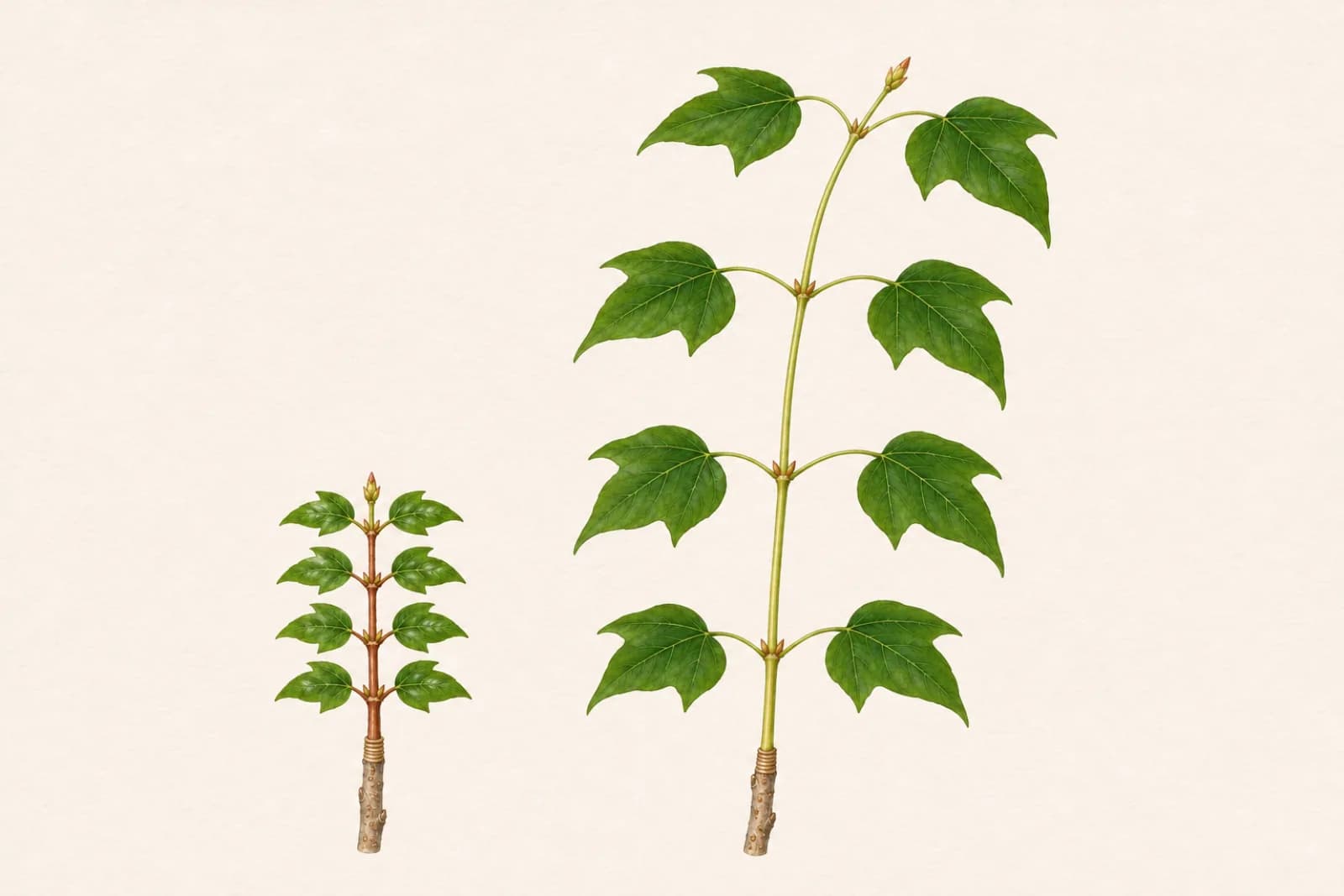
- Long, thin growth. New shoots grow long, with long gaps between their pairs of leaves (long internodeThe stretch of stem between two neighboring nodes. Internodes tend to be longer in vigorous or shaded growth and shorter in slow growth or strong light, and short internodes help a bonsai's branches look finer and more compact.Open the glossary), and the leaves on them grow large and thin: shade leafA leaf that grew in dim light, such as in a window, under greenhouse glass, or deep inside a canopy. It is thinner and often larger than a leaf grown in sun, with a thinner cuticle and fewer layers of light-catching cells, so it uses weak light well but bleaches or scorches if moved suddenly into strong sun.Open the glossary, built to catch weak light.
- Less sugar to store. Leaves kept in shade make less of the sugar that refills the tree's reserves for winter and next spring (Course 01, Lesson 9).
- Slower drying. A shaded pot dries more slowly, and a watering habit set in the heat keeps it wetter than the checks would.
- Shoots that stay soft longer. A review of nursery shading in the USDA Forest Service's Forest Nursery Notes found that with enough water in the soil the shade was usually unnecessary, that heavy shade made seedlings stretch, and that too much of it delays the firming of new shoots (Landis, Cooling with Shade, Forest Nursery Notes, 2005). Late in the season, heavy shade also slows readiness for cold (Lesson 4).
- Leaves that burn in sudden sun, the cost that arrives when the shade comes off.
On a tree in refinementThe phase of keeping a developed bonsai's shape fine and compact, with short shoots, small leaves, and dense twigs. Lighter, well-timed feeding, especially through the spring flush, helps keep the shoots short and the leaves small while the tree stays healthy. Withholding nutrients does not: a starved tree grows weak rather than refined, and pruning and light do most of the shaping.Open the glossary, like the display trident, long shoots with large leaves are exactly the coarse growth its owner prunes and feeds lightly to avoid (Course 05, Lesson 4). Five weeks of cloth undid part of a summer of that care.
Putting a tree back in the sun
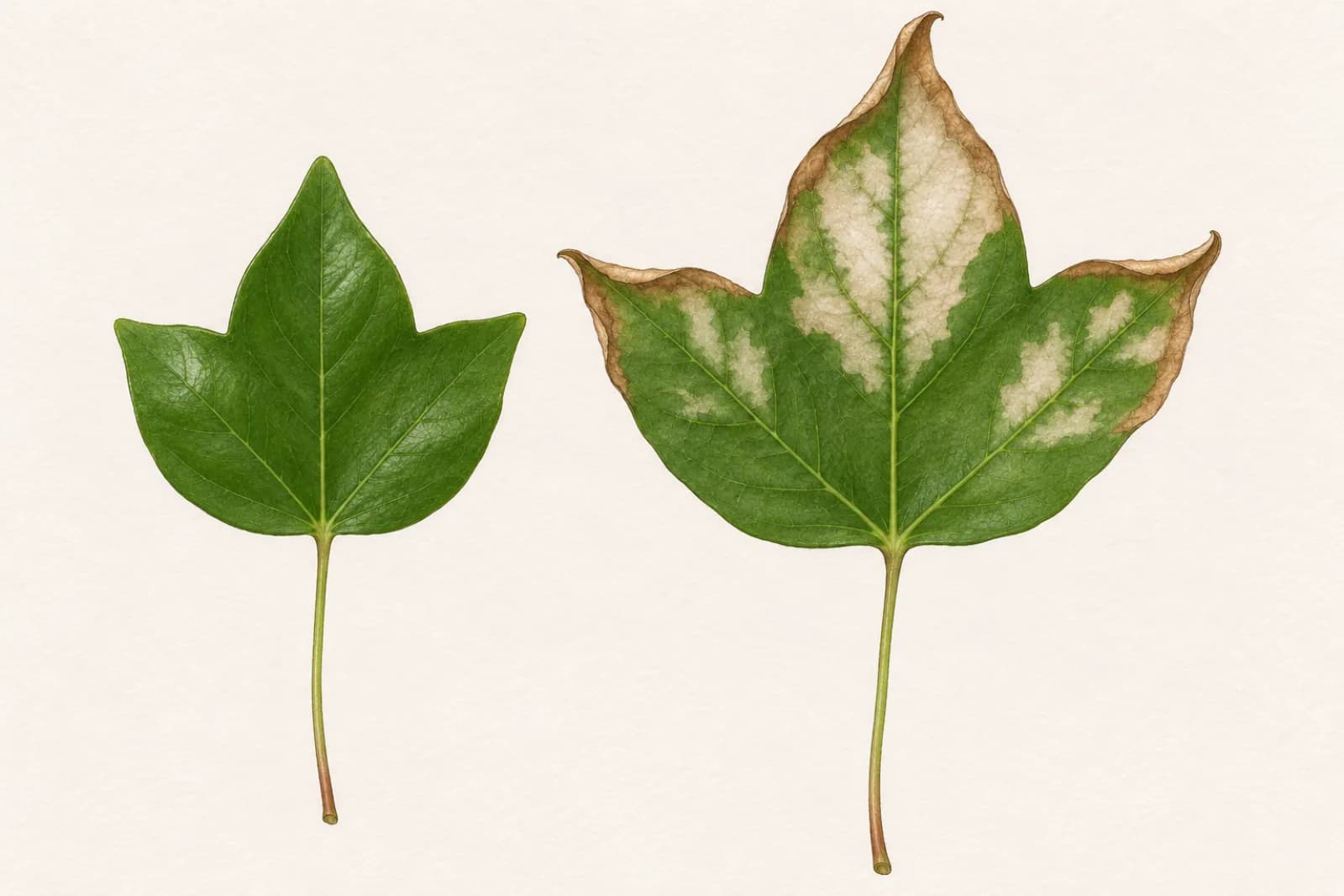
Leaves are built for the light they grew in: thick and dense in sun, larger, thinner, and often darker green in shade, and once grown they adjust only partly (Course 02, Lesson 3). So when shade comes off all at once, the leaves grown under it meet more sun than they can handle, even on a day that is not hot, and they burn.
That injury is sunburnInjury from more sun than leaves or bark are used to, often after a sudden change: a tree moved from shade into full sun, shade cloth taken off at once, or inner leaves and bark newly exposed by pruning. On leaves it shows first as bleached or silvery patches, then as the browning called leaf scorch; on bark, as dry, sunken patches. It is a warm-season injury; sunscald is the winter one.Open the glossary: damage from more sun than leaves or bark are used to, often after a sudden change. On a leaf it shows first as bleached or silvery patches, often between the veins, then as the dry browning at edges and tips that Course 02 calls leaf scorch. The University of California's integrated pest management program lists the loss of shade among its usual causes, with bark suddenly exposed by pruning, and finds it worst on the south and west sides of a plant in the Northern Hemisphere (UC IPM: Sunburn). It is a warm-season injury; sunscaldWinter injury to bark, when the sun warms the bark on a cold day and the living tissue beneath is then killed as the temperature drops quickly. It shows later as dry, sunken, or split patches, usually on the sunny side of a thin-barked trunk. It is a different injury from sunburn, which is warm-season sun damage.Open the glossary, an injury to bark in winter, is a different thing (Lesson 5).
The display trident is the worked example. The cloth went up for the heat wave, rightly, and nobody took it down when the heat broke after July 18, because taking it down was nobody's job. It stayed up for five weeks, and the growth made under it was long, with large, thin leaves. On August 22, a clear day after the storm of August 20, the cloth came off in one go, and within days the leaves made under it showed pale patches between their veins, then brown edges. The leaves of the first flush, built in full sun before July, were marked far less.
Two things would have prevented it. The first is an end date: cloth hung for a heat wave comes down when the heat breaks, and a line in the log saying so makes that somebody's job; five afternoons of light shade leave few shade leaves to worry about. The second, once weeks have passed, is to put the tree back in steps: the cloth off for the morning first, then for longer each time, starting on a mild or cloudy day, holding at a step through any hot spell, and going back a step if pale patches appear, the same rules as hardening offGetting a plant that grew indoors or under glass used to outdoor sun, wind, and temperatures gradually, by moving it from bright shade toward full exposure over one to two weeks or more. For bonsai, it protects soft leaves from scorch when a tree goes outdoors for the season or arrives from a greenhouse. It is not the same as shoots hardening, or turning woody, in late summer.Open the glossary a tree in spring (Course 02, Lesson 3). There is no fixed number of days; the leaves set the pace. Stepping cannot turn shade leaves into sun leaves, but it keeps them working through the weeks of storing ahead.
Leaves that have already burned stay marked until they fall: a record of the change, not a reason for more work.
A summer under shade cloth
What does the shade cost? follows two trees of the same kind through twelve weeks of one invented summer on the courtyard's display bench, with a heat wave in week 3, hot weeks after it, and warm, clear weather from week 8. Both pots stand behind a board that keeps the sun off their walls, and both are checked morning and afternoon, so only the light on the leaves differs. Tree A stays on the open bench all summer; Tree B stands under a light frame that carries shade cloth.
Choose The tree, for both: Trident maple or Juniper. Under B's shade, choose Cloth up: For the heat wave's afternoons or From the heat wave on; with the second, Cloth down asks whether it comes off In one day or In steps. Under Your call, choose A, B, Both, or Neither for which tree ends with scorched leaves, or press Skip. Press Run the summer, and use Pause, Back, Next, Replay, or Skip to the end, or the week strip, to stop on any week. The close-up This summer's shoot (This summer's foliage for the juniper) follows the growth, and for each tree the readouts Leaves (Foliage), This summer's shoots (This summer's growth), and What is happening follow it in words, while two rows under the week strip show the light on each tree's leaves. Find all four challenges to finish. Try these:
- The simulation opens on Trident maple and For the heat wave's afternoons. Make your call, press Run the summer, and compare Leaves on A and B in the heat wave's week.
- Change Cloth up to From the heat wave on and Cloth down to In one day. Watch This summer's shoots from week 5, and read the weather chip on the day the cloth comes down.
- Run it again with In steps, and compare B's shoot with A's at the end of the summer.
- Switch to Juniper, and run For the heat wave's afternoons, then From the heat wave on with In one day.
Simulation
What does the shade cost?
Tree A On the open bench all summer.
B's shadeBoth pots are shaded and checked; only the light on the leaves differs.
Calls: none yet
- Week 1: Warm · 27 °C (81 °F)
- Week 2: Hot · 31 °C (88 °F)
- Week 3: Heat wave · 36 °C (97 °F)
- Week 4: Hot · 32 °C (90 °F)
- Week 5: Hot · 31 °C (88 °F)
- Week 6: Hot · 33 °C (91 °F)
- Week 7: Hot · 31 °C (88 °F)
- Week 8: Warm · 28 °C (82 °F)
- Week 9: Warm · 27 °C (81 °F)
- Week 10: Warm · 27 °C (81 °F)
- Week 11: Warm · 26 °C (79 °F)
- Week 12: Warm · 25 °C (77 °F)
- Week 1: Not reached yet
- Week 2: Not reached yet
- Week 3: Not reached yet
- Week 4: Not reached yet
- Week 5: Not reached yet
- Week 6: Not reached yet
- Week 7: Not reached yet
- Week 8: Not reached yet
- Week 9: Not reached yet
- Week 10: Not reached yet
- Week 11: Not reached yet
- Week 12: Not reached yet
Close-upThis summer's shoot
| Week 1 | Tree AStays as it isOn the open bench all summer. | Tree BYour changesFor the heat wave's afternoons |
|---|---|---|
| Leaves | No damage | No damage |
| This summer's shoots | Short shoots with leaves close together | Short shoots with leaves close together |
| What is happening | Full sun on the open bench. This summer's new shoots are short, with leaves close together. | Full sun on the open bench. This summer's new shoots are short, with leaves close together. |
What is happening
Full sun on the open bench. This summer's new shoots are short, with leaves close together.
Full sun on the open bench. This summer's new shoots are short, with leaves close together.
- Dashes on B's close-up: where A's shoot ends
- Heat over the bench
- A board shading each pot
Result
Which tree ends with scorched leaves?
Press Run the summer. At the end of week 12, the result says which tree's leaves were scorched, how each tree grew, and why.
Challenges
0 of 4 found
Find all four challenges to finish.
Find shade that helps, not found yet.
Match the shade to the days, and to the tree.
Find shade that changes nothing, not found yet.
Try a tree that wants the sun, with its pot already shaded.
Find a tree that never scorched and still lost the summer, not found yet.
Watch the shoots, not the leaf edges.
Scorch a tree's leaves on a warm day, not a hot one, not found yet.
Read the weather chip on the day the leaves scorch.
Text description
A scene in the courtyard on summer afternoons: the limewashed wall under terracotta coping, a summer sky with the sun at the upper left, the cedar display bench, and flagstones. Two trees of the same kind stand on the bench in matching shallow glazed pots, each with a small cedar board standing in front of the pot's sunny end so the pot wall stays shaded: Tree A on the left, on the open bench, and Tree B on the right, under a light frame that can carry shade cloth in three panels.
Sun on the leaves is a warm wash from the upper left; the cloth's shade is a cool, soft shadow falling over B; heat is an orange haze with wavy shimmer over the bench, strongest in the heat wave. Leaf scorch shows as browned edges or tips, or as pale patches that turn brown; growth made under the cloth is drawn with longer gaps and larger, thinner leaves on a trident, and sparser and paler on a juniper.
Twelve weeks of one invented summer, the same in every run: Week 1, Warm · 27 °C (81 °F); Week 2, Hot · 31 °C (88 °F); Week 3, Heat wave · 36 °C (97 °F); Week 4, Hot · 32 °C (90 °F); Week 5, Hot · 31 °C (88 °F); Week 6, Hot · 33 °C (91 °F); Week 7, Hot · 31 °C (88 °F); Week 8, Warm, clear · 28 °C (82 °F); Week 9, Warm, clear · 27 °C (81 °F); Week 10, Warm, clear · 27 °C (81 °F); Week 11, Warm, clear · 26 °C (79 °F); Week 12, Warm, clear · 25 °C (77 °F). Both trees are checked morning and afternoon in the heat and watered when the check says so. Both pots are shaded and checked; only the light on the leaves differs. Tree A: On the open bench all summer.
The controls:
- The tree, for both: Trident maple (Its leaves can scorch in hot afternoon sun); Juniper (It needs full sun).
- B's shade, Cloth up: For the heat wave's afternoons (Off again when the heat breaks); From the heat wave on (Left up, all day).
- B's shade, Cloth down, shown only with From the heat wave on: In one day (All of it in week 8); In steps (A panel at a time from week 8).
Before each run, an optional call asks “Which tree ends with scorched leaves?” The options are A, B, Both, Neither, or Skip. Run the summer plays the twelve weeks. Play, Pause, Back, Next, and Replay control it, the weather strip jumps to any week, and Skip to the end jumps to week 12. Under the weather, two rows show the light on each tree's leaves, week by week, as the run reaches them: Full sun; Cloth on the hot afternoons; Under the cloth; One panel drawn back; Two panels drawn back; All at once.
Under the scene, a round close-up shows each tree's growth this summer: for a trident, one of this summer's shoots, the leaves it makes under the cloth large, thin, and deep green, with a dashed line on Tree B's close-up where Tree A's shoot ends; for a juniper, a spray of this summer's foliage, sparser and a softer green where it grew under the cloth. Each close-up is warm in full sun and cool under the cloth. A table gives each tree's readouts in words, week by week:
- Leaves (for a juniper, Foliage): No damage or Leaf scorch, with where the scorch shows.
- This summer's shoots (for a juniper, this summer's growth): Short shoots with leaves close together; Long shoots with long gaps between leaves; Dense, deep green; Sparse and pale; and Large, thin leaves.
- What is happening: a sentence for each tree.
At week 12, a result card says what happened to each tree's leaves and growth and why, and stamps a call Called it or Surprise. The challenges tick themselves off when a run finds them. Find all four challenges to finish. A finish card then sums up the pattern.
- Find shade that helps
- Find shade that changes nothing
- Find a tree that never scorched and still lost the summer
- Scorch a tree's leaves on a warm day, not a hot one
On Trident maple with For the heat wave's afternoons, B came through the heat wave with no damage, while A, in the glare, showed light Leaf scorch on the edges of its sunniest leaves; both then grew Short shoots with leaves close together. With From the heat wave on and In one day, B never scorched under the cloth, but from week 5 its This summer's shoots read Long shoots with long gaps between leaves and Large, thin leaves, and within days of the cloth coming down in week 8, on a day the chip read Warm, bleached and browned patches spread over those thin leaves: Leaf scorch, which the narration called sunburn. Both trees ended scorched. In steps grew the same long, thin shoots, and B's leaves did not burn, though A's had scorched in the heat wave: stepping saved B's leaves, but it could not give back the summer's light.
The juniper showed the other half. With For the heat wave's afternoons, B ended as A did, dense and deep green: it lost a few afternoons of sun it had no need to lose, because its pot was already shaded. Left under the cloth From the heat wave on, B's This summer's growth read Sparse and pale; taken down In one day, its new tips browned within days, and taken down In steps, it stayed sparse and pale but unburned.
Go deeper · optional, not assessedHow hot does a pot get? Measurements from nursery containers
The most detailed published measurements of hot root zones come from nursery growing, gathered in the University of Kentucky's summary (HO-119, linked above). In black plastic nursery containers in full sun, some part of the root zone ran above 40 °C (104 °F) for 5 to 10 hours on a summer day, the mix near the west wall usually passed 49 °C (120 °F), and readings above 54 °C (130 °F) have been recorded. Roots were injured directly within half an hour at about 45 to 54 °C (113 to 130 °F), depending on the plant, and more slowly when a root zone sat near 40 °C (104 °F) for five or six hours a day.
The same work measured what helps. Light-colored containers ran 5 to 10 °C (9 to 18 °F) cooler inside than black ones in full sun, a difference that mostly vanished in shade, and shading the wall, or standing one pot inside another, brought the root zone close to the air's temperature. None of these numbers was measured in a ceramic bonsai pot, and none is a limit for any tree; they show how much hotter than the air a sunlit pot can run, and that shading the wall is the remedy the measurements support.
Dry spells and wind
A pot can run dry within a day of summer heat; a dry spell is the same thing stretched over weeks. This summer had no rain from July 2 to July 24, with the heat wave in the middle of it. Through a spell like that the air stays dry, nothing tops a pot up between checks, and the store that carried a pot through one hot afternoon is drawn down a little faster each day (Course 03, Lesson 1).
Wind adds to it. It strips the thin layer of still, moist air from each leaf, the boundary layerA thin layer of slow-moving, more humid air next to the surface of a leaf or needle, which slows the escape of water vapor into the open air. Wind thins this layer, increasing water loss.Open the glossary, so the leaves lose water faster, and it dries a pot's surface (Course 01, Lesson 8). It does not cool the roots: the Kentucky measurements found that wind made little difference to a sunlit pot's root zone.
Short of a full dry-out, a pot that runs a little dry day after day still costs growth: drought stressStress from a root zone too dry to supply the water the leaves lose. The stomata narrow and growth slows before any wilting shows, and a juniper may only turn dull and grayish. Roots that cannot take up water from a wet pot cause similar signs, but that is a different problem.Open the glossary narrows the stomaA microscopic pore (plural: stomata), mostly on leaves and needles, through which gases pass in and out, chiefly carbon dioxide entering and water vapor leaving. A pair of guard cells widens or narrows each pore in response to light, the water supply, and the surrounding air.Open the glossary and slows growth before any leaf droops (Course 03, Lesson 4). So in a dry spell the afternoon check matters even when nothing wilts. What changes, in the usual order:
- The checks. Add an afternoon check on hot or windy days, smallest and most exposed pots first (Course 03, Lesson 6), and water thoroughly at Drying or drier.
- The pots. Group them so that they shade one another's walls and shelter one another from the wind.
- The wind. Stand the group in the lee of a fence or a screen that lets some air through, a windbreakAnything that slows the wind over the area behind it, such as a fence, screen, hedge, or panel of netting. A screen that lets some air through slows the wind over a longer stretch, with less swirling, than a solid wall, and keeps the air moving.Open the glossary that slows the gusts without stilling the air (Course 02, Lesson 5). Tie tall pots on, or set them on the ground, before a gusty day (Course 03, Lesson 5).
A pot that runs dry between checks costs more than the day it wilts. The fine roots in its driest layers die first, and watering brings back the water but not those roots (Course 03, Lesson 4). The leaves may look normal by evening, but the cost can show weeks later, or as shorter growth next spring, because a tree can draw on its reserves for a while (Course 01, Lesson 14). After a hard dry-out, rewet the whole root ball slowly (Course 03, Lesson 3), hold the feed until new growth shows the roots working (Course 05, Lesson 4), and count the dry-out as a stressAny condition that pushes a tree's functioning outside its normal range and limits growth or survival, such as drought, waterlogging, heat, cold, poor light, root loss, pests, or heavy pruning. Several stresses at once can add up to more than the tree can support.Open the glossary already spent this year when work is planned (Lesson 7).
Days of rain
The fortnight from June 8 to 21 brought the opposite problem: rain on eleven of fourteen days, afternoons of 17 to 20 °C (63 to 68 °F), and little sun. Pots in the open read Wet morning after morning, while on the west balcony the trident at the back wall, in the rain shadowAn area that rain does not reach because something blocks it, such as the ground under an overhang or eave, beside a wall on the side away from wind-driven rain, or under a dense canopy. Pots in a rain shadow can stay dry through a day of rain, so they need checking and watering by hand.Open the glossary of the balcony above, still dried and was watered when its chopstick said so (Course 03, Lesson 5). Rain changes which pot you check first; it never replaces the check.
Rain does not harm roots in a free-draining mix. In a pot that drains, water runs through and air follows it back into the larger pores within the hour, as after a thorough wateringWater applied evenly across the whole surface, slowly enough to soak in, until it runs from the drainage holes, and then confirmed by a check that the root ball wetted through. It usually takes two or three passes a minute or two apart. Water at the holes alone shows only that water reached the bottom, not that the roots got it.Open the glossary (Course 03, Lesson 4). The harm comes from a root zone that stays saturatedDescribes soil or substrate whose pore spaces are completely filled with water, leaving little or no air. Brief saturation right after watering is normal in a pot that drains; saturation that lasts starves roots of oxygen.Open the glossary: the roots use up the oxygen around them (hypoxiaAn oxygen supply too low for cells to respire normally. In containers it most often affects roots when the substrate stays saturated, because oxygen moves through water roughly ten thousand times more slowly than through air.Open the glossary), their tips die back, and the tree takes up less water from a pot full of it (Course 01, Lesson 7). Virginia Cooperative Extension's guide to water stress in container plants ranks air ahead of water for roots, and notes that a plant in a waterlogged container can wilt with its pot full (Identifying Water Stress in Container-Grown Plants).
So in a rainy week the question for each pot is not whether it rained but whether its root zone drains. Before any watering, lift the pot, read a chopstick left a few minutes in the core, and watch the drainage holes (Course 03, Lesson 2). After a shower, water from a pot that drains runs out freely, then slows to a drip; holes that only seep, or a pot still sodden at its base the next morning, mean slow drainage. Look under the pot too: a tray, a saucer, or a cover pot fills with rain as surely as with watering (Course 03, Lesson 5).
Some pots are far more likely to be the slow ones. Bark-based and peat-based nursery mixes hold more water and drain more slowly than akadama, pumice, and lava, and an old one that has broken down and filled with roots is slower still (Course 04, Lesson 7). In any pot the bottom stays wettest after drainage, and in a shallow pot that wetter zone takes a larger share of the root ball (Course 04, Lesson 4).
A pot that is wet but draining stays where it is: Not yet: check again later, with its holes cleared and anything under it emptied. A pot that reads Wet or Saturated morning after morning, with holes that drain slowly, gets no water by habit: clear its holes, prop one side on a small wedge so that the water held in its wettest layer runs toward the low corner and out (Course 04, Lesson 2), and move it under cover, somewhere with open sky in front of it: under the eave along the patio wall in the small backyard, or into the courtyard's roofed passage by the gate. Under cover it is a pot in a rain shadow and is checked like one; after a day or two it may read Drying while the rain still falls outside. When the rain stops, Put it back.
Two things wait. A slow pot's mix may be worth changing at its next repot (Course 11, Repotting and Root Development), but the rain will be long over before new roots could grow, and changing the conditions comes before changing the mix (Course 04, Lesson 6). And the next feed on the interval replaces what the rain washed out, given once the mix has drained to Moist (Course 05, Lesson 3). Leaf disease that a long wet spell can bring belongs to Course 07, Tree Health and Diagnosis.
Practice check · not scored
The light moves with the season
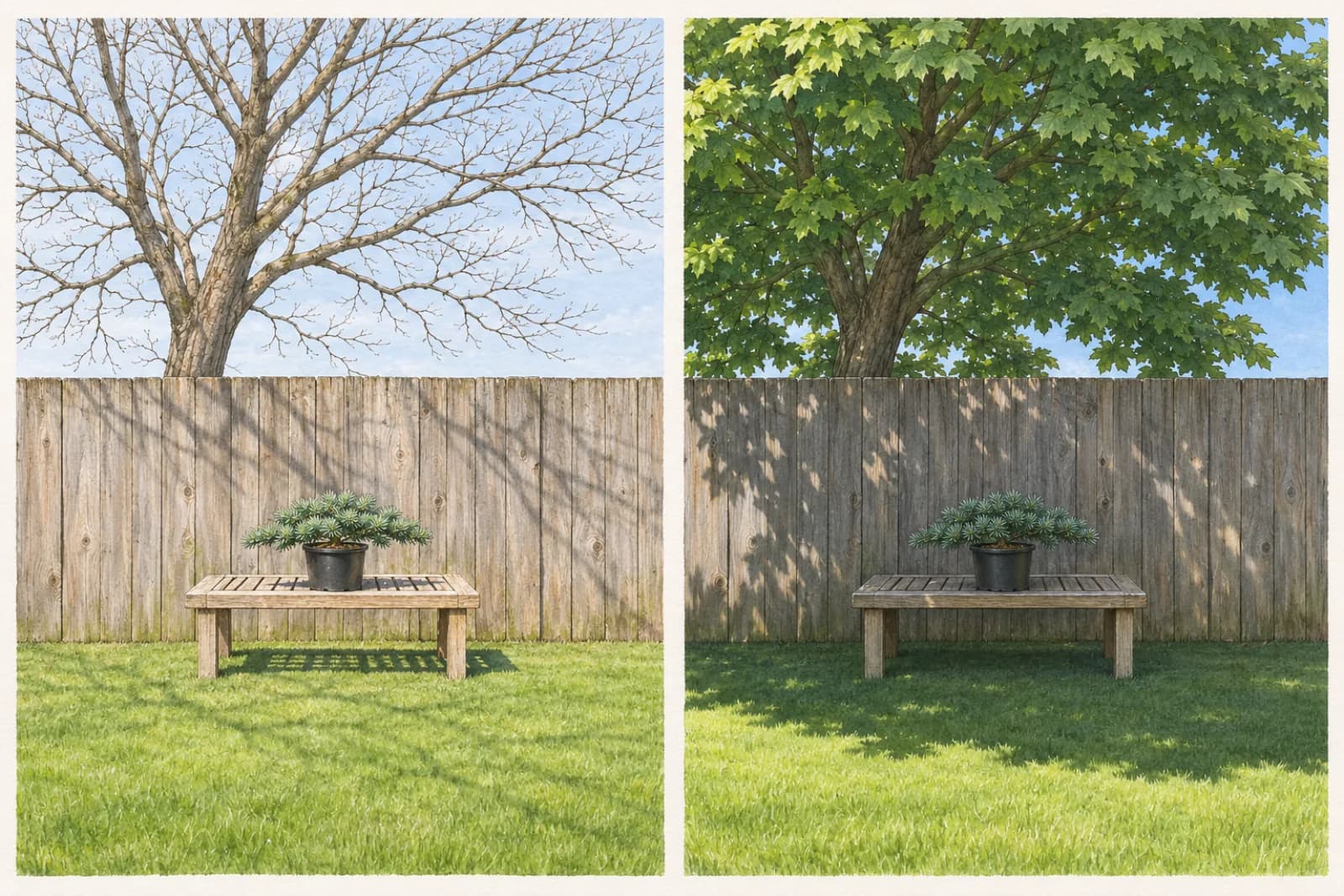
A spot's light, part of its microclimateThe climate of a small area, such as one corner of a balcony or the strip of ground along a wall, where it differs from the general weather around it in temperature, sun, wind, rain, or humidity. A tree responds to the microclimate of its own spot, not to the forecast for the city.Open the glossary, is not fixed for the summer. At about 40° N the noon sun stands about 73° above the horizon at midsummer and only about 27° at midwinter, so the shadows of fences, walls, and overhangs shorten and lengthen through the year (Course 02, Lesson 4). The trees around a spot change too: a deciduous tree casts only thin shade while it is bare and dense shade in full leaf (Course 02, Lesson 4). So a tree placed in full sunA label for a spot that gets about six hours or more of direct sun a day in the growing season. Trees sold as needing full sun, such as junipers, grow weakly and thin out with much less, but the label does not say when the hours come, and hot afternoon hours are harder on leaves than morning ones.Open the glossary in spring may not be in it by midsummer.
The small backyard has a clear case. The neighbor's large maple beyond the west fence is bare from November to April, so the western third of the yard is sunny through winter and early spring. As the maple leafs out in May its crown fills, and by July its shade reaches the benches in the western third from late morning or early afternoon, depending on where they stand. A bench that was among the sunniest in the yard in April can be among the shadiest in July.
Practice check · not scored
The west balcony shows the other kind of change. Its back half is roofed by the balcony above, which keeps the back wall shaded through the early afternoon in midsummer, when the sun is high (Course 03, Lesson 1). From late August the lower sun gets under the overhang sooner and stays longer, so a pot by the back wall can get more sun in September than in July (Course 03, Lesson 7), and that sun falls on its wall.
So check a spot again at midsummer, when the trees around it are in full leaf, and again as autumn lowers the sun, by counting its hours of direct sun or with the shadow test (Course 02, Lesson 4). The tree reports it too: new growth that comes out thinner, paler, or with longer gaps than the same tree's last year is a reason to check its light before anything else (Course 02, Lesson 4).
Practice check · not scored
Difficult weather is a reason to wait
Predict first
Wait until the heat breaks. A repot cuts roots, and for weeks afterward the azalea would have fewer of them to supply leaves that hot, dry air is drawing on harder than at almost any other time of year. The tree is already working at the edge of what its roots can supply, and the root work would add a second stress to the first. Look again in the week after the heat: if the azalea is firm in the morning, its leaves unmarked, and the forecast ordinary for the season, the job can be weighed again. The 15th was the household's date, not the azalea's.
Any elective job, such as a repot, structural pruning, wiring, or a first styling, takes something from a tree and asks it to make the loss good. In a heat wave the tree has nothing spare. Cut roots supply less water for weeks, while hot, dry air and a drying wind raise the evaporative demandHow strongly the surrounding air draws water vapor from leaves, rising with sun, heat, dry air, and wind. High evaporative demand can make a tree lose water faster than reduced or damaged roots can replace it.Open the glossary on the leaves higher than at almost any other time of the year (Course 01, Lesson 8). Pruning or thinning takes away working leaves and opens shaded inner leaves, bark, and pot walls to sun they are not used to, which in a heat wave can mean sunburn. Oregon State University Extension's guide to heat waves advises against fertilizing, pruning, or transplanting until the heat has passed (Heat wave in the garden, Oregon State University Extension). Each stress might be survivable alone; together they add up (Course 01, Lesson 14).
For the azalea, the cost might not show as wilting at once, but as browned leaves, stalled growth, or fewer flower buds next spring, since an azalea forms next spring's flowers during this growing season (Course 01, Lesson 13). How and exactly when to repot it belong to Course 11, and work around its flowering to Course 14, Refinement and Long-Term Stewardship. The feed follows the same logic: Not now: hold the feed in the heat, then feed again once the heat has broken and the tree is firm and growing (Course 05, Lesson 4).
In the week after the heat, the question is the tree's, whatever date a workshop or a day off has set: is it firm in the morning, has its growth started again, are its leaves unmarked, and is the forecast ordinary for the season? If so, the job can be weighed at its own work windowThe growth stage, with suitable weather, at which a job such as repotting or structural pruning is commonly done, for stated reasons: growers tie each job to a stage because the tree is expected to recover well from it then. A window opens and closes with the stage, not with the date, and it is a starting point that a tree's kind, its health, and the technique itself can move.Open the glossary, which Lesson 7 builds into a year's plan. The same holds after a hard dry-out or days in a saturated pot: work that cuts roots waits until new growth shows the roots working again.
What never waits is urgent care. A pot that checks dry is watered at once, in the heat, at any hour; a tree whose leaves are scorching is shaded now; a tall pot that blows over is set upright now (Course 01, Lesson 14). Waiting is for work you chose, never for care the tree needs.
Change the checks first, then the exposure
The bonsai decision
Answer the weather with the smallest change, then undo it
Starting point
For an established tree in leaf, in a free-draining pot, whenever the forecast turns difficult:
- When the forecast turns, change the checks: morning and afternoon for heat or wind (Course 03, Lesson 6), and the lift and the chopstick before any watering in rain. Water thoroughly whenever a check reads Drying or drier, and not before.
- Deal with what the weather acts on: shade the pot walls, clear the drainage holes and empty the trays, and break the wind with a screen that lets some air through (Course 02, Lesson 5).
- Change the tree's own light only for the spell, and only for the trees that need it.
- Put it back when the weather passes, in steps wherever the light increases, and write the date of every change in the log (Course 03, Lesson 7).
This assumes
- The tree is established and healthy, in leaf, in a free-draining pot, and in its right summer place (Course 02, Lesson 5).
- Someone can check it every day, and twice on hot or windy days. Time away needs its own plan (Course 03, Lesson 6).
- The months in this lesson belong to the course's Northern Hemisphere example climate. In the Southern Hemisphere, swap north and south, and shift the months by half a year.
Change course if
- Scorch-prone leaves in a heat wave: shade cloth over the tree on the hottest afternoons, with its pot already shaded, and down when the heat breaks (Course 03, Lesson 5).
- Roots reduced or damaged this year: bright shelter for the spell, out of wind and hot afternoon sun: lower the demand, keep the light (Course 03, Lesson 4).
- A pot too small to last between checks: bright shade out of the wind for the days of the spell, an extra check, and back to its place when the weather turns.
- Days of rain on a pot of dense nursery mix: if it stays Wet or Saturated morning after morning with slow holes, move it under cover, propped to drain, check it there, and put it back when the rain stops.
- A tree droops in the shade, or over a pot that stays wet in warm weather: this is not a seasonal problem: investigate, starting with the roots (Course 03, Lesson 4), and get help with a diagnosis if it does not recover (Course 07).
Back to the question
What should change when the weather turns difficult?
The checks first, then whatever the weather is acting on, and the tree's own light last, only for the spell. In heat, check morning and afternoon and shade the pot wall; shade cloth goes over leaves that scorch on the hottest afternoons and comes down when the heat breaks. In a dry, windy spell, add the afternoon check, group the pots, and break the wind. In days of rain, check before any watering: a pot that drains stays out, and one that stays Wet morning after morning with slow holes goes under cover to drain. Check each spot's light again as the sun and the trees around it change. Every change has a cost, so each is undone when the weather passes, in steps where the light increases. Elective work waits for the extremes to pass; urgent care never does.
Key takeaways
- Before changing anything, name what the weather is running short or building up: water in the pot, air at the roots, light on the leaves, or heat at the pot wall or on leaves that scorch. Then choose the smallest change that answers it.
- Change the checks first, then what the weather acts on, such as a pot wall, a drainage hole, or the wind, and the tree's own light last, only for the spell and only for the trees that need it. Write down the day each change will be undone.
- Sun on the pot wall, more than the air, heats a root zone: shade the pot, not the tree, and water because the tree needs water. The hot side of a pot and the light on a spot both move with the season, so check them again at midsummer and again as autumn lowers the sun.
- Shade over a tree takes heat off its leaves and takes light with it. Left up for weeks, it grows long, thin shoots whose large, thin leaves burn when it comes off at once, so it comes down when the heat breaks, in steps if it stayed up.
- Rain does not harm roots in a pot that drains; a root zone that stays saturated does, so check before watering and shelter only the slow pots. Elective work and feeding wait for extreme weather to pass; urgent care never waits.
Optional · not required for completion
Write three lines for the next difficult day
Choose one tree and watch the forecast for the next spell of difficult weather: a hot day, a windy one, or rain that is set to last. On its first morning, check the tree below the surface and write three lines in your log: what the weather is running short or building up for this tree (water, air at the roots, light, or heat at the pot wall or on the leaves), what you changed and why, and the day you will change it back. On that day, read the three lines again and look at the tree before you undo anything. Did the change answer what you named, and did it cost the tree anything you can see?
No tree? Take the next five days of your local forecast and write the three lines, day by day, for a trident maple in a small black nursery pot on a sunny balcony. Which days call for no change at all, and which change would you be most likely to forget to undo?