Course 06 · Lesson 4 of 7 · Rest, climate, and the year's plan
Slowing growth and building resilience
When shoots stop extending, a tree has not stopped working. It is setting buds, storing reserves, and getting ready for the cold. Learn to recognize the slowdown, adjust water and feeding to it, and leave the tree what it needs to prepare.
The question
What is a tree doing when its growth slows?
By the end of this lesson, you will be able to:
- Recognize the signs that growth is slowing: shoots stop extending, buds set, and leaves color or older needles shed.
- Explain how a tree stores reserves and gets ready for cold as days shorten and nights cool, and what interferes with both.
- Adjust watering, feeding, and work as demand falls, by the tree's own signs instead of a calendar date.
About 18 minutes to read and explore
Early September this year, in the small backyard. Like every case in this course, it is an instructional example, set in one temperate Northern Hemisphere city at about 40° N (USDA zone 7a). On the morning of September 6, one of the household's two adults stands at the trident maple (Acer buergerianum) on its bench in the western third, shears in hand. The tree is in its fourth year in the 18 cm (7 in) black nursery pot it came in, healthy again since last summer's salts were rinsed out (Course 05, Lesson 5). Its long summer shoots now reach well past the outline the household likes. The adult wants to tidy it before autumn and cut them back hard, since “it has finished growing anyway.” The other adult is not sure.
The trident's shoots have stopped lengthening. A fat bud sits at the tip of each and in the joint of every leaf, and the leaves are dark green and firm. On the patio bench against the sunny south wall, the Japanese larch (Larix kaempferi) has stopped too: its long shoots end in small, round buds. At the patio's lawn edge, the new juniper, a Japanese garden juniper (Juniperus procumbens ‘Nana’), still has tips of a paler green than the rest, creeping out as they have all summer. And on the lawn, the household's ficus (Ficus microcarpa), outdoors since late May, is opening a new leaf from its sheath as if it were July. Four trees on one morning give four answers to “has it finished?”
The season ahead has its usual shape in this city. The days are about 13 hours long and shortening fast. The first frostA night when the temperature at the tree falls to 0 °C (32 °F) or below. A light frost is just below freezing for a few hours, usually on a clear, still night; a hard frost is −4 °C (25 °F) or below, the tag Course 02's planner uses. Frost matters most to growth that is tender, such as swelling buds and new leaves, and a frost on a still night and a freeze on the wind call for different shelter.Open the glossary usually comes in mid-October and the first hard frost in late November or early December, and between them the trident's leaves will color and fall. Should the household cut, feed, move, or simply leave each of the four, and what should they be getting ready while they wait? This lesson shows how to see growth slowing and ending on each kind of tree, what a tree does in the weeks after its shoots stop, what gets in the way of that work, how watering and feeding follow it, and how to plan the winter before the cold arrives.
Slowing is a stage you can see
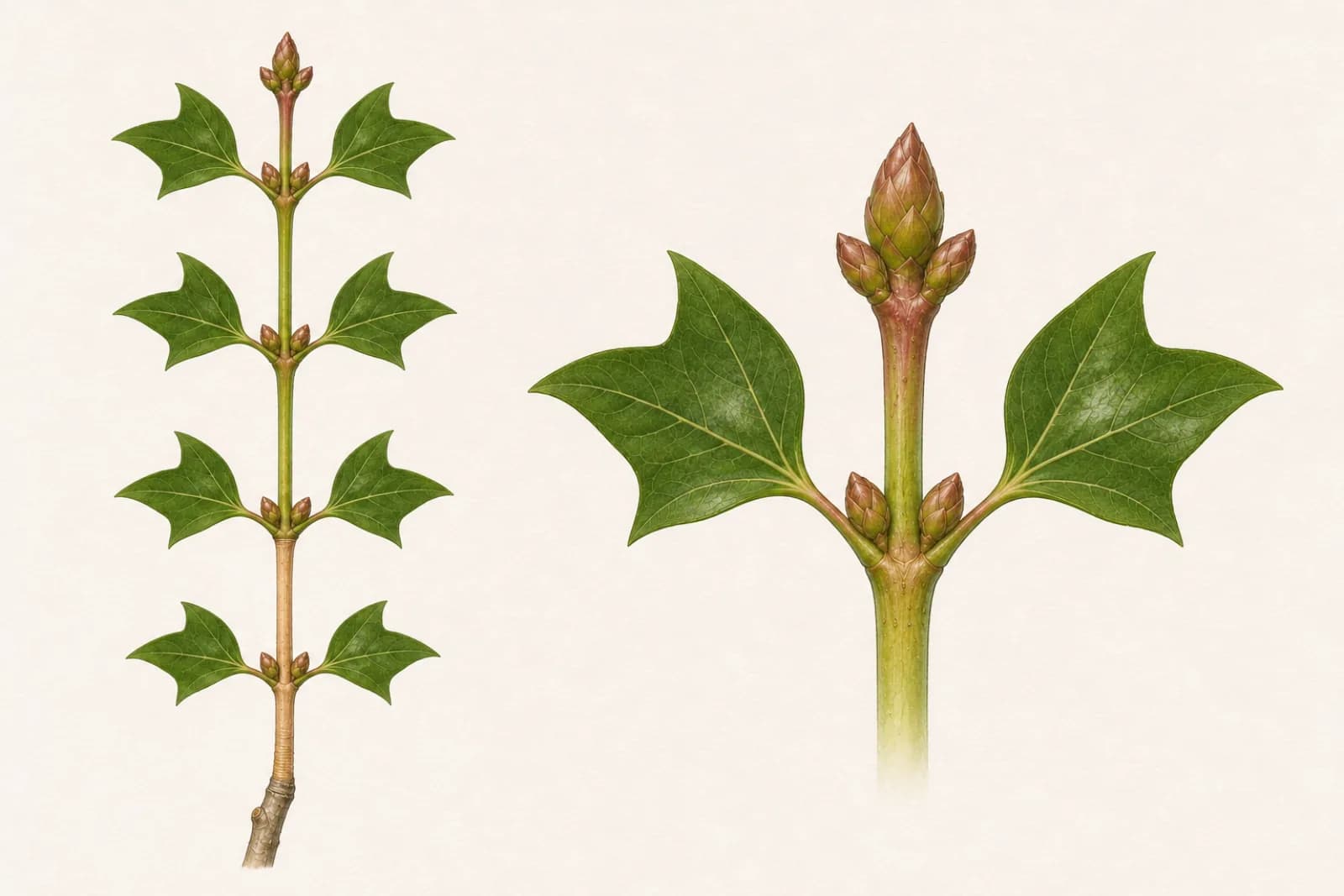
A shoot that stops is not a tree that stops. What the adult with the shears is looking at is a growth stageA step in a tree's yearly cycle that you can see on the tree, such as buds swelling, bud break, shoots extending, or leaf fall. Care is timed to the stage a tree has reached, not to a date, because the same stage falls on different dates in different years, places, and kinds of tree.Open the glossary, the one Course 01 named bud set and hardening (Course 01, Lesson 13): the shoots stop extending, next year's buds form, and this year's soft stems shoot hardeningThe firming of new growth after it stops extending: the leaves reach full size, darken, and turn firm, and the new stem turns woody from its base. It is not the same as cold acclimation, which makes tissues able to survive freezing, or hardening off, which is moving a tree into sun and wind in steps.Open the glossary. That bud setThe stage when shoots stop extending and form well-developed, often scale-covered buds that will carry the next season's growth. In many temperate trees, shortening days and cooler temperatures help trigger it in late summer or autumn.Open the glossary comes while the weather is still warm, because in many temperate trees the cue is the shortening days, not the cold. For a trident in this city it usually comes by early September; this year the household's trident reached it about September 5.
On a trident, three signs together show it, and each takes a minute to check:
- No new pair of leaves at the tip. While a shoot extends, a pair of small, soft, pale leaves keeps opening at its end. Once it stops, the last pair grows to full size and darkens like the rest, and nothing opens beyond it.
- A bud at the tip and in every leaf joint. Plump, firm, and closed, these buds hold next year's shoots (Course 01, Lesson 5). On a shoot that is still extending, the tip is a soft growing point, not a closed bud.
- Stems turning woody from the base. This year's stem is tan and firm at its base and still green toward the tip, and the tan creeps upward week by week.
Read the three together, on several shoots, over a week or two: one shoot can stop while a stronger one goes on, and a closed tip on a single shoot may only mean that shoot was damaged. In the stage recordA dated note, for one tree, of whether each growth stage has been reached: the date, then a yes or a no for the stage, on each day you look, with a word on the weather and where the tree stood. Kept over several years, with the no entries that bracket each first yes, it shows how far the tree's dates move with the weather.Open the glossary from Lesson 1, the line reads “September 5 · Bud set and hardening: yes”, below the dated no's of the weeks before. The watering logA dated record of each check of a tree's root zone, usually one short line per pot: the weather, what each check found, the decision, and the reason for it. Read over weeks, it shows how fast each pot dries in different weather, whether the decisions worked, and patterns no single check can show, such as a pot that keeps drying fast even as the weather cools.Open the glossary shows the turn from another side, as the intervals between waterings begin to lengthen (Course 03, Lesson 7), but the weather moves them too, so read the log alongside the tree, never instead of it.
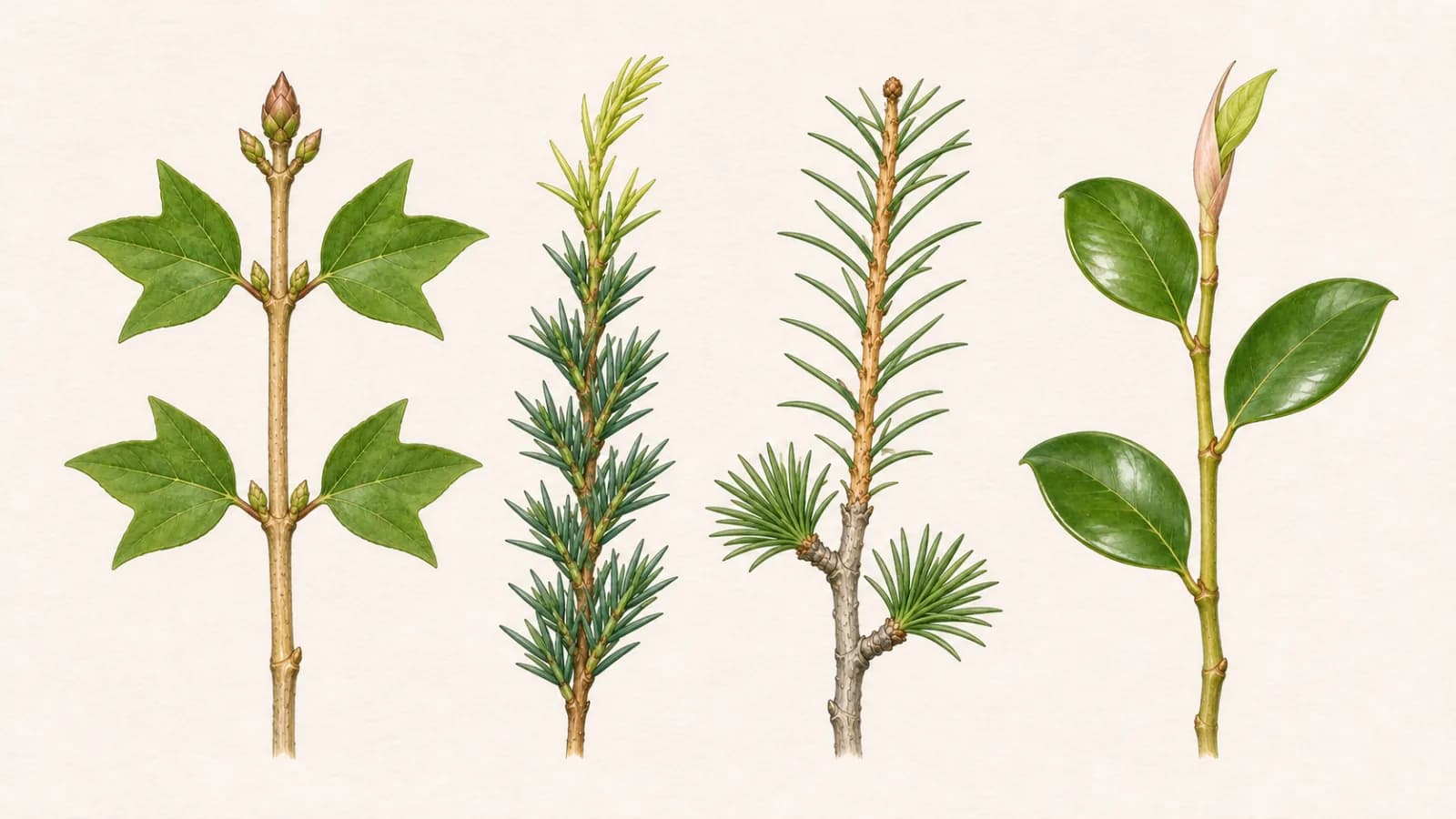
Other kinds of tree show the same turn in other ways: a deciduousDescribes a tree that drops all its leaves for part of each year, usually before winter or a dry season, and grows new ones when growth resumes. Most deciduous trees are broadleaves, like the trident maple, but a few conifers, such as larches, are deciduous too.Open the glossary conifer, an evergreenDescribes a tree that keeps living foliage all year, replacing old leaves or needles gradually instead of all at once. Keeping foliage does not mean a tree grows all year: temperate evergreens such as junipers still go dormant in winter.Open the glossary, a tropicalDescribes warm regions near the equator without a cold winter, and the trees adapted to them. Tropical trees such as ficus have no chilling requirement and can be damaged or killed by frost; their growth slows when light or warmth drops.Open the glossary tree. Course 05's feeding decision ends an evergreen's season at “cold halting growth” and leaves the signs of it to this course (Course 05, Lesson 4). The juniper's row of this table gives them, beside the small backyard's other trees:
| The tree | Growth slowing | Growth over for the year |
|---|---|---|
| Trident maple | No new leaves at the tip; buds at the tip and in each leaf joint; stems turning woody | Leaves begin to color, then fall |
| Japanese larch | Long shoots stop, each with a small round end bud; needles darken | Needles turn gold, then fall |
| Juniper | Tips stop lengthening and darken to the older foliage's color | No new tips, with nights near freezing; later, bronze winter color |
| Chinese elm | Shoots stop and buds set, as on the trident | Leaves drop late; in a mild winter some stay on |
| Ficus | Only when its light or warmth drops | Never, for the season: no winter rest |
One row is easy to misread. A juniper sheds some of its oldest, innermost foliage each year, mostly in autumn: it yellows and browns deep inside the pads while the tips stay fresh (Course 02, Lesson 6). That is the season, Course 05's Nothing to fix: normal for the season (Course 05, Lesson 1), as long as this year's tips stay green.
One flush or several
Not every tree reaches bud set the same way. A review in the USDA Forest Service's Forest Nursery Notes sorts woody plants by how their shoots grow (Landis, Forest Nursery Notes, 2012). Some make a single spring flushA burst of new shoot growth, with leaves expanding together, that happens once or several times a year depending on the tree and conditions. Between flushes, shoots stop extending and mature.Open the glossary from shoots already formed inside last year's buds and then stop, as many pines and spruces do; others keep extending at intervals for as long as warmth, water, and day length allow. Junipers grow the second way and form no resting bud at all: their tips stop when cooling weather and shortening days halt them.
Between the two sit trees that make one main flush in spring and can add another: a trident maple, if it is vigorA tree's observed growth performance relative to its expected seasonal behavior, meaning what a tree of its kind should be doing at that point in the season. It is judged from shoot extension, bud development, foliage condition, and root activity when visible, across several observations over time, not from one large leaf or green color. A vigorous tree is growing at or above that expected pace.Open the glossary, may flush again later in the summer (Course 01, Lesson 12). The same review lists maples among the trees that can grow a second flushA further burst of shoot growth after a tree's first flush has hardened, which some trees make and others do not. Warm weather, water returning after a dry spell, and nitrogen favor it, so it is common in containers, where water and feed come regularly. Growth that starts late in the season has little time to firm up before the first frosts, which can damage it.Open the glossary after their buds have set, and names what favors one: warm weather, water returning after a dry spell, and nitrogen. It notes that second flushes are common in containers, where water and feed come regularly.
A second flush that starts late has weeks, not months, to firm up before the first frost. The review's author expects such growth to be slower to get ready for cold and easier for an early frost to damage, while noting that this has hardly been tested. The grower's rule is simpler: a shoot still soft and pale in October has not finished hardening, and a frost can take it. A tree still extending into autumn is no cause for alarm, but it is a reason to add nothing that pushes more growth: no heavy feed, and no hard cut.
Trees do not all slow down together
This year the small backyard showed the whole range within a few meters. The trident and the larch had stopped by about September 5; the larch turned gold from about October 24 and was bare by mid-November. The juniper's tips went on lengthening for three more weeks and stopped in late September, the week the nights began to fall below 10 °C (50 °F). The ficus never stopped: it came indoors on September 25 still opening leaves, because a tropical tree has no cold-set stop and slows only when its light or warmth drops (Course 01, Lesson 13). The household's Chinese elm (Ulmus parvifolia) still held most of its leaves in late November, after the trident was bare, and dropped them only as the hard frosts set in during December, which is normal for a tree that is semi-evergreenDescribes a tree that keeps some of its leaves through a mild winter but drops most or all of them in a cold one, so it can look evergreen in one climate and deciduous in another. The Chinese elm is a familiar example; going bare in a cold winter is normal for it, not a sign of trouble.Open the glossary in mild winters (Course 02, Lesson 2).
Kinds of tree differ in how strongly each responds to day length and to temperature, and a tree's place and care move it within its kind: one kept growing by late feeding or water runs on longer in autumn. So no date can say when “the trees” stop, and a calendar line such as “stop feeding in September” fits only part of a mixed bench. Course 05's signals fit all of it, because each tree gives its own: taper the feed at bud set, and stop it when the leaves begin to color on a deciduous tree or when cold halts an evergreen's growth.
Practice check · not scored
What a tree does with a quiet autumn
When its shoots stopped on September 5, the household's trident had about four more weeks of full work in its leaves before they began to color, and about eleven before the last one fell. Those weeks are not idle. Two things happen in them that decide how the tree comes through the winter and how it opens next spring: it stores, and it gets ready for cold. Neither shows from across the yard, which is why “it has finished growing anyway” sounds right.
It stores
A leaf on a stopped shoot goes on making sugar in every hour of light. With no new shoots or leaves to build, the tree sends most of that sugar down into its twigs, trunk, and roots, where it is stored as starch (Course 01, Lesson 9). Those reservesCarbohydrates, mostly starch, stored in living cells of the roots, trunk, branches, and bark for later use. Reserves fuel early spring growth before new leaves can supply sugar, and they help a tree recover after losing foliage or roots. A seed carries reserves of its own, such as starch, oils, and proteins, that fuel the embryo's first growth.Open the glossary keep the living cells respiring through winter and pay for next spring's buds before the new leaves can, and since they are often lowest soon after the spring flush, late summer and autumn are when they are rebuilt. No number describes that store for a tree on a bench; what a grower can see is the leaves that fill it. The trident's long summer shoots, whatever they do to its outline, are still sending sugar down.
Then the leaves end their work, in order. As the days shorten and the nights cool, each leaf's green pigment breaks down, so that the yellows and oranges already in it show, and a trident makes new reds of its own. That orderly end is leaf senescenceThe orderly end of a leaf's working life in autumn. Its green pigment breaks down so that yellow, orange, or red shows, part of its nitrogen and phosphorus is withdrawn into the tree, and the leaf falls. Stress such as drought or root damage can color or drop leaves too, at other times of year, so color alone is a clue, not proof of the season.Open the glossary, and while it runs, the tree withdraws part of what the leaves hold, chiefly nitrogen and phosphorus, into its twigs, trunk, and roots for next spring's first growth (Course 05, Lesson 1). The withdrawal is nutrient resorptionThe movement of nutrients, chiefly nitrogen and phosphorus, out of leaves and back into the twigs, trunk, and roots before the leaves fall, to be used for the next spring's growth. Woody plants withdraw a large share of both, though how much varies widely among kinds of tree and places. An early hard frost can cut it short by killing the leaves before they have been emptied.Open the glossary. A 2024 paper on how temperate deciduous trees do it cites an average, across woody plants worldwide, of about half the leaves' nitrogen and phosphorus, with wide variation among kinds and places (Wang and others, Plants, 2024). Only then comes leaf fallThe autumn stage when a deciduous tree's colored leaves drop, after the tree has withdrawn part of their nutrients, leaving it bare for winter. Leaves lost at other times, or green leaves shed after a drought or a move, are leaf drop, a sign of stress or adjustment rather than of the season.Open the glossary, the stage that leaves the tree bare, with next year's buds in place. Leaves lost at other times, to drought, a move, or a root problem, are leaf drop, and they fall with whatever they still held.
So the late leaves do next spring's work twice over: they store sugar, and they hand back nutrients. Anything that ends them early cuts those weeks short: a hard cut, a pot that dries out, or a frost that kills them before they have been emptied, which the same paper notes can interrupt the withdrawal.
Predict first
More than a January night would. In mid-October, after a warm September, it has had few cool nights since its shoots stopped, so its readiness for cold has only begun to build; it peaks in midwinter. A hard frost now can kill its green leaves before they have finished storing sugar and before their nitrogen has been withdrawn, along with any soft late shoots. Its roots in their pot have built little readiness yet either, and roots generally gain less root hardinessHow much cold a tree's roots survive. Roots are generally less cold hardy than the branches above them and gain less hardiness in autumn, and young roots are more tender than older ones. That is why a tree that is hardy in the ground can lose its roots in a pot, where they are far more exposed to the cold.Open the glossary than shoots (Lesson 5). So protect it for that night, roots and top, and put it back out in the morning to go on cooling.
It gets ready for cold
In the same weeks the tree is getting ready for freezing. Course 01 calls this cold acclimationThe gradual process, triggered by shortening days and falling temperatures, in which a tree's tissues become able to survive freezing. A tree moved suddenly from a warm room into frost has not acclimated and can be badly damaged. It is not the same as shoots hardening, or turning woody, though the two often happen around the same time.Open the glossary, and Course 02's plain phrase for it is cold readiness (Course 02, Lesson 3): over several weeks, the tree's living cells change so that they can survive cold that would kill them in summer. Two signals drive it, in order (Course 01, Lesson 13): the shortening photoperiodThe length of daylight in each 24-hour day, which changes with the seasons and acts as a calendar signal for plants. Shortening days help tell many temperate trees to stop growing, set buds, and prepare for winter.Open the glossary starts it while the weather is still warm, and cooling nights and the first frosts carry it on. NC State Extension's guide, Preparing Nursery Plants for Winter, describes the same order, with readiness still rising through the winter to a midwinter maximum.
A tree left outdoors is ready for hard frost by about the time its leaves are down, and readiest only in midwinter. This year the order ran as usual. The nights fell below 10 °C (50 °F) from about September 27; the first frost came on October 16, a light one of −1 °C (30 °F) on a clear, still night, while the tridents' leaves were coloring; and the first hard frost, −5 °C (23 °F), came on November 29, a week after they were bare.
Two things follow for a grower. The first is that cold readiness is built outdoors, in the open air, where the tree feels the days shorten and the nights cool. A tree kept warm builds little of it, and heavy shade slows it too, which is why NC State's guide advises taking shade down in autumn. Leaving a tree in its full outdoor light through the autumn is not neglect: it is the care.
The second is that the order can break. An unusually early hard frost, one that comes before a tree has had its cool weeks, can injure a tree that would shrug off the same night in midwinter. It can kill leaves that are still working, kill any soft late shoots, and reach roots that have built little readiness yet in their pot. A hardinessA plant's ability to survive the conditions of a place, most often its cold hardiness: the coldest winter temperatures it can survive once it has acclimated to cold. Ratings such as hardiness zones describe plants growing in the ground; roots in a pot are more exposed, so a potted tree needs more protection than its rating suggests.Open the glossary rating says nothing about such a night, because it describes a tree at its midwinter best (Course 02, Lesson 1). So the autumn plan follows the forecast as well as the stage. When a hard frost is forecast while a tree's leaves are still green or coloring, protect its roots for those nights, and its top too while the leaves are on, in the shelter the frost plan uses for that kind of night (Lesson 2), and put it back out in the morning so that the cooling goes on.
What gets in the way
Four things commonly cut the autumn's work short or undo it, and each acts at its own moment: a hard cut, feeding that is too heavy or withheld, shade and drought that cost leaves, and a move into warmth.
A hard cut late in the growing season
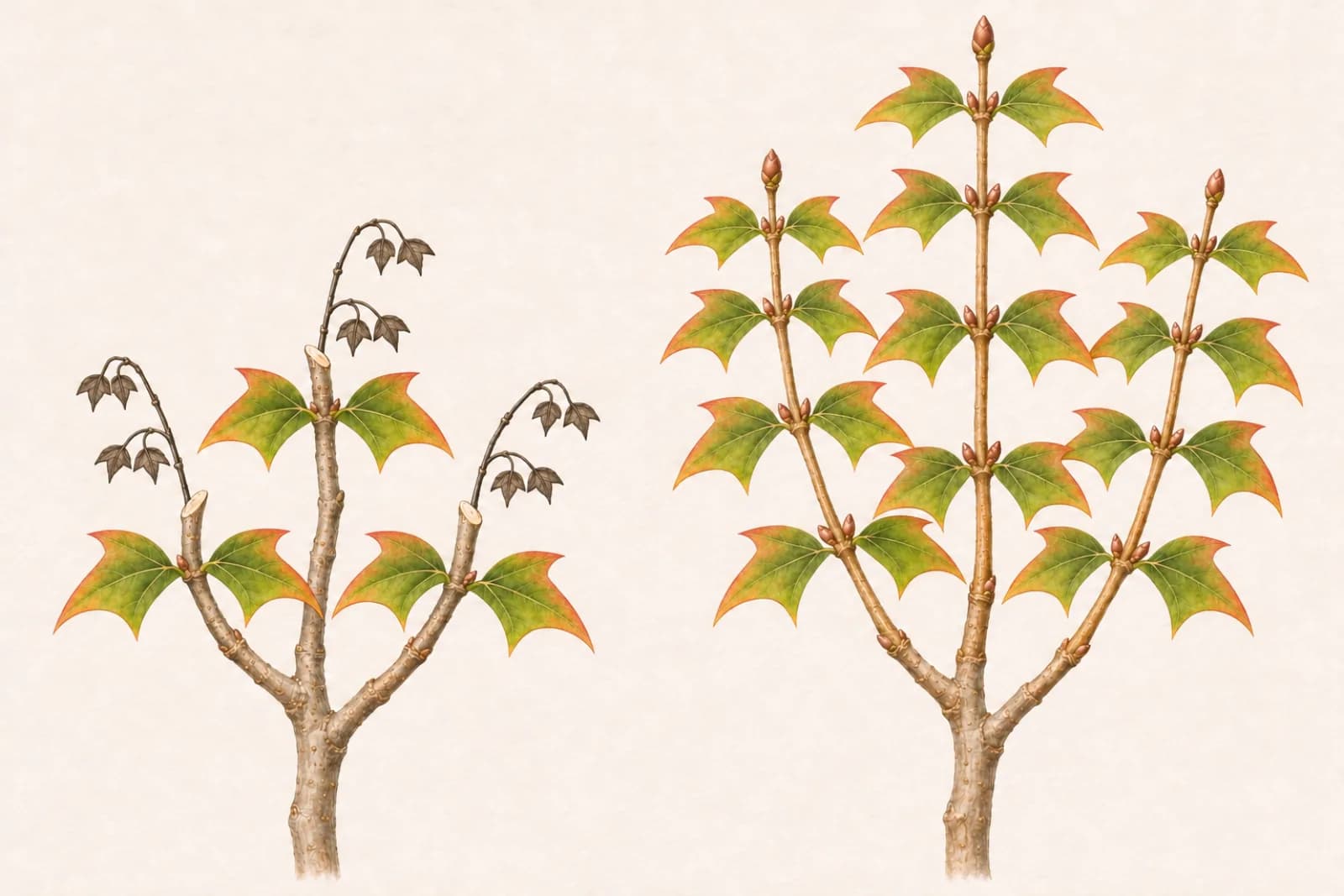
Back to the shears. The buds in the leaf joints of the trident's long shoots are held back by the shoot tips above them, which Course 01 calls apical dominanceThe tendency of an actively growing shoot tip to hold back the buds below it, mainly through the hormone auxin moving down the stem along with other signals. Removing the tip often releases one or more of the buds below it to grow.Open the glossary (Course 01, Lesson 12). Cut the shoots back hard and that hold is gone. Late in the season many of those buds simply stay closed until spring, but after a cut in a warm September some can open: soft new shoots with small, pale leaves, built from the very reserves the autumn is meant to fill, with only weeks to firm up before the first frost. NC State's guide gives the same warning for nursery plants: pruning late in the season can wake buds into new growth that is not ready before cold weather. The cut also takes away the leaves that were storing sugar, so the tree loses twice: fewer leaves at work, and new shoots that spend what the rest have stored.
As with a late second flush, this has hardly been tested, and never on bonsai in the sources this course relies on, and a hard cut does not always restart growth. But the long shoots, left on, are leaves at work, and cutting them gains the tree nothing now. So the household leaves the shoots on. The tidying is not cancelled, only moved: from here, the next time a cut cannot be followed by soft growth before frost is once the tree is bare. When and how to cut each kind of tree is the subject of Course 09, Pruning and Managing Growth, and Lesson 7 places that work on the year.
None of this rules out work in autumn or winter. The warning is about a cut that can wake growth while warm weeks remain. After leaf fall a cut does not restart growth in the same way, and some work on some trees is commonly done once growth has plainly stopped, such as a juniper's heavy work after its tips have stopped and darkened; Lesson 7 and the technique courses decide those tree by tree.
Heavy feeding, and the myth about withholding it
Autumn feeding can go wrong in both directions, and this course keeps Course 05's position exactly (Course 05, Lesson 4). Cold readiness comes from day length and cooling nights, not from the feed. The feed tapers at bud set because slowing growth needs less: on the household's feeding planA written plan for feeding one tree, short enough to fit on a card: the product and its label line, the amount for your can, the interval, when to start, taper, and stop in growth stages, when to water first or hold, who feeds, where it is logged, and when to review it. It turns a label's directions into decisions already made, so that anyone who helps can follow them.Open the glossary card for the trident, half strength, 4 mL of the 8-4-6 in the 2 L can, every 14 days while the leaves are green (Course 05, Lesson 6), and nothing once they begin to color. A light feed still has work to do in those weeks, because the leaves are working and nitrogen taken up now can be stored for next spring's flush. The real risk is heavy nitrogen late in a warm, wet season, which can push soft shoots that an early frost may damage, the late second flush described above. Tapering guards against it, and a tree still extending in October gets nothing that would push it further.
The opposite belief is common too: stop all feeding in midsummer “so it hardens early.” It does not work. Withholding feed does not make a tree any readier for cold, because the days and the nights do that, and it is not free. A tree in a mix that holds little, fed nothing from July, can go into autumn running short of nitrogen, with less of it to store, and open more thinly the next spring. And whatever the feeding did, a tree in a pot goes to its winter place with the others when the time comes: an early stop makes its roots no hardier, and the roots are the part a pot leaves exposed (Course 02, Lesson 5).
Two kinds of feed cannot be tapered at all. Seed-meal cakes, an organic fertilizerFertilizer made from plant or animal materials, such as seed meals, fish, or bone. Soil organisms must break down most of it before roots can take up its nutrients, so it releases faster when the root zone is warm and moist and slowly when it is cold or dry. The word describes the source, not gentleness, and its legal meaning varies by country.Open the glossary, are simply not replaced after late summer, as their label says, so the last set runs out on its own; that is how the new juniper's feeding ends. controlled-release fertilizerGranules of soluble fertilizer inside a coating that lets water in and nutrients out slowly, for the period its label states at a stated root-zone temperature. Warmth speeds the release and cold slows it, and the granules keep releasing whether or not the tree is growing, so they are counted as the tree's feed until they are spent.Open the glossary granules keep releasing whether the tree grows or not, and in a mild autumn they go on into October, so count them as the tree's feed and add nothing on top (Course 05, Lesson 3).
Shade, drought, and leaves lost early
Weeks of heavy shade cost a tree in autumn what they cost it in summer, and more. Leaves under shade make less sugar, so the store fills more slowly, and the tree's readiness for cold builds more slowly as well. The display trident in the courtyard spent five weeks under shade clothAn open-weave fabric hung on a frame over plants to cut part of the sun. It lowers the heat on leaves at the cost of light, so it is used on the days and over the trees that need it, such as scorch-prone leaves in a heat wave, and taken down afterward. Left up for weeks, it leaves the tree growing long, thin shoots whose large, thin leaves burn when the cloth comes off at once.Open the glossary this summer, and the leaves it grew there showed leaf scorchBrowning and drying of leaf edges, tips, and the tissue between the veins when leaves lose water faster than the roots can replace it, as in hot sun, wind, or dry air. Thin shade leaves moved suddenly into strong sun scorch the same way, often after pale, bleached patches. It is a symptom, not a diagnosis: a dried-out root ball, damaged roots, or salt buildup can cause the same browning.Open the glossary within days of the cloth coming off in late August (Lesson 3), so it goes into autumn with fewer sound leaves at work. Shade put up for a heat waveA run of days much hotter than is usual for the place and the season. Where summer afternoons are usually about 30 to 33 °C (86 to 91 °F), for example, a run of days near 36 °C (97 °F) is one, and an ordinary hot week is not. Many trees stop growing until it passes while their pots dry faster than usual, so checks are added and elective work and feeding wait.Open the glossary comes down, in steps, when the heat breaks, and it stays down through the autumn.
A pot that dries out hard costs more in autumn than it seems to. A windy, sunny week in autumn can still dry a small pot in a day or two, with the tree in leaf or bare. A tree that dries out can drop its leaves early, and the fine rootOne of the many thin, branching roots, often pale when young, that do most of a tree's absorbing of water and mineral nutrients. Fine roots live a relatively short time and are constantly replaced, so they depend on a root zone that holds both water and air.Open the glossary in the driest layers die (Course 03, Lesson 4). Leaves lost in September are weeks of storing and withdrawing lost, and NC State's guide notes that plants left very dry in autumn are less able to withstand a hard winter. So keep the morning check going, as in summer, until the leaves are down, and water whenever it reads Drying.
Leaves can be lost early in other ways too, to a hard cut, an early hard frost, a pest, or a disease, and each cuts short the same weeks. When a tree's leaves color or drop weeks before others of its kind nearby, and nothing in the weather or the care explains it, that is not the season: investigate (Course 07, Tree Health and Diagnosis).
Coming indoors at the wrong time
Cooling nights are part of the work, so a move into warmth undoes it. A temperate tree carried into a warm room in autumn, to protect it, builds little cold readiness there, gets no chilling requirementThe amount of time a temperate tree's buds must spend in cool weather before endodormancy ends and normal bud break can follow. Temperatures a few degrees above freezing count most, and hard cold counts for less. Requirements vary widely among trees; without enough chilling, bud break is often delayed, uneven, and weak.Open the glossary, and loses light (Course 02, Lesson 3). Carried back out into a hard frost, it can be badly damaged where it would have been safe had it stayed out. The backyard's temperate trees spend the autumn in the open air until their winter places are ready.
A tropical tree is the opposite, and its signal is the nights, not a stage. A ficus has no cold readiness to build, and many tropical trees are harmed by cool nights well above freezing, which is why many growers bring a ficus in before nights fall below about 10 °C (50 °F). This year the household's ficus came in on September 25, just before the nights began to fall below that: checked for pests outdoors first, then carried straight to its bright window, with no steps, because the light falls whatever you do (Course 02, Lesson 3). Some leaf drop as it adjusts to the lower light is common.
Two tridents into winter
What does the tree take into winter? follows two young trident maples through one invented autumn on the west balcony, drawn in side section, from late August to late November and on to the next April. Tree A, drawn in ink, is the tree left to finish its season: it stands in the open middle in full afternoon sun, is watered by the check, has its feed tapered when its shoots stopped and stopped as its leaves began to color, and gets no cuts. Tree B, drawn in red, stands beside it and differs in one thing. The autumn is the same for both: shoots stopped by early September, a warm September with two hot, windy days in the middle of the month, the first frost in mid-October, and the first hard frost in late November.
Under B's one change, choose Heavy shade since August, which moves B deep under the overhang; Cut back hard in September; Dried out hard, twice, which moves it to the windy south end; or No feed after midsummer, which gives it no feed from July on, in a mix that holds little. Under Your call, choose when B is first damaged, In September, At the first frost, At the first hard frost, or Not this autumn, or press Skip. Press Run the autumn, and the sun's arc shrinks stop by stop while the leaves color and fall; use Pause, Back, Next, Replay, or Skip to the end to stop anywhere from Late August to Next April. Under the drawing, a close-up for each tree, Trunk and roots, shows sugar arriving from the leaves as amber dashes and the store filling as amber grains, and a pill on each pot gives its moisture in Course 03's six words. The readouts Shoots, Leaves, Reserves, and Cold readiness follow each tree, and at the last stop Next spring shows how each one leafs out. Run all four autumns to finish. Try these:
- The simulation opens on Heavy shade since August. Make your call, press Run the autumn, and compare Cold readiness on the two trees at the first hard frost.
- Choose Cut back hard in September, and watch B's Shoots and Leaves from late September to the first frost.
- Choose Dried out hard, twice, and watch B's pot and its Leaves through September, then its Reserves in late November.
- Choose No feed after midsummer, and compare Leaves, Cold readiness, and Next spring on the two trees. When all four autumns have run, read the report.
Simulation
What does the tree take into winter?
Tree AStays as it is
In the open middle, in full afternoon sun. Watered by the check. Feed tapered when its shoots stopped and stopped as its leaves began to color. No cuts.
Calls: none yet
Late August
WarmWarm days
Day lengthLong but shorteningAbout 13 hours of daylight
Close-upTrunk and roots
Amber grains: reserves storedAmber dashes: sugar on the move
| Late August | Tree ALeft to finish its season | Tree BYour changeHeavy shade since August |
|---|---|---|
| Shoots | Stopped, hardening | Stopped, hardening |
| Leaves | Green and at work | Green and at work |
| Reserves | Refilling | Refilling |
What is happening
Press Run the autumn to follow both trees from late August to the next April.
Result
When is B first damaged?
Press Run the autumn. When the trees have leafed out the next April, the result says when B was first damaged, what it took into winter, and how it opened.
Four autumns
0 of 4 autumns run
Run each of B's changes once. Each autumn is stamped with the moment B was first damaged.
Heavy shade since August, not run yet.
Cut back hard in September, not run yet.
Dried out hard, twice, not run yet.
No feed after midsummer, not run yet.
Text description
The drawing is the west balcony in side section, looking north along it: the open sky and the glass railing at the left, the back wall at the right under the balcony above, whose slab roofs the back half. Afternoon sun reaches in from the west, lower and redder each stop; a small sun arc in the corner shrinks with the days, and a bar under it shows the hours of daylight. Tree A, a young trident maple in a terracotta pot, stands in the open middle. Tree B stands where its change puts it. Leaves color and fall, frost sparkles on the railing, the stand, and the pots on frost mornings, and wind streaks cross the balcony on windy days.
Under the drawing, one close-up per tree, Trunk and roots, shows the base of the trunk and the thick roots cut open. Stored reserves are amber grains: more grains, more stored. Amber dashes show sugar on the move, down from the leaves into the store, or out of it to new growth. The store is drawn as more or less, never as an amount.
Tree A is left to finish its season: In the open middle, in full afternoon sun. Watered by the check. Feed tapered when its shoots stopped and stopped as its leaves began to color. No cuts. Its autumn, stop by stop:
- Late August (Warm · Warm days): Its shoots have stopped. Its leaves keep working, filling the store.
- Early September (Warm · Afternoons about 24 °C (75 °F)): Plump buds sit in every leaf joint: bud set. Its feed tapers as growth slows.
- Mid-September (Hot · Two hot, windy days): Two hot, windy days. Checked and watered, its pot never runs dry.
- Late September (Mild · Nights below 10 °C (50 °F); a dry, windy week): Its new shoots have turned woody. Shortening days and cooling nights start its cold readiness.
- Early October (Cool · Cool nights): Its leaves begin to color, so the feed stops. Before they fall, they return part of their nitrogen.
- Mid-October (Frost · The first frost: −1 °C (30 °F), clear and still): The first frost, light and still. Its firm, woody shoots come through it.
- Late October (Mild · A mild, sunny spell): Its last leaves finish their work in a mild, sunny spell.
- Mid-November (Cool · Cool and gray, with light frosts): Its leaves have fallen, and its store is full for winter.
- Late November (Hard frost · The first hard frost: −5 °C (23 °F), on a northwest wind): The first hard frost: it is ready, and nothing is marked. Roots in a pot are generally less cold hardy: they need protecting.
- Next April (Mild · Buds open): Its buds open on last autumn's store: a strong, even flush.
B's one change, one of four: Heavy shade since August (Deep under the overhang); Cut back hard in September (Beside A, in early September); Dried out hard, twice (At the windy south end, in September); No feed after midsummer (No feed from July on, in a mix that holds little). Each change takes something from B's autumn at its own moment; the run shows when, and how B opens the next April, when it stands beside A in the open so that only what it stored differs. The readouts name each tree's shoots, leaves, and reserves at every stop, its cold readiness from late September, when it starts to build, and at the end the reserves it took into winter and how it opened in spring. A moisture pill on each pot gives its root-zone moisture in Course 03's six words.
Before a run you may make a call: When is B first damaged? The options are In September, At the first frost, At the first hard frost, Not this autumn, or Skip. The call is settled when the run reaches the moment B is first damaged, or the first hard frost if nothing marks it. Run all four changes to collect the four autumns.
Tree A, left to finish its season, came through both frosts unmarked. Its Shoots read Hardened by late September and its Leaves stayed Green and at work until they began Coloring in October, while amber dashes ran down into Trunk and roots all through September. By late November its Reserves read Full for winter and its Cold readiness Ready for hard frost, and at Next April it opened a Strong, even flush.
Each change took from that at its own moment. Dried out hard, twice left B's pot Bone dry twice in September, and by late September its Leaves read Dropped early: “Leaves lost in September are weeks of storage lost.” Cut back hard in September woke the buds below the cuts into Soft new growth, and the first frost killed it back. Heavy shade since August left B's Cold readiness still Building at the first hard frost, and its twig tips singed. All three went into winter Part full for winter and opened a Modest flush. No feed after midsummer marked nothing at either frost (“B was as ready for cold as A: the days and the nights did that.”), and its Reserves filled too, since the store is sugar the leaves make. But from late September its Leaves read Slightly pale, and it opened a Modest flush as well, for a different reason: it had stored less nitrogen. When the shoots stop, the tree is not finished: what its leaves do in the weeks after decides how it meets the frosts and how it opens in spring.
Go deeper · optional, not assessedHow cold readiness builds, step by step
Cold readiness is not one switch. NC State's guide describes it in two stages. In the first, set off by shorter days and cooler weather, growth stops and the plant begins to change, but longer days or warmth could still coax it back into growth, which is why a warm autumn spell, or a lamp left on over a tree at night, can matter. The first autumn frost starts the second stage, and from then on cold hardiness rises steadily to a midwinter maximum. A review of freezing tolerance in temperate deciduous trees traces the same arc across many species: tolerance built through autumn, greatest in midwinter, and lost quickly once warmth sets the buds moving in late winter and spring, the deacclimationThe loss of cold hardiness as a tree leaves its winter rest and begins to grow, while its buds swell and open and its first leaves come out. It happens faster than hardiness was built in autumn, and what a warm spell takes away is only partly regained if cold returns. It is the reverse of cold acclimation.Open the glossary of Lesson 2, faster than it was built and only partly regained if cold returns (Vitasse, Lenz, and Körner, Frontiers in Plant Science, 2014).
So how much cold a tree can take on any night depends on where it stands along that arc, not on the date or its kind alone: a trident in mid-October, a few weeks into the first stage, is near the low end, and the same tree in January near the top. Roots follow their own, lower arc, which is why a pot needs protecting even when the branches are fully ready for cold (Lesson 5).
Care as demand falls
The autumn's care is mostly a matter of letting the routine follow the tree down without stopping it. The checks stay; what they find changes.
Water: the same check, longer intervals
A tree's water use follows its leaves and the weather, and in autumn it drops away as the days shorten and cool and a deciduous tree's leaves color and fall (Course 03, Lesson 1). The morning check stays the same, and a thorough wateringWater applied evenly across the whole surface, slowly enough to soak in, until it runs from the drainage holes, and then confirmed by a check that the root ball wetted through. It usually takes two or three passes a minute or two apart. Water at the holes alone shows only that water reached the bottom, not that the roots got it.Open the glossary still goes on when the check reads Drying; what changes is how often it reads Drying. In a cool, gray week in late November, with the trident bare, one thorough watering lasts the west balcony's pots most of a week. A bare tree's pot that stays heavy for days in cool weather is normal, not a sign of trouble (Course 03, Lesson 7).
Two things keep the checks from drifting off with the leaves. Evergreens keep losing water on sunny, windy days through autumn and winter, so the junipers still dry, only more slowly (Course 03, Lesson 6), and a dry, windy week can still empty a small pot fast. And a pot in a rain shadowAn area that rain does not reach because something blocks it, such as the ground under an overhang or eave, beside a wall on the side away from wind-driven rain, or under a dense canopy. Pots in a rain shadow can stay dry through a day of rain, so they need checking and watering by hand.Open the glossary, like the balcony's at the back wall, gets no autumn rain either, so it is checked like any other. Once the trees are resting, the checks can come every day or two, but they never stop; Lesson 5 takes them through the winter.
Two habits do harm here. Holding water back to “help the tree rest” helps nothing: rest comes from the days and the nights, and a root ball left dry for weeks can kill a resting tree. Watering by the calendar does harm the other way, because a schedule that kept up in July keeps a bare tree's pot wet in November. Trees go into winter moist: neither dry nor saturated, watered by the check.
Feeding: taper, then stop, by each tree's signs
Course 05's feeding window sits on this lesson's stages without a change of wording. Start once the spring flush is growing; taper once the shoots stop extending, feeding lighter or less often while the leaves stay green; stop when the leaves begin to color on a deciduous tree, or when cold halts an evergreen's growth; and give a tree resting outdoors no feed until spring, since its roots take up little in a cold pot. On the household's cards, that put each tree on its own dates this year:
- The trident: half strength from bud set, about September 5, and no feed once its leaves began to color, in the first week of October.
- The larch: half strength once its long shoots had stopped in early September, and no feed once its needles began to turn gold, about October 24.
- The new juniper: no taper; its cakes run out on their own after late summer.
- The ficus: no stop, because it never stopped growing; its feed moved to the houseplant line when it came indoors.
For an evergreen, Course 05's line, stop “when cold halts its growth”, needs signs you can check, because a juniper has no leaves to color and no bud to set. Read three together:
- The tips no longer lengthen. Mark a few tips with a loop of thread, or photograph them against something fixed. When a week or two passes with no new length, extension has stopped.
- The tips have darkened to the color of the older foliage, the stage Course 01's season wheel calls “Growth stops and hardens”. Later the whole tree may take on a bronze or purplish winter color, which is normal (Course 01, Lesson 13).
- The nights are near freezing. Shortening days begin the slowdown, but it is the cold that holds a juniper still until spring.
When all three agree, the evergreen's growth is over for the year and its feed stops. The browning of old foliage deep inside the pads, which often comes in the same weeks, is the autumn shed and changes nothing: it is not a shortage, and a feed cannot keep it. Until the three agree, a juniper still lengthening its tips in late September is still growing, and a light, tapered feed is still in step with it.
Practice check · not scored
Plan the winter before the cold arrives
The summer's places were chosen for summer. On the west balcony the junipers stand on the slatted shelf in the open middle for its afternoon sun, and the trident stands by the back wall, shaded through the early afternoon (Course 02, Lesson 5). On a clear winter night that shelf is the coldest place on the balcony. Course 02 ended its summer decision with the warning this section answers: the best summer spot is not the best winter spot, so plan winter placement and root protection. October is the time to do it, while the trees are still finishing their season and nothing has to be done in a hurry.
What to settle in October
Write a short list for each place, and settle each line before the first hard frost is in the forecast:
- What each tree tolerates. Look each one up by its name (Course 02, Lesson 2), and remember that a rating describes a tree in the ground. Roots in a pot need a margin, which Lesson 5 explains.
- Where each will stand. Lesson 5 judges a winter place on four things, in this order: cold enough that the tree keeps resting, not too cold at the roots, moist, and light enough for what the tree is doing. Note the candidates now, and what each would need.
- Materials. Whatever the place calls for, bought and stacked before it is needed: bark, a crate or a box, battens, a sheet of rigid foam, an old blanket, a min/max thermometer.
- Winter water. Where the water will come from once outdoor taps are shut off and rain barrels drained. In the small backyard, that means jugs filled at the hose tap beforehand and kept in the basement.
- Frost alerts. A reminder that comes up on the evenings when frost or hard frost is forecast, set where you will see it (Course 03, Lesson 6).
- Who is away, and when. Every trip between November and March, who will check the trees while you are gone, and a card that tells them what to do in the cold as well as the dry.
When the trees move
Trees move to their winter places by stage and forecast, not by date: once a deciduous tree's leaves are down, so that its year's work is done, and before the hard frosts set in. The evergreens move with them, and so does a semi-evergreen such as the elm, leaves or not, once the hard frosts are near. Too early costs something: a tree still in leaf loses light it is using, and roots packed in bark while the nights are still mild are kept from the cooling that readies them (Lesson 5 shows what covering too early does). Too late costs more, because a pot left on an open shelf into the hard frosts leaves its roots exposed. In this city the gap between the last leaves and the first hard frosts is short, which is why the plan is written in October, not on the evening of the first hard-frost forecast.
Practice check · not scored
Each place in this course wrote its plan this October, and Lesson 5 follows all three through the winter. On the west balcony, with no ground and no shed, all three pots go into the mulch crate at the back wall in the last week of November, with a winter card for the friend. In the small backyard, from the first hard frost, the trees stand grouped on the ground along the south fence, mulched to their rims, with the unheated garage for cold snaps and the azalea, the least cold hardy, in it first. In the courtyard, the owner built a plunge bedA shaded, free-draining bed of sand, bark, or gravel, kept moist but never waterlogged, into which pots are sunk up to their rims to slow drying and even out root temperature, often while an owner is away. Roots can grow out through the drainage holes into it, so the pots are lifted or turned now and then. Course 06, Seasonal Care and Timing, covers its use in winter.Open the glossary in October at the foot of the north-facing wall, and the display trident, in the most exposed pot, goes in first. Each is a way of overwinteringHow a plant is kept through winter. A temperate bonsai usually overwinters cold, outdoors or in an unheated shelter, with its roots protected from hard freezes; a tropical one overwinters indoors in warmth and strong light. Course 06, Seasonal Care and Timing, covers the details.Open the glossary a temperate tree cold with its roots protected, and each has its own ways to fail, which Lesson 5 sets out.
Let the tree finish its season
The bonsai decision
Let the leaves finish their work, and plan the winter in October
Starting point
For the household's trident, healthy in its nursery pot on its bench, from the day its shoots stop until it goes to its winter place:
- Once the shoots stop, leave the tree in its full light outdoors, where it feels the days shorten and the nights cool, and let its leaves color and fall on their own (Course 01, Lesson 13). Take down any summer shade.
- Keep checking water every morning, and let the interval lengthen as the checks find; water thoroughly whenever the check reads Drying, so that the tree goes into winter moist (Course 03, Lesson 1).
- Taper and stop the feed by Course 05's signals: half strength from bud set, and no feed once the leaves begin to color (Course 05, Lesson 4). Make no heavy cut that could restart growth; for this tree this autumn, any shortening for shape waits until it is bare (Course 09 decides how).
- Write the winter plan in October, and move the tree to its winter place by stage and forecast: once its leaves are down, and before the hard frosts set in (Lesson 5).
This assumes
- The tree is a healthy temperate tree that spends the year outdoors, with no major work this growing season.
- It is fed from a written plan on its label's line, with a taper and a stop written as growth stages (Course 05, Lesson 6).
- If your tree lives indoors all year, read this lesson for the reasoning and use Lesson 6's decision.
- The months in this lesson belong to the course's Northern Hemisphere example climate. In the Southern Hemisphere, swap north and south, and shift the months by half a year.
Change course if
- An unusually early hard frost is forecast before the tree has had its cool weeks: protect its roots for those nights, and its top too while it is still in leaf, in the shelter your frost plan uses for that kind of night (Lesson 2), and put it back out in the morning.
- The tree is still extending in October: expect a frost to take the soft tips, add nothing that pushes more growth, no heavy feed and no hard cut, and note it in the record for next year.
- The tree is tropical: bring it in before the nights fall below about 10 °C (50 °F), as many growers do, checked for pests first, straight to its brightest place, and keep feeding it only while it grows (Course 05, Lesson 4).
- You will be away when the first hard frosts are likely: set up the winter place before you go, and leave a card that covers the cold as well as the watering.
- Leaves color or drop weeks before others of the same kind, or after a pot dried out: this is not a seasonal problem: investigate, starting with the roots and the water (Course 05, Lesson 5), and get help with a diagnosis if the cause is unclear (Course 07).
Back to the question
What is a tree doing when its growth slows?
Getting ready for winter, and for next spring. When its shoots stop, a temperate tree has stopped lengthening them, not stopped working. Its leaves go on making sugar for weeks, and with no new shoots to build, that sugar is stored in the twigs, trunk, and roots to open next spring's buds. Before the leaves fall, the tree withdraws part of their nitrogen and phosphorus. Meanwhile the shortening days, then the cooling nights and first frosts, make it ready for cold, toward a midwinter peak. A hard cut, heavy shade, a pot that dries out, or a move into warmth takes from that work, each at its own moment, and an early hard frost can catch a tree before it is ready. Kinds of tree reach this stage weeks apart, so read each one's signs, not the date.
Key takeaways
- Slowing is a stage you can see: on a deciduous tree, no new leaves at the tip, a bud at the tip and in every joint, and stems turning woody; on a juniper, tips that stop and darken. Kinds of tree reach it weeks apart, and a tropical tree never does.
- When the shoots stop, the leaves keep working. Their sugar goes into reserves for next spring, and before they fall the tree withdraws part of their nitrogen and phosphorus, so let them finish and fall on their own.
- Cold readiness builds outdoors as the days shorten and then the nights cool and the first frosts come, over weeks, to a midwinter peak. Warmth and heavy shade slow it, and an unusually early hard frost can injure a tree before it is ready.
- A hard cut late in the growing season, weeks of heavy shade, a pot that dries out hard, and leaves lost early each take from the autumn's work at their own moment. Withholding feed does not make a tree readier for cold: the days and the nights do that.
- As demand falls, keep the checks and let the intervals lengthen, taper the feed at bud set and stop it at leaf color or when cold halts an evergreen, and write the winter plan while the leaves are still at work, moving trees by stage and forecast.
Optional · not required for completion
Mark the last leaves of the year
Choose one deciduous tree outdoors. On its longest shoot, find this year's last pair of leaves and the bud beyond them, tie a loop of thread just below that pair, and write the date and the weather. Each week until the leaves begin to color, add a line: is anything new opening beyond the thread, are the buds plump and closed, and how far up has the stem turned woody? If it is spring or early summer where you are, mark the newest pair instead and count how many follow it. How many weeks passed between the last new leaves and the first color?
No tree? Choose a street tree you pass every day and read one shoot within reach of the pavement in the same way, once a week, until its leaves color. Read a second kind of tree nearby too. Which stopped first, and which colored first?