Course 01 · Lesson 5 of 14 · Tree structures
Buds, nodes, and growing points
Every future shoot starts at a growing point. Learn to read buds, nodes, and internodes so you can see which growth options a cut would keep or remove, and why the answer depends on how the tree actually buds.
The question
Where could the next branch grow after a cut?
By the end of this lesson, you will be able to:
- Identify terminal buds, lateral buds, nodes, and internodes on a shoot.
- Explain that meristems in buds and shoot tips are the source of new growth.
- Predict which growth options a cut keeps or removes, and explain why a plan must fit the tree's actual budding behavior.
About 15 minutes to read and explore
Picture the trident maple, one of this course's instructional example trees, in late winter. One shoot has grown long and straight, and you would like it shorter. The obvious question is where to cut. A more useful one comes first: after the cut, what will be left that can grow?
A tree cannot start a new branch anywhere it likes. New shoots grow from growing points it already has, which on many trees you can see right now, or, on some trees, from new buds it forms on older wood. Read a twig closely and it shows you what a cut would leave behind.
The parts of a shoot
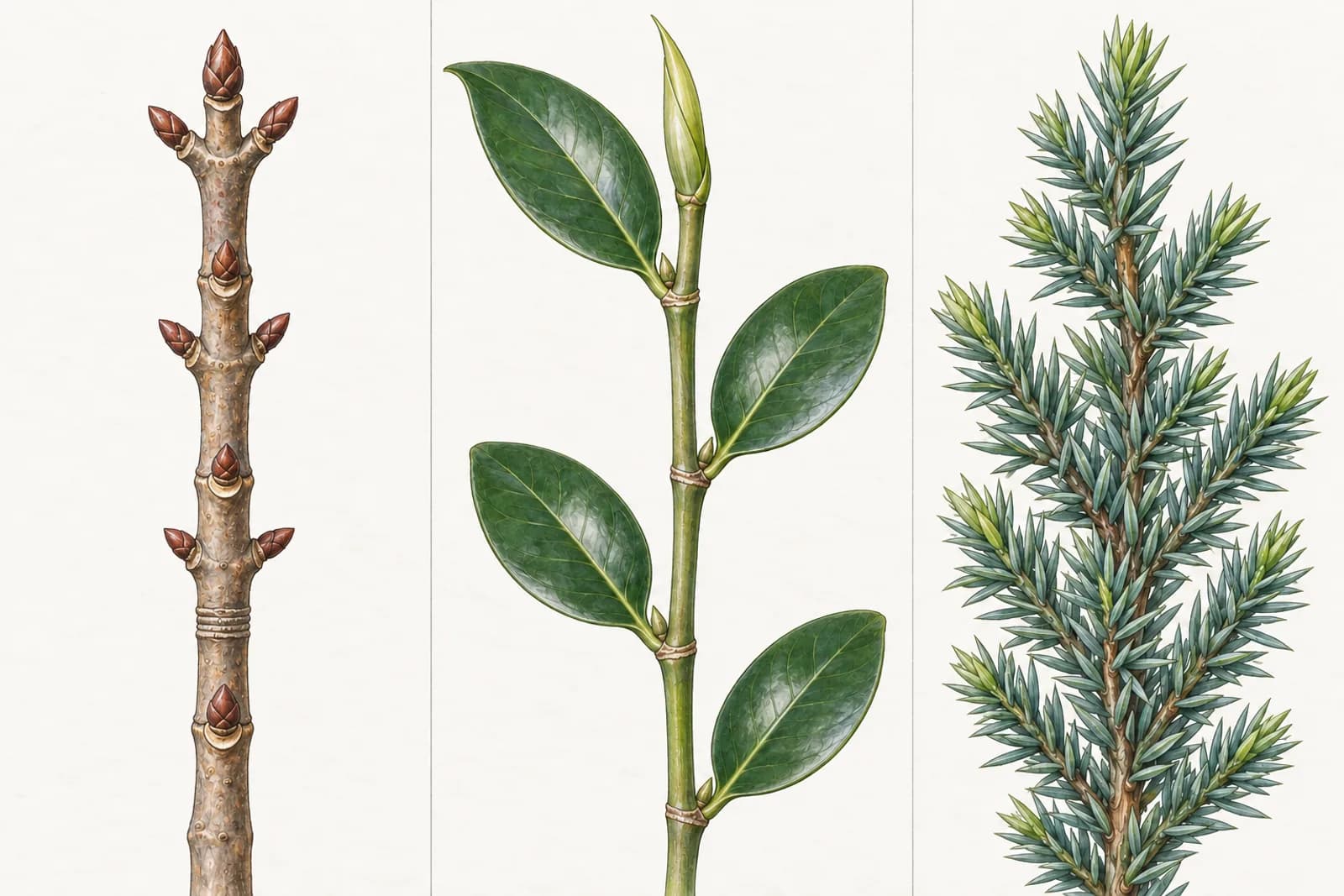
A shoot is a stem with its leaves, built in a repeating pattern. The place where a leaf attaches is a nodeThe point on a stem where one or more leaves attach, usually with a bud in the angle of each leaf. New shoots most often grow from nodes, so they show where a cut can leave a growth option behind.Open the glossary. The bare stretch of stem between one node and the next is an internodeThe stretch of stem between two neighboring nodes. Internodes tend to be longer in vigorous or shaded growth and shorter in slow growth or strong light, and short internodes help a bonsai's branches look finer and more compact.Open the glossary. Internodes carry no leaves and no buds of their own, so on a young stem, new shoots start at the nodes.
Look at a leaf where it meets the stem. The angle on its upper side is the leaf axilThe angle on the upper side where a leaf joins its stem. A lateral bud usually forms there, which is why buds sit right above leaves, or above the scars left by fallen leaves.Open the glossary, and in that angle sits a small budA compact, undeveloped shoot, flower, or both, containing a growing tip and tightly folded young leaves or flower parts, often protected by overlapping scales. Buds mark the places where new shoots can appear.Open the glossary: a compact, undeveloped shoot, flower, or both, often wrapped in protective scales. A bud on the side of the stem like this is a lateral budA bud on the side of a stem, formed in the angle where a leaf joins the stem. Lateral buds can grow into side shoots, often after the shoot tip above them is removed or slows.Open the glossary, also called an axillary bud. At the very end of the shoot is the terminal budThe bud at the tip of a shoot, which continues that shoot's growth in length when it opens. While it is actively growing, it tends to hold back the buds below it.Open the glossary, or apical bud, which continues the shoot's growth in length.
That gives you a dependable rule of thumb: wherever a leaf is attached, a bud usually sits directly above it. Find the leaves and you have found the buds. On many trees, though, including cherries and elms, some buds hold only flowers, and a flower bud will not grow into a branch.
Internodes tend to be longer on fast-growing or shaded shoots and shorter on slower growth in strong light. Short internodes fit more nodes, and so more possible branches, into a small space, which is one reason bonsai growers value them.
Opposite or alternate: how many shoots, and which way
In an opposite arrangementA leaf pattern in which two leaves, each with a bud, grow from the same node on opposite sides of the stem, as in maples. Cutting above such a node can produce a pair of shoots.Open the glossary, two leaves grow from each node on opposite sides of the stem, each with a bud in its axil. Maples, including the trident maple, grow this way. Each pair usually sits at right angles to the pair below, so on a real twig the buds point in four directions. A cut immediately above a node often produces a pair of shoots, one from each side.
In an alternate arrangementA leaf pattern with one leaf and one bud at each node, the nodes alternating sides or spiraling around the stem, as in ficus and elms. Growth after a cut tends to come as single shoots pointing in different directions.Open the glossary, each node has one leaf and one bud, and the next node's leaf is on a different side; on many trees the leaves spiral around the stem. Beeches, elms, and the ficus all have alternate leaves. A cut immediately above a node usually leaves a single bud at the top, so new growth tends to come singly.
Either way, a new shoot tends to start out in the direction its bud points, before it turns upward and toward the light. A bud on the outer side of a branch tends to send a shoot outward; a bud facing the trunk tends to send one inward.
Reading a twig in winter
When a deciduous tree drops its leaves, the pattern stays readable. Where each leaf fell, it left a leaf scarThe mark left on a stem where a leaf was attached before it fell, often crescent- or shield-shaped, usually with a bud right above it. Leaf scars help you find the nodes on a bare winter twig.Open the glossary, often a crescent or shield with tiny dots where the leaf's veins passed through. The bud that formed in that leaf's axil sits directly above the scar, so the scars lead you to nodes and buds even when the buds are tiny.
Farther down, look for a band of fine, crowded rings around the stem. These bud scale scarA ring of narrow, crowded scars around a stem, left where a bud's protective scales fell away as it opened. Each ring marks where a flush of growth began, often once a year, so on many trees you can count recent years of growth along a twig.Open the glossary mark where a bud's protective scales fell away as it opened, and so where a burst of growth, or flushA burst of new shoot growth, with leaves expanding together, that happens once or several times a year depending on the tree and conditions. Between flushes, shoots stop extending and mature.Open the glossary, began. On a tree that flushes once a year, each stretch from one band to the next, or to the tip, is one season's growth, so you can count back through recent years; a tree that flushes several times a year leaves several bands in a year.
In Read a twig, press Start at the tip and step through the parts with Next. Then switch Twig to Alternate, a shoot still in leaf, and find the bud in each leaf axil. When you can name every part, try Count the years.
Interactive
Read a twig
Opposite: two leaves and buds at each node. Alternate: one at each node.
Opposite arrangement, in winter
A twig from a tree with opposite buds, such as a trident maple, in winter after its leaves have fallen.
Choose a part above, or tap it on the twig, to see where it is and what it does.
Text description
Two illustrated twigs, each drawn growing upward from a short piece of older branch. Choose either one.
Opposite twig, maple-like, in winter. At the tip is a plump terminal bud wrapped in overlapping scales, flanked by a pair of small lateral buds. Below it, the stem is marked at intervals by nodes. Each node carries two lateral buds pointing out on opposite sides, and directly below each bud is a pale, crescent-shaped leaf scar where a leaf was attached; tiny dots inside each scar are bundle scars. Moving down from the tip, there is a short stretch with two nodes, then a band of fine rings around the stem, then a longer stretch with three nodes, then another band of fine rings, then a stretch with three nodes on older, grayer, thicker wood whose buds are smaller, and finally a band of fine rings immediately above where the twig joins the branch.
Alternate twig, beech-like, in leaf. At the tip is a slender, pointed terminal bud. Below it, a slightly zigzag green stem carries four leaves, one per node, on alternating sides; in the angle between each leaf stalk and the stem sits a small bud. Below the leaves is a band of fine rings around the stem. Below that band, the stem is brown and leafless, with three nodes, each with one bud above a rounded leaf scar, on alternating sides, and then another band of fine rings immediately above where the twig joins the branch.
On both twigs, pale flecks on the bark are lenticels, small pores that let air reach living tissue under the bark.
The parts you can explore:
- Terminal bud: the bud at the shoot tip. It contains the apical meristem, a zone of dividing cells that builds new stem, nodes, and leaves.
- Lateral bud: a bud on the side of the stem, formed in a leaf axil. Each is a possible side shoot; many stay dormant, and long-dormant buds are called latent buds.
- Node: the place where a leaf is or was attached. Opposite twigs have two leaves and buds per node; alternate twigs have one.
- Internode: the bare stem between two nodes, longer on fast-growing or shaded shoots and shorter on slow growth in strong light.
- Leaf axil (leafy twig only): the upper angle between a leaf stalk and the stem, where a lateral bud forms.
- Leaf scar: the mark left where a leaf stalk was attached, with bundle scars where its veins passed through.
- Bud scale scars: a band of fine rings left where a bud's scales fell away as it opened. Each band marks where a burst of growth, or flush, began, usually one per season; a tree that flushes more than once a year can leave more than one band in a year.
Count the years asks how many seasons of growth a twig shows, assuming one flush a season, using the descriptions above. Label it asks you to match five letters on the drawing to part names; each letter's menu describes what it points to.
On both twigs, every bud sits at a node, above a leaf or leaf scar, never partway along an internode: one per node on the alternate twig, two on the opposite one. The stretches between bands differ too: the maple-like twig grew its longest stretch two seasons ago and a much shorter one last season, a record of how the tree has been growing.
Where new growth comes from
Buds matter because of what is inside them. Under the scales of a terminal bud lies a shoot in miniature: tightly folded young leaves around the apical meristemThe group of dividing cells at the tip of a shoot or root that makes new cells for growth in length. In a shoot it also forms new leaves, nodes, and buds.Open the glossary, a small zone of dividing cells at the shoot tip. In Lesson 2 you met a meristemA group of plant cells that keep dividing to produce new cells, found at the tips of shoots and roots, inside buds, and in thin layers beneath the bark. All of a tree's new growth, in length or in thickness, starts in a meristem.Open the glossary at each root tip; this is the shoot's version. As the shoot grows, the apical meristem makes new stem, nodes, and leaves, and a new bud forms in each leaf axil along the way.
Each lateral bud holds its own small meristem. Some grow into side shoots in their first season; many wait. A bud that stays inactive for years is a latent budA bud that stays inactive beyond its first season, often for years, and may lie hidden beneath the bark of older wood. It may grow after a disturbance such as pruning, which is one source of new shoots on older branches. Growers sometimes call these dormant buds, but any bud resting through winter is dormant.Open the glossary (growers sometimes say dormant bud, though any bud resting through winter is dormant). On older wood it can lie hidden beneath the bark, still alive, and after a disturbance, such as losing the shoot beyond it, it may grow.
Some trees can also form an adventitious budA bud that forms in an unusual place where no bud existed before, such as near a wound, on a root, or on older wood. The ability to form these buds varies greatly among trees.Open the glossary: a new bud where none existed before, such as in the new tissue around a wound or on older wood. This ability varies greatly; some trees do it readily, others hardly at all.
So new shoots come from meristems in buds and shoot tips; these are a tree's growing points. The vascular cambium from Lesson 3 is a meristem too, but its main work is to thicken a branch, not to make the buds along a shoot. A stretch of branch with no buds, no foliage, and no ability to form new buds has no way to grow a branch, however healthy the rest of the tree is.
Go deeper · optional, not assessedHow a latent bud survives under thickening bark
A branch adds a layer of wood every year, so why isn't a latent bud buried? In many trees, the bud stays connected to the center of the branch by a thin strand of tissue, a bud trace, which lengthens a little each year as the branch thickens. Some of these buds die over time, one reason older wood can hold fewer usable buds than younger wood. On some broadleaf trees, such as oaks, a latent bud can also form extra buds around itself over the years, which is why several shoots sometimes appear from one spot on an old branch.
Conifers: growing points in the foliage
On broadleaf trees such as the trident maple and the ficus, buds usually sit plainly along the stem. Many conifers are different. On a juniper, the growing points sit at the tips of the shoots and within the foliage itself, small and hard to see, rather than as distinct buds spaced along a bare stem.
What happens on bare wood matters even more. Many conifers, including most junipers and pines, rarely produce new shoots from bare, older wood. On a dense nursery juniper, foliage often grows only at the outer ends of the branches: the inner stems, shaded by the growth outside them, lost their own foliage long ago, and their growth options went with it.
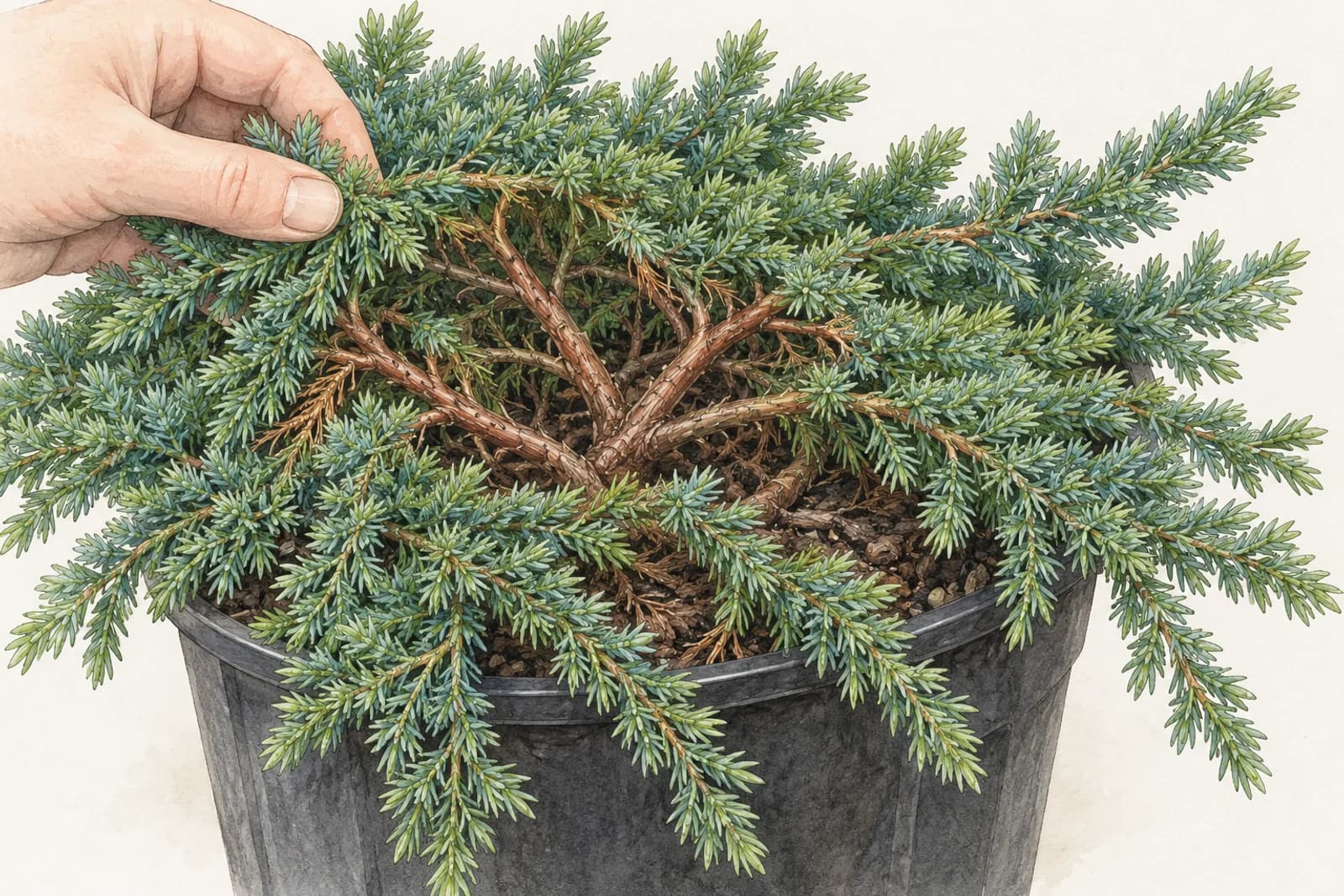
Not every conifer behaves this way: yews often regrow well from old wood, and broadleaf trees differ among themselves too. “Conifer” or “broadleaf” alone does not tell you how a tree will respond to a cut.
Practice check · not scored
What a cut keeps and what it removes
While a shoot tip is actively growing, it tends to hold back the buds below it, an influence called apical dominance that Lesson 12 explains. Remove the tip, and one or more of the buds nearest the cut often grow instead.
Which buds grow, and how strongly, depends on the tree's vigorA tree's observed growth performance relative to its expected seasonal behavior, meaning what a tree of its kind should be doing at that point in the season. It is judged from shoot extension, bud development, foliage condition, and root activity when visible, across several observations over time, not from one large leaf or green color. A vigorous tree is growing at or above that expected pace.Open the glossary (how strongly it is growing compared with what is normal for its kind and the season), the season itself, the light reaching the buds, and the tree's own budding behavior. A cut changes the odds; it does not issue orders.
What grows after a cut? tests this on two branches, drawn in leaf during the growing season. With Tree behavior on Buds readily on older wood, choose Position 3, on last year's leafless wood, and read what stays below the cut. Before you press Show likely response, find the growth the cut would keep. Then try Positions 1 and 5. Finally, switch to Rarely buds on bare, older wood: Position 3 is the cut from the juniper question, and Position 4 keeps a little foliage.
Simulation
What grows after a cut?
- Likely new shoot
- Possible new shoot
- Visible bud
- Latent bud under the bark
- Planned cut
This trident maple–like branch has leaves only on this year’s shoot at the outer end. Last year’s wood is leafless but still carries visible buds at its nodes, and the older wood near the trunk has latent buds, shown as faint dots, resting under the bark.
Choose a cut position to see what it would leave below the cut, on the part between the cut and the trunk.
Text description
A side view of one branch growing out from a trunk on the left toward its tip on the right. Five numbered cut positions run along it, from position 1 near the trunk to position 5 near the tip. You can switch between two kinds of tree behavior, choose a cut, read what stays below it, and then show the likely response.
Buds readily on older wood (e.g., trident maple). This trident maple–like branch has leaves only on this year’s shoot at the outer end. Last year’s wood is leafless but still carries visible buds at its nodes, and the older wood near the trunk has latent buds, shown as faint dots, resting under the bark. What stays below each cut:
- Position 1, old wood near the trunk: Bare, older wood: no leaves and no visible buds, only a few latent buds resting under the bark near the trunk.
- Position 2, older wood: Bare, older wood with latent buds resting under the bark. No leaves and no visible buds.
- Position 3, last year’s wood: No leaves, but a pair of visible buds sits at the node immediately below the cut, one on each side of the branch.
- Position 4, base of this year’s shoot: One pair of leaves, with a bud in each leaf axil, at the node immediately below the cut. Resting buds sit further back on last year’s wood.
- Position 5, near the shoot tip: Nearly all of this year’s shoot: three pairs of leaves, each with a bud in its axil. Only the soft growing tip is removed.
Rarely buds on bare, older wood (e.g., many junipers). On this juniper-like branch, only the outer part carries foliage, and its growing points sit among the needles. The inner wood is bare: no foliage and no visible buds. What stays below each cut:
- Position 1, bare wood near the trunk: Bare, older wood only: no foliage and no visible buds.
- Position 2, bare wood: Bare, older wood only: no foliage and no visible buds.
- Position 3, bare wood right behind the foliage: Bare wood only. The cut is right behind the last foliage, so none of it stays.
- Position 4, inside the foliage: Several foliage-bearing shoots between the bare wood and the cut.
- Position 5, near the tip: Nearly all the foliage, with the growing points within it.
After you choose a cut and show the likely response, the outcome and its explanation appear as text below the buttons. In the drawing, likely new shoots are solid green lines and possible ones are dashed. A section that may die back turns a muted, hatched brown. Not every bud grows, and whether, and how far, a section dies back varies with the tree and its health.
On the maple, Position 5 keeps leaves that go on making sugars for the new shoots. Positions 1 to 3 leave a leafless stub, so any shoots there grow at first on stored reserves (Lesson 9). At Position 3, the visible pair of buds is likely to grow. At Positions 1 and 2, only latent buds remain, so shoots are possible, not promised; if none grow, the stub may die back. On the juniper, Position 3 is close behind the green but keeps no foliage and no growing points, so that section may die back; Position 4 keeps foliage, and growth continues.
Practice check · not scored
The bonsai decision
Find the growth you mean to keep before you cut
Starting point
Before any cut, trace the branch from the planned cut back toward the trunk and name the first growth that will remain: a bud or pair of buds, a leaf with a bud in its axil, or a foliage-bearing shoot. Note which way it points; a new shoot will likely head that way. If only bare wood remains, ask whether this tree reliably grows from older wood. If the kept growth points where you want a branch, the plan fits; if not, move the cut to a better-placed bud or leave the branch for now.
This assumes
You know what the tree is and how it generally buds, and it is healthy and growing as expected for the season. This is a way to read growth options, not a pruning method; how and when to cut belong to Course 09, Pruning and Managing Growth, and Course 06, Seasonal Care and Timing.
Change course if
- No visible bud or foliage remains below the cut, on a tree that does not reliably grow from bare wood. Move the cut outward so it keeps some foliage, or do not cut.
- The tree is weak or stressed. Shoots are shorter and sparser than usual for this tree at this point in the season, foliage is thin or discolored, or it has had heavy work recently. Fewer buds are likely to respond, so keep visible buds or foliage below any cut, and postpone cuts you do not need until growth looks normal over several checks. Lesson 14 covers how to judge this.
- You are not sure what the tree is or how it buds. Treat it as a tree that may not grow from bare wood, and keep foliage below every cut until you find out.
Back to the question
Where could the next branch grow after a cut?
On the trident maple's long shoot, the next branches will most likely grow from the pair of buds at the node immediately below your cut, each heading the way its bud points. Any new branch needs a growing point the cut leaves behind: a bud, foliage that carries growing points, or, on trees able to use them, latent or new buds on older wood. Vigor, season, light, and the tree's own budding behavior decide whether one grows.
Key takeaways
- A terminal bud sits at the shoot tip; lateral buds sit at nodes, directly above a leaf or leaf scar. Internodes carry no buds of their own.
- New shoots come from meristems in buds and shoot tips. Latent and adventitious buds can add options on older wood, but trees vary greatly in this.
- Opposite arrangement often gives a pair of shoots at the node below a cut; alternate usually gives one shoot per node. A new shoot tends to start out the way its bud points.
- Many junipers and pines rarely grow from bare, older wood, so a cut that removes all the foliage from a section may leave it with no growth option.
- Growth after a cut is likely or possible, never guaranteed, so find the growth you mean to keep before you cut.
Optional · not required for completion
Read a real twig
Find a twig on a deciduous tree or shrub you are free to examine, or a leafy shoot in the growing season. Without cutting anything, start at the terminal bud and work back: find each node, note whether buds come in pairs or singly, and compare the internodes. On a winter twig, count the bands of bud scale scars. How many seasons can you read?
No tree? On a pothos houseplant, each node carries a leaf, a small bud, and often a short aerial root. Or return to Read a twig and try Label it on both twigs.