Course 01 · Lesson 10 of 14 · Resources and transport
Mineral absorption and the root environment
Roots absorb mineral nutrients as dissolved ions, spending energy to do it, and only when the root environment allows. See why fertilizer helps only when supply is what holds a tree back.
The question
Why might fertilizer fail to improve growth?
By the end of this lesson, you will be able to:
- Explain that roots absorb mineral nutrients as dissolved ions, using energy from respiration.
- Identify how moisture, oxygen, temperature, chemistry, and microbial partners influence uptake.
- Distinguish supplying a nutrient from absorbing it, and explain why fertilizer can fail when something else limits growth.
About 14 minutes to read and explore
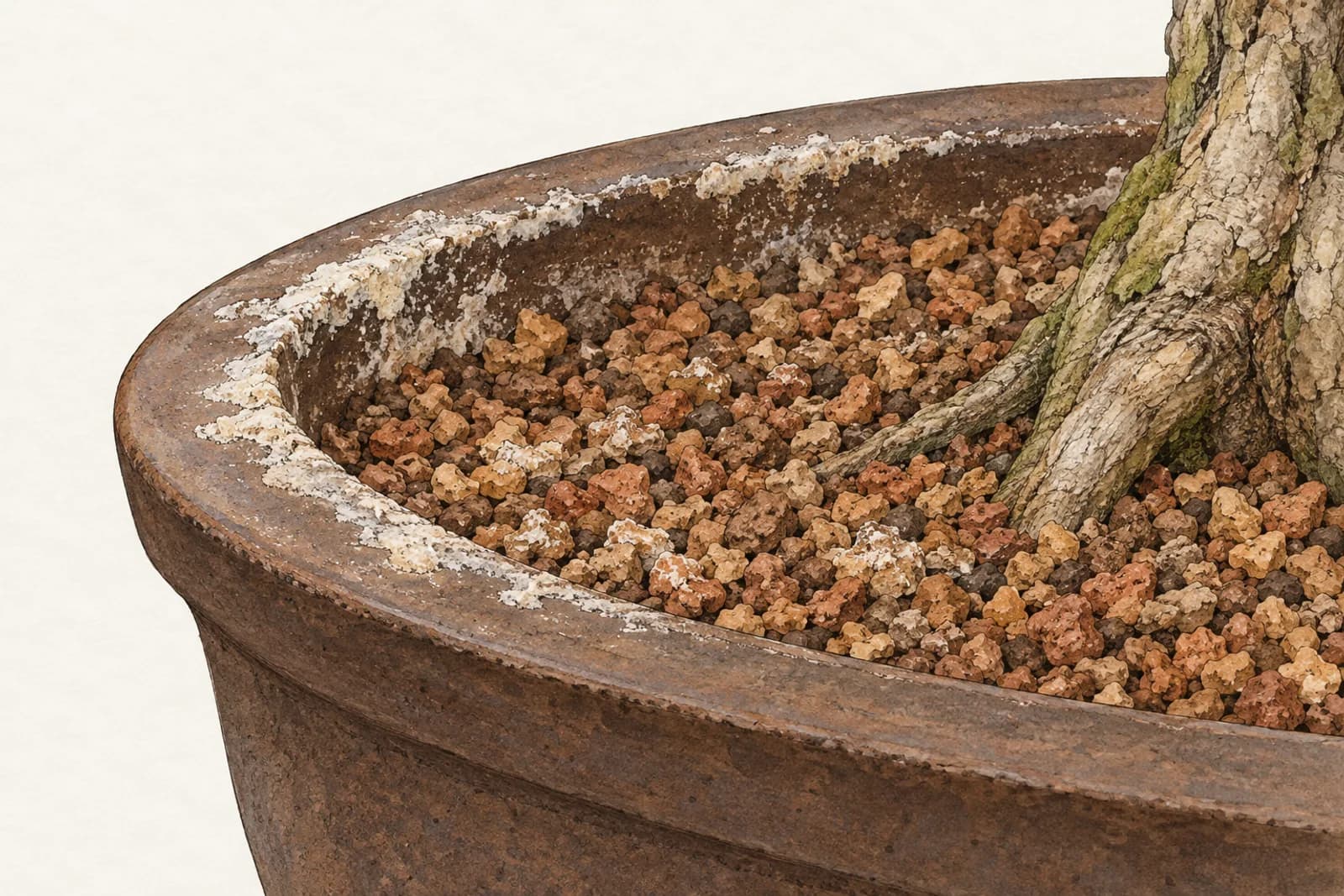
Picture an instructional example: the trident maple in a glazed pot after a slow spring, with a few short shoots and small leaves paler than last year's. Its owner reads this as a nutrient shortage and feeds it, then, when nothing changes, feeds it twice as often at double strength. By midsummer many of its leaves have crisp brown edges, and a white crust rims the pot. Given more of what seemed to be missing, the tree grew worse.
One detail went unnoticed: the pot stands in a deep decorative tray that never quite empties.
Between a bag of fertilizer and a new shoot, four things must happen: the nutrients are supplied to the pot, they dissolve and reach the roots, the roots absorb them, and the tree uses them, with sugar, to grow. Growth moves only as fast as the narrowest step, and fertilizer widens only the first.
What roots collect from the substrate
A tree builds itself mostly from carbon, hydrogen, and oxygen, taken from air and water through photosynthesis (Lesson 6). Everything else arrives through its roots as mineral nutrientA chemical element, such as nitrogen, potassium, or iron, that a tree needs and takes up through its roots from the water around them. Mineral nutrients help build and run cells, but they supply no energy and only a small share of the tree's mass.Open the glossary: chemical elements dissolved in the water around them, a small share of the tree's weight but essential to every working cell.
They fall into two groups:
- macronutrientA mineral nutrient that plants need in relatively large amounts: nitrogen, phosphorus, potassium, calcium, magnesium, and sulfur. Nitrogen, phosphorus, and potassium are the three behind the N-P-K numbers on fertilizer labels.Open the glossary are needed in relatively large amounts: nitrogen, phosphorus, potassium, calcium, magnesium, and sulfur.
- micronutrientA mineral nutrient that plants need only in tiny amounts, such as iron, manganese, zinc, copper, or boron. Tiny amounts are still essential: a shortage of iron, for example, can yellow new leaves between their veins.Open the glossary are needed in tiny amounts but are equally essential: iron, manganese, zinc, copper, boron, molybdenum, chlorine, and nickel.
Lesson 6 showed why a few of them matter: nitrogen and magnesium are part of chlorophyll, and nitrogen is in every protein. You do not need to memorize the list; Course 05, Mineral Nutrition and Fertilizing, will return to it.
fertilizerA product that supplies mineral nutrients, such as nitrogen, phosphorus, and potassium, for roots to absorb. It supplies no energy or carbohydrates that the tree can use, so it cannot make up for too little light or too few healthy leaves, and too much can harm roots.Open the glossary adds these elements to the pot. It supplies no energy, and none of the carbohydrate that new wood and leaves are built from.
Minerals travel as ions in water
Roots take in only what is dissolved. A dissolving mineral salt separates into ionAn atom or small group of atoms carrying an electric charge, positive or negative, such as potassium, calcium, or nitrate. Roots absorb mineral nutrients as ions dissolved in the water around them.Open the glossary, atoms or small groups of atoms that carry an electric charge: potassium and calcium as positive ions, nitrogen mostly as negative nitrate or positive ammonium, and phosphorus as negative phosphate. Roots absorb them from the thin films of water that cling to substrate particles (Lesson 2).
A fertilizer granule does nothing until water dissolves it. Organic fertilizers, such as the seed-meal cakes many bonsai growers use, release most of their nutrients only as substrate microbes break them down, slowly when cold or dry.
Ions next to a root are soon used up, so more must keep arriving, in three ways:
- Carried by moving water. As leaves lose water through transpiration, roots draw in more (Lesson 8), and the water flowing toward them carries ions along. This mass flowThe carrying of dissolved nutrients toward roots by moving water, as roots take up water to replace what the leaves lose. It delivers nutrients such as nitrate and calcium, while others, such as phosphate, reach roots mostly by slow diffusion.Open the glossary delivers much of a tree's nitrate and calcium.
- Drifting on their own. Over short distances, ions spread from where they are concentrated toward where they are scarce, a process called diffusion. Phosphate, which clings to many soil and substrate particles and so moves little, arrives largely this way.
- Roots growing to them. Growing root tips push into fresh substrate.
Some particles also store nutrients. Their negative charges hold positive ions, called cations, such as potassium, calcium, and magnesium, and trade them back into the water for other positive ions, including hydrogen ions that roots give off. This cation exchangeThe ability of some soil and substrate particles to hold positively charged nutrient ions, such as potassium, calcium, and magnesium, on their surfaces and release them into the surrounding water in exchange for other ions. It helps a substrate store nutrients between fertilizer applications.Open the glossary lets a substrate store some nutrients between feedings (Course 04, Soil, Substrates, and the Root Environment); negatively charged nitrate is not held and washes out.
Roots spend energy to take minerals in
Reaching a root is not the same as getting in. Ions cross a root cell's membrane only through transport proteins built into it, which let some in and keep others out. Root cells often hold nutrients at far higher concentrations than the water outside, so they must pull ions in against the direction those ions would drift. Moving a substance that way is called active transportThe movement of a substance into or out of a cell against the direction it would drift on its own, which takes energy. Much of a root's mineral uptake works this way, powered by respiration, so it depends on living roots with enough oxygen.Open the glossary, and much mineral uptake works like this. It costs energy, supplied by respirationThe process in which living cells break down sugars using oxygen to release energy they can use, giving off carbon dioxide and water. It runs in every living cell of a tree, in leaves, stems, buds, and roots, both day and night. Without oxygen, cells fall back on fermentation.Open the glossary (Lesson 7).
So good uptake needs:
- Living, growing fine roots. Most uptake happens in young fine roots near their tips, where root hairs add absorbing surface, so a tree that has lost fine roots, to rot or recent root pruning, absorbs less.
- Oxygen, from the air in the pore spaces of the substrate.
- Sugar, sent from the leaves or drawn from starch stored in the roots (Lesson 9).
- Suitable warmth. Cold slows respiration and the transport proteins, so cold roots absorb slowly even when nutrients are plentiful. At the other extreme, a small pot baking in strong sun can overheat and injure its roots.
Take away any one of these, and a root can sit in nutrient-rich water and absorb little of it.
Once absorbed, minerals travel up the tree with the water, while the sugar that powers their uptake reaches the roots by another route. The map opens with water, minerals, and sugars all shown; switch each one off and on to see which tissue carries it.
Interactive
Water, minerals, and sugars, side by side
Inside a leaf
Around a young root
What the map shows
- Water Water enters fine roots from thin films around substrate particles, rises through the xylem in the wood, and leaves through stomata as vapor.
- Sugars Mature leaves are the source. The phloem in the inner bark carries sugar to the sinks: out to growing shoot tips, into the cambium, and down to the roots.
- Minerals Dissolved mineral ions are absorbed by living root cells, then ride the water stream up the xylem to leaves and growing points. They do not leave with the water vapor. Some, such as nitrogen and potassium, can later move again in the phloem to newer growth or, before autumn leaf fall, into storage.
Water and the minerals taken up by roots rise in the xylem; sugars travel in the phloem, carried in water drawn from the xylem. They are separate channels that trade water side by side, not one circulating sap.
Text description
A small broadleaf tree in a shallow pot. The pot is cut away to show substrate particles and roots. A window in the lower trunk shows its layers from the outside in: outer bark, phloem (the inner bark), a thin cambium, and xylem (the wood), crossed by rays of living storage cells. Two magnified circles show the inside of a leaf, with a vein and a stoma on its lower surface, and a young root with root hairs among substrate particles, water films, and air spaces.
Water. Water enters fine roots from thin films around substrate particles, rises through the xylem in the wood, and leaves through stomata as vapor.
- Water films around particles. In a moist substrate, water clings as thin films around particles and fills the narrowest gaps between them. The larger gaps hold air.
- Into root hairs and young roots. Water enters near the root tips, where young roots and, in many trees, their root hairs reach into those films. Root hairs add a great deal of absorbing surface. Some trees, pines among them, grow few root hairs and depend more on partner fungi (mycorrhizae, not shown).
- Across the root into the xylem. Water crosses the root's outer tissues toward its center. A selective inner layer controls what passes, and then water enters the xylem, which carries it toward the trunk.
- Up through the sapwood. In the trunk, water rises in the xylem of the outer wood, the sapwood. Its conducting cells are hollow tubes. In a leafy tree, the pull comes from evaporation at the leaves; the tree does not pump water up.
- Out into branches and leaf veins. The xylem continues through every branch and into the veins of each leaf, where water reaches the cells around the veins.
- Out through the stomata. Inside the leaf, water evaporates from wet cell walls into air spaces, and the vapor diffuses out through open stomata. This loss of water vapor is transpiration. Most of the water a tree absorbs leaves this way.
Sugars. Mature leaves are the source. The phloem in the inner bark carries sugar to the sinks: out to growing shoot tips, into the cambium, and down to the roots.
- Made in mature leaves. Mature leaves in light make sugars by photosynthesis. They make more than they use, so they are sources.
- Loaded into the phloem. Sugar is moved into the phloem of the leaf veins. Water follows it in, building pressure that pushes the sugar solution along.
- Carried in the inner bark. The phloem lies just inside the outer bark. It carries sugar toward wherever it is being used or stored: down to the cambium and roots, and out to growing shoot tips.
- Delivered to sinks. Growing shoot tips, the cambium that thickens the trunk and branches, and the roots are sinks. They use sugar faster than they make it, or make none at all.
- Used or stored. Sinks use sugar for respiration and to build new cells. Some is converted to starch, the tree's stored reserve.
Gases. Daylight is shown. Carbon dioxide enters leaves through stomata and oxygen leaves. Day and night, roots take in oxygen from the air spaces in the substrate and release carbon dioxide.
- Carbon dioxide enters through stomata. In daylight, carbon dioxide from the air diffuses into the leaf through open stomata. The tree adjusts how open they are as light, water supply, and other conditions change.
- Used to make sugars. In the chloroplasts of leaf cells, light energy is used to combine carbon dioxide with water into sugars. This is photosynthesis.
- Oxygen leaves the leaf. Photosynthesis releases oxygen. In good light a leaf makes more than its own cells use, and the extra diffuses out through the stomata.
- Roots take in oxygen from air spaces. Roots cannot photosynthesize. Day and night, they take oxygen from the air between substrate particles for respiration and release carbon dioxide.
Minerals. Dissolved mineral ions are absorbed by living root cells, then ride the water stream up the xylem to leaves and growing points. They do not leave with the water vapor. Some, such as nitrogen and potassium, can later move again in the phloem to newer growth or, before autumn leaf fall, into storage.
- Dissolved in water films. Mineral nutrients such as nitrogen, potassium, and iron are present as dissolved ions in the water films around substrate particles. Roots can take up only what is dissolved.
- Absorbed by living root cells. Root cells take up ions through transport proteins in their membranes. Much of this uptake uses energy from respiration, so it depends on live roots with oxygen, sugar, and suitable warmth. On many trees, partner fungi (mycorrhizae, not shown) gather some ions for the roots, especially phosphorus.
- Carried up with the water. Inside the xylem, ions ride the water stream up the trunk and out along the branches.
- Delivered to leaves and growing points. When the water evaporates and leaves through the stomata, the minerals stay behind in the leaf. Leaves and shoot tips build some, such as nitrogen and magnesium, into chlorophyll, proteins, and new cells. Others, such as potassium, stay dissolved and help cells manage water.
Water and the minerals taken up by roots rise in the xylem; sugars travel in the phloem, carried in water drawn from the xylem. They are separate channels that trade water side by side, not one circulating sap.
Minerals ride the water stream up the xylem, in the wood, to the leaves and growing points. Sugars travel separately in the phloem of the inner bark, from the leaves toward sinks such as shoot tips and the roots doing the absorbing. These are two transport systems working side by side, not one sap circulating around the tree.
The root environment decides what is available
A nutrient can be present in the pot and still be out of reach. Whether it is dissolved, in a usable form, and close enough for roots to take up is its nutrient availabilityWhether a mineral nutrient in the root zone is dissolved, in a form roots can take up, and close enough to reach them, which depends on the conditions around the roots, such as moisture, pH, and the substrate itself. A nutrient can be present in the substrate yet unavailable to the tree, and an available nutrient still has to be absorbed by living roots.Open the glossary, and that depends on the conditions around the roots.
Moisture and air
Dry substrate leaves ions undissolved or stranded in films too thin to carry them, and roots in it lose root hairs and take up little water. Substrate saturated for days holds plenty of dissolved nutrients, but its roots are short of oxygen and can power little uptake. Uptake works best where roots work best: water films around the particles, and air in the larger pores.
Acidity and alkalinity
pHA scale, usually 0 to 14, that measures how acidic or alkaline a solution or substrate is: 7 is neutral, lower numbers are acidic, and higher numbers are alkaline. It affects which mineral nutrients stay dissolved and available to roots.Open the glossary measures how acidic or alkaline something is: 7 is neutral, lower numbers are acidic, and higher numbers alkaline. In the root zone, pH changes which nutrients stay dissolved. In alkaline conditions, iron, manganese, and zinc form solid compounds that roots cannot absorb, though they are still present. In strongly acidic conditions, calcium and magnesium become scarce, and phosphorus is least available at both extremes.
Many trees grow well in a slightly acidic to neutral root zone; some, such as azaleas, need more acid. If your tap water leaves limescale in the kettle, the carbonates dissolved in it can slowly raise your substrate's pH.
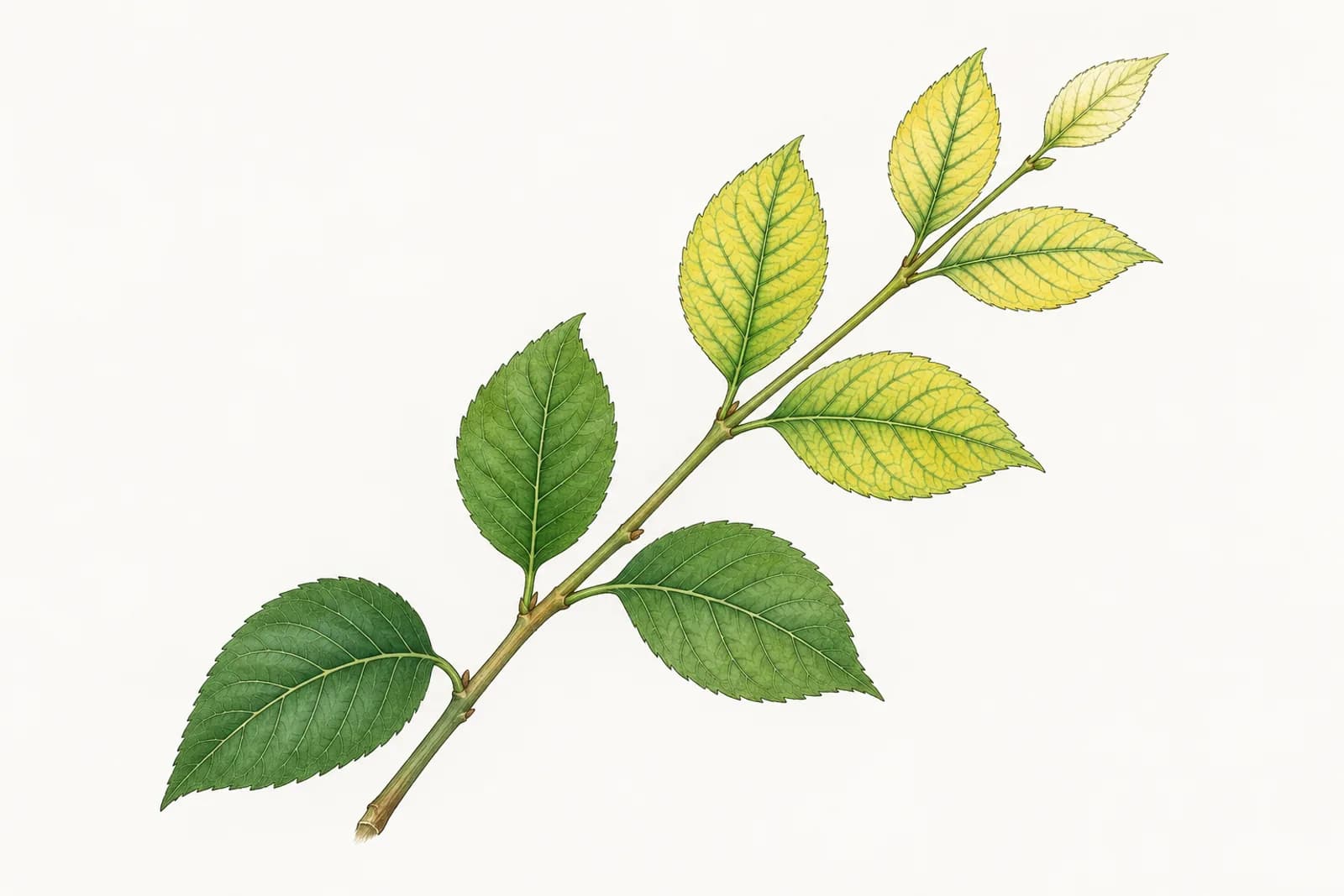
Iron is the best-known casualty. Short of usable iron, a tree cannot make enough chlorophyll, and its newest leaves turn yellow between veins that stay green. Yellowing of leaves that should be green is called chlorosisYellowing of leaves that should be green, caused by too little chlorophyll. It is a symptom, not a diagnosis: nutrient shortages, damaged or waterlogged roots, high pH, and other problems can all cause it.Open the glossary; this vein-patterned kind is a well-known sign of iron shortage in sensitive trees. But chlorosis is a symptom, not a diagnosis: waterlogged or damaged roots, other shortages, and other problems can yellow leaves too (Course 07, Tree Health and Diagnosis).
Go deeper · optional, not assessedWhy some shortages show on new leaves first
Once inside a root, minerals ride the water stream up the xylem and are left behind, mostly in the leaves, when the water evaporates (Lesson 8). Some can be moved again after they reach a leaf. Nitrogen, phosphorus, potassium, and magnesium can be withdrawn from older leaves and sent through the phloem to new growth, so when they run short, older leaves tend to show it first. Deciduous trees also withdraw much of the nitrogen and phosphorus from their leaves before the leaves fall in autumn. Iron and calcium are hard to move once in place, so new leaves and shoot tips depend on what is arriving now, and a shortage shows there first. That is why iron chlorosis appears on the newest leaves. These patterns are clues, not proof: many other problems also change leaf color.
Dissolved salts
Most fertilizers are salts, or release them as they break down. The dissolved minerals they leave in the root zone, along with those from tap water, are called soluble saltsDissolved minerals, from fertilizer and from tap water, that can accumulate in a container's substrate as water evaporates. A high concentration makes it harder for roots to take up water and can damage them. Buildup can leave a white crust on the pot or surface, though hard tap water alone can leave a similar crust, so a crust by itself does not show that roots are harmed.Open the glossary. At suitable strengths they supply what roots need; far above that, they backfire. Water moves into roots partly because their cells hold more dissolved material than the water around them. Very salty substrate water weakens that pull, so a tree can wilt in a moist pot; strong solutions also damage root tips and hairs.
Salts build up when fertilizer goes in faster than the tree uses it or water carries it out, and they concentrate as the substrate dries. If you see a white crust on the pot or surface, or leaf edges browning, treat them as signs to investigate. Neither proves salt damage alone, and hard tap water by itself can leave a similar crust (Course 03, Watering and Daily Observation, and Course 05).
Practice check · not scored
Fungal partners extend the roots
Most trees form partnerships with certain soil fungi (Lesson 2). Each is called a mycorrhizaA partnership (plural: mycorrhizae) between a plant's roots and certain soil fungi, known as mycorrhizal fungi, whose fine threads reach far beyond the roots and help supply water and nutrients, especially phosphorus, in exchange for sugars from the plant. Many trees, including pines, depend heavily on these partnerships.Open the glossary (plural mycorrhizae), meaning “fungus root.” The fungus's threads, called hyphae, are thinner than root hairs and spread well beyond the zone where the roots have already used up the nutrients. They are especially good at gathering phosphorus and bring in other nutrients and water too. The tree pays in sugar, which makes the fungus one more sink (Lesson 9).
In pines and many other trees, such as oaks and birches, the fungus sheathes most young root tips, leaving them short, swollen, and usually without root hairs, so these trees depend heavily on their partners. Many others, including maples, junipers, and figs, host a kind that grows partly inside root cells, invisible without a microscope.
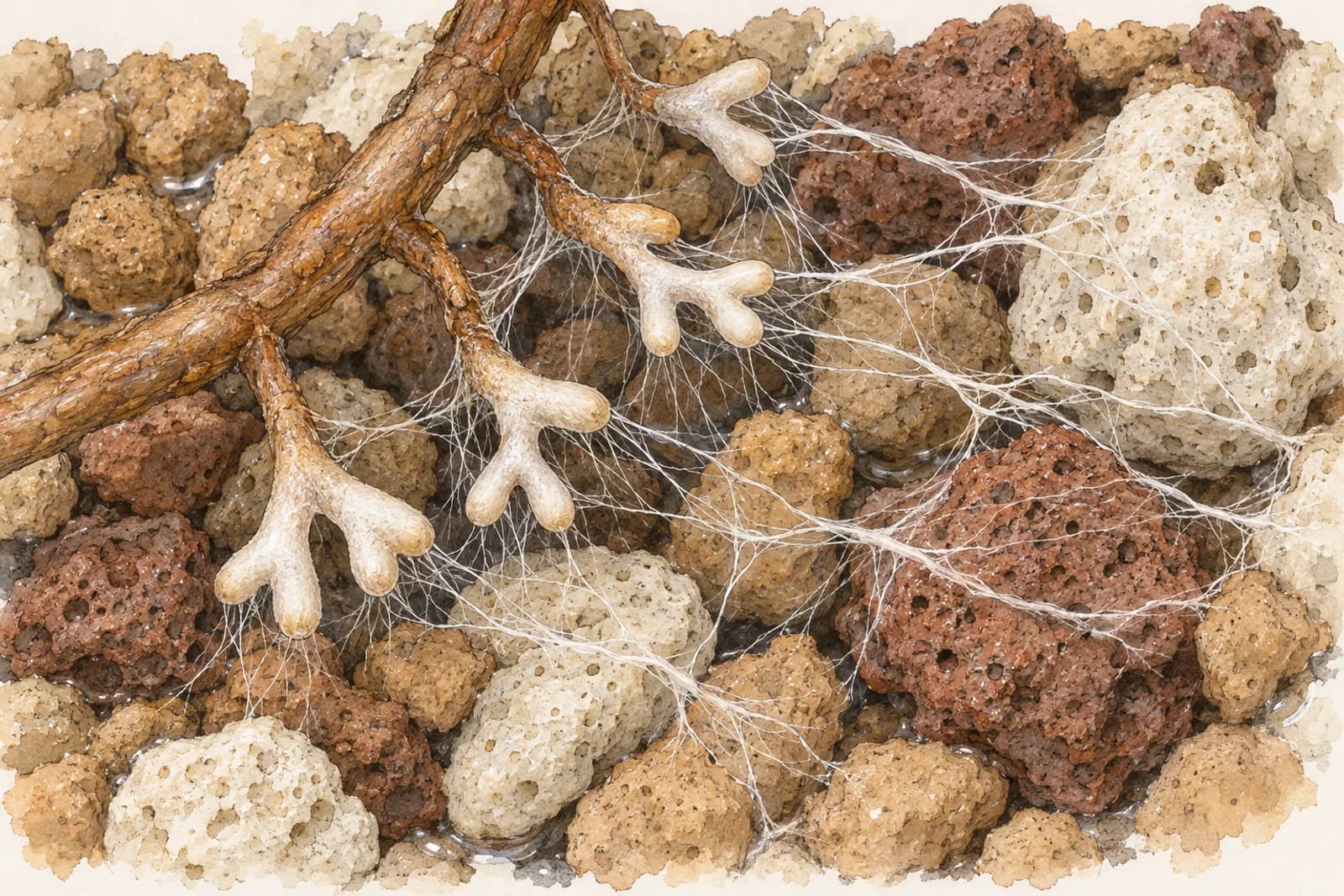
The partners need oxygen and the tree's sugar too, so whatever harms roots, such as waterlogging, harms them as well. They help most where nutrients, especially phosphorus, are scarce, and often less in a pot that is fed regularly.
When fertilizer cannot help
Those four steps now have mechanisms behind them. The last also needs sugar, because new shoots and leaves are built mostly from the carbohydrates of photosynthesis. This is the limiting factorWhichever necessary resource or condition, such as light, water, carbon dioxide, temperature, or a mineral nutrient, is in shortest supply and so caps how fast a process like photosynthesis can go. Adding more of anything else brings little benefit until it is addressed.Open the glossary idea from Lesson 6, where whatever is scarcest sets the pace, applied to the whole route from bag to branch.
Predict first
Absorption. Roots saturated for days are short of oxygen, so they cannot respire enough to power much uptake, and fine roots die back. The extra fertilizer could not get past that stage; held in the pot by the tray's water, it built up as salts that made water harder to absorb, stressing roots already struggling. Dying roots and salt stress together likely explain the brown leaf edges, and evaporating water left the white crust. The fix starts with the tray, not the fertilizer.
Test your prediction: press Fed, waterlogged, find where the band pinches, then set Fertilizer to Far too much to recreate the maple. Next, try four single changes, pressing Healthy and fed before each one:
- Fertilizer to None
- Substrate pH to Alkaline
- Root-zone temperature to Cold
- Light at the leaves to Low
Each time, read the bottleneck and the Fertilizer? answer.
Simulation
From fertilizer to new growth
The flow
No bottleneck
Nutrients are supplied, dissolved, absorbed, and used for growth.
Fertilizer? Far more fertilizer would make growth worse: the extra salts would stress the roots.
Stage 1: Supplied
FlowingFertilizer applied at the rate on its label puts mineral nutrients into the pot.
Stage 2: Dissolved and reaching roots
FlowingIons dissolve in the water films around particles and move toward the roots with the water and by diffusion.
Stage 3: Absorbed by roots
FlowingLiving root cells pump ions in through their membranes, powered by respiration. Fungal threads gather ions from beyond the root hairs.
Stage 4: Used for growth
FlowingLeaves in good light make sugars, so the tree can build new shoots and leaves with the minerals that arrive.
Text description
Four connected stages run from left to right (top to bottom on a narrow screen). Mineral ions, drawn as small magenta diamonds, flow through them along a band. Where a condition limits a stage, the band narrows and fewer ions get through: they queue before the narrowing, or, with no fertilizer, fewer are released at all; ions locked by pH turn grey where they stick. The narrowest stage is the bottleneck: it limits how much reaches growth, whatever is supplied before it.
- Supplied: fertilizer on the substrate puts mineral nutrients into the pot. With none added, only the little already in the substrate and water is available.
- Dissolved and reaching roots: ions dissolve in the films of water around substrate particles and move toward roots with the water and by diffusion. Dry substrate stops this, and it also leaves the tree short of water: root hairs shrivel, and leaves close their stomata and make less sugar. Substrate pH changes which nutrients stay dissolved: at high pH, iron and some phosphorus become locked in solid forms; in strongly acidic substrate, phosphorus, calcium, and magnesium become less available.
- Absorbed by roots: living root cells move ions in through transport proteins in their membranes, using energy from respiration. That needs oxygen, suitable warmth, and sugars sent down from the leaves. Roots saturated for days are short of oxygen; cold roots respire slowly; damaged roots have fewer working tips and root hairs; excess fertilizer salts make water uptake harder and can damage roots. Mycorrhizal fungi extend fine threads beyond the root hairs and add to uptake, especially of phosphorus; they matter most where nutrients are scarce, and in this model their absence narrows uptake only when nothing is fed.
- Used for growth: the tree builds the minerals into new shoots and leaves, which also takes sugars from photosynthesis. In low light the leaves make too little sugar, so minerals arrive but little new tissue is built; shoots often stretch long and thin, with small, sparse leaves. Salt stress also holds growth back, because it leaves the tree short of water.
More fertilizer helps only when supply is the narrowest stage. When the limit is somewhere else, more of the same fertilizer does not help, and far too much adds salt stress that makes growth worse. The growth response is shown in words, from very weak to good.
Only one change made feeding the answer: Fertilizer at None, where supply was the bottleneck. Everywhere else the narrowest stage lay downstream, so more of the same fertilizer could not help, and far too much made growth worse, as it did for the maple. Cold roots narrowed absorption. Alkaline substrate locked iron away; the usual remedies are correcting the pH or using a form of iron made to stay dissolved at high pH (Course 04 and Course 05). Low light moved the bottleneck to use for growth: with too little sugar to build with, extra fertilizer mostly stays in the pot as salts. Real trees often have several limits at once; fixing the narrowest reveals the next.
Practice check · not scored
The bonsai decision
Check the roots and light before the fertilizer
Starting point
Feed a healthy, actively growing tree at the rate and interval on its fertilizer's label, and note each feeding (Course 05). When a tree grows weakly, check these before reaching for more or stronger fertilizer:
- The root zone. Is it staying soaked or drying out below the surface? Does a tray hold drained water against the pot?
- The roots you can see at the drainage holes. Firm fine roots are a good sign; soft, mushy ones whose outer layer slides off are a warning.
- The light, judged against what that kind of tree needs.
- Recent work, such as repotting or heavy pruning, and pests or disease on leaves and shoots.
Correct what you find before changing the feeding.
This assumes
- You know what the tree is and roughly what light and seasonal conditions it needs (Course 02, Choosing a Tree and Creating Its Growing Environment).
- It is in its growing season, not resting in winter or recovering from root work.
- The pot drains, and you can check moisture below the surface.
Change course if
- A soaked root zone or soft, mushy roots: fix drainage and moisture first, and hold off feeding until new growth shows the roots are working again (Course 07).
- New leaves yellow between green veins while older leaves stay green: high pH locking up iron is one possible cause, especially with hard tap water. Check pH before adding more of the usual fertilizer, which will not fix it (Course 04).
- Leaf edges browning, or wilting in moist substrate, after regular or heavy feeding: suspect salts, pause feeding, and look into rinsing them out with plenty of plain water (Course 03). A white crust alone, on a tree growing well, mostly shows minerals building up; keep watching.
- Every check is clear, yet new growth stays weak or pale for weeks: a nutrient shortage becomes a reasonable suspect, though a missed pest or disease is still possible.
Back to the question
Why might fertilizer fail to improve growth?
Fertilizer only puts mineral nutrients into the pot. To become new growth, they must dissolve and reach the roots, be absorbed by living roots powered by respiration, and be built into new tissue with sugar made in good light. When a later step is the bottleneck, such as waterlogged, cold, or damaged roots, a pH that locks a nutrient away, or too little light, more of the same fertilizer cannot get past it, and the excess builds up as salts that can harm roots, as it did for the maple.
Key takeaways
- Roots absorb mineral nutrients as dissolved ions, delivered by moving water, diffusion, and root growth. - Much of that uptake is active transport powered by respiration, so it needs living fine roots, oxygen, sugar, and suitable warmth. - Moisture, pH, and salts decide what is available; fungal partners extend the roots' reach. - Supplying, absorbing, and using a nutrient are separate steps. More fertilizer helps only when supply is the bottleneck; far too much adds salt stress. - When a tree struggles, check its roots, moisture, light, recent work, and pests before its fertilizer.
Optional · not required for completion
Read a fertilizer label
Find any fertilizer you have. Its label gives three numbers, such as 10-10-10: the percentages of nitrogen, phosphorus, and potassium, in that order. Many countries count the last two as phosphate and potash, which overstates the actual phosphorus and potassium (Course 05 will explain). Note any other nutrients listed and the directions: how much, how often, and for which plants.
The label describes supply, the first of the four stages, not whether a tree's roots can absorb it or its leaves have the light to use it.
No fertilizer at home? Look up any fertilizer's label on its maker's or a store's website.