Course 01 · Lesson 7 of 14 · Resources and transport
Respiration: powering living cells
Every living cell in a tree spends carbohydrates through respiration, day and night, and needs oxygen to do it. See why roots in a pot that stays waterlogged can run short of oxygen while surrounded by water.
The question
Why can roots struggle in persistently saturated media?
By the end of this lesson, you will be able to:
- Explain that respiration releases energy from carbohydrates in all living tissues, during both day and night.
- Compare where and when photosynthesis and respiration take place.
- Explain why poorly aerated, persistently saturated media can deprive roots of oxygen even though water is plentiful.
About 15 minutes to read and explore
Here is an instructional example. A ficus arrives as a gift in a glossy glazed pot with no drainage hole. Its owner waters whenever the surface looks dry, which is every day or two. A few weeks later the leaves droop, yellow, and begin to drop. Yet the pot is heavy, and the soil a finger's depth down is soaked. The tree is surrounded by water and behaving as if it had none.
To see why, follow the other half of the carbohydrateSugars and the larger compounds built from them, such as starch and cellulose, all made of carbon, hydrogen, and oxygen. Trees make their own carbohydrates from carbon dioxide and water using light energy, then use them as both building material and fuel.Open the glossary story. Lesson 6 showed how leaves make sugar. This lesson is about how every living cell spends it, and about the one ingredient that spending depends on: oxygen.
How living cells spend sugar
The sugar made by photosynthesisThe process in which green plant cells use light energy to combine carbon dioxide from the air with water, making sugars and releasing oxygen. It is how a tree makes the carbohydrates that it builds with and runs on.Open the glossary goes three ways. Some is spent as fuel, some is built into new cell walls and wood, and some is stored, mostly as starch, in living cells of the roots, trunk, and branches.
respirationThe process in which living cells break down sugars using oxygen to release energy they can use, giving off carbon dioxide and water. It runs in every living cell of a tree, in leaves, stems, buds, and roots, both day and night. Without oxygen, cells fall back on fermentation.Open the glossary is how a living cell spends sugar for energy. The cell breaks sugar down step by step, uses oxygen to finish the job, and gives off carbon dioxide and water:
sugar + oxygen → carbon dioxide + water + usable energy
Most of this work happens inside mitochondrionA tiny structure (plural: mitochondria) inside nearly every plant and animal cell where respiration releases most of the usable energy from sugars, using oxygen. Every living cell in a tree relies on its mitochondria, including root cells that never see light.Open the glossary, tiny structures found in nearly every living cell. The energy they release is captured in ATPShort for adenosine triphosphate, a small molecule that carries usable energy within cells. Respiration makes ATP from the energy in sugars, and cells spend it to grow, repair themselves, and take up mineral nutrients.Open the glossary, a small molecule that carries energy in convenient amounts to wherever the cell needs it. On paper, respiration looks like photosynthesis run backward, but it is a separate process with its own machinery, and it needs no light.
That energy pays for growth at shoot tips, root tips, and the vascular cambiumA layer of dividing cells, only a few cells thick, between the wood and the inner bark. It adds new xylem on its inner side and new phloem on its outer side, which is how trunks, branches, and roots grow thicker.Open the glossary; for upkeep, replacing worn proteins and membranes even when nothing seems to be happening; for uptake and transport, pulling mineral nutrients into roots (Lesson 10) and keeping sugar moving through the inner bark (Lesson 9); and for defense, such as making resin.
Every living cell, day and night
Respiration runs wherever cells are alive: in leaves and buds, in the cambium and inner bark, in living cells threaded through the sapwood, and in every root, down to the finest root tip. Most wood cells, nearly all of the corky outer bark, and heartwood, where a tree has it, are dead and do not respire (Lesson 3).
Cells hold only a small stock of ATP, so they keep making more around the clock, in sun and in darkness, in summer and in winter. Respiration slows in the cold, but in a living tree it never stops.
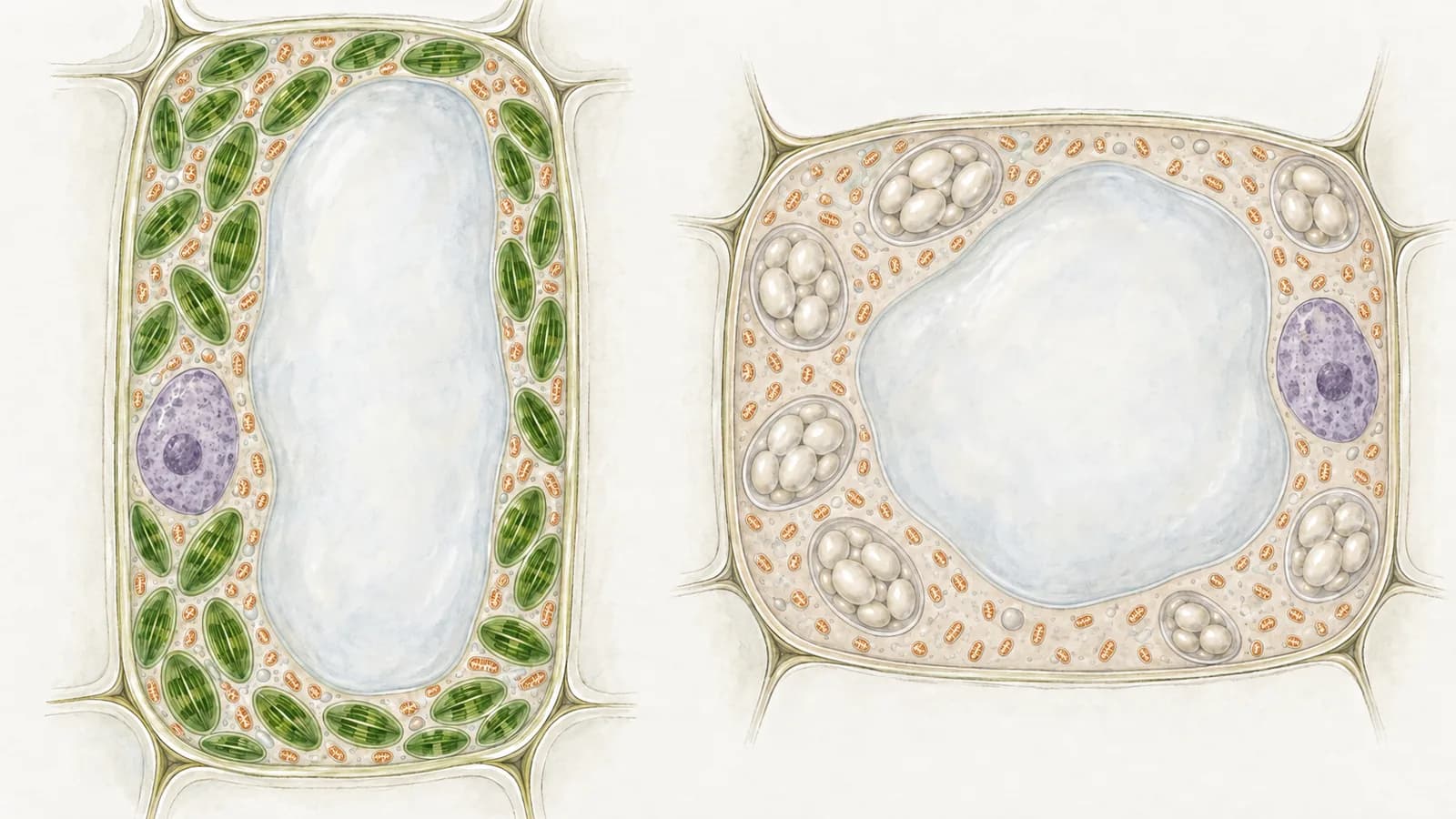
Go deeper · optional, not assessedInside the mitochondrion
As a chemical equation: C₆H₁₂O₆ (glucose) + 6 O₂ → 6 CO₂ + 6 H₂O, with the energy released captured as ATP and some lost as heat.
The first stage, glycolysis, splits glucose outside the mitochondria and yields a little ATP without oxygen. Inside the mitochondria, later stages break the pieces down to carbon dioxide and pass electrons along a chain of proteins, with oxygen accepting them at the end to form water. Without oxygen the chain stops, and the cell is left with glycolysis, kept running by fermentation, which produces ethanol or lactic acid. Respiration with oxygen yields about 30 ATP per glucose molecule; fermentation yields 2.
Making and spending, side by side
Photosynthesis and respiration run in the same tree on the same day, but not in the same places or at the same times:
| Photosynthesis | Respiration | |
|---|---|---|
| Where | Green tissue with chloroplasts, mostly leaves and needles | Every living cell: leaves, buds, the living layers of trunk and branches, and roots |
| When | Only in light | All the time, in light and in darkness |
| Uses | Carbon dioxide and water, with energy from light | Sugar and oxygen |
| Produces | Sugar and oxygen | Carbon dioxide, water, and usable energy (ATP) |
| Sugar supply | Adds to it | Draws on it |
In a sunlit leaf, both happen at once. The chloroplasts use far more carbon dioxide than the leaf's mitochondria give off, so overall the leaf takes in carbon dioxide and releases oxygen, and its respiration is hidden. At night only respiration remains, and in most trees the same leaf then takes in oxygen and gives off carbon dioxide.
Roots in the dark substrateThe material that fills a container and surrounds a tree's roots, such as a mix of mineral grit, bark, or soil. Its job is to anchor the roots and to hold water, mineral nutrients, and air in a balance the roots can use.Open the glossary never photosynthesize, and the woody trunk, branches, and buds make little or none of their own sugar. They run on sugar sent from the leaves and on reserves stored earlier. So a tree's carbohydrate supply is a running balance: photosynthesis adds to it in daylight, respiration draws on it every hour, and only what is left over can go into growth and storage.
The simulation opens at midday on a sunny day. Compare the two meters in the sugar ledger, then press Replay to run the day from midnight to midnight, watching the What each part is doing list after sunset: does any part stop respiring? Then turn on Cloudy week, Warm night, and Leaves removed one at a time, switching the previous one off, and press Replay each time to run the whole day.
Simulation
Making and using sugar, day and night
Midday12:00 p.m.
Full sunWarm air
The leaves make far more sugar than the whole tree uses, so the supply is building.
The sugar ledger, right now
Higher than at midnight. The supply is building.
What each part is doing
LeavesPhotosynthesizing and respiring
PhotosynthesisRespiration
Photosynthesis takes in far more carbon dioxide than respiration gives off, so overall the leaves take in carbon dioxide and give off oxygen.
BudsRespiring
No photosynthesisRespiration
Living bud tissue uses sugar from the leaves and from stored reserves.
Trunk and branchesRespiring
Little or noneRespiration
The living cells (cambium, inner bark, and living sapwood) respire day and night. The inner bark also carries sugar to where it is used.
RootsRespiring
No photosynthesisRespiration
Roots in the dark substrate never photosynthesize. They depend on sugar sent from the leaves and on stored reserves, and they take oxygen from air in the pore spaces.
Text description
A trident maple bonsai stands on a bench outdoors, its pot cut away to show the roots in the substrate. A clock runs through one day, from midnight to midnight, with sunrise at 6 a.m. and sunset at 6 p.m. Beside the tree, a ledger compares the sugar being made by photosynthesis with the sugar being used by respiration, in words from none to very high, and charts the tree's carbohydrate supply through the day.
Photosynthesis happens almost entirely in the leaves, and only in light. In daylight, carbon dioxide moves from the air into the leaves and oxygen moves out. From sunset to sunrise there is no photosynthesis; twilight is too dim for the leaves to make more sugar than they use.
Sugar moves through the inner bark day and night. By day, newly made sugar travels from the leaves to the buds, trunk, and roots. At night the leaves keep sending out sugar, more slowly, from starch they stored during the day. With the leaves removed, stored reserves move up the trunk toward the buds.
Respiration never stops. Living cells in the leaves, buds, trunk and branches (the cambium, inner bark, and living sapwood), and roots take in oxygen, break down sugar for energy, and give off carbon dioxide, every hour of the day and night. It runs faster in warm air. Roots in the dark substrate never photosynthesize; they depend on sugar from the leaves and on stored reserves, and they take oxygen from air in the spaces between particles.
In bright daylight, photosynthesis in the leaves far outpaces their respiration, so overall they take in carbon dioxide and give off oxygen. The tree makes far more sugar than it uses, and its carbohydrate supply builds. Near dawn and dusk, production and use roughly balance and the supply holds steady. At night the tree only uses sugar, so the supply draws down. On a sunny day with a cool night, the day ends with a surplus that can go into growth and storage.
- Cloudy week: less light reaches the leaves, so they make less sugar. The day ends about even, with little to spare.
- Warm night: respiration runs faster through the night, so the supply draws down faster and the day's surplus is smaller.
- Leaves removed: no sugar is made even in full sun. Buds, trunk, and roots keep respiring on stored reserves, so the supply draws down all day and night and the day ends in deficit.
- Cloudy week and warm night together: the day ends in deficit.
At midday the leaves made sugar far faster than the whole tree spent it. Through the night nothing was made while every part kept respiring, so the supply drew down. The sunny day still ended with a surplus for growth or storage.
A warm night spent more of that surplus. Like most chemistry in living cells, respiration speeds up with warmth: over ordinary growing temperatures, many plant tissues respire roughly twice as fast with each rise of about 10 °C (18 °F), and near freezing it slows to a crawl. A cloudy week left the day about even. With the leaves removed, nothing was made even in full sun, yet buds, trunk, and roots kept spending, so the day ended in deficit, paid for from stored reserves. Losing much of the foliage to pests or hail has a similar effect, and it does not end the moment new leaves appear: growing them draws on reserves too, until they are large enough to export sugar (Lesson 9).
Practice check · not scored
Where roots get their oxygen
Growing root tips, root hairs, and root cells taking up mineral nutrients all run on respiration, so roots need oxygen as steadily as they need water. In most trees, oxygen made in the foliage does not travel down to the roots in useful amounts. Roots depend on the air around them.
As Lesson 2 showed, that air sits in the pore spaceThe gaps between particles in soil or substrate, which hold water, air, or both. Large pores usually drain and refill with air after watering while small pores hold water, so the mix of pore sizes sets how wet and how airy a root zone stays.Open the glossary of the substrate, the growing medium (plural, media). After watering, the larger pores of a well-drained pot empty and refill with air, linked in passages to the surface, so oxygen keeps diffusing in as roots use it. This supply is called aerationThe supply of air, especially oxygen, to roots through air-filled pore spaces, and the exchange of gases between those spaces and the open air. Roots need good aeration because their living cells use oxygen constantly.Open the glossary.
Water-filled pores cannot do that job. Water holds far less oxygen than the same volume of air, and oxygen moves through it roughly ten thousand times more slowly.
Go deeper · optional, not assessedTrees that tolerate wet roots
A few trees of swamps and floodplains, such as bald cypress, can form spongy tissue with open air channels that carry some oxygen down toward their roots, and their roots cope with low oxygen better than most. Most trees grown as bonsai lack these adaptations, so how much wetness your own tree tolerates is worth finding out before you trust it to a wet pot.
When the pores stay full of water
A medium is saturatedDescribes soil or substrate whose pore spaces are completely filled with water, leaving little or no air. Brief saturation right after watering is normal in a pot that drains; saturation that lasts starves roots of oxygen.Open the glossary when water fills all of its pores. A thorough watering fills most of a pot's pores for a short time. In a pot that drains, that brief saturation is normal: as the excess runs out, it draws fresh air into the larger pores behind it.
Predict first
The root tips. Within about a day they run short of oxygen and are stressed while the leaves still look normal. The foliage dulls, droops, or yellows only after many roots have stopped working, so by the time a tree wilts in a wet pot, the damage below is already well under way.
When saturation lasts, a chain of events follows:
- Roots and soil microbes use up the oxygen dissolved in the water within hours to a day or so, sooner in warm weather, when they use it faster and the water holds less of it. The root zone falls into hypoxiaAn oxygen supply too low for cells to respire normally. In containers it most often affects roots when the substrate stays saturated, because oxygen moves through water roughly ten thousand times more slowly than through air.Open the glossary, too little oxygen for cells to respire normally, and in places becomes anaerobicWithout oxygen, or describing a process or organism that works without it. A root zone that becomes anaerobic forces roots to rely on fermentation. The waterlogging that usually causes it also favors some root-rot organisms, such as water molds, which attack the weakened roots.Open the glossary, with no oxygen at all.
- Root cells fall back on fermentationA way of releasing energy from sugar without oxygen, which yields far less usable energy than respiration with oxygen and produces byproducts that can harm cells as they accumulate. Roots in persistently saturated media fall back on it and can run short of energy.Open the glossary, a way of getting energy from sugar without oxygen. It yields only a small fraction of the energy, and its byproducts can harm cells as they build up.
- Short of energy, root tips stop growing and begin to die back, followed by the fine roots behind them.
- With fewer working roots, the tree takes up less water and fewer mineral nutrients. The foliage can wilt, yellow, or drop, even though the pot is wet.
- Some root-rot organisms, including water molds, thrive in waterlogged media and readily attack weakened roots.
Watch that chain in the simulation. It opens with the free-draining pot: press Water thoroughly and let the week play, then set Time since watering back to 1 hour and look at the magnified root tip. Next, choose No drainage hole, press Start over, and step through the week with Next, watching the Oxygen meter, the Root tip scale, and the Foliage row. Then try Pot in a saucer of water and Compacted, fine soil the same way, and finally turn on Warm weather.
Simulation
Air and water in the root zone
Free-draining pot · Mild weather
Before watering
Around the circled root tip
- Healthy
- Stressed
- Dying back
What is happening
- Before wateringThe coarse medium is moist: films of water cling to every particle, and the larger pores hold air. Roots take in oxygen from that air.
Free-draining pot, mild weather. Before watering. Water around the root tip: Moist. Oxygen: High. Root tip: Healthy. Foliage: Looks normal.
Text description
A bonsai pot is shown in cross-section, with its tree above and its roots spread through the substrate. A circle marks one fine root tip near the bottom of the pot, and a magnified view shows that tip among the substrate particles: water films around the particles, air in the larger gaps (pores), and oxygen moving through the air to the root. Saturated medium, where water fills every pore, is shaded blue; in the magnified view, water films around particles are outlined in pale blue. Each pot starts moist and airy, is watered thoroughly once, and is then followed for a week: just watered, after 1 hour, 1 day, 3 days, and 1 week.
- Free-draining pot: the excess water runs out of the drainage hole within the first hour. Air is drawn back into the larger pores while films of water stay around the particles, so oxygen around the root tip returns to high and the tip stays healthy all week. The pot slowly dries.
- Pot in a saucer of water: the pot stands in a deep saucer, and water drained into it rises above the bottom of the pot. Inside the pot, the pores fill up to that level and a little above it, so the lowest part stays saturated for as long as the water stands. Around the root tip there, oxygen falls from low to very low within about a day. The tip is stressed after a day and dying back after about three days. The foliage may later look dull or limp.
- No drainage hole: the water sinks through the medium and collects in the lower half of the pot, where it cannot leave, so that half stays saturated all week while the surface dries and can look as if it needs water. Oxygen around the tip runs very low within a day; the tip is stressed after a day and dying back by three days. Roots short of oxygen take up water poorly even before they die, so the foliage looks dull by three days, and with many fine roots lost, the tree wilts or yellows by the end of the week, even though the pot is wet.
- Compacted, fine soil: water soaks in and drains slowly, and the small pores keep holding water, so the lower part stays nearly saturated for about a day and the soil holds less air than a coarse medium even when drained. In mild weather the root tip is stressed after a day, then recovers once air has returned, without dying back.
Warm weather makes roots and soil microbes use oxygen faster, and warm water holds less of it. In the pots that stay saturated, oxygen runs out within hours and root tips die back sooner: by about one day with a saucer or no drainage hole, and by about three days in compacted soil. In the free-draining pot the roots stay healthy either way.
Watering filled most of the pores in every pot; what differed was how long they stayed full. The free-draining pot shed its excess within the hour, air returned to the larger pores, and the root tip stayed healthy all week. In the saucer and no-hole pots, the bottom stayed saturated, oxygen at the tip fell to very low within a day, and the tip was stressed while the foliage still looked normal. It was dying back by three days, and only then did the leaves dull, droop, or yellow.
The no-hole pot is the gift ficus's trap: its surface dried and looked thirsty while its lower half stayed saturated, so each new watering added to the problem. Compacted soil drained slowly, held less air even once drained, and left its root tip stressed for a time. Warm weather sped up every harmful change.
Pots that stay waterlogged
The simulation's three problem pots are common. Many decorative glazed pots and outer covers have no drainage hole. A saucer, tray, or outer pot that collects drained water keeps the bottom of the pot wet from below. And garden soil packed into a pot, or old substrate whose particles have broken down, is mostly tiny pores that hold water and leave little room for air (Course 04, Soil, Substrates, and the Root Environment).

What growers call overwatering is rarely about how much water is poured at once. It is about a root zone that stays wet so constantly, or drains so poorly, that air never gets back in.
Practice check · not scored
Wilting has other causes too, from a dry root zone to hot, windy weather. Lesson 8 explains them, and why the root zone, not the leaves, tells you whether to water.
The bonsai decision
Water is only half of what roots need
Starting point
Make sure water can leave the pot and air can come back in: an open drainage hole, nothing holding water around the base, and a medium that drains freely instead of pooling. Then water when a check below the surface (Lesson 2 describes how) shows the root zone needs it, rather than on a fixed schedule. Course 03, Watering and Daily Observation, will go further.
This assumes
- The tree is established and healthy, and not recently repotted. - It grows in an open, coarse bonsai mix in a pot with at least one drainage hole.
Change course if
- The pot has no drainage hole: no watering routine can fix this. Check moisture deep in the pot before adding any water, and plan a move to a pot that drains (Course 11, Repotting and Root Development). - Water stands in a saucer, tray, or outer pot: empty it after watering, or raise the pot above the water on gravel or a grid. - Water pools on the surface, or the pot stays wet for days in warm weather while the tree is in leaf: the medium may be too fine, compacted, or broken down (Course 04). Even a sound medium dries slowly in cool weather, in shade, while a deciduous tree is bare, or when roots are already damaged. - The tree wilts or yellows while the medium is wet: do not water. Check drainage and the lower root zone, and investigate possible root damage (Course 07, Tree Health and Diagnosis). - The weather turns hot: waterlogging harms roots faster, and draining pots dry faster, so check more often.
Back to the question
Why can roots struggle in persistently saturated media?
Roots are living cells that respire constantly, so they need oxygen as surely as they need water, and they get it from air in the pore spaces of the substrate. When a medium stays saturated, water fills those spaces, oxygen moves through it about ten thousand times more slowly than through air, and roots and microbes use up what little is dissolved. Root tips fall back on fermentation, run short of energy, and die back, so the tree takes up less water and can wilt in a pot that is still wet.
Key takeaways
- Respiration breaks down sugar with oxygen to release usable energy (ATP) in every living cell, from leaves to root tips, day and night. - Photosynthesis happens only in green tissue and only in light; growth and storage come from what is left after respiration. - Warmth speeds respiration, so warm nights spend more sugar and warm roots use oxygen faster. - Roots take oxygen from air in the pore spaces. Lasting saturation, from a pot with no hole, standing water, or a compacted medium, starves them of it. - Brief saturation after watering is normal in a pot that drains. Wilting in a wet pot calls for investigation, not more water.
Optional · not required for completion
Where does the water linger?
Poke several holes in the bottom of one clear plastic cup and leave a second cup intact. Fill both with the same substrate or garden soil, set the holed cup on two pencils laid across an empty bowl so it can drain, and pour the same amount of water into each, enough that some runs out of the holes.
Look through the sides after an hour, a day, and three days: saturated medium looks darker and glistens, with no air gaps. Where does water linger in each cup? A third holed cup of fine garden soil lets you compare it with a coarse bonsai mix.
No tree is needed, and none should be used.