Course 01 · Lesson 11 of 14 · Growth through time
From seed to seedling
A seed carries a tiny plant and a packed lunch. Follow germination from dry seed to self-supporting seedling, and learn why water alone is not enough and why a healthy seed can wait in good conditions.
The question
Why does a seed need more than water to become a tree?
By the end of this lesson, you will be able to:
- Identify the parts of a seed and explain how stored reserves fuel early growth.
- Explain the conditions germination requires and distinguish germination from dormancy.
- Explain why establishing a seedling begins a long process, making seed an option rather than a starting requirement for bonsai.
About 15 minutes to read and explore
Here is an instructional example: a bonsai starter kit arrives as a gift, with a small pot, a bag of seed mix, and a packet of seeds with a tree's name on the front. Its new owner soaks the seeds, sows them, and keeps the mix moist on a warm windowsill, exactly as the directions say. Weeks pass, and nothing comes up.
Were the seeds dead? Possibly. But a healthy seed can also sit in moist mix and refuse to grow. A seed is alive and waiting: for water, for air, for the right temperature, and sometimes for a signal, such as a long spell of winter cold.
What is packed inside a seed
A seedA small package a plant produces to start a new generation, containing a living embryo, stored reserves to fuel its first growth, and a protective outer coat. There are no special bonsai seeds; kits contain ordinary tree seeds.Open the glossary is a young plant in a protective package, with enough food to get it started. Every tree seed packs three things:
- The seed coatThe protective outer layer of a seed, which shields the embryo from drying, injury, and decay. In some seeds it is hard and waterproof, so water cannot enter until it is cracked, worn, or broken down.Open the glossary, a tough outer layer that shields the inside from drying, injury, and decay.
- The embryoThe tiny, partly formed young plant inside a seed, with a first root, a short stem, a shoot tip, and one or more seed leaves. It is alive but largely inactive until germination.Open the glossary, a tiny, partly formed plant. It already has a young root called the radicleThe young root of a seed's embryo, usually the first part to emerge during germination. It grows downward to become the seedling's first root.Open the glossary, a short stem called the hypocotylThe short stem of a seedling between its young root and its seed leaves. In many trees it lengthens as a hook that pulls the seed leaves up through the soil, then straightens.Open the glossary, a shoot tip from which the young stem and its leaves will grow, and one or more seed leaves, called cotyledonOne of the first leaves of a plant, already formed in the embryo, which may store reserves or absorb them from surrounding tissue. Maples have two and pines often have several; in many trees they emerge, turn green, and photosynthesize.Open the glossary.
- A store of food: starch, oils, and proteins the embryo will live on until its leaves can make sugar in the light.
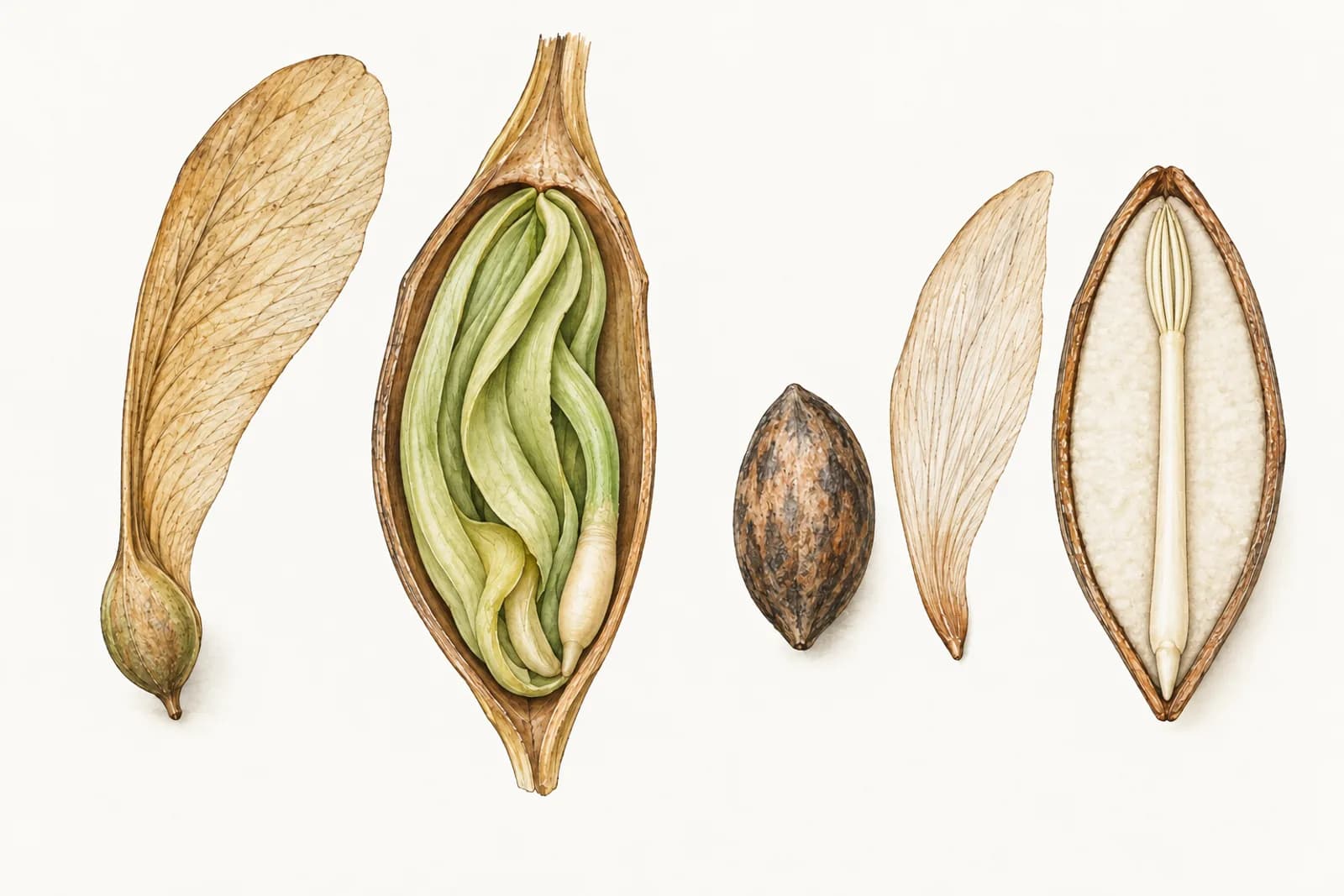
Where that food is kept depends on the plant. In a maple, the two long, folded cotyledons hold it themselves. In many other flowering plants, such as wheat and corn, it sits beside the embryo in a separate tissue called endospermA tissue in many flowering-plant seeds that stores reserves and supplies them to the embryo during germination. Some seeds, such as maples, keep their reserves mainly in the cotyledons instead, and pine seeds hold theirs in a similar storage tissue.Open the glossary. A pine seed wraps its embryo in a pale nutritive tissue full of stored food, and the embryo has a ring of several seed leaves, often five or more.
Go deeper · optional, not assessedFruits, naked seeds, and where the seed leaves go
A maple's winged “seed” is a fruit: the wing and the hard wall around the seed grow from the flower's ovary, and the true seed coat is a thin layer inside. Conifers have no flowers or fruits. Their ovules, the structures that become seeds, sit exposed, usually on cone scales, rather than sealed inside an ovary, which is what gymnosperm, “naked seed,” means. Even a juniper's berry-like cone is made of scales that fuse around the seeds. A pine's nutritive tissue is often called endosperm, but it forms before fertilization, as part of the female gametophyte, whereas a flowering plant's endosperm forms at fertilization.
Seed leaves also go to different places. Maples and pines lift theirs into the light to photosynthesize. Oaks leave theirs inside the acorn below ground, feeding the shoot that grows up from between them. An oak seedling's first green leaves are true leaves, and the acorn's store goes on feeding it after they open.
A green seed leaf is not proof that it has seen light. Many maple embryos are already pale green inside the seed, and pine seedlings can make chlorophyll in darkness. What every seedling needs light for is photosynthesis, and light is also a signal: it tells a seedling that has reached the surface to stop stretching, straighten up, and open its seed leaves.
Germination, step by step
germinationThe process in which a seed's embryo resumes growth and breaks out of the seed, beginning with water uptake and usually marked by the young root emerging. It needs water, oxygen, and a suitable temperature, and some seeds also need light, darkness, or a dormancy treatment first.Open the glossary is the process in which the embryo resumes growth and breaks out of the seed. Germination and the growth that follows run in a consistent order:
- The seed takes up water. A dry seed holds so little water that its cells are nearly inactive, which is how it can wait for months. Now it soaks up water and swells, a step called imbibitionThe first step of germination, when a dry seed soaks up water and swells. In a living seed this restarts metabolism, but the uptake is largely physical, so a dead seed can swell too. A seed with a hard, waterproof coat cannot take up water this way until the coat is cracked or worn.Open the glossary.
- Its cells restart. Respiration resumes, at first using small amounts of sugar already in the seed; once growth begins, the main store is broken down into sugars and other building blocks. Respiration needs oxygen (Lesson 7), so a waking seed needs air as well as water.
- The root comes out first. The radicle pushes through the seed coat and grows down, anchoring the young plant and taking up water. Botanists usually count germination as complete here; what follows is the growth of a seedlingA young plant raised from seed, especially in its early, fragile stages after germination. Years usually pass before a seedling has a trunk worth styling, which is why growing from seed is a long-term option rather than a starting requirement.Open the glossary.
- The stem pushes up. In many trees, the hypocotyl grows upward bent into a hook, so the bend, not the delicate shoot tip, leads the way through the soil.
- The seed leaves open. Above ground, the hook straightens, and the cotyledons spread in the light and begin photosynthesis (Lesson 6).
- True leaves follow. The shoot tip between the seed leaves makes true leafOne of the leaves a seedling's shoot tip forms after its seed leaves, usually closer in shape to the plant's typical foliage. Young true leaves import sugar at first and export it once they mature. Many seedlings come to rely more on their own photosynthesis than on seed reserves around the time true leaves appear, though the timing varies by species.Open the glossary, the first leaves with the form of the plant's later foliage.
Until its first green leaves reach light (in maples and pines, the seed leaves), every new cell of root and stem is paid for from the seed's stored food, its packed lunch. Watch that handover in the interactive: on the Sugar supply chart, when does each line rise or fall, and where do they cross? Compare the Pine-like seed, then try Order it without looking back at the list.
Interactive
From seed to seedling, stage by stage
Stage 1 of 7
Dry seed
Alive, resting, and waiting
A dry seed is alive but almost inactive. Inside its protective seed coat is an embryo, a tiny plant with an embryonic root, a short stem, and seed leaves, with a store of food held in its seed leaves or in a tissue around it. It can stay like this for months. Taking up water starts germination, though some seeds will not go on to grow until they have spent a long period cold and moist.
Maple-likeIn this maple-like seed, the food is stored in two long, folded seed leaves that fill most of the seed.
Depends on now
- Water Waiting for it
- Oxygen Not yet
- Suitable temperature Not yet
- Light for making sugar Not yet
Stored food
Sugar for growth now
Sugar supply
Put the stages in the order they happen, from the resting seed at the top to the established seedling at the bottom. Use the arrow buttons to move a card.
Position 1: Established seedling
Its own leaves now supply most of its sugar; the stored food is nearly gone.
Position 2: Dry seed
The embryo rests inside its coat with its store of food.
Position 3: First true leaves
Leaves with the plant's own leaf form grow from the shoot tip.
Position 4: Cotyledons open
Seed leaves rise above the soil, spread apart, and catch the light.
Position 5: Radicle emerges
An embryonic root breaks through the coat and grows downward.
Position 6: Imbibition
The seed soaks up water, swells, and restarts respiration.
Position 7: Hypocotyl hook
A bent stem pushes up through the soil, pulling the seed leaves behind it.
Dry seed: Alive, resting, and waiting.
Text description
A cutaway view of soil with a seed sown below the surface. You can follow a maple-like seed with two seed leaves that hold its stored food, or a pine-like seed with several needle-like seed leaves inside a nutritive tissue. The seed passes through seven stages:
- Dry seed (alive, resting, and waiting). A dry seed is alive but almost inactive. Inside its protective seed coat is an embryo, a tiny plant with an embryonic root, a short stem, and seed leaves, with a store of food held in its seed leaves or in a tissue around it. It can stay like this for months. Taking up water starts germination, though some seeds will not go on to grow until they have spent a long period cold and moist. Maple-like seed: In this maple-like seed, the food is stored in two long, folded seed leaves that fill most of the seed. Pine-like seed: In this pine-like seed, the embryo lies in a pale nutritive tissue that holds the food, inside a hard seed coat. Stored food left in the seed: full. Sugar for growth drawn from stored food: none; made by photosynthesis: none. It depends on: water (waiting for it), oxygen (not yet), suitable temperature (not yet), light for making sugar (not yet).
- Imbibition (taking up water). The seed soaks up water and swells, a step called imbibition. Water reawakens its cells, and respiration restarts, at first using small amounts of sugar already in the seed. Respiration needs oxygen, which reaches the seed from air spaces in the soil. A seed in waterlogged soil has plenty of water but too little oxygen, and it can fail or rot. Maple-like seed: The coat softens and darkens as it takes up water. Pine-like seed: Water passes through the coat to the tissue inside. In some other kinds of seed, a hard, waterproof coat keeps water out until it is scratched or otherwise opened. Stored food left in the seed: full. Sugar for growth drawn from stored food: low; made by photosynthesis: none. It depends on: water (needed now), oxygen (needed now), suitable temperature (needed now), light for making sugar (not yet).
- Radicle emerges (the root comes first). The radicle, the embryo's root, pushes out through the seed coat and grows downward. The root comes first: it anchors the seedling and starts taking up water before any shoot appears. Botanists usually count germination as complete here; what follows is seedling growth. Fine root hairs form close behind the root tip, and the main store of food is now broken down and carried to the growing tips. Both seeds: It emerges from the narrow end of the seed, where the embryo's root tip was already pointing. Stored food left in the seed: most. Sugar for growth drawn from stored food: high; made by photosynthesis: none. It depends on: water (needed now), oxygen (needed now), suitable temperature (needed now), light for making sugar (not yet).
- Hypocotyl hook (pushing up through the soil). The hypocotyl, the stem between the root and the seed leaves, lengthens and pushes up through the soil bent into a hook. The bend leads the way, so the delicate shoot tip and seed leaves are pulled up behind it instead of being forced tip-first through the soil. Underground, in darkness, the seedling cannot photosynthesize yet, so its stored food pays for all of this fast growth. Maple-like seed: The seed leaves are still folded inside the seed coat. Pine-like seed: The seed leaves are still bundled inside the seed coat, absorbing the last of the nutritive tissue. Stored food left in the seed: some. Sugar for growth drawn from stored food: very high; made by photosynthesis: none. It depends on: water (needed now), oxygen (needed now), suitable temperature (needed now), light for making sugar (not yet).
- Cotyledons open (seed leaves reach the light). Above ground, the hook straightens and the cotyledons, or seed leaves, open. In the light they begin photosynthesis, so the seedling starts making new sugar of its own. That supply is still small, so it keeps drawing on what is left of its stored food. Maple-like seed: A maple's two seed leaves are long and strap-shaped and look nothing like its later leaves. The empty seed coat is left behind. Pine-like seed: A pine-like seedling spreads a ring of several needle-like seed leaves, often lifting the seed coat on their tips until it falls away. Stored food left in the seed: little. Sugar for growth drawn from stored food: moderate; made by photosynthesis: low. It depends on: water (needed now), oxygen (needed now), suitable temperature (needed now), light for making sugar (needed now).
- First true leaves (leaves of its own kind). The shoot tip between the seed leaves begins making true leaves, the first leaves with the form of the plant's later foliage. While young, they are fed sugar like any growing tip. Meanwhile the green seed leaves, now fully working in the light, supply more sugar than the shrinking store can. Maple-like seed: In a maple-like seedling they come as an opposite pair, with toothed edges more like the leaves to come. Pine-like seed: In a pine-like seedling, the first true needles grow singly from the shoot tip above the seed leaves. The bundled needles of an older pine come later. Stored food left in the seed: little. Sugar for growth drawn from stored food: low; made by photosynthesis: moderate. It depends on: water (needed now), oxygen (needed now), suitable temperature (needed now), light for making sugar (needed now).
- Established seedling (living on light). The seedling now makes nearly all of its sugar in its own leaves, its grown true leaves included, and its spreading roots take up water and dissolved minerals. Its stored food is all but gone: it has switched from living on a packed lunch to living on light. It is still fragile: drying out, poor light, stagnant air, and disease can all set it back, and years of growth lie ahead before it has a trunk worth shaping. Maple-like seed: The seed leaves often yellow and drop once the true leaves have taken over. Pine-like seed: The seed leaves often stay green for a long time alongside the new needles. Stored food left in the seed: nearly gone. Sugar for growth drawn from stored food: none; made by photosynthesis: high. It depends on: water (needed now), oxygen (needed now), suitable temperature (needed now), light for making sugar (needed now).
In the scene, water is shown as solid blue lines, oxygen as dotted teal lines, and sugars as dashed amber lines. From the moment the root emerges, a water line shows the root taking up water. A chart follows two sources of sugar for growth: sugar drawn from the seed's stored food, which rises as the seed wakes and then falls as the store runs out, and sugar made by photosynthesis, which stays at none until the seed leaves reach the light and then rises. The two lines cross around the time the first true leaves appear, although the young true leaves themselves still take in sugar at first; the green seed leaves are doing most of the work.
The Order it mode shuffles the seven stage names onto cards. Move each card up or down with its arrow buttons, then check the order. Feedback marks the cards in the right place and gives a hint about the first one that is not.
In both seeds the root led, and the photosynthesis line stayed at none until the seed leaves opened in the light. The lines crossed around the time the first true leaves appeared, but not because of them: young leaves are sinkAny part of a tree that uses or stores more sugar than it makes, such as growing shoot tips, young leaves, the cambium, roots, flowers, fruits, and storage tissues while they fill. Phloem carries sugar from sources toward sinks.Open the glossary that import sugar while they are small (Lesson 9). The green seed leaves, working in the light, had begun supplying more sugar than the dwindling store; the timing varies by species. That crossover is the turning point from living on a packed lunch to living on light. Notice, too, that a maple's two strap-shaped seed leaves look nothing like maple leaves.
Predict first
The deeply buried one. Until its first leaves reach light, all of its growth is paid for from the seed's stored food, and the deeper the seed, the longer its stem must grow in the dark. The food can run out before the shoot reaches the surface. This is one reason small seeds are usually sown shallowly; sowing depth itself belongs to Course 13, Propagation and Creating New Material.
Practice check · not scored
What germination needs
Water starts germination, but it is only one requirement. Germination needs the first three of these together, and some seeds also need the fourth:
- Water. Enough to soak in and to keep the seed moist while it grows; a seed that dries out after it has started can die.
- Oxygen, for respiration. Oxygen moves roughly ten thousand times more slowly through water than through air, so in waterlogged mix a seed can take up plenty of water and still fail or rot.
- A suitable temperature. Too cold, and the seed's chemistry runs too slowly for growth; it may wait until conditions warm. Too hot, and many seeds will not germinate, and some are damaged.
- Light or darkness, for some seeds. Some seeds, often small ones, germinate only after sensing light, which keeps them from starting too deep to reach the surface; a few are held back by light. This is light as a signal, separate from the light a seedling later needs to make sugar.
Dormant is not dead
Sometimes a seed has water, air, and warmth and still does nothing for months, like the seeds in the starter kit. It may be dead: a seed's viabilityWhether a seed is alive and able to germinate under the right conditions. Viability falls with age and poor storage, and some seeds, such as many acorns, die if they dry out.Open the glossary, its ability to germinate given the right conditions, falls with age and poor storage, and the acorns of many oaks die if they dry out.
Or it may be dormant. seed dormancyA state in which a living seed will not germinate, even in good conditions, until a specific requirement is met, such as a period of cold, moist conditions or a break in a hard seed coat. It differs from a seed failing to germinate because conditions are wrong.Open the glossary is a state in which a living seed will not germinate, even in good conditions, until a particular requirement has been met. A seed that fails only because conditions are wrong will go ahead once they are fixed; a dormant seed keeps waiting.
Dormancy protects a tree's offspring. Many temperate trees shed seed in autumn, and a seed that sprouted in the next warm spell would leave a tender seedling to face winter. Two kinds of dormancy are common in tree seeds:
- Dormancy in the embryo. The embryo is held back, often until it has spent a long period cold and moist, as it would through a winter outdoors. Growers imitate that winter with stratificationA pretreatment that holds seeds in moist conditions at a set temperature, most often cool but above freezing (cold stratification), for weeks or months to break the dormancy that many temperate tree seeds have. The needed length and temperature vary with species and seed source.Open the glossary: holding seeds moist and cool, usually a little above freezing, for weeks or months. The chill readies the embryo; germination usually follows once conditions warm.
- A hard, waterproof seed coat. Water cannot get in, so imbibition never starts. Growers use scarificationWeakening or breaking a hard, waterproof seed coat, for example by nicking it, rubbing it with sandpaper, or soaking it in hot water, so water can reach the embryo. It addresses only coat-imposed dormancy, so some seeds need both scarification and stratification.Open the glossary: nicking, sanding, or otherwise weakening the coat (or, for some seeds, a hot-water soak) so water can reach the embryo. Hard coats are common in the pea family, which includes black locust.
Some seeds have both kinds and need scarification followed by stratification; some have neither.
Test this in the simulation, predicting each result before you sow. Start with Seed A, which has no dormancy, and change one condition at a time: try Waterlogged, Dry, and Too cold. Then give Seeds B and C the conditions that worked, and try each pretreatment on each seed.
Simulation
What is this seed missing?
- 1Sown
- 2Water
- 3Waking up
- 4Result
Choose a seed and conditions, then press Sow and wait.
Ready to sow
Seed A: no dormancy
An instructional example of a seed with no dormancy. It can germinate as soon as conditions suit it.
- Moisture
- Moist
- Temperature
- Suitable
- Pretreatment
- None
Predict what will happen, then press Sow and wait.
Germinated so far
- Seed A: not yet
- Seed B: not yet
- Seed C: not yet
Text description
A wooden seed tray is shown in cross-section, filled with gritty seed mix. A soil thermometer stands in the mix, and a seed packet marked A, B, or C leans behind the tray. One seed, drawn enlarged and cut open to show the embryo and stored reserves inside, waits above a small hole in the mix.
There are three instructional example seeds, not real species:
- Seed A: no dormancy. An instructional example of a seed with no dormancy. It can germinate as soon as conditions suit it.
- Seed B: needs a cold, moist period first. An instructional example of a seed with dormancy inside the embryo. It will not grow until it has spent a long period cold and moist.
- Seed C: hard seed coat that blocks water. An instructional example of a seed whose dormancy is in its coat: a hard, waterproof coat keeps water from the embryo until the coat is scarified, scratched or otherwise opened.
You set three conditions: moisture (dry, moist, or waterlogged), temperature (too cold, suitable, or too hot), and a pretreatment given before sowing (none, a completed cold, moist period, or a scarified seed coat). Dry mix looks pale; moist mix is darker, with films of water around the grit and air in the gaps; waterlogged mix has water filling every gap and standing on the surface.
Sow and wait plays a four-step time-lapse: the seed is sown; water does or does not enter it (a seed that takes up water swells); oxygen does or does not reach it, shown as dotted teal arrows, so respiration can restart, and carbon dioxide from that respiration leaves it, shown as dotted purple arrows; and the result. A seed that germinates sends its radicle, the embryonic root, down first, then pushes a hooked shoot up through the mix, and opens two seed leaves above the surface.
The possible results are: Germinated; Stayed dormant (conditions are fine, but the embryo's dormancy has not been broken); Couldn't take up water (hard coat); Failed (waterlogged, too little oxygen, may rot); No germination (too cold, or too hot); No germination yet (too dry); and No germination (the seed dried out), for a seed sown into dry mix straight from its cold, moist period. As a seed that germinates grows, its stored reserves visibly shrink. After each sowing, a checklist shows which of five needs the seed met: water to absorb, a way for water into the seed, oxygen for respiration, a suitable temperature, and an embryo ready to grow. The first unmet need, in that order, decides the result.
Every seed needed the same basics: water, oxygen, and a suitable temperature. Waterlogged mix stopped even Seed A, though it offered the most water. Seed B took up water and respired but stayed dormant until it had its cold, moist period; Seed C stayed hard until its coat was scarified. Each treatment removes a different block, so one cannot stand in for the other.
Every seed has its own instructions
Dormancy requirements vary between species, and even between batches of one species collected in different places. Some seeds need weeks or months of cold, some a warm period and then a cold one, and some take more than one season to come up. No single recipe fits every seed, so find out what yours needs from a reliable source, such as the seed supplier or Iowa State University's guidance on germinating tree seed.
Practice check · not scored
From seedling to tree
Once a seedling lives on its own leaves and roots, it is established, but far from safe. Its few shallow roots sit where the mix dries first, and it has little stored food to fall back on. In dim light it stretches, pales, and makes too little sugar to build roots; in wet mix, crowded in still, humid air, it is prone to damping-off, rot caused by several soil fungi and water molds that can kill seeds before they emerge or collapse young stems at the soil line.
Even a healthy seedling is a long way from a bonsai. After its first season, many are barely thicker than a matchstick. Building a trunk worth styling takes years of largely unrestricted growth, and how many depends on the tree, the climate, and what you want to make. Lesson 12 explains why a tree has to grow long to grow thick.
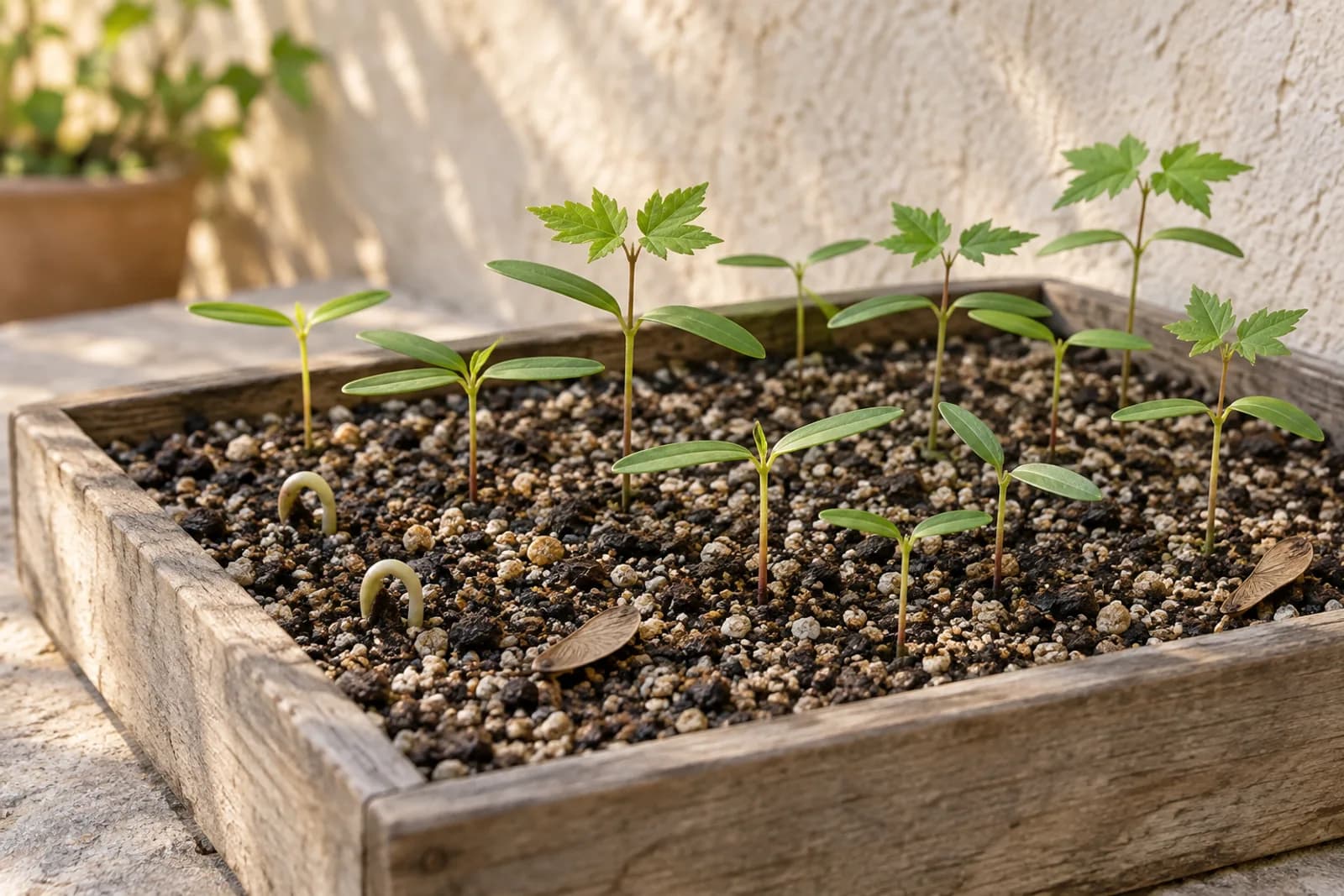
Growing from seed has real rewards: it is inexpensive, you see a tree's whole life from its first root, and each seedling differs a little from its siblings, giving you variety to choose from. Course 13, Propagation and Creating New Material, will teach it in depth. But it is an option, not a requirement. A young nursery tree, like this course's nursery juniper or trident maple, has already done years of that growing, so you can start learning to care for and shape a tree this season.
The bonsai decision
Choose seed for the journey, not the shortcut
Starting point
If you want a tree to care for and work on this year, start with nursery stock. If growing from seed appeals to you, run it alongside as a long-term project: identify the seed, look up its germination requirements before you sow, meet them, and keep a dated record of what you did and what happened.
This assumes
- You know the species, and ideally where the seed was collected. - You can give the young tree what it will need for years afterward, such as strong light and, for many temperate trees, a winter outdoors.
Change course if
- The packet names no species, only “bonsai tree”: treat it as an experiment, or buy identified seed from a supplier who lists its requirements. - You cannot provide what the grown tree will need, such as a winter outdoors for a temperate maple: choose a tree suited to your conditions (Course 02, Choosing a Tree and Creating Its Growing Environment). - Nothing has come up after the expected time: recheck the requirements before discarding the tray. Some seeds take more than one season, and a seed that failed may have been dead, dormant, too wet, too cold, or sown too deep.
Back to the question
Why does a seed need more than water to become a tree?
Water only starts germination. A waking embryo must respire, so it needs oxygen, and it needs a suitable temperature; some seeds also need light or darkness, and many tree seeds stay dormant until a requirement, such as a long cold, moist period or an opened seed coat, is met. Even then, stored food carries the seedling only until its leaves can make sugar in the light, and years of growth follow before it is a tree worth shaping.
Key takeaways
- A seed holds a living embryo (radicle, hypocotyl, shoot tip, and cotyledons), a protective coat, and stored food. - Germination runs in order, root first, and stored food pays for all growth until the seedling's first green leaves, usually the seed leaves, begin photosynthesis in the light. - Germination needs water, oxygen, and a suitable temperature, and sometimes light or darkness. Waterlogged mix can starve a seed of oxygen. - A dormant seed is alive but will not germinate, even in good conditions, until a requirement is met, often through stratification or scarification. Check what your seed needs. - There are no bonsai seeds. Growing from seed is a rewarding, years-long project, not a prerequisite; nursery stock lets you start now.
Optional · not required for completion
Wake up a seed
Soak a few whole dried beans from the kitchen overnight (not split ones), and keep a few dry. Next day, compare their size, their coats, and how easily a fingernail dents each.
Split a soaked bean along its seam and open it like a book. The two thick halves are cotyledons, full of stored food; tucked at one edge are the embryo's tiny root and first folded leaves.
Lay a few soaked beans on a damp paper towel in a jar, damp but not swimming, and sink one more in a glass of water. Check them each day for several days: which part appears first on the towel? The submerged bean often fails to sprout and may smell sour as it runs short of oxygen.
No tree? None is needed for this one. Do not eat the beans afterward.