Course 01 · Lesson 9 of 14 · Resources and transport
Sugar transport, storage, and demand
Sugars move through the phloem from where they are made or stored to wherever they are needed, and that direction changes through the year. See how leaves feed roots and new shoots, and why foliage and stored reserves matter for growth and recovery.
The question
How do leaves support roots and new shoots?
By the end of this lesson, you will be able to:
- Explain how phloem carries sugars from sources to sinks.
- Explain why phloem flow is not simply downward and changes with season and growth.
- Explain why retained foliage and stored reserves matter for development and recovery.
About 15 minutes to read and explore
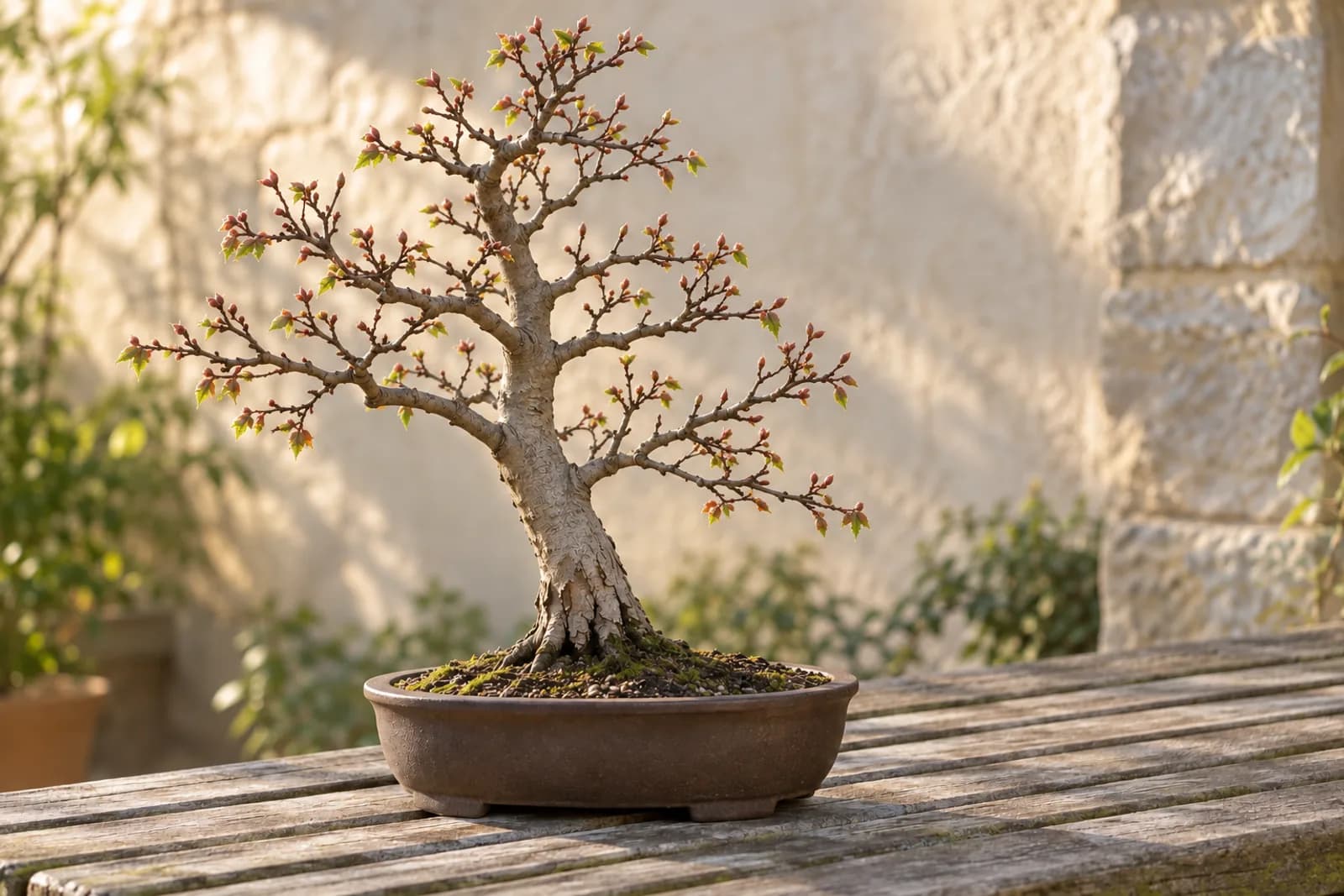
Picture the trident maple, one of this course's instructional example trees, in early summer. Out of sight in its pot, fine white root tips are pushing through the substrate, building new cells, respiring day and night, and spending energy to take up mineral nutrients (Lesson 7). Yet roots grow in the dark and cannot make sugar from light and air. Nearly all the sugar they use was made in leaves they will never touch. How does it reach them?
Each spring, the maple also unfolds a whole set of new shoots and leaves before any of them can feed it. Where does that sugar come from? Following the sugar answers both questions.
Sources and sinks
Leaves make sugar by photosynthesis (Lesson 6), but every living cell uses it, so sugar has to move from the parts that have extra to the parts that need it.
A sourceAny part of a tree that makes or releases more sugar than it uses, so it exports sugar to other parts, such as a mature leaf in good light or storage tissue turning its starch back into sugar. Whether a part acts as a source can change with its age and the season.Open the glossary is any part that makes or releases more sugar than it uses, so it has sugar to send out: a mature leaf in good light, or storage tissue turning its saved starchA carbohydrate made of many glucose units linked together, which plants use to store energy and building material. Trees store starch in living cells of roots, wood, and bark, then convert it back to sugar to fuel spring growth and recovery.Open the glossary back into sugar.
A sinkAny part of a tree that uses or stores more sugar than it makes, such as growing shoot tips, young leaves, the cambium, roots, flowers, fruits, and storage tissues while they fill. Phloem carries sugar from sources toward sinks.Open the glossary is any part that uses or stores more sugar than it makes, so it must take sugar in. Growing shoot tips, young leaves, the vascular cambiumA layer of dividing cells, only a few cells thick, between the wood and the inner bark. It adds new xylem on its inner side and new phloem on its outer side, which is how trunks, branches, and roots grow thicker.Open the glossary that thickens the trunk and branches, roots, flowers, fruits, and seeds are all sinks.
These roles can change. A young leaf imports sugar while it is small, then exports for the rest of its working life, often starting well before it reaches full size. Storage tissue is a sink while it fills and a source while it empties. Fine roots, which cannot make sugar, are always sinks.
How the phloem moves sugar
Sugar travels from sources to sinks in the phloemThe living tissue that carries dissolved sugars and other compounds from where they are made or stored to where they are needed, such as roots, shoot tips, and storage tissues. In trunks and branches it forms the inner bark, and its flow can run upward or downward.Open the glossary, the living inner bark you met in Lesson 3. It moves dissolved in water, in most trees mainly as sucrose (table sugar), through long channels of living cells called sieve tubes. This movement is called translocationThe movement of sugars and other dissolved compounds through the phloem from sources to sinks, in whichever direction the demand lies. It can carry sugar up to a growing shoot and down to the roots at the same time.Open the glossary.
What moves it is pressure. The widely accepted explanation, called pressure flowThe main explanation of how phloem moves sugar: loading sugar into the phloem at a source draws in water, raising pressure that pushes the sugar solution along to sinks, where the sugar is unloaded and the water leaves.Open the glossary, works in three steps:
- Loading at the source. In a mature leaf, sugar is moved into the phloem of the veins until the solution there is very concentrated.
- Water follows. Water tends to move across cell membranes toward wherever dissolved substances are more concentrated, a process called osmosis. So water from the neighboring xylemThe tissue that carries water and dissolved minerals from the roots up through the trunk and branches to the leaves, mostly through hollow cells that are dead when they work. Built up in layers year after year, xylem makes up a tree's wood.Open the glossary seeps into the loaded phloem, and the pressure inside rises, much as air pressure rises in a pumped-up tire.
- Unloading at the sink. At a root tip, a growing shoot, or a storage cell, sugar is taken out of the phloem to be used or stored. Water leaves too, and the pressure there stays low.
The solution flows from high pressure to low, from source to sink, like water in a garden hose running from the tap to the open end. Water in the xylem moves differently (Lesson 8): it is pulled up through dead, hollow cells by evaporation at the leaves. Sugar is pushed through living cells by pressure built at the source.
Go deeper · optional, not assessedInside the phloem, and an insect that reveals the pressure
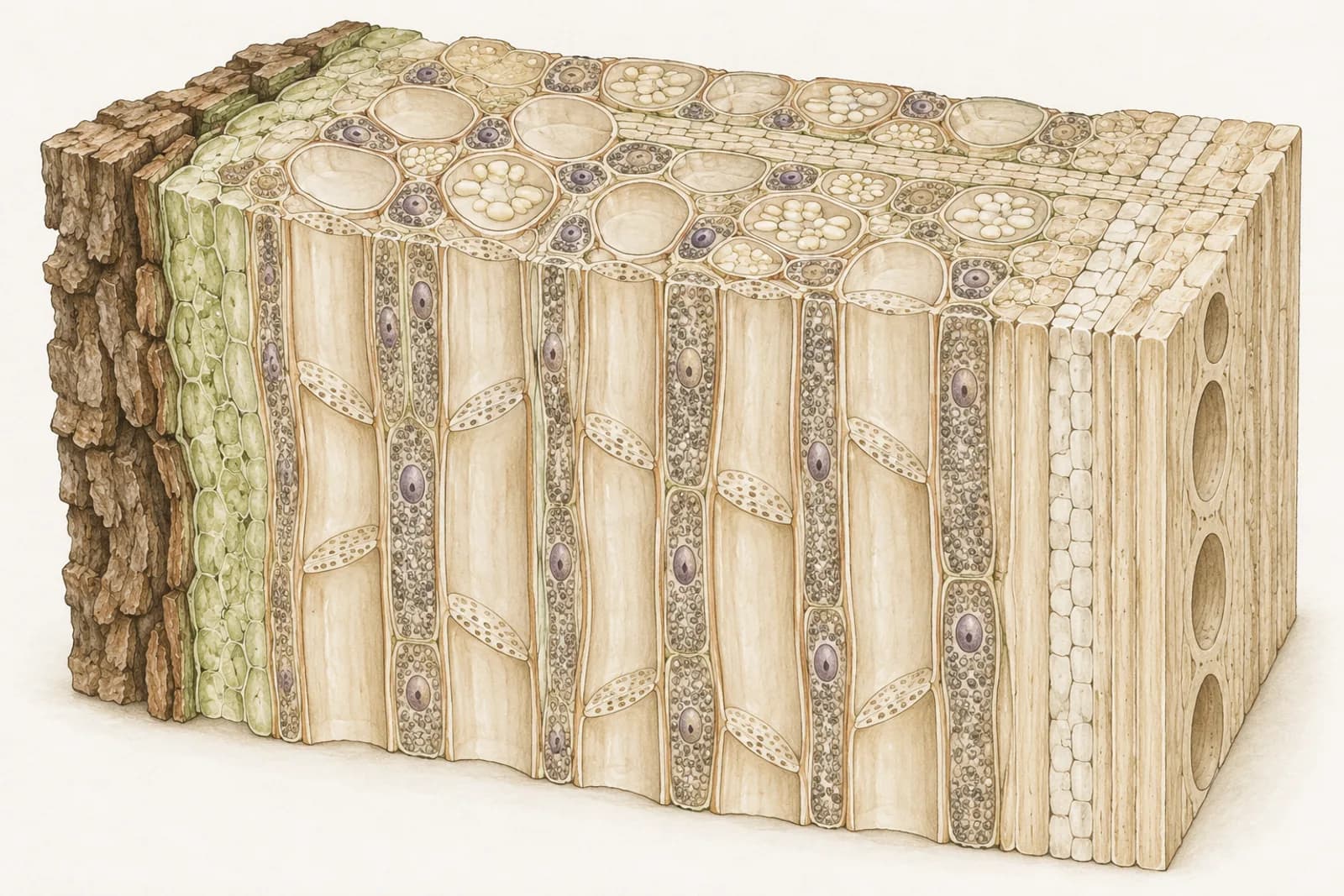
Each sieve tube is a file of living cells, called sieve-tube elements, joined end to end through end walls perforated like a sieve. As each of these cells matures, it loses its nucleus and most of its internal machinery, leaving a nearly open channel lined by a living membrane. A narrow companion cell beside it keeps it alive and, in many plants, spends energy from respiration to pump sugar in; in many trees, sugar may instead enter more passively, and how each species does it is still being studied. Conifers such as the nursery juniper use a similar arrangement of differently shaped cells.
Aphids show that the phloem is under pressure. An aphid slips its needle-like mouthparts into a single sieve tube, and the pressure pushes the sugary solution into it with little sucking needed. Aphids take in more sugar than they can use and excrete the excess as sticky honeydew, which is why aphids on the tender shoot tips of a bonsai often leave a glossy film on the leaves below.
Predict first
With no sugar being unloaded, the solution backs up near the tip, so the pressure there rises toward the pressure at the source. Less solution flows that way, and more goes to sinks that are still unloading. Both the direction and the amount of flow follow demand.
Direction follows demand
Because the flow runs from where sugar is loaded to where it is unloaded, its direction depends on where the sinks are. Sugar from the same leaves can travel up to a growing shoot tip, down the trunk to the roots, or sideways into a fruit, and neighboring sieve tubes in one branch can carry sugar in opposite directions at once. Sinks draw most on the nearest sources, so upper leaves feed more of the shoot tips and lower leaves send more to the trunk and roots.
The flow changes through the year
In a temperate deciduous tree such as the trident maple, the sources and sinks change through the year, and the flow follows them. Before you explore the map, predict where spring growth gets its sugar.
Practice check · not scored
Now check your prediction. The map opens on “Summer growth.” Switch Season to “Bud break,” then “Late season,” and watch the Source and Sink labels, the amber dashes in the trunk cutaway, and the starch grains. To follow a route stop by stop, press “Start tracing.”
Interactive
Tree transport map
A temperate deciduous tree, such as a trident maple. Evergreen and tropical trees follow different rhythms.
Inside a leaf
Around a young root
Trace the route
Follow sugars one step at a time, from where they start to where they end up. The numbered markers show each stop.
What the map shows
- Sugars, summer growth Mature leaves are the source. The phloem in the inner bark carries sugar to the sinks: out to growing shoot tips, into the cambium, and down to the roots.
Water and the minerals taken up by roots rise in the xylem; sugars travel in the phloem, carried in water drawn from the xylem. They are separate channels that trade water side by side, not one circulating sap.
Text description
A small broadleaf tree in a shallow pot. The pot is cut away to show substrate particles and roots. A window in the lower trunk shows its layers from the outside in: outer bark, phloem (the inner bark), a thin cambium, and xylem (the wood), crossed by rays of living storage cells. Two magnified circles show the inside of a leaf, with a vein and a stoma on its lower surface, and a young root with root hairs among substrate particles, water films, and air spaces.
Sugars travel in the phloem from sources to sinks. The pattern changes with the season in a temperate deciduous tree:
Bud break. Stored reserves in the roots and trunk are the source. The phloem carries sugar up to opening buds and young leaves, which cannot yet supply themselves. Young roots that are growing draw on the reserves too.
- Stored reserves become the source. Before new leaves can make enough sugar of their own, starch stored in living cells of the roots and trunk is converted back to sugar and moved into the phloem. In the wood, those storage cells are the rays, which run sideways across it.
- Carried upward in the phloem. Phloem carries sugar toward demand, so at bud break the flow in the trunk and branches runs up. In some trees, maples among them, sugar also rises in the xylem sap before the leaves open; the map shows only the phloem route.
- Delivered to opening buds. Opening buds and expanding young leaves are strong sinks. Much of their first growth is built from reserves.
- Young leaves become sources. As each new leaf matures, it stops importing sugar and starts exporting it. Once enough leaves are exporting and the first flush of growth slows, leaves supply the tree and reserves begin to rebuild.
Summer growth. Mature leaves are the source. The phloem in the inner bark carries sugar to the sinks: out to growing shoot tips, into the cambium, and down to the roots.
- Made in mature leaves. Mature leaves in light make sugars by photosynthesis. They make more than they use, so they are sources.
- Loaded into the phloem. Sugar is moved into the phloem of the leaf veins. Water follows it in, building pressure that pushes the sugar solution along.
- Carried in the inner bark. The phloem lies just inside the outer bark. It carries sugar toward wherever it is being used or stored: down to the cambium and roots, and out to growing shoot tips.
- Delivered to sinks. Growing shoot tips, the cambium that thickens the trunk and branches, and the roots are sinks. They use sugar faster than they make it, or make none at all.
- Used or stored. Sinks use sugar for respiration and to build new cells. Some is converted to starch, the tree's stored reserve.
Late season. Mature leaves are still the source, but shoot growth has slowed. Most sugar moves down the phloem to refill starch storage in the trunk and roots.
- Leaves are still working. Mature leaves keep making sugar while conditions allow, even as shoot growth slows.
- Loaded into the phloem. As in summer, sugar is moved into the phloem of the leaf veins.
- Carried down toward storage. With shoot growth slowing, most of the flow runs down the phloem toward storage in the trunk and roots. Shoot tips, developing buds, and roots that are still growing draw a smaller share.
- Stored as starch for spring. Living cells in the wood, inner bark, and roots, especially the older woody roots, convert sugar to starch. In the wood, starch is held in the rays, living cells that run sideways across it, not in its water-conducting tubes. Storage is now the main sink, and these reserves will fund bud break next spring.
Water and the minerals taken up by roots rise in the xylem; sugars travel in the phloem, carried in water drawn from the xylem. They are separate channels that trade water side by side, not one circulating sap.
In summer, sugar left the mature leaves in two directions at once: out to the shoot tips and down to the cambium and roots. At bud break, the trunk flow ran upward from storage to the opening buds, and the starch grains shrank. Late in the season, most of the leaves' sugar ran down to storage, and the grains grew. As each new leaf starts exporting in spring, the tree shifts from living on its savings to living on its income.
Other trees keep different rhythms. Evergreens such as the nursery juniper keep foliage that can make sugar whenever conditions allow, so their spring growth draws on older foliage as well as on stored starch. A tropical tree such as the ficus needs no winter rest and grows in flushes, bursts of new shoots and leaves, each one a sink.
Go deeper · optional, not assessedWhy some trees drip sweet sap in spring
Spring sap flows help keep the myth alive. Before leafing out, a few trees, such as sugar maples and birches, release some of their stored sugar into the water in their xylem, which is why maple sap can be boiled into syrup. At that time a cut birch or grapevine may also drip xylem sap that is mostly water, pushed up by root pressure (Lesson 8). These flows are brief. Once the leaves are working, the sugar they make travels in the phloem.
Reserves: savings for spring and for setbacks
Sugar a tree does not need right away is mostly converted to starch and kept as reservesCarbohydrates, mostly starch, stored in living cells of the roots, trunk, branches, and bark for later use. Reserves fuel early spring growth before new leaves can supply sugar, and they help a tree recover after losing foliage or roots. A seed carries reserves of its own, such as starch, oils, and proteins, that fuel the embryo's first growth.Open the glossary in living cells of the roots, trunk, branches, and bark. Reserves pay for spring growth before new leaves can, keep living cells respiring through winter, fund recovery when leaves or roots are lost, and supply defenses against pests and decay (Lesson 14). In a deciduous tree they are often lowest soon after the spring flush, when new growth has spent them and the new leaves have only begun to repay them.
Now sort the parts of a tree yourself. The sorter opens on “Midsummer, healthy tree”: choose Source, Sink, or “Neither now” for each numbered part, then check your answers and watch where the arrows go. Then predict what changes “After heavy leaf loss” before checking it.
Exercise
Sources and sinks through the year
A full canopy of mature leaves in good light. Shoots are still extending in places, and fruit is developing.
Badges show your choices:
Source Sink Neither now
The cutaway on the trunk shows outer bark, inner bark (phloem, where sugar travels), the cambium (drawn green for visibility; in life it is a pale layer too thin to see), and wood. White grains are stored starch.
- Source
- Makes or releases more sugar than it uses, so it sends sugar out.
- Sink
- Uses or stores more sugar than it makes, so it takes sugar in.
- Neither now
- About break-even, or barely active at this moment.
Buds and shoot tips
Shoot tips still extending; next year's buds are forming.
Young expanding leaves
A few new leaves unfolding at the shoot tips.
Mature sunlit leaves
Full size, in strong light.
Shaded interior leaves
Full size, but inside the canopy where light is dim.
Cambium · the thin growing layer under the bark
Adding new wood and inner bark.
Fine roots
Growing and absorbing water and minerals.
Root and trunk storage · starch held in living cells of roots and wood
Partly emptied by spring growth.
Developing fruit · on a maple, the winged seeds
Seeds and wings growing.
Text description
A drawing of a small deciduous tree, an instructional example like a trident maple, in a shallow pot. The front of the pot is cut away to show the roots, and a strip of the trunk is cut away to show its layers: outer bark, inner bark (phloem), cambium, and wood. Eight parts are numbered: 1, buds and shoot tips at the top of the tree; 2, young expanding leaves at the end of an upper right branch; 3, mature sunlit leaves on the upper left, standing for all the sunlit foliage; 4, shaded interior leaves near the trunk; 5, the cambium, drawn as a thin green line between the inner bark and the wood (in life it is pale and too thin to see); 6, fine roots on the left of the root zone; 7, root and trunk storage, shown as white starch grains in a thick root and in the wood; and 8, developing fruit, winged seeds hanging below the lowest branch.
You can choose one of four moments: spring bud break, midsummer on a healthy tree, a few weeks after heavy leaf loss, or late season. Not every part is on the tree at every moment, and the drawing changes to match. For each part that is present, choose source (it makes or releases more sugar than it uses, so it sends sugar out), sink (it uses or stores more sugar than it makes, so it takes sugar in), or neither now (about break-even, or barely active).
Checking shows the answer for each part and why. Amber dashed arrows then trace sugar through the phloem in the inner bark, from each source to the sinks it supplies. In the trunk, sugar heading up and sugar heading down travel in separate lanes. A table at the end collects the roles for every moment you have checked, so you can compare them.
After heavy leaf loss, storage became a source again, as at bud break. Losing most leaves in early summer, to caterpillars or hail, takes a tree's sources at the moment its savings are lowest. The tree often pushes out replacement leaves from buds meant for next year, drawing its reserves down further, while roots, cambium, and fruit compete for what little remains. Rebuilding takes healthy new leaves, good light, and time, sometimes more than one season.
You cannot see reserves in a photograph or in leaf color. You infer them from the tree's history: how much healthy foliage it has carried, in what light, for how long, and what has been taken from it. Growers' talk of a tree's “energy” is best read as this carbohydrate supply and its recent spending (Lesson 14).
Cutting the phloem but not the wood
Because water and sugar travel in different tissues, one can stop while the other keeps running. Removing a complete ring of bark from a branch, down to the wood, cuts the phloem all the way around but leaves the xylem whole. This is girdlingDamage that removes or crushes a complete ring of bark around a trunk, branch, or root, severing the phloem all the way around. Sugars from the leaf side can no longer pass, so tissues on the root side lose that supply; a fully girdled trunk usually kills the tree over time.Open the glossary (Lesson 3).
Practice check · not scored
Now test your prediction. Switch on “Remove a ring of bark” and step through the three times, from “At first” to “Months later,” reading the status list as you go. Then switch on “Wrap in moist moss” and step through them again.
Interactive
Removing a ring of bark
Bark intact
Bark intact: both routes open
Water rises through the wood to the leaves. Sugar made in the leaves travels through the phloem in the inner bark, down toward the trunk and roots and up to the growing tip.
- Water to the leaves
- Flowing
- Sugar to the growing tip
- Flowing
- Sugar to trunk and roots
- Flowing
- This spot on the branch
- Nothing collects
Trunk and roots below: Receiving sugar from these leaves, as well as from the rest of the tree’s foliage.
Text description
An upright section of a branch, with two leafy twigs near the top. The branch continues upward to its growing tip and downward to the trunk and roots. Below the twigs, part of the branch is cut away lengthwise to show its layers from the outside in: outer bark; phloem, the inner bark that carries sugars; the thin cambium, which makes new cells; and the wood (xylem), which carries water. Water, drawn as solid blue lines with upward arrows, moves up through the wood and out along the twigs to the leaves. Sugars, drawn as dashed amber lines with small hexagons, move from the leaves into the phloem: down toward the trunk and roots, and up toward the growing tip.
Removing a ring of bark takes the outer bark, phloem, and cambium all the way around the branch but leaves the wood in place. What happens next:
- Bark intact. Water rises through the wood to the leaves. Sugar made in the leaves travels through the phloem in the inner bark, down toward the trunk and roots and up to the growing tip.
- Ring removed, at first. The ring took the outer bark, phloem, and cambium, but the wood is untouched. Water still rises through it, so the leaves above keep their water supply. Sugar moving down the phloem reaches the upper edge of the ring and can go no farther.
- Weeks later, left uncovered. Sugar keeps arriving at the upper edge, and living cells there use it to grow. The edge swells into callus, a rounded roll of new tissue. The lower edge changes little, because nothing arrives from above. Left uncovered, the bare wood surface starts to dry.
- Months later, left uncovered. The upper edge has grown a large roll of callus, and the branch above the ring has thickened more than the branch below it. The exposed surface has dried, and roots rarely form on dry tissue. Water still reaches the leaves through the deeper wood. If a ring is narrow, the new tissue may eventually bridge the gap and reconnect the bark.
- Weeks later, wrapped in moist moss. Sugar keeps arriving at the upper edge, and living cells there use it to grow. The edge swells into callus, a rounded roll of new tissue, while the lower edge changes little. In the damp moss, the first root tips may start to appear at the upper edge. How soon depends on the tree and the conditions.
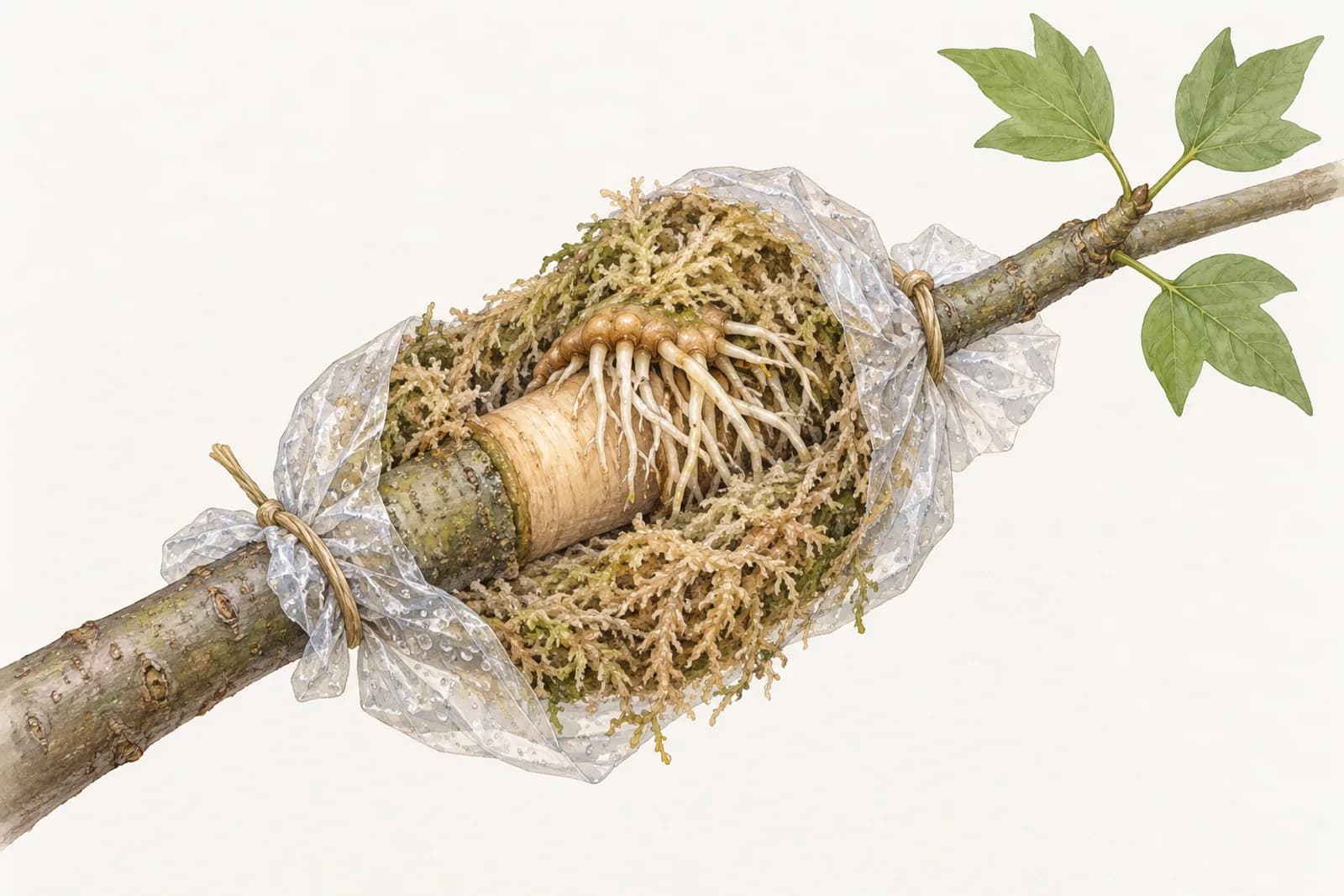
- Months later, wrapped in moist moss. Roots have grown from the upper edge into the moss, where sugars and growth signals collect. The leaves above now supply both the branch and its new roots, while water still rises through the wood. Once the new roots are well developed, the top could be cut free and grown as a tree of its own. That is the principle behind an air layer.
Below the ring, the branch, trunk, and roots receive no sugar from these leaves. Because only one branch is ringed here, the tree's other leaves and its stored reserves still supply the trunk and roots. A ring removed all the way around the main trunk, below all of its branches, would cut off every leaf's supply to the roots, which usually kills a tree over time.
Water kept crossing the ring through the wood, and sugar still reached the growing tip, but sugar heading down stopped at the upper edge. That edge swelled into callus, a rounded roll of new tissue, while the lower edge changed little. auxinA plant hormone made mainly in shoot tips and young leaves that moves down the stem and helps control growth, including holding back buds below the tip and encouraging roots to form. It is the active ingredient in many rooting powders.Open the glossary, a hormone made in shoot tips and young leaves, collects there too, because it moves down mainly through the cambium and the living cells beside it, which the ring also removed. Among its many roles, it encourages roots to form; Lesson 12 shows how it shapes growth. Left bare, the wood dried; wrapped in moist moss, the upper edge grew roots.
That is the principle behind layeringA way of making a new plant by encouraging roots to form on a stem while it is still attached to, and watered through, the parent plant, then separating it once it has roots of its own.Open the glossary, making a new plant by growing roots on a stem while it is still attached to its parent. An air layerA form of layering done above ground: a ring of bark is removed or the stem is wounded and wrapped in moist material, and roots form at the upper edge of the wound, where sugars collect. The rooted part is later cut free and potted.Open the glossary does it above ground: once the new roots are well developed, the branch is cut free below them and grown on its own. Trident maples generally root well this way; many trees root far less readily. Course 13, Propagation and Creating New Material, will teach the technique.
What this means for your bonsai
Leaves feed the tree, but mostly nearby. Together, the leaves supply every sink, including the roots in the pot. But a mature branch runs mainly on its own leaves, so stripping or shading its foliage cuts supply most to that branch and the trunk and roots below it, and a branch kept bare or deeply shaded for long can die back even on a healthy tree (Lesson 4). Removing all the leaves on purpose, called defoliation, spends reserves the same way; it suits only particular healthy, vigorous trees and goals (Course 14, Refinement and Long-Term Stewardship).
A long, leafy branch feeds what lies below it. Much of a vigorous low branch's sugar moves into the trunk beneath it and on to the roots. Growers use this when they let a sacrifice branchA branch deliberately allowed to grow long and leafy for a time, so its foliage supplies extra sugars that thicken the trunk below it and the roots, then removed once it has done its job. Its removal leaves a wound that the tree must grow over.Open the glossary grow freely to thicken the trunk, then remove it (Lesson 12).
Flowers and fruit are strong sinks. A heavy crop competes with shoots, roots, and storage and can slow other growth; Course 14 will also cover managing it.
Anything that girdles bark cuts the supply. A wire, label tie, or string left around a thickening trunk or branch can girdle it, and so can gnawing rodents; deep wire bite (Lesson 3) is a partial version of the same injury. A complete girdle around the main trunk, below all its branches, cuts every leaf off from the roots: the leaves may stay green for months while the roots use up their reserves, but the tree usually dies.
The bonsai decision
Protect the supply before you spend it
Starting point
Treat major work, such as heavy pruning, extensive root work, or removing a large branch, as spending reserves: what regrows afterward is built from stored starch and from the remaining leaves' sugar. Plan it for when, since its last major work or setback, the tree has carried a full set of healthy foliage in good light and grown normally for its kind. Afterward, keep the foliage healthy and well lit so it can repay what the work spent. Course 06, Seasonal Care and Timing, will match jobs to growth stages.
This assumes
- You know what the tree is and where it is in its yearly cycle, such as dormant, opening its buds, or in full leaf. - The tree is healthy and growing in light that suits it. - The work is elective: styling or development that can wait.
Change course if
- The tree has recently lost much of its foliage or roots, to pests, hail, scorch, drought, or earlier work: postpone elective work and judge its recovery by its new growth (Lesson 14). - It has been growing in poor light: improve the light first, since dimly lit leaves make little more sugar than they use (Lesson 6). Increase it gradually, because leaves grown in dim light can scorch if moved suddenly into strong sun. - It is flowering or fruiting heavily: the crop competes for the same supply, so favor postponing elective work until the crop has finished. - Something is actively injuring the tree, such as wire cutting into the bark or a tie tightening around a branch: remove it now, because the damage costs more than the work (Lesson 3).
Back to the question
How do leaves support roots and new shoots?
Leaves support roots and new shoots by exporting the sugar they make. The phloem carries it by pressure flow wherever the demand lies: up to growing shoot tips, down to the cambium and roots, or into fruit and storage. Leaves also refill the reserves that carry the tree through spring growth and recovery, so healthy foliage in good light keeps every part of the tree supplied.
Key takeaways
- Sources, such as mature leaves in good light or storage tissue turning starch back into sugar, send sugar out; sinks, such as shoot tips, young leaves, the cambium, roots, and fruit, take it in. - In the phloem, pressure built by loading sugar at a source pushes the solution toward sinks: up, down, or sideways, even in opposite directions at once, separate from the water rising in the xylem. - In a deciduous tree, reserves pay for spring growth and recovery; mature leaves supply everything else and refill reserves through summer and the late season. - Each branch runs mainly on its own leaves. Protect foliage, let a tree restock before major work, and keep anything from girdling its bark.
Optional · not required for completion
Watch reserves at work
Visit a deciduous tree or shrub every few days in spring: a bonsai, a garden shrub, or a street tree. As its buds open, note or photograph one shoot's length and leaf size. How much does it grow while its leaves are still small and soft? Much of that earliest growth is paid for from reserves saved the year before.
No tree? If you have none handy, or it is not spring, find a time-lapse video of a deciduous tree leafing out. Pause it where the leaves are still small and soft, then again when they reach full size. How much shoot length and leaf area was already there at the first pause? Much of that early growth was paid for from stored reserves.