Course 01 · Lesson 12 of 14 · Growth through time
How trees grow and change shape
Trees grow longer at their tips and thicker beneath their bark. See how shoot tips, light, and retained growth shape a tree, and why bonsai growers sometimes let one branch grow long.
The question
Why let a branch grow long if the goal is a small tree?
By the end of this lesson, you will be able to:
- Distinguish primary growth in length from secondary growth in thickness.
- Explain how shoot tips, light, and resource supply influence where new growth develops.
- Explain how retained growth can thicken a trunk, and describe back-budding as a behavior that varies among trees.
About 14 minutes to read and explore
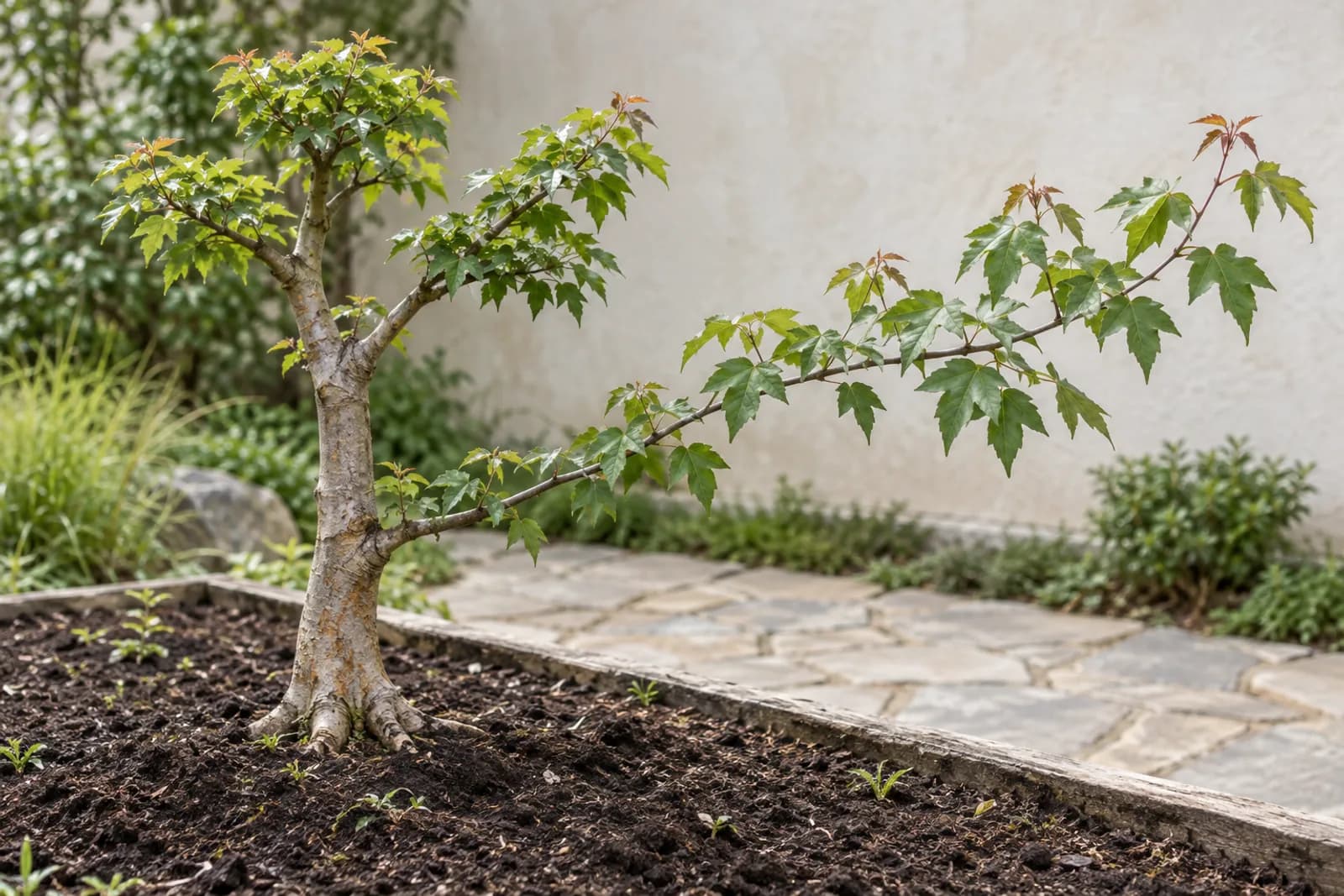
Walk through a nursery that grows trees for bonsai and you may see something that looks like neglect. A young trident maple, one of this course's instructional example trees, has its top kept short and tidy, yet one low branch has been left to sprawl, long and leafy, far beyond the rest of the tree. A season or two later, the grower cuts that branch off completely.
If the goal is a small tree, growing a big branch only to remove it seems backward. It makes sense once you see that a tree grows in two different ways, in two different places, and that one of them depends on how many leaves are working above it.
Two ways a tree grows
The first is growth in length. At the tip of every growing shoot is an apical meristemThe group of dividing cells at the tip of a shoot or root that makes new cells for growth in length. In a shoot it also forms new leaves, nodes, and buds.Open the glossary (Lesson 5), a small zone of dividing cells. Its new cells multiply and stretch, so the shoot lengthens, laying down new nodes, leaves, and internodes behind it. Root tips do the same underground (Lesson 2). This growth in length at the tips is called primary growthGrowth in length at the tips of shoots and roots, produced by apical meristems, which also forms new leaves, nodes, and buds. It is how a branch extends and how a root explores new substrate.Open the glossary.
Primary growth happens only at the tips and in the young, still-soft stem close behind them. Once a stretch of stem has matured, it stops lengthening, so a branch that starts 20 centimeters up the trunk stays 20 centimeters up for the rest of the tree's life.
Many trees lengthen their shoots in bursts. A flushA burst of new shoot growth, with leaves expanding together, that happens once or several times a year depending on the tree and conditions. Between flushes, shoots stop extending and mature.Open the glossary is a period when many shoots extend and unfold new leaves together, followed by a pause while the new growth matures. A trident maple makes its main flush in spring and, if vigorous (growing strongly for its kind and the season), may flush again later; a ficus kept warm and bright can flush repeatedly through the year.
The second is growth in thickness, called secondary growthGrowth in thickness of stems and roots, produced mainly by the vascular cambium adding wood on its inside and phloem on its outside, while a separate layer renews the outer bark. It depends on sugars made by the foliage, used as they are made or drawn from stored reserves.Open the glossary. It comes from the vascular cambiumA layer of dividing cells, only a few cells thick, between the wood and the inner bark. It adds new xylem on its inner side and new phloem on its outer side, which is how trunks, branches, and roots grow thicker.Open the glossary (Lesson 3), a living layer a few cells thick beneath the bark. The cambium adds new wood on its inner side and new phloem on its outer side; a separate cork cambium renews the outer bark.
So the idea that a tree grows at the top is only half true. It grows longer at its tips, but thicker along its whole trunk, every branch, and its woody roots, out of sight beneath its bark.
Leaves pay for wood
Wood is built from sugars made by photosynthesis in the leaves (Lesson 6), whether freshly made or drawn from reserves stored earlier. The phloem carries those sugars to every sinkAny part of a tree that uses or stores more sugar than it makes, such as growing shoot tips, young leaves, the cambium, roots, flowers, fruits, and storage tissues while they fill. Phloem carries sugar from sources toward sinks.Open the glossary, any part that uses or stores them: growing shoot tips, roots, and the cambium all along the trunk. The cambium also needs water, warmth, and signals from growing shoots, but it cannot build more wood than its supply of sugars allows.
That leads to a general rule: a trunk or branch tends to thicken most where it supports and connects the most active foliage. As Lesson 9 showed, much of what a large, leafy branch exports moves into the trunk below its junction and on toward the roots; the cambium along that route takes its share, while the trunk above gains comparatively little. This is one reason a trunk normally widens toward its base: the lower trunk serves all the foliage above it.
Practice check · not scored
Growing a branch in order to remove it
Growers turn that rule into a technique. A sacrifice branchA branch deliberately allowed to grow long and leafy for a time, so its foliage supplies extra sugars that thicken the trunk below it and the roots, then removed once it has done its job. Its removal leaves a wound that the tree must grow over.Open the glossary is a branch left to grow long and leafy for a time to thicken the trunk below it, then removed once it has done its job.
In Two trees, four growing seasons, press Next to grow one season at a time and compare the ring each trunk adds in the two Cross-section cards. After the fourth season, press Remove the sacrifice branch and compare the width markers on each trunk, below and above the low branch.
Simulation
Two trees, four growing seasons
Tree A: Trimmed every season
Every new shoot is cut back after it grows.
Tree B: One low branch left to grow
The top is trimmed as in A; the low branch is the sacrifice branch.
Available after four growing seasons.
Start: two identical young trees
- Shoots lengthenprimary growth
- Trimmingshoots cut back
- Wood addedsecondary growth
Cross-section
- Trunk thickness below the branch
- Thin
- Leaves above this point
- Compact
Cross-section
- Trunk thickness below the branch
- Thin
- Leaves above this point
- Compact
Trimmed tree. A young tree with a top, two upper branches, and one low branch. Every new shoot will be cut back after it grows.
Sacrifice-branch tree. The same young tree. The top and upper branches will be trimmed exactly like the other tree, but the low branch will be left to grow. It is the sacrifice branch.
Text description
Two identical young deciduous trees, an instructional example, grow in open ground for four seasons. Each has a top, two upper branches, and one low branch. In tree A, every new shoot is cut back after it grows. In tree B, the top and upper branches are trimmed the same way, but the low branch is left to grow freely: it is a sacrifice branch.
Each season is shown in three steps. Shoots lengthen at their tips (primary growth). The trimmed shoots are cut back. Then each trunk adds a layer of wood under its bark (secondary growth), seen as a new ring in a cross-section of the trunk right below the low branch. In a real tree, shoot growth and wood formation overlap through the growing season. Wood is built from sugars made by the leaves; the sugars move through the phloem toward the trunk and roots. In this simplified model, the more leaves there are above a point on the trunk, the more wood is added there.
- Start. Both trunks are thin below the low branch, and both trees have compact foliage.
- Season 1. Tree A: New shoots lengthened at their tips, then were cut back. With about the same leaves as before, the trunk added a thin ring. Tree B: The low branch kept its new shoot and leaves. Sugars from those extra leaves reached the trunk below the branch, which added a wider ring. In words: the trunk below the low branch is thin in A and thin in B; the foliage above it is compact in A and moderate in B.
- Season 2. Tree A: Another flush, another trim. The foliage stays compact, so the ring is thin again. Trimming keeps the tree small; it does not speed thickening. Tree B: The branch is longer and leafier. More leaves above the cross-section mean more sugars for the cambium there, and an even wider ring. In words: the trunk below the low branch is thin in A and moderate in B; the foliage above it is compact in A and large in B.
- Season 3. Tree A: The trunk keeps thickening slowly, by about the same thin ring each season. Its shape changes very little. Tree B: The branch now carries more leaves than the rest of the tree. The trunk below it is clearly thicker; above the branch, the trunk has grown no faster than the trimmed tree's. In words: the trunk below the low branch is thin in A and moderate in B; the foliage above it is compact in A and very large in B.
- Season 4. Tree A: After four seasons: four thin rings. The trunk below the low branch is still thin, and only slightly wider than the trunk above it. Tree B: After four seasons: rings that widened as the branch grew. The trunk below the branch is thick. The branch has done its job and can be removed. In words: the trunk below the low branch is thin in A and thick in B; the foliage above it is compact in A and very large in B.
Above the low branch, both trunks thicken at the same slow pace in this simplified model, because they carry the same trimmed upper foliage. Tree A keeps adding a thin ring every season: trimming does not stop thickening, and it does not speed it up. The model holds the trimmed foliage steady; a real trimmed tree slowly gains leaves as it branches, but its rings stay narrow. Tree B's low branch thickens at its own base too, fed by its own leaves, until it is thicker than the trunk above it.
After the fourth season you can remove the sacrifice branch. The wood it helped build stays, so tree B's trunk stays clearly thicker below where the branch was than above it (clear taper, compared with slight taper in tree A). With one branch, that change is fairly sudden, at the old junction. Removal leaves a large wound. New wood and bark grow in from its edges and, on a vigorous tree, can slowly cover it, often over several years. That part of tree B has no fine branches yet. With the branch gone, the foliage above the cross-section is back to about the same as tree A's, so further thickening there slows.
Also simplified in the drawing: rings are drawn evenly, although wood below a large branch often builds up more on that branch's side; the roots are drawn without growing; and sugars are shown moving only toward the trunk and roots, although growing shoot tips draw on them too.
Tree B's rings grew wider each season as its low branch carried more leaves, while tree A's stayed thin. Above the low branch, the two trunks grew alike: the extra wood went where the extra leaves' sugars went, into the trunk below the branch.
When you removed the branch, the wood it had helped build stayed: tree B's trunk is now clearly thicker below where the branch was than above it. That narrowing from a thick base toward the top is called taperThe narrowing of a trunk or branch from its thick base toward its tip, which helps a tree look mature and natural. Stems thicken more where they support and connect more foliage, so a single retained branch thickens the trunk below it, with a fairly sudden change in width at its junction, while smooth, gradual taper is usually built over years by growth at several heights.Open the glossary, and it helps a small tree look old. One low branch makes the change fairly suddenly, at its junction; smooth, gradual taper is usually built over years by letting branches grow long at several heights in turn (Course 12, Developing Bonsai from Starting Material).
Removal has costs. It leaves a wound, larger the longer the branch stays, which the tree walls off and slowly grows over from the edges; it does not heal the way skin does (Lesson 14). That stretch of trunk also has no fine branches yet. And while it grows, a heavy branch can swell the trunk where it joins and shade branches you mean to keep.
Shoot tips hold back the buds below
A sacrifice branch decides how thick a trunk becomes. Where new branches appear is a separate question: it depends on which buds grow. Lesson 5 showed that removing a shoot tip often lets buds below it grow; here is why.
While a shoot tip is actively growing, the lateral budA bud on the side of a stem, formed in the angle where a leaf joins the stem. Lateral buds can grow into side shoots, often after the shoot tip above them is removed or slows.Open the glossary below it tend to stay dormant: able to grow, but held back by the tip rather than by the season. This is called apical dominanceThe tendency of an actively growing shoot tip to hold back the buds below it, mainly through the hormone auxin moving down the stem along with other signals. Removing the tip often releases one or more of the buds below it to grow.Open the glossary. The growing tip and its young leaves make auxinA plant hormone made mainly in shoot tips and young leaves that moves down the stem and helps control growth, including holding back buds below the tip and encouraging roots to form. It is the active ingredient in many rooting powders.Open the glossary, a plant hormone that moves down the stem. While it keeps arriving, the buds below are held back, most strongly near the tip. Other signals and the supply of sugars to the buds play a part as well. The strength of this hold varies: in some trees, and on very vigorous shoots, side buds grow out while the tip is still growing.
Predict first
Usually close to the cut. The one to three buds nearest it tend to grow; on an opposite-leaved tree, often the pair at the top node. On an alternate-leaved shoot, the topmost is usually strongest and often turns upward as the new leading shoot. Buds farther down usually stay dormant.
In What the shoot tip holds back, press Play with the tip intact and watch the side buds. Then press Remove the shoot tip and Play again. Finally, set Light on this shoot to Shaded, Tree condition to Weak, or both, and press Replay.
Simulation
What the shoot tip holds back
Tip intact · Start
The growing tip holds the buds back
The shoot tip is actively growing. It sends a chemical signal, mainly the hormone auxin, down the stem. While that signal keeps arriving, the buds below stay dormant, held back most strongly near the tip.
Full light on a vigorous tree: plenty of light for making sugars, on a tree that is growing well.
Tip intact. Start. The growing tip holds the buds back. The shoot tip is actively growing. It sends a chemical signal, mainly the hormone auxin, down the stem. While that signal keeps arriving, the buds below stay dormant, held back most strongly near the tip.
Text description
A single upright shoot grows from an older branch. Along the shoot are six leaves, one per node on alternating sides (alternate leaves), and in the angle above each leaf stalk sits a small closed lateral bud. At the top is the growing shoot tip: a terminal bud with young leaves unfolding around it. A glow and small arrowheads inside the stem show a chemical signal, mainly the hormone auxin, moving down from the tip. The signal is strongest near the tip and fades toward the base.
You can set the light (full light or shaded) and the tree's condition (vigorous or weak), remove the shoot tip, and step through time: the start, days later, and weeks later.
With the tip left on:
- The tip keeps growing, adding length, nodes, and leaves: strongly in full light on a vigorous tree, more slowly in shade or on a weak tree.
- The signal keeps arriving, and the lateral buds stay dormant, held back most strongly near the tip.
With the tip removed (cut a short way above the top bud):
- No new signal comes down, and the signal left in the stem fades over the following days. Sugars that were flowing to the tip can now go to the buds below, and the nearest buds can begin to swell before that signal has gone.
- Vigorous tree in full light: the buds nearest the cut swell first. Weeks later, the top two buds have grown into shoots and a third may grow. The top shoot is the strongest, turns upward, and becomes the new leading tip; its own signal then holds back the buds below it.
- Shaded shoot, or weak tree: only the top bud responds, slowly, with one short, weak shoot.
- Shaded shoot on a weak tree: the top bud may make a short, weak shoot, or nothing may grow at all.
- In every case, the lower buds stay dormant.
Solid shoots are likely responses; dashed shoots are possible responses that may not happen. Everything shown assumes the cut is made while the tree is actively growing. On a tree with opposite leaves, such as a maple, each node carries a pair of buds, and after a cut the pair at the top node often grows out together as a fork rather than one clear new leader. And the hold is not equally strong in every tree: on very vigorous shoots of some trees, side buds grow out while the tip is still growing.
With the tip in place, the side buds stayed dormant. Once it was gone, no new signal came down, sugars that had been flowing to the tip could go to the buds, and the buds nearest the cut, the first to be freed, woke first. On a vigorous tree in full light, one shoot became two or three, the top one taking over as the leader. That holds for an alternate-leaved shoot like this one. On an opposite-leaved tree such as the trident maple, the pair of buds at the top node often grows out together as a fork rather than one clear leader. Either way, cutting back builds branching.
Shade or a weak tree changed the answer: only the top bud stirred, and with both, perhaps nothing grew. A cut frees buds from the signal, but it cannot supply more sugar than the shoot is making and the tree has in store. In every case the lower buds stayed dormant: a cut wakes the buds nearest it, and once a new leading shoot grows, its own signal holds back the buds below. Season matters too: late in the growing season, released buds may stay closed until the next one (Lesson 13).
Go deeper · optional, not assessedMore than auxin
Auxin does not need to enter a bud to hold it back. As it moves down the stem, it lowers the supply of cytokinins, hormones that encourage buds to grow, and raises strigolactones, which hold them back. Sugar matters too. In experiments on peas, buds began growing after the tip was removed sooner than the drop in auxin could have reached them, apparently because sugars that had been flowing to the tip became available. The fall in auxin seems to matter more for whether a released bud keeps growing. Researchers still debate how these signals combine, and the balance differs among plants.
Auxin also links the two halves of this lesson. Flowing down from growing shoots, it helps stimulate the vascular cambium; in many trees, cambial activity in spring begins beneath the opening buds and spreads down the stem, so shoot growth and wood formation overlap through the season. Leaves and auxin are not the only influences on where wood forms, either: when wind sways a tree, the bending is greatest low on the trunk, and that flexing also stimulates thickening there.
Light and the whole crown
Apical dominance works within a single shoot. Across the whole tree, a related pattern is at work: the leading shoot and upper branches tend to restrain the growth of the branches below them. This crown-wide tendency is called apical controlThe tendency, across a whole tree, of the leading shoot and upper branches to restrain the growth of the branches below them. Its strength varies among trees and with age; together with shading, it helps explain why lower and interior bonsai branches can weaken over time.Open the glossary. Its strength varies: it is strong in many conifers and young trees, and weaker in many mature broadleaves. It need not match the strength of apical dominance in the same tree.
Light adds to it. A leaf in good light makes more sugar than it uses and has some to export; a shoot in deep shade makes little, grows weakly, and its buds are slower to grow. A strong top shades the branches below it, they grow more weakly still, and the gap widens. Over years, shaded lower and interior branches may die.
For bonsai, this often works against you: the low and inner branches a design most needs are the ones the tree tends to neglect. Growers counter it by keeping strong upper growth in check and letting light reach the interior, techniques that belong to Course 09, Pruning and Managing Growth.
Practice check · not scored
New shoots on older wood
After a sacrifice branch comes off or a long shoot is cut back hard, can the tree grow new shoots where none are growing now? Growth of new shoots on older wood, behind the current foliage, is called back-buddingThe growth of new shoots on older wood behind the current foliage, from latent buds or newly formed ones. Many broadleaves do it readily when vigorous and well lit, while many conifers, such as most junipers and pines, rarely do so on bare, older wood.Open the glossary. The shoots come from latent budA bud that stays inactive beyond its first season, often for years, and may lie hidden beneath the bark of older wood. It may grow after a disturbance such as pruning, which is one source of new shoots on older branches. Growers sometimes call these dormant buds, but any bud resting through winter is dormant.Open the glossary that have waited beneath the bark, sometimes for years, or from adventitious budA bud that forms in an unusual place where no bud existed before, such as near a wound, on a root, or on older wood. The ability to form these buds varies greatly among trees.Open the glossary the tree forms where none existed before.
Trees differ widely in this. Many broadleaves, such as the trident maple, elms, and the ficus, generally back-bud readily, especially when vigorous and well lit; many conifers, including most junipers (this course's nursery juniper among them) and most pines, rarely do on bare, older wood. Even a tree that back-buds well responds to vigor, light, and the season: it may grow several shoots from old bark in good light and none on a shaded branch of a weak tree. Back-budding is a tendency, not a promise.
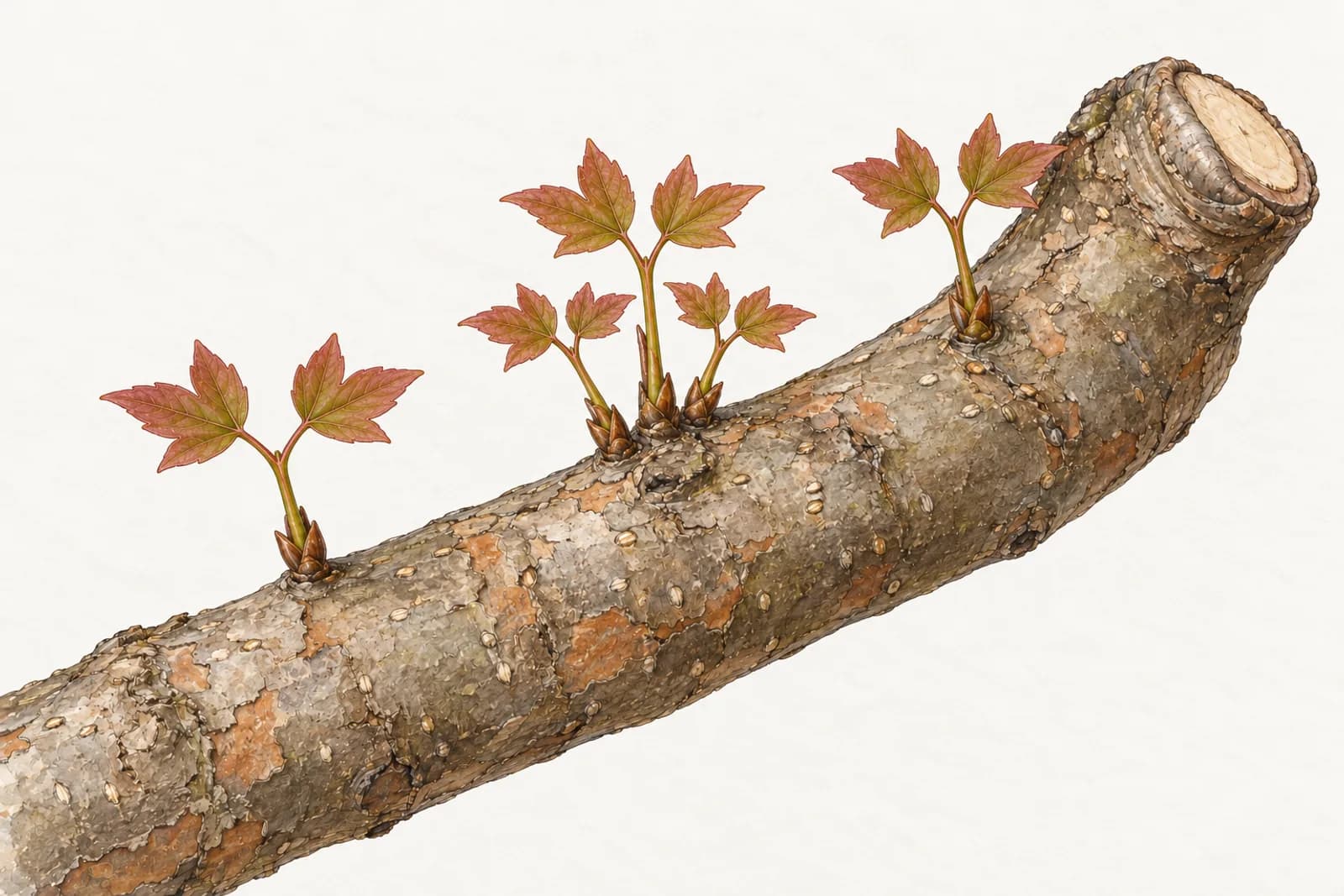
So on a tree that back-buds readily, removing a sacrifice branch often brings new shoots near the wound. On one that rarely back-buds, a sacrifice branch can still build thickness, but every branch you will need must already be there, with foliage in good light.
Decide what a long shoot is for
Left to grow, a long shoot feeds thickening below it, which is development work: building a trunk and main branches. Shortened, it keeps the tree compact and, by releasing buds below the cut, builds the finer branching a refined tree needs. The same shoot rarely does both jobs well at once, so decide before you cut. Course 12 and Course 14, Refinement and Long-Term Stewardship, will cover each kind of work.
The bonsai decision
Decide whether this growth is for thickness or for detail
Starting point
On a healthy tree still in development, where the trunk or a main branch needs to thicken, leave one or a few branches growing freely, often for a season or more, while keeping the rest compact. Choose a branch attached immediately above the section you want thicker; a low branch builds the base of the trunk. Look over the free growth every few weeks for the signals below.
On a tree whose trunk and main branches are already built, shorten new growth in the way and at the stage that suit this kind of tree, letting enough grow to keep it vigorous, so the detail stays compact. Accept that the trunk will thicken slowly.
This assumes
The tree is healthy and growing as expected for its kind and the season, in good light, with roots that have room to support more foliage, as in the ground or a large container. You know how this kind of tree responds to cutting back, including whether it grows new shoots on older wood. How long to keep a sacrifice branch, how and where to remove it, and how to shorten new growth belong to Courses 09 and 12.
Change course if
- The long branch is shading branches you mean to keep. If growth beneath it turns sparse and weak, or inner leaves yellow and drop, shorten the long branch or remove it sooner.
- The tree rarely back-buds on older wood. This is true of many junipers and pines. Keep foliage, in good light, on every branch you will need.
- The branch's base or its junction is getting too thick. A thicker base leaves a larger scar, and the trunk can bulge where it joins. Remove the branch sooner, or let a less visible branch do the job.
- The tree is weak. Its new growth is short and sparse. Put development on hold, keep its foliage in good light, and let it recover first; Lesson 14 covers how to judge this.
Back to the question
Why let a branch grow long if the goal is a small tree?
Because a tree thickens where leaves feed it. Length is added only at the tips, but the cambium adds thickness beneath the bark from sugars the foliage makes, so a long, leafy branch thickens the trunk below it, and the extra wood and taper stay after it comes off. The cost is a wound and a bare stretch of trunk, which a tree that back-buds readily can often refill.
Key takeaways
- Primary growth lengthens shoots and roots at their tips; secondary growth thickens trunks, branches, and roots beneath the bark.
- Wood is built from sugars made by leaves, so a sacrifice branch thickens the trunk below it, while constant trimming keeps rings narrow.
- A growing shoot tip holds back the buds below it, mainly through auxin; removing it often releases the buds nearest the cut, if light, vigor, and the season allow.
- Across the crown, upper growth tends to restrain the branches below, and shade weakens them.
- Back-budding varies: many broadleaves do it readily; many junipers and pines rarely do on bare, older wood.
Optional · not required for completion
Read the response to an old cut
Find a shrub or tree that was pruned last year and, without cutting anything, look at a few old cut ends. How many shoots grew right below each cut? Did the topmost take over, or did a matched pair grow from the top node? Compare cuts in sun with cuts in shade.
No tree? If there is no pruned plant nearby, look closely at a few photos of clipped hedges. Is the dense outer surface made of short shoots released below many small cuts, and the shaded interior mostly bare stems?