Course 01 · Lesson 1 of 14 · Tree structures
A bonsai is a living tree
What makes a bonsai a bonsai, what it still needs at any size, and how a container, pruning, material, and design keep a tree small without starving it.
The question
How can a tree stay small and still be healthy?
By the end of this lesson, you will be able to:
- Explain that a bonsai is an ordinary woody plant kept small through cultivation and design, not a special kind of tree.
- Identify the resources every bonsai still needs: light, water, air, and mineral nutrients, in suitable conditions.
- Distinguish the methods that keep a tree small from starvation and neglect.
About 15 minutes to read and explore
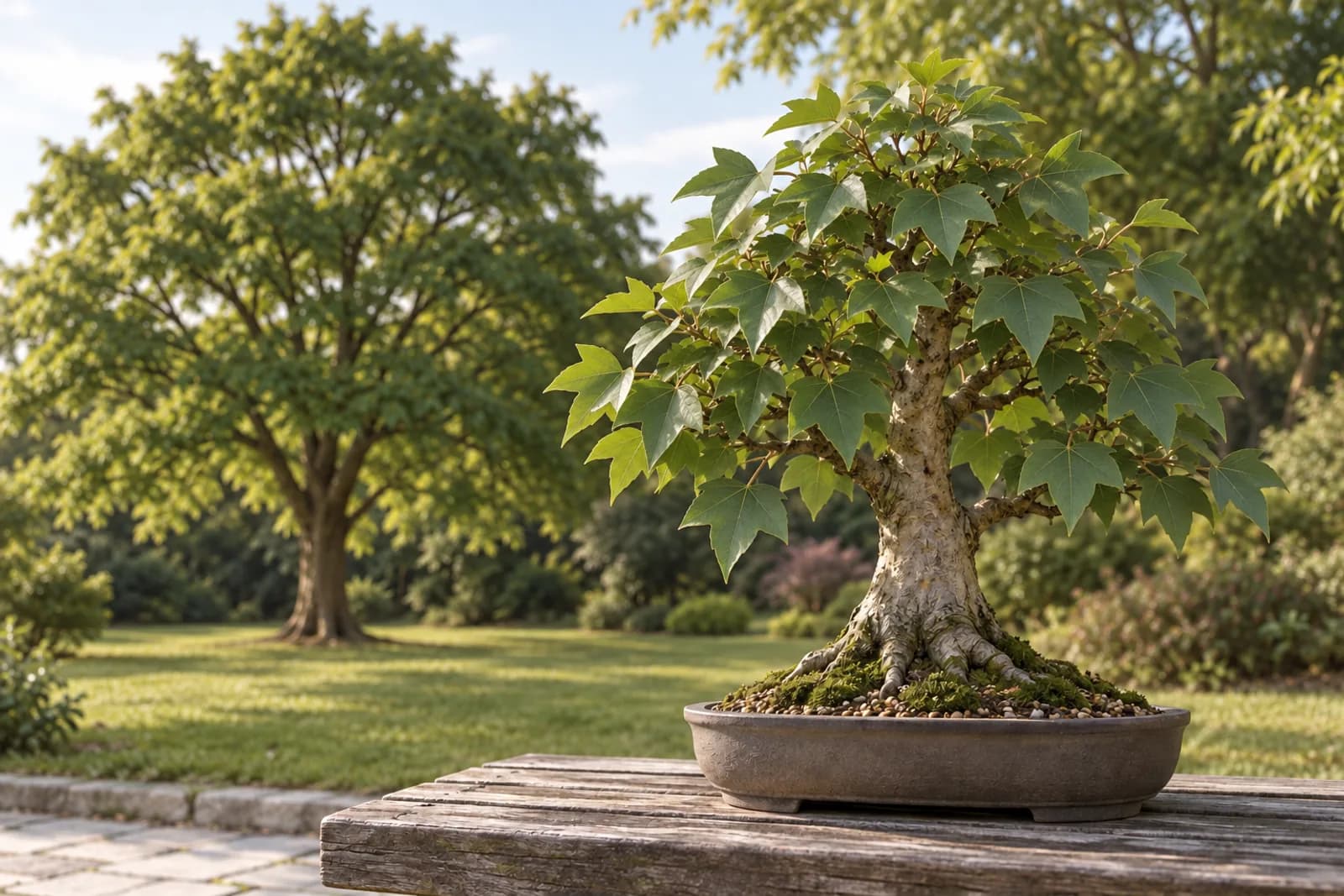
Picture two trident maples. One grows in a park, about as tall as a two-story house. The other sits in a shallow pot on a wooden bench, about as tall as your arm from elbow to fingertip. Their leaves have the same three-pointed shape, their buds sit in the same pairs along each shoot, and in spring both push out new growth from those buds. Inside both, every living cell is doing the same work.
The small one is not a different kind of plant. It is the same kind of tree, grown in a different way. So how can it stay small for decades and still be healthy?
An ordinary tree, grown in a particular way
The word bonsaiA woody plant, usually a tree or shrub, grown in a container and shaped over many years so it suggests a mature tree at a small scale. The word is Japanese, roughly “planted in a tray or pot,” and names a practice, not a kind of plant.Open the glossary is Japanese and means, roughly, “planted in a tray or container.” It names a practice, not a plant: growing a tree in a container and shaping it over many years so that it suggests a mature tree at a small scale. Bonsai developed in Japan from penjingThe Chinese art of growing and shaping trees, and sometimes whole miniature landscapes with rocks and water, in containers. It is the older tradition from which bonsai developed in Japan.Open the glossary, an older Chinese art of growing trees and miniature landscapes in containers, and is now practiced worldwide. Course 08, Bonsai Design and Styling, will cover its history and culture.
Every bonsai is a woody plantA plant, such as a tree, shrub, or woody vine, whose stems live above ground from year to year and grow thicker by adding layers of hard, long-lived tissue. Every bonsai is an ordinary woody plant, not a special kind of plant.Open the glossary: a tree, shrub, or woody vine whose stems live above ground from year to year and thicken as they age. There is no separate group of bonsai plants, no bonsai gene, and no such thing as a bonsai seed; a packet sold as “bonsai seeds” holds the seeds of ordinary trees. The junipers, maples, elms, pines, and figs grown as bonsai are the same plants found in gardens and forests.
Two words help you say exactly what a tree is. A speciesA group of closely related plants or animals that share distinctive features and usually breed with one another, given a two-part scientific name such as Acer buergerianum for the trident maple. Knowing a tree's species tells you much about its growth and care.Open the glossary is a group of closely related plants that share distinctive features and usually breed with one another. Each has a two-part scientific name: the trident maple is Acer buergerianum. A cultivarA cultivated variety: a plant selected for particular traits, such as compact growth, small leaves, or unusual color, and kept consistent through propagation, often by cuttings or grafting. Cultivar names appear in single quotes, as in Juniperus procumbens ‘Nana’.Open the glossary is a cultivated variety, selected for traits such as compact growth or small leaves and kept consistent through propagation. Its name follows the species name in single quotes, as in Juniperus procumbens ‘Nana’, a compact Japanese garden juniper. Even a compact cultivar grows every year.
Three instructional example trees return throughout this course, all ordinary nursery plants: the nursery juniper, a young plant of that cultivar that keeps its short, prickly needles all year; the trident maple, which drops its leaves each autumn; and the ficus (Ficus microcarpa), a broad-leaved tree from warm climates that keeps its leaves all year.
What a small tree still needs
Shrinking a tree does not shrink its biology. A bonsai's leaves, buds, and roots are made of the same kinds of living cells as a park tree's, and those cells need the same things:
- Light. Leaves use light energy to make sugars in photosynthesisThe process in which green plant cells use light energy to combine carbon dioxide from the air with water, making sugars and releasing oxygen. It is how a tree makes the carbohydrates that it builds with and runs on.Open the glossary (Lesson 6).
- Water. Roots take it up, and it moves to the leaves, where most of it evaporates (Lesson 2 and Lesson 8).
- Air. Leaves take in carbon dioxide to make sugars. Every living cell, roots included, uses oxygen day and night to release energy from sugars, a process called respirationThe process in which living cells break down sugars using oxygen to release energy they can use, giving off carbon dioxide and water. It runs in every living cell of a tree, in leaves, stems, buds, and roots, both day and night. Without oxygen, cells fall back on fermentation.Open the glossary (Lesson 7). Roots get that oxygen from air spaces around them.
- Mineral nutrients. mineral nutrientA chemical element, such as nitrogen, potassium, or iron, that a tree needs and takes up through its roots from the water around them. Mineral nutrients help build and run cells, but they supply no energy and only a small share of the tree's mass.Open the glossary are elements such as nitrogen, potassium, and iron, taken up by the roots from the water around them (Lesson 10).
- Suitable temperatures through the seasons. The trident maple and the nursery juniper need a cool winter rest outdoors; the ficus is damaged by frost (Lesson 13).
Food is missing from that list because a tree makes its own. Its leaves use light energy to combine carbon dioxide and water into sugars, which the tree also turns into starch for storage and cellulose for new cell walls. Sugars, starch, and cellulose are all carbohydrateSugars and the larger compounds built from them, such as starch and cellulose, all made of carbon, hydrogen, and oxygen. Trees make their own carbohydrates from carbon dioxide and water using light energy, then use them as both building material and fuel.Open the glossary: the tree's building material and its fuel. Mineral nutrients are essential but supply no energy. fertilizerA product that supplies mineral nutrients, such as nitrogen, phosphorus, and potassium, for roots to absorb. It supplies no energy or carbohydrates that the tree can use, so it cannot make up for too little light or too few healthy leaves, and too much can harm roots.Open the glossary, which supplies them, cannot make up for too little light or too few healthy leaves, so this course does not call it “food.”
To see what depends on size and what does not, move the “Tree size” slider one step at a time from “Mature tree” to “Small bonsai.” After each step, compare the two leaves in the “One leaf” panel, then read the two cards below them. Then turn on “Show what it needs” and step through the sizes again.
Interactive
From full-size tree to bonsai
For scale: an adult, about 1.7 m (5 ft 7 in) tall
One leaf
Real leaf
Bar: about the width of an adult palm
Stays about the same size
If it shrank with the tree
Full size: the same leaf
Changes with size
- Height
- About 6–9 m (20–30 ft)
- Roots grow in
- Open ground, often spreading wider than the canopy
- What sets its size
- Its species, age, and growing site
The soil around the roots holds a large reserve of water and air and changes slowly.
Stays the same at every size
- Kind of plant
- The same species: trident maple, a woody tree
- Leaf size
- About the same; it never shrinks in proportion to the tree
- Carbohydrates
- Made by the tree itself from carbon dioxide and water, using light
- Needs
- Light: energy the leaves use to make carbohydrates
- Water: taken up by the roots
- Air: carbon dioxide for the leaves; oxygen for the roots and every living cell
- Mineral nutrients: dissolved in water and taken up by the roots
Plus suitable temperatures through the seasons
Text description
A trident maple drawn at five sizes, from a mature tree in a park to a small bonsai in a pot on an outdoor garden bench. The drawing keeps the same trunk, branches, and canopy shape at every size. An adult stands beside the tree at the larger sizes, and an adult hand appears beside the smaller bonsai, for scale. A separate panel shows one real leaf, which stays about the same size throughout, beside the leaf the tree would have if leaves shrank in proportion to it. The root-zone buffer is the reserve of water and air around the roots.
- Mature tree: about 6–9 m (20–30 ft). Roots: open ground, often spreading wider than the canopy. Size set by: its species, age, and growing site. A leaf in proportion would be full size: the same leaf. Root-zone buffer: very large. The soil around the roots holds a large reserve of water and air and changes slowly.
- Young tree: about 3 m (10 ft). Roots: open ground, often spreading wider than the canopy. Size set by: mostly its age: it is still growing. A leaf in proportion would be about two-fifths the size. Root-zone buffer: large. The soil around the roots holds a large reserve of water and air and changes slowly.
- Large bonsai: about 1 m (3 ft). Roots: a container that limits how far the roots can spread. Size set by: a container and pruning; material choice and design keep it in proportion. A leaf in proportion would be about one-eighth: the size of a fingernail. Root-zone buffer: moderate. A container holds far less water and air than open ground, so conditions change faster.
- Medium bonsai: about 40–60 cm (16–24 in). Roots: a container that limits how far the roots can spread. Size set by: a container and pruning; material choice and design keep it in proportion. A leaf in proportion would be about one-fifteenth: the size of a rice grain. Root-zone buffer: small. A smaller container dries faster and can also stay too wet, so it needs closer observation.
- Small bonsai: about 20 cm (8 in). Roots: a container that limits how far the roots can spread. Size set by: a container and pruning; material choice and design keep it in proportion. A leaf in proportion would be about one-fortieth: a speck. Root-zone buffer: very small. The smallest containers change fastest. A small bonsai needs the closest observation, not less care.
Real leaves do not shrink with the tree. With refinement, a bonsai's leaves can become somewhat smaller, but never in proportion, which is why design and proportion create the impression of a large, old tree.
What stays the same at every size: the species, the leaf size, the carbohydrates the tree makes for itself from carbon dioxide and water using light, and its needs. It needs light, the energy its leaves use to make carbohydrates; water, taken up by the roots; air, meaning carbon dioxide for the leaves and oxygen for the roots and every living cell; and mineral nutrients, dissolved in water and taken up by the roots; plus suitable temperatures through the seasons. The “Show what it needs” switch adds arrows from each of these to the canopy and the root zone, and the arrows are the same at every size. In open ground they reach the roots through the soil; in a pot, water, air, and mineral nutrients arrive through the surface of the potting mix.
Everything in the “Changes with size” card is about size and setting, including the root-zone buffer: the reserve of water and air around the roots, which falls from Very large in open ground to Very small in the smallest pot. The other card holds the biology, and with the needs switched on, the same arrows reach the leaves and the root zone at every size. The real leaf stays about the same size too; if it shrank with the tree, it would be a grain of rice on the medium bonsai and a speck on the small one.
Practice check · not scored
What actually keeps a bonsai small
If a bonsai's needs do not shrink, something else must keep it small. Before reading on, sort eight things people do to keep a bonsai small. Each card explains itself after you choose, and you can change any answer.
Exercise
What keeps a bonsai small?
Growing it in a container that limits how far the roots can spread
Withholding fertilizer so the tree cannot grow
Shortening new shoots after they have extended
Keeping it in a dim corner to slow it down
Choosing a tree with naturally small leaves and short gaps between them
Letting it wilt between waterings to toughen it up
Designing proportions so a small tree reads as an old, large one
Stripping most of its leaves every few weeks to stop it growing
Text description
Eight practices to sort into two groups. Practices that keep a bonsai small and healthy work with the tree's biology: they limit or redirect growth while the tree keeps enough healthy foliage and a full supply of light, water, air, and mineral nutrients. Practices that starve or stress the tree remove one of those supplies, or the foliage that uses them.
- Growing it in a container that limits how far the roots can spread
- Withholding fertilizer so the tree cannot grow
- Shortening new shoots after they have extended
- Keeping it in a dim corner to slow it down
- Choosing a tree with naturally small leaves and short gaps between them
- Letting it wilt between waterings to toughen it up
- Designing proportions so a small tree reads as an old, large one
- Stripping most of its leaves every few weeks to stop it growing
Each card reveals an explanation after you choose. You can change any answer.
Four things work together, and none depends on withholding light, water, air, or mineral nutrients. Two of them limit how large the tree grows; the other two make a small tree look in proportion.
A container. A tree's crown and roots grow in relation to each other. In open ground, roots often spread beyond the edge of the canopy. A pot limits how far they can go, and a limited root system tends to support a smaller canopy. The container limits size without stopping growth: a healthy bonsai still makes new roots, new shoots, and a little more wood every year.
Pruning. Each growing season, a healthy bonsai extends its shoots. Pruning removes some of that extension, so the outline stays about the same size while the tree keeps growing. It takes some leaves with it, but the tree keeps enough healthy foliage to go on making carbohydrates. Course 09, Pruning and Managing Growth, will teach how and when.
Material choice. In bonsai, “material” means the plant you start with. Species and cultivars with naturally small leaves and short stretches of stem between them stay in proportion at a small size more readily.
Design and proportion. Much of what makes a bonsai look old and large is design: a trunk that tapers from a broad base, branches arranged as they might be on an old tree, open space between them, and a suitable pot. Your eye reads those proportions and fills in the scale, even though a trident maple bonsai has, more or less, trident maple leaves. With dense, fine branching, the leaves of many trees become somewhat smaller, but nowhere near in proportion. Proportion, not miniature biology, does the work.
Each of the four practices that starve or stress the tree takes something away: light, water, mineral nutrients, or the healthy foliage that makes its carbohydrates.
Go deeper · optional, not assessedWhy a container limits the whole tree
When the same kind of plant is grown in containers of different sizes, plants with less root space generally grow smaller tops, even when water and mineral nutrients are kept plentiful. So the effect is not only a shortage of supplies. Researchers think several factors contribute, including chemical signals from crowded roots that influence shoot growth; the details vary among species and are still being studied.
Small is not the same as starved
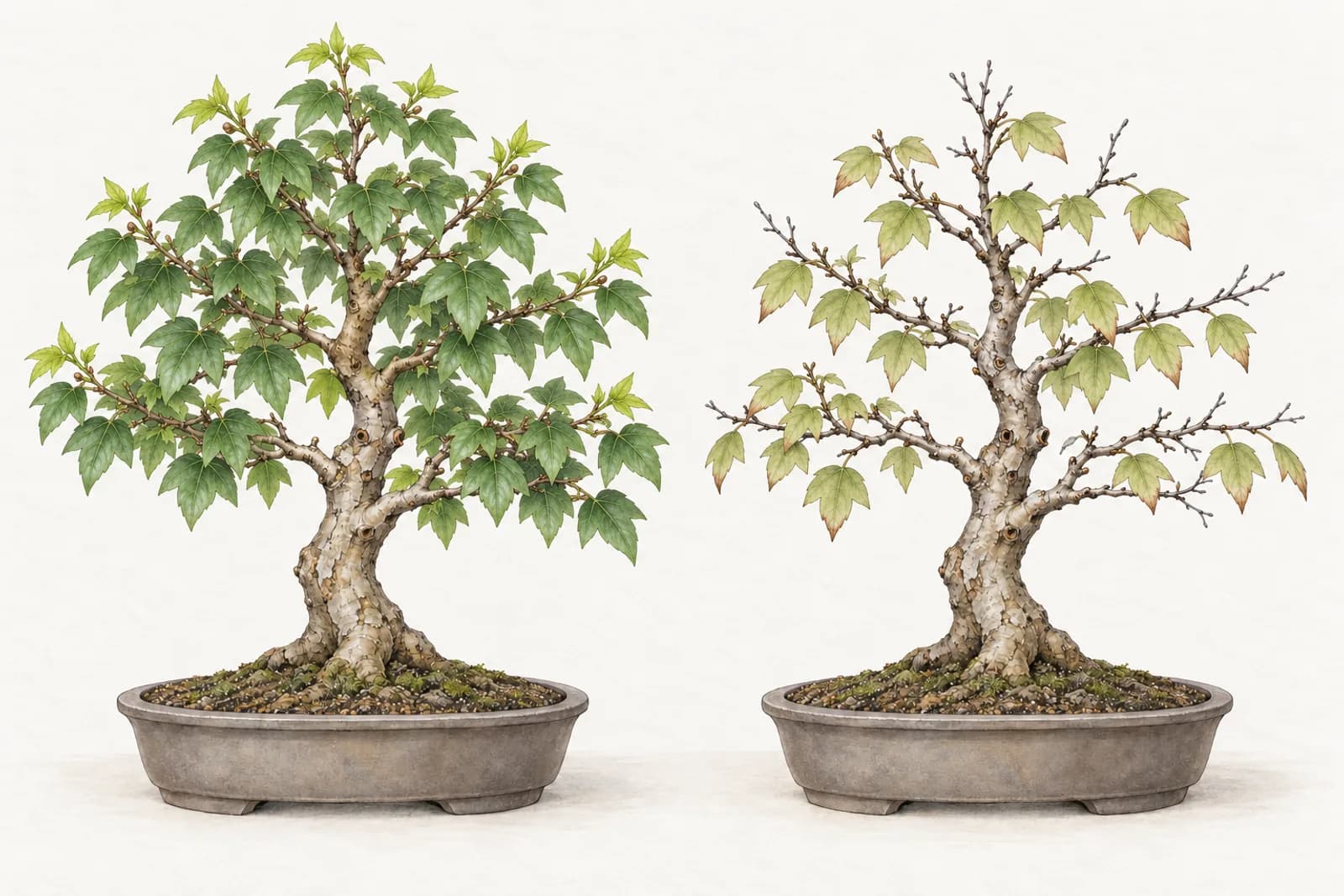
Starvation and size control can look alike for a while, because both can keep a tree small. The difference shows over months and years. A healthy small tree carries full, well-colored foliage, makes new shoots and buds in its growing season, and responds when pruned. A deprived tree carries sparse or pale foliage, makes little new growth or only thin, stretched shoots, and gradually loses twigs.
Small does change one thing about care: how closely you need to watch. A pot holds a far smaller reserve of water and air than open ground, so on a hot or windy day it can dry out much faster than a garden bed. It can also stay too wet. After watering, water tends to linger in the lower part of a container instead of draining away into the ground below, and roots in persistently waterlogged potting mix can run short of oxygen (Lesson 7). So a bonsai typically needs closer observation than a tree in the ground, not less care. Course 03, Watering and Daily Observation, will turn that into a routine.
Practice check · not scored
Health comes first
A healthy tree grows, and growth is what bonsai is built from. New shoots give you branches to choose among, buds give you places for new growth after a cut, and thickening trunks and branches add taper and age. A tree that cannot grow cannot respond to pruning, wiring, or repotting, however skillfully it is styled.
So the first job is always to keep the tree healthy, and that starts with understanding how it works. The rest of this course builds that understanding in three sections: tree structures, continuing with roots; resources and transport, beginning with photosynthesis; and growth through time, beginning with seed and seedling. The later courses these lessons name by number, such as Course 03, Watering and Daily Observation, are still being prepared.
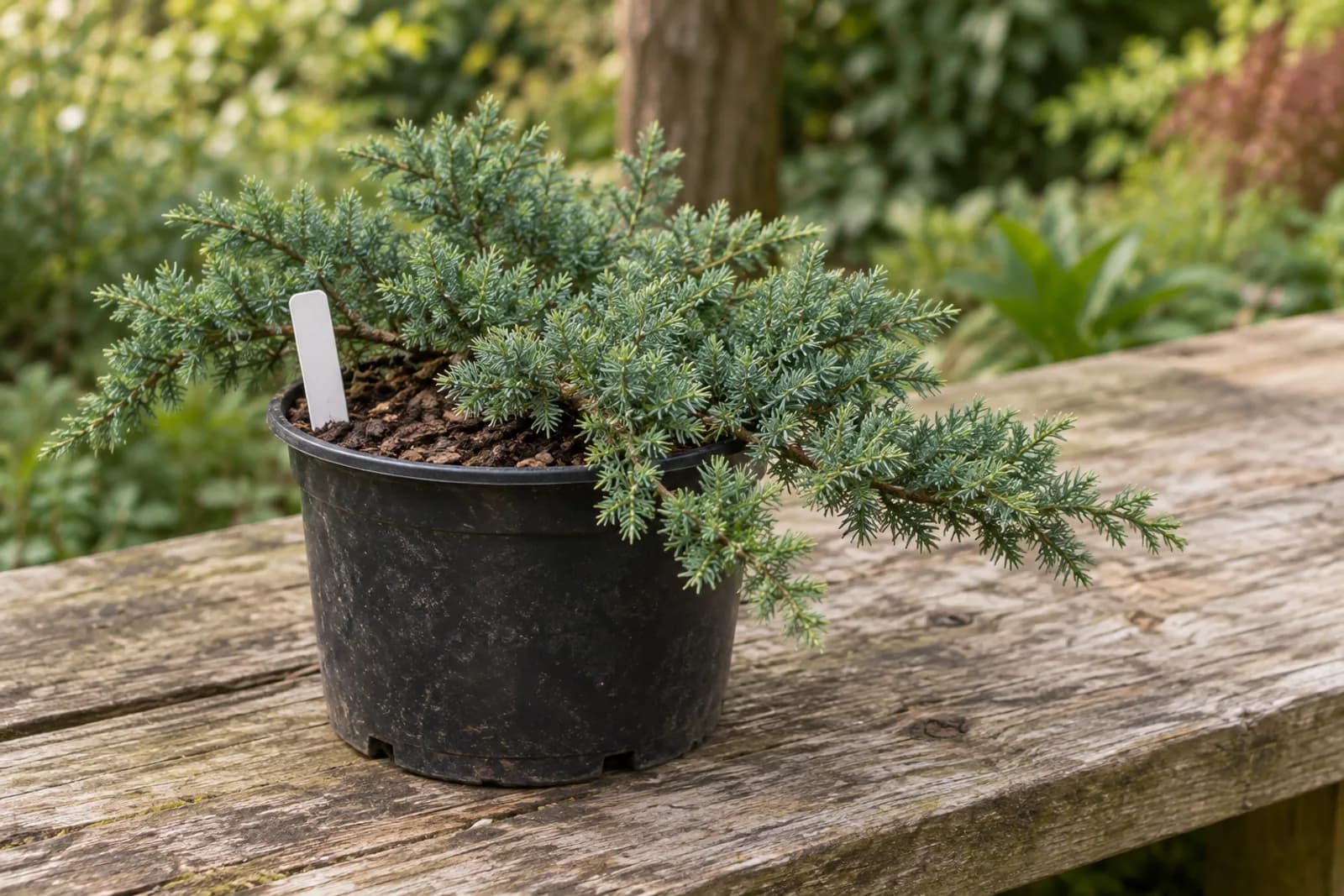
That understanding pays off the first time you bring a tree home. Take the nursery juniper, an instructional example, sold with a tag that calls it an “indoor bonsai.” Like most junipers grown as bonsai, it is an outdoor tree that needs full outdoor light, which even a bright room cannot match, and the seasons, including a cool winter rest. Kept indoors, such junipers usually decline, often too slowly to notice at first. Nothing on the shelf warns you; only knowing what the tree is tells you the tag is wrong.
The bonsai decision
A new tree: learn what it is before you change it
Starting point
Before pruning, wiring, or repotting a newly acquired tree, find out what it is and where it should live. Identify it at least to species, checking any label against a reliable reference; a tag such as “indoor bonsai” names no species. Learn whether it is an outdoor tree that needs the seasons or one that can live indoors in strong light, and place it to suit. A tree kept indoors, in a heated shop, or in a greenhouse has foliage not yet adjusted to full sun, wind, or frost, so move it into its new conditions in stages. Make sure the pot has drainage holes and is not standing in water. Then watch it for a few weeks: its foliage, its new growth, and how quickly the potting mix dries. Course 02, Choosing a Tree and Creating Its Growing Environment, will cover identification, placement, and this gradual adjustment, called acclimation.
This assumes
- The tree is alive and shows no sign of urgent trouble. - You can look at it often during its first weeks with you. - Nothing about its shape needs to change now.
Change course if
Some problems cannot wait. If the foliage is wilting, check the root zone first: wilting can come from roots that are too dry or from roots that cannot take up water, such as damaged or waterlogged ones (Lesson 8). A juniper may show water stress only as dull or grayish foliage, so check its root zone rather than wait for wilting. If the root zone is dry well below the surface, water it thoroughly now. Before frost, move a frost-sensitive tree such as the ficus, or any new tree that has been kept warm, somewhere frost-free (Lesson 13). Wire already cutting into the bark needs to come off (Lesson 3). If you cannot identify the tree, ask a local bonsai club or specialist nursery before deciding where it spends the winter. Course 07, Tree Health and Diagnosis, will cover first response.
Back to the question
How can a tree stay small and still be healthy?
A tree stays small because of how it is grown: a container limits its roots, pruning removes some of each season's extension, suitable material helps, and design creates the impression of age and scale. It stays healthy because its needs are still met in full: light, water, air, mineral nutrients, and suitable seasons, with enough healthy foliage to make its carbohydrates. Being small does not reduce those needs, and a small container calls for closer attention, not less.
Key takeaways
- A bonsai is an ordinary woody plant grown in a container and shaped over years. “Bonsai” names a practice, not a kind of plant. - Size changes; needs do not. Every bonsai needs light, water, air (carbon dioxide for leaves, oxygen for every living cell), mineral nutrients, and suitable seasons. - A tree makes its own carbohydrates from carbon dioxide and water, using light. Fertilizer supplies mineral nutrients, not food. - A container, pruning, material choice, and design keep a tree small. Depriving it of light, water, air, or nutrients, or repeatedly stripping most of its foliage, makes it weak.
- A small root zone has a small buffer, so a bonsai needs closer observation, not less care.
Optional · not required for completion
Compare a tree and a bonsai
Find a tree growing in the ground and a bonsai, your own or one at a nursery, ideally of the same kind. List three things they share, such as bark, leaves or needles, and buds. Then find one thing in the bonsai that makes it look older or larger than it is, such as a broad, tapering trunk, roots spreading at the surface, or the arrangement of its branches.
No tree? If there is no tree or bonsai nearby, use two photographs instead: a bonsai from a public collection's website and a full-size tree of the same kind.