Course 01 · Lesson 4 of 14 · Tree structures
Leaves and needles: working surfaces
Foliage is where a tree captures light and exchanges gases. See why every leaf or needle you remove or shade changes the tree's resources, not only its outline.
The question
Why does keeping healthy foliage matter when shaping a tree?
By the end of this lesson, you will be able to:
- Explain how chloroplasts in leaves and needles capture light to make carbohydrates.
- Explain how stomata balance taking in carbon dioxide against losing water.
- Predict how removing or shading foliage changes a tree's resource supply as well as its silhouette.
About 15 minutes to read and explore
When you look at a bonsai with scissors in hand, you see a silhouette: the line of the trunk, the outline of the canopy, a crowded spot you would like to open up. The tree experiences something else. Every leaf or needle is a working surface that supplies the rest of the tree, and each one you remove leaves the tree less to work with, whatever happens to the outline.
What leaves and needles do
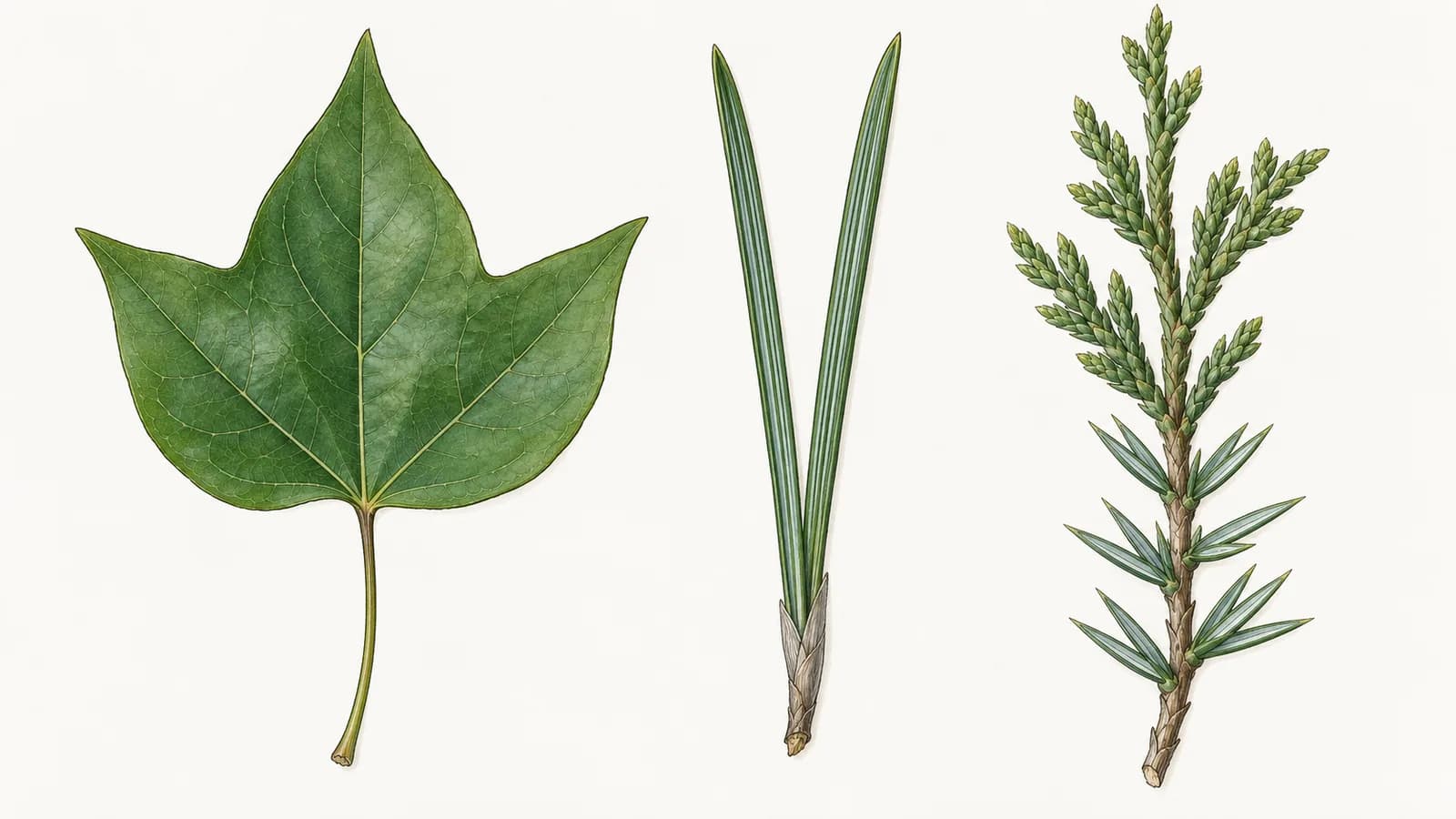
foliageA tree's leaves or needles considered together: the living surfaces where light is captured, carbohydrates are made, and gases and water vapor pass to and from the air. The amount, health, and light exposure of the foliage largely set how much carbohydrate a tree can make, one of the main limits on its growth.Open the glossary is the general word for a tree's leaves or needles. The three-lobed leaves of the trident maple, the glossy leaves of the ficus, and the short needles of the nursery juniper all do the same three linked jobs:
- They capture light, the energy behind nearly everything a tree builds.
- They carry out gas exchangeThe movement of gases between a plant's tissues and the surrounding air. In leaves it happens mainly through stomata, as carbon dioxide and oxygen pass in and out and water vapor escapes; roots and stems also take in oxygen from the air around them.Open the glossary with the air. In light they take in carbon dioxide and release oxygen, and they lose water vapor; their living cells also use oxygen for respiration, day and night.
- They make carbohydrateSugars and the larger compounds built from them, such as starch and cellulose, all made of carbon, hydrogen, and oxygen. Trees make their own carbohydrates from carbon dioxide and water using light energy, then use them as both building material and fuel.Open the glossary, the sugars and related compounds that become wood, roots, buds, and new leaves, and that fuel the tree's living cells.
Inside a leaf, layer by layer
A flat leaf, like the trident maple's, is a fraction of a millimeter thick, yet it is built in layers, each with a job. From the top down:
- The cuticleA thin, waxy, water-resistant film covering the outer surface of leaves, needles, and young stems. It greatly slows water loss through the leaf surface, so most of a leaf's water vapor escapes through the stomata instead.Open the glossary: a thin, waxy film that greatly slows water loss from the surface.
- The upper epidermis: usually a single layer of clear cells that protects the leaf and lets light through.
- The mesophyllThe inner tissue of a leaf between its upper and lower surfaces, packed with chloroplast-rich cells where most photosynthesis happens. Loosely arranged cells with air spaces between them let carbon dioxide reach every cell.Open the glossary, the leaf's working interior. Tall, tightly packed palisade cells directly under the upper epidermis catch most of the light. Below them, the looser spongy layer has air spaces between its cells, so gases can reach every cell.
- Veins, running through the mesophyll, each bringing water in through its xylem and carrying sugars out through its phloem, the transport tissues you traced through the trunk in Lesson 3.
- The lower epidermis, dotted with microscopic pores called stomaA microscopic pore (plural: stomata), mostly on leaves and needles, through which gases pass in and out, chiefly carbon dioxide entering and water vapor leaving. A pair of guard cells widens or narrows each pore in response to light, the water supply, and the surrounding air.Open the glossary (one pore is a stoma). Two curved guard cellOne of the two curved cells around each stoma that swell with water to open the pore and lose water to close it. Guard cells balance carbon dioxide intake against water loss, responding to light, carbon dioxide, the leaf's water supply, and the hormone abscisic acid, which leaves make as water runs short and which may also arrive from drying roots.Open the glossary surround each pore and control how wide it opens. On many trees with flat leaves, most or all of the stomata are on the underside.
How chloroplasts capture light
Mesophyll cells hold many tiny green bodies called chloroplastA tiny green structure inside leaf cells and other green cells where light energy is used to make sugars from carbon dioxide and water. It holds chlorophyll, the pigment that captures that light.Open the glossary, most densely in the palisade layer. Chloroplasts are packed with chlorophyllThe green pigment in chloroplasts that absorbs light, most strongly red and blue, and passes its energy into sugar-making. It absorbs green less strongly, so leaves reflect and transmit more green than other colors and look green, though a leaf still absorbs most of the green light that reaches it.Open the glossary, a pigment that absorbs red and blue light strongly and green light less well, so leaves reflect more green than other colors and look green.
Chloroplasts use that captured energy to join carbon dioxide from the air with water from the roots, building sugars and releasing oxygen. This is photosynthesisThe process in which green plant cells use light energy to combine carbon dioxide from the air with water, making sugars and releasing oxygen. It is how a tree makes the carbohydrates that it builds with and runs on.Open the glossary, the subject of Lesson 6. The leaf's layers bring its three supplies together in the same cells: light through the upper surface, water through the veins, and carbon dioxide through the stomata.
Needles and scales: same jobs, different packaging
A broadleafA flowering tree or shrub with flat, typically broad leaves, such as a maple, elm, oak, or ficus, as distinct from a conifer. Broadleaves can be evergreen or deciduous, tropical or temperate, so the label alone does not tell you how to care for one.Open the glossary tree, such as the trident maple or the ficus, has flat, usually wide leaves and bears its seeds in flowers and fruits. A coniferA tree or shrub that bears seeds in cones, which are berrylike in junipers, instead of in flowers and fruits, and usually has needle-like or scale-like leaves. Most conifers are evergreen, but larches and a few others drop their needles each autumn.Open the glossary, such as a pine, juniper, or larch, usually has needle-like or scale-like leaves and bears its seeds in cones (berrylike ones, in junipers).
Conifer foliage has the same chloroplasts and stomata and does the same jobs, though a needle or scale usually has one or two veins along its center instead of a branching network. Much of it is built to lose less water. A thick cuticle slows water loss. The stomata are often sunken in small pits and lined up in rows; on many pines and junipers, those rows show as pale lines or bands along the needles, whitened by wax. Many conifers, including pines, also carry resin canals, a defense against insects.
Many junipers carry two forms: prickly, needle-like juvenile foliage and adult foliage of tiny scales pressed flat against the shoot. Some junipers, including the nursery juniper's cultivar, keep needle-like foliage as mature plants, so foliage shape alone does not show whether a juniper is old enough to produce cones.
A second pair of words describes how long leaves last. An evergreenDescribes a tree that keeps living foliage all year, replacing old leaves or needles gradually instead of all at once. Keeping foliage does not mean a tree grows all year: temperate evergreens such as junipers still go dormant in winter.Open the glossary keeps living foliage all year, replacing it gradually; a deciduousDescribes a tree that drops all its leaves for part of each year, usually before winter or a dry season, and grows new ones when growth resumes. Most deciduous trees are broadleaves, like the trident maple, but a few conifers, such as larches, are deciduous too.Open the glossary tree drops all its leaves for part of each year and grows a new set when growth resumes. The two pairs combine in every direction:
| Evergreen | Deciduous | |
|---|---|---|
| Broadleaf | Ficus, boxwood | Trident maple, most other maples |
| Conifer | Nursery juniper, pines | Larches, bald cypress |
Tropical or temperate is a third, separate description, which Lesson 13 takes up. None of these labels, on its own, tells you how to care for a tree.
Stomata: one doorway, two directions
Photosynthesis needs carbon dioxide, and stomata are its way in: the cuticle that keeps water in also keeps gases out.
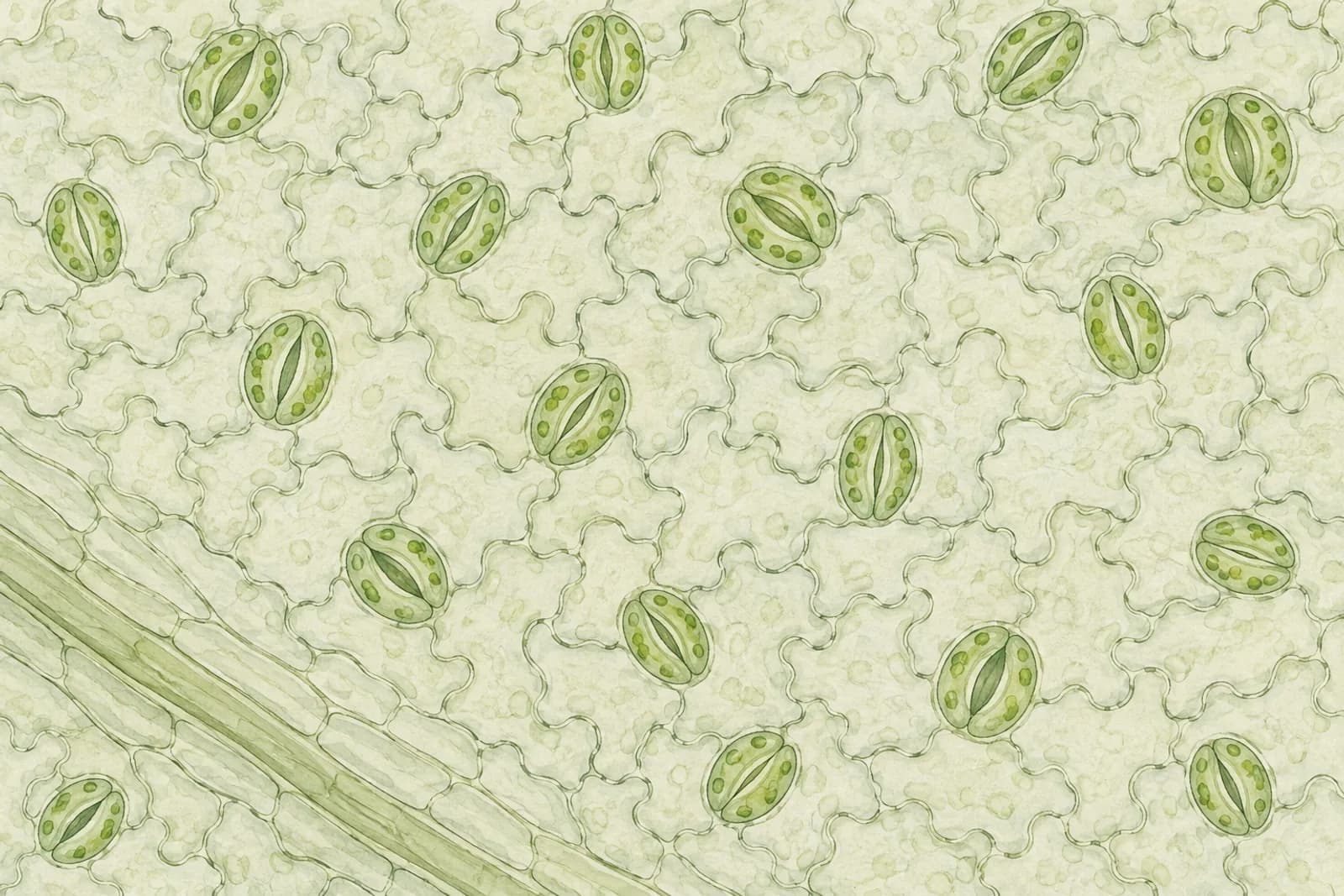
Opening a stoma has a cost. The inside of a leaf is moist and the air is usually drier, so whenever a stoma opens to let carbon dioxide in, water vapor escapes through the same opening. This loss of water vapor is transpirationThe evaporation of water from inside a plant and its escape as vapor, mostly through the stomata of leaves. As water evaporates, more is pulled up from the roots through the xylem; most of the water a tree absorbs is lost this way.Open the glossary, and it is not small: a leaf loses hundreds of water molecules for each molecule of carbon dioxide it takes in, and most of the water a tree absorbs leaves this way (Lesson 8).
So every leaf and needle lives with a tradeoff, and its guard cells manage it: they swell and open the pore when they take up water, and close it when they lose water. Answer the prediction at the top of the simulation first. Then change one condition at a time, watching the guard cells and the Carbon dioxide entering and Water vapor leaving meters, and try Night and Drought.
Simulation
Stomata at work
Try a scenario
Predict first
On a sunny morning with moist roots, the stomata are wide open. By afternoon the air is hot, dry, and windy, and water at the roots is limited. What will the stomata do?
Stomata
Wide open
Bright light and moist roots: the guard cells take up water, swell, and bow apart, opening the pores wide.
Tradeoff. Wide-open pores let plenty of carbon dioxide in for photosynthesis. The price is water: even in humid, still air, a moderate amount escapes.
Text description
A magnified cross-section of a broadleaf leaf, from top to bottom: a waxy cuticle; the upper epidermis, a single layer of clear cells; the palisade layer, tall cells packed with chloroplasts; the spongy layer, loosely arranged cells with air spaces between them, with a vein running through it, its xylem bringing water in and its phloem carrying sugars out; and the lower epidermis, where one stoma is enlarged. Two guard cells surround the stoma's pore, which opens into an air space inside the leaf. A second view shows the stoma from below: two kidney-shaped guard cells joined at their ends, the pore between them, and jigsaw-shaped epidermal cells around them.
Carbon dioxide (dotted purple circles) moves from the outside air through the pore and into the air spaces, toward the chloroplasts. Water evaporates from the cells into the air spaces and leaves through the same pore as water vapor, an invisible gas, drawn as small blue wisps. When the guard cells take up water, they swell and bow apart, opening the pore. When they lose water, the pore narrows or nearly closes. When water runs short, a dashed line from the vein to the guard cells shows a hormone signal reaching them. Readouts name the opening (nearly closed, narrow, partly open, or wide open) and rate carbon dioxide entering, water vapor leaving, and the air's drying pull in words.
You can set four conditions:
- Light: bright light lets stomata open wide, dim light only part way. In darkness they close most of the way, though many leaves keep them slightly open overnight. Without light there is no photosynthesis, so no carbon dioxide is taken in; the leaf's cells keep respiring, so a little carbon dioxide drifts out instead.
- Air humidity: dry air pulls water vapor out faster through any opening.
- Wind: moving air also speeds water loss through any opening, though less than dry air does, and the two together pull hardest.
- Root water supply: plentiful, limited, or scarce.
Before reading on, predict: on a sunny morning with moist roots, the stomata are wide open. By afternoon the air is hot, dry, and windy, and water at the roots is limited. Will the stomata open wider, partly close, or stay the same?
Check your prediction
They partly close, to a narrow slit. As water at the roots runs short, the leaf's own water supply falls and a hormone signal builds up at the guard cells, while the dry, windy air pulls water out faster than the roots can replace it, so the guard cells lose water. With very little water at the roots, stomata close almost completely, even in bright light. Dry air on its own leads many leaves to narrow their stomata part way, even when the roots are moist. In this simplified model wind alone does not close them; it mainly speeds water loss, though strong wind can lead some leaves to narrow their stomata.
The result is a tradeoff. Open stomata let in carbon dioxide for photosynthesis but lose water vapor. Closing them saves water but limits carbon dioxide, so photosynthesis slows. On the afternoon, water loss is still higher than on the calm morning, because the air pulls so hard, but far less than wide-open pores would lose in that air. Stomata are regulated through the day, not simply open by day and closed at night, and real responses vary by species, leaf age, and conditions.
Three tendencies drive what you saw. Light opens stomata: wide in bright light, part way in dim light, and mostly closed in darkness, when no carbon dioxide comes in. A shortage of water at the roots narrows them through a hormone signal that builds up at the guard cells; when water is very short, they close almost completely, even at midday. Dry air pulls water out faster through any opening without bringing in any more carbon dioxide, and wind sweeps away the moist air at the leaf surface, which speeds water loss while doing little for carbon dioxide uptake. Many leaves respond to dry air by narrowing their stomata part way.
Narrowing always trades one gas against the other. On the hot, dry, windy afternoon, the pores narrowed to a slit. Water loss was still higher than on the calm morning, but far below what wide-open pores would lose in that air, and carbon dioxide fell from high to low, so sugar-making slowed. A bonsai in a small pot can run short of water quickly on such a day, and its stomata may narrow well before any leaf wilts. A tree often short of water makes less to grow with, even if it never looks stressed.
Practice check · not scored
Go deeper · optional, not assessedHow guard cells open and close
In light, guard cells use energy to pump out hydrogen ions, and the electrical pull this creates draws in potassium and other dissolved particles. Water follows by osmosis, moving toward where dissolved material is more concentrated, so the guard cells swell. Tough bands of cellulose in their walls let them lengthen but not widen much, so the pair bows apart and the pore opens. When the particles leave, water follows, and the pore narrows.
The water-shortage signal is a hormone called abscisic acid, or ABA. Some of it may travel from roots in drying soil, and leaves also make it as their own water supply falls; how much each source contributes is still being studied. Guard cells also respond to blue light, to the carbon dioxide inside the leaf, and to an internal daily rhythm that anticipates dawn and dusk. Wind's effect varies: it mainly speeds water loss, though strong or persistent wind can lead some species to narrow their stomata.
Chlorophyll absorbs green light less strongly than red or blue, but light scatters back and forth inside a leaf, so an intact leaf still absorbs most of the green light that reaches it.
A few succulent plants grown as bonsai, such as jade (Crassula) and Portulacaria, can work the other way around, opening their stomata mainly at night to save water, especially in dry conditions. They take in carbon dioxide in the dark and store it until daylight, when their chloroplasts can use it.
Which foliage makes the most sugar
How much carbohydrate a tree can make depends on its working surface: how much healthy foliage it has, how much light that foliage receives, and what condition it is in.
Predict first
The tree that lost its sunny outer leaves loses much more. Those leaves made the largest share of its sugars; the shaded interior leaves made little. Removing the outer leaves lets more light reach the ones beneath, but leaves that grew in shade cannot make full use of it right away, so that covers only part of the loss.
Test your prediction on the model tree. Remove pad 10, deep in the shade, then restore it and remove pad 1 at the top. Then compare Remove 3 shaded pads with Remove 3 sunny pads, and switch Tree condition to the weak tree.
Simulation
Silhouette or supply?
Outer outlineUnchanged
The full silhouette.
Compared with this tree’s full canopy.
What changed
Start with a shaded pad deep inside the canopy, such as pad 10. Then remove a sunny pad at the top or outside, such as pad 1, and compare what changes in each picture.
Foliage pads
Select a pad to remove it. Select it again to restore it.
Interior pads: lightLow
Dense outer pads shade them. Interior foliage that stays heavily shaded tends to weaken over time.
Ability to rebuildGrowing well
A full working surface and good stored reserves. This tree has a margin to respond to shaping.
Text description
A stylized bonsai with twelve foliage pads appears twice. “What you see” shows the tree as a viewer does: every pad is the same green, and removing pads changes the outline. “What the tree experiences” shows the same tree in sunlight from above and slightly to the left. Each pad is shaded by how much light reaches it, and small dashes show sugars leaving each pad toward the trunk. That direction is a simplification: in a real tree, sugars travel wherever they are being used or stored, up to shoot tips and new leaves as well as down to the roots.
The pads, and the light each receives on the intact tree:
- Pad 1: top, full sun.
- Pad 2: upper left, full sun.
- Pad 3: upper right, full sun.
- Pad 4: center, inside, deep shade (beneath pad 1).
- Pad 5: middle left, outer, full sun.
- Pad 6: middle left, inner, shade (beneath pad 2).
- Pad 7: middle right, inner, shade (beneath pad 3).
- Pad 8: middle right, outer, partial sun (beneath pad 3).
- Pad 9: lower left, outer, partial sun (beneath pad 5).
- Pad 10: lower left, inner, deep shade (beneath pad 5).
- Pad 11: lower right, inner, deep shade (beneath pad 8).
- Pad 12: lower right, outer, full sun.
The model’s rules: carbohydrate production depends on how many pads remain and how much light each receives. Pads in full sun make the most; pads in deep shade make very little. Removing a pad that shades another lets more light reach the pad beneath it, but foliage that grew in shade cannot immediately make full use of brighter light, so this makes up only part of the loss. Removing interior pads leaves the outline unchanged. When every pad on a branch is removed, the branch has no foliage left, and whether it can regrow depends on whether the tree produces new shoots from buds on bare wood.
The tree’s condition changes what the same removal means. A healthy, vigorous tree has good stored reserves and can regrow foliage from them and from the foliage that remains. A weak tree after recent repotting has low reserves, and its new roots depend on sugars from the foliage, so removing foliage deepens its deficit. The model gives both trees the same light; in reality a recently repotted tree may also make less carbohydrate while its roots recover.
Two comparison buttons remove three pads each from the full tree: the three pads in deep shade, or the three sunny pads at the top.
The two pictures disagree on purpose. Removing the three shaded pads left the outline unchanged and barely moved production; removing the three sunny pads changed the outline and cut production sharply. Each layer of foliage shades the one beneath, so the top and outside of a canopy make the largest share, while leaves deep inside may get only a small fraction of full sun. Switching Tree condition changed the outlook but not the production meter, for reasons the next section explains.
Shading works the same way without a cut. Foliage that gets less light, whether under dense growth above or in a dim spot indoors, makes less, though the outline does not change. Inner shoots that stay in deep shade tend to weaken, and on bonsai they are often the first to thin and die back (Course 14, Refinement and Long-Term Stewardship).
What this means when you shape a tree
When you remove foliage, the tree loses what that foliage was making. It rebuilds from the foliage that remains and from reserves stored in its wood and roots, and each new leaf imports sugars until it is well grown (Lesson 9). On many conifers, needles work for several years, so a branch's foliage builds up over several seasons and is slow to replace. Fertilizer cannot fill the gap: it supplies mineral nutrients, not carbohydrates.
How much the loss matters depends on the tree's condition. A healthy, vigorous tree, one growing strongly for its kind and the season, generally has the reserves and remaining foliage to rebuild, though new growth tends to come where light is good. A weak or recently repotted tree may not: its new roots already depend on sugars from its leaves, so the same removal deepens its shortfall. Judge condition from growth seen over several observations (Lesson 14), not from leaf color alone, which has many possible causes (Course 07, Tree Health and Diagnosis). Deliberately removing most or all of the leaves is a technique for particular vigorous trees and aims, not routine maintenance; Course 14 will cover it.
Where the foliage sits matters too. Take an instructional example: you strip the inner half of a branch and leave a tuft of foliage at its tip. The trident maple can generally regrow along that bare stretch later. The nursery juniper may never do so, because like many junipers it does not reliably produce new buds on bare, older wood (Lesson 5). Interior foliage makes little sugar, but it may be where future growth has to come from.
Practice check · not scored
The bonsai decision
Keep the working surface you'll need
Starting point
Before you shape, notice where the healthy, well-lit foliage is, usually toward the top and outside. Plan removals so that the tree as a whole, and every branch you want to keep growing, keeps healthy foliage in good light. Course 09, Pruning and Managing Growth, will teach how much to remove and where to cut.
This assumes
- The tree is otherwise healthy and growing as expected for its kind and the season. - It grows in light suited to its kind, and its foliage is in good condition. - The removal is for shape, not to deal with damaged or diseased foliage.
Change course if
- The tree is weak, its foliage is thin or slow to grow, or it was recently repotted: defer elective foliage removal and let the foliage work while it recovers. - It grows in low light, such as indoors away from a bright window: defer removal, since each leaf is already making less, and address the light first. - You do not know whether its kind regrows from bare wood, or it is known not to, as with many junipers: keep foliage on every part of the branch where you will want growth later. - After a removal, new growth is sparse, late, or weaker than the tree's usual pattern: hold off further elective removal and keep observing over several checks (Lesson 14).
Back to the question
Why does keeping healthy foliage matter when shaping a tree?
Leaves and needles capture light, take in carbon dioxide through stomata regulated against water loss, and make the carbohydrates the rest of the tree depends on. Removing or shading them changes that supply, not only the silhouette, by an amount that depends on the light the foliage was getting and on the tree's condition. Keeping enough healthy, well-lit foliage lets the tree rebuild and keeps growth possible where you will want it.
Key takeaways
- Chlorophyll in chloroplasts captures light, and that energy builds sugars from carbon dioxide and water. - Stomata let carbon dioxide in and water vapor out through the same pores; guard cells balance the two in response to light, root water, and the air, not as a simple day-and-night switch. - Broadleaf or conifer and evergreen or deciduous are separate descriptions, and neither alone tells you how to care for a tree. - Removing well-lit outer foliage costs far more supply than removing shaded interior foliage, but interior foliage may be where future growth has to come from, especially on trees, like many junipers, that do not reliably bud on bare wood. - A vigorous tree can usually regrow lost foliage where it still has buds; a weak or recently repotted tree may not be able to afford the loss.
Optional · not required for completion
Find the stomata
With a hand lens or a phone camera's zoom, compare the top and underside of a broadleaf leaf: the underside, where most stomata are, is often paler and less glossy. Then look closely at a few pine or juniper needles. Individual stomata are too small to see without a microscope, but on many needles their rows show as pale lines or bands. Which face of the needle are they on?
With a microscope, a dried peel of clear nail polish lifted from a leaf's underside with tape shows the paired guard cells.
No tree? A houseplant, a street tree, or a park conifer works as well; a fallen leaf or needle is enough.