Course 01 · Lesson 8 of 14 · Resources and transport
Water transport and transpiration
Water is pulled from the pot to the leaves by evaporation, not pumped. Learn what drives that flow and why a tree can wilt in wet media when its roots cannot keep up.
The question
Why might wind make a recently repotted tree wilt?
By the end of this lesson, you will be able to:
- Trace the path of water from the substrate through roots, xylem, and leaves to the air.
- Explain how transpiration and water-potential differences drive water movement.
- Explain why reduced roots and high evaporative demand can cause wilting in wet media, and why moderating exposure can help more than adding water.
About 15 minutes to read and explore
Picture the trident maple, one of this course's instructional example trees. Two weeks ago it was repotted, and some of its roots were trimmed to fit the new pot. This afternoon is sunny and windy, and its leaves hang limp, the soft tips of its new shoots bent over. Yet below the surface, the substrateThe material that fills a container and surrounds a tree's roots, such as a mix of mineral grit, bark, or soil. Its job is to anchor the roots and to hold water, mineral nutrients, and air in a balance the roots can use.Open the glossary is still wet.
Watering again feels like the obvious response, but the pot is already wet. To decide what would help, follow water from the pot to the air, and find out what pulls it along and what sets its pace.
Follow the water from pot to air
In a leafy tree in daylight, water follows one continuous route upward. Trace it on the tree transport map: press “Start tracing” and step through the six numbered stops with “Next,” using the two circles that magnify a young root and the inside of a leaf. Then turn on “Minerals,” choose it under “Route to trace,” and see where the minerals part company with the water.
Interactive
Tree transport map
Inside a leaf
Around a young root
Trace the route
Follow water one step at a time, from where it enters to where it ends up. The numbered markers show each stop.
What the map shows
- Water Water enters fine roots from thin films around substrate particles, rises through the xylem in the wood, and leaves through stomata as vapor.
Water and the minerals taken up by roots rise in the xylem; sugars travel in the phloem, carried in water drawn from the xylem. They are separate channels that trade water side by side, not one circulating sap.
Text description
A small broadleaf tree in a shallow pot. The pot is cut away to show substrate particles and roots. A window in the lower trunk shows its layers from the outside in: outer bark, phloem (the inner bark), a thin cambium, and xylem (the wood), crossed by rays of living storage cells. Two magnified circles show the inside of a leaf, with a vein and a stoma on its lower surface, and a young root with root hairs among substrate particles, water films, and air spaces.
Water. Water enters fine roots from thin films around substrate particles, rises through the xylem in the wood, and leaves through stomata as vapor.
- Water films around particles. In a moist substrate, water clings as thin films around particles and fills the narrowest gaps between them. The larger gaps hold air.
- Into root hairs and young roots. Water enters near the root tips, where young roots and, in many trees, their root hairs reach into those films. Root hairs add a great deal of absorbing surface. Some trees, pines among them, grow few root hairs and depend more on partner fungi (mycorrhizae, not shown).
- Across the root into the xylem. Water crosses the root's outer tissues toward its center. A selective inner layer controls what passes, and then water enters the xylem, which carries it toward the trunk.
- Up through the sapwood. In the trunk, water rises in the xylem of the outer wood, the sapwood. Its conducting cells are hollow tubes. In a leafy tree, the pull comes from evaporation at the leaves; the tree does not pump water up.
- Out into branches and leaf veins. The xylem continues through every branch and into the veins of each leaf, where water reaches the cells around the veins.
- Out through the stomata. Inside the leaf, water evaporates from wet cell walls into air spaces, and the vapor diffuses out through open stomata. This loss of water vapor is transpiration. Most of the water a tree absorbs leaves this way.
Minerals. Dissolved mineral ions are absorbed by living root cells, then ride the water stream up the xylem to leaves and growing points. They do not leave with the water vapor. Some, such as nitrogen and potassium, can later move again in the phloem to newer growth or, before autumn leaf fall, into storage.
- Dissolved in water films. Mineral nutrients such as nitrogen, potassium, and iron are present as dissolved ions in the water films around substrate particles. Roots can take up only what is dissolved.
- Absorbed by living root cells. Root cells take up ions through transport proteins in their membranes. Much of this uptake uses energy from respiration, so it depends on live roots with oxygen, sugar, and suitable warmth. On many trees, partner fungi (mycorrhizae, not shown) gather some ions for the roots, especially phosphorus.
- Carried up with the water. Inside the xylem, ions ride the water stream up the trunk and out along the branches.
- Delivered to leaves and growing points. When the water evaporates and leaves through the stomata, the minerals stay behind in the leaf. Leaves and shoot tips build some, such as nitrogen and magnesium, into chlorophyll, proteins, and new cells. Others, such as potassium, stay dissolved and help cells manage water.
Water and the minerals taken up by roots rise in the xylem; sugars travel in the phloem, carried in water drawn from the xylem. They are separate channels that trade water side by side, not one circulating sap.
Water entered young roots from the films around substrate particles, crossed to the root's center, and rose in the xylemThe tissue that carries water and dissolved minerals from the roots up through the trunk and branches to the leaves, mostly through hollow cells that are dead when they work. Built up in layers year after year, xylem makes up a tree's wood.Open the glossary through the trunk and branches to the leaf veins. Inside a leaf, it evaporated from wet cell walls into the air spaces and left through the stomaA microscopic pore (plural: stomata), mostly on leaves and needles, through which gases pass in and out, chiefly carbon dioxide entering and water vapor leaving. A pair of guard cells widens or narrows each pore in response to light, the water supply, and the surrounding air.Open the glossary as vapor, the loss called transpirationThe evaporation of water from inside a plant and its escape as vapor, mostly through the stomata of leaves. As water evaporates, more is pulled up from the roots through the xylem; most of the water a tree absorbs is lost this way.Open the glossary (Lesson 4). Minerals rode the same stream but cannot evaporate, so they were left behind, mostly in the leaves (Lesson 10). Sugars travel separately, in the phloem (Lesson 9).
Two parts of that route need a closer look. The first is where water gets in, because repotting disturbs it; the second is the pipes that carry it up.
Where water gets in
Much of the water enters near the growing ends of the fine roots, through young root surfaces and, in many trees, root hairA tiny, hairlike outgrowth of a single cell on a root's surface, a short way behind the growing tip, that greatly increases the area for absorbing water and minerals. Some trees, such as pines, grow few and rely more on fungal partners. Root hairs are fragile and short-lived, so disturbing roots destroys many of them and temporarily reduces uptake.Open the glossary that reach into the water films (Lesson 2). Root hairs are delicate and short-lived, and they are among the first things lost when a root ball is disturbed.
Go deeper · optional, not assessedThe root's gatekeeper, and root pressure
Near the center of a root, water meets a ring of cells called the endodermis, whose side walls are sealed by a waterproof band of lignin, the same material that stiffens wood. To get past, water and whatever is dissolved in it must cross a living cell membrane, so the root, not the substrate, largely controls which minerals reach the xylem (Lesson 10).
This seal also makes root pressure possible. When roots load minerals into the xylem while the leaves are losing little water, as at night or in spring before the leaves open, water follows and builds a gentle push from below. Cut grapevines and birches can drip sap in spring because of it, and some plants bead their leaf edges with droplets on humid nights, called guttation and often mistaken for dew. But root pressure is weak, and in many trees it is absent for most of the year. A leafy tree on a sunny day is supplied by a pull from above.
The pipes
The xylem's conducting cells are dead when they work: each builds a stiff wall and dies, leaving a hollow tube (Lesson 3). Most broadleaf trees, including the trident maple and the ficus, have vesselA long tube in the xylem of most broadleaf trees, made of hollow, dead cells joined end to end with open or perforated end walls. Their width lets vessels move water quickly.Open the glossary, stacks of these cells joined end to end through open end walls into long pipes. Conifers such as the nursery juniper rely instead on tracheidA long, narrow, hollow xylem cell, dead when working, with tapered ends that pass water to neighboring cells through small pits in their walls. Conifer wood is made mostly of tracheids, which both conduct water and support the tree.Open the glossary, narrower cells with closed, tapering ends that pass water sideways to their neighbors through thin spots called pits. Either way, the tubes link into unbroken pipelines from the young roots to the leaf veins.
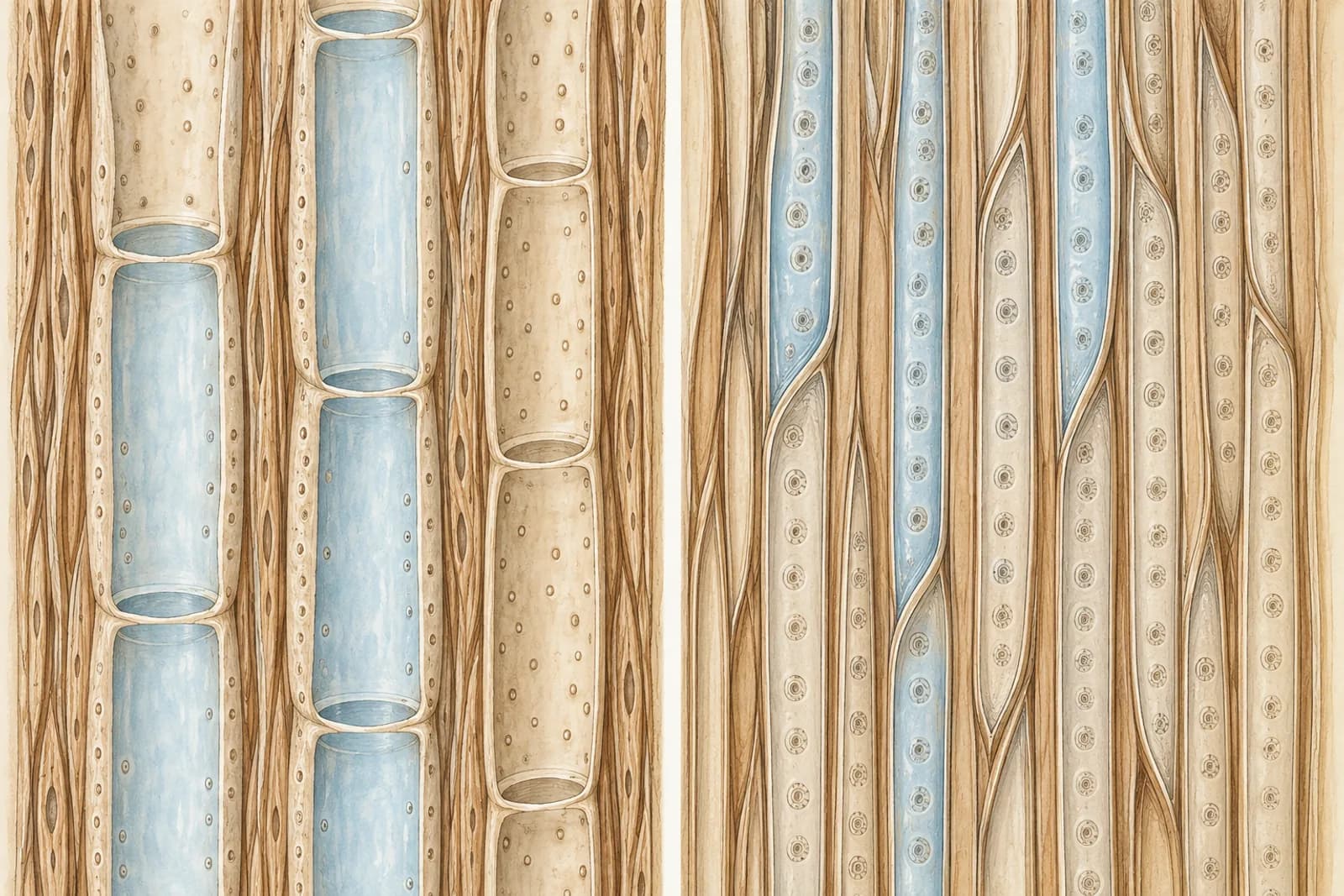
What pulls water up a tree
As the sun's warmth drives evaporation from the wet cell walls inside a leaf, the water film left behind is stretched thinner and pulls on the water behind it, drawing more from the nearest vein. Because water molecules cling strongly to each other and to the tube walls, that pull passes down unbroken columns all the way to the roots, which draw in more from the substrate. Water behaves a little like a rope: pull on the top, and the whole length moves. This widely accepted explanation is called cohesion–tensionThe widely accepted explanation of how water rises in trees: evaporation from leaves pulls on water in the xylem, and because water molecules cling to each other and to cell walls, the pull passes down unbroken columns to the roots. The tree does not pump water upward.Open the glossary: cohesion holds the columns together, and tension is the pull.
To predict which way water will move, scientists use water potentialA measure of water's tendency to move from one place to another, lowered by dissolved substances, by suction, and by attraction to surfaces. Water moves from higher to lower water potential, which is why it flows from moist substrate, through the tree, into drier air.Open the glossary, a measure of water's tendency to move. Water always moves from higher water potential to lower, the way a ball rolls downhill: from moist substrate, through root and leaf cells, to the air, lowest of all. Evaporation keeps the leaf end of that slope low, and the tension in the xylem carries its pull down to the roots. Except in very humid air, the leaf-to-air step is by far the steepest, and dry air steepens it further, so the air around the leaves, and the stomata that guard that step, have the most say over the flow. At the other end, a drying substrate holds its last water more and more tightly, so roots find it harder to draw.
Go deeper · optional, not assessedWater potential in a little more detail
Water potential sums up everything that affects water's tendency to move. Dissolved substances lower it, which is how cells take in water by osmosis. Attraction to surfaces lowers it: water in thin films and narrow gaps is held tightly, and more tightly as a substrate dries. Tension, as in the xylem on a sunny day, lowers it. Pressure, such as the water pressure inside a firm cell, raises it. Water potential is measured in units of pressure, with pure water at rest set at zero, so nearly every value inside a tree is below zero, and dry air is far lower still.
Practice check · not scored
Sun, dry air, and wind set the pace
Only a small part of the water a tree absorbs stays to build new cells and supply photosynthesis. Most of it, often estimated at well over nine-tenths, evaporates from the leaves. That is not waste: transpiration is the price of letting carbon dioxide in through open stomata (Lesson 6), and it also carries minerals up from the roots and cools leaves in strong sun. For a bonsai, a small pot is a small reservoir, and how fast a leafy tree empties it depends less on the calendar than on the conditions around its leaves.
How strongly the air draws water vapor out of leaves is called evaporative demandHow strongly the surrounding air draws water vapor from leaves, rising with sun, heat, dry air, and wind. High evaporative demand can make a tree lose water faster than reduced or damaged roots can replace it.Open the glossary. It rises with sun, which heats the leaves and supplies the energy for evaporation, and with warm air, dry air, and wind.
Wind works in a particular way. Every leaf is wrapped in a thin layer of slow-moving air, its boundary layerA thin layer of slow-moving, more humid air next to the surface of a leaf or needle, which slows the escape of water vapor into the open air. Wind thins this layer, increasing water loss.Open the glossary, where vapor from the stomata collects and slows further loss. Wind thins that layer and brings in drier air, so vapor escapes faster, the same reason laundry dries faster on a breezy day. In most conditions, more wind means more water loss, and wind combined with strong sun and dry air can raise demand sharply.
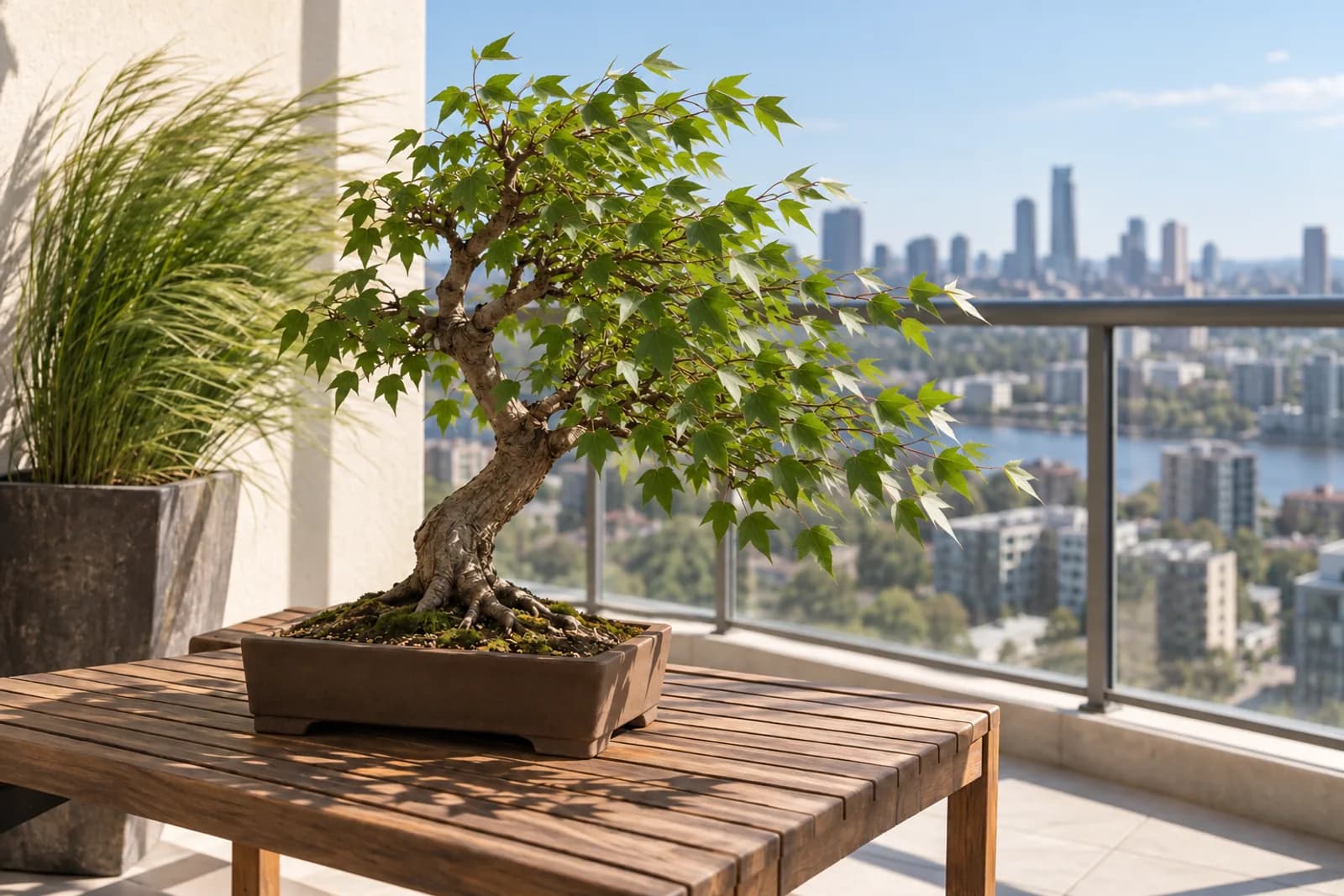
The tree cannot change the weather, but it can narrow its stomata.
Predict first
Water loss would drop to a trickle through the leaves' waxy cuticle, and the flow up the trunk would nearly stop. But photosynthesis would nearly stop too, because carbon dioxide enters through the same pores, and the leaves would warm without evaporation to cool them. So stomata usually narrow well before they shut, trading some sugar-making for water saved. Regulation trims the loss; it does not cancel it.
Wilting: when loss outruns supply
The soft cells of a leaf are held firm by turgorThe pressure of water inside plant cells pushing against their walls, which keeps soft tissues such as leaves and young shoots firm. When cells lose water faster than they gain it, turgor drops and the tissues go limp.Open the glossary, water pressure inside each cell pushing out against its wall, much as air pressure firms a tire. When the leaves lose water faster than the roots replace it, for long enough, their cells lose turgor, and the leaves and soft shoot tips go limp. That is wiltingDrooping of leaves or soft shoots when their cells lose turgor because water loss has outpaced uptake. It can come from a dry root zone, but also from damaged or reduced roots, very high demand, or blocked xylem, even when the substrate is wet.Open the glossary.
Not every tree shows it clearly. Needles, scale leaves, and thick, leathery leaves are stiffened by tough tissues, so a thirsty juniper may show only dull, grayish foliage and drooping soft tips before parts of it brown. With such trees, check the root zone rather than wait for droop.
Mild wilting on a hot afternoon often reverses as the sun drops and uptake catches up. Wilting that lasts, or keeps returning, cuts into the tree's sugar-making, and a severe shortage can kill leaves, shoot tips, and fine roots.
Wilting tells you the balance has tipped, not why. Loss can outrun supply in several ways:
- The root zone is dry, leaving too little water to take up.
- The roots cannot absorb enough, because they have been reduced by root pruning, injured, chilled, rotted, or left short of oxygen in a root zone kept saturatedDescribes soil or substrate whose pore spaces are completely filled with water, leaving little or no air. Brief saturation right after watering is normal in a pot that drains; saturation that lasts starves roots of oxygen.Open the glossary (Lesson 7).
- The root-zone water is too salty, often from fertilizer building up, so roots struggle to draw it in (Lesson 10).
- Demand is very high, with intense sun, heat, dry air, and strong wind together.
- The pipes are blocked or broken, by diseases that plug the xylem or by damage to the wood.
Go deeper · optional, not assessedWhen a water column breaks
Water under tension can snap like a stretched rope. In severe drought, the pull can draw an air bubble into a xylem tube; freezing and thawing can also release bubbles from the sap. The bubble breaks the column, an embolismA blockage in a xylem pipe caused by an air bubble that breaks its water column, often during severe drought or after freezing and thawing. A blocked pipe stops carrying water, so the tree relies on its other pipes and on new wood to replace that capacity.Open the glossary, and that tube stops carrying water, leaving the tree to rely on its other tubes and, in time, on new wood. Narrow tracheids are generally less prone to embolism from freezing than wide vessels. Broken tubes do not all refill, which is one reason a severe drought can leave lasting damage.
Why the repotted maple wilts
Repotting removed some of the maple's roots, and the handling broke many of the root hairs and young root tips that did much of the absorbing. Until new fine roots grow out into the fresh substrate, its capacity to take up water stays low. On a mild, still day, that may be enough. On a sunny, windy afternoon, demand rises past it, and the leaves wilt in a wet pot.
Practice check · not scored
Now test your answer in the water balance simulation, which weighs what the roots can supply against what the leaves lose, for a tree much like the maple. Choose “Repotted, sunny and windy,” read the “Why” panel, and press “Try it” on the change marked “Helps most.” Then choose “Dry root ball” and see whether the same advice holds. Finally, return to “Repotted, sunny and windy” and set Sun to “Deep shade.”
Simulation
The water balance
Try a scenario
Uptake
What roots can supply
Established roots · moist root zone
Water loss
What leaves lose
Intense sun · breezy · dry air
Uptake keeps pace with loss
LeavesFirm
Uptake keeps pace with loss
LeavesFirm
Sets uptake
Choose Wet to try a root zone that stays saturated for days.
Sets water loss
Why
Uptake keeps pace with loss, so the leaves stay firm.
Working roots in a moist root zone can match even high water loss.
What would help most here?
Nothing needs fixing. On days like this, check the moisture below the surface more often.
Text description
A balance compares two rates for a small potted tree. The left pan holds uptake: the water the roots can supply. The right pan holds water loss: the water vapor the leaves lose, mostly through their stomata (transpiration). When loss outweighs uptake, the leaf cells lose turgor, the water pressure that keeps them firm, and the leaves go from firm to slightly limp to wilting.
What sets uptake:
- Root system. Established roots supply the most. Roots recently reduced by repotting, with fewer fine roots and root hairs, supply much less. Damaged or rotting roots supply the least.
- Root-zone moisture. A dry root zone leaves almost nothing to take up. Moist and wet supply the same: extra water does not raise uptake. A root zone that stays saturated for days lowers uptake, because roots short of oxygen work poorly.
What sets water loss, the evaporative demand:
- Sun. Loss rises from deep shade (under a dense canopy) to bright sun to intense sun.
- Wind. A breeze, and more so a strong wind, thins the layer of slow, humid air around each leaf (the boundary layer), so water vapor escapes faster.
- Air. Dry air draws water vapor out of the leaves faster than humid air.
- When uptake falls short, the stomata partly close and trim the loss, but in daylight they cannot stop it.
The four scenarios:
- Established tree, hot afternoon (established roots, a moist root zone, intense sun, a breeze, dry air): uptake keeps pace with loss, and the leaves stay firm.
- Repotted, sunny and windy (roots reduced by repotting, a wet root zone, intense sun, strong wind, humid air): loss far exceeds uptake, and the leaves wilt even though the root zone is wet. Watering again does not help; moving the tree out of the wind and the harshest sun does.
- Repotted, bright and sheltered (roots reduced by repotting, a wet root zone, bright sun, no wind, humid air): uptake keeps pace with loss, and the leaves stay firm.
- Dry root ball (established roots, a dry root zone, bright sun, a breeze, humid air): the leaves wilt, and would wilt in any weather, until the root zone is watered.
Whenever the leaves are not firm, the simulation compares the changes a caretaker could make, such as watering, letting a saturated root zone drain, or reducing exposure. It marks the one that would help most when a change today can firm the leaves. When none can, it says so and names the next step, such as letting a saturated pot drain or finding out why the roots are failing.
Other cases to explore:
- A wet root zone saturated for days: the roots are short of oxygen and take up less. Watering again makes it worse. Letting the pot drain lets air back in, so surviving roots can work better over the following days, but it does not firm the leaves the same afternoon; reducing exposure is what helps today.
- Damaged or rotting roots: reducing exposure narrows the gap but cannot repair the roots, so the next step is to find out why they are failing.
- Reduced roots in deep shade: water loss is low and the leaves stay firm, but leaves need light to make the sugars new roots are built from, so bright, sheltered light suits recovery better.
What the drawing shows: the balance tips toward whichever rate is larger, with water drops piled in the uptake pan and vapor puffs in the loss pan. Beside it, a tree stands in a cutaway pot. Recently repotted roots end in pale cut ends with a few new white tips; damaged roots are dark with rot patches. The substrate looks pale and shrunken from the pot wall when dry, darker with blue water films when moist or wet, and fully flooded, with water standing on the surface, when saturated for days. Blue dots climb the trunk as water is taken up (arrows when the animation is paused), fewer when uptake is low, and dotted puffs drift from the leaves as vapor; the sun grows brighter with rays in intense sun and disappears behind a dense overhead canopy in deep shade, streaks show the wind, and a light haze shows humid air. The leaves and soft shoot tips droop as the tree wilts.
With reduced roots in a wet root zone, “Water again” offered no help: the roots were already taking up all they could. Reducing exposure brought the loss down to what they could supply, and the leaves firmed with nothing changed below ground. With the dry root ball, the advice reversed. The same drooping leaves called for opposite responses, and only the root zone told them apart. Deep shade firmed the repotted tree's leaves too, but the simulation flagged its cost: too little light slows recovery.
Helping the roots keep up
When reduced roots are the limit, lower the demand but keep the light. Darkness or deep shade cuts water loss, but leaves need light to make sugar, and new roots are built from sugar supplied by the leaves and by stored reserves (Lesson 9). Stripping leaves to “balance” lost roots is not a default response for the same reason: fewer leaves lose less water, but they also make less of what regrowing roots need. Course 03, Watering and Daily Observation, and Course 11, Repotting and Root Development, will cover watering and aftercare in detail.
The bonsai decision
When roots are reduced, manage exposure
Starting point
After repotting or other work that reduces or disturbs the roots, keep the tree in bright or lightly filtered light, sheltered from strong wind and from the harshest sun of the day. Check the moisture below the surface before watering (Lesson 2 describes how), and water when the root zone needs it, not because the leaves droop. Make sure the pot drains freely. Then return the tree to its usual spot gradually, a little more sun and wind at a time: move on only while new growth keeps extending and the leaves stay firm, and step back if they soften.
This assumes
- The roots were recently reduced or disturbed, and the tree was healthy before the work. - The root zone is confirmed wet below the surface, and the pot drains freely. - The tree is in leaf, and no frost is expected.
Change course if
- The root zone is actually dry: water it thoroughly now, since shelter cannot replace water the roots do not have. - The leaves are still wilted the next morning, or the tree keeps declining in its sheltered spot: suspect a root problem and investigate (Course 07, Tree Health and Diagnosis). - Water stands in the pot, or the root zone stays saturated for days: restore drainage before watering again. - Frost is possible: protect the tree from freezing (Course 06, Seasonal Care and Timing).
Back to the question
Why might wind make a recently repotted tree wilt?
Evaporation from the leaves pulls water up through the tree, so the roots must keep pace with whatever the leaves lose. Wind thins the humid boundary layer around each leaf and, with strong sun, drives evaporative demand up. Repotting left the maple with fewer fine roots and root hairs, so uptake fell behind, the leaf cells lost turgor, and the leaves wilted in a wet pot. A bright, sheltered spot lowers demand to what those roots can supply; more water cannot.
Key takeaways
- Water moves in one stream: from substrate films into young roots, up the xylem's vessels or tracheids, and out through the stomata as vapor. - Trees do not pump water. Evaporation pulls on unbroken water columns, and water moves from higher to lower water potential, from moist substrate to drier air. - Most absorbed water is transpired. Evaporative demand (sun, heat, dry air, and wind) drives the pace, and the stomata trim it when water runs short. - Wilting means loss has outpaced uptake. It is a symptom with several causes, not proof of a dry pot, and some trees, such as junipers, barely droop. - When reduced roots meet high demand in a wet pot, a bright, sheltered spot helps more than more water.
Optional · not required for completion
Catch transpiration in a bag
On a sunny day, slip a clear plastic bag over a leafy shoot of a garden shrub or street tree you are allowed to handle, not a bonsai you care about, and bag a similar shoot in shade. Close each loosely around the stem and look again within an hour: the fog inside is water that rose from the roots and left through the stomata. Which bag fogs first? Remove both when you are done.
No tree? Fill two identical glasses to the same mark. Set one in a steady breeze, outdoors or in front of a fan, and the other in still air in the same light. After a day or two, which lost more, and what was the moving air doing to the humid layer just above its water?