Course 01 · Lesson 6 of 14 · Resources and transport
Photosynthesis: building carbohydrates
A willow, a tub of soil, and five years of weighing. Find out where the material in new wood comes from, how leaves build it using light, and what fertilizer can and cannot do.
The question
Where does the material in new wood come from?
By the end of this lesson, you will be able to:
- Explain that photosynthesis uses light energy to build carbohydrates from carbon dioxide and water.
- Explain that most of a tree's dry mass is built from carbon taken from the air.
- Distinguish carbohydrates from mineral nutrients, and explain why fertilizer cannot replace light or lost foliage.
About 15 minutes to read and explore
Let a young trident maple grow freely for a few seasons, and its trunk thickens year after year. Every new layer of that wood is real material that you could cut, dry, and weigh. Where did it come from? Many people guess the soil, the way an animal's body is built from what it eats.
A willow, a tub, and five years
Nearly four hundred years ago, the Flemish physician Jan Baptist van Helmont tested that guess with a willow shoot, a tub of soil, and a set of scales. Make your prediction, then run the five years and watch the On the scale panel. At the final weighing, press Reveal the answer and step through How the willow built its wood.
Interactive
Van Helmont’s willow
Predict
In an experiment published in 1648, Jan Baptist van Helmont planted a willow shoot weighing about 5 pounds in a tub holding 200 pounds of dried soil. He covered the soil to keep out dust and, for five years, added nothing but water.
Choose one, then run the experiment.
Run the five years
Year
Planting0 of 5
A willow shoot weighing about 5 pounds goes into 200 pounds of dried soil. A perforated lid keeps out dust. From now on, only water is added.
On the scale
As reportedAdded: only water, whenever the soil needed it. The amount was not recorded.
Explain the result
Reach year 5 to see the final weighing. You can play the years or select 5 on the timeline.
Text description
This interactive retells an experiment published in 1648 by Jan Baptist van Helmont. He planted a willow shoot weighing about 5 pounds in a tub holding 200 pounds of soil that he had dried in a furnace. He covered the tub with a perforated metal lid to keep dust out, and for five years he added nothing but water. No fertilizer was added.
The illustration follows the five years. Each spring, buds open and new shoots grow; through each summer the shoots lengthen and the stem, branches, and roots thicken; each autumn the leaves turn yellow and fall. A cutaway in the tub shows roots spreading through the soil. Van Helmont did not weigh the leaves that fell in four autumns.
The weighings, as reported:
- Willow: about 5 lb at planting, and about 169 lb after five years, a gain of about 164 lb.
- Soil, dried: 200 lb at the start, and about 199 lb 14 oz after five years, a loss of about 2 oz.
Nothing was weighed between the start and the end. You predict where most of the material in the willow’s new wood came from: soil, water, fertilizer, or air. After the five years, an explanation gives feedback on each option and steps through a diagram of the tree.
The willow gained about 164 pounds while the soil lost about 2 ounces. Van Helmont concluded that the tree had been built from water, the only thing he added.
He was partly right. A living tree holds a great deal of water, probably around half of the weight he measured, and water also becomes part of its substance. But the willow had a second supply he could not weigh: the air around its leaves. Carbon dioxide is only a trace of the air, about four molecules in every ten thousand today, yet it supplied most of the solid material the willow built.
Photosynthesis: sugar from air and water
The process the willow was using is photosynthesisThe process in which green plant cells use light energy to combine carbon dioxide from the air with water, making sugars and releasing oxygen. It is how a tree makes the carbohydrates that it builds with and runs on.Open the glossary, a name that means “putting together with light.” It takes place in the chloroplastA tiny green structure inside leaf cells and other green cells where light energy is used to make sugars from carbon dioxide and water. It holds chlorophyll, the pigment that captures that light.Open the glossary, the tiny green bodies in leaf cells that you met in Lesson 4. Their green pigment, chlorophyllThe green pigment in chloroplasts that absorbs light, most strongly red and blue, and passes its energy into sugar-making. It absorbs green less strongly, so leaves reflect and transmit more green than other colors and look green, though a leaf still absorbs most of the green light that reaches it.Open the glossary, captures light energy, and the chloroplast uses that energy to join carbon dioxide and water into sugars, releasing oxygen:
carbon dioxide + water → sugar + oxygen, powered by light energy
Carbon dioxide enters through the stomaA microscopic pore (plural: stomata), mostly on leaves and needles, through which gases pass in and out, chiefly carbon dioxide entering and water vapor leaving. A pair of guard cells widens or narrows each pore in response to light, the water supply, and the surrounding air.Open the glossary, the leaf's adjustable pores, and water arrives from the roots through the xylemThe tissue that carries water and dissolved minerals from the roots up through the trunk and branches to the leaves, mostly through hollow cells that are dead when they work. Built up in layers year after year, xylem makes up a tree's wood.Open the glossary. Each ingredient supplies something different:
| Ingredient | What it supplies |
|---|---|
| Carbon dioxide | The carbon in sugar, and, on balance, its oxygen |
| Water | The hydrogen in sugar, and the oxygen gas released |
| Light | Energy, not material |
The best-known product is glucoseA simple sugar that plants form through photosynthesis and use both as fuel and as a basic building unit. Trees link many glucose units together to make starch for storage and cellulose for cell walls.Open the glossary, a simple sugar. Sugars are carbohydrateSugars and the larger compounds built from them, such as starch and cellulose, all made of carbon, hydrogen, and oxygen. Trees make their own carbohydrates from carbon dioxide and water using light energy, then use them as both building material and fuel.Open the glossary, and they carry energy as well as material: the light captured in the leaf is stored as chemical energy in the sugar.
Go deeper · optional, not assessedThe chemical equation and the two stages
Experiments in the late 1700s and early 1800s showed that green plants in light take in carbon dioxide and give off oxygen. In chemical formulas, the simplified overall reaction is 6CO₂ + 6H₂O → C₆H₁₂O₆ + 6O₂: six molecules of carbon dioxide and six of water become one of glucose and six of oxygen.
It runs in two linked stages. In the light-dependent reactions, chlorophyll absorbs light, and that energy splits water molecules, releasing oxygen gas and charging up energy-carrying molecules such as ATP (Lesson 7). In the carbon-fixing stage, or Calvin cycle, an enzyme called rubisco attaches carbon dioxide to an existing sugar molecule, and the energy carriers turn the products into small three-carbon sugars. The cell assembles these into glucose, into sucrose (the sugar most trees move through their phloem), and into starch. This stage uses no light directly, but it runs on the energy carriers the light stage makes, so it soon stops in the dark.
The oxygen a leaf releases comes from the water it splits, as experiments with traceable forms of oxygen first showed in the 1940s. On balance, the oxygen in the sugar is accounted for by carbon dioxide, but inside the cell oxygen atoms trade places with water, so that is bookkeeping rather than the path of each atom. The equation above is a net shorthand in the same way. Counted atom by atom, twelve water molecules are split and six new ones form: 6CO₂ + 12H₂O → C₆H₁₂O₆ + 6O₂ + 6H₂O.
Wood is built mostly from air
Dry a piece of wood completely and weigh what remains: that is its dry mass. About half of it is carbon, and nearly all the rest is oxygen and hydrogen. mineral nutrientA chemical element, such as nitrogen, potassium, or iron, that a tree needs and takes up through its roots from the water around them. Mineral nutrients help build and run cells, but they supply no energy and only a small share of the tree's mass.Open the glossary from the soil, such as nitrogen, potassium, calcium, and magnesium, make up a few percent of a tree's dry mass at most. The carbon came from carbon dioxide in the air; on balance, so did most of the oxygen, and the hydrogen came from water. As dry material, a tree is built mostly from air, assembled using the energy of light.
What sugars become
Sugar is both the tree's raw material and its fuel. From it, a tree builds nearly everything else:
- celluloseA tough carbohydrate made of long chains of glucose units that forms the main framework of plant cell walls. It is the largest component of wood, and like all of a tree's carbohydrates, it comes from sugars made in photosynthesis.Open the glossary: long chains of glucose that form the framework of every plant cell wall, and the largest single part of wood.
- ligninA stiff, complex compound deposited in the cell walls of wood and other supporting tissues, making them rigid and water-resistant. Trees build lignin from compounds they make from sugars, so it, too, comes ultimately from photosynthesis.Open the glossary: a stiff substance the tree builds from compounds it makes from sugars. It hardens the walls of wood cells and makes them water-resistant.
- starchA carbohydrate made of many glucose units linked together, which plants use to store energy and building material. Trees store starch in living cells of roots, wood, and bark, then convert it back to sugar to fuel spring growth and recovery.Open the glossary: glucose packed away in living cells of the roots, wood, and bark, then turned back into sugar when needed, as when buds open in spring.
- Fuel: every living cell breaks down sugar to release its energy, day and night, in respiration (Lesson 7). That returns some carbon to the air, so a tree keeps only part of what it makes.
- Everything else: proteins (including enzymes), pigments, resins, and defensive compounds, many of which also need mineral nutrients, such as the nitrogen in every protein.
Wood itself is mostly cell walls. Each growing season, the vascular cambiumA layer of dividing cells, only a few cells thick, between the wood and the inner bark. It adds new xylem on its inner side and new phloem on its outer side, which is how trunks, branches, and roots grow thicker.Open the glossary, a thin layer of dividing cells between the bark and the wood, adds new wood cells (Lesson 3). They build thick walls of cellulose and lignin, and most then die, leaving their walls behind as wood. The new wood in a trunk that thickened this year is sugar from its leaves, turned into cell walls.
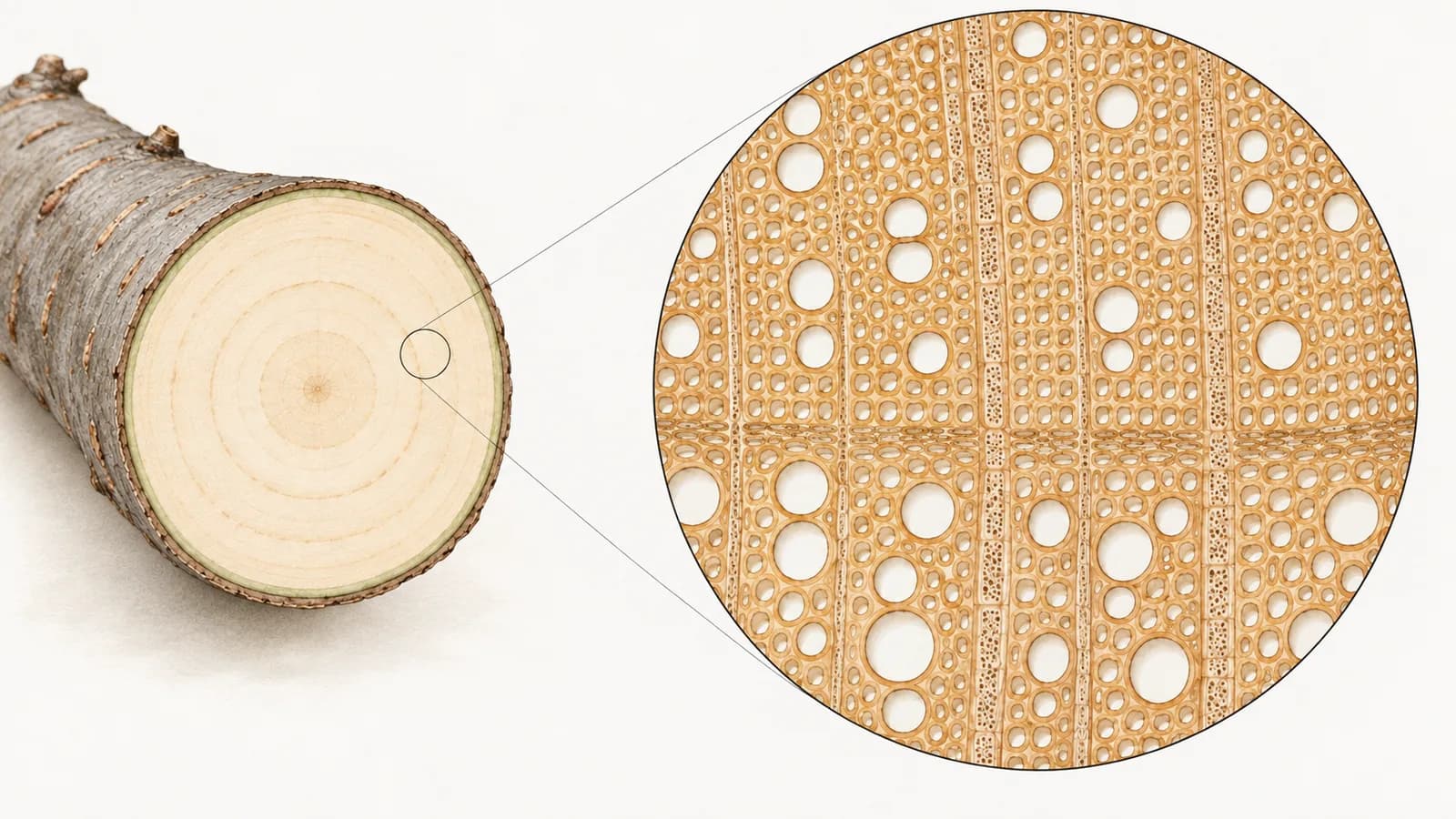
Sugars reach the cambium, and every other place they are used or stored, through the phloemThe living tissue that carries dissolved sugars and other compounds from where they are made or stored to where they are needed, such as roots, shoot tips, and storage tissues. In trunks and branches it forms the inner bark, and its flow can run upward or downward.Open the glossary in the inner bark. They travel up to growing shoot tips or down to the trunk and roots, wherever they are needed, in a separate tissue from the water rising in the xylem (Lesson 9 shows how).
Practice check · not scored
What sets the pace
Photosynthesis needs several things at once: light, carbon dioxide, water, healthy leaves with plenty of chlorophyll, and a suitable temperature. Whichever input is scarcest or least favorable holds the pace back most: that input is the limiting factorWhichever necessary resource or condition, such as light, water, carbon dioxide, temperature, or a mineral nutrient, is in shortest supply and so caps how fast a process like photosynthesis can go. Adding more of anything else brings little benefit until it is addressed.Open the glossary. Picture a woodshop: light is the power, carbon dioxide is the lumber, and mineral nutrients are the screws and tools. When the power is weak, more lumber or more screws barely speed the work. Water is used too, but a leaf almost never runs out of it as an ingredient; in drought, the shop slows because the stomata close and less lumber gets in.
For a bonsai, the usual limits are these:
- Light. The most common limit indoors. A window that looks bright to you usually delivers far less light than open sky outdoors, and light fades quickly as you move back from the glass. In dim light, many trees grow long, thin shoots with widely spaced leaves, a common sign (not proof) that light is short.
- Carbon dioxide. When roots run short of water, the stomata partly close to save it, and less carbon dioxide gets in (Lesson 4). A tree that often dries out makes less sugar, even if it never wilts. Even with open stomata, the air's small share of carbon dioxide often sets the pace in bright sun.
- Leaves. Fewer leaves make less in total. Pale leaves, such as those short of a mineral nutrient, have less chlorophyll and less of the machinery that builds sugar, so they make less, especially in strong light.
- Temperature. Photosynthesis slows in cold and in extreme heat.
Test that in the workshop. Step Light down from Full sun to Deep shade, watching Limited by. Return to Full sun, try Partly closed under Stomata, then set it back to Open. Now choose Pale under Leaf health and press Add fertilizer. When the leaves have greened, choose Pale again, move Light to Deep shade, and add fertilizer again. Last, return to Full sun, choose Half removed under Leaf area, and add fertilizer once more.
Simulation
The photosynthesis workshop
Paused: arrows show which way each substance moves; thicker arrows mean faster flow.
Fertilizer supplies mineral nutrients such as nitrogen, magnesium, and iron, not sugars or energy. Try it with pale leaves and with healthy ones.
What each input allows
In this model, a leaf works only as fast as its scarcest input allows. The dashed line marks that ceiling.
- Lightallows high
- Carbon dioxideallows high
- Leaf healthallows high
- Sugars per leafhigh
Carbohydrate production
Limited by
The leaf’s own capacity
None of the inputs you can change here is short, so each leaf works near its own capacity. In bright sun, that capacity is usually set by how fast the chloroplasts can capture carbon dioxide from the air, which holds only a trace of it.
Carbohydrate production per leaf: High. Whole tree: High. Each leaf is near its own capacity; none of the adjustable inputs is short.
Text description
The scene shows a small broadleaf tree in a pot and, inside a magnifying lens, a thin slice through one of its leaves. Light falls on the upper surface. Inside the leaf, cells are lined with green chloroplasts. Carbon dioxide from the air enters through a stoma, a pore on the underside, and moves through air spaces to the cells. Water arrives through the xylem of a vein; most of it replaces water the leaf loses as vapor, so more arrives in brighter light and less when the stomata partly close. Using light energy, the chloroplasts combine carbon dioxide and water into sugars, releasing oxygen, which leaves through the stoma. Sugars move into the phloem of the vein and travel out of the leaf to wherever they are used or stored: up to a new shoot growing at the top of the tree, into the cambium of the trunk, and down to the roots.
Three inputs each set a ceiling on how fast a leaf can work, and in this model the leaf works only as fast as the lowest ceiling allows (real leaves follow this rule less strictly). That lowest input is the limiting factor. When none of them is short, the leaf works near its own capacity; in bright sun, that capacity is usually set by how fast the chloroplasts can capture carbon dioxide from the air, which holds only a trace of it. In this model:
- Light: deep shade allows low production; a bright window indoors, low to moderate (even a bright window usually delivers far less light than being outdoors); outdoor shade, moderate; full sun, high.
- Carbon dioxide: open stomata allow high production; stomata partly closed, for example during drought, cap it at moderate.
- Leaf health: healthy green leaves allow high production. Pale leaves short of a mineral nutrient have less chlorophyll and less of the enzymes that build sugar, which caps production at low to moderate.
- Leaf area: with half the leaves removed, each remaining leaf works as before, and the whole tree’s production drops by roughly half. Real trees often lose somewhat less, because the remaining leaves may get more light.
Adding fertilizer supplies mineral nutrients. If the leaves are pale from a mineral shortage, the foliage gradually turns green over the following weeks, provided the roots can absorb the minerals (in a real tree, mostly as greener new leaves), and production rises only if leaf health was the tightest limit. If the leaves are healthy, fertilizer changes nothing here, because in this model healthy leaves have all the minerals they need. In a real tree, a mild shortage can slow growth before any paleness shows.
Production is shown in words (very low, low, low to moderate, moderate, high) for each leaf and for the whole tree, with the current limiting factor named.
With full sun, open stomata, and healthy leaves, none of the workshop's inputs was short. Each step down in light lowered production; the bright window allowed only low to moderate, less than outdoor shade. Partly closed stomata capped production at moderate, and pale leaves capped it lower still. Real leaves follow this rule less strictly, since several inputs often hold them back together, but the scarcest input still matters most.
Fertilizer raised production only for pale leaves in full sun, where the mineral shortage was the tightest limit. In deep shade the foliage greened up, but production stayed low because light was still the limit. With half the leaves gone, fertilizer changed nothing: the whole tree's total had fallen by roughly half, and no mineral can put missing leaves back. A real tree partly compensates, since its remaining leaves may get more light, but the loss is real.
The workshop treats green leaves as fully supplied. In a real tree, a mild shortage can slow growth before any paleness shows, so green color alone does not prove minerals are sufficient; Course 05, Mineral Nutrition and Fertilizing, will cover how to tell.
What fertilizer can and cannot do
A tree has two very different kinds of supply. Carbohydrates it makes for itself, in its leaves, from air and water. Mineral nutrients it cannot make; it must absorb them, dissolved in water, through its roots. fertilizerA product that supplies mineral nutrients, such as nitrogen, phosphorus, and potassium, for roots to absorb. It supplies no energy or carbohydrates that the tree can use, so it cannot make up for too little light or too few healthy leaves, and too much can harm roots.Open the glossary supplies only this second kind: elements such as nitrogen, phosphorus, potassium, magnesium, and iron.
These elements are essential. Chlorophyll contains nitrogen and magnesium, iron is needed to build it, and every protein contains nitrogen. A shortage can hold a tree back, as the pale leaves did in the workshop.
But mineral nutrients make up only a small share of a tree's substance, and they supply no energy. So fertilizer cannot make up for too little light or lost foliage. More than a tree can use is not always harmless, either: excess salts can build up in the root zone and damage roots. And even a nutrient that is genuinely short helps only if the roots can absorb it (Lesson 10 covers both).
Practice check · not scored
What this means for your bonsai
Everything you hope a bonsai will build is made from carbohydrate: a thicker trunk, new branches, more roots, new wood growing over a pruning wound. Building it takes plenty of healthy foliage in good light, for long enough. That is why growers who want a thicker trunk often let a tree, or one branch, grow freely for a season or more before cutting back (Lesson 12). A tree with few leaves in low light has little to build with, whatever you feed it.
The bonsai decision
Supply light before feeding
Starting point
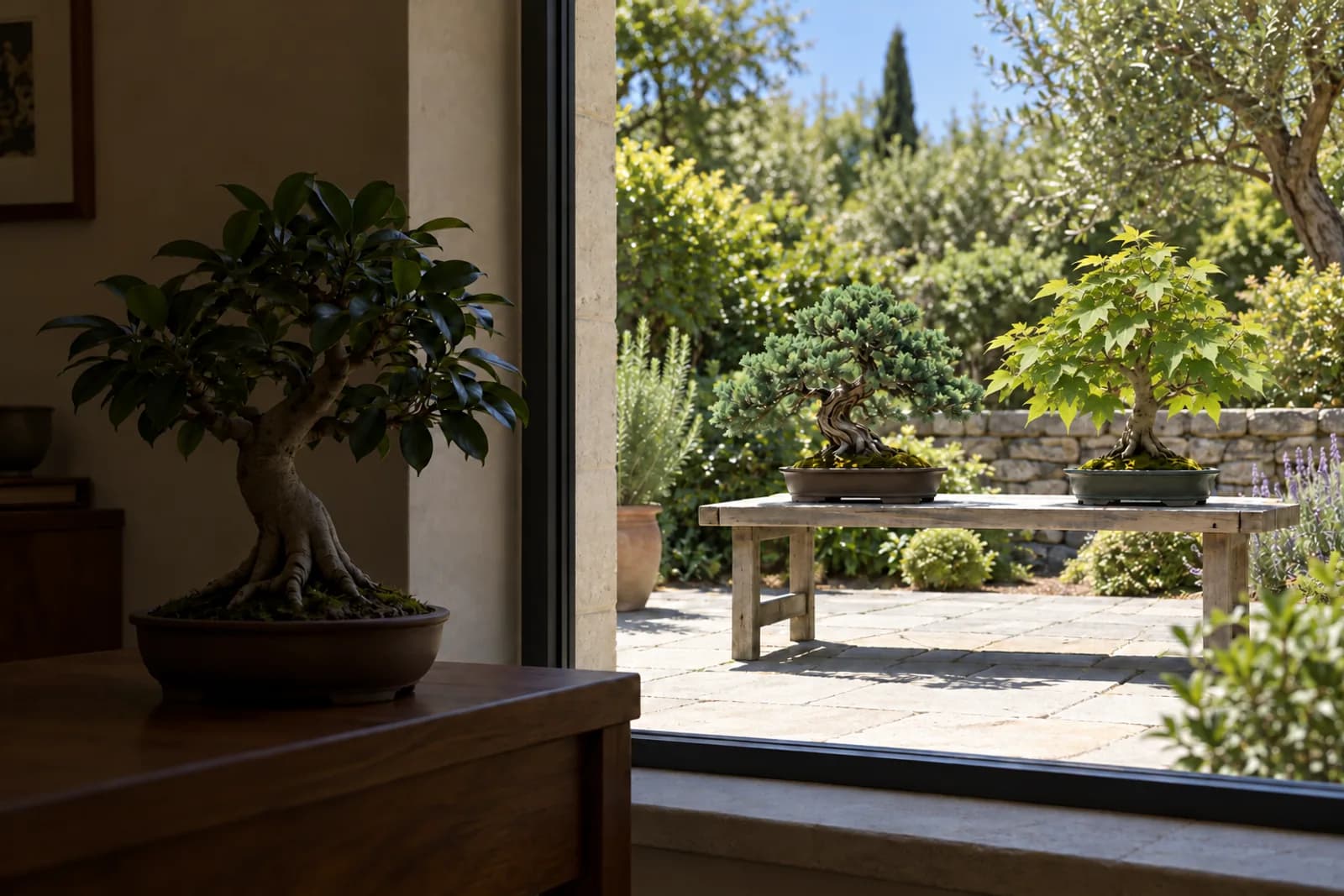
When a tree is growing weakly, check its light and how much healthy foliage it has before you reach for fertilizer. Temperate trees such as the trident maple and the nursery juniper belong outdoors; a ficus kept indoors needs the brightest position you can give it. Improve the light, keep its healthy foliage, and judge the change by the new growth over the following weeks.
This assumes
- You know what kind of tree it is and roughly what light it needs, or you are finding out (Course 02, Choosing a Tree and Creating Its Growing Environment). - Its roots are working: the pot drains, and the root zone is neither waterlogged nor dried out. - It is in a season when it should be growing, not a temperate tree resting through winter.
Change course if
- A tree in strong light still shows signs of a nutrient shortage, such as new leaves that come out pale: look into feeding and other possible causes (Course 05, Mineral Nutrition and Fertilizing, and Course 07, Tree Health and Diagnosis). - The roots are damaged, waterlogged, or dried out: fix the root environment first, since a tree cannot use nutrients its roots cannot absorb (Lesson 10). - The tree has lived in dim light for a long time: increase its light in stages, since moving it straight into full sun can scorch leaves that grew in shade.
Back to the question
Where does the material in new wood come from?
The material in new wood comes mostly from the air. Leaves take in carbon dioxide and, using light energy captured by chlorophyll, combine it with water to make sugars, which the tree builds into the cellulose and lignin of wood. About half of dry wood is carbon from the air; minerals from the soil are a small fraction. Fertilizer supplies those minerals, so it cannot stand in for light or for the leaves that use it.
Key takeaways
- Photosynthesis uses light energy to combine carbon dioxide and water into sugars, releasing oxygen. - About half of a tree's dry mass is carbon taken from the air; minerals from the soil are a small fraction. - Sugars become cellulose and lignin for wood, starch for storage, and fuel for respiration in every living cell. - Photosynthesis is held back most by its scarcest input; for a bonsai indoors, that is usually light. - Fertilizer supplies mineral nutrients, not carbohydrates or energy, so it cannot replace light or lost foliage.
Optional · not required for completion
Compare a window with the outdoors
On a bright day, stand a few steps back from a sunny window and look at a sheet of white paper. Then carry it outside into open sky. Notice the squint as you step out, and how quickly your eyes settle until both places seem bright.
That adjustment makes eyes poor light meters: they shrink a large difference into a small-seeming one. A leaf gets no such correction; its chloroplasts work with the light that actually reaches them. Course 02, Choosing a Tree and Creating Its Growing Environment, will show how to measure light at the foliage.
No tree? None is needed for this one.