Course 01 · Lesson 2 of 14 · Tree structures
Roots: anchorage, absorption, and storage
Structural and fine roots do different jobs. Learn where absorption happens, why roots need air as well as water, and what that means for a tree in a small pot.
The question
What are the roots doing inside this small pot?
By the end of this lesson, you will be able to:
- Distinguish structural roots from fine roots by their main roles in anchorage, transport, storage, and absorption.
- Locate root tips and root hairs and explain how they help a tree absorb water and nutrients.
- Explain why healthy roots need both water and oxygen, and why that makes the root environment a care priority.
About 15 minutes to read and explore
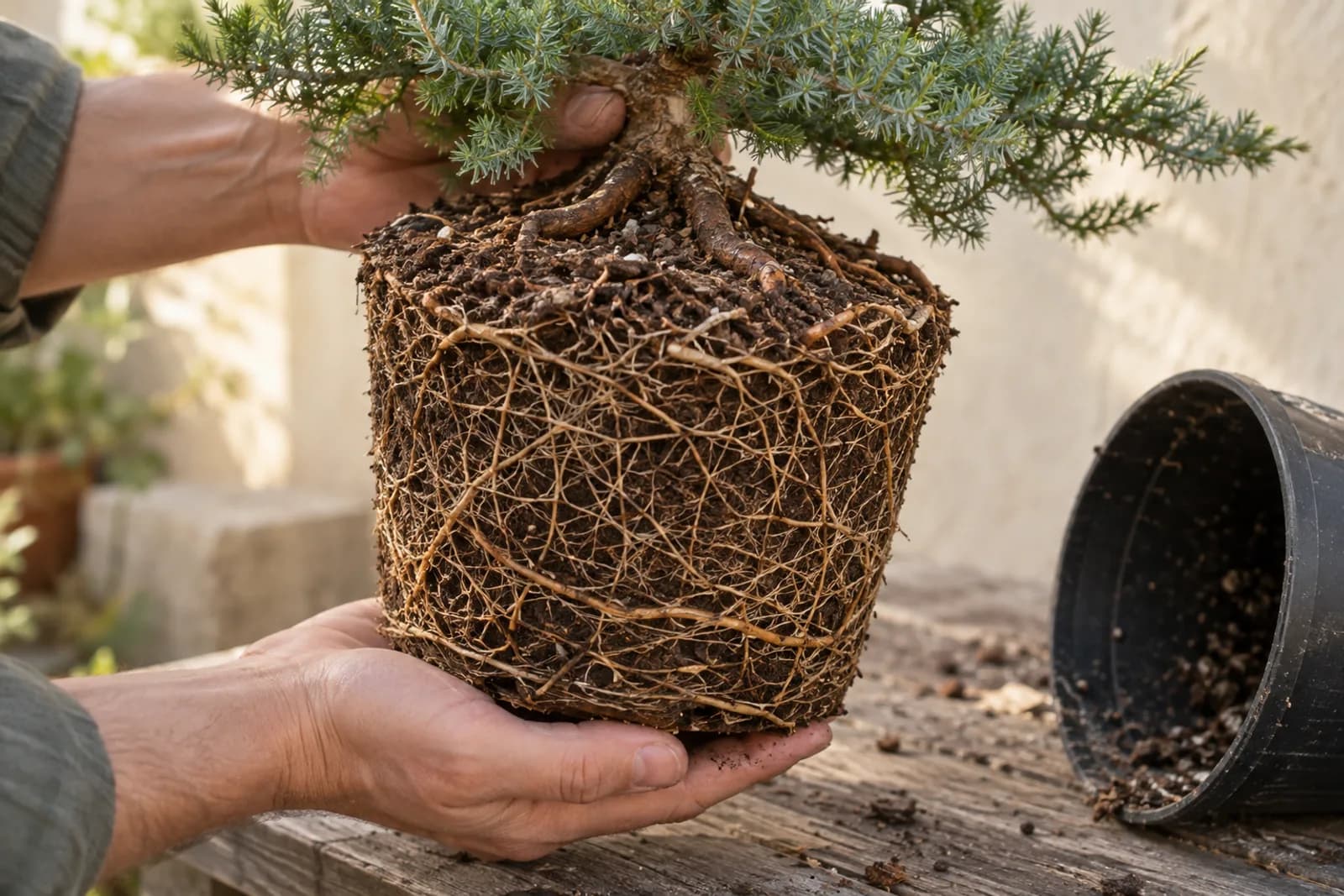
Picture a nursery worker easing the nursery juniper, this course's recurring instructional example, out of its black plastic pot. The soil does not tumble out. It keeps the shape of the pot, because roots have grown through all of it. Near the trunk, a few roots are as thick as a pencil, brown and woody. Everywhere else, the root ball is wrapped in a web of thin, pale roots, some ending in plump white tips where they pressed against the pot wall.
Above the rim, you can see the tree and judge how it is doing. Below it, out of sight, the roots work all the time. What exactly are they doing, and what do they need from you?
Four jobs underground
All of a tree's roots together make up its root systemAll of a tree's roots together, from the thick woody roots near the trunk to the many thin roots at the edges. It anchors the tree, absorbs water and mineral nutrients, and stores carbohydrates; in a bonsai, all of it must fit inside a small container.Open the glossary, and it does four main jobs.
- Holding the tree in place. This is anchorageThe way roots hold a tree firmly in place against wind, gravity, and its own weight, mainly through the spread and grip of its structural roots. A shallow bonsai pot offers little anchorage, which is one reason newly potted trees are often secured with wire or ties.Open the glossary: roots spread through the soil and grip it, keeping the tree upright against wind and its own weight.
- Absorbing. Roots take up water and the mineral nutrientA chemical element, such as nitrogen, potassium, or iron, that a tree needs and takes up through its roots from the water around them. Mineral nutrients help build and run cells, but they supply no energy and only a small share of the tree's mass.Open the glossary dissolved in it. Nearly all the water a tree uses enters through its roots.
- Storing. Roots store carbohydrates, mostly as starch, and some mineral nutrients. The tree draws on them to grow new roots and shoots, especially early in the growing season and after losing roots or leaves (Lesson 9).
- Transporting. Roots carry water and minerals toward the trunk and receive sugars from the leaves to fuel their own growth. Water and sugars travel in separate tissues (Lesson 3).
Roots also make some hormones, chemical signals that help coordinate growth between roots and shoots.
In a bonsai, all of this happens inside a small container filled with substrateThe material that fills a container and surrounds a tree's roots, such as a mix of mineral grit, bark, or soil. Its job is to anchor the roots and to hold water, mineral nutrients, and air in a balance the roots can use.Open the glossary, the growing medium in the pot.
Structural roots and fine roots
structural rootA thick, woody, long-lived root that anchors the tree, stores carbohydrates, and connects the fine roots to the trunk, conducting water and sugars along its length. Structural roots absorb relatively little water compared with young fine roots.Open the glossary are the thick, woody roots that spread from the base of the trunk. They live for many years and thicken each year, much as branches do. They do most of the anchoring, carry water and sugars between the fine roots and the trunk, and hold much of the tree's underground starch. Their thick, corky outer layers let water through only slowly, so they absorb relatively little. On a bonsai, the flare of roots at the soil surface is the top of this framework.
fine rootOne of the many thin, branching roots, often pale when young, that do most of a tree's absorbing of water and mineral nutrients. Fine roots live a relatively short time and are constantly replaced, so they depend on a root zone that holds both water and air.Open the glossary are the thin, numerous, branching roots that make up most of the web. Growers sometimes call them feeder roots, though they bring in water and minerals, not food. Young fine roots, especially near their tips, do most of the tree's absorbing. Many are short-lived: the tree keeps growing new ones while older ones die, and that turnover is normal. A few fast-growing fine roots keep extending instead, and over the years they thicken into new structural roots.
Growing fine roots end in pale, often white, root tipThe growing end of a root, made up of the root cap, the dividing cells behind it, and short zones where new cells lengthen and mature. Active tips are usually pale or white and show where a root is extending into fresh substrate.Open the glossary. Behind the tips, roots turn tan or brown as their outer layers toughen; that does not mean they are dead, and they still take up some water, more slowly. Even so, how well a tree absorbs depends less on how much root it has than on how many young, living fine roots it has, and on the conditions around them.
Where absorption happens: the root tip
The part of a fine root that absorbs most actively is a short stretch just behind its tip, too small to study in detail by eye. In “Zoom into the root zone,” start with “Whole root system” to find the structural and fine roots you just met. Then choose “A fine root tip” and select its parts in order, from 1, “Root cap,” to 4, “Root hairs.” Finally, choose “Root hairs in the substrate” and notice where the water sits and where the air is.
Interactive
Zoom into the root zone
Level 1 of 3: Whole pot, cut away
Whole root system
A bonsai pot cut open to show the root system. Thick structural roots spread from the base of the trunk and divide into many thin fine roots that fill the substrate.
Choose a numbered part to see what it is, what it does, and why it matters in a pot. Or select Zoom in to look closer.
Zoom level: Whole root system.
Text description
Three views of the same root system, each closer than the last. Every view has four numbered parts with a short explanation of what each part is, what it does, and why it matters for a tree in a pot.
Level 1, whole root system (whole pot, cut away). A bonsai pot cut open to show the root system. Thick structural roots spread from the base of the trunk and divide into many thin fine roots that fill the substrate.
- Structural roots. Thick, woody roots that spread from the base of the trunk. Each began as a fast-growing fine root, then lived on for years and thickened, much as branches do. They anchor the tree, conduct water and dissolved minerals toward the trunk and sugars out to growing root tips, and store carbohydrates, mostly as starch. Their corky outer layers let water in only slowly, so they absorb relatively little themselves. They hold the tree steady in a shallow container and form the flare you see at the soil surface. Their stored reserves help support new growth and recovery after root work.
- Fine roots. Thin, numerous, branching roots, pale near their growing tips. Many are short-lived: the tree keeps growing new ones while older ones die back, and that turnover is normal. Young fine roots near their tips, with their root hairs, do most of the absorbing of water and dissolved mineral nutrients. Older stretches still absorb some, more slowly. A tree's absorbing capacity rises and falls with its supply of young fine roots. A long dry spell, lasting saturation, or rough handling can kill many at once, and uptake stays low until new ones grow.
- Substrate. The growing medium in the pot: particles with spaces, called pores, between them. It holds water in thin films and narrow pores, lets extra water drain from the larger pores, and lets air back into the pores that drain. It also gives roots something to grip. A pot holds far less substrate than open ground, so it is a small buffer. It can dry out quickly, yet after watering its lowest layer stays wetter than the top (Course 04 explains why).
- Drainage hole. An opening in the floor of the pot, usually covered with mesh so the substrate stays in. Water the substrate cannot hold runs out through it. As water drains from the larger pores, air moves in to replace it. A pot that cannot drain freely can stay waterlogged and leave roots short of oxygen. When you get a tree, check that water runs out freely after watering.
Level 2, a fine root tip (magnified: a few millimeters of root). One fine root tip, magnified. A root grows in length at its tip: new cells form behind a protective cap, then stretch, then mature. Root hairs appear only where cells have finished stretching.
- Root cap. A thimble of cells covering the very tip of the root. Its outer cells keep sloughing off and are replaced from within. It shields the growing point as the root pushes between particles, and its living outer cells release a slippery coating called mucilage that eases the way. Cells in the cap also sense gravity, which helps the root keep its direction of growth: main roots tend downward, while many side roots grow outward at a shallow angle. Tips grow into whatever spaces they can enter. When one meets the pot wall, it often turns and follows the wall, which is how roots begin to circle (Course 11).
- Meristem. A small zone of dividing cells behind, and partly tucked inside, the root cap. Meristems are a tree's growing points; shoot tips have them too (Lesson 5). Its cells divide again and again, adding new cells to the root behind it and to the cap in front, which replaces the cap cells that wear away. Every new length of root starts here. Tips are tiny and delicate: drying out, a long shortage of oxygen, or rough handling can kill them, and new roots must then branch from farther back.
- Elongation zone. A short zone behind the meristem where the new cells stretch, growing many times longer than they were. This stretching pushes the tip forward through the substrate. Most of a root's growth in length happens here, not at the very tip. Stretching cells take up water and use energy from respiration, so root growth slows when the root zone is dry, cold, very hot, or short of oxygen. Roots grow best when it is moist and mild, which does not always match when the shoots are growing.
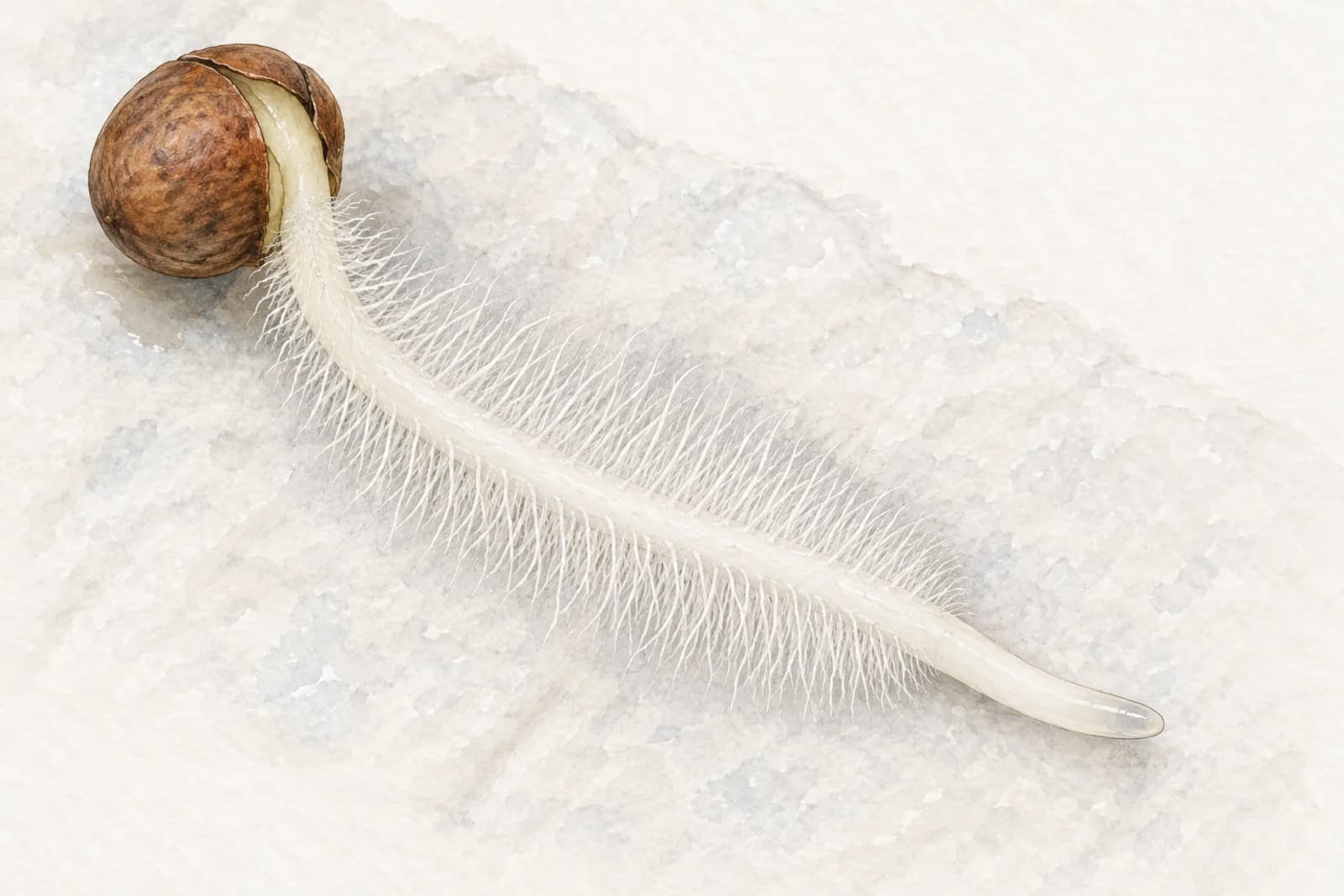
- Root hairs. Fine outgrowths in the maturation zone, where cells have finished stretching. Each root hair is a single cell of the root's outer layer, grown long and thin. Together they greatly enlarge the root's surface and reach into small spaces between particles, taking up water and dissolved mineral nutrients. They help most with nutrients that move slowly, such as phosphorus. Some trees, such as pines, grow few and rely more on fungal partners. Root hairs often live only days to a few weeks and break off easily. Disturbing roots strips many away, which is one reason a tree can wilt after root work (Lesson 8).
Level 3, root hairs in the substrate (magnified further: single root hairs). Root hairs threading between substrate particles. Water clings to the particles in thin films, and the larger gaps between them hold air.
- Root hair cells. Each hair is an outgrowth of one living cell in the root's outer layer: a thin tube, far finer than a human hair. Hairs grow along particle surfaces and into water films, taking up water and dissolved minerals through their thin walls. Like all living cells, they also need oxygen for respiration. They absorb only while they are alive and in contact with water. If the substrate dries out, they shrivel quickly; if it stays waterlogged, they run short of oxygen.
- Water films. Thin layers of water clinging to particle surfaces and filling the narrow spaces where particles nearly touch. This held water, with minerals dissolved in it, is what roots absorb. Oxygen diffuses roughly ten thousand times more slowly through water than through air, so it crosses a thin film slowly, and the larger gaps must empty for air to return. These films are the water roots draw on between waterings. After watering and draining, a healthy substrate keeps them while its larger gaps fill with air, so a drained pot is still moist.
- Air-filled pores. The larger gaps between particles. They fill with water when the tree is watered, then drain and fill with air again. Oxygen travels quickly through connected air spaces to the roots, and carbon dioxide released by respiring roots moves out the same way. Healthy roots need both: water films to absorb from and air-filled pores to supply oxygen. Too dry, and root hairs and fine roots dry out; saturated for long periods, and they run short of oxygen.
- Substrate particles. The grains that make up the growing medium, drawn here far smaller than they are: in a typical bonsai mix each grain is larger than a fine root, and root hairs work across its surface and in the water held where grains touch. Many bonsai substrates use porous particles that also hold some water inside them. Their size and shape set the size of the spaces between them: larger gaps drain and fill with air, while narrow gaps and particle surfaces hold water. The balance between water-holding and air-filled space is why substrate choice matters so much in a container (Course 04).
In the root-tip view, cap cells slowly slough away from the tip. In the root-hair view, water films shimmer around the particles, the youngest hair lengthens, and oxygen moves through the air-filled gaps, slowing sharply once it reaches the water film around a hair.
As the zoom showed, a root grows in length only at its tip, which is organized in zones. From the very end backward:
- Root cap. The root capA thimble-shaped cover of cells over the very end of a root that protects the dividing cells behind it as the root pushes through soil, and senses gravity to help steer its growth. Its living outer cells release a slimy coating, called mucilage, that eases the root's path, and they wear away and are replaced from within.Open the glossary is a thimble of cells over the end of the root. Its outer cells wear away against the particles and are replaced from within. It also senses gravity, which helps the root keep its direction: main roots tend to grow downward, while many side roots grow outward at a shallow angle.
- Meristem. Just behind the cap, small cells keep dividing, adding new cells to the root and the cap. A meristemA group of plant cells that keep dividing to produce new cells, found at the tips of shoots and roots, inside buds, and in thin layers beneath the bark. All of a tree's new growth, in length or in thickness, starts in a meristem.Open the glossary is a growing point; shoot tips and buds have them too (Lesson 5).
- Elongation zone. The new cells stretch to many times their length, pushing the tip forward. Most growth in length happens here.
- Maturation zone. Cells take on their final jobs, including carrying water toward the trunk, and root hairs grow.
Where a tree grows them, root hairA tiny, hairlike outgrowth of a single cell on a root's surface, a short way behind the growing tip, that greatly increases the area for absorbing water and minerals. Some trees, such as pines, grow few and rely more on fungal partners. Root hairs are fragile and short-lived, so disturbing roots destroys many of them and temporarily reduces uptake.Open the glossary greatly enlarge the root's surface and its contact with the water films between particles. Each is a single cell of the root's outer layer, grown into a tube far finer than a human hair that reaches into narrow gaps. They help most with mineral nutrients that move slowly through the substrate, such as phosphorus, and with keeping contact with water as the substrate dries. Some trees, including pines, grow few and rely largely on mycorrhizaA partnership (plural: mycorrhizae) between a plant's roots and certain soil fungi, known as mycorrhizal fungi, whose fine threads reach far beyond the roots and help supply water and nutrients, especially phosphorus, in exchange for sugars from the plant. Many trees, including pines, depend heavily on these partnerships.Open the glossary, partnerships with soil fungi whose threads take over much of that work.
Root hairs are fragile and short-lived, often lasting days to a few weeks, and new ones form only as the tip grows on, so a root that stops growing soon stops renewing them. Lifting, combing out, or cutting roots strips many away and breaks tips, which is one reason a tree can wilt after repotting even when its substrate is wet (Lesson 8).
Practice check · not scored
Go deeper · optional, not assessedFungal partners at the root tips
In a mycorrhiza, a fungus's fine threads grow into or around young roots and spread far out into the surrounding soil or substrate. They help the tree take up water and mineral nutrients, especially phosphorus, and the tree supplies the fungus with sugars in return. On a healthy pine, white fungal threads among the roots are often these partners, not a sign of disease. Lesson 10 explains these partnerships.
Why roots need air as well as water
Predict first
Probably not. The standing water keeps the lower part of the pot saturatedDescribes soil or substrate whose pore spaces are completely filled with water, leaving little or no air. Brief saturation right after watering is normal in a pot that drains; saturation that lasts starves roots of oxygen.Open the glossary, every pore full, and oxygen moves through water far more slowly than through air, so the roots there run short of it. Roots short of oxygen absorb poorly and begin to die back, so the tree can wilt while surrounded by water. Lesson 7 follows that chain step by step.
Root cells are alive. Like every living cell in a tree, they release energy from sugars through respirationThe process in which living cells break down sugars using oxygen to release energy they can use, giving off carbon dioxide and water. It runs in every living cell of a tree, in leaves, stems, buds, and roots, both day and night. Without oxygen, cells fall back on fermentation.Open the glossary, which uses oxygen and gives off carbon dioxide, day and night (Lesson 7). A root gets nearly all of its oxygen from air spaces in the substrate around it.
Substrate is made of particles, and the gaps between them are its pore spaceThe gaps between particles in soil or substrate, which hold water, air, or both. Large pores usually drain and refill with air after watering while small pores hold water, so the mix of pore sizes sets how wet and how airy a root zone stays.Open the glossary. A thorough watering fills most of the pores. In a pot that drains freely, gravity then pulls water out of the largest pores and air is drawn in behind it, while thin films of water cling to the particles and fill the narrowest gaps. A healthy, drained substrate holds both, as you saw at the last zoom level: water to absorb, and connected air-filled pores that let oxygen in and carbon dioxide out. That supply and exchange of air is aerationThe supply of air, especially oxygen, to roots through air-filled pore spaces, and the exchange of gases between those spaces and the open air. Roots need good aeration because their living cells use oxygen constantly.Open the glossary.
“Water and air between the particles” shows this at the scale of single particles. Move the “Moisture” slider one step at a time down to “Very dry,” then up to “Saturated for days,” watching the root and the two meters. Then set it to “Wet after watering” (the Wet mark), press “Water and let it drain,” and watch which pores empty first. Try the same from “Saturated for days.”
Interactive
Water and air between the particles
Moisture
Moist and airy
Root conditionHealthy
Films coat the particles and the small pores stay full of water, while the large pores hold air. Oxygen moves quickly through the connected air spaces and across the thin films to the root. Root hairs press into the wet films, so the root has water and oxygen at the same time.
Text description
A magnified slice of bonsai substrate: rounded particles with pore spaces between them, and a fine root with root hairs threading through those spaces. Water is shown in blue, air-filled spaces are pale, and oxygen appears as small teal dots that drift through the air spaces toward the root.
The Moisture slider has five settings:
- Very dry. Only thin films of water are left on the particles, and they cling too tightly for roots to draw much from them. Air fills every pore, but root hairs shrivel and fine root tips brown as they dry. Dead root hairs do not revive; new ones form only as living root tips grow. Water around the roots: very low. Oxygen reaching roots: plenty. Root condition: drying out.
- Drying. Water remains as thin films on the particles and in the narrowest gaps, where particles nearly touch. Every larger pore holds air. Roots can still draw on these films, but the supply is shrinking, which is why moisture below the surface is worth checking at this stage. Water around the roots: low. Oxygen reaching roots: plenty. Root condition: working, but the supply is shrinking.
- Moist and airy. Films coat the particles and the small pores stay full of water, while the large pores hold air. Oxygen moves quickly through the connected air spaces and across the thin films to the root. Root hairs press into the wet films, so the root has water and oxygen at the same time. Water around the roots: good. Oxygen reaching roots: good. Root condition: healthy.
- Wet after watering. Right after a thorough watering, water fills most pores and only a few pockets of air remain. In a container that drains freely this does not last: gravity pulls water out of the large pores, and fresh air is drawn in behind it. Water around the roots: plenty. Oxygen reaching roots: low. Root condition: normal for a short time.
- Saturated for days. Every pore stays full of water. Oxygen diffuses roughly ten thousand times more slowly through water than through air, so living root cells and soil microbes use it up faster than it is replaced. Root tips stop growing and darken, and damaged roots absorb water and minerals poorly even though water is everywhere. Water around the roots: plenty. Oxygen reaching roots: very low. Root condition: oxygen-starved.
The Water and let it drain button waters the medium thoroughly, then lets it drain. Draining empties the largest pores first, starting near the top, while the films and small pores stay full, so a drained medium is still moist: it ends at the Moist and airy setting. Starting from Very dry or Saturated for days, the water and air change, but roots and root hairs that died stay dead. Root hairs and fine root tips that dried out do not revive when water returns. Roots that survived take up water again, but new root hairs form only as living root tips grow on. Root tips and fine roots killed by days without oxygen do not revive when air returns. Roots that survived can resume work, but the tree has to grow new roots to replace those that died, which takes time and sugars from its foliage and reserves. The Pause button stops all motion, and with reduced motion the watering and draining can be stepped through one picture at a time.
Only “Moist and airy” reads Good on both meters, and it is where a freely draining pot settles after watering. “Drying” still works, though the supply is shrinking. The two ends harm roots for opposite reasons: at “Very dry,” the last films cling too tightly to supply much; at “Saturated for days,” little oxygen reaches the root.
“Wet after watering” looks almost as full as “Saturated for days,” yet its root condition reads “Normal for a short time.” The difference is time. Harm comes when the substrate stays saturated for days: in a pot that cannot drain, a pot standing in water, or a substrate with too few large pores (Course 04, Soil, Substrates, and the Root Environment). It comes sooner in hot weather, and some trees tolerate wet roots far better than others.
Draining brings the air back and surviving roots resume their work, but dead roots do not revive, and neither do root hairs lost in a dried-out pot. The tree must grow replacements, which takes time and sugars from its foliage and stored reserves (Lesson 9).
Roots in a small pot
A container changes these conditions in three ways.
- A small buffer. A pot holds little water and air in reserve, so it can dry out quickly, and a pot crowded with roots often dries faster still.
- Uneven moisture. The surface dries first, while a wetter zone tends to linger at the bottom of the pot after watering (Course 04 will explain why).
- Walls. A root tip that reaches the pot wall often turns and follows it. Over time, roots can circle the pot, something growers deal with when they repot (Course 11, Repotting and Root Development).
Roots also keep their own schedule. They grow most in a moist, airy, mild root zone, neither cold nor hot, and not always when the shoots do: in many temperate trees, roots keep growing into autumn after the shoots stop lengthening.
Practice check · not scored
How to check below the surface
Gently push an unvarnished wooden chopstick or skewer deep into the root zone, partway between trunk and rim, and leave it a few minutes: wood that comes out darker, cool, and damp has found moisture. Lift the pot right after a thorough watering, and again when the probe comes out dry, to learn how heavy it feels wet and dry. Tilt the pot to look at and touch the substrate at the drainage holes, and feel with a fingertip a little below the surface near the rim.
Each check has blind spots: a probe reads one spot, a large pot is hard to judge by lifting, and the holes and surface show the wettest and driest layers, so use more than one. Do not go by the surface or its moss alone; moss can stay green over a root zone that has dried. This is a starting routine, not a schedule, and Course 03, Watering and Daily Observation, will go further.
The bonsai decision
Judge the root environment, not only the surface
Starting point
When you get a tree, check two things about its root zone. First, that the container drains freely: the next time it needs water, water it thoroughly and watch the water soak in rather than pool, then run out of the drainage holes. Draining is what lets air back into the pores. Second, judge moisture below the surface with the checks just described. Leave the tree in its pot for now: sliding it out just to look can tear fine roots and root hairs, and these checks tell you what you need first.
This assumes
- The tree is established in its current container, not recently repotted or root-pruned (Lesson 8 explains why that changes things). - It is growing, or resting, as expected for its kind and the season. - You can check on it often enough to notice changes.
Change course if
- Water stands in a saucer or outer pot: empty it after watering so the pot can drain and air can return. - Water pools or barely drains, or the pot has no drainage hole: expect long wet spells, check below the surface before each watering, and plan to fix the cause (Courses 04 and 11). - The root zone smells sour, or the tree wilts, yellows, or drops foliage while the substrate stays wet: investigate rather than add water (Course 07, Tree Health and Diagnosis). - The substrate dries all the way down very quickly: check more often, especially in heat and wind.
Back to the question
What are the roots doing inside this small pot?
The roots hold the tree steady in a pot that offers little to grip. Their young fine roots, helped by root hairs or fungal partners, absorb water and dissolved minerals that the roots carry toward the trunk, and the roots store carbohydrates made from sugars the leaves supply. All the while they respire, so they need oxygen as well as water, and keeping a root zone that holds both is one of the most important things you do for a bonsai.
Key takeaways
- Structural roots anchor, transport, and store; young fine roots near their tips do most of the absorbing. - Root hairs, where a tree grows them, greatly enlarge the absorbing surface but are short-lived and fragile, so disturbing roots reduces uptake for a while. - Roots respire, so they need oxygen from air-filled pores as well as water from the films around particles. - Brief saturation after watering is normal in a pot that drains. Lasting saturation starves roots of oxygen, a root zone that dries out completely kills root hairs and fine roots, and dead roots do not revive. - A pot is a small, uneven root zone: check that it drains freely, and judge moisture below the surface.
Optional · not required for completion
Read the roots you can see
If your tree is in a nursery pot, tilt it and look at the drainage holes without sliding the tree out. If roots show there, note their thickness and color. Plump white or cream tips are new, growing roots; tan or brown roots are older ones. Look again in a few weeks for new white tips, and note what the weather and the shoots were doing. A resting tree may show few white tips; its roots still take up water, so keep checking its moisture.
No tree? Sprout a few radish seeds on a damp paper towel in a closed clear jar. After a few days, look with a magnifying glass for the fuzzy band of root hairs a little way behind each smooth tip. Or pull up a small weed, rinse its roots gently, and compare the thicker roots near the stem with the fine ones at the edges.