Course 01 · Lesson 3 of 14 · Tree structures
Trunks and branches: structure and transport
A branch is mostly wood wrapped in a thin living sleeve. Explore the layers from bark to pith, see how a branch grows thicker, and learn why wire can harm a branch long before it breaks.
The question
Why can wire damage a branch even before it breaks?
By the end of this lesson, you will be able to:
- Locate the outer bark, inner bark and phloem, vascular cambium, and wood, and distinguish sapwood from heartwood.
- Explain the role of each layer in protection, transport, support, and growth in thickness.
- Explain how a thickening branch can press its living tissues against wire, and why that damage affects growth beyond the wire.
About 15 minutes to read and explore
Picture the trident maple, our instructional example. Early in the growing season, you wire one young branch to bring it down to a better angle. For weeks it looks unchanged. Then you notice the bark puffing up between the coils, and the wire seems to have sunk into the branch. Nothing has snapped, and the leaves beyond the wire are a healthy green.
The wire did not tighten; the branch grew. To see why that harms the branch long before anything breaks, you need to know what a branch is made of and which parts of it are alive.
A branch from the outside in
A trunk or branch is built in layers nested like sleeves, and a cut straight across shows them as rings.
The bark: a dead shield over a living layer
barkEverything outside the wood of a trunk, branch, or root: a protective, mostly dead outer layer and a thin, living inner layer beneath it. Because the inner layer carries sugars, damaged bark can harm a tree even when the wood underneath is intact.Open the glossary is everything outside the wood, and it has two very different parts. The outer barkThe outermost layer of a trunk or branch, made of dead tissue, chiefly cork, added from the inside by a thin living layer called the cork cambium. On older trunks it also holds older bark tissues cut off as new cork forms beneath them. It shields the living tissues inside from water loss, injury, temperature extremes, and disease organisms.Open the glossary is dead tissue, chiefly cork, added from the inside by a thin living layer called the cork cambium. Dead does not mean useless: cork is a tough, water-resistant shield against drying, injury, and disease organisms. On a young branch, it is only a thin skin.
Beneath it lies the inner barkThe living layer between the outer bark and the wood, made mostly of phloem, the tissue that carries sugars. It is thin, soft, and close to the surface, so wire, tools, and careless handling can readily damage it.Open the glossary, a layer of mostly living cells. Its main tissue is phloemThe living tissue that carries dissolved sugars and other compounds from where they are made or stored to where they are needed, such as roots, shoot tips, and storage tissues. In trunks and branches it forms the inner bark, and its flow can run upward or downward.Open the glossary, the tissue that carries sugars and other compounds made in the leaves to wherever they are needed: growing shoot tips, roots, and storage tissues.
The cambium: where thickening starts
Between the bark and the wood is the vascular cambiumA layer of dividing cells, only a few cells thick, between the wood and the inner bark. It adds new xylem on its inner side and new phloem on its outer side, which is how trunks, branches, and roots grow thicker.Open the glossary, a layer only a few cells thick and too thin to see unaided. While the tree is growing, its cells divide, making new wood toward the inside and new phloem toward the outside. Like the growing tips of shoots and roots, the cambium is a meristemA group of plant cells that keep dividing to produce new cells, found at the tips of shoots and roots, inside buds, and in thin layers beneath the bark. All of a tree's new growth, in length or in thickness, starts in a meristem.Open the glossary, a group of cells whose work is making new cells, and it is why trunks and branches grow thicker.
The wood: water pipes and support
Inside the cambium is the woodThe hard interior of trunks, branches, and older roots, made of layer upon layer of xylem added by the vascular cambium. The outer, younger wood carries water and stores reserves, while the inner wood in many trees no longer conducts and mainly gives support.Open the glossary, built from layer upon layer of xylemThe tissue that carries water and dissolved minerals from the roots up through the trunk and branches to the leaves, mostly through hollow cells that are dead when they work. Built up in layers year after year, xylem makes up a tree's wood.Open the glossary, the tissue that carries water and dissolved minerals up from the roots. Its water-conducting cells die as they mature, leaving hollow, stiff-walled cells that link into long pipelines, built a little differently in broadleaf trees and conifers (Lesson 8).
In many older trees the wood has two zones. The outer sapwoodThe outer, younger part of the wood, which carries water and dissolved minerals upward and contains living cells that store carbohydrates. It is usually paler than heartwood and is the part of the wood that is still working.Open the glossary is the working part: it conducts water, and living cells threaded through it in thin lines called rays store carbohydrates. The inner heartwoodThe inner, older wood at the center of many trunks and large branches, which no longer carries water and has no living cells. It is often darker from deposited compounds that can help resist decay; not every tree forms distinct heartwood.Open the glossary no longer carries water and has no living cells. It is often darker from deposited compounds, and not every tree forms it distinctly. Both zones help hold the branch up.
Heartwood forms only as a stem ages, so a young branch, the kind usually wired, is typically all sapwood. At the very center is the pithThe small core of soft tissue at the very center of a stem, formed when that part of the stem first grew as a young shoot. In older trunks and branches it remains as a narrow center surrounded by many layers of wood.Open the glossary, a small core of soft tissue left from the shoot's first year.
The living sleeve
“Inside a branch” shows a short piece of an older branch with a wedge cut out. In “Explore,” choose each layer from “Outer bark” inward to “Pith” and check what you have just read: is it alive, and what does it do? Then choose “All living tissue.” The drawing colors the cambium green only so you can find it; in life it is colorless, and the green under scratched young bark is living bark tissue outside it.
Interactive
Inside a branch
Layers, outside to center
Start here
A branch from the outside in
Six layers, from the cracked outer bark to the pith at the center. Choose one to see whether it is alive, what it does, and what happens when it is damaged. You can also click a layer in the drawing.
Text description
A short, upright piece of an older branch is drawn with a wedge cut out of the front, so its layers show on the cut end and along the two cut faces. The layers are sleeves nested one inside the next. From the outside in:
- Outer bark (mostly dead tissue, chiefly cork). Shields the living tissues underneath from drying out, injury, and disease organisms. Its cork cells are dead; a thin living layer inside the bark, the cork cambium, makes new ones. On older branches it also holds old inner bark, cut off by newer cork layers. If damaged: A scrape exposes the living inner bark to drying and infection. A deeper injury reaches the phloem and cambium beneath it.
- Inner bark and phloem (living). The phloem carries sugars and other compounds made in the leaves to wherever they are needed: growing shoots, roots, and storage tissues. It can move them up or down, depending on where the demand is. If damaged: Sugars cannot pass through the damaged patch, though they can flow around a partial wound. If a complete ring is removed or crushed (girdling), the roots below stop receiving sugars from the leaves above, and sugars build up on the leaf side of the injury, which can swell.
- Vascular cambium (living, and dividing). A layer only a few cells thick. Its cells divide to make new xylem (wood) toward the inside and new phloem toward the outside. This is how a branch grows thicker. If damaged: No new wood or bark forms at that spot. The tree does not repair it; instead, new growth from the edges slowly covers the wound, leaving a scar.
- Sapwood (partly living). Its water-conducting cells are dead and work like pipes, carrying water and dissolved minerals up from the roots to the leaves. Living cells in the wood's rays store carbohydrates. It also helps hold the branch up. If damaged: A deep injury all the way around can cut off water to the leaves above. A shallow injury usually leaves enough sapwood conducting, so leaves can stay green for a while even when the bark and phloem are badly damaged.
- Heartwood (not living). Forms from the innermost sapwood only as a branch or trunk ages, so a young branch is usually all sapwood. It no longer carries water, but it still supports the branch. In many trees it darkens as compounds are deposited in it, which can help it resist decay. Not every tree forms distinct heartwood. If damaged: Transport carries on, because the working tissues are near the outside. Decay here weakens the branch, yet a hollow old tree can stay alive for many years.
- Pith (often not living in older branches). The soft center of the shoot from its first year of growth, when it can store starch and water for the young shoot. In older branches it has little role. If damaged: Little direct effect on the tree. A soft or hollow center can make a branch somewhat weaker.
The layers made mostly of living cells, the inner bark with its phloem and the vascular cambium, form a thin sleeve just under the outer bark. Beneath them the sapwood is only partly alive: its water-conducting cells are all dead when mature, and only scattered cells store carbohydrates. The heartwood has no living cells at all.
Show transport: water and dissolved minerals move up through the sapwood only (solid blue arrows). Sugars move through the phloem in the inner bark, mainly in its newest part next to the cambium, both up and down (dashed amber lines), toward wherever they are needed. Nothing travels through the heartwood or the pith.
Show growth steps through one growing season:
- Start of the growing season. The vascular cambium, a layer only a few cells thick, lies between the wood and the inner bark. The last ring of wood ends in a dense band of late wood.
- Early wood forms. Early in the season, cambium cells divide. Toward the inside they make new xylem with wide, thin-walled cells, called early wood. Toward the outside they make a thinner layer of new phloem.
- Late wood completes the ring. Later in the season the new xylem cells are smaller and thicker-walled. This denser late wood completes the season's growth ring. In many temperate trees, each growing season adds one ring like this.
- A thicker branch. The cambium and everything outside it have been pushed outward, while the older wood stays where it was. The outer bark cannot stretch much, so its cracks widen. A wire coiled around the branch would not stretch either.
Label it: six letters, A to F, point to the six layers, one letter per layer. Each letter has a menu of the six layer names, and each menu's label describes where its letter points. Choose a name for each letter, then check your labels.
With “All living tissue” chosen, the inner bark and cambium, made mostly of living cells, light up as a thin band under the cork, drawn far thicker than life; the hatched sapwood is only partly alive. The cork, the heartwood, and often the pith are dead.
Next, switch to “Label it” and match each of the six letters to a layer. They do not run in order from the outside in, so look at where each one points.
Water up, sugars wherever they are needed
Back in “Explore,” turn on “Show transport.” Follow the solid blue arrows and dashed amber lanes on the cut faces, then find the same channels end-on as dots on the cut end.
Xylem and phloem together are the tree's vascular tissueThe tree's transport tissues, xylem and phloem, which run in connected strands and layers from just behind the root tips through the trunk and branches into every leaf. Xylem carries water and dissolved minerals; phloem carries sugars.Open the glossary, an unbroken transport system from the roots into every leaf. They carry two mostly separate flows. Water and dissolved minerals rise through the sapwood. Sugars travel mainly in the phloem toward wherever they are being used or stored at the time, not by gravity: down toward the roots, or up toward opening buds and growing shoot tips.
There is no single “sap” rising in the wood and returning through the bark (Lesson 8 follows the water, Lesson 9 the sugars).
How a branch grows thicker
In “Inside a branch,” turn on “Show growth” and step through the four stages with “Next,” or press “Play.” Watch where new wood and new phloem appear, and where the bark surface ends up compared with the dashed line marking its start.
The cambium adds new wood on its inner side, so the newest wood always lies close under the bark and the oldest near the center. The older wood never moves; the cambium and everything outside it are pushed outward to make room. The outer bark cannot stretch much, so as the branch widens it cracks, flakes, or peels, while the cork cambium makes new cork beneath it. That is why an old trunk's bark is often deeply furrowed while a young shoot's is smooth.
Practice check · not scored
Each season's wood forms a growth ringA band of wood laid down during one period of growth, seen in a cross-section as lighter, more open early wood followed by denser late wood. In many temperate trees each ring marks one year, but rings can be faint or irregular, especially in tropical trees.Open the glossary. Early in the season the cambium makes wide, thin-walled cells, called early wood; later it makes smaller, thicker-walled late wood. The sharp line where one season's late wood meets the next season's early wood marks the edge of a ring. In many temperate trees, including the trident maple, one ring forms each growing season, so counting rings gives a rough age; rings can be faint or irregular, especially in tropical trees.
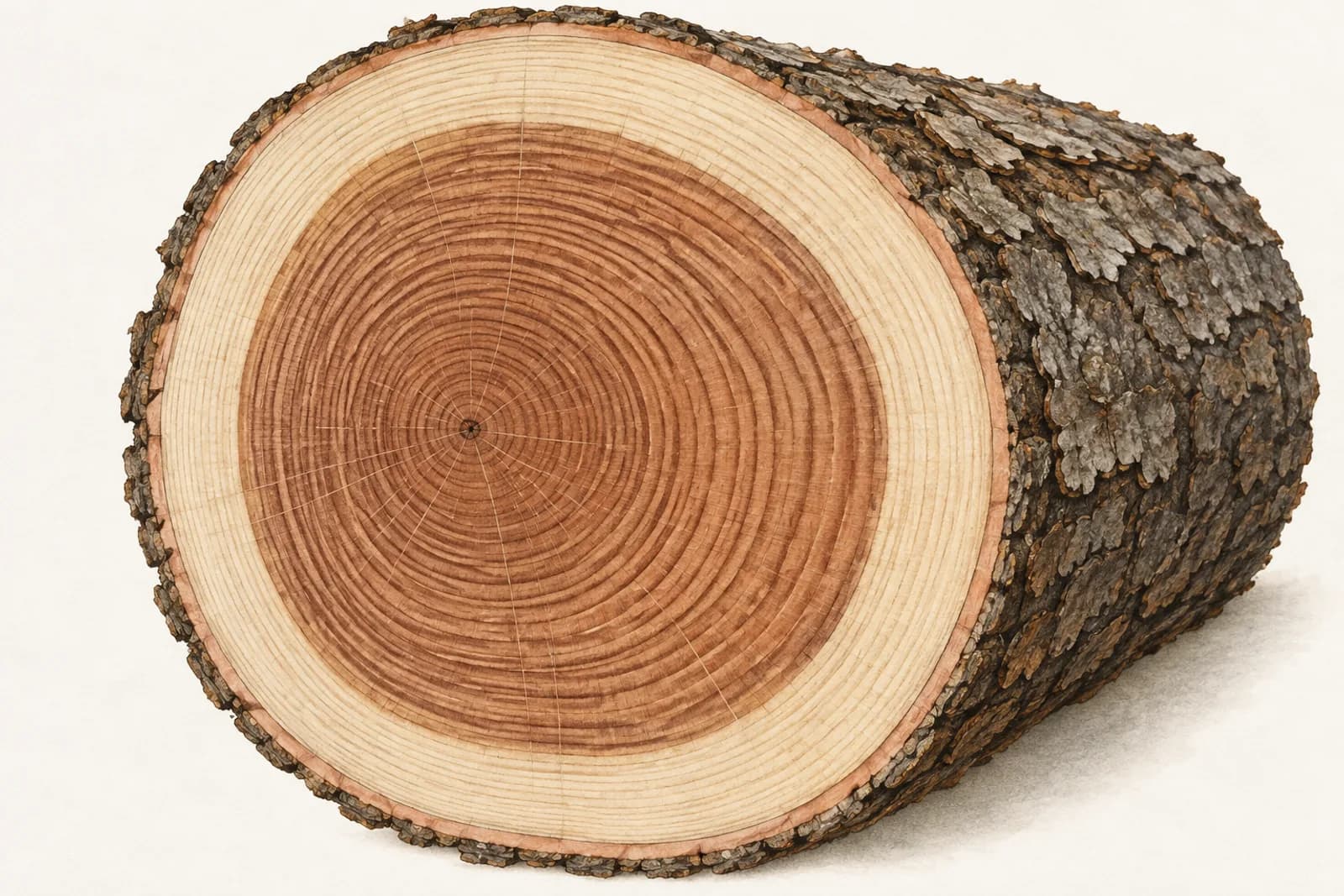
Go deeper · optional, not assessedWhat growth rings record
Ring counts have other limits. A drought can occasionally add an extra band, a badly stressed tree can fail to form a ring in places, and a count gives the age of the stem only at the height where it was cut, since the parts above it are younger.
Ring width records growth, too. A wide ring means the cambium made a lot of wood that season; a narrow one means it made little. A pruned bonsai in a small pot usually lays down narrow rings, which is why growers who want a branch to thicken let it grow freely for a time (Lesson 12).
Why a hollow tree can live
The living sleeve explains a sight that surprises many people: an old tree hollowed out by decay, still leafing out every spring. Its essential living tissues were never in the middle. As long as an outer sleeve of sapwood, cambium, and bark connects roots and leaves, the tree carries on, though a hollow trunk is weaker.
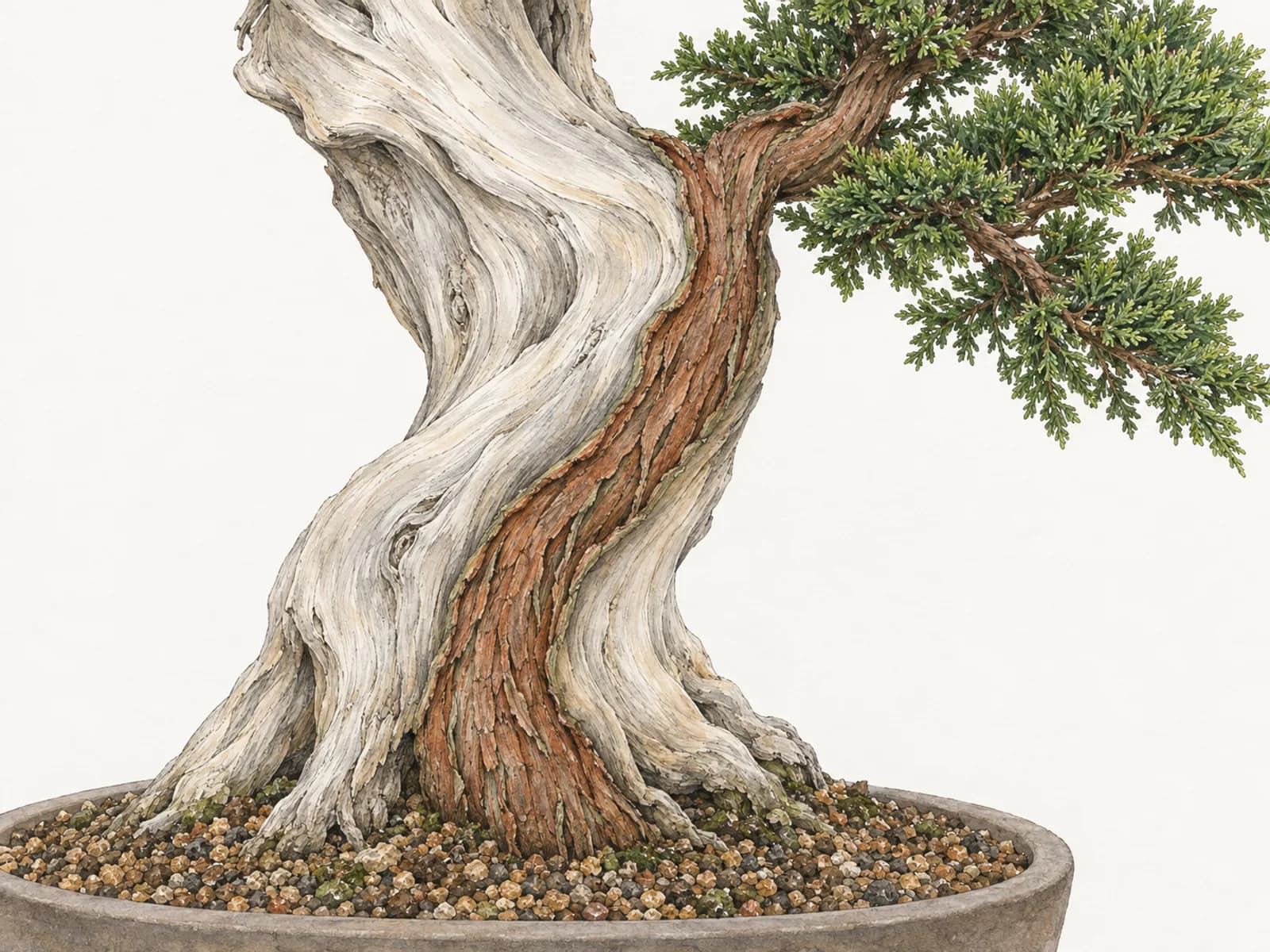
When the living sleeve is damaged
When the phloem is cut. Remove or crush a complete ring of bark, and the phloem is severed all the way around: this is girdlingDamage that removes or crushes a complete ring of bark around a trunk, branch, or root, severing the phloem all the way around. Sugars from the leaf side can no longer pass, so tissues on the root side lose that supply; a fully girdled trunk usually kills the tree over time.Open the glossary. Sugars made by the leaves beyond the injury can no longer pass it, so the roots and trunk below lose that supply, while sugars build up on the leaf side, where the bark often swells. A girdled trunk usually kills the tree over time, as its roots starve.
When the cambium is crushed. No new wood or bark forms at that spot, and the tree does not repair it. Instead, living cambium at the edges of the injury slowly spreads new wood and bark over the wound, leaving a scar that can stay visible for years (Lesson 14).
What wire does to a growing branch
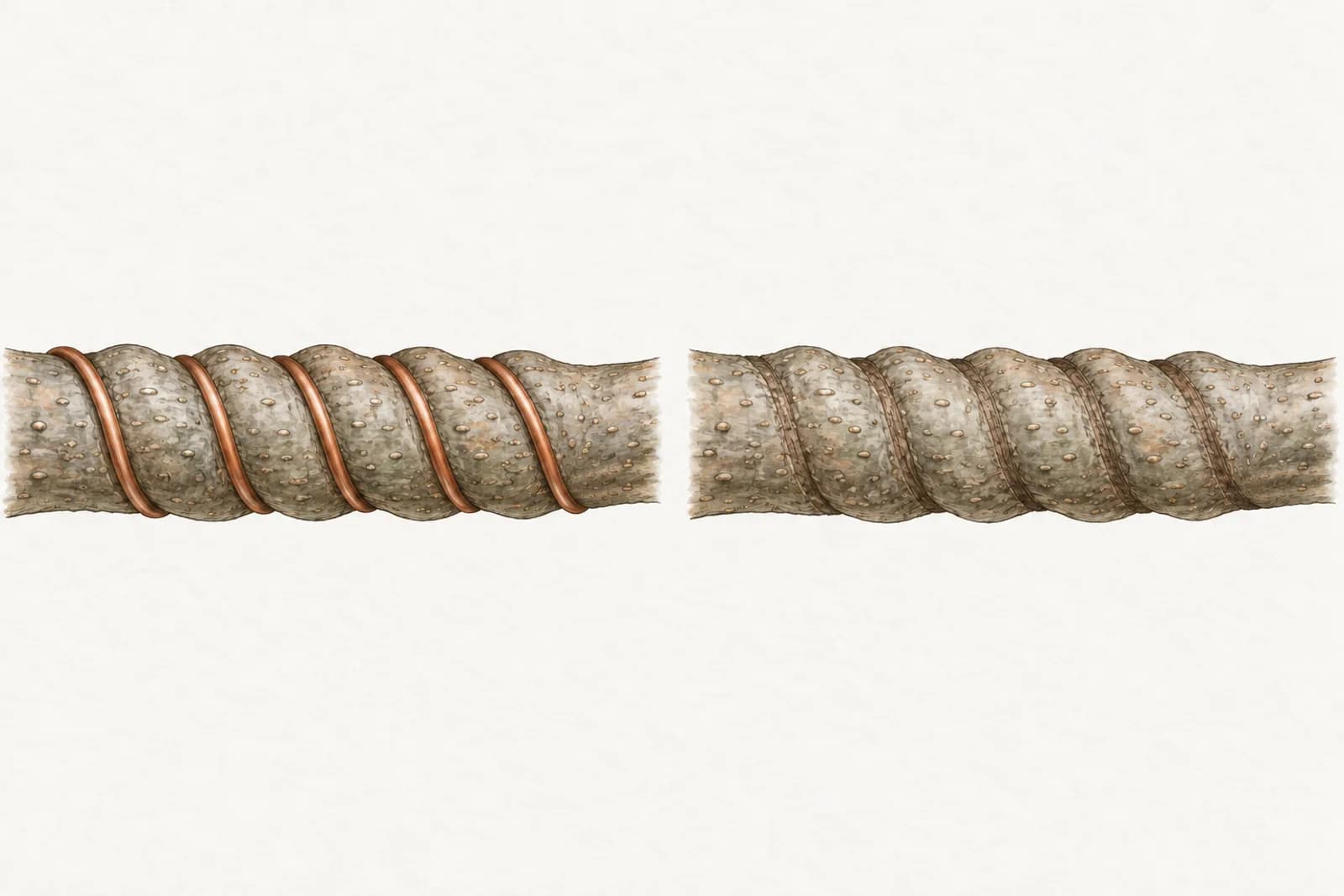
Wire holds a branch in a new position while the branch lays down new wood that helps it keep that shape. It is applied to rest snugly on the bark without pressing. But the branch keeps growing and the wire does not, so each new layer pushes the bark outward against coils that cannot give. When the wire begins to cut into the bark, the injury is called wire biteDamage that occurs when a branch thickens against bonsai wire, which cannot stretch, so the coils press into the bark and the living tissues beneath. It can restrict sugar transport and leave spiral scars that last for years.Open the glossary.
Predict first
The leaves most likely stay green: the water-carrying wood lies deepest, and the wire reaches it last. Through the thin bark, the phloem is squeezed first, so sugars from the leaves collect on the leaf side of the coil, as at a girdle, and feed extra growth there that makes the bark swell; the trunk side receives less. With more pressure, the cambium under the wire is crushed and stops making wood and bark there, so removing the wire reveals a spiral groove that the tree can only grow over from its edges.
In “How wire bites a growing branch,” press “Next” one stage at a time or move the slider. At each stage, read the status card, then check the magnified view (A), a lengthwise cut through one coil, to see which layer the wire is pressing.
Interactive
How wire bites a growing branch
Side view · the outside of the branch
Stage 1 of 6 · Just applied
Wire resting on bark: fine
How long this takes depends on how fast the branch thickens: weeks in vigorous growth, months in slow growth.
A · Magnified · cut lengthwise through one coil
- Outer barkWire resting on it
- Inner bark (phloem)Untouched
- Vascular cambiumUntouched
- Wood (xylem)Carrying water
On the outside
The coils lie against the bark at an even spacing. Nothing is pressing on the branch.
Under the wire
The wire rests on the outer bark. The living layers underneath, the phloem and the cambium, are untouched.
What still looks fine
- Branch: Unbroken
- Leaves: Green
- Water: Flowing
What it means for care: Nothing to change. Look at the wire whenever the tree is growing.
Stage 1 of 6, Just applied. Wire resting on bark: fine. Sugar flow past the wire: unrestricted.
Text description
Two views of the same wired branch. The side view shows the outside of a branch running from the trunk (left) toward its leaves (right), with a copper-brown wire coiled around it. The magnified view, marked A, cuts lengthwise through one coil to show the layers under the wire: outer bark, inner bark with its phloem, the thin vascular cambium, new wood made since wiring, and older wood. In that view, water moves through both the new and the older wood toward the leaves, and sugars made in the leaves move through the phloem toward the trunk and roots. Sugars can also move toward growing tips, which this view does not show.
- Outer bark: Mostly dead cork cells that protect the branch. On a young branch it is only a thin skin.
- Inner bark (phloem): Living cells that carry sugars from the leaves to where they are needed.
- Vascular cambium: A thin layer of dividing cells that adds new wood and new phloem.
- Wood (xylem): Carries water and dissolved minerals through dead, pipe-like cells, including the new wood; scattered living cells in the sapwood store carbohydrates.
The branch keeps thickening because its cambium adds new wood on the inside and new phloem on the outside. The wire cannot stretch, so the growing branch presses outward into it. Six stages:
- Just applied. Wire resting on bark: fine. Outside: The coils lie against the bark at an even spacing. Nothing is pressing on the branch. Inside: The wire rests on the outer bark. The living layers underneath, the phloem and the cambium, are untouched. Sugar flow past the wire: unrestricted.
- Some growth. Touching, not pressing: fine for now. Outside: The branch is a little thicker and looks no different. The wire cannot stretch, so its slack is gone. Inside: The cambium has added a thin layer of new wood, so the bark now bears lightly on the wire all the way around and any slack is gone. Sugar flow past the wire: unrestricted.
- Tight. Tight against the bark: inspect often while it grows. Outside: The coils sit tight against the bark, but the bark beside the wire is still level. Inside: The wire now presses on the outer bark. On a young branch that layer is only a thin skin, so the pressure already reaches the living phloem beneath it, lightly for now. Sugar flow past the wire: unrestricted.
- Starting to bite. Bark rising, wire sinking in: remove the wire now. Outside: The bark begins to rise beside the coils: the wire is starting to sink in. Taken off now, it would leave a shallow spiral mark. Inside: The wire dents the thin outer bark and squeezes the inner bark beneath it, where the phloem carries sugars from the leaves. Sugars begin to collect on the leaf side. Sugar flow past the wire: slightly reduced.
- Biting. Phloem compressed: sugar flow restricted; the leaf side may swell. Outside: The wire sits in a groove between raised ridges of bark, and the branch may swell on the leaf side of the wire. It has not broken, and its leaves still look healthy. Inside: The phloem under the wire is squeezed, so sugars from the leaves pass less easily and build up on the leaf side. The cambium is now under pressure too. Sugar flow past the wire: restricted.
- Grown over. Cambium damaged: a scar that can stay visible for years. Outside: Ridges of bark are rolling over the wire. Once the wire is removed, a spiral scar can stay visible for years. Inside: The cambium under the wire is crushed, so no new wood or bark forms there. The tree grows new tissue over the injury from its edges; it does not repair the damaged cells. Sugar flow past the wire: very restricted.
At every stage the branch is unbroken, water still moves through the wood, and the leaves beyond the wire stay green. That is why an unbroken branch with green leaves is not evidence that the wire is harmless. How long this takes depends on how fast the branch thickens: weeks in vigorous growth, months in slow growth.
“Just applied” and “Some growth” look almost identical from outside, but by the second stage the slack is gone, and every bit of thickening becomes pressure. The first sign you can see, bark rising beside the coils at “Starting to bite,” comes when the wire is already squeezing the inner bark. Through every stage, the row headed “What still looks fine” reports an unbroken branch, green leaves, and flowing water.
The harm reaches beyond the coil. Sugars from that branch's leaves are held up at the wire, so the trunk and roots, which use them for growth and storage, receive less. Because the crushed cambium makes no new wood along the spiral, the branch thickens unevenly there and can be weaker. How fast this unfolds depends on how fast the branch thickens, not on the calendar: weeks in vigorous growth, months in slow growth. Thickening can continue long after the new shoots have stopped lengthening.
Bending strains the same tissues another way. The outside of a curve is stretched and the inside compressed; bent too far or too fast, a branch can crack, or its bark and cambium can tear from the wood. Course 10, Wiring and First Styling, and Course 15, Advanced Structural Techniques, will cover bending.
Practice check · not scored
The bonsai decision
Inspect wire by growth, not by date
Starting point
Whenever a branch is wired, look closely at where the wire meets the bark along its whole length each time you check the tree while it is growing. Treat the first sign of bark rising beside the coils, or any indentation, as the signal to remove the wire carefully, even if the branch has not yet held its new position. Course 10, Wiring and First Styling, will cover removal and how to judge whether the branch needs support again.
This assumes
- The wire was applied to a healthy, actively growing tree and rested snugly on the bark without pressing. - You can see where the wire meets the bark, parting foliage where needed.
Change course if
- The tree is growing strongly, or a branch is being left to grow freely: look more often, because contact can become a bite within weeks, even after the new shoots have stopped lengthening. - The tree is dormant: expect little change, but look again as soon as growth resumes. - You find a bite on one branch: check every wired branch, since they share the same growing conditions. - A stake tie or label wire circles a trunk or branch: treat it the same way, because it girdles just as wire does. - Wire cuts in right after it is applied, or bark cracks at a bend: the cause is how the wire was applied or how far the branch was bent, not growth; Course 10 will cover what to do.
Back to the question
Why can wire damage a branch even before it breaks?
Wire damages a branch from the outside in. As the cambium adds new wood, the branch pushes its bark against wire that cannot stretch, so the pressure lands on the thin living sleeve: first on the phloem, slowing the flow of sugars, then on the cambium, which is crushed and leaves a lasting scar. The wood, which holds the branch together and carries water, can stay intact the whole time, so the branch does not break and its leaves stay green while the damage builds.
Key takeaways
- A branch is built in sleeves: outer bark (protection), inner bark and phloem (sugar transport), vascular cambium (growth in thickness), wood or xylem (water transport and support), and pith. - Only a thin sleeve near the surface is made mostly of living cells. Heartwood, where it has formed, carries nothing, which is why a hollow tree can live. - Water rises through the sapwood; sugars move mainly through the phloem toward wherever they are needed, in a separate system, not one circulating sap. - The cambium thickens a branch by adding wood inside and phloem outside, pushing the bark outward. - Wire bites because the branch grows and the wire does not. Judge wire by how it meets the bark, not by the date or by whether the branch has broken.
Optional · not required for completion
Read the end of a branch
Find wood that has already been cut, such as a pruned garden branch, firewood, or a log end; do not cut your bonsai for this. In good light, with a magnifying glass if you have one, find the outer bark, the thinner, often paler inner bark, the pale sapwood, darker heartwood if the piece is old enough and the species forms it, the growth rings, and the pith. Count the rings to estimate the branch's age.
No tree? If you have no cut wood handy, use the log cross-section illustration in this lesson: find each layer, count the rings, and point to where this year's wood would be and where a tight wire would press first.