Course 01 · Lesson 14 of 14 · Growth through time
Stress, vigor, and recovery
Readiness for more work is something you observe over weeks, not something you read from green foliage. Learn to judge vigor, see how stresses add up, and find out why trees seal their wounds instead of healing them.
The question
What evidence suggests that a tree is ready for more work?
By the end of this lesson, you will be able to:
- Define vigor as growth performance compared with what the tree normally does in that season, using several kinds of evidence gathered over time.
- Explain how root loss, foliage loss, and environmental stress interact and add up.
- Explain that trees compartmentalize wounds and cover them with new growth rather than restoring the original tissue.
About 16 minutes to read and explore
Picture two nursery junipers side by side on a garden-center bench (an instructional example). Both are a deep, even green, dense and full.
Below the soil, they differ. One root ball is laced with firm roots and fresh white tips. The other sat at the dry end of the bench, missed by the sprinklers through a hot week; its root ball dried out completely, and most of its fine roots died (Lesson 2). Watered again, it looks just like its neighbor. Unless new roots grow, it will brown, but it may stay green for weeks or even months first.
If green cannot tell these two apart, what can?
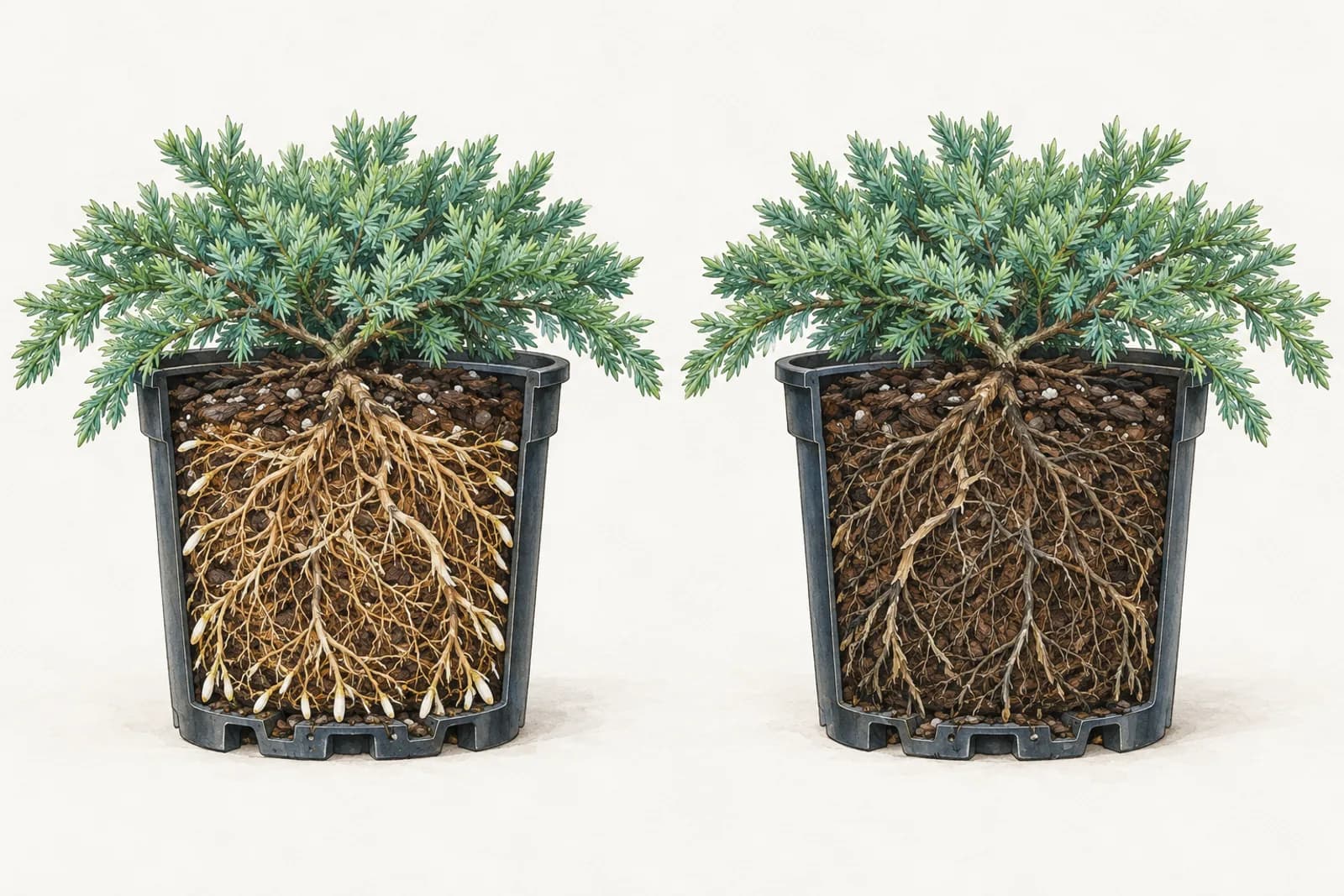
Foliage color is a lagging sign. A leaf stays green as long as its cells keep their chlorophyll, and that can outlast the roots that supply it. coniferA tree or shrub that bears seeds in cones, which are berrylike in junipers, instead of in flowers and fruits, and usually has needle-like or scale-like leaves. Most conifers are evergreen, but larches and a few others drop their needles each autumn.Open the glossary are the extreme case, especially in cool weather, because their needles lose water slowly. Broadleaf trees usually show trouble sooner, by wilting, yellowing, or dropping leaves, though a symptom says only that something is wrong, not what.
Growth is a better witness, especially growth that continues. A swelling bud or a first flush of shoots can run on stored reserves, so on its own it shows only that the tree had reserves, not that its roots are working now. Shoots that keep lengthening and then harden, new leaves that reach full size, and root tips that advance over several weeks show a tree building new tissue with working roots and leaves.
What vigor means
In this course, vigorA tree's observed growth performance relative to its expected seasonal behavior, meaning what a tree of its kind should be doing at that point in the season. It is judged from shoot extension, bud development, foliage condition, and root activity when visible, across several observations over time, not from one large leaf or green color. A vigorous tree is growing at or above that expected pace.Open the glossary means a tree's observed growth performance compared with what that kind of tree normally does at that stage of the season.
- Observed. You see vigor in shoots, buds, leaves, and roots; it is not a hidden force.
- Compared with what that kind of tree normally does. In mid-spring, a healthy trident maple can add several pairs of leaves per shoot within a few weeks; a healthy juniper shows modest, paler green tips. Each is vigorous by its own standard.
- At that stage of the season. A trident maple with bare twigs in midwinter is resting, not weak (Lesson 13). The same bare twigs in early summer would be a serious warning.
Because vigor shows in how a tree changes, judge it from several observations over time, alongside what has recently been done to the tree.
Growers also call trees strong or weak, out of balance, or low on energy. In observable terms, strong and weak describe growth compared with what is expected. Balance usually means where growth goes, toward the parts with the most light (Lesson 12). Energy means carbohydrate supply and use: the sugars leaves make in light (Lesson 6) and the reservesCarbohydrates, mostly starch, stored in living cells of the roots, trunk, branches, and bark for later use. Reserves fuel early spring growth before new leaves can supply sugar, and they help a tree recover after losing foliage or roots. A seed carries reserves of its own, such as starch, oils, and proteins, that fuel the embryo's first growth.Open the glossary stored in roots, trunk, and branches (Lesson 9), which you infer from how the tree has grown, never read from a photograph.
What to look for, and when
Five kinds of evidence are worth a minute at every check:
- Shoot extension. New shoots lengthening, then hardening (firming and turning woody from the base), at this tree's normal pace for the stage.
- Buds. Plump, firm new buds forming where leaves join the shoot and at the tips (Lesson 5). Small, shriveled, or missing buds suggest little to spare.
- Foliage. Color, size, and density, compared with this tree's past growth. Leaves that come out paler or smaller with each round of growth, for no reason you know of, say more than any single large leaf.
- Roots, when visible. White, active root tipThe growing end of a root, made up of the root cap, the dividing cells behind it, and short zones where new cells lengthen and mature. Active tips are usually pale or white and show where a root is extending into fresh substrate.Open the glossary at the drainage holes or along the pot edge show roots that are growing (Lesson 2); seeing none is an unknown, not a bad sign. Routine checks need nothing more, and a recently potted root ball can break apart if lifted out. When a root problem is suspected, a careful look becomes a diagnostic step (Course 07, Tree Health and Diagnosis).
- Recent history. What was done to the tree, such as repotting, pruning, wiring, or a move, and how it has responded since.
At each check, note the date and what you see, and take a photo from the same spot. Changes too slow to notice day to day, such as shoots a little shorter than last month, become obvious when dated photos sit side by side, and the record shows you this tree's own normal.

Weigh the evidence
In Is this tree ready for more work?, you judge three instructional-example trees. For each, reveal the observations, look back through the dated Observation record, and choose what the evidence supports. Two of the choices mention elective work: styling, pruning, or root work that you choose to do, as opposed to urgent care.
Exercise
Is this tree ready for more work?
Case A · Instructional example
Trident maple Acer buergerianum
Mid-spring, outdoors in good light in a temperate garden. No pruning, wiring, or root work so far this year.
Observation record
Observations
0 of 5 revealed
Shoot extension
Look for: Are new shoots lengthening the way this tree normally does at this stage?
Buds
Look for: Are new buds forming, and do they look plump and firm?
Foliage
Look for: Is the color, size, and density of the foliage typical for this tree?
Roots
Look for: Are active root tips visible anywhere you can see without disturbing the tree?
Recent history
Look for: What has been done to the tree recently, and how has it responded over the weeks?
What does the evidence support?
You have seen 0 of 5 observations. You can decide now or reveal more first.
Separate from readiness: urgent problems, such as a dry root zone, frost, or wire cutting into a branch, need action right away whatever the tree’s condition.
Text description
Three instructional-example trees, each with five observations (shoot extension, buds, foliage, roots, and recent history) and a dated record of earlier checks. For each tree, decide whether the evidence supports proportionate work, observing and gathering more evidence, or deferring elective work and addressing care first.
Case A, Trident maple (Acer buergerianum). Mid-spring, outdoors in good light in a temperate garden. No pruning, wiring, or root work so far this year.
- Shoot extension: New shoots are extending strongly, each with several pairs of fresh leaves.
- Buds: Plump, firm buds are forming where the leaves join the shoots.
- Foliage: The leaves are an even, healthy green, full-sized for the stage, and evenly spread.
- Roots: White, active root tips show at the drainage holes, seen without lifting the tree.
- Recent history: No work so far this year. Your notes show this pattern building over several weeks, much like last spring.
Record: week 0, buds swelling; week 2, leaves opening; week 4, shoots extending (latest check).
Case B, Nursery juniper (Juniperus procumbens ‘Nana’). Bought from a garden center three weeks ago, during the growing season. Outdoors on a bench, still in its nursery pot.
- Shoot extension: No new extension visible yet. Fresh juniper growth often shows as paler green tips; none stand out.
- Buds: The growing points are tiny and tucked among the needles, hard to judge by eye.
- Foliage: Green and dense all over, with no browning.
- Roots: Unknown. Nothing shows at the drainage holes, and the nursery pot hides the root zone.
- Recent history: Unknown before purchase: no record of watering, root work, or pests. Its conditions changed when it moved to your bench.
Record: week 0, bought: green, dense; week 3, unchanged: green, dense (latest check); week 6, not yet observed; week 9, not yet observed.
Case C, Ficus (Ficus microcarpa). Repotted three weeks ago with substantial root reduction. Since then it has stood indoors in a dim room, far from a window.
- Shoot extension: No new shoots since repotting.
- Buds: The buds at the shoot tips are closed and unchanged.
- Foliage: Several leaves have turned yellow and are dropping.
- Roots: Many roots were removed three weeks ago, so far fewer roots now supply the leaves. No new tips show yet, which is not unusual this soon.
- Recent history: Repotted with substantial root reduction three weeks ago, then kept in a dim room. Yellowing began about two weeks later.
Record: week 0, repotted; week 2, first yellow leaves; week 3, more leaves yellowing and dropping (latest check).
After you choose, the board labels each observation as supporting readiness, weak on its own, unknown so far, or a sign of stress, marks the evidence that mattered most, and explains what would change the decision.
The three trees earned three different answers, and none came from a single observation. The maple's case rests on four weeks of agreeing records, and even then the answer is proportionate work: one planned job, not everything at once. The juniper's green foliage is only “Weak on its own,” and its unknowns are a reason to keep watching, not bad news. The ficus is the opposite: every card is marked “Sign of stress,” and the stresses are connected.
Practice check · not scored
How stresses add up
stressAny condition that pushes a tree's functioning outside its normal range and limits growth or survival, such as drought, waterlogging, heat, cold, poor light, root loss, pests, or heavy pruning. Several stresses at once can add up to more than the tree can support.Open the glossary is any condition that pushes a tree's functioning outside its normal range and limits growth or survival: drought, waterlogging, heat, cold, poor light, root loss, pests, or heavy pruning. A healthy tree can usually recover from one moderate stress, given time and good conditions. Trouble comes when a stress is severe or several stack up, as they did for the ficus in case C, because they strain the same connected systems.
- Root loss cuts water and mineral uptake (Lesson 10) and removes some stored reserves. After root work, water loss can outrun uptake on a sunny, windy day (Lesson 8).
- Foliage loss cuts sugar production. Leaves supply the sugars that build new roots, and roots supply the water that leaves need, so losing a lot of both at once leaves each part waiting on the other.
- Environmental stress adds on top. Poor light lowers sugar production even when every leaf remains; heat and wind raise water demand; cold and pests bring their own damage.
The same logic explains why heavy root work, heavy pruning, and wiring with strong bends in one session can be more than a tree can support: root work reduces uptake and reserves, pruning removes sugar-making leaves, and strong bending can crack living tissue that must then be walled off and grown over.
Predict first
More slowly, and perhaps for longer than either loss alone would suggest. The reduced roots take up less water and fewer minerals, and they took some stored reserves with them. The frost removed the leaves that would have made sugars for new roots, so the tree must push replacement leaves from reserves that root work had already reduced. Each loss slows recovery from the other, and the cost may still show as shorter growth the following spring.
Costs that surface a season later are common, because a tree can draw on reserves for a while. When stress continues, shoot tips may die back. This diebackThe progressive death of shoots, branches, or roots, usually starting at the tips and moving back toward older parts. It is a symptom with many possible causes, such as root damage, drought, frost, disease, or removing all foliage from a branch that cannot regrow.Open the glossary, the progressive death of shoots or roots from the tips toward older parts, is a symptom with many possible causes. Several stresses together can lead to declineA gradual loss of health and growth over months or years, usually from several stresses acting together, such as poor light, root problems, or a missing winter rest. Early signs are subtle, so comparing dated records over time helps catch it.Open the glossary, a gradual loss of health and growth over months or years. Its early signs, slightly shorter shoots and smaller, paler leaves each season that recent work does not explain, are easiest to catch in a dated record.
Recovery takes leaves, roots, and time
recoveryA tree's return toward normal growth and function after stress or work such as repotting or heavy pruning, drawing on its remaining leaves, roots, and reserves. It takes time that cannot be guaranteed, and fertilizer cannot speed it beyond what roots and light allow.Open the glossary is a tree's return toward normal growth and function after stress or work. It draws on what the tree has left: leaves to make sugars, roots to take up water and minerals, and reserves to bridge the gap. It needs conditions that let those parts work, such as good light and a root zone that holds both water and air, and it needs time: new roots and leaves take weeks to grow, and rebuilding reserves can take a growing season or more.
You can support recovery, but you cannot hurry it past what roots and light allow. fertilizerA product that supplies mineral nutrients, such as nitrogen, phosphorus, and potassium, for roots to absorb. It supplies no energy or carbohydrates that the tree can use, so it cannot make up for too little light or too few healthy leaves, and too much can harm roots.Open the glossary supplies mineral nutrients, not energy (Lesson 10). It can correct a shortage, but a tree short of roots can absorb only so much, a tree short of light lacks sugars that no fertilizer supplies, and a strong dose around a reduced root system can harm the roots that remain.
What helps is correcting the conditions, holding off on elective work, and watching for the signs of vigor to return. No one can promise how long that takes; read it from the tree, not the calendar.
Trees seal wounds; they do not heal them
Every pruning cut, broken branch, or deep wire scar is a wound.
A tree responds in two ways. First, it walls the damage off. Wood exposed by the cut is open to air and to decay organisms. Within weeks, the living wood around it changes chemically and structurally, forming boundaries that resist the spread of decay inward, up and down, and sideways. This response is called compartmentalizationA tree's response to a wound: it forms chemical and anatomical boundaries that wall off the damaged wood and resist the spread of decay. The damaged tissue is sealed off, not repaired; CODIT, the name of the model that describes this, stands for “compartmentalization of decay in trees.”Open the glossary.
Second, it grows over the wound. The vascular cambiumA layer of dividing cells, only a few cells thick, between the wood and the inner bark. It adds new xylem on its inner side and new phloem on its outer side, which is how trunks, branches, and roots grow thicker.Open the glossary, the thin living layer that makes new wood and bark (Lesson 3), is gone across the cut but survives at its edges. There it makes woundwoodNew wood and bark that grow from the living edges of a wound, forming a rounded roll that gradually spreads over the exposed surface. It covers the wound but does not restore the damaged wood beneath. Bonsai growers often call it callus, though strictly callus is the soft tissue that forms first at a wound's edge, before woundwood.Open the glossary, often called callus: a rounded roll of new wood and bark that creeps over the exposed surface year by year. wound closureThe gradual covering of a wound's exposed surface as woundwood grows in from its edges until the edges meet. Its speed depends on the tree's vigor, the wound's size and position, and the kind of tree; large wounds may never fully close.Open the glossary is complete when the rolls from the edges meet.
In A pruning wound over five years, press Play with a vigorous tree and a small wound, and compare the front view with section A, a slice across the trunk at the dashed line. Once the wound is covered, set Section A to Along the trunk. Then press Replay with a Weak tree, and again with a Large wound.
Interactive
A pruning wound over five years
Front view · the surface of the trunk
Bare wood, ringed by cut bark. Living cambium remains only at the edge.
A · Cross-section · cut across the trunk, wound side up
Inward and sideways, the discolored wood is held at a boundary. New rings form outside it.
Just cut
Exposed
The cut leaves bare wood open to the air. The cambium, the thin layer that makes new wood and bark, survives only around the edges of the cut.
- Exposed woodThe whole cut surface
- WoundwoodNot formed yet
- New wood since the cutNone yet
- Discolored woodBeginning to form behind the cut
- Boundary that resists the spread of decayNot formed yet; begins within weeks
Small wound, vigorous tree: thick rolls of woundwood advance quickly from the edges, and the discolored zone stays small.
This wound is covered within the five years shown.
Just cut. Exposed. The cut leaves bare wood open to the air. The cambium, the thin layer that makes new wood and bark, survives only around the edges of the cut. Small wound, vigorous tree.
Text description
Two linked views of the same pruning wound on a trunk, followed for five years after the cut. The front view shows the surface of the trunk. The section, marked A, shows the inside of the wood: either cut across the trunk through the middle of the wound, or cut lengthwise down through it.
What happens after the cut:
- The cut exposes bare wood. The cambium, the thin layer that makes new wood and bark, is gone across the wound and survives around its edges.
- Within weeks, the tree alters the wood around the damage, forming chemical and structural boundaries that resist the spread of decay inward, up and down, and sideways. The discolored wood behind the cut is held within these boundaries. It usually reaches farther up and down than inward or sideways, because the boundaries across the wood's up-and-down water-conducting cells are the weakest. The cambium also forms a boundary layer in the new wood, separating the wood that existed at the time of the cut from wood formed afterward.
- The living cambium at the edges makes woundwood (often called callus): a rounded roll of new wood covered in bark that slowly grows over the exposed surface. It usually advances fastest from the sides, so the opening narrows toward a vertical slit before it closes.
- Each year a new growth ring forms outside the old wood. Once the rolls meet, a seam remains, and later rings grow continuously over the old wound.
- The discolored wood is never replaced. It stays sealed inside, behind the boundary and under the new wood. Decay organisms may still work slowly within it, but the boundary resists their spread into wood formed after the cut.
Choose a vigorous or weak tree and a small or large wound. A vigorous tree makes thicker rolls and wider rings; a weak tree makes woundwood more slowly and may wall off damage less effectively, so its discolored zone can be larger. A larger wound takes longer to cover and has a larger discolored zone behind it. Year by year in this illustration:
- Small wound, vigorous tree. Just cut: exposed. Year 1: woundwood forming at the edges. Year 2: mostly covered. Years 3 to 5: covered, with the old damage sealed inside.
- Small wound, weak tree. Just cut: exposed. Years 1 and 2: woundwood forming at the edges. Years 3 and 4: mostly covered. Year 5: covered, with the old damage sealed inside.
- Large wound, vigorous tree. Just cut: exposed. Years 1 and 2: woundwood forming at the edges. Years 3 to 5: mostly covered.
- Large wound, weak tree. Just cut: exposed. Years 1 to 5: woundwood forming at the edges.
On the surface, the story ends with a seam: within a few years, the small wound on the vigorous tree looks nearly whole. Inside, the discolored wood is still there, sealed behind its boundary and buried under new growth ringA band of wood laid down during one period of growth, seen in a cross-section as lighter, more open early wood followed by denser late wood. In many temperate trees each ring marks one year, but rings can be faint or irregular, especially in tropical trees.Open the glossary. The lengthwise section showed it reaching farther up and down than inward, because the boundaries that resist spread up and down, along the wood's water-conducting cells, are the weakest.
The weak tree made thinner rolls and narrower rings, so its wound stayed open longer, and its discolored zone can be larger. The large wound was still open after five years, even on the vigorous tree. Real closure speed varies widely with the kind of tree, its vigor, and the wound's size and position, and some large wounds never close fully.
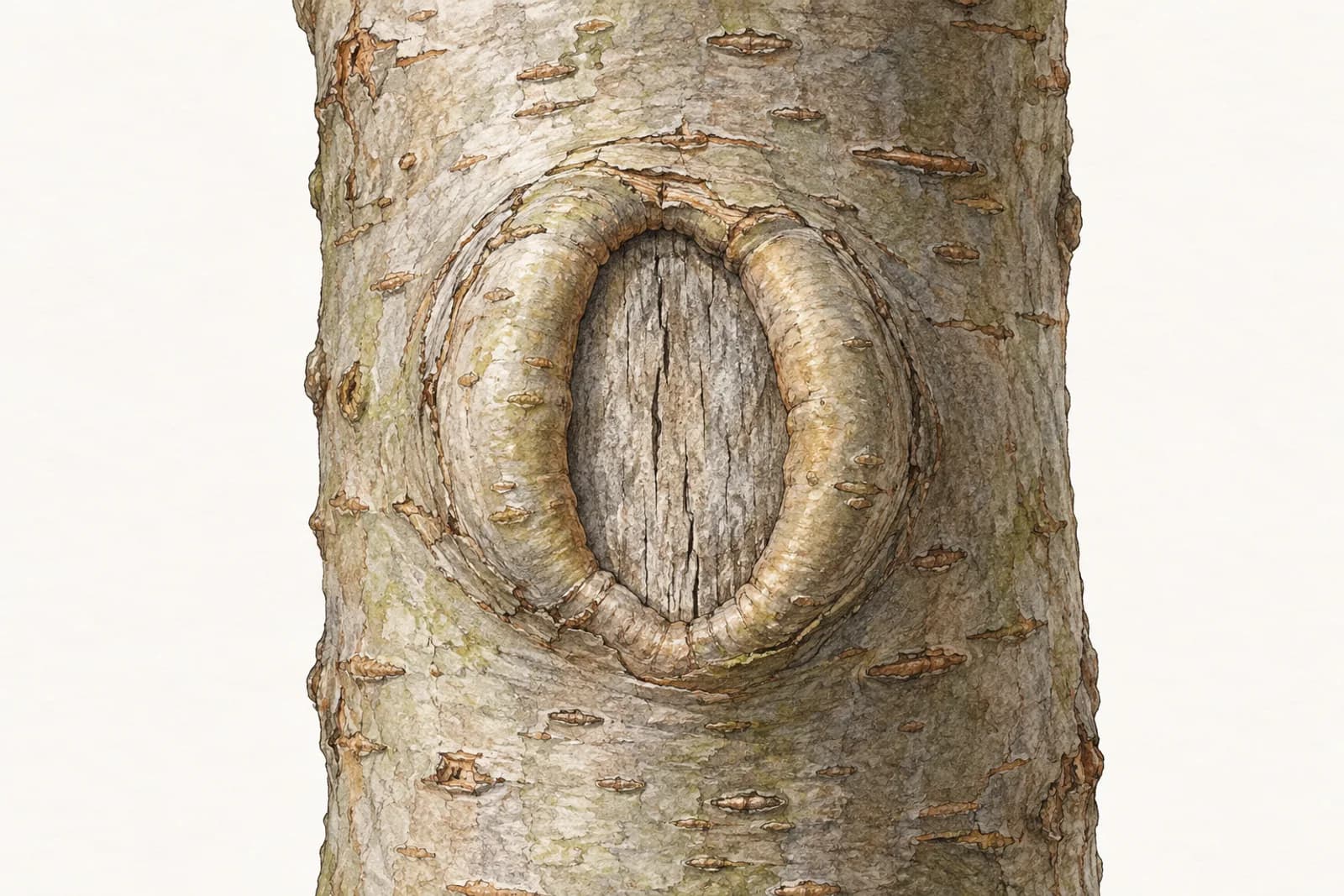
For bonsai, two consequences follow. A vigorous tree covers wounds faster, one more reason to judge vigor before cutting. And a large cut permanently changes the trunk: it takes years to cover, if it ever does, and the damage stays inside. Where and how to cut, and whether to use a wound dressing, which growers debate, belong to Course 09, Pruning and Managing Growth.
Practice check · not scored
Go deeper · optional, not assessedCODIT: the walls inside the wood
The model behind this section is CODIT, short for compartmentalization of decay in trees, developed by the plant pathologist Alex Shigo and colleagues at the U.S. Forest Service. It describes four walls. Wall 1, the weakest, resists spread up and down as water-conducting cells near the wound are plugged. Wall 2 resists spread inward, across the growth rings. Wall 3, formed by the rays (bands of living cells running outward from the trunk's center), resists spread sideways around the trunk. Wall 4, the barrier zone, is made by the cambium after the injury and separates the wood present at the time of the wound from wood formed later; it is usually the strongest.
Each wall is really a zone of altered wood that resists decay rather than stopping it outright. Strictly, callus is the soft tissue that forms first at a wound's edge, and woundwood the more organized wood and bark that follows, though growers often say “callus” for both.
Read several signs before more work
The bonsai decision
Confirm readiness before elective work
Starting point
Before elective work such as styling, heavy pruning, or root work, confirm over several checks spanning at least a few weeks, with a dated record and photos, that the tree is growing normally for its kind and the season and has recovered from any recent work. For work done before shoots can extend, such as repotting many deciduous trees as their buds swell (Course 11, Repotting and Root Development), judge from how the tree grew last season and how its buds look now. Watch a newly acquired tree through a period of active growth first, to learn its normal. When the signs agree, choose proportionate work: one planned job, then watch the response before the next.
This assumes
You know what kind of tree it is and its normal growth at this stage (identification belongs to Course 02, Choosing a Tree and Creating Its Growing Environment). It is in conditions it can grow in: suitable light and temperature, and a root zone that holds both water and air. Timing for particular techniques belongs to Course 06, Seasonal Care and Timing.
Change course if
- A sign is missing for the stage, or getting worse: shoots stalling, new leaves paler or smaller than this tree's recent growth, buds shriveling, or foliage thinning. Defer elective work and check light, watering, and the root zone; Course 07, Tree Health and Diagnosis, will teach how to find a cause.
- The tree is still recovering from earlier work. Wait until new growth extends normally again, not for a set number of weeks.
- Something urgent needs attention, such as a dry root zone, frost, or wire cutting into a branch. Act now, whatever the tree's readiness; urgent care is not elective work.
Back to the question
What evidence suggests that a tree is ready for more work?
A tree is ready when several kinds of evidence agree over time, each judged against what this kind of tree normally does at that stage of the season: normal shoot growth (or, before growth starts, a good record from last season), plump buds, typical foliage, active roots where visible, and recovery from recent work. Green foliage alone is not enough. When stresses have stacked up, defer elective work and correct the conditions first; a vigorous tree also covers wounds faster.
Key takeaways
- Vigor is growth compared with what this kind of tree normally does at this stage, read from shoots, buds, foliage, and visible roots over several checks.
- Green foliage alone is weak evidence, especially on a conifer.
- Stresses add up and can show a season later: root loss cuts uptake and reserves, and foliage loss and poor light cut sugar supply.
- Recovery needs remaining leaves, roots, and reserves, good conditions, and time. Fertilizer can correct a mineral shortage, but it supplies no energy and cannot hurry recovery past what roots and light allow.
- Trees compartmentalize wounds and grow woundwood over them; the damaged wood stays sealed inside, never replaced.
Optional · not required for completion
Start an observation record
Choose one tree. Today, note the date, take a photo from a spot you can find again, and jot down what you see in the shoots, buds, foliage, and drainage holes. In two weeks, repeat and set the photos side by side. What changed? What would you need to see over the next few checks to call the tree vigorous?
No tree? Do the same with a street tree, a garden shrub, or a houseplant.
This lesson completes How Trees Work and its model of a tree: roots that need water and air, leaves that build sugars from light, separate routes for water and sugars, and growth that follows the seasons. After the synthesis checkpoint, Course 02, Choosing a Tree and Creating Its Growing Environment, will put that model to work, and Course 03, Watering and Daily Observation, will turn this observation habit into a routine; both are being prepared.