Course 01 · Lesson 13 of 14 · Growth through time
Growth cycles, dormancy, and reproduction
Trees keep time with the seasons. Learn how a tree's year unfolds, why many trees need a cold winter rest, why a warm room all year can slowly harm them, and where flowers and seeds fit in.
The question
Why can't every bonsai live in a warm room all year?
By the end of this lesson, you will be able to:
- Describe the seasonal cycle of growth, hardening, dormancy, and renewed growth in a temperate tree.
- Explain why many temperate trees need a cold rest while tropical and subtropical trees follow different cycles.
- Explain how flowering and seed production fit the cycle, and why placement and timing must match the actual tree.
About 16 minutes to read and explore
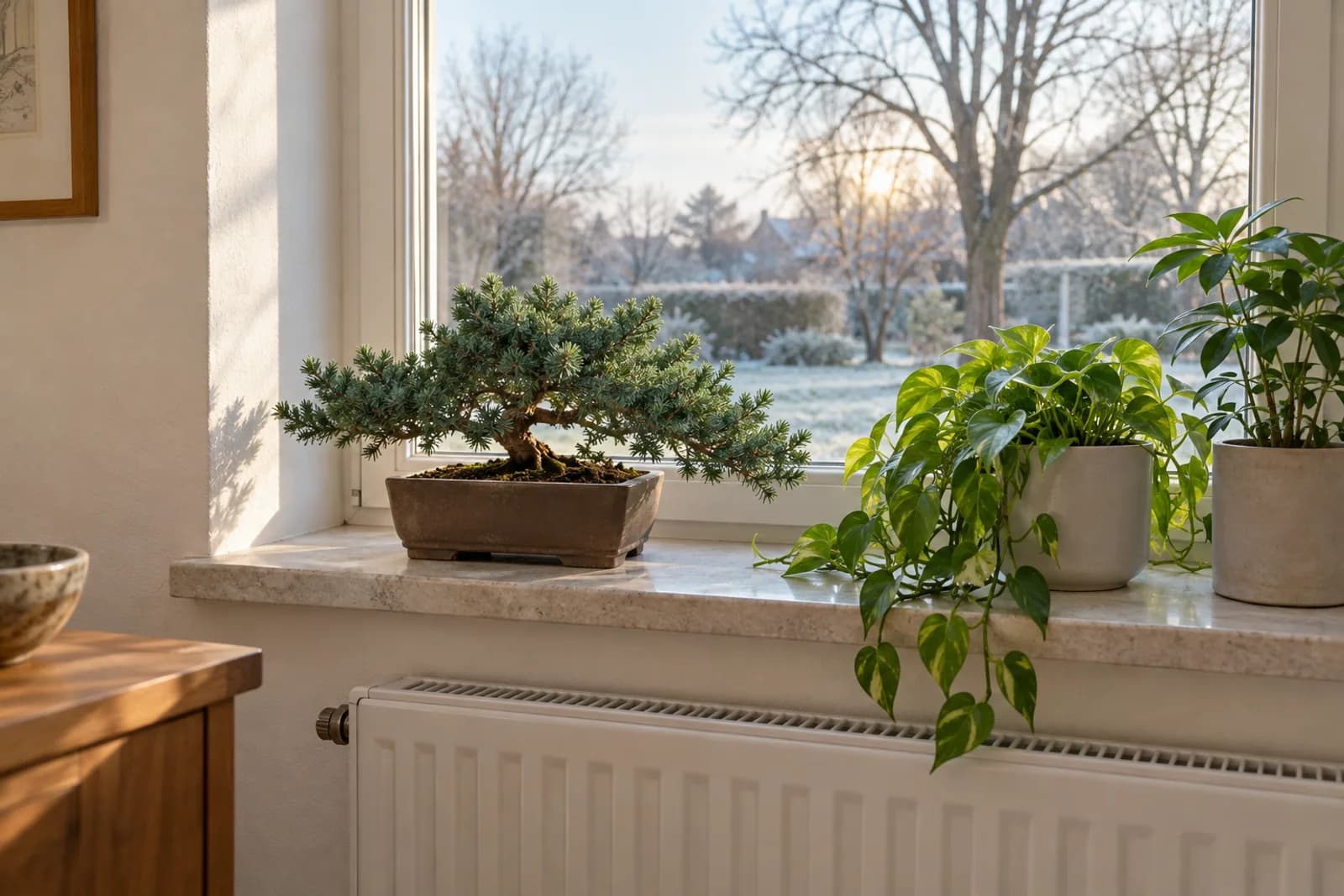
Instructional example: the nursery juniper from earlier lessons goes home in spring with a tag that says “indoor bonsai.” It sits on a sunny windowsill above a radiator, watered with care, and through summer, autumn, and winter it stays green.
The next spring, new growth starts late and comes in short and pale. Over the following months the foliage thins and the inner tufts turn brown. The tree was not neglected; it was in the wrong place for what it is. A juniper is a temperateDescribes regions with distinct warm and cold seasons, and the trees adapted to them, which typically need a cool winter rest. Trident maples and the junipers commonly grown as bonsai are temperate trees and need seasonal outdoor conditions rather than a warm room all year.Open the glossary tree, adapted to warm summers and cold winters, and it spent its year short of light, waiting for a winter that never came.
A tree's year, read in stages
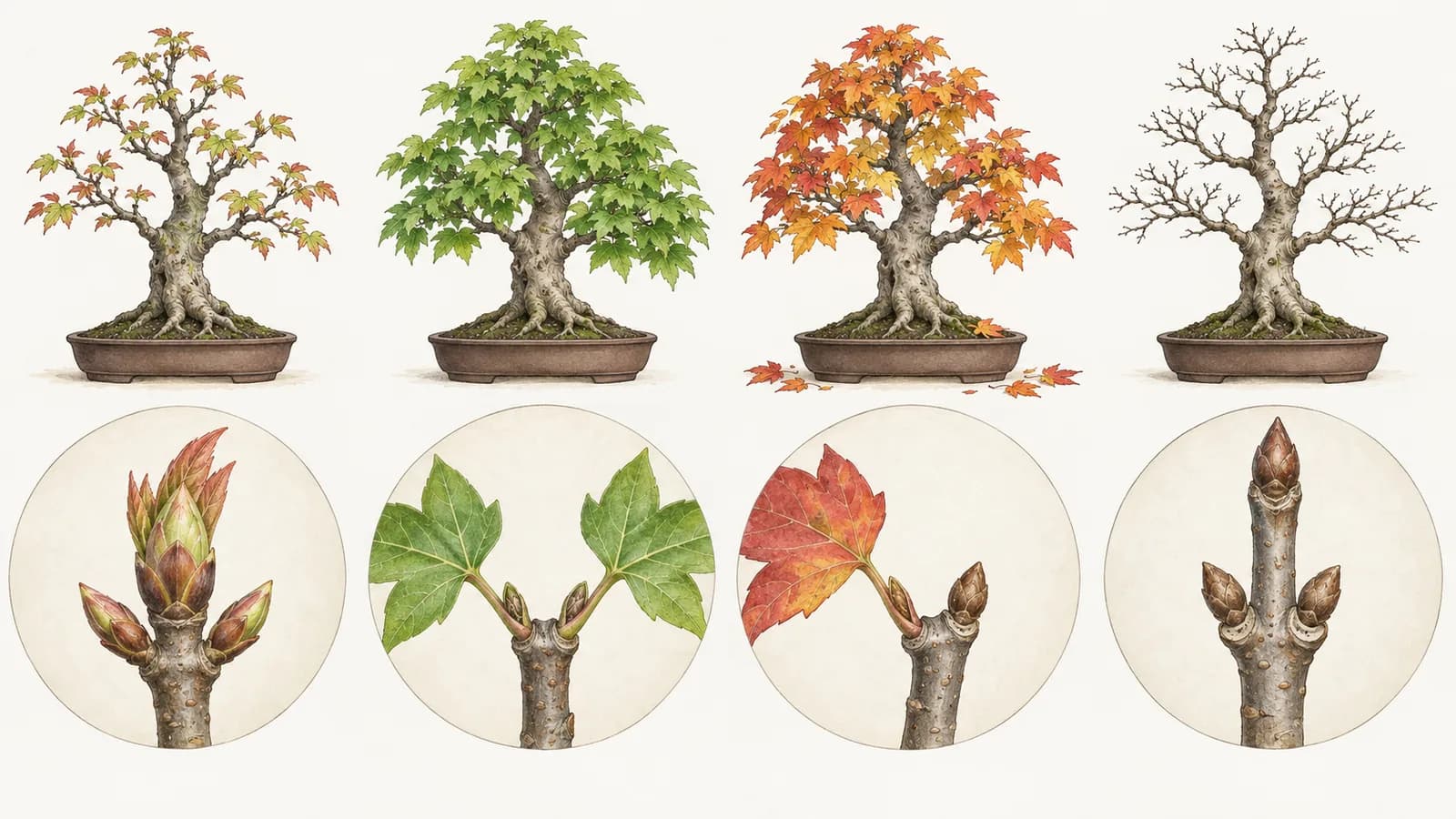
Trees do not keep a calendar, but they do keep time. phenologyThe timing of a plant's recurring life events through the year, such as bud break, flowering, leaf color change, leaf fall, and dormancy, and how weather and climate shift them. Timing care to these stages works better than following calendar dates.Open the glossary is the timing of a tree's recurring, visible events. Follow the trident maple, an instructional example, through a year outdoors in a temperate climate:
- bud breakThe stage when buds swell and open and new leaves or shoots begin to emerge, marking the start of a growth period. In deciduous temperate trees it is fueled at first largely by stored reserves.Open the glossary. As spring warms, buds swell, their scales part, and new leaves unfold, often tinged red, drawing at first on sugars stored the year before (Lesson 9).
- Shoot growth. Shoots extend in a spring flush (Lesson 12), and a vigorous tree may flush again later.
- bud setThe stage when shoots stop extending and form well-developed, often scale-covered buds that will carry the next season's growth. In many temperate trees, shortening days and cooler temperatures help trigger it in late summer or autumn.Open the glossary and hardening. In late summer, shoots stop extending and form the buds that will carry next year's growth. The soft new shoots then firm up and turn woody, which growers call hardening.
- Autumn color and leaf fall. As days shorten and nights cool, the green pigment chlorophyll breaks down. Yellow and orange pigments that were in the leaf all along show through. Many maples, the trident among them, also make new red pigments. Then the leaves drop.
- Winter rest. The tree stays alive but stops growing until spring.
These stages arrive on different dates in different places and shift with each year's weather; south of the equator, July is midwinter. So this course times care by the stage you can see on the tree, not by the month.
Day length and temperature set the clock
A tree starts preparing for winter well before the first frost, by reading two signals.
The first is photoperiodThe length of daylight in each 24-hour day, which changes with the seasons and acts as a calendar signal for plants. Shortening days help tell many temperate trees to stop growing, set buds, and prepare for winter.Open the glossary, the length of daylight in each day. In any one place it follows the same pattern every year, whatever the weather. In many temperate trees, shortening days in late summer are the cue to stop extending shoots and set buds, while it is still warm.
The second is temperature, which varies more from year to year and fine-tunes the timing; in some trees it matters more than day length. Together, shortening days and then cool nights and early frosts drive cold acclimationThe gradual process, triggered by shortening days and falling temperatures, in which a tree's tissues become able to survive freezing. A tree moved suddenly from a warm room into frost has not acclimated and can be badly damaged. It is not the same as shoots hardening, or turning woody, though the two often happen around the same time.Open the glossary, also called cold hardening: over several weeks, the tree's living cells change so that they can survive freezing. A fully acclimated twig survives cold that would kill the same twig in summer.
Acclimation fades in warmth, and a tree that spent the autumn in a warm room built little of it. Moved suddenly into frost, such a tree can be badly damaged, even if it would have been hardy had it stayed outdoors.
Dormancy: resting, not dead
dormancyA period when a tree, bud, or seed is alive but not growing, held back by its own internal controls, by outside conditions such as cold, or, for a bud, by an actively growing shoot tip above it. Dormant trees still respire and still need moisture, protection, and attention.Open the glossary is a period when a tree, or a bud, is alive but not growing. Buds can also be held back by a growing shoot tip above them (Lesson 12), a different reason for staying inactive. In temperate trees, winter dormancy has two phases, and the difference between them answers this lesson's question.
Deep rest. By the time the leaves fall, the buds are in endodormancyThe deep phase of dormancy in which buds will not grow even if conditions turn warm, because signals within the buds hold them back. In most temperate trees it ends only after enough time at cool temperatures, the tree's chilling requirement.Open the glossary: they will not grow even if the weather turns warm, because signals inside the buds hold them back. This protects the tree. Otherwise a warm week in late autumn could coax out tender shoots for the next frost to kill.
Time in the cold ends this rest. Each tree has a chilling requirementThe amount of time a temperate tree's buds must spend in cool weather before endodormancy ends and normal bud break can follow. Temperatures a few degrees above freezing count most, and hard cold counts for less. Requirements vary widely among trees; without enough chilling, bud break is often delayed, uneven, and weak.Open the glossary, an amount of time its buds must spend in cool weather before deep rest is released. Cool weather a few degrees above freezing counts most, hard cold counts for less, and warmth does not count. Freezing is not required. The amount varies widely among species, and even among varieties.
Waiting for warmth. Once chilling is met, the buds can grow, but cold still holds them back. This phase is ecodormancyThe phase of dormancy after the chilling requirement has been met, when buds are able to grow but cold or other outside conditions still hold them back. Rising warmth then brings bud break.Open the glossary. As warmth builds in spring, the buds break.
Go deeper · optional, not assessedHow growers count chilling
Fruit growers estimate chilling to choose varieties that suit their winters. One simple method counts the hours between freezing and about 7 °C (45 °F). Other methods weight temperatures differently, but they agree that a few degrees above freezing counts most, and some subtract hours for warm spells, because a long warm spell in winter can undo some recently built chilling.
The two phases also blur into each other. In many trees, buds that got somewhat less chilling than they need can still break if spring brings extra warmth, though later and less evenly, and in a few, such as European beech, long days partly make up for missing chill. Published figures exist mainly for fruit trees, not for most trees grown as bonsai, so no number in a table settles what your tree needs.
Without enough chilling, deep rest is never fully released. The next spring, bud break comes late, uneven, and weak: some buds open long after their usual time, many never open, and the new shoots are short. Less foliage makes less sugar, so the tree grows and stores less, and over several winters it declines.
Practice check · not scored
Evergreens rest too
The nursery juniper keeps its foliage all winter but follows the same cycle: as days shorten, its shoots stop growing and harden, its foliage acclimates to cold, and its buds enter deep rest. Many junipers turn bronze or purplish in cold weather, a normal winter color that fades in spring. Like many temperate conifers, junipers generally need winter chilling too.
Indoors, an evergreen meets a second problem. Its foliage keeps respiring, faster when warm (Lesson 7), while even a sunny window gives far less light than open sky (Lesson 6), so it struggles to make the sugar it uses. The windowsill juniper missed its winter and ran short of light at the same time, and because it stayed green, both problems stayed hidden.
A missed winter shows up a year later
A missed winter does no visible harm at first, so the season wheel runs three years. Try these in order:
- With Trident maple and Outdoors all year, press Play or step with Next through Year 1. When does Bud set and hardening begin, and what are the day length and temperature doing then? When does Winter chilling reach Met?
- Switch to Warm room all year and compare Year 1, Year 2, and Year 3, watching Winter chilling and Condition.
- Try Outdoors, warm room in winter, the move many beginners make to protect a tree from frost.
- Choose Juniper in a warm room and switch Indoor light between Strong and Dim.
Simulation
The season wheel: growth, rest, and placement
Year 1Late spring
Around May in the Northern Hemisphere
Spring flush
New shoots extend quickly and leaves expand. This burst of growth is a flush. It starts on stored reserves, then the new leaves begin to pay their way.
Day length
Long and lengthening
Temperature outdoors
Warm
Last winter's chilling was met. Chilling counts again from autumn.
Stages in year 1 for this tree and placement
Text description
A circular year wheel. Its inner ring is divided into the tree's growth stages rather than months; an outer band shows the temperature where the tree is, from cold to warm, with frost marked by dots and time in a warm room by stripes. Stages that signal a problem are hatched. Midsummer, with the longest days, is at the top and midwinter at the bottom. Month names around the edge are examples only and swap by about six months between the Northern and Southern Hemispheres, while the stages stay with the seasons. Inside the wheel a bonsai is drawn in its setting: on an outdoor bench in a temperate climate with frosty winters, or on a windowsill in a warm room. Outdoors in hard frost, the pot is set down on the ground with mulch heaped around it, because roots in a pot are less cold-hardy than the branches above them. Each scenario starts in spring with a healthy tree: the maple and juniper spent the previous winter outdoors at a nursery, and the ficus spent it frost-free under cover.
Cues: days lengthen through spring, are longest in early summer, and start shortening while it is still warm. Temperature lags behind day length, so the coldest weather comes after the shortest days. Chilling builds during dormancy in cool weather, fastest a few degrees above freezing, more slowly in hard cold, and not at all in warm weather or a warm room. Freezing is not required.
- Trident maple (temperate deciduous), outdoors: bud break, spring flush, summer growth, bud set and hardening, autumn color and leaf fall, deep rest (endodormancy) while chilling builds, then waiting for warmth (ecodormancy) once chilling is met, and bud break again.
- Juniper (temperate conifer), outdoors: new growth, spring flush, summer growth, hardening, and cold acclimation, with foliage that stays on and may turn bronze in the cold; then the same deep rest and waiting for warmth.
- Ficus (tropical evergreen): no dormancy and no chilling requirement. Growth picks up with warmth and light, is strongest in long, warm days, and slows when it is cooler and darker. Left outdoors, the first frosts damage it and hard frost damages it severely or kills it. With a warm room in winter, it comes inside as nights turn cool, well before frost, and goes back out once nights are mild.
- A maple or juniper in a warm room all year builds no chilling; one brought into a warm room for winter stops building it almost as soon as it starts. Either way, the tree looks normal through its first season, but the next spring brings delayed, uneven, weak bud break, and repeated winters lead to decline. Strong indoor light does not replace the missing winter; dim light makes things worse for trees holding foliage. A ficus in a warm room stays healthy if the light is strong enough, and in dim light its growth turns weak and stretched and it drops leaves.
Controls: tree, placement, indoor light (used only for indoor placements), hemisphere (which changes only the month labels), a time-of-year slider, Play, Pause, Back and Next by stage, Replay, and Years 1 to 3. The panel names the current stage and explains it, describes day length and temperature, and shows winter chilling and the tree's condition in words.
Outdoors, the maple set its buds while it was still warm, cued by shortening days, and its chilling was met in late winter, leaving the buds waiting only for warmth.
In the warm room, Year 1 looked normal, because the tree had spent the winter before at a nursery. No chilling built indoors, so Year 2 brought late, weak bud break, and by Year 3 the tree was declining. Bringing it in before the first frost did the same harm, stopping its chilling almost as soon as it began. The juniper declined too: in the model, strong light did not make up for its missing winter, and dim light made things worse. A warm room shelters a temperate tree from the very cold it needs; a sheltered place that stays cool is a different matter.
Trees from warm climates keep a different clock
Not every tree evolved with winter. tropicalDescribes warm regions near the equator without a cold winter, and the trees adapted to them. Tropical trees such as ficus have no chilling requirement and can be damaged or killed by frost; their growth slows when light or warmth drops.Open the glossary trees come from warm regions near the equator with no cold season, and subtropicalDescribes regions bordering the tropics, with hot summers and mild winters that bring occasional cool spells or light frost, and the plants adapted to them. Subtropical trees typically have little or no chilling requirement but may tolerate cooler weather than tropical ones.Open the glossary trees from the regions bordering them, where winters are mild and frost is rare and light. The ficus, the course's third example tree, comes from tropical and subtropical regions; for placement, treat it as a tropical tree.
A ficus has no chilling requirement and no winter rest to complete. Light and warmth set its pace: it grows strongly in long, warm, bright days and more slowly when either drops. But it has little ability to acclimate to frost. Frost damages it, a hard frost can kill it, and many tropical plants suffer from cold even above freezing. Some tropical trees do rest, but through a long dry season rather than a cold one.
Return to the season wheel, choose Ficus, and compare the three placements with Indoor light set to Strong and then Dim. Which placement harmed it, and what decided its condition indoors?
Practice check · not scored
Left outdoors, the ficus was damaged by the first frosts and severely damaged by hard frost. Indoors, light decided its condition: it stayed healthy in Strong light, weakened in Dim light, and declined if kept dim all year. So a warm room can suit a ficus, but only where the light is strong; indoors it was short of light, not warmth.
Flowers, cones, and seeds in the cycle
Reproduction runs on the same seasonal clock, once a tree is mature enough. Young trees pass through juvenilityThe early phase of a tree's life when it cannot yet reproduce, by flowering or bearing cones, however well it grows. It can last from a few years to decades depending on the tree. Many junipers grow needle-like foliage when young, but foliage shape alone does not show whether a juniper is mature enough to bear cones.Open the glossary, a phase when they cannot flower however well they grow, which can last from a few years to decades.
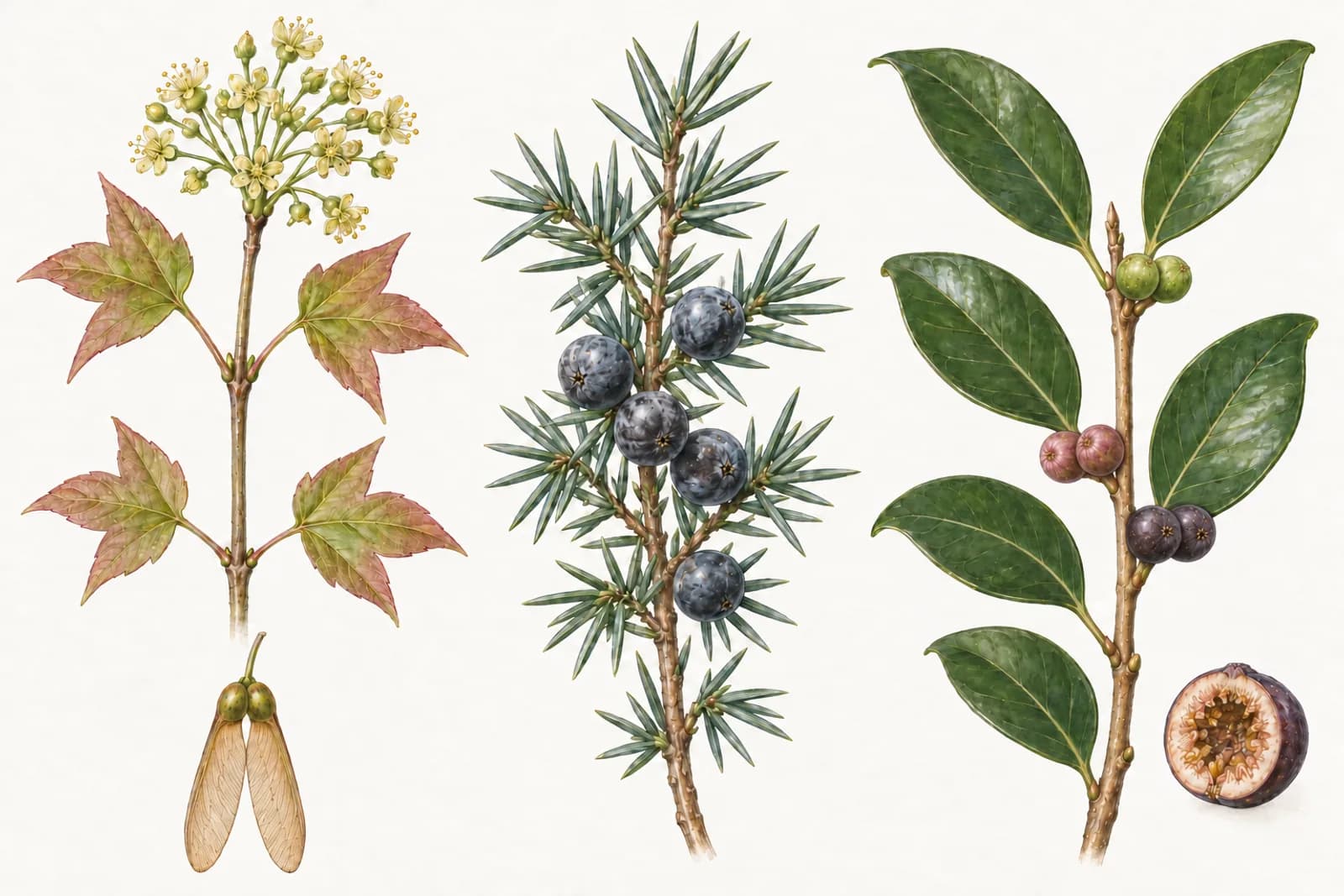
Many spring-flowering trees and shrubs, such as flowering apricot, crabapples, and azaleas, form next spring's flowers inside buds during the growing season before, a stage called flower bud initiationThe stage when a bud begins forming flowers instead of only leaves and shoots. In many spring-flowering trees it happens during the previous growing season, so pruning at the wrong time can remove next year's flowers.Open the glossary. The trident maple does the same: once mature, it opens small, yellow-green flowers with its new leaves, from buds formed the summer before, and later sets pairs of winged seeds.
Predict first
Far fewer flowers than usual. By late summer, many of next spring's flower buds had already formed along those shoots, and the cuts removed them with the wood. Where and when flower buds form differs among trees, so learn your tree's pattern before planning cuts; Course 14, Refinement and Long-Term Stewardship, will cover timing work around flowering.
Flowers and fruit are strong sinkAny part of a tree that uses or stores more sugar than it makes, such as growing shoot tips, young leaves, the cambium, roots, flowers, fruits, and storage tissues while they fill. Phloem carries sugar from sources toward sinks.Open the glossary, drawing sugars and mineral nutrients away from shoots, roots, and reserves (Lesson 9), so a heavy crop can set back a weak tree.
Conifers such as junipers make cones instead of flowers, and a ficus hides its tiny flowers inside its figs. The seeds of many temperate trees have a chilling requirement of their own: like the seeds that needed stratificationA pretreatment that holds seeds in moist conditions at a set temperature, most often cool but above freezing (cold stratification), for weeks or months to break the dormancy that many temperate tree seeds have. The needed length and temperature vary with species and seed source.Open the glossary in Lesson 11, they wait out a winter before they germinate.
Go deeper · optional, not assessedWhy some young bonsai flower early
Juvenility belongs to the shoot, not to the tree's age in years. A cutting, graft, or air layer taken from a mature tree keeps the maturity of the shoot it came from, so it can often flower within a year or two, while a seedling of the same tree must first grow through juvenility. This is one reason many flowering trees sold in nurseries are grafted. Course 13, Propagation and Creating New Material, will return to it.
Choosing where a tree spends its year
The bonsai decision
Match placement to the tree's cycle
Starting point
Identify the tree first: at least whether it is temperate, tropical, or subtropical, and ideally its species (Course 02, Choosing a Tree and Creating Its Growing Environment). Then place it by its cycle:
- Temperate trees, such as the trident maple and the nursery juniper, spend the year outdoors, where they feel the days shorten, the autumn cool, and the winter cold. In winter, protect their roots from hard freezes, which in harsh climates often means an unheated shelter that stays cold, and keep checking moisture (Course 06, Seasonal Care and Timing).
- Tropical trees, such as the ficus, get warmth and the strongest light you can give them. Where frost occurs, keep them outdoors only while nights stay mild, and bring them into a warm, bright place, often with a grow light, once nights turn cool and well before the first frost.
- Subtropical trees vary. Most need protection from hard frost, but many do best in winter in a cool, bright, frost-free place rather than a warm room, so check what your tree needs.
This assumes
You know what the tree is and how cold and long your winters are. The tree is healthy. A temperate tree has an outdoor spot where it can be protected and still checked through winter; a tree kept indoors has light strong enough for steady growth, such as a bright window plus a grow light.
Change course if
- You can't identify the tree. Get help from a knowledgeable nursery or a local bonsai club before its first winter. Until then, keep it out of frost without settling it into a warm room for the season.
- Frost is forecast for a tree that has been living indoors, such as the windowsill juniper. It has not acclimated, so do not move it straight into frost. Shelter it from the freeze and let it adjust to cooler conditions gradually (Course 02 and Course 06).
- Your winters are mild and the tree is known to need a lot of chilling. It may never get enough outdoors. Choose a tree suited to your climate, or ask experienced local growers what does well there.
- A tree indoors makes long, thin shoots with small, widely spaced leaves. That is a common sign, though not proof, of too little light: give it stronger light (Lesson 6), or plan a temperate tree's return outdoors. Leaf drop alone has many possible causes, from low light or a recent move to cold drafts or root problems, so look at the light and the root zone before deciding (Course 07, Tree Health and Diagnosis).
Back to the question
Why can't every bonsai live in a warm room all year?
Because many trees grown as bonsai are temperate trees whose year includes a winter rest that needs time in the cold to complete. In a warm room, a trident maple, and very likely a juniper, never collects the chilling that releases its buds, so after a normal-looking first season it breaks bud late and weakly, then declines; strong light cannot replace the missing winter. A tropical tree such as the ficus has no such need and can live in a warm room if the light is strong. Placement has to match the tree's cycle, not the label on its pot.
Key takeaways
- A tree's year is a sequence of visible stages, its phenology, whose dates shift with place and weather; care follows the stages, not the calendar.
- Shortening days tell many temperate trees to stop growing and set buds; cooling weather then builds cold acclimation over weeks, which warmth undoes.
- In most temperate trees, deep rest ends only after enough chilling. Without it, bud break is late, uneven, and weak, and the harm shows only the following spring.
- Tropical trees such as the ficus have no chilling requirement but need strong light indoors, and frost can kill them. Subtropical trees vary.
- Flowering needs a mature tree, many trees form next spring's flower buds the season before, and flowers and fruit are strong sinks.
Optional · not required for completion
Watch the season arrive
In spring or autumn, check the same two or three trees once or twice a week for a month. Note what each is doing (buds swelling or opening, shoots lengthening, leaves coloring or falling), the date, and the day length from a weather app's sunrise and sunset times.
Then compare. Did trees of the same kind reach each stage together? Did one in a sunny, sheltered spot run ahead of one in shade? How much did the day length change?
No tree? If you have none to watch, or nothing is changing yet, look up this week's sunrise and sunset for your city and for a city on the other side of the equator. Which is gaining day length, and which stage would a trident maple be entering in each place?