Course 06 · Lesson 7 of 7 · Rest, climate, and the year's plan
Plan work and recovery together
Several jobs can be in season at once, but each one draws on the same tree. Learn to build a rolling care plan that pairs every piece of work with its window, its aftercare, and a reason to wait, and that changes when the weather or the tree does.
The question
How much work can one tree take in a year?
By the end of this lesson, you will be able to:
- Build a rolling care plan that includes monitoring, possible work windows by growth stage, aftercare, and reasons to defer.
- Explain why major interventions compete for the same recovery, and space them across growth cycles.
- Revise a plan when unusual weather or delayed growth changes what the tree is ready for.
About 18 minutes to read and explore
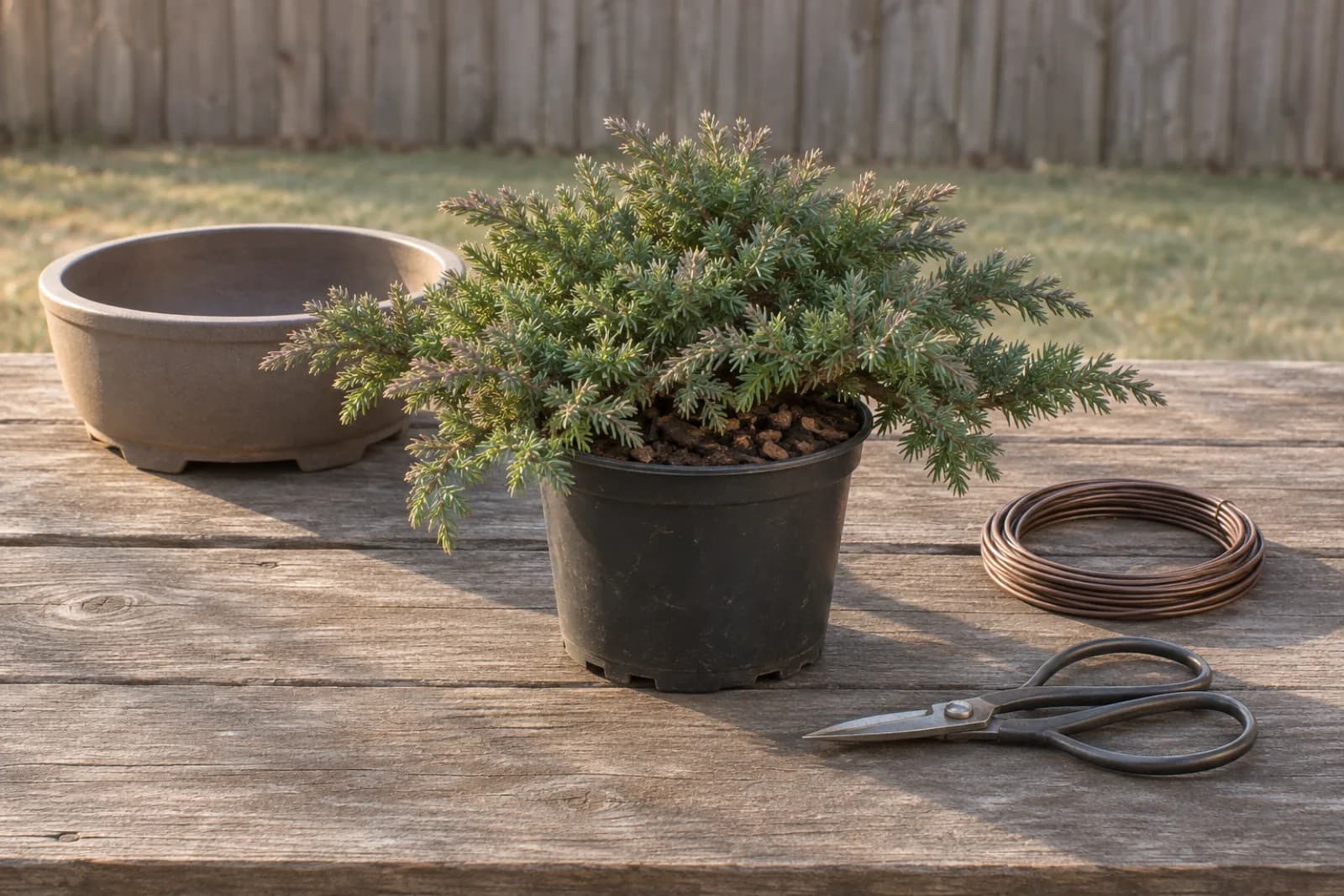
February in the small backyard. Like every case in this course, it is an instructional example, set in one temperate Northern Hemisphere city at about 40° N (USDA zone 7a). At the kitchen table, the household's two adults are writing a wish list for the new juniper, the dense young Japanese garden juniper (Juniperus procumbens ‘Nana’) in its 4 L (1 gallon) black nursery pot of open, bark-based mix. It has never been repotted, and it has grown well on seed-meal cakes (Course 05, Lesson 3). Its first styling has been on the list since its first year with them. Tonight the list says: its first styling, and its first repot out of the nursery's mix, “both this spring, while it is strong.”
Below that comes the trident maple (Acer buergerianum), in its fifth year in the same 18 cm (7 in) nursery pot. Its first repot was on last year's calendar for “March”, but in that early, warm spring the household looked on March 14 and found green leaf tips already showing. The stage the repot was tied to had passed, so the job waited a year (Lesson 1). This year's line puts the stage first, “as its buds swell”, with the month beside it only as an example. Last on the list is the larch, whose needle tufts opened against the warm south wall in the first days of last March and were singed by the frost that followed: it winters along the shaded fence now, and its page has to keep it off the warm wall until the spring frosts are over (Lesson 2).
Every line on the list is reasonable, and each job has a stage at which growers commonly do it. On paper, the juniper's repot and its styling could both fit between now and autumn. But one of the adults points to the other dates on the household's calendar: the first two weeks of July away, as every year, with the neighbor watering, and last July's heat wave, five days near 36 °C (97 °F) (Lesson 3). Can one healthy tree take two major jobs in one year, and if not, which comes first?
This lesson explains why every job a tree is given draws on the same leaves, roots, and reserves, ties each common job to the growth stage many growers give it, and shows how to write a tree's year on one page, with one job, its aftercare, and the reasons that would make it wait. It ends with how a plan changes when the year does.
Every job draws on the same tree
A tree pays for everything it does from one budget. Course 01 described it in three parts: leaves that make sugar in light, roots that bring in water and minerals, and reservesCarbohydrates, mostly starch, stored in living cells of the roots, trunk, branches, and bark for later use. Reserves fuel early spring growth before new leaves can supply sugar, and they help a tree recover after losing foliage or roots. A seed carries reserves of its own, such as starch, oils, and proteins, that fuel the embryo's first growth.Open the glossary of starch stored in the wood and roots. The reserves pay for the spring flushA burst of new shoot growth, with leaves expanding together, that happens once or several times a year depending on the tree and conditions. Between flushes, shoots stop extending and mature.Open the glossary before the new leaves can, keep living cells going through winter, and fund recoveryA tree's return toward normal growth and function after stress or work such as repotting or heavy pruning, drawing on its remaining leaves, roots, and reserves. It takes time that cannot be guaranteed, and fertilizer cannot speed it beyond what roots and light allow.Open the glossary when leaves or roots are lost (Course 01, Lesson 9). New shoots, new roots, closing a wound, and getting through winter all draw on that one supply.
A major job spends from the budget twice: it costs reserves to rebuild what it removed, and it takes away part of what refills them. A repot that reduces the roots removes part of the water and mineral supply and the reserves stored in those roots; a review of how transplanted trees establish notes both, and adds that even moderate drought in the root zone cuts the regrowth of new roots (Struve, Arboriculture & Urban Forestry, 2009). A heavy prune or a first styling takes away leaves, so less sugar is made while the tree rebuilds, and every large cut is a wound walled off with new wood paid for from the same supply (Course 01, Lesson 14).
The costs add. A tree short of roots and of leaves at once has the least to draw on, and the least margin for weather nobody chose: a late frostA frost that comes after a tree's buds have begun to open in spring. New leaves and shoots have little cold tolerance, so a late frost can blacken or kill them on a tree that stood through far colder nights in midwinter. How many late frosts a tree meets depends as much on when its buds open as on when the frosts end.Open the glossary on its new leaves, a heat waveA run of days much hotter than is usual for the place and the season. Where summer afternoons are usually about 30 to 33 °C (86 to 91 °F), for example, a run of days near 36 °C (97 °F) is one, and an ordinary hot week is not. Many trees stop growing until it passes while their pots dry faster than usual, so checks are added and elective work and feeding wait.Open the glossary, a hot, windy day between checks. Course 01 called this the way stressAny condition that pushes a tree's functioning outside its normal range and limits growth or survival, such as drought, waterlogging, heat, cold, poor light, root loss, pests, or heavy pruning. Several stresses at once can add up to more than the tree can support.Open the glossary add up, and showed that the cost of two together can surface a season later, as shorter growth the next spring (Course 01, Lesson 14).
This budget is a model, with no numbers: no one can measure a bonsai's reserves or say what a repot costs them. It says only which way each job pushes, and the tree's growth over the following weeks shows the rest.
What counts as major work
Any job that removes or disturbs a large share of a tree's roots, foliage, or branches is major workA job that removes or disturbs a large share of a tree's roots, foliage, or branches, such as repotting with root reduction, structural pruning, or a first styling with heavy wiring. Each one spends the tree's reserves and takes away part of what refills them, so a common starting point is one major job at a time, with the tree's recovery read before the next.Open the glossary: repotting with root reduction, structural pruning that takes off large branches, cutting back a sacrifice branchA branch deliberately allowed to grow long and leafy for a time, so its foliage supplies extra sugars that thicken the trunk below it and the roots, then removed once it has done its job. Its removal leaves a wound that the tree must grow over.Open the glossary once it has done its job, and a first styling with heavy pruning and wiring with strong bends. All of these are elective work in Course 01's sense: they serve the tree's future shape or health, and they can wait for a better moment without harm (Course 01, Lesson 14). How each is done belongs to the technique courses: design to Course 08, Bonsai Design and Styling; pruning to Course 09, Pruning and Managing Growth; wiring and a first styling to Course 10, Wiring and First Styling; and repotting to Course 11, Repotting and Root Development. This lesson plans around them.
Routine care is not major work, and it never stops for a job's recovery: the checks, watering by the check, feeding by the card (which holds the feed after root work until new growth shows the roots working), moving a tree for the weather. Urgent care never waits for a stage: water for a dried-out root zone, shelter for tender growth on a frost night, a wire cut free before it bites. And some jobs that sound large are not major: when the gift juniper was slipped whole into a bigger pot in its first December, its roots were not loosened or cut, so slip-pottingMoving a plant's root ball, whole, into a slightly larger container and filling only the gap around it with fresh substrate, without loosening, washing, or cutting the roots. Because the roots are barely disturbed, it can fix a pot that does not drain outside the usual repotting season.Open the glossary left it almost nothing to recover from, and it did not have to wait for the repotting season (Course 02, Lesson 7).
One major job in a growth cycle
Predict first
The juniper repotted in spring will be struggling, and the one left untouched will be filling in. The repotted tree meets the heat with roots that are still regrowing, paid for from a store that its spring tips have also drawn on, so on the hottest days it can lose water faster than its roots replace it: expect browned tips and growth that stalls. The untouched tree meets the same heat with all its roots and foliage at work.
Course 01's lesson on readiness ended with a rule for elective work: one planned job, then watch the response before the next (Course 01, Lesson 14). This course sets that rule into the year. Its starting point is one major job at a time, and the next only at its own stage and only once the tree shows it has recovered. In a climate with cold winters, such as the example city's, where the growing seasonThe part of the year warm enough for plants to grow, often counted as the frost-free days between the last spring frost and the first autumn frost. Its length shapes how long trees grow each year, and it is the most time a frost-tender tree could spend outdoors.Open the glossary lasts about five and a half months, that usually leaves room for one major job in a growth cycle: the stretch from one spring's buds to the next, with work done while the tree is bare in late winter counted with the spring that follows it. A hard year, with a late frost on the new leaves or a summer heat wave, can take even that room away.
Doing two or more major jobs in one growth cycle, so that their costs land on the tree together, is what this course calls stacking: Course 01's point that stresses add up, applied to work you plan (Course 05 used the word for feeds). Biology does not forbid it. But in February nobody knows whether the year will be kind, and a second job is what leaves the tree no margin when it is not, so the starting point is advice about margin, not a law. A technique course may pair two jobs for a particular kind of tree, with its reasons; that is no reason to stack jobs on another.
That is why the household gives this year to one job. The new juniper gets its first styling in early autumn, once its tips have stopped lengthening and darkened, with the household home and mild weather forecast, and its repot waits for next spring, as its tips begin to pale, if its growth shows by then that it has recovered. The other order would put the tree's fewest roots into July, the month the household is away and the heat usually comes.
Work windows are growth stages
Every decision about an elective job is one of five, and this lesson and its simulation use them by name. Go ahead means the stage fits and the tree is ready. Both halves are needed: the growth stageA step in a tree's yearly cycle that you can see on the tree, such as buds swelling, bud break, shoots extending, or leaf fall. Care is timed to the stage a tree has reached, not to a date, because the same stage falls on different dates in different years, places, and kinds of tree.Open the glossary the job is tied to, and the readiness evidence Course 01 described, a tree growing normally for its kind and the season, with nothing about it unexplained (Course 01, Lesson 14). Not now: wait for the stage means the tree is healthy but has not reached the stage the job is tied to. Not now: let it recover means it is still recovering from earlier work or a setback. Recovery is read from the tree, by the three signs Course 05 named, shoots extending, new leaves of normal size and color, and white root tipThe growing end of a root, made up of the root cap, the dividing cells behind it, and short zones where new cells lengthen and mature. Active tips are usually pale or white and show where a root is extending into fresh substrate.Open the glossary at the holes where you can see them, and never from a count of weeks (Course 05, Lesson 4). Not this year means the job waits for the next growth cycle, because its stage has passed, or because the tree will not have shown recovery from an earlier job before the stage closes. Investigate first means no elective work at all on a tree whose trouble is unexplained, until you know what it is (Course 07, Tree Health and Diagnosis).
A window is a stage with reasons
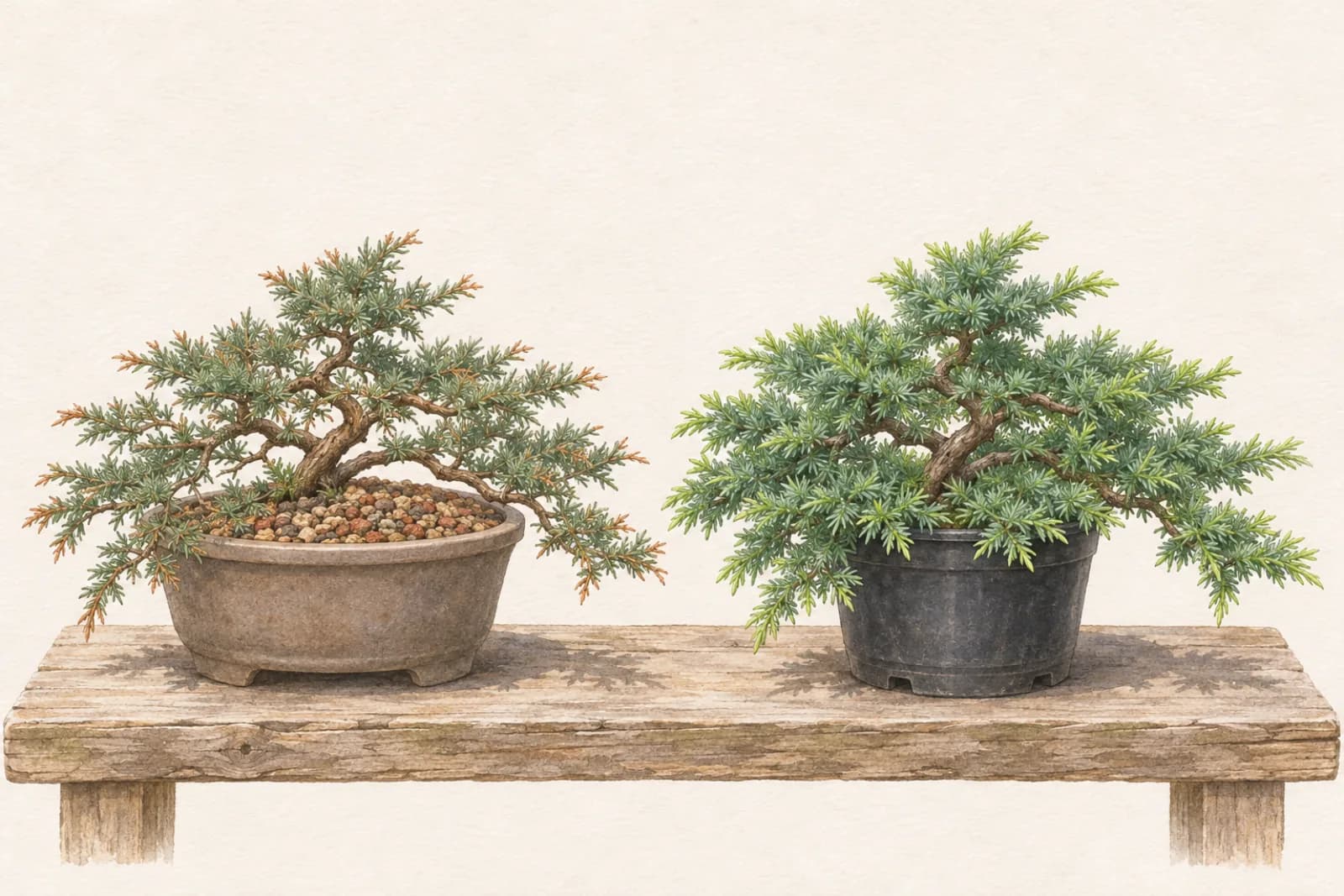
A job's work windowThe growth stage, with suitable weather, at which a job such as repotting or structural pruning is commonly done, for stated reasons: growers tie each job to a stage because the tree is expected to recover well from it then. A window opens and closes with the stage, not with the date, and it is a starting point that a tree's kind, its health, and the technique itself can move.Open the glossary is the growth stage, with suitable weather, at which it is commonly done, for stated reasons. Growers tie each job to a stage because they expect the tree to recover well from it then, so a window opens and closes with the stage, not with the date. Course 01 said this course would match jobs to growth stages (Course 01, Lesson 9), and Course 02 spoke of “the repotting season” without dating it. These are the windows many growers use, each a practice with its reasons rather than a proven rule (the reasons and limits of the first are in Lesson 2):
| The job | The stage many growers tie it to | Why |
|---|---|---|
| Repotting many temperate deciduous trees, such as the trident, the elm, and the larch (Course 11) | As the buds swell | Bare, so it loses little water; the root zone is warming; reserves are still in the tree; cut roots wait least in cold mix |
| Repotting a juniper (Course 11) | As its tips begin to pale | Growth is starting, with all the foliage at work to pay for new roots |
| Repotting a ficus (Course 11) | While it is growing strongly | It has no winter rest, and a tree in strong growth has working leaves to pay for new roots |
| Structural pruning of many deciduous trees (Course 09) | While bare in late winter, before the buds swell | Every branch can be seen, and no soft new growth follows with frosts ahead |
| Wiring a deciduous tree (Course 10) | While bare; then checked closely from bud swellThe stage before bud break when a resting bud grows fatter and longer and its scales pull apart, showing paler bands between them, but no green tip shows yet. It is the first visible sign that a tree is leaving its winter rest, and it can come weeks earlier in a warm year than in a cold one.Open the glossary on | Every branch can be seen; once growth resumes, branches thicken against the wire |
| Styling or heavy pruning of a juniper (Courses 09 and 10) | As growth begins, or once its tips have stopped and darkened; not while new tips extend | The tree is not yet, or no longer, pouring its store into soft new tips |
Read the table as starting points: the controlled evidence is thin, mostly from landscape trees, and none of it from bonsai, and a tree's kind, health, and history can each move a window. The wiring row carries Course 01's warning that a growing branch can make the wire bite within weeks (Course 01, Lesson 3). In this city a trident's buds usually begin to swell in late March and a juniper's tips usually pale in late April, and either can come weeks earlier or later (Lesson 1).
Practice check · not scored
What closes a window
A window closes when a job would land on the tree at a bad moment:
- While the new leaves are soft and the store is low. New roots and expanding shoots draw on the same sugars: a study of transplanted landscape trees found them competing (Watson and Himelick, Arboriculture & Urban Forestry, 1982).
- Late in the growing season, where a cut would push soft growth. A hard cut in early autumn can wake buds into shoots that do not firm up before the cold, and it takes away leaves still refilling the store (Lesson 4). The risk shrinks as the warm weeks run out: the household's trident had stopped by September 5 with warm weeks still ahead (Lesson 4), while a juniper's tips stop here only in late September, as the nights cool, which is one reason many growers do its heavy work then. None of this bans work after leaf fall or in winter, which Course 09 decides tree by tree.
- In a heat wave, or a dry, windy spell. Cut roots cannot keep up with what hot, dry air draws from the leaves, and a newly thinned crown opens shaded shoots and the pot wall to the sun (Lesson 3).
- When nobody can give the aftercareThe care a tree needs after major work until it shows it has recovered: a suitable place, shelter from frost, strong wind, and harsh sun, watering by the check, and no further demands. It is arranged before the job and ends when new growth shows recovery, not after a set number of weeks. Course 11, Repotting and Root Development, gives the aftercare for repotting in detail.Open the glossary. A job is not finished on its day.
Weather draws the last line, between what you can shelter the tree from and what you cannot. A frost you can shelter the tree from is part of the aftercare, not a reason to wait. The courtyard maple was repotted on February 28 last year with its buds swelling; five days later a hard frost arrived on a northwest wind, and it spent both nights in the coolest room of the house, then four later light frosts in the roofed passage (Lesson 2). Weather you cannot shelter the tree from is a reason to wait: a heat wave in the weeks after the job, a run of dry wind with nobody home, or a cold snap forecast for a tree with nowhere cold and sheltered to go.
A year on one page
A tree's care planA tree's year written on one page and laid out by growth stage, with example months: what to watch for, the routine care, at most one major job with its window and its aftercare, protection from weather and cold, and the reasons that would make the job wait. It is reviewed at each stage and changed when the weather or the tree changes, so its dates stay examples, not instructions.Open the glossary is its year written on one page, laid out by growth stage with example months: what to watch for, the routine care, at most one major job and its window, protection, aftercare, and the reasons that would make the job wait. It is reviewed at each stage and changed when the weather or the tree changes. It gathers what the household already keeps: the feeding planA written plan for feeding one tree, short enough to fit on a card: the product and its label line, the amount for your can, the interval, when to start, taper, and stop in growth stages, when to water first or hold, who feeds, where it is logged, and when to review it. It turns a label's directions into decisions already made, so that anyone who helps can follow them.Open the glossary, whose start, taper, and stop slot into its stages (Course 05, Lesson 6); the watering logA dated record of each check of a tree's root zone, usually one short line per pot: the weather, what each check found, the decision, and the reason for it. Read over weeks, it shows how fast each pot dries in different weather, whether the decisions worked, and patterns no single check can show, such as a pot that keeps drying fast even as the weather cools.Open the glossary and its weekly photo (Course 03, Lesson 7); the stage recordA dated note, for one tree, of whether each growth stage has been reached: the date, then a yes or a no for the stage, on each day you look, with a word on the weather and where the tree stood. Kept over several years, with the no entries that bracket each first yes, it shows how far the tree's dates move with the weather.Open the glossary (Lesson 1); and the winter plan (Lesson 4). It also holds the checks the date itself sets, such as where the sun falls near midsummer and midwinter (Course 02, Lesson 4).
The household's page for the new juniper, written this February and pinned to the garage door beside the feeding card, reads:
| Stage (example month) | The plan |
|---|---|
| Winter color (now, until the tips pale) | Watch for: the first paler green at the tips. Routine care: a check every day or two; a thorough wateringWater applied evenly across the whole surface, slowly enough to soak in, until it runs from the drainage holes, and then confirmed by a check that the root ball wetted through. It usually takes two or three passes a minute or two apart. Water at the holes alone shows only that water reached the bottom, not that the roots got it.Open the glossary at Drying when the root ball is not frozen (Lesson 5). Protection: pot mulched by the south fence; the garage for a cold snap. |
| Tips paling (late April; earlier in a warm spring) | Watch for: paler tips, then soft new ones. Routine care: back to its bench once hard frosts are over; daily checks as water use climbs (Lesson 2). Protection: the evening frost check until the forecast shows no more frost. |
| Tips extending (May into summer) | Watch for: tips lengthening at last year's pace. Routine care: seed-meal cakes once the tips extend, renewed every 6 weeks to late summer; full sun, clear of the neighbor's maple (Lesson 3). Job: none while the tips are soft. |
| Midsummer (July; away for two weeks) | Routine care: the neighbor checks daily and waters by the checks; morning and afternoon checks in a heat wave (Course 03, Lesson 5). Protection: the pot wall shaded on the hottest afternoons. Light check: where the sun falls now. |
| Growth stops and hardens (late September) | The one job: its first styling (Courses 08 to 10), if the tree shows it is ready. Before the day: a mild forecast, both adults home, the aftercare place chosen. Aftercare: its usual sun, out of strong wind; the wire checked at every look. Reasons to defer: tips still extending; heat or an early hard frost; a trip; unexplained browning. |
| Inner foliage shedding (October) | Watch for: older inner foliage yellowing and dropping, the normal autumn shed (Lesson 4), not browning at the tips. Routine care: no fresh cakes; checks every day or two. Protection: the winter plan, reviewed. |
| Winter color again (from the first hard frosts) | Protection: winter quarters by the fence; the garage for cold snaps. Light check: where the low sun falls. Watch for: no browning spreading from the cuts. Next year's job: the repot as the tips pale, if the styling has shown recovery (Course 11). |
Every line about the tree begins with a stage, and the bracketed months are examples that an early or a late spring moves. The one job sits at its stage with the conditions for its day beside it, so the decision on the day is a check, not a debate. And next year's job is already on the page with the condition that releases it: since a juniper styled in autumn cannot show all its recovery before winter, the repot will be judged, as Course 01 advised for work done before shoots can extend, from how it came through the autumn and how its tips look as they pale.
Aftercare is part of the job
The care a tree needs after major work, until it shows it has recovered, is its aftercare: a suitable place, protection from frost, strong wind, and harsh sun, watering by the check, and no further demands. It is part of the job, and it is arranged before the job: where the tree will stand, what will shelter it on a frost night or a hot afternoon, and who will be home to check it every day. Until the plan can say those three things, the job has no day.
Its shape is Course 01's for any tree with reduced roots: demand low but light up, bright but sheltered from strong wind and the harshest sun (Course 01, Lesson 8), the root zone checked daily and watered thoroughly only when it is drying (Course 03, Lesson 4), and no feed until new growth shows the roots working (Course 05, Lesson 4). After a styling, watch shoots and bark newly opened to the sun on the first hot afternoons. Each technique course gives its own aftercare in detail (Courses 09 to 11); this course plans the place, the protection, and your time.
Aftercare has no fixed length: it ends when the tree shows recovery by Course 05's three signs, read together over weeks against the tree's normal vigorA tree's observed growth performance relative to its expected seasonal behavior, meaning what a tree of its kind should be doing at that point in the season. It is judged from shoot extension, bud development, foliage condition, and root activity when visible, across several observations over time, not from one large leaf or green color. A vigorous tree is growing at or above that expected pace.Open the glossary for the stage. A swelling bud or a first flush can run on reserves alone; shoots that keep extending and then shoot hardeningThe firming of new growth after it stops extending: the leaves reach full size, darken, and turn firm, and the new stem turns woody from its base. It is not the same as cold acclimation, which makes tissues able to survive freezing, or hardening off, which is moving a tree into sun and wind in steps.Open the glossary, with new leaves at full size, show a tree building with working roots (Course 01, Lesson 14).
Reasons to defer
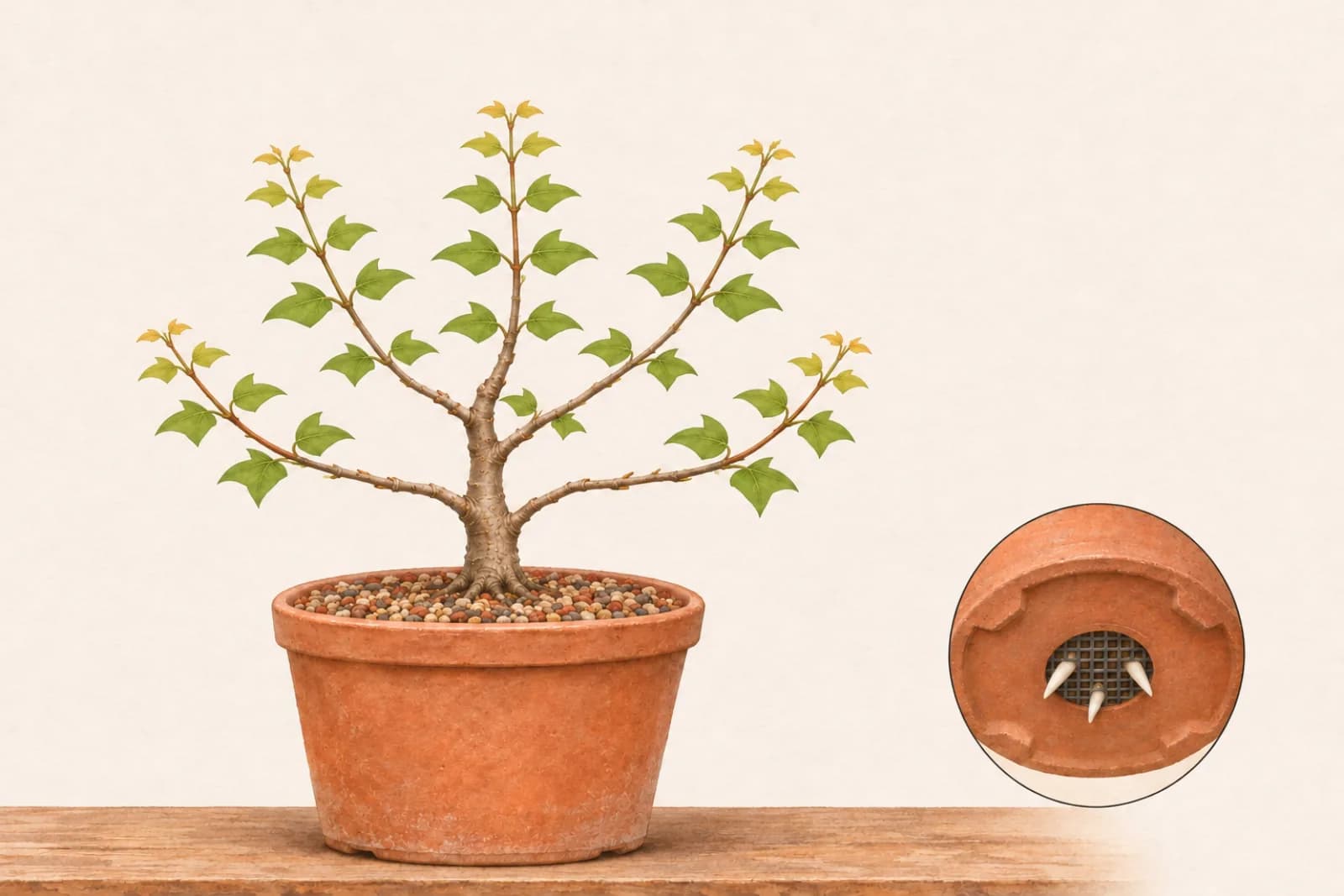
A plan names its reasons to wait before the day comes, so that a helper's free afternoon or a sunny weekend does not decide for you:
- The stage has not come: Not now: wait for the stage. If it has already passed, Not this year.
- The tree has not recovered from an earlier job or a setback: Not now: let it recover.
- Weather you cannot shelter it from is forecast for the aftercare weeks: a heat wave, or a long dry, windy spell (Lesson 3).
- You will be away, or nobody can check the tree daily, in the weeks after the job.
- The tree has trouble nobody can explain: Investigate first (Course 07).
- A setback has just struck: a late frost that blackened the new leaves, a root zone that dried out hard, a wet spell that left the roots short of air. Its cost can keep showing for weeks, so the rest of that cycle's elective work waits.
None of these is the job's due date. Each is something you can see on the tree, in the forecast, or in your own calendar, and each moves the job to its next window rather than off the page.
Practice check · not scored
One juniper, two jobs
Can one tree take both jobs? lays the household's question out as a paper plan on the kitchen table: one young, healthy Japanese garden juniper in a nursery pot, two jobs, and one year. A strip across the plan follows the juniper's stages through the year, with a slot under each of the three where work could go. Give First styling (heavy pruning and wiring) and Repot (out of the nursery mix) one setting each: At Tips paling, At Tips extending, At Growth stops and hardens, or Not this year. A line under each placed job says what the tree is doing at that stage. Then choose The year: An easy year, with no late frost and no heat wave, or A hard year, with a late frost on the new tips and a heat wave in July. On a phone, the settings sit under Change. Under Your call, choose how many of the two jobs the tree will allow this year, Both, One, or Neither, or press Skip.
Press Follow the plan, and the paper becomes the small backyard through the year. The run stops at each job you placed, on a card showing what the tree shows now: Stage, Tips, New foliage, and Root tips at the holes, with the forecast. Press Go ahead or Not now; each decision is graded Right call or Not quite from what the card showed. A budget panel reads Foliage at work, Roots at work, Reserves, and Growth this year in words, with What is happening under the stage; use Pause, Back, Next, Replay, or Skip to the end to stop on any stage. Each run ends on Next spring, with a result card that sets the year beside an untouched juniper's. Find all four challenges to finish. Try these:
- The simulation opens on Repot at At Tips paling, First styling at At Growth stops and hardens, and An easy year: the two jobs spread across one year. Make your call, press Follow the plan, and read each card before you decide.
- Keep the same plan, switch to A hard year, and run it again. Watch the frost at Tips extending, the heat at Midsummer, and the card at Growth stops and hardens.
- Put both jobs At Tips paling, the household's “both this spring”, and read the second card before you decide.
- Move one job to At Tips extending, and read the line under its slot and the Stage on its card.
Simulation
Can one tree take both jobs?
The plan
One young, healthy Japanese garden juniper in a nursery pot, on the kitchen table in February.
Calls: none yet
The plan for the new juniper
An easy year
- February. The juniper, Winter color
- April. The juniper, Tips paling
- May. The juniper, Tips extending
- July. The juniper, Tips extending
- September. The juniper, Growth stops and hardens
- November. The juniper, Inner foliage shedding
- January. The juniper, Winter color
- Next spring. The juniper, Tips paling
Tips palingoften late April
RepotGrowth is starting, and roots can regrow with all of the foliage to pay for them.
Tips extendingoften from May
No job hereGrowth stops and hardensusually late September
First stylingGrowth has stopped and the year's foliage is firm and at work (usually late September in this city).
Not this year
Nothing
What is happeningThe plan is on the kitchen table in February. Place the jobs, choose the year, then follow the plan.
Before the yearLate winter, at the table
Foliage at workFull
Roots at workFull
ReservesFull for winter
Growth this yearNot startedDashed mark: an untouched juniper
Result
How much can the juniper take this year? Press Follow the plan. When the year has run, the result shows the jobs done, how the tree recovered, and whether it is ready for next spring.
Challenges
0 of 4 found
Get one job done in the hard year and have it ready for next spring
Give the job its stage, and give the tree the rest of the year.
Find a plan the hard year changes
Run one plan in both kinds of year.
Make a right call to wait
Read the card before the second job.
Find a job at the wrong stage
When do the new tips have the most to do?
Text description
One young, healthy Japanese garden juniper in a nursery pot, dense and never styled, its crowded branches spilling over the rim, and a plan for its year, written on paper at the kitchen table in February. The plan is a strip of the juniper's stages across the year: Winter color in late winter, Tips paling (often in late April in this city), Tips extending (often from May, and through midsummer), Growth stops and hardens (usually late September), Inner foliage shedding in late autumn, Winter color in winter, and Tips paling again the next spring. Under the three working stages are slots where two major jobs hang as paper tags: the first styling (heavy pruning and wiring) and the repot (out of the nursery mix). Each job takes one of: At Tips paling · At Tips extending · At Growth stops and hardens · Not this year. When a job is placed, a line under its slot says what that stage is like:
- Tips paling: Growth is starting, and roots can regrow with all of the foliage to pay for them.
- Tips extending: New tips are soft, and the tree is spending its reserves on them; many growers avoid heavy work now.
- Growth stops and hardens: Growth has stopped and the year's foliage is firm and at work (usually late September in this city).
The year is easy (no late frost, no heat wave) or hard (a late frost the forecast missed, on the soft new tips while they are extending, and a heat wave in July, days near 36 °C (97 °F), with the pot wall shaded). Before the run you can make an optional call: How many of the two jobs will the tree allow this year? The options are Both, One, Neither, or skip.
Follow the plan turns the paper into the small backyard, with the juniper on its bench, and plays the year stop by stop: late winter, Tips paling, Tips extending, midsummer, Growth stops and hardens, late autumn, winter (on the ground by the fence, its pot sunk in mulch), and next spring. Beside the tree, a budget panel shows four gauges in words and small drawings: foliage at work (three foliage pads, which turn pale and dashed as foliage is taken), roots at work (roots at full length, cut short, or regrowing with white tips), reserves (amber grains in a cut trunk foot, more or fewer, with a dashed amber arrow for sugar going in or out), and growth this year (a shoot whose length reads Stalled, Slow, or Steady, beside a faint dashed mark for an untouched juniper of the same age).
At each placed job the run waits for a decision. A card shows what the tree shows at that moment: whether the stage is the job's usual window, and why; one tip, magnified; its tips (Paling, Extending, Firm, Stalled); its new foliage (Normal or Sparse); its root tips at the drainage holes (White or None seen); the forecast; and, after a frost this spring, a chip that says so. You press Go ahead (The stage fits and the tree is ready.) or Not now (Wait for the stage, or let it recover first.). Each decision is graded Right call or Not quite from what the card showed. Go ahead plays the job: for the styling, the foliage thins and wire goes onto the branches; for the repot, the pot lifts and a round close-up shows the root ball reduced and set in fresh, coarse mix. The job takes its payment from the gauges. Not now hangs a tag on the slot (Not now when the job's own stage is still ahead this growth cycle, Not this year when it is not) and costs the tree nothing.
A tree with no earlier job this growth cycle, and no frost damage to its new tips, shows recovered: tips at the stage's normal look, new foliage normal, and white root tips at the holes. After a job, recovery takes time, and how long depends on the stage the job was done at and on the weather. The result card says in one sentence how the year went, then lists the jobs done, recovery by late autumn, growth this year against an untouched juniper, and whether the tree is ready next spring. There are four challenges: get one job done in the hard year and have it ready for next spring; find a plan the hard year changes; make a right call to wait; find a job at the wrong stage.
In the easy year, the repot At Tips paling found the stage and the tree both ready, so Go ahead was the right call, and the payment came out of Roots at work and Reserves. By Growth stops and hardens, with a stage between the two jobs, its card showed firm tips, normal new foliage, and white root tips at the holes: it had recovered. The styling went ahead too, the tree reached Next spring ready for more, and the call settled at Both.
The same plan in A hard year came out differently. A clear, still night turned colder than forecast, and the late frost singed the soft tips at Tips extending, its Growth this year fell to Slow, and the July heat wave stalled it while its roots were still regrowing. At Growth stops and hardens the card showed the right stage on a tree still recovering: stalled tips, sparse new foliage, and no white root tips at the holes. Not now was the right call, a Not this year tag swung onto the styling's slot, and the juniper came out of winter ready, so the call settled at One. Pressing Go ahead there instead left it not ready for more by next spring. Even with nothing done in spring, the frost on the new tips left no room for the autumn styling: in the hard year every card at Growth stops and hardens called for Not now.
Both jobs At Tips paling, as the household first wished, gave one job in either year: the styling's card, straight after the repot, showed a tree with nothing yet to show for its new roots. A job At Tips extending showed the wrong stage, because the new tips are soft and the tree is spending its store on them, and so did a repot At Growth stops and hardens, because roots cut that late in a cold-winter climate go into winter still regrowing. In every run, two jobs held only when the first was at its stage, a stage passed between them, and the weather stayed kind. In a real year, the weather is the one line you cannot write in February.
Go deeper · optional, not assessedShould the top be cut to match the roots?
The idea has a real basis: a tree that has lost roots still has all its leaves losing water, so cutting back the crown lowers its demand at once, and in nursery trials top-pruned transplants have sometimes done better. Washington State University Extension's handout, The Myth of Top-Pruning Transplanted Material, records that side and notes that the evidence conflicts, with short-term studies tending to show a benefit and longer-term effects generally negative. It concludes that a crown cut at transplanting removes the leaves that make the sugar new roots are built from and pushes the tree to regrow shoots at the roots' expense, and that with reliable watering the demand can be met another way. A University of Florida extension article adds the other half of the mechanism: buds on living branches send the signals that start new roots (UF/IFAS Extension: Let Trees Adjust to Being Transplanted).
None of this was measured on bonsai. A landscape tree dug from a field loses far more of its roots than a bonsai at a repot, and is usually tended less closely afterward, so the evidence transfers as a principle, not a rule: leaves and buds pay for and start new roots, and a tree short of roots needs its leaves. Whether any trimming suits a particular kind of tree at its repot is a question for that tree and its technique course (Course 11), not a rule of balance.
Revise the plan when the year changes
A care plan is reviewed at each stage, not filed away in February: at every look, read the tree and the forecast against the page, and change what they say has changed.
When the stage comes early or late
An early spring brings a stage-tied job forward, or puts it off to next year if you cannot be there when the stage comes, and a job booked for a month can miss its stage altogether. Last year the courtyard maple was repotted on February 28, three weeks before the club's day, while the household's trident, booked for “March”, had green tips by March 14 and waited a year.
A late spring moves a job later, and the plan waits with it. This February the other places wrote their years the same way: on the balcony, the gift juniper's repot as its tips begin to pale, with the club member's help (Course 11); in the courtyard, one job for the maple, cutting back its long low branch while the tree is still bare (Course 09). The spring came late and cold. The maple was still bare through March, so its cut went ahead inside its window; the gift juniper was still in winter color in mid-April, and its repot waited. Nothing on a stage-tied page has to be rewritten for a late spring: the jobs wait for their stages, and the example months in brackets turn out to be early. Nor does a late spring cancel a job whose stage comes later: the new juniper's styling, tied to the end of its growth, is untouched by a cold March. No club? The technique course is the help: plan the job now, and do it after that course.
Practice check · not scored
Which lines move with the tree
A plan holds two kinds of line, and the review treats them differently. Stage lines move with the tree: every line that begins with what the tree is doing. On the new juniper's page they are the evening frost check (from the day its tips pale until the forecast shows no more frost), the cakes (once the new tips are extending), the styling (once the tips have stopped and darkened), the end of feeding, and the move into winter quarters (by stage and forecast, before hard frosts). In an early year they come sooner and in a late one later, and the review moves them without debate.
Date lines stay on your calendar, because they belong to your own time or to the sun: the July trip and the neighbor's card, a club's workshop or repotting day, the days a helper can come, and the check of where the sun falls near midsummer and midwinter, which follows the date exactly (Course 02, Lesson 4). A late spring does not move the July trip, but it may move a job toward it, and then the trip becomes one of the job's reasons to defer: a job whose stage drifts into a week you will be away keeps its stage and loses its day.
Writing next year's line from the record
At the end of a year, the record is what makes the next page better. Take one line and work it through as the courtyard owner will next February: the maple's first feed, written since Course 05 as “once the spring flush is growing” (Course 05, Lesson 4). Three springs are on record:
- The ordinary spring, the year before last. bud breakThe stage when buds swell and open and new leaves or shoots begin to emerge, marking the start of a growth period. In deciduous temperate trees it is fueled at first largely by stored reserves.Open the glossary came in early April, and the flush was growing by late April: first feed in late April.
- Last year's early, warm spring. Its buds broke about March 12, but it had been repotted on February 28, so its feed waited for new growth that showed working roots: first feed in late May.
- This year's late, cold spring. Its buds broke about April 27, and the flush was growing by about mid-May: first feed in mid-May.
In the two springs without root work the line held and only its date moved, by about three weeks; in the year of the repot, the plan's hold line decided instead, until new growth showed the roots working. So the new line keeps the stage first, adds the record as examples, and names the odd year: “First feed once the spring flush is growing (late April and mid-May in the springs without a repot); after a repot, once new growth shows the roots working (late May in the spring of the repot).” It does not become “first feed in late April”, it takes on no deadline such as “no later than mid-May”, which the next spring later than any on record would break, and it does not average the dates into a target. The record shows only how far the stage moves, so you know when to start looking.
Setbacks, and what never waits
A setback can cancel the rest of a cycle's elective work. A frost that blackens most of a freshly repotted tree's new leaves takes the leaves that were to pay for its new roots, at the moment its store is lowest, and Course 01 showed that the cost of the two together can last into the next spring (Course 01, Lesson 14). Such a tree gets no further major work that cycle: shelter it, water by the check, hold the feed until new growth is under way, and read its recovery. A lighter setback costs less, but it still costs. When the frost of March 5 and 6 last year singed the larch's opened tufts on the side away from the wall, it re-greened from later buds and was fine by May, but it paid for the new needles from its reserves, so it had no room for major work that cycle (Lesson 2). How much of the new growth a setback took decides how long the tree needs, and the tree shows it within weeks.
Some things never wait for a plan. Urgent care goes ahead whatever the stage. And a tree in declineA gradual loss of health and growth over months or years, usually from several stresses acting together, such as poor light, root problems, or a missing winter rest. Early signs are subtle, so comparing dated records over time helps catch it.Open the glossary is assessed now, not at its next window. Course 04 asked you to plan a possible repot for a suitable time, and these windows say when that is; it also set the limit, that you do not simply wait for a preferred repotting month while a tree declines (Course 04, Lesson 7). Work windows are for elective work only.
One major job, then read the tree
The bonsai decision
Give each tree one major job at its stage, and read its recovery before the next
Starting point
For a healthy, established tree with more than one job on its wish list, such as the new juniper:
- Write the year on one page for each tree, by stage, with last year's dates as examples: what to watch for, the routine care (the checks, and the feeding card's start, taper, and stop), protection, and the job (Course 05, Lesson 6).
- Give it one major job at a time, at the stage that job is tied to, and plan a second for a later stage only if the tree shows recovery by then; for most trees in most years, that means next year. For the new juniper, that is its first styling once its tips have stopped and darkened, and its repot next spring as its tips begin to pale.
- Arrange the aftercare first: the place, the protection, and your own time for the weeks after the job, before you set its day (Course 01, Lesson 8).
- Read its recovery from the tree before planning the next job: shoots extending, new leaves of normal size and color, and white root tips where you can see them, never a count of weeks (Course 01, Lesson 14).
This assumes
- The tree is healthy and established, of a kind you know (Course 02, Lesson 2), and growing normally for its kind and the season.
- The job is elective: it can wait for a better moment without harm.
- You can give the aftercare: a sheltered place is ready, and someone can check the tree every day in the weeks after the job.
- The months in this lesson belong to the course's Northern Hemisphere example climate. In the Southern Hemisphere, swap north and south, and shift the months by half a year.
Change course if
- The stage arrives early or late: the job moves with it. If you cannot be there for the job and its aftercare when the stage comes, the decision is Not this year, as it was for the household's trident in Lesson 1.
- The tree has not recovered from the last job or a setback: Not now: let it recover, and read the recovery from its new growth, not from the calendar.
- Weather you cannot shelter the tree from is forecast for the aftercare weeks, such as a heat wave: wait for the next window. A frost you can shelter it from is part of the aftercare, not a reason to wait (Lesson 2).
- A technique course pairs two jobs for your kind of tree: follow it for that tree (Courses 09 to 11). It is not a license to stack other jobs, or to pair them on another kind of tree.
- The tree is declining and you do not know why: this is not a seasonal problem: investigate now, and do not wait for a preferred month (Course 04, Lesson 7; Course 07).
Back to the question
How much work can one tree take in a year?
Usually one major job in a growth cycle, where winters are cold, and in a hard year sometimes none. Every job is paid for from the same leaves, roots, and reserves, and each takes away part of what refills them, so the costs add and the margin for a late frost or a heat wave shrinks. The new juniper gets its first styling in early autumn, once its tips have stopped and darkened, and its repot next spring as its tips pale, if its growth shows it has recovered. A plan written by stage moves with the year: an early spring brings a job forward or puts it off to next year, and a late one makes it wait. Two jobs in one year hold only when nothing goes wrong, so the plan leaves room for the year that does.
Key takeaways
- Every major job, such as a repot with root reduction, structural pruning, or a first styling, is paid for from the same leaves, roots, and reserves, and takes away part of what refills them, so costs add and the margin for bad weather shrinks.
- The starting point is one major job at a time, at the stage it is tied to, and the next only at its own stage once the tree shows recovery; where winters are cold, that usually means one major job in a growth cycle.
- A work window is a growth stage with suitable weather and stated reasons, not a date. A frost you can shelter the tree from belongs to the aftercare; weather you cannot shelter it from is a reason to wait.
- A care plan puts a tree's year on one page by stage, with example months: what to watch for, routine care, the one job and its window, protection, aftercare arranged in advance, and the reasons that would make it wait.
- A plan is reviewed at each stage: stage lines move with the tree in an early or a late year, date lines stay with your calendar, and recovery is read from shoots, leaves, and root tips, never from a count of weeks.
Optional · not required for completion
Write next year on one page for one tree
Choose one tree and write its next year on one page, by stage. List its stages in order, with last year's dates beside each as examples, from your stage record, your log, or your photos; where you have no date, write the month this course's city would give and mark it as a guess. Beside each stage, write what you will watch for and the routine care. Then choose one major job, if the tree needs one at all, set it at its stage, and write its aftercare beside it: where the tree will stand, what will shelter it, and who will be home. Finish with two reasons you would defer the job. Which lines would move in an early spring, and which would stay put?
No tree? Write it for the household's larch from this lesson's facts: a Japanese larch in a black plastic nursery pot of bark-based mix, on the patio bench by the warm south wall, and the first tree in the yard to move each spring. Last year its needle tufts opened in the first days of March, a hard frost on a northwest wind singed the tufts on the side away from the wall, and it re-greened from later buds and was fine by May. It turns gold in late October and is bare by mid-November. Decide where it will stand from the day its buds swell until the frosts are over, and mark which of its lines would move in an early spring.
This lesson completes Seasonal Care and Timing: growth stages read from the tree instead of the calendar, the weeks of bud break and their frosts, summer's difficult weather, the slowing of autumn, roots protected through winter, advice translated between climates, and a year of work planned around recovery. Quiz 2 brings the whole course together, ending with one household's plan for a late, cold spring. After it, Course 07, Tree Health and Diagnosis, now being prepared, will turn this course's “investigate” into a method: gathering evidence, telling a symptom from its cause, and knowing when to ask for experienced help.