Course 06 · Lesson 6 of 7 · Rest, climate, and the year's plan
Different climates, different cycles
Care advice is written for someone's climate, and it may not be yours. Compare how trees cycle in cold-winter, mild-winter, tropical, and wet-and-dry climates, in the other hemisphere, and indoors, and learn to translate advice into growth stages you can observe.
The question
What if your seasons are not the ones in the guide?
By the end of this lesson, you will be able to:
- Compare how growth cycles differ between cold-winter, mild-winter, tropical, and seasonally wet and dry climates.
- Translate month-based advice from another region or hemisphere into growth stages and local conditions.
- Explain what a managed indoor environment can and cannot replace.
About 18 minutes to read and explore
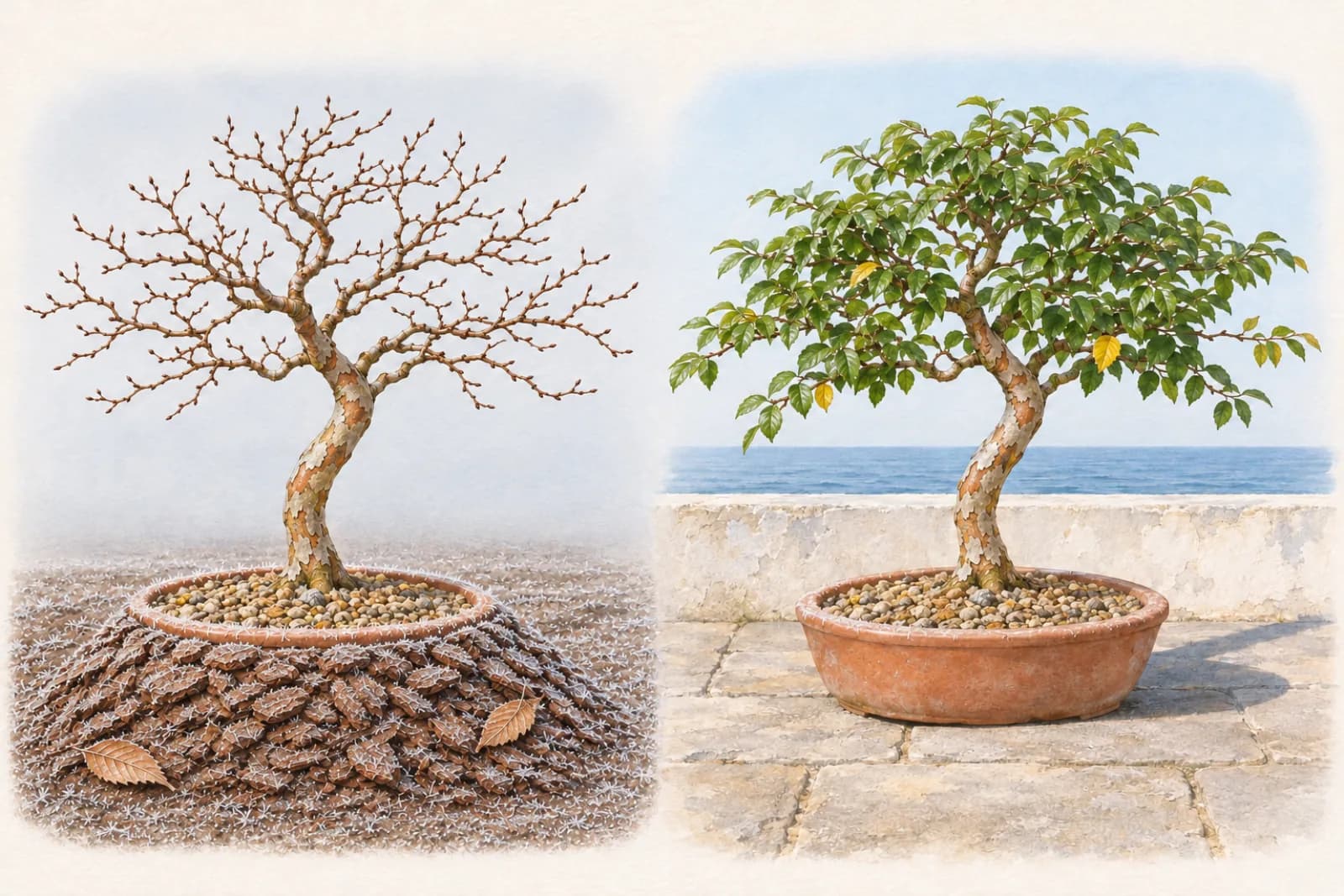
Late September, and two messages arrive in the same week. Like every case in this course, they are instructional examples, but unlike the others, each names its own climate. The first comes from the grower at 40° S, the courtyard owner's cousin, who grows a trident maple (Acer buergerianum) outdoors in a temperate climate with cold winters: the mirror image of the course's example city, one temperate Northern Hemisphere city at about 40° N (USDA zone 7a), as far south of the equator as the city is north of it. In the courtyard this week the trident maples are finishing their year, their shoots stopped and next year's buds set. At 40° S the trident's buds are swelling: fatter and longer, their scales pulling apart to show pale bands.
The grower plans to repot the tree this spring, and the bonsai book they were given, printed in the north, says “repot in March.” Should they wait six months for March to come round? At 40° S, March is early autumn. By then the leaves would be about to color, and the buds that are swelling now would have opened long before.
The second message comes from the bright window. Its owner's ficus (Ficus microcarpa) lives indoors all year at a south-facing living-room window, with a radiator below the sill and a grow lightAn electric lamp made to supply light for photosynthesis, today usually an LED fixture. Mounted at the distance its maker's light map gives and run on a timer, it can make a tropical tree such as a ficus workable indoors, but it cannot give a temperate tree its outdoor seasons.Open the glossary on a timer, in a room kept at 20 to 22 °C (68 to 72 °F). With the heating about to come on for the winter, the owner has found a care guide that says “reduce watering in winter, while the tree rests” and “repot in spring.” The guide names no room, no window, and no climate.
Two readers and two guides, each guide written for someone else's year. Should the grower at 40° S wait for March, and should the window's owner water less from October? This lesson shows what changes for trees in the other hemisphere, where winters are mild, in the tropics, and indoors, and what does not change, and it shows how to translate any dated advice into a growth stageA step in a tree's yearly cycle that you can see on the tree, such as buds swelling, bud break, shoots extending, or leaf fall. Care is timed to the stage a tree has reached, not to a date, because the same stage falls on different dates in different years, places, and kinds of tree.Open the glossary you can see on your own tree.
Every guide has a climate behind it
Lesson 1 turned calendar tips into stages: “repot in March” stood for swelling buds in the example city, and “bring tender trees in during October” for nights falling below about 10 °C (50 °F) (Course 02, Lesson 3). It also showed the same stage moving by weeks from one year to the next in one city. Between climates the gap is not a matter of weeks. A stage can come half a year from the guide's date, or a month or two before it, or not at all, and a tree in a pot indoors can have a year that the guide's author never imagined. The month is easy to print and easy to remember; the stage or the condition behind it is the instruction.
Three things decide how far a guide's year is from yours:
- The hemisphere. South of the equator the months shift by half a year, and north and south swap, so the warm, sunny wall faces the other way.
- The kind of climate. A cold-winter climate like the example city's, a mild-winter coast, the humid tropics, the wet and dry tropics, and a heated room each give a tree a different year.
- The kind of tree. Most temperateDescribes regions with distinct warm and cold seasons, and the trees adapted to them, which typically need a cool winter rest. Trident maples and the junipers commonly grown as bonsai are temperate trees and need seasonal outdoor conditions rather than a warm room all year.Open the glossary trees carry their need for a winter rest wherever they are grown, and a tropicalDescribes warm regions near the equator without a cold winter, and the trees adapted to them. Tropical trees such as ficus have no chilling requirement and can be damaged or killed by frost; their growth slows when light or warmth drops.Open the glossary tree its need for warmth and its intolerance of frost (Course 02, Lesson 2).
The tool for all three is Lesson 1's: find the stage. Course 01 stated the rule first: care is timed by the stage you can see on the tree, not by the month (Course 01, Lesson 13). This lesson takes that rule out of the example city and tries it in four other climates and one room: at 40° S, on a mild-winter coast, in the humid tropics, in the wet and dry tropics, and at the bright window.
What sets a tree's clock
A tree's year, its phenologyThe timing of a plant's recurring life events through the year, such as bud break, flowering, leaf color change, leaf fall, and dormancy, and how weather and climate shift them. Timing care to these stages works better than following calendar dates.Open the glossary, is timed by signals from its surroundings, and different trees listen for different ones. In many temperate trees, shortening photoperiodThe length of daylight in each 24-hour day, which changes with the seasons and acts as a calendar signal for plants. Shortening days help tell many temperate trees to stop growing, set buds, and prepare for winter.Open the glossary stops the shoots, cooling nights build cold acclimationThe gradual process, triggered by shortening days and falling temperatures, in which a tree's tissues become able to survive freezing. A tree moved suddenly from a warm room into frost has not acclimated and can be badly damaged. It is not the same as shoots hardening, or turning woody, though the two often happen around the same time.Open the glossary, and the buds' deep rest ends only after enough time in cool weather, their chilling requirementThe amount of time a temperate tree's buds must spend in cool weather before endodormancy ends and normal bud break can follow. Temperatures a few degrees above freezing count most, and hard cold counts for less. Requirements vary widely among trees; without enough chilling, bud break is often delayed, uneven, and weak.Open the glossary (Course 01, Lesson 13). A tropical tree such as a ficus has no winter rest to complete: light and warmth set its pace, and where the rain comes in seasons, water sets it too.
So a tree moved to a new climate does not take up the new place's calendar. It keeps its own needs and meets the new place's weather with them: a trident maple still needs a winter wherever it is planted, and a ficus still needs warmth. Whether its year lines up with the guide's depends on whether the new place supplies what the tree's clock listens for, and in what order.
The other hemisphere: the same year, half a year away
The grower at 40° S gardens in the same kind of climate as the example city: cold winters, warm summers, and frost at both ends of the growing season. Their trident maple goes through every stage the courtyard maple does, in the same order, half a year away. Its buds swell in late September, its leaves color in April, and it stands bare from late May until its buds break in October. Side by side, with each month an example from an ordinary year in its own place, the two years look like this:
| Stage | The example city, about 40° N | The grower at 40° S |
|---|---|---|
| Winter buds | December to mid-March | June to mid-September |
| Buds swelling | Late March | Late September |
| Bud break | April | October |
| Shoots extending | Late April and May | Late October and November |
| First flush hardened | Early summer, in June | Early summer, in December |
| Summer growth | July and August | January and February |
| Bud set and hardening | By early September | By early March |
| Autumn color | October | April |
| Leaf fall | Bare by late November | Bare by late May |
The day length shifts with it. At 40° S the days are about 15 hours long at midsummer, in December, and about 9 at midwinter, in June: the pattern the example city has at about 40° N (Course 02, Lesson 4), half a year on. So the signals a temperate tree's clock listens for, shortening days and then cooling nights, arrive in the same order, and the tree answers them in the same order.
The directions swap too. South of the equator the noon sun stands in the northern sky, so a wall that faces north is the warm, sunny one, and on a summer afternoon the side of a pot that overheats is the one facing northwest. Anything in a guide that names a direction, such as a south wall for warmth or the north side for shade, has to be turned around before it is used.
So the answer to the grower at 40° S is no. The book's “March” was its author's example for a stage: bud swellThe stage before bud break when a resting bud grows fatter and longer and its scales pull apart, showing paler bands between them, but no green tip shows yet. It is the first visible sign that a tree is leaving its winter rest, and it can come weeks earlier in a warm year than in a cold one.Open the glossary, the work windowThe growth stage, with suitable weather, at which a job such as repotting or structural pruning is commonly done, for stated reasons: growers tie each job to a stage because the tree is expected to recover well from it then. A window opens and closes with the stage, not with the date, and it is a starting point that a tree's kind, its health, and the technique itself can move.Open the glossary many growers give repotting for temperate deciduousDescribes a tree that drops all its leaves for part of each year, usually before winter or a dry season, and grows new ones when growth resumes. Most deciduous trees are broadleaves, like the trident maple, but a few conifers, such as larches, are deciduous too.Open the glossary trees such as the trident, for reasons and with limits that Lesson 2 sets out. At 40° S that stage is now, in late September. Whether this tree needs a repot this year and is ready for one is Course 01's readiness test (Course 01, Lesson 14), and how to do it belongs to Course 11, Repotting and Root Development. Waiting for March would put the job at the other end of the tree's year, with its leaves about to color.
What the shift does not do
Shifting the months works for the grower at 40° S because the two places have the same kind of climate, and even then only roughly. Two places at the same latitude can have very different winters: one on a coast warmed by the sea, one far inland, one high in the hills. The grower's frost dateThe average date of the last frost in spring or the first frost in autumn at a place, worked out from many years of weather records. It is an average, not a promise: some years bring frost later in spring or earlier in autumn, so check the forecast before trusting tender trees or new growth to the night air.Open the glossary are their own, read from their own weather records, not the example city's “late April” moved to “late October” (Course 02, Lesson 1). And an early spring at 40° S brings the buds out sooner and a late one later, as Lesson 1 showed for the example city. A shift tells you roughly when to start looking; the stage on the tree and your own forecast say when to act.
Practice check · not scored
Mild winters: a short rest, or not enough
The grower on the mild coast is a former member of the local club who moved away with two trees, a trident maple and a Chinese elm (Ulmus parvifolia). Their new home, north of the equator like the example city, has a mild-winter climateA climate where frost is rare and light, and winter days stay cool to mild. Temperate trees often rest only briefly there, and one whose buds need a long cool rest may not get enough of it, so its bud break can come late, uneven, and weak in some years. Roots in pots seldom need protection from hard freezes there; heat and drying wind are often the harder season.Open the glossary: frost comes on a few nights a year and is never hard, and winter afternoons are about 12 to 16 °C (54 to 61 °F).
The elm's first winter there looked like a different tree's. In the example city a Chinese elm drops most or all of its leaves once the hard frosts set in, usually in December, and is bare or nearly bare by midwinter. On the coast it keeps most of its leaves all winter and never looks bare. Both are normal. The Chinese elm is semi-evergreenDescribes a tree that keeps some of its leaves through a mild winter but drops most or all of them in a cold one, so it can look evergreen in one climate and deciduous in another. The Chinese elm is a familiar example; going bare in a cold winter is normal for it, not a sign of trouble.Open the glossary: it keeps some of its leaves through a mild winter and drops most or all of them in a cold one (Course 02, Lesson 2). Its leaf habit is a clue to the climate it lives in, not to its health.
The trident still goes bare, but briefly. On the coast it colors in late November, about when the example city's trident is already bare, drops its last leaves in late December, and breaks bud in February. In the example city it stands bare from late November until its buds break in April, four months or more. On the coast its rest is over in a month or two, and its growing seasonThe part of the year warm enough for plants to grow, often counted as the frost-free days between the last spring frost and the first autumn frost. Its length shapes how long trees grow each year, and it is the most time a frost-tender tree could spend outdoors.Open the glossary runs longer at both ends.
Is a short rest enough?
By the time a trident's leaves fall, its buds are in deep rest, endodormancyThe deep phase of dormancy in which buds will not grow even if conditions turn warm, because signals within the buds hold them back. In most temperate trees it ends only after enough time at cool temperatures, the tree's chilling requirement.Open the glossary, and they leave it only after enough time in cool weather. Course 01 set out what counts: cool weather a few degrees above freezing counts most, hard cold counts for less, warmth does not count, and freezing is not required. How much a tree needs varies widely among species, and even among varieties (Course 01, Lesson 13). A mild winter with cool nights can supply some chilling. Whether it supplies enough for a particular tree is the open question for every temperate tree on a mild coast, and no published figure settles it for a trident or for most other trees grown as bonsai.
The answer shows on the tree the following spring. After too little chilling, bud breakThe stage when buds swell and open and new leaves or shoots begin to emerge, marking the start of a growth period. In deciduous temperate trees it is fueled at first largely by stored reserves.Open the glossary comes later than the spring's warmth alone would bring it, and uneven and weak: some buds open long after the others, some never open, and the new shoots are short. The grower on the mild coast has seen a milder version of this: in some years the trident's buds open unevenly, days or weeks apart, after a warm winter. That is the evidence to watch, and a bud break date for each tree written in a stage recordA dated note, for one tree, of whether each growth stage has been reached: the date, then a yes or a no for the stage, on each day you look, with a word on the weather and where the tree stood. Kept over several years, with the no entries that bracket each first yes, it shows how far the tree's dates move with the weather.Open the glossary (Lesson 1) shows it across years better than memory does.
Fruit growers know the problem best, because a missed winter costs them a crop. Mississippi State University Extension's guide to chilling-hour requirements of fruit crops lists delayed leafing out among the effects of too little chilling, and advises choosing kinds and varieties whose needs the local winters meet. Its figures are for fruit crops; none exist for most trees grown as bonsai. The advice carries over, and it is Course 01's own: where winters are mild, choose trees that suit the climate, or ask experienced local growers what does well there (Course 01, Lesson 13). On the coast, the elm is at home. The trident may do well for years, and its record will say if it does not.
The hard season moves to summer
What the coast does not need is the example city's winter protection. Roots in a pot need protecting from hard freezes, the days of deep cold in a cold snapSeveral days in a row when even the afternoons stay below freezing and the nights fall far below a hard frost, often arriving on a dry, gusty wind. It lasts long enough to freeze an exposed pot through, so the roots follow the air down: the hard freeze that calls for protecting a potted tree's roots. A run of frosty nights with afternoons above freezing is not a cold snap, because the pots thaw by day.Open the glossary that can freeze a root ball through (Lesson 5), and the coast has none. A light frostA night when the temperature at the tree falls to 0 °C (32 °F) or below. A light frost is just below freezing for a few hours, usually on a clear, still night; a hard frost is −4 °C (25 °F) or below, the tag Course 02's planner uses. Frost matters most to growth that is tender, such as swelling buds and new leaves, and a frost on a still night and a freeze on the wind call for different shelter.Open the glossary on a clear night chills a pot's surface and wall for a few hours and is gone by morning. A resting tree, bare like the trident or in leaf like the elm, needs nothing for it. The one thing a light frost there can hurt is tender growth: a trident that breaks bud in February may meet a late frostA frost that comes after a tree's buds have begun to open in spring. New leaves and shoots have little cold tolerance, so a late frost can blacken or kill them on a tree that stood through far colder nights in midwinter. How many late frosts a tree meets depends as much on when its buds open as on when the frosts end.Open the glossary with its new leaves out, and on that night it needs a roof overhead, as new leaves do on any clear, still night of frost (Lesson 2).
The coast's hard season is summer: heat, long dry spells, and drying wind. The checks, the shade for pot walls, and the shelter from wind that Lesson 3 plans for a heat waveA run of days much hotter than is usual for the place and the season. Where summer afternoons are usually about 30 to 33 °C (86 to 91 °F), for example, a run of days near 36 °C (97 °F) is one, and an ordinary hot week is not. Many trees stop growing until it passes while their pots dry faster than usual, so checks are added and elective work and feeding wait.Open the glossary are the grower's real seasonal work there. Where a mild winter comes with a dry summer, as it does in many mild-winter places, many trees in the ground pause in the summer drought and may grow again when the rain returns in autumn (the summer-dry pause is below, in Go deeper).
Between temperate and tropical trees sit subtropicalDescribes regions bordering the tropics, with hot summers and mild winters that bring occasional cool spells or light frost, and the plants adapted to them. Subtropical trees typically have little or no chilling requirement but may tolerate cooler weather than tropical ones.Open the glossary ones, from the regions bordering the tropics, where winters are mild and frost is rare and light. A coast like this one can suit many of them outdoors all year, with shelter on a frosty night, though subtropical trees vary. Where winters are colder, many do best through the coldest months in a cool, bright, frost-free place rather than a warm room (Course 02, Lesson 3), so find out what your kind needs before you choose its winter place.
Practice check · not scored
The tropics: no winter to wait for
The grower in the humid tropics is the balcony owner's colleague. Where they live it is warm and wet all year, the days and nights are much alike, and the length of the day barely changes from one month to the next. Their ficus, a tropical evergreenDescribes a tree that keeps living foliage all year, replacing old leaves or needles gradually instead of all at once. Keeping foliage does not mean a tree grows all year: temperate evergreens such as junipers still go dormant in winter.Open the glossary, grows outdoors all year, flushA burst of new shoot growth, with leaves expanding together, that happens once or several times a year depending on the tree and conditions. Between flushes, shoots stop extending and mature.Open the glossary after flush, so that no month passes without new growth: new leaves unfold from their pointed sheaths, the shoots lengthen, then pause and firm before the next flush begins. A ficus has no chilling requirement and no winter rest to complete; light and warmth set its pace (Course 01, Lesson 13), and there neither runs short for long. So its stage is Growing strongly in every month, and the care that hangs on its growth follows the flushes: the check before each watering, feeding while it grows, and work timed to a strong flush. A temperate guide's months have nothing to attach to there.
A temperate tree fares far worse. The grower in the humid tropics was given a trident maple, and it declined over two years: with no cool season, the deep rest of its buds is never fully released, and the tree weakens year on year, a slow declineA gradual loss of health and growth over months or years, usually from several stresses acting together, such as poor light, root problems, or a missing winter rest. Early signs are subtle, so comparing dated records over time helps catch it.Open the glossary (Course 01, Lesson 13). Nothing done to the tree in a place with no winter supplies the cold its buds need, so the right trees for the humid tropics are tropical ones.
Wet seasons and dry seasons
The grower in the wet and dry tropics lives where it is warm all year and the year has two halves: rain from about May to September, then a long dry season from about October to April. Trees in the ground there keep time by rain. Many drop their leaves as the dry season takes hold and grow new ones as the rains return, or just before. A tree that does this is drought deciduousDescribes a tree that drops many or all of its leaves in a dry season and grows new ones when the rain returns, or just before. Its resting phase is set by water, not by cold, so in a climate of wet and dry seasons its year has no spring or autumn in the temperate sense. The same kind of tree kept in a watered pot may not feel the dry season at all.Open the glossary: its rest is set by water, not by cold. The USA National Phenology Network's phenophase definitions give such trees a group of their own and note that their new leaves often follow rain, and a study of a seasonally dry forest in India found leaf fall tracking the dry season and many kinds of tree putting out new leaves around the first rains, with wide differences between kinds (Singh and Kushwaha, Annals of Botany, 2006).
These two seasons are not spring and autumn, and calling them that misleads. The dry season brings no cold, so there is no chilling to count and no cold readiness to build; the first rains bring back water, not warmth. A tree standing bare in the dry months is not in winter rest, and its falling leaves are not autumn color and leaf fall in Course 01's sense. Even there, falling leaves are an observation to read with the place's weather: they mean “dry season” only when the weather says so too.
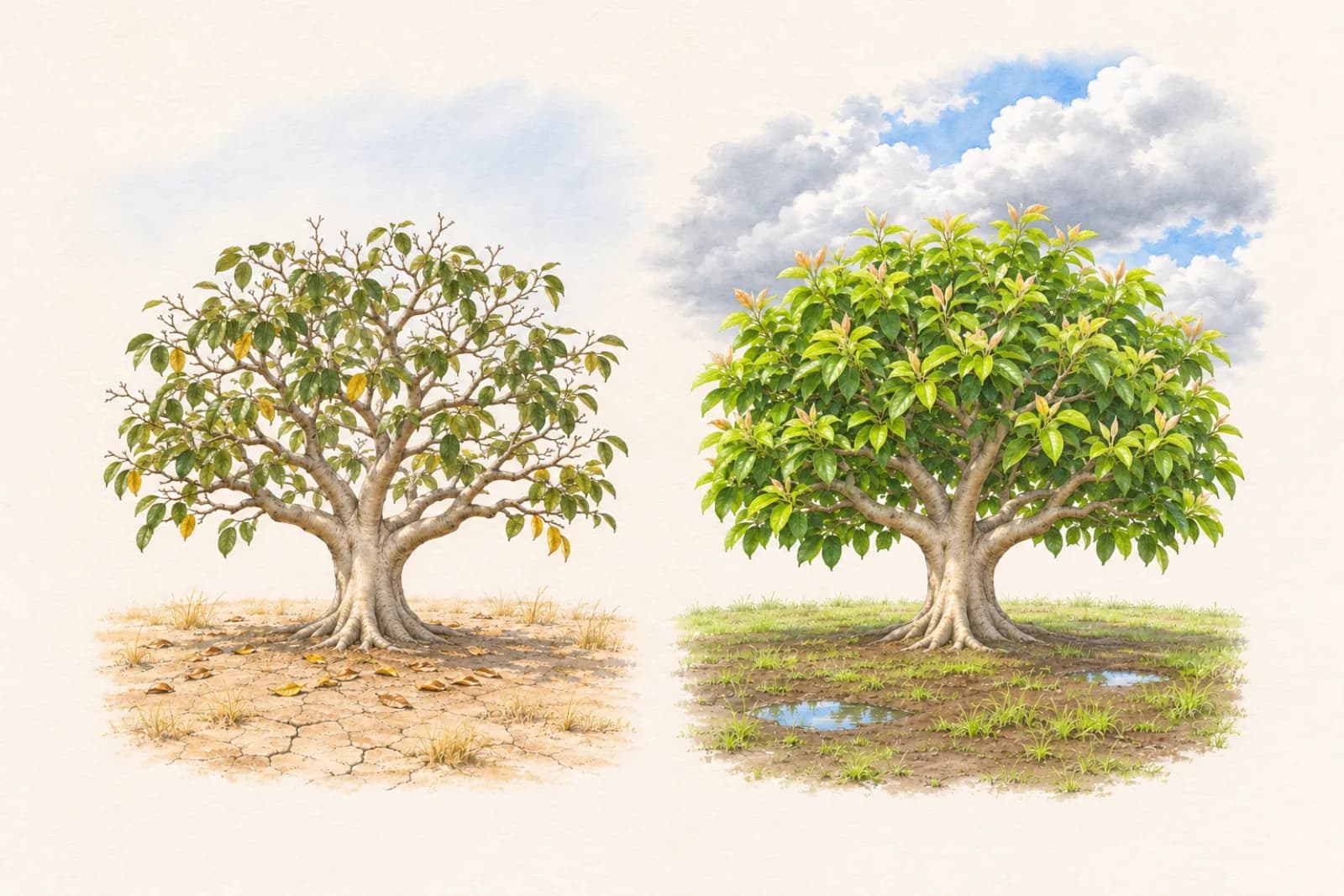
The grower's own ficus lives in a pot and is watered through the dry months, so it never feels the drought that thins the trees around it. It still has a year of its own: it grows more slowly through the cooler months, when the air is dry, and most strongly in the warm, humid weeks of the rains. So its year is Growing slowly and Growing strongly, following the warmth of the rains rather than the drought, and any work a ficus is given while it grows strongly is timed to those weeks (Course 11). Watering the pot through the dry season has, in effect, given it a different climate from the fig in the ground a few steps away.
Practice check · not scored
One tree in two climates
Does the year line up? sets one kind of tree in two climates at once and runs both through the same twelve months. A, drawn in ink, is always the example city, “cold winters, about 40° N”; B, drawn in red, is the climate you choose. Two stage ribbons share one month axis, A's above B's, and a month cursor runs along them. Above the ribbons, two round close-ups, The same twig, the same month, show one twig of each tree against its own place's sky, land, and weather. These are demonstrations of typical years, not the growers in this lesson.
Choose The tree, for both: Trident maple or Ficus. With the ficus, A's card adds that it is outdoors from late May to late September and by a bright window for winter. Then choose B's climate: South of the equator, A mild-winter coast, Humid tropics, or Wet and dry tropics; with the ficus, the last card reads A fig in the ground there, a tree that is not watered in the dry season. On a phone, these settings sit under Change. Under Your call, answer When does B's growth start up for the year? with The same month as A's, About half a year from A's, A month or two before A's, or In no one month, or press Skip; growth starting up means bud break for the trident and Growth picking up for the ficus, and the run stamps your call Called it or Surprise. Press Run the year to step from January to December, and use Pause, Back, Next, Replay, or Skip to the end to stop on any month. For each tree, the readouts Stage, Weather, What sets its clock, and What is happening follow the year in words. When the year ends, B's ribbon slides along the axis to see whether it lines up with A's. Find all four challenges to finish. Try these:
- The simulation opens on Trident maple and A mild-winter coast. Make your call, press Run the year, and watch how far B's ribbon slides at the end, and whether its winter fills A's.
- Change B's climate to South of the equator and run it again. Stop in April and in October and compare the two close-ups.
- Run Humid tropics, then Wet and dry tropics, and read B's What is happening in the months when B's buds open.
- Switch The tree, for both to Ficus and run all four climates, reading What sets its clock beside each ribbon, above all with A fig in the ground there.
Simulation
Does the year line up?
Climate AStays as it is
The example city: cold winters, about 40° N.
Calls: none yet
The same twig, the same monthJanuary
| January | A: The example cityStays as it is | B: A mild-winter coastYour change |
|---|---|---|
| Stage | Winter buds | Winter buds |
| Weather | Cold, with frost | Mild and wet |
| What sets its clock | Both · Cold and day length | |
| What is happening | Bare and resting. The winter's cold is what releases its buds from deep rest. | Bare for a short rest. Frost comes on only a few nights here, and never hard. |
- January: not reached yet
- February: not reached yet
- March: not reached yet
- April: not reached yet
- May: not reached yet
- June: not reached yet
- July: not reached yet
- August: not reached yet
- September: not reached yet
- October: not reached yet
- November: not reached yet
- December: not reached yet
- Winter buds
- Buds swelling
- Bud break
- Shoots extending
- First flush hardened
- Summer growth
- Bud set and hardening
- Autumn color
- Leaf fall
- Band: bare, buds closed
- Pin: Bud break
Result
When does B's growth start up for the year?
Press Run the year. Once B's ribbon has tried to line up with A's, the result shows when each tree's growth started up, its months at rest or slow, and what sets its clock.
Challenges
0 of 4 found
Find all four to finish.
Find a year that lines up after a slide, not found yet.
Keep the kind of climate. Change where it is.
Find a winter rest one month long, not found yet.
Look for a climate where frost is rare.
Find a temperate tree with no winter to wake from, not found yet.
Take the temperate tree somewhere no month is cold.
Find a year that lines up for the wrong reason, not found yet.
Read what sets each tree's clock, not just its month.
Text description
Two round close-ups sit side by side under the title “The same twig, the same month”. Each shows one twig against its own place in the current month: A in the example city, and B in the climate you choose. Behind the twig are that place's sky (a low, pale sun in winter, a high one in summer and all year in the tropics), its far land and trees, and its near ground, green, parched, or frosted. Rain falls as slanting streaks, heat rises as an orange shimmer, and frost is white sparkles over a pale slate wash. For the trident, the close-up shows a bud large through winter, swelling, and bud break, then this year's shoot as it extends, hardens, colors, and drops its leaves. For the ficus it shows a shoot tip with its newest leaf, small and slow or long and fresh, and an older leaf yellowing when the tree sheds. A ficus indoors is drawn at a window, with its place's sky outside.
Below the close-ups, two ribbons run along one month axis, January to December: A's above, B's below. Each month is colored by the tree's stage and named where there is room. A slim band under each ribbon marks the months at rest: for the trident, bare, buds closed, in slate; for the ficus, growing slowly. Hatched months mark weak, ragged growth. A cursor moves along the axis, and the ribbons fill in as it reaches each month. After December, B's ribbon lifts and slides along the axis, wrapping round the year, to put its start-up under A's. It locks when every stage then lines up, falls short when its months at rest are fewer than A's, cannot lock when its growth starts up in more than one month or never slows, and stays put when it already lines up. A's months at rest are then outlined in B's band, and a paper tag and a sentence say what happened.
Choose the tree, for both (trident maple or ficus), and B's climate. Climate A stays the example city. Before the run you can answer “When does B's growth start up for the year?” with one of: The same month as A's; About half a year from A's; A month or two before A's; In no one month; or skip it. Press Run the year to play twelve months and the line-up. Pause, Back, Next, Replay, and Skip to the end control the run, and each reached month on the axis is a button that jumps there. For each tree the readouts give: Stage, Weather, What sets its clock, What is happening.
A's year in the example city:
- The trident maple, outdoors: Winter buds in December to February, Buds swelling in March, Bud break in April, Shoots extending in May, First flush hardened in June, Summer growth in July to August, Bud set and hardening in September, Autumn color in October, and Leaf fall in November.
- The ficus, outdoors from late May to late September; by a bright window for winter: Growing slowly in October to April, Growth picking up in May, and Growing strongly in June to September.
B's four climates:
- South of the equator (the same kind of climate): hot in January to February, warm in March and December, mild and cooling in April, cool, getting colder in May, cold, with frost in June to August, cool, with frosty nights in September, cool, warming up in October, and mild and warming in November.
- A mild-winter coast (frost rare and light): mild and wet in November to February, mild and warming in March to April, warm in May, warm and dry in June and September, hot and dry in July to August, and mild and cooling in October.
- Humid tropics (warm and wet all year): warm, with rain most days all year.
- Wet and dry tropics (rain from about May to September): warm and dry in October to February, hot and dry in March to April, and warm, with rain most days in May to September.
With the ficus, B in the wet and dry tropics is a fig growing in the ground there, not watered in the dry season. A watered pot of the same tree would not feel the drought. On the mild coast a ficus spends the coolest weeks in a bright, sheltered, frost-free place, as it spends the city's winter at a window. How a temperate tree fares when it is kept warm through winter is the subject of Course 01's season wheel, under A missed winter shows up a year later.
Each run ends with a result card: when each tree's growth started up, its months at rest or slow, and what sets its clock, with your call marked Called it or Surprise. Four challenges, each with a hint:
- Find a year that lines up after a slide. Hint: Keep the kind of climate. Change where it is.
- Find a winter rest one month long. Hint: Look for a climate where frost is rare.
- Find a temperate tree with no winter to wake from. Hint: Take the temperate tree somewhere no month is cold.
- Find a year that lines up for the wrong reason. Hint: Read what sets each tree's clock, not just its month.
On the mild-winter coast, B's trident showed Autumn color in November and Leaf fall in December, held Winter buds through January only, and broke bud in February, with a note that its bud break is uneven in some years because a short, mild rest may not be enough. Its ribbon slid two months, but its winter band could not fill A's (“Winter rest: short”), and the call settled on A month or two before A's. South of the equator, B kept every stage in the same order and moved them half a year: Bud break in October, Autumn color in April, bare from June to August. Its ribbon slid six months and locked, “Same stages, six months on”: About half a year from A's.
In both tropics, B's trident was shown in its second year there: leaves held past their time and dropped raggedly, buds opening a few at a time across several months, and weak growth. Its What is happening read “With no cool season, the deep rest of its buds is never properly released. Rain or no rain, there is no winter.” With no winter band to line up, the ribbon could not lock: In no one month. With the ficus, A grew slowly by its bright window from October to April, picked up in May, and grew strongly outdoors from June to September. B did the same half a year on south of the equator, picked up in March on the mild coast, where its nights still fell below what a ficus is kept above, and grew strongly in every month in the humid tropics. The fig in the ground in the wet and dry tropics grew slowly and shed some older leaves through the dry months, then picked up in May with the first rains, the same month as A's ficus. But B's What sets its clock read Rain, beside A's Warmth and light: the same month for a different reason, and a watered pot of the same tree would not have felt the dry season at all.
In every run, the tree carried its own needs into B's climate. A temperate tree kept its stages and moved its months where the climate was the same kind, rested only briefly where winters were mild, and had nothing to wake from where there was no winter. A tropical tree followed warmth, light, and rain. A month in one place lines up with a month in another only when the reason behind it does.
Go deeper · optional, not assessedSummer-dry climates: when the pause comes in summer
In places with mild, wet winters and long, dry summers, the kind of climate often called Mediterranean, water rather than cold sets the pause for many trees in the ground: they grow in spring, stop in the summer drought, and some grow again once the autumn rain returns. A review of wood formation, drawing on maritime pine at one site, found that the summer drought pushed the vascular cambiumA layer of dividing cells, only a few cells thick, between the wood and the inner bark. It adds new xylem on its inner side and new phloem on its outer side, which is how trunks, branches, and roots grow thicker.Open the glossary, the layer that makes new wood, into a pause, and that a second spell of growth after the autumn rain was possible but not guaranteed (Vieira, Carvalho, and Campelo, Frontiers in Plant Science, 2020). That is one kind of tree, at one site, and its trunk rather than its shoots, so it shows a pattern, not a rule for every tree in such a climate.
For a tree in a pot the picture changes again. A watered pot removes most of the summer drought, so a potted tree in a summer-dry climate may keep growing where the same kind of tree in the ground has stopped, or it may still pause in the heat, as many trees in the example city do in a heat wave (Lesson 3). Watch for the pause and for any autumn growth on your own tree before you plan around either.
Indoors: a climate you build
Predict first
In winter. On clear winter days the low sun reaches across the sill from late morning to mid-afternoon, the grow light adds more, and the heating dries the room's air, so the pot dries sooner than in summer, even though the ficus grows more slowly in winter's short days. In summer the high sun barely gets inside, its new shoots grow longer and thinner, and the pot often stays moist for days (Course 03, Lesson 1). The guide was written for a tree whose winter is darker and cooler than this room's. Here the daily check, not the season, says when to water.
Indoors, the climate is whatever the room, the window, and the lamps make it: a microclimateThe climate of a small area, such as one corner of a balcony or the strip of ground along a wall, where it differs from the general weather around it in temperature, sun, wind, rain, or humidity. A tree responds to the microclimate of its own spot, not to the forecast for the city.Open the glossary built almost entirely by its owner, which an outdoor guide's seasons fit no better than another country's. Warmth is the easy part: a heated room stays warm all year. Light is usually what runs short. Iowa State University Extension's guide to setting up supplemental lights for indoor plants names light as often the most limiting factor for plants indoors, and even a bright window gives a tree a small part of the light of open sky (Course 02, Lesson 4). The same guide suggests lamps for 12 to 14 hours a day for most houseplants, no fewer than 10 and no more than 16, on a timer, with a dark period every night. That is a starting point for houseplants, not a figure for any one tree; the bright window's 13 hours sits inside it, and its owner judges the light by what the ficus grows.
At the bright window, the south-facing glass, the grow light on its 13-hour timer through the winter, and heating that lowers the air's relative humidityThe amount of water vapor in the air, as a percentage of the most the air could hold at its current temperature. Warm air can hold more vapor, so heating cold winter air indoors lowers its relative humidity sharply, and drier air draws water from leaves and pots faster.Open the glossary from about October to April make that room's year. In winter the sill can get more sun than in summer and the air is at its driest, though the days are short; in summer the sill is shaded and the air more humid: the outdoor year run the other way round.

Water use, growth, and feeding move apart
Outdoors in the example city, a trident's water use, its growth, and its feeding rise and fall together through the year. At the bright window they come apart. The pot dries faster in winter than in summer, because the sun on the sill, the lamp, and the heated air all draw on it then. Growth goes on all year, but more slowly in winter's short days; in summer, with the high sun off the sill, the new shoots grow longer and thinner while the pot stays moist for days (Course 02, Lesson 4). Feeding follows the growth: every 14 days in spring and summer, and every 28 days in autumn and winter for as long as it keeps growing (Course 05, Lesson 4).
So no single season word fits all three, and the guide's “reduce watering in winter, while the tree rests” describes neither the water use nor the growth at this window. It was written for a tree whose winter is darker and cooler than this room's, or for a temperate tree resting outdoors, where water use falls as growth does. The rule here is the one Course 03 gave for every pot: check every day, and give a thorough wateringWater applied evenly across the whole surface, slowly enough to soak in, until it runs from the drainage holes, and then confirmed by a check that the root ball wetted through. It usually takes two or three passes a minute or two apart. Water at the holes alone shows only that water reached the bottom, not that the roots got it.Open the glossary when the check says the root zone is Drying, in whatever month that is (Course 03, Lesson 6). Feed by the growth, and if the growth stops, check the light first. The guide's “repot in spring” translates the same way: a ficus is repotted while it is growing strongly (Course 11), and the window's own record of new leaves shows when that is. No repot is planned for it this year.
What a room cannot give a temperate tree
A room can be built to suit a tropical tree. It cannot give a temperate tree its year. It takes away the winter, and with it the chilling its buds need (Course 01, Lesson 13). It takes away the autumn's cooling, so the tree builds no cold readiness. And it takes away most of the light the tree grew in: a juniper on a warm sill can spend more sugar than it makes for months while it still looks green (Course 02, Lesson 3).
Long lamp days do not change that. A grow light on a long timer changes the day length a tree reads, and in many temperate trees that can keep shoots growing past the point where autumn days would have stopped them. It cannot supply the cool weeks that end deep rest, and even a strong lamp gives far less light than open sky. A grow light can make a tropical tree workable indoors, but it cannot make a temperate tree an indoor one (Course 02, Lesson 4). This course does not teach keeping temperate trees indoors: they spend the year outdoors, and their winter is planned cold, outdoors or in an unheated shelter, as Lesson 5 plans it.
A tropical tree that summers outdoors lives in two climates
The small backyard's ficus lives in both kinds of climate each year. It goes out to the lawn in late May, once nights stay reliably above about 10 °C (50 °F), and comes back in before autumn nights fall below that: this year on September 25, checked for pests first and taken straight to a bright window in the house for its overwinteringHow a plant is kept through winter. A temperate bonsai usually overwinters cold, outdoors or in an unheated shelter, with its roots protected from hard freezes; a tropical one overwinters indoors in warmth and strong light. Course 06, Seasonal Care and Timing, covers the details.Open the glossary indoors. Outdoors it gets more light than any window gives and grows strongly; indoors it lives the room's year. The moves follow conditions, not dates. Going out takes steps, Course 02's hardening offGetting a plant that grew indoors or under glass used to outdoor sun, wind, and temperatures gradually, by moving it from bright shade toward full exposure over one to two weeks or more. For bonsai, it protects soft leaves from scorch when a tree goes outdoors for the season or arrives from a greenhouse. It is not the same as shoots hardening, or turning woody, in late summer.Open the glossary, because the leaves it grew indoors are shade leafA leaf that grew in dim light, such as in a window, under greenhouse glass, or deep inside a canopy. It is thinner and often larger than a leaf grown in sun, with a thinner cuticle and fewer layers of light-catching cells, so it uses weak light well but bleaches or scorches if moved suddenly into strong sun.Open the glossary that scorch in sudden sun; coming in takes none, because the light falls whatever you do (Course 02, Lesson 3). Each move also changes how fast its pot dries, so the first days after either move need a closer look (Course 03, Lesson 1).
Translate advice in three questions
Lesson 1 asked three things of a tip: who wrote it, where, and for which tree. Across climates, ask them in this form before you follow a piece of advice:
- Where was it written? The hemisphere, and the kind of climate: cold winters, mild winters, the tropics, a heated room.
- For what kind of tree? Temperate or tropical, deciduous or evergreen, in the ground or in a pot.
- What stage or condition did the date stand for? The thing the author could see when the month came round: buds swelling, nights falling below about 10 °C (50 °F), the first hard freeze, the first rains.
Then restate the advice as that stage or condition, and look for it on your own tree and in your own forecast. The four pieces of advice this lesson has met translate like this:
| The advice, and where it was written | The stage or condition behind it | For the reader |
|---|---|---|
| “Repot in March”, from a cold-winter guide in the north | Buds swelling, on temperate deciduous trees | At 40° S: as the buds swell, usually late September there; this year, now |
| “Reduce watering in winter”, from a place where winter is darker and cooler | Water use falling as light and growth fall | At the bright window: water by the daily check; the pot dries sooner in winter |
| “Protect the roots from November”, from a cold-winter guide in the north | Hard freezes coming to a tree at rest (Lesson 5) | On the mild coast: no hard freezes, so no root protection; plan for summer |
| “Repot in spring”, from a cold-winter guide, read for a ficus | The warm weeks when a ficus grows strongly | In the wet and dry tropics: as strong growth begins with the first rains |
The first question matters even when a guide comes from a climate like your own. A nursery a few hundred kilometers (a couple of hundred miles) north keeps its own frost dates, and when it tells you to “set tropical trees out after June 1”, the date stands for a condition there: nights reliably above about 10 °C (50 °F). Find that condition in your own forecast, and the date you end up with will be your own.
Some advice has no stage behind it that you can find. A tip that names a month but no place and no tree, or that gives one date for every tree, is unverified until you can say what the date stood for. The other half of the method is Lesson 1's stage record. Once you have written down when your own trees reached each stage, last year's dates in your own place are the best examples you will ever have, and they are still examples, never next year's rules.
So the grower at 40° S repots as the buds swell, now, if the tree is ready, and the window's owner keeps the daily check through a winter in which the ficus's pot will dry sooner, not later.
Read advice for the stage it meant
The bonsai decision
Find the stage behind the advice, then follow your own tree
Starting point
For any tree, wherever it grows, before you follow care advice that names a month:
- Find your own year: your frost dates, your winter lows and hardiness zoneAn area on a map defined by how cold its winters get, usually measured as the average of the coldest temperature reached each winter. In the USDA system each zone spans 10 °F (about 5.6 °C), split into halves a and b, and plant labels name the zones where a plant survives winter in the ground. Roots in a pot are more exposed, so a tree in a pot needs hardiness to spare.Open the glossary (Course 02, Lesson 1), your wet and dry months if your climate has them, your day length, and your own stage record (Lesson 1).
- Ask the three questions before you follow dated advice: where it was written, for what kind of tree, and what stage or condition the date stood for.
- Restate it as a stage or a condition, with your own place's example month after it: “as the buds swell (here, usually late September)”.
- Check it against your tree and your forecast on the day, and act on the stage the tree shows, not on the date.
This assumes
- You know what kind of tree you have and where its kind comes from: temperate, subtropical, or tropical (Course 02, Lesson 2).
- The tree is healthy and lives where its kind can live: a temperate tree outdoors where it gets a winter, a tropical tree out of frost and cool nights.
- Each case in this lesson names its own climate, and its months belong to that place: the grower at 40° S is south of the equator; the mild coast is north of it, like the example city, one temperate Northern Hemisphere city at about 40° N.
Change course if
- The advice names no place and no tree: treat it as unverified until you find the stage it stood for, then look for that stage on your own tree.
- Your winters are too mild for a tree known to need a long cool rest: choose trees that suit your climate, or expect uneven bud break and keep a stage record to see it; ask local growers what does well (Course 01, Lesson 13).
- You grow a tropical tree where frost occurs: it lives outdoors only while nights stay above about 10 °C (50 °F), as many growers keep a ficus, going out in steps and coming in at once (Course 02, Lesson 3).
- Your tree lives indoors: the room's light, heating, and lamp hours are its seasons. Check it daily, water by the check, feed by its growth, and look again at the light near midsummer and midwinter.
- A tree declines though its care matches its climate and its kind: this is not a seasonal problem: investigate before changing its care again (Course 07, Tree Health and Diagnosis).
Back to the question
What if your seasons are not the ones in the guide?
Then the guide's months belong to someone else's year, and only the stages behind them carry over. A month in advice is its author's example for a stage or a condition: buds swelling, nights falling below about 10 °C (50 °F), the first hard freeze. Across the equator a temperate tree keeps the same stages half a year away, so the grower at 40° S repots as the buds swell in late September. On a mild coast a temperate tree rests briefly and may get too little chilling; in the humid tropics it gets none. Tropical trees keep time by warmth, light, and seasonal rain. Indoors the room makes the seasons: at the bright window the pot dries sooner in winter than in summer. Ask where advice was written, for what tree, and what stage it meant, then watch your own tree.
Key takeaways
- A month in care advice is its author's example for a stage or a condition in their own climate. Ask where it was written, for what kind of tree, and what the date stood for, then look for that stage on your own tree and in your own forecast.
- South of the equator, a temperate tree in a cold-winter climate goes through the same stages half a year away, and north and south swap. The shift fixes the months for the other hemisphere and nothing else: it does not turn one climate into another.
- Where winters are mild, a temperate tree rests only briefly and may not get the chilling its buds need, so its bud break can be uneven. Choose trees that suit the climate, and plan for the climate's own hard season instead of copying cold-winter protection.
- Tropical trees have no winter rest and keep time by warmth, light, and, where rain is seasonal, water. Wet and dry seasons are not spring and autumn, and a pot watered through the dry season does not feel the drought.
- Indoors, the room sets the seasons and light is usually the limit. Water use, growth, and feeding do not move together there, so check daily, water by the check, and feed by the growth; no room or lamp gives a temperate tree its winter.
Optional · not required for completion
Rewrite one line of dated advice
Find one line of care advice that names a month: in a book, on a care tag, in a forum post, or on a nursery's sheet. Copy it down, then answer the three questions in a line each: where it was written, by hemisphere and kind of climate; for what kind of tree; and what stage or condition the month stood for. Rewrite the advice as that stage, with an example month from your own place after it in parentheses, as in “as the buds swell (here, usually late March)”. If you cannot find the stage, write “unverified” beside it. Which part of the original would have misled you where you live?
No tree? Take “Repot bonsai in early spring (March)” and rewrite it three times: for the trident on the mild coast, for the ficus in the humid tropics, and for a temperate tree in your own town. Which of the three needed more than a shift of months?