Course 02 · Lesson 3 of 8 · Matching a tree to a place
Indoors or outdoors?
A warm room suits some trees and slowly harms others. Learn where a temperate tree and a tropical tree should spend each season, why leaves and cold readiness need time to adjust, and how to move a tree in safe steps timed to the forecast.
The question
Where should this tree spend the year, and how do you move it there safely?
By the end of this lesson, you will be able to:
- Compare where a temperate tree and a tropical tree should spend each season, and explain what a warm room cannot give a temperate tree.
- Explain why leaves that grew in dim light scorch in sudden full sun, and why a tree from a warm room is not ready for frost.
- Plan a gradual move to a new place, timed to the forecast and adjusted to the tree's response.
About 16 minutes to read and explore
Three trees from this course's cases, all instructional examples, each need to move.
The gift juniper, bought in mid-December, has spent weeks in a heated shop and a warm home, and now sits on a windowsill above a radiator in the west balcony apartment. Lesson 2 showed that its “INDOOR BONSAI” tag is wrong: the junipers sold as bonsai are temperate trees, and this one, most likely Juniperus procumbens 'Nana', belongs outdoors. Its owner is ready to carry it out to the balcony, but the forecast shows four hard frosts in a row, down to −9 °C (16 °F).
The house with the small backyard has two moves to plan. In early spring, its owners bring home a trident maple from a heated greenhouse, already in soft new leaf while the neighbor's maple is still bare. In late spring, they want the ficus, which spent the winter in a bright window, out on the sunny lawn.
Each owner knows where the tree should go. Moved there today, the juniper would meet a frost it is not ready for, the ficus a sun its leaves were not built for, and the maple's new leaves a frost that would blacken them. Where a tree should spend its year is half of this lesson's question; the other half is how to get it there.
Where each kind of tree belongs
Placement starts with what the tree is. As Course 01, Lesson 13 showed, a tree's year follows the climate it is adapted to, and broadleaf or conifer, evergreen or deciduous, do not settle where it should live. First find out whether it is temperate, tropical, or subtropical.
temperateDescribes regions with distinct warm and cold seasons, and the trees adapted to them, which typically need a cool winter rest. Trident maples and the junipers commonly grown as bonsai are temperate trees and need seasonal outdoor conditions rather than a warm room all year.Open the glossary trees, such as the junipers, the trident maple, and the Chinese elm, spend the whole year outdoors. There they get full daylight, feel the shortening days and cooling nights of autumn, and then get the cold winter rest that meets their buds' chilling requirementThe amount of time a temperate tree's buds must spend in cool weather before endodormancy ends and normal bud break can follow. Temperatures a few degrees above freezing count most, and hard cold counts for less. Requirements vary widely among trees; without enough chilling, bud break is often delayed, uneven, and weak.Open the glossary.
tropicalDescribes warm regions near the equator without a cold winter, and the trees adapted to them. Tropical trees such as ficus have no chilling requirement and can be damaged or killed by frost; their growth slows when light or warmth drops.Open the glossary trees, such as the ficus, have no winter rest, and frost damages or kills them. Where winters bring frost, they spend the cold months indoors, in warmth and the strongest light available. subtropicalDescribes regions bordering the tropics, with hot summers and mild winters that bring occasional cool spells or light frost, and the plants adapted to them. Subtropical trees typically have little or no chilling requirement but may tolerate cooler weather than tropical ones.Open the glossary trees vary; many do best in winter in a cool, bright, frost-free place rather than a warm room.
So the groups differ most in their overwinteringHow a plant is kept through winter. A temperate bonsai usually overwinters cold, outdoors or in an unheated shelter, with its roots protected from hard freezes; a tropical one overwinters indoors in warmth and strong light. Course 06, Seasonal Care and Timing, covers the details.Open the glossary, how they are kept through winter. A temperate tree overwinters cold, outdoors or in an unheated shelter, with its roots protected from hard freezes; a tropical tree overwinters warm and bright. In the course's example climate, with frost from mid-October to late April, the three example trees spend their year like this:
| Tree | Spring to autumn | Winter |
|---|---|---|
| Junipers (the nursery juniper and the gift juniper) | Outdoors in full sun | Outdoors, cold, with roots protected from hard freezes |
| Trident maple | Outdoors in full sun to part shade, with some protection from strong afternoon sun and wind in a hot summer | Outdoors, cold and bare, with roots protected from hard freezes |
| Ficus | Outdoors in strong light once nights stay above about 10 °C (50 °F), or indoors in the strongest light you have | Indoors, warm, in the strongest light you have, often a bright window plus a grow light |
What a warm room takes away
For a temperate tree, a heated room takes away three things.
Light. Indoors, light comes from one side, through glass, for only part of the day. In the Northern Hemisphere, where all the course's cases are, a south-facing window gets the most direct sun (in the Southern Hemisphere, swap north and south), yet even there the sun reaches the sill for only a few hours on a clear winter day, and a step or two back from the glass the light falls to a small fraction of what open sky gives. Leaves build sugars from light (Course 01, Lesson 6), while evergreen foliage keeps respirationThe process in which living cells break down sugars using oxygen to release energy they can use, giving off carbon dioxide and water. It runs in every living cell of a tree, in leaves, stems, buds, and roots, both day and night. Without oxygen, cells fall back on fermentation.Open the glossary, faster in warmth (Course 01, Lesson 7), so a juniper on a warm sill can spend more sugar than it makes for months while it still looks green. Lesson 4 shows how to measure the light a spot really gets.
Winter. A warm room gives no chilling, so the next spring bud breakThe stage when buds swell and open and new leaves or shoots begin to emerge, marking the start of a growth period. In deciduous temperate trees it is fueled at first largely by stored reserves.Open the glossary comes late and weak, and over several winters the tree declines. Nor does the tree build cold acclimationThe gradual process, triggered by shortening days and falling temperatures, in which a tree's tissues become able to survive freezing. A tree moved suddenly from a warm room into frost has not acclimated and can be badly damaged. It is not the same as shoots hardening, or turning woody, though the two often happen around the same time.Open the glossary, the readiness for freezing that develops over weeks of cooling.
Moist air. Winter heating makes indoor air very dry. That raises the evaporative demandHow strongly the surrounding air draws water vapor from leaves, rising with sun, heat, dry air, and wind. High evaporative demand can make a tree lose water faster than reduced or damaged roots can replace it.Open the glossary on foliage (Course 01, Lesson 8) and dries a pot above a radiator fast; Lesson 5 looks at humidity.
Tropical trees indoors, and summers outside
A ficus can live indoors all year where the light is strong: close to a bright window, often with a grow lightAn electric lamp made to supply light for photosynthesis, today usually an LED fixture. Mounted at the distance its maker's light map gives and run on a timer, it can make a tropical tree such as a ficus workable indoors, but it cannot give a temperate tree its outdoor seasons.Open the glossary as well (Lesson 4). Compact new shoots with closely spaced leaves suggest the light is enough; long, thin shoots with small, widely spaced leaves suggest it is not.
Many growers in cold-winter climates also move tropical trees outdoors for the summer. Even in bright shade outdoors, a tree usually gets more light over a day than in a window, so it grows more strongly and builds reservesCarbohydrates, mostly starch, stored in living cells of the roots, trunk, branches, and bark for later use. Reserves fuel early spring growth before new leaves can supply sugar, and they help a tree recover after losing foliage or roots. A seed carries reserves of its own, such as starch, oils, and proteins, that fuel the embryo's first growth.Open the glossary for the next winter indoors. Summering outdoors is a choice, and it has three rules: go out only once nights stay reliably above about 10 °C (50 °F), move into stronger light gradually, and come back in before autumn nights fall below that again. The rest of this lesson explains why.
Practice check · not scored
Leaves are built for the light they grew in
Whenever a tree moves, its surroundings change faster than the tree can. Plants do adjust to stronger light, cooler nights, or drier air, but over days to weeks. That gradual adjustment is acclimationThe gradual adjustment of a plant to new conditions, such as stronger light, colder nights, or drier air, which takes days to weeks. A tree moved suddenly into very different conditions has had no time to acclimate and can be damaged, so bonsai are moved to new places in steps. Cold acclimation is one kind.Open the glossary, and cold acclimation is one kind of it.
A leaf's structure is set while it grows, to suit the light around it. Leaves that expand in strong light become sun leaves: smaller and thicker, with a thicker cuticleA thin, waxy, water-resistant film covering the outer surface of leaves, needles, and young stems. It greatly slows water loss through the leaf surface, so most of a leaf's water vapor escapes through the stomata instead.Open the glossary and, in the mesophyllThe inner tissue of a leaf between its upper and lower surfaces, packed with chloroplast-rich cells where most photosynthesis happens. Loosely arranged cells with air spaces between them let carbon dioxide reach every cell.Open the glossary, two or more layers of tall palisade cells packed with chloroplastA tiny green structure inside leaf cells and other green cells where light energy is used to make sugars from carbon dioxide and water. It holds chlorophyll, the pigment that captures that light.Open the glossary (Course 01, Lesson 4). They can use a great deal of light and safely get rid of much of the excess.
A shade leafA leaf that grew in dim light, such as in a window, under greenhouse glass, or deep inside a canopy. It is thinner and often larger than a leaf grown in sun, with a thinner cuticle and fewer layers of light-catching cells, so it uses weak light well but bleaches or scorches if moved suddenly into strong sun.Open the glossary expands in dim light: in a window, under greenhouse glass, or deep inside a canopy. It is larger, thinner, and softer, often darker green, with a thinner cuticle and usually a single, shorter layer of palisade cells. It is efficient in weak light and poorly protected in full sun.
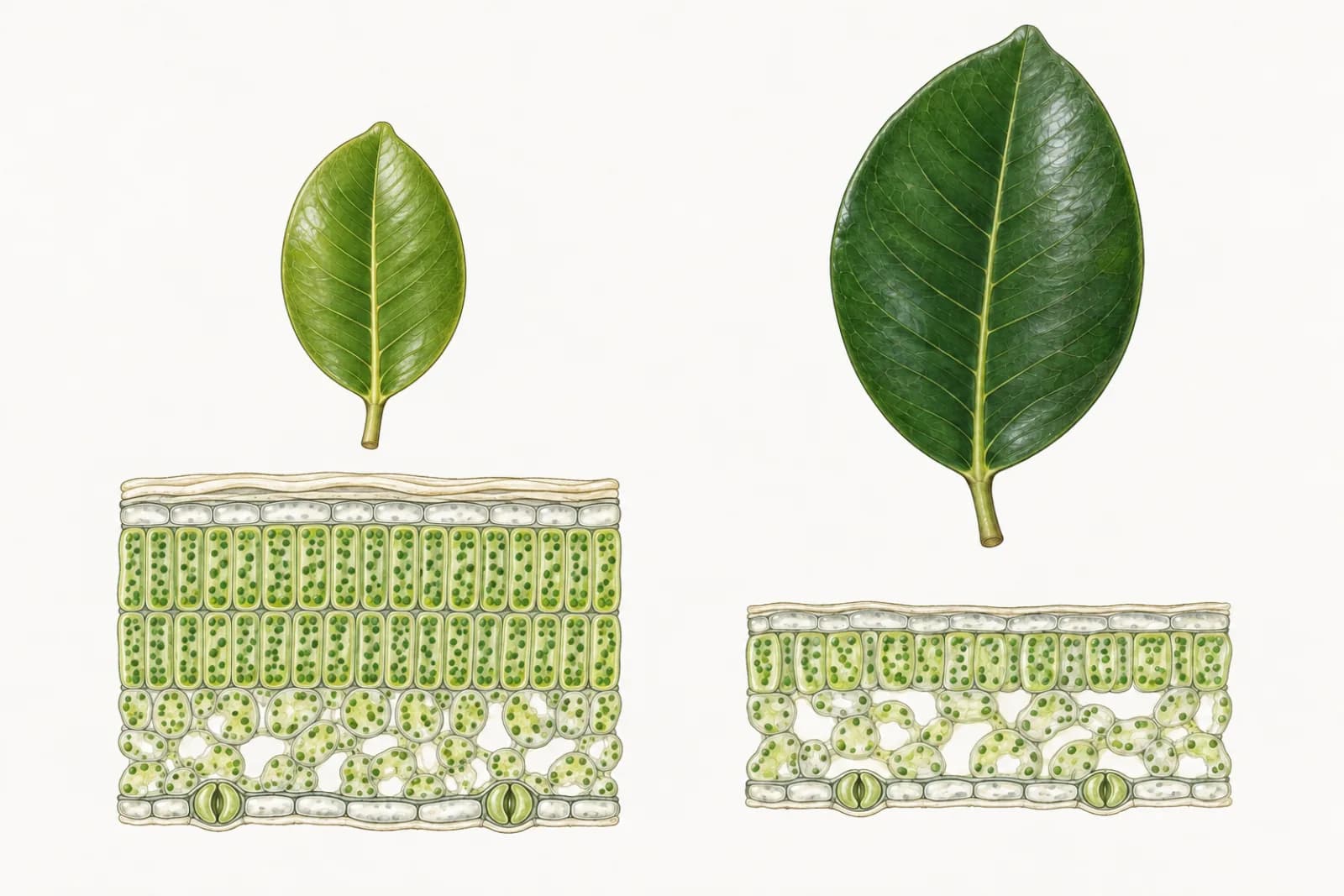
Conifer needles also differ between sun and shade, less visibly. Nobody knows where the gift juniper grew, but junipers are usually raised outdoors at nurseries, so its needles most likely grew in sun. Winter sun is also weak, so light is not its main risk.
Predict first
Pale, bleached patches on many of the leaves facing the sun, some drying to brown, while leaves shaded by others stay green. Its leaves grew in window light as shade leaves, built to catch weak light, and full sun on a hot day gave them far more light and heat than they can handle. The tree will very likely survive and grow new leaves suited to the sun, but it has lost some of the leaves that make its sugars, and it is set back. Moving it outdoors in steps, shade first, would have avoided the damage.
In full sun, a shade leaf absorbs more light energy than it can use or safely shed. The excess damages its light-capturing machinery and breaks down its chlorophyllThe green pigment in chloroplasts that absorbs light, most strongly red and blue, and passes its energy into sugar-making. It absorbs green less strongly, so leaves reflect and transmit more green than other colors and look green, though a leaf still absorbs most of the green light that reaches it.Open the glossary, so patches turn pale, almost white: bleaching. The thin leaf also heats up and loses water fast, and the damaged patches dry and turn brown: leaf scorchBrowning and drying of leaf edges, tips, and the tissue between the veins when leaves lose water faster than the roots can replace it, as in hot sun, wind, or dry air. Thin shade leaves moved suddenly into strong sun scorch the same way, often after pale, bleached patches. It is a symptom, not a diagnosis: a dried-out root ball, damaged roots, or salt buildup can cause the same browning.Open the glossary. Both show on the leaves, and the parts of leaves, that face the sun, and both are worse on hot or windy days.
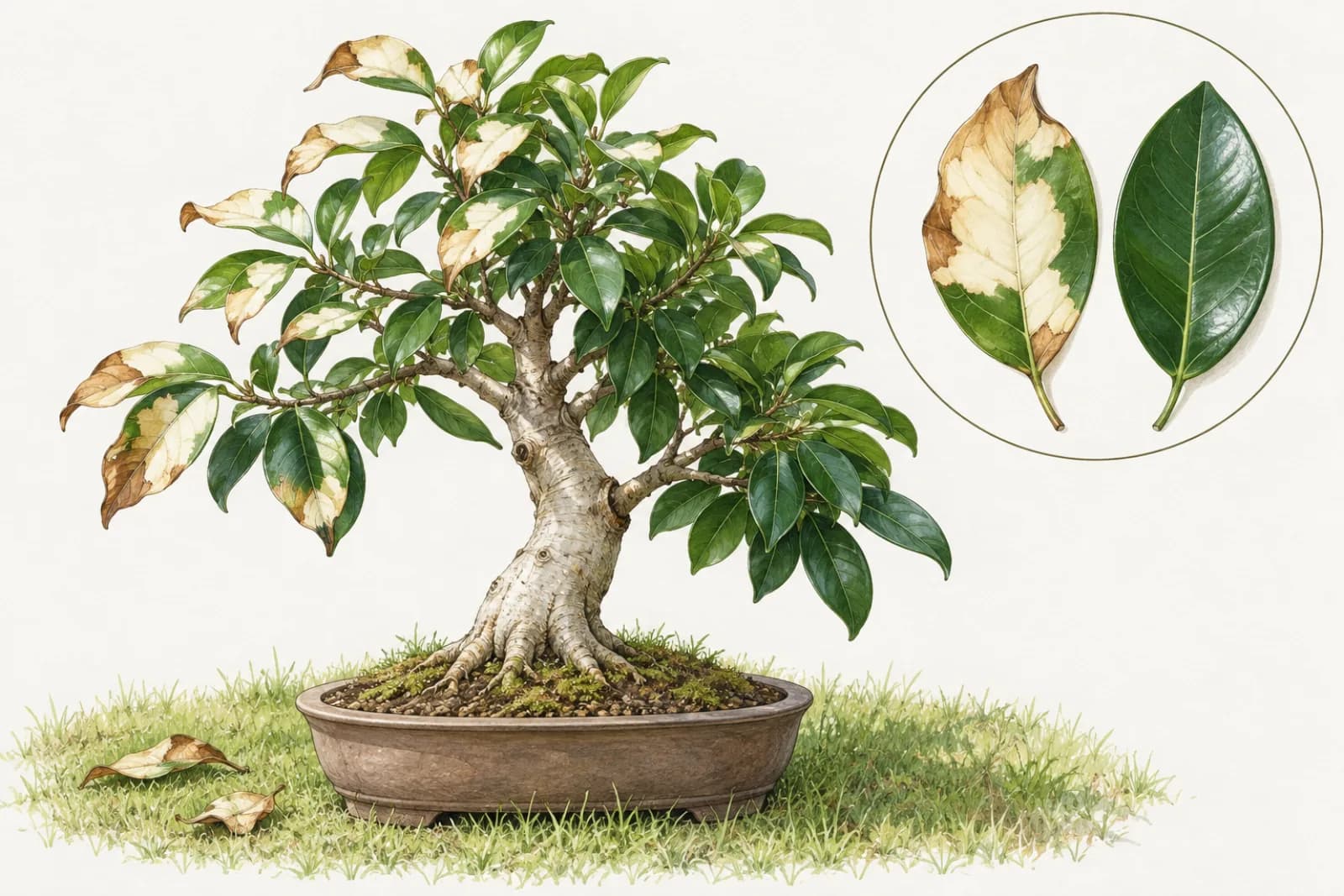
Badly bleached and scorched patches do not turn green again, and a severe episode can strip much of a canopy, leaving the tree to regrow from its reserves. Similar patches can come from drought, cold, pests, or chemicals, so read them alongside what changed: a recent jump in light, with the damage on the sunny side, points to scorch.
Existing leaves adjust only partly, building more protective pigment within days; they cannot rebuild their structure. The full change comes from new leaves grown to suit the new light. That is why it takes weeks, and why a tree moves into stronger light in steps.
Go deeper · optional, not assessedWhy strong light harms a shade leaf
Chlorophyll absorbs light energy, and in a working leaf most of it drives photosynthesisThe process in which green plant cells use light energy to combine carbon dioxide from the air with water, making sugars and releasing oxygen. It is how a tree makes the carbohydrates that it builds with and runs on.Open the glossary. Leaves handle the surplus with protective pigments, carotenoids among them, which turn it into heat, and with repair systems that fix the damage bright light does to their light-capturing proteins every day. Sun leaves have more of all three: more capacity for photosynthesis per square centimeter, more protective pigment, and faster repair.
In a shade leaf in full sun, the surplus overwhelms them. It forms reactive kinds of oxygen that damage the light-capturing proteins, a process called photoinhibition, and then destroy chlorophyll, which is bleaching. Mild photoinhibition reverses within hours to days; severe damage kills cells. Heat adds to it, especially when the stomaA microscopic pore (plural: stomata), mostly on leaves and needles, through which gases pass in and out, chiefly carbon dioxide entering and water vapor leaving. A pair of guard cells widens or narrows each pore in response to light, the water supply, and the surrounding air.Open the glossary narrow and the cooling from transpirationThe evaporation of water from inside a plant and its escape as vapor, mostly through the stomata of leaves. As water evaporates, more is pulled up from the roots through the xylem; most of the water a tree absorbs is lost this way.Open the glossary falls (Course 01, Lesson 8).
Hardening off: one step at a time
hardening offGetting a plant that grew indoors or under glass used to outdoor sun, wind, and temperatures gradually, by moving it from bright shade toward full exposure over one to two weeks or more. For bonsai, it protects soft leaves from scorch when a tree goes outdoors for the season or arrives from a greenhouse. It is not the same as shoots hardening, or turning woody, in late summer.Open the glossary is the gardener's name for getting a plant that grew indoors or under glass used to outdoor conditions gradually. It is not the late-summer hardening of shoots into wood that Course 01, Lesson 13 described; the word is shared, the process is not. For leaves that grew in a window or a greenhouse, hardening off means stepping up the light:
- Bright shade first: open sky above but no direct sun, for a few days or longer.
- Then partial shadeA label for a spot that gets about three to six hours of direct sun a day, or light, broken shade for much of it. Some labels use part sun for the sunnier end of this range and part shade for the shadier end. Trees whose leaves scorch in hot afternoon sun, such as the trident maple, often do well with morning sun and afternoon shade.Open the glossary: some hours of direct sun each day, ideally morning sun with afternoon shade, for a few days or longer.
- Then full sunA label for a spot that gets about six hours or more of direct sun a day in the growing season. Trees sold as needing full sun, such as junipers, grow weakly and thin out with much less, but the label does not say when the hours come, and hot afternoon hours are harder on leaves than morning ones.Open the glossary, for a tree that wants it.
Allow one to two weeks or more in all, and longer after very dim light. Start in mild or cloudy weather, somewhere sheltered from wind, which these leaves have never met, and hold at the current step through a heat wave or strong wind. Check the leaves facing the sun every day, and go back a step if pale or brown patches appear. The tree dries out faster at each step, so check its root zone more often (Course 03, Watering and Daily Observation). New leaves that come out smaller and firmer than the old ones are a good sign that it is adjusting.
Cold readiness takes weeks to build
Cold works the same way. Course 01, Lesson 13 described how shortening days and then cooling nights prepare a temperate tree's cells for freezing over several weeks of autumn. Three consequences matter whenever a temperate tree moves:
- Warmth undoes it. Weeks in a heated shop and home strip away much of the readiness a tree built outdoors, and a tree kept warm since autumn never built it. Carried straight into a hard frost, a tree that would have been hardy outdoors can be badly damaged. This is the gift juniper's position.
- It returns slowly. Cool nights a few degrees above freezing rebuild readiness over weeks, not overnight. How quickly depends on the tree and on how long it was warm; nobody can give you an exact schedule.
- New leaves are tender, whatever the tree. A temperate tree loses its cold readiness as it starts to grow, so soft new leaves are damaged by frost even on a tree whose bare twigs came through a hard winter. The greenhouse trident opened its leaves weeks early, and in the example climate frost is possible until the last spring frost, usually in late April. Until then, its leaves need shelter on every frost night.
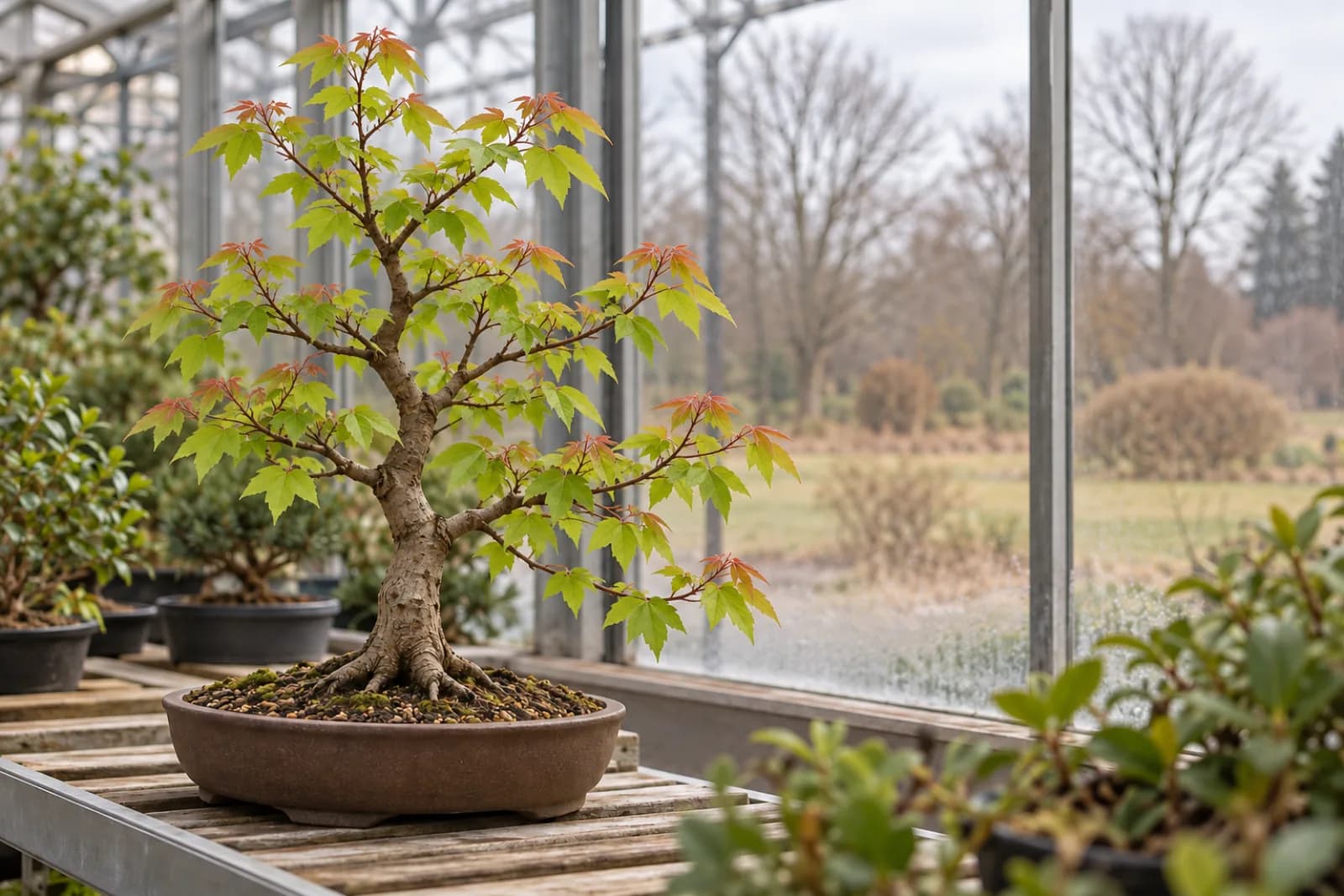
Roots need their own protection. As Lesson 1 showed, they are generally less cold-hardy than branches, and in a pot they get far colder than roots in the ground. So even a fully acclimated tree in a container needs its roots protected from hard freezes, in ways that keep the tree cold: a sheltered spot outdoors, or an unheated space (Course 06, Seasonal Care and Timing). A tropical tree, by contrast, builds little frost tolerance however gradually it cools, and many tropical plants are harmed by cold above freezing, which is why many growers keep a ficus above about 10 °C (50 °F).
Practice check · not scored
Moving day: plan it with the forecast
Now plan the three moves from the start of this lesson. In Moving day: plan the transition, choose a tree under Tree and season, read its ten-day forecast, and pick a place for every day, from Warm room and Cool bright room to Outdoors, shade, Outdoors, part sun, or Outdoors, full sun; each choice covers that day and the night after it. Press Run the plan and watch the Used to strong sun, Ready for cold, and Condition readouts and the Day by day log. Try these:
- With Gift juniper in December, first try the move its owner was about to make: outdoors from day 1. Then plan a version that keeps it safe.
- With Ficus in late spring, keep it in its Warm room (its bright window) for days 1 to 3, then put it in Outdoors, full sun from day 4, when the nights turn mild. Then try stepping it up instead.
- With Trident maple from a heated greenhouse, find the two frost nights in the forecast and plan around them.
- For any tree, press Show one sensible plan, read Why this plan works, and run it to compare with your own.
Simulation
Moving day: plan the transition
Instructional example
The gift juniper (most likely Juniperus procumbens 'Nana')
It has spent weeks in a heated shop and a warm home, and now sits on a windowsill above a radiator in the west balcony apartment. It is a temperate juniper that belongs outdoors, but it has almost no cold readiness. Its needles most likely grew outdoors before it reached the shop, so sun is not its main risk here.
Before the move
On the warm windowsill
ConditionGood
Your goalGet it out of the warm room and on its way outdoors without frost damage.
Plan all ten days below, then press Run the plan.
Your plan
0 of 10 days planned
- Warm room. The windowsill above the radiator
- Cool bright room. Frost-free: a bright bedroom with its radiator off
- Outdoors, shade. Sheltered, out of direct sun
- Outdoors, part sun. Some hours of low winter sun
- Outdoors, full sun. The sunniest spot on the balcony
10 days left to plan
Text description
A planning simulation with three instructional-example trees. Each needs to move to a new place over ten days of forecast weather. For each day you choose where the tree spends that day and night, then the plan plays day by day. A log describes what happens each day, and three readouts follow the tree: how used its leaves are to strong sun (very low to very high), how ready it is for cold (very low to high), and its condition (good, stressed, or damaged).
How the simulation works: places range from dim indoors to full sun outdoors in steps. Leaves that grew in weaker light adjust to a place one step brighter over a few days; a bigger jump in sunny weather can scorch them, worse in heat or wind, and cloud softens a jump. Temperate trees build cold readiness slowly on cool nights in a frost-free place or outdoors above freezing; a warm room builds none and undoes some. Frost harms leaves that are not ready for it. A tropical tree builds almost no cold readiness, and chilly nights stress it.
Gift juniper in December: The gift juniper (most likely Juniperus procumbens 'Nana'). It has spent weeks in a heated shop and a warm home, and now sits on a windowsill above a radiator in the west balcony apartment. It is a temperate juniper that belongs outdoors, but it has almost no cold readiness. Its needles most likely grew outdoors before it reached the shop, so sun is not its main risk here. Goal: Get it out of the warm room and on its way outdoors without frost damage. It starts: on the warm windowsill.
Places to choose from: Warm room (the windowsill above the radiator); Cool bright room (frost-free: a bright bedroom with its radiator off); Outdoors, shade (sheltered, out of direct sun); Outdoors, part sun (some hours of low winter sun); Outdoors, full sun (the sunniest spot on the balcony).
- Day 1: Cloudy, high 2 °C (36 °F), low −6 °C (21 °F), breezy, hard frost.
- Day 2: Sunny, high 0 °C (32 °F), low −9 °C (16 °F), calm, hard frost.
- Day 3: Sunny, high 1 °C (34 °F), low −8 °C (18 °F), calm, hard frost.
- Day 4: Cloudy, high 3 °C (37 °F), low −4 °C (25 °F), windy, hard frost.
- Day 5: Sun and cloud, high 5 °C (41 °F), low −2 °C (28 °F), breezy, frost.
- Day 6: Cloudy, high 7 °C (45 °F), low 2 °C (36 °F), calm.
- Day 7: Sunny, high 8 °C (46 °F), low 1 °C (34 °F), calm.
- Day 8: Rain, high 9 °C (48 °F), low 4 °C (39 °F), breezy.
- Day 9: Sun and cloud, high 8 °C (46 °F), low 3 °C (37 °F), calm.
- Day 10: Sunny, high 6 °C (43 °F), low −1 °C (30 °F), calm, frost.
Ficus in late spring: The ficus (Ficus microcarpa). It spent the winter indoors in a bright window of the house with the small backyard. Its leaves grew in window light, which is far weaker than sun outdoors. Nights are warming from about 8 °C to 14 °C (46 to 57 °F), with mostly sunny days. Goal: Start its summer outdoors without chilling it or scorching its leaves. It starts: in its bright window.
Places to choose from: Warm room (its bright window, where it spent the winter); Outdoors, shade (bright, but no direct sun); Outdoors, part sun (morning sun, afternoon shade); Outdoors, full sun (the open lawn, sun all day).
- Day 1: Sunny, high 19 °C (66 °F), low 8 °C (46 °F), breezy.
- Day 2: Sunny, high 21 °C (70 °F), low 9 °C (48 °F), calm.
- Day 3: Sun and cloud, high 20 °C (68 °F), low 9 °C (48 °F), windy.
- Day 4: Sunny, high 22 °C (72 °F), low 11 °C (52 °F), calm.
- Day 5: Cloudy, high 18 °C (64 °F), low 11 °C (52 °F), breezy.
- Day 6: Sunny, high 23 °C (73 °F), low 12 °C (54 °F), calm.
- Day 7: Sun and cloud, high 24 °C (75 °F), low 13 °C (55 °F), calm.
- Day 8: Rain, high 21 °C (70 °F), low 12 °C (54 °F), breezy.
- Day 9: Sunny, high 27 °C (81 °F), low 14 °C (57 °F), calm.
- Day 10: Sunny, high 28 °C (82 °F), low 14 °C (57 °F), breezy.
Trident maple from a heated greenhouse: The trident maple (Acer buergerianum). Bought in early spring from a heated greenhouse and brought home to the small backyard, it is already in soft new leaf. The leaves grew under glass, so they are not used to outdoor sun, and new leaves are damaged by frost. The unheated garage, by its window, stays frost-free on light frosts. Goal: Get it used to the outdoors and keep its new leaves out of frost. It starts: just home from the heated greenhouse.
Places to choose from: Warm room (a heated room in the house); Cool bright room (frost-free: the garage, by its window); Outdoors, shade (bright, but no direct sun); Outdoors, part sun (morning sun, afternoon shade); Outdoors, full sun (the open lawn, sun all day).
- Day 1: Sunny, high 14 °C (57 °F), low 4 °C (39 °F), breezy.
- Day 2: Sunny, high 12 °C (54 °F), low −2 °C (28 °F), calm, frost.
- Day 3: Sun and cloud, high 15 °C (59 °F), low 3 °C (37 °F), breezy.
- Day 4: Cloudy, high 13 °C (55 °F), low 6 °C (43 °F), windy.
- Day 5: Sunny, high 16 °C (61 °F), low 5 °C (41 °F), calm.
- Day 6: Sunny, high 11 °C (52 °F), low −1 °C (30 °F), calm, frost.
- Day 7: Cloudy, high 15 °C (59 °F), low 6 °C (43 °F), breezy.
- Day 8: Sun and cloud, high 18 °C (64 °F), low 7 °C (45 °F), calm.
- Day 9: Sunny, high 19 °C (66 °F), low 8 °C (46 °F), breezy.
- Day 10: Sunny, high 21 °C (70 °F), low 9 °C (48 °F), calm.
After a run, a summary says whether the plan kept the tree safe and moving toward its goal, and Show one sensible plan fills in one good plan with the reasons for it.
A few rules decided every result. Light worked in steps: a place one step brighter than the leaves were used to was safe, and after about three days they had adjusted, but a jump of two or more steps on a sunny day scorched the sunny side, worse in heat or wind, while cloud softened a jump. The ficus carried straight to the open lawn scorched badly; stepped through shade and part sun, it came through. Put outdoors on days 1 to 3, when nights were below about 10 °C (50 °F), it was stressed by the chill; waiting in its window was the right call. The juniper, whose needles most likely grew in sun, never scorched.
Cold readiness built slowly, a level every few cool nights, and the warm room undid it. So in the sensible plan, the juniper waited out the frosts of days 1 to 5 in the cool bright room and went out in the milder spell, and the trident maple spent the frost nights of days 2 and 6 in the garage, because frost damaged its new leaves however it had been prepared. Staying put was safe for ten days but never the goal (the juniper left in the warm room ended “Safe, but no winter rest yet”), and many different plans worked. Real trees adjust at their own pace, and many real transitions take one to two weeks or more.
Correcting a placement, with the weather in mind
A tree in the wrong place should move, but not always today. Before each move, ask three questions:
- Where did its current leaves grow? If the new place is more than a step brighter, use an in-between place.
- How ready is it for cold, and what do the next ten nights bring? A temperate tree from a warm room has little readiness, and a tropical tree has almost none.
- What is tender right now? New spring leaves and any tropical tree need shelter on frost nights, however well prepared.
Here is how the answers play out for the three trees, beyond the simulation's ten days.
The gift juniper in December
Its destination is the west balcony in full sun, but its first move is indoors: off the radiator to the coolest bright, frost-free place the apartment has, here a bedroom with a bright window and its radiator off. It stays sheltered from the hard frosts there, and the cooler the room stays without freezing, the more readiness the cool nights can rebuild. It will dry more slowly there, so check before watering, starting with the weight of the pot, rather than keeping to the tag's twice a week (Course 03).
When the milder spell arrives, with nights near or above freezing, it moves out to the balcony: sheltered at first, then into its sunny spot. That step can be quick, since sun is not its main risk. From then on the forecast decides. Protect its roots before the next hard freeze (Course 06), and in its first weeks outdoors, bring it back into the cool room, never the warm one, for any night much colder than it has met since the move. If its foliage turns bronze or purplish in the cold, that is a normal winter color for many junipers, not damage.
Its pot has no drainage hole, so rain and winter watering would collect around the roots outdoors, and its glued pebble crust hides the root zone; Lesson 7 corrects both while it waits in the cool room. And although it missed the start of winter, the rest of the winter still brings the cool weather its buds need.
The ficus in late spring
In the example climate the last frost usually comes in late April, but nights often stay reliably above about 10 °C (50 °F) only well into May. Until then the ficus waits in its window: one night at 8 °C (46 °F) is unlikely to kill it, but it is stress for no gain.
Then it steps up: a few days in bright shade, for example under shade cloth; a few days in part sun, ideally in the western third of the yard, which gets morning sun while the neighbor's maple shades it on summer afternoons; then full sun on the open lawn. It dries much faster outdoors, so moisture checks become daily.
It comes back in before autumn nights fall below about 10 °C (50 °F), in the example climate often by late September or early October, weeks before the first frost. First, inspect it outdoors: under the leaves, along the stems, and where leaves join the stems, for webbing, sticky residue, cottony patches, or small bumps that could be scale insects, which can multiply indoors and spread to houseplants (Lesson 8 covers inspecting a tree and keeping it apart). Then give it the brightest place at once, close to its window and often with a grow light; going in needs no steps, since the light falls whatever you do. Some leaf drop as it adjusts is common. Its new indoor leaves will be shade leaves, so next spring the stepping starts again.
Practice check · not scored
The trident maple from a heated greenhouse
Bought in early spring, perhaps early April in the example climate, it belongs outdoors, and every frost-free day there in good light helps it adjust. Its leaves grew under glass, so it hardens off like the ficus, starting in bright shade out of strong wind. On frost nights it shelters in the unheated garage, by its window, which stays frost-free on light frosts, and goes back out in the morning; for a harder frost, it spends the night in the coolest room of the house.
Keeping it in the dimmer garage until the last frost would be safe but costly, because its leaves would stay unready for sun. After the last spring frost, usually in late April, it settles into its outdoor year. A Chinese elm, or any temperate tree bought in leaf before the trees around you, needs the same care. A tree from an outdoor nursery is used to local light and weather, though its new leaves still need watching on frost nights; ask where a tree was grown before you buy it (Lesson 6).
A placement plan you can follow
The bonsai decision
Plan the move, then let the forecast and the tree set the pace
Starting point
Place the tree by what it is: a temperate tree outdoors all year and cold in winter, with its roots protected from hard freezes; a tropical tree in warmth and strong light, indoors whenever nights fall below about 10 °C (50 °F). Then write a move schedule:
- Check the ten-day forecast before each step: night lows (frost, hard frost, and for a tropical tree about 10 °C, 50 °F), sun, heat, and wind.
- Use an in-between place. A temperate tree leaving a warm room, or a tree in tender new leaf on a frost night, goes somewhere cool, bright, and frost-free, such as an unheated room or a garage with a window. Leaves that grew in a window or under glass start outdoors in bright shade.
- Step up one level every few days, from shade to part sun to full sun, over one to two weeks or more.
- Look at the tree daily during the move: the leaves facing the sun, any afternoon wilting, and the moisture of the root zone.
- Write down the date of each step and what you saw.
This assumes
You know at least whether the tree is temperate, tropical, or subtropical (Lesson 2). It is healthy, and its pot drains. You have an in-between place. The months in this lesson belong to the course's Northern Hemisphere example climate; use your own frost dates and forecasts.
Change course if
- Pale or brown patches appear on leaves facing the sun. Go back a step and slow down, and judge progress by the new leaves.
- The forecast shows cold the tree is not ready for: any frost for a tree in new leaf, a hard frost for a tree still rebuilding cold readiness, or a night below about 10 °C (50 °F) for a tropical tree. Shelter it that night and put it back out the next day; in autumn, a tropical tree comes in for the winter instead.
- A heat wave or strong wind arrives mid-move. Hold at the current step, add some afternoon shade, and check moisture more often (Lesson 5).
- Leaves drop or new growth stalls. Check the light and the root zone first. Many ficus shed some leaves after a big change in light, but leaf drop has many possible causes (Course 07, Tree Health and Diagnosis).
- You don't yet know what the tree is. Keep it out of frost and sudden strong sun, without settling it into a warm room for the season.
Back to the question
Where should this tree spend the year, and how do you move it there safely?
Where a tree spends its year depends on what it is. A temperate tree, such as a juniper or trident maple, lives outdoors, cold in winter with its roots protected from hard freezes. A tropical tree, such as the ficus, lives warm and in strong light, indoors whenever nights fall below about 10 °C (50 °F) and often outdoors in summer. Moving it there safely depends on what it is ready for now: leaves that grew in dim light step up to sun over one to two weeks or more, a temperate tree from a warm room waits out hard frosts somewhere cool, bright, and frost-free, and tender leaves and tropical trees are sheltered on frost nights. Time each step to the forecast, and let the leaves set the pace.
Key takeaways
- Placement follows the climate a tree is adapted to: temperate trees spend the year outdoors with a cold winter rest; tropical trees need warmth and strong light, indoors when nights are cool and often outdoors in summer.
- Even beside a sunny window, a room gives a fraction of outdoor light, no winter, and dry heated air.
- Leaves are built for the light they grew in. Shade leaves bleach or scorch in sudden full sun, so harden a tree off one step at a time over one to two weeks or more.
- Cold readiness takes weeks to build and is lost in warmth. A temperate tree from a warm room goes somewhere cool, bright, and frost-free first, and new leaves need shelter on every frost night.
- Time each move to the forecast, use an in-between place, and adjust to what the tree shows.
Optional · not required for completion
Plan a real move
Pick a tree that needs to move this season, your own or one of the course's three. Copy out the next ten days of your local forecast: sky, high, low, and wind. Mark the frost nights, and for a tropical tree the nights below about 10 °C (50 °F). List the places you really have, from warmest and dimmest to sunniest, and write where the tree spends each day. Which day is the first safe step, and where does it go on the frost nights? If the tree is real, follow the plan and note each evening how the leaves facing the sun look.
No tree? Without picking anything, compare a leaf from the sunny outside of a tree or shrub with one from deep inside or on its shady side. Which is larger, which is thinner, and which is darker green? Which is the shade leaf, and how can you tell?