Course 02 · Lesson 5 of 8 · Setting up a good start
Temperature, air movement, and humidity
One balcony, yard, or room can hold several small climates. Learn how walls, paving, overhangs, height, and low ground change the heat, cold, wind, and moisture around a tree, and how to choose and adjust a spot for it.
The question
Why can two spots a few steps apart feel like different climates to a tree?
By the end of this lesson, you will be able to:
- Explain how walls, paving, overhangs, corners, height, and low ground create microclimates that differ in heat, cold, wind, and rain.
- Explain how heat, wind, and dry air raise water loss, and why the roots in a small pot can overheat or freeze while the air seems safe.
- Choose a summer placement on a hot, windy site, and tell useful adjustments apart from substitutes for good light and watering.
About 16 minutes to read and explore
Instructional example: the west balcony from Lesson 1, on a July afternoon. Its owner has stood the nursery juniper and a trident maple on the concrete floor in the middle, where the sun is best. The weather app says 32 °C (90 °F).
On the balcony, that number is true almost nowhere. The sunny side of the juniper's dark pot is too hot to keep a hand on. Beside the air-conditioner condenser, the fan blows air hotter than the forecast. Under the balcony above, the floor along the back wall is still dry after last night's storm. By the end of the month, the trident maple's sunny-side leaves have brown, crisp edges.
The forecast is not wrong: it describes air measured in the shade, about 1.25 to 2 m (4 to 6½ ft) above open grass, so that places can be compared. A tree lives somewhere else: at pot height, beside a wall, over concrete, in the sun or out of it.
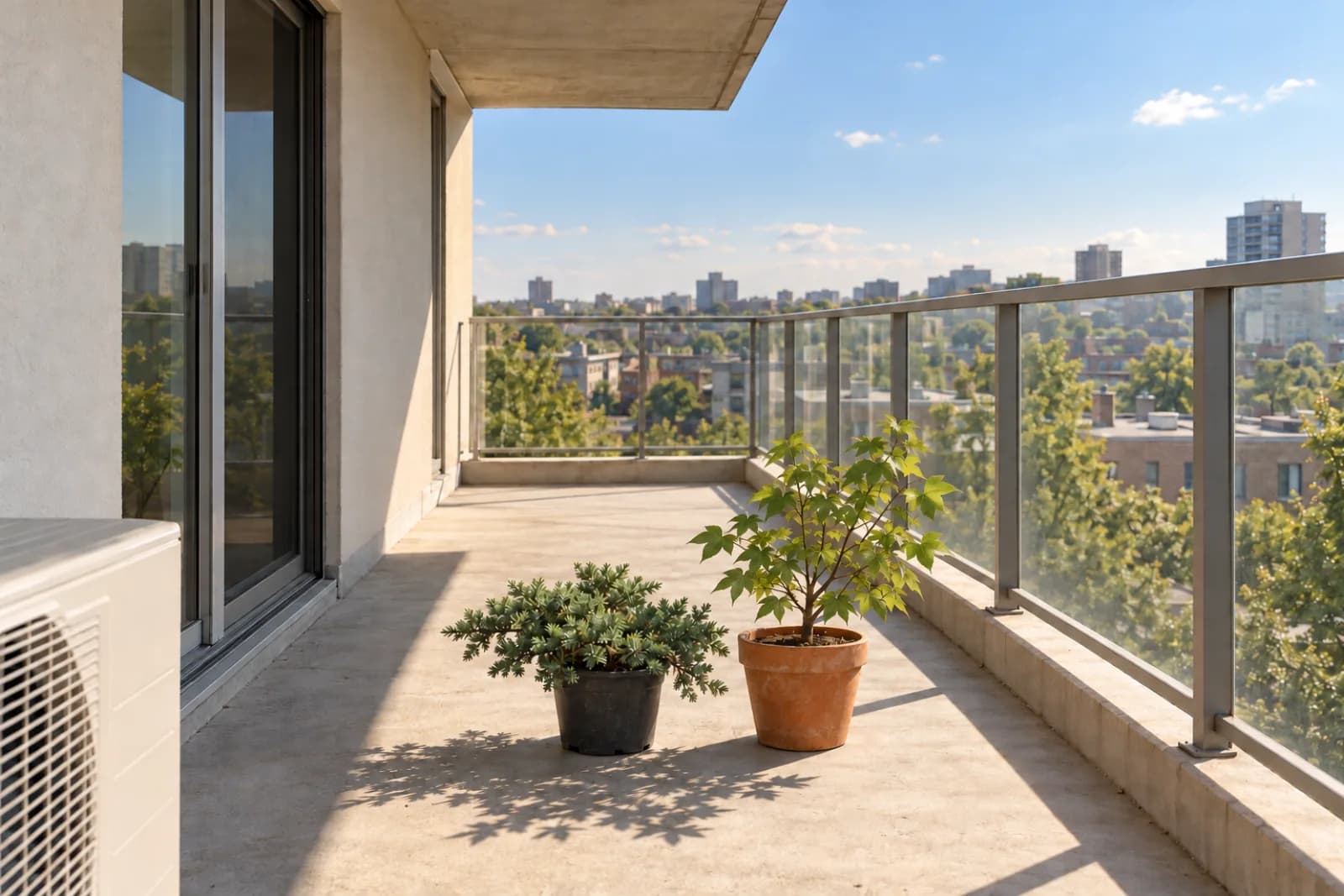
Every spot has its own climate
A microclimateThe climate of a small area, such as one corner of a balcony or the strip of ground along a wall, where it differs from the general weather around it in temperature, sun, wind, rain, or humidity. A tree responds to the microclimate of its own spot, not to the forecast for the city.Open the glossary is the climate of a small area, such as one corner of a balcony or the strip of ground along a wall, where it differs from the weather around it. A few features cause most of the differences:
- Walls and paving soak up sun and pass the heat to whatever is near them, into the night. A heated building's wall also leaks warmth on cold nights.
- Overhangs and roofs cut sun and rain, and on clear nights they hide what is under them from the open sky, which draws heat away.
- Corners and screens funnel or block the wind. An open corner can be the breeziest spot; a closed one can trap still, hot air.
- Height adds wind, on a fourth-floor balcony or a shelf at railing height. On clear, still nights over open ground, though, the coldest air lies right at the ground.
- Low ground collects cold air, which drains downhill.
The cases in this course are in the Northern Hemisphere, where south-facing walls and slopes are the sunny side; in the Southern Hemisphere, swap north and south. A west-facing spot gets the afternoon sun in either hemisphere.
Lesson 4 mapped light. Heat, cold, wind, and moisture matter too, because each changes how fast a tree loses water and how well its roots keep up (Course 01, Lesson 8).
Heat builds through the afternoon
The west balcony gets about six hours of direct summer sun, from early afternoon to sunset. An east-facing doorstep might get almost as many, from sunrise to late morning. For light, the two are similar. For heat, they are not.
At the same height in the sky, the sun delivers about the same energy morning or afternoon; what differs is everything around it. Morning sun meets air and surfaces that cooled overnight, and leaves that refilled with water. Afternoon sun shines while the air is at or near its daily peak, which usually comes in mid to late afternoon, after walls and paving have heated for hours, and while the air is driest. So west-facing spots run hottest, and their sun lands when evaporative demandHow strongly the surrounding air draws water vapor from leaves, rising with sun, heat, dry air, and wind. High evaporative demand can make a tree lose water faster than reduced or damaged roots can replace it.Open the glossary, the air's pull on the water in leaves, is highest.
Hard surfaces add reflected heatExtra heat a tree receives from sunlit surfaces nearby, such as paving, walls, and glass: sunlight bounced off them, plus the heat they give off once warm, which can continue after sunset. It makes spots beside hard surfaces hotter and drier than the air temperature suggests.Open the glossary: the extra heat a tree gets from sunlit walls, glass, and paving nearby, as bounced sunlight and as heat those surfaces give off once warm, even after sunset. The small backyard's patio, paved and along the house's sunny south wall, gets plenty of both.
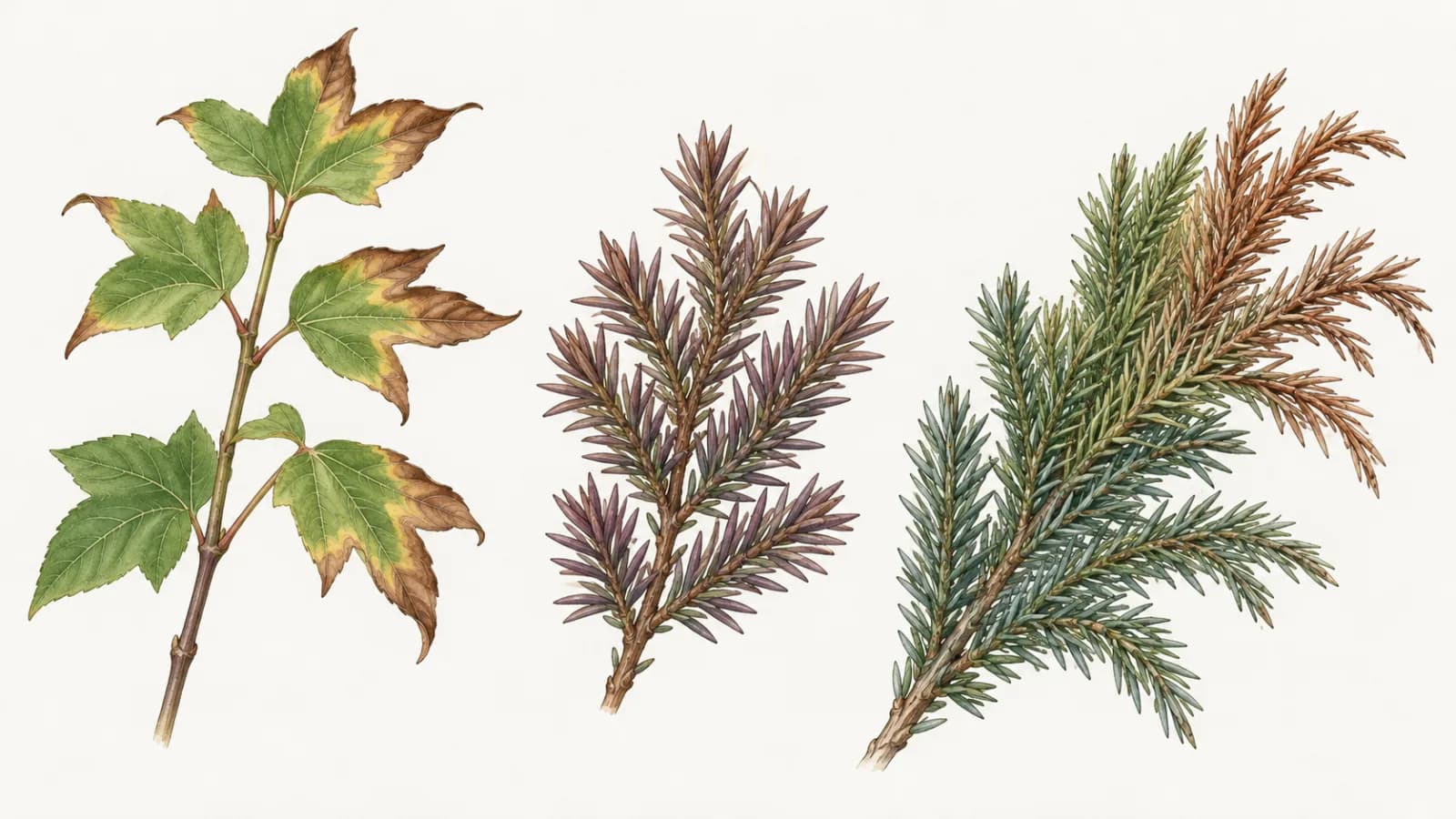
The leaves pay in water. Heat and dry air speed transpirationThe evaporation of water from inside a plant and its escape as vapor, mostly through the stomata of leaves. As water evaporates, more is pulled up from the roots through the xylem; most of the water a tree absorbs is lost this way.Open the glossary, and when loss outruns what the roots supply for long enough, the leaf tissue farthest from the water supply dies first. leaf scorchBrowning and drying of leaf edges, tips, and the tissue between the veins when leaves lose water faster than the roots can replace it, as in hot sun, wind, or dry air. Thin shade leaves moved suddenly into strong sun scorch the same way, often after pale, bleached patches. It is a symptom, not a diagnosis: a dried-out root ball, damaged roots, or salt buildup can cause the same browning.Open the glossary is the result: leaf edges and tips turn brown and crisp, worst on the sunny or windward side. The trident maple is prone to it in strong afternoon sun and wind. Scorch is a symptom, not a diagnosis: a dried-out root ball, damaged roots, or salt buildup can brown leaf edges too (Course 07, Tree Health and Diagnosis).
Practice check · not scored
Hot roots in a small pot
In the ground, roots sit in a large mass of soil that warms and cools slowly, so at root depth it rarely gets as hot as the air. Roots are adapted to that steadiness, and fine rootOne of the many thin, branching roots, often pale when young, that do most of a tree's absorbing of water and mineral nutrients. Fine roots live a relatively short time and are constantly replaced, so they depend on a root zone that holds both water and air.Open the glossary are generally more easily injured by heat than leaves.
A pot in the sun has no such buffer. Its sunny wall heats first, and a dark surface, a small pot, and hot paving underneath all make it worse. Nursery studies have measured more than 45 °C (113 °F) just inside the sunny side of black containers on summer afternoons, with the air in the low 30s °C (around 90 °F). Fine roots of many temperateDescribes regions with distinct warm and cold seasons, and the trees adapted to them, which typically need a cool winter rest. Trident maples and the junipers commonly grown as bonsai are temperate trees and need seasonal outdoor conditions rather than a warm room all year.Open the glossary trees are injured when the root zone stays above roughly 40 °C (104 °F) for hours, though the limit varies with the tree and how long the heat lasts, and a dry root zone heats faster than a moist one. Injured roots take up less water, so a tree can then wilt or scorch in a moist pot, as a freshly repotted tree can (Course 01, Lesson 8).
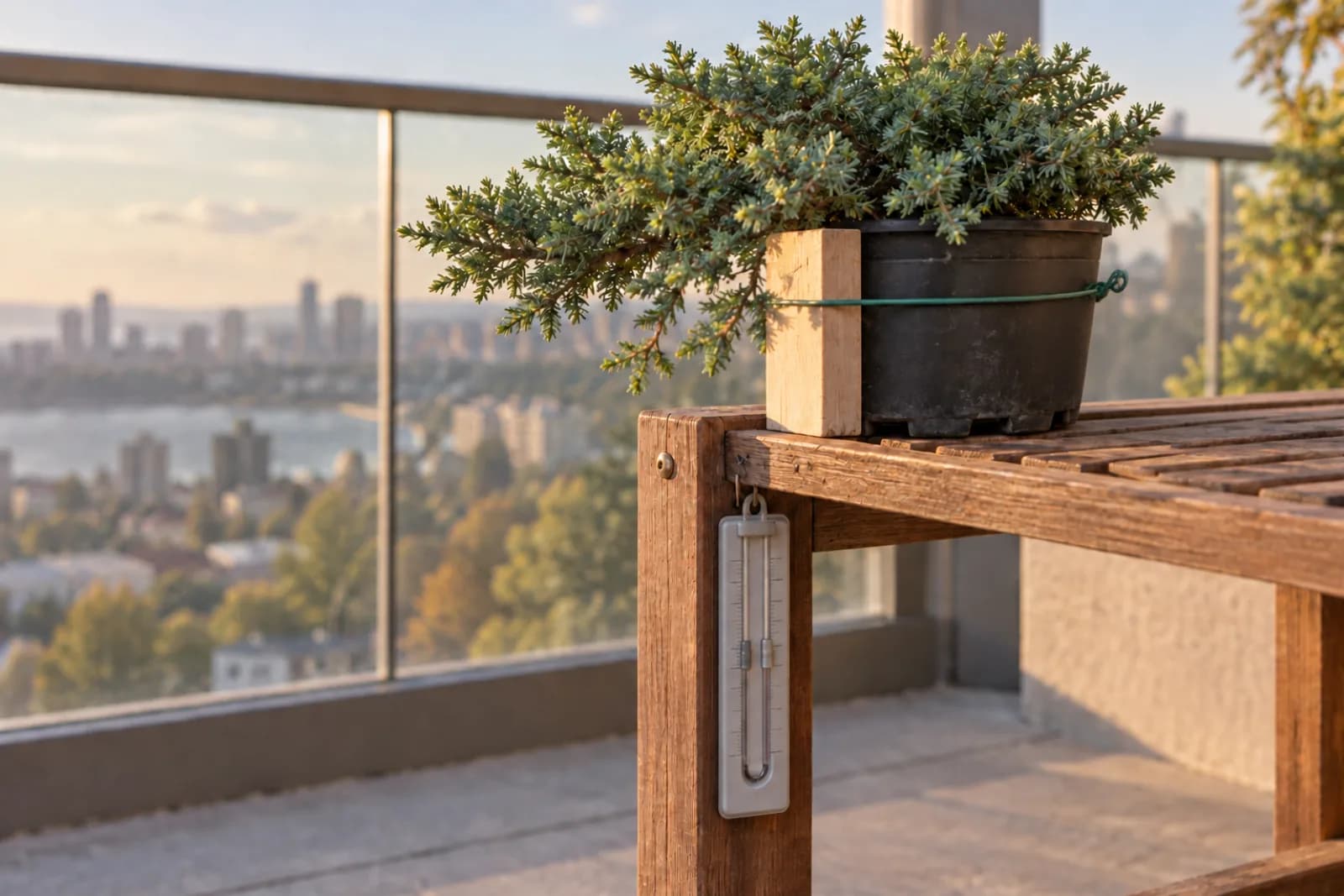
For a sun-loving tree, the fix is targeted: the juniper's foliage needs the sun, and its pot wall does not. Shading the pot, not the tree, protects the roots without taking light from the leaves: a board or other pots on the sunny side, or a pale sleeve or wooden box around the pot. Lifting the pot off hot paving onto a slatted shelf helps as well, though it does not keep the sun off the pot wall.
Predict first
Later than the air, and much hotter. The high sun of early afternoon only grazes the side of the pot; as the sun sinks toward the west, it strikes the wall more and more squarely, so the wall takes the most sun in late afternoon. Moist soil heats slowly, so the root zone lags behind, and the concrete keeps giving off heat after sunset. The roots can be at their hottest while the air is already cooling.
Check your prediction in A hot afternoon, from the roots' point of view. It starts with a Dark glazed pot on the Concrete floor and no shading. Press Play or step with Next, and compare Root zone, sunny side with Air in the shade until How this setup did appears at sunset. Then change one setting at a time and run the day again (the dashed line keeps your previous setup), and try the three challenges under Try these.
Animation
A hot afternoon, from the roots' point of view
Setup
The nursery juniper (Juniperus procumbens 'Nana') on the west balcony, hot July day
Each setting changes how much heat reaches the roots, the leaves, or both. Change one, then play the day again and compare it with the dashed line from before.
Late morning
The sun is still on the other side of the building, so the balcony is in bright shade. The root zone on the sunny side is a little cooler than the air.
Root zone, sunny side
Warm
Air in the shade:Warm
Heat through the afternoon
Late morning to sunset
How this setup did
Play the day to sunset, or press Next until Sunset, to see how long the roots were too hot and how much sun the leaves had.
Try these
Each one is checked at sunset, for the setup you have then.
Not yetKeep the root zone out of Too hot for roots all day while the leaves still get full sun.
Not yetDo it without any shading: change only the pot and what it stands on.
Not yetBring the leaves' water loss at its peak down from Very high.
0 of 3 found
Text description
The nursery juniper, a sun-loving temperate conifer, stands in a pot on the west balcony on a hot July day. The drawing looks south along the balcony, so the afternoon sun is on the right and shines on the pot's right-hand side, its sunny side. The front of the pot is cut away on that side to show the root zone: granular substrate and roots, with fine roots running along the inside of the wall. A colored band inside the wall shows how hot the root zone is there, on a four-word scale: Cool, Warm, Hot, and Too hot for roots, which is also hatched.
The day runs from late morning to sunset. Until early afternoon the sun is on the other side of the building and the balcony is in bright shade. Then direct sun reaches the balcony until sunset. At first the sun is high and only grazes the side of the pot; as it sinks toward the west it strikes the sunny side more and more squarely, so the pot wall takes the most sun late in the day. The air in the shade is warm in late morning, hot through the middle of the afternoon, and eases toward sunset. Moist soil heats and cools slowly, so the root zone lags behind the sun and the air.
The setup controls:
- Pot: Dark glazed or Pale unglazed. A dark surface absorbs most of the sunlight that lands on it, and glaze stops water evaporating through the wall. A pale surface reflects much of the sunlight, and water evaporating through unglazed clay carries some heat away, though that pot dries out faster.
- Stands on: Concrete floor or Slatted shelf. Concrete soaks up sun, warms the base of the pot, radiates heat, and stays warm after sunset. A slatted shelf at railing height keeps the pot off the concrete, with air moving underneath, but catches more wind. The drawing follows the pot, so on the shelf the railing's top rail runs behind it.
- Pot shading: None or Pot shaded, with a board (or a row of other pots) on the sunny side. It keeps the sun off the pot wall but not off the leaves.
- Foliage shading: None or Shade cloth, stretched on a hoop over the whole tree. It cuts the sun on the leaves and the pot alike, by about half.
Readouts: the time of day and whether the sun is on the balcony; the root zone on the sunny side and the air in the shade, on the same four-word scale, with a sentence saying how they compare; a chart of both through the afternoon, where the setup before your last change appears as a dashed line; Light for the leaves (Shade, Bright shade, Filtered sun, or Full sun); and Water loss from the leaves (Low, Moderate, High, or Very high), also drawn as dotted vapor puffs rising from the foliage. Short sun strokes show sunlight landing on the pot wall, or on the board when the pot is shaded. At sunset, a summary says how long the root zone was too hot for roots, how much sun the leaves had, and the peak water loss.
Controls: Play and Pause, Back and Next (stepping between Late morning, Early afternoon, Mid-afternoon, Late afternoon, Early evening, Sunset), Replay, a Time of day slider, and Skip to sunset. Three challenges under Try these are checked at sunset for the setup you have then.
With nothing done, the leaves had full sun and looked fine, but the root zone on the sunny side reached Too hot for roots in late afternoon and stayed there through sunset, while the air never went above Hot. Sun on the pot wall was the main source: the Slatted shelf alone still left a dark pot too hot for most of the afternoon. Pot shaded kept the roots safe with either pot on either stand, and the leaves kept every hour of sun. Shade cloth cut water loss but also about half the light, and over a dark pot on concrete the roots still overheated. With no shading at all, only the Pale unglazed pot on the shelf stayed out of danger, and it dries out faster.
Cold: pots, clear nights, and low ground
In winter the comparison reverses. As Lesson 1 showed, soil in the ground buffers the roots, but a pot above ground is exposed on every side and, over a cold spell, can freeze through, starting at the wall, where many fine roots grow. Roots are also generally less cold hardy than shoots, because they build much less cold acclimationThe gradual process, triggered by shortening days and falling temperatures, in which a tree's tissues become able to survive freezing. A tree moved suddenly from a warm room into frost has not acclimated and can be badly damaged. It is not the same as shoots hardening, or turning woody, though the two often happen around the same time.Open the glossary than branches and buds (Course 01, Lesson 13), and the hardiness zoneAn area on a map defined by how cold its winters get, usually measured as the average of the coldest temperature reached each winter. In the USDA system each zone spans 10 °F (about 5.6 °C), split into halves a and b, and plant labels name the zones where a plant survives winter in the ground. Roots in a pot are more exposed, so a tree in a pot needs hardiness to spare.Open the glossary on plant labels describe trees planted in the ground, so a tree rated for much colder winters than yours can still lose its roots in a pot. Winter protection belongs to Course 06, Seasonal Care and Timing. What this lesson adds is where on a site the cold is worst.
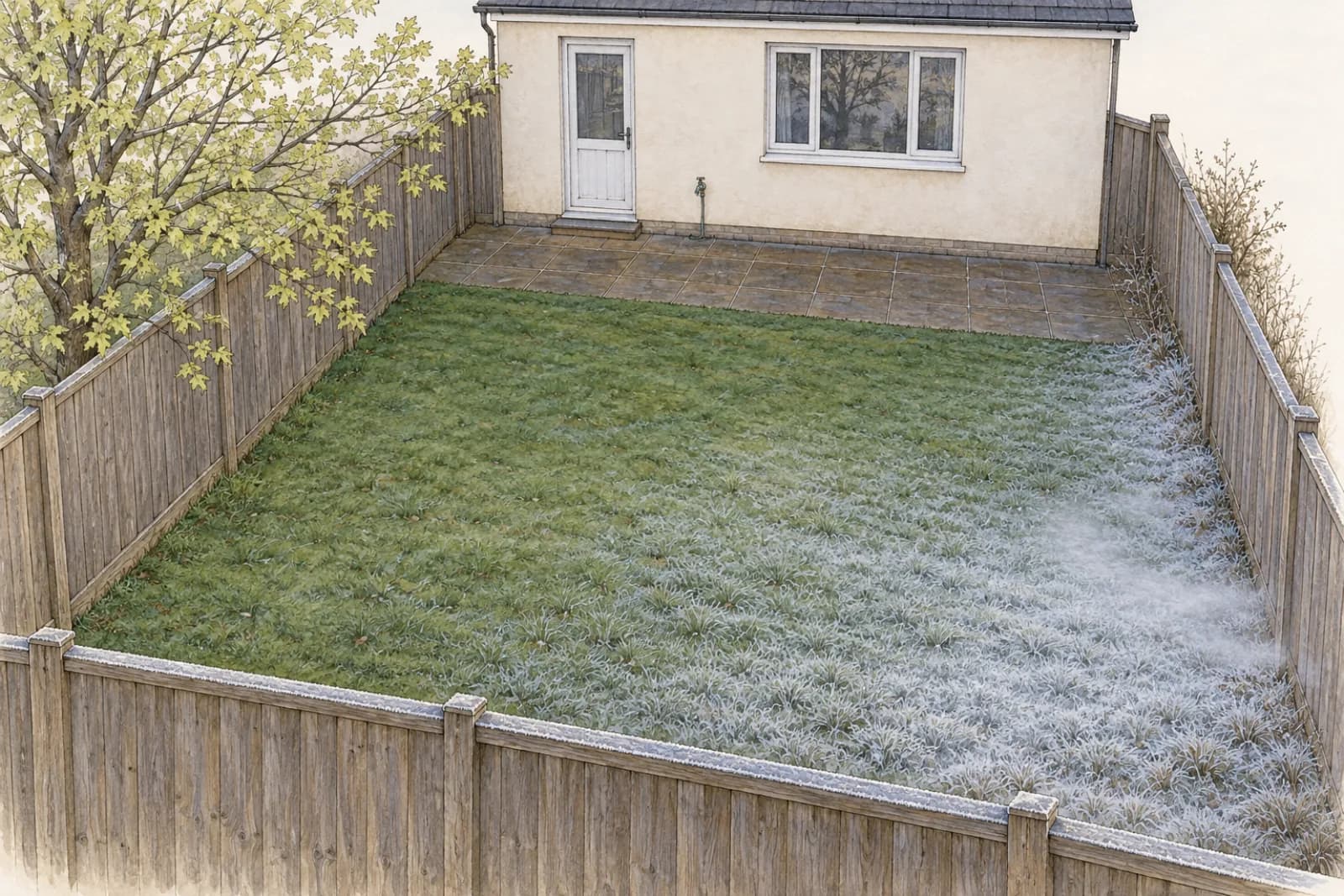
The coldest nights are clear and still. Ground, pots, and leaves radiate heat to the open sky, and with no wind to mix the air, the air just above the ground can end up several degrees colder than at head height. That is why frost can whiten a lawn while the official temperature stays above freezing. An overhang or a canopy that hides part of the sky slows the loss.
Cold air is also denser than warm air, so on still nights it drains downhill and pools in low ground. A frost pocketA low spot where cold air collects on clear, still nights, because cold air is denser than warm air and drains downhill as water would. Frost comes earlier in autumn, later in spring, and harder there than in spots a little higher up.Open the glossary is a low spot where this happens: frost comes earlier in autumn, later in spring, and harder there than a few steps upslope. The small backyard's southeast corner, its lowest point, is one. Its patio, against the house's south wall, is the opposite: the wall stores the day's sun and leaks a little warmth from the house. A warm wall has a catch, though: in late winter it can wake buds early, putting tender leaves out in time for the last spring frosts, usually in late April in the example climate.
Practice check · not scored
Wind: useful air and drying gusts
A gentle breeze helps. It thins the humid boundary layerA thin layer of slow-moving, more humid air next to the surface of a leaf or needle, which slows the escape of water vapor into the open air. Wind thins this layer, increasing water loss.Open the glossary around each leaf (Course 01, Lesson 8), carrying away heat and bringing in carbon dioxide, and it dries leaves after rain. Without it, heat and humidity build up, as in the still corner by the west balcony's privacy screen.
Strong or drying wind raises water loss, sharply so with sun and heat, tears soft leaves, dries pots, and blows them over. Four floors up, a falling pot endangers people below: fasten any pot that stands high, and never stand pots on the railing (Lesson 7 covers stable setups).
A windbreakAnything that slows the wind over the area behind it, such as a fence, screen, hedge, or panel of netting. A screen that lets some air through slows the wind over a longer stretch, with less swirling, than a solid wall, and keeps the air moving.Open the glossary is anything that slows the wind behind it: a fence, a screen, a hedge, or netting. The best ones let some air through. A solid barrier sends the wind tumbling over its top in gusts and eddies, with still air close behind it; a screen with roughly half its area open slows the wind over a longer stretch and keeps air moving. Netting across part of the balcony's open south end, if the building allows it, would calm that end without making it airless.
Winter wind and evergreen foliage
In winter, evergreenDescribes a tree that keeps living foliage all year, replacing old leaves or needles gradually instead of all at once. Keeping foliage does not mean a tree grows all year: temperate evergreens such as junipers still go dormant in winter.Open the glossary foliage keeps losing water through its stomata and waxy cuticleA thin, waxy, water-resistant film covering the outer surface of leaves, needles, and young stems. It greatly slows water loss through the leaf surface, so most of a leaf's water vapor escapes through the stomata instead.Open the glossary on sunny or windy days, and if the root ball is frozen, nothing replaces it. The result is winter desiccationDrying and browning of evergreen foliage in winter, when sun and wind draw water from the leaves while frozen roots or a frozen root ball cannot replace it. The damage usually shows on the sunny or windward side, often not until late winter or spring.Open the glossary, or winter burn: foliage on the sunny or windward side dries and browns, often noticed only in spring, when it stays brown while the rest of the tree greens. A juniper's even, purplish bronze in cold weather is different, a normal winter color that fades in spring (Course 01, Lesson 13). A potted juniper in the balcony's windy south corner is a classic case for winter burn; shelter from winter wind, and a root ball that goes into freezes moist rather than dry, are the main defenses (Course 06).
Humidity: what it changes, and what misting cannot
The drier the air, the faster leaves and pots lose water. relative humidityThe amount of water vapor in the air, as a percentage of the most the air could hold at its current temperature. Warm air can hold more vapor, so heating cold winter air indoors lowers its relative humidity sharply, and drier air draws water from leaves and pots faster.Open the glossary measures that dryness: the amount of water vapor in the air, as a percentage of the most the air could hold at its temperature. Warm air can hold far more vapor, so relative humidity falls as air warms, outdoors through each afternoon and indoors whenever cold air is heated. Air at 0 °C (32 °F) and 80 percent relative humidity, heated to 21 °C (70 °F), ends up near 20 percent, so the bright window's room is very dry in winter, and the air rising off its radiator is hotter and drier still.
Misting, a humidity tray (a shallow tray of water and gravel under the pot), and grouping plants all raise humidity, but only a little and only near the plant, because room air mixes away quickly. None of them replaces what matters more: an indoor tree is usually short of light long before it is short of humidity (Lesson 4), and its water comes in through the roots. For the ficus on the bright window, the order is strong light, watering based on checks below the surface, and a spot out of the radiator's rising air. If you use a tray, keep the pot on the gravel above the water, so its drainage holes never sit in it (Course 01, Lesson 7).
Practice check · not scored
Go deeper · optional, not assessedWhy warm, dry air pulls harder
Water leaves a leaf in proportion to the difference between the nearly saturated air inside it and the air outside, called the vapor pressure deficit. Relative humidity hides how big that difference is: at 50 percent relative humidity, air at 30 °C (86 °F) has more than three times the deficit of air at 10 °C (50 °F), so, other things being equal, it draws water from leaves roughly three times as fast.
Where the rain does not reach
A rain shadowAn area that rain does not reach because something blocks it, such as the ground under an overhang or eave, beside a wall on the side away from wind-driven rain, or under a dense canopy. Pots in a rain shadow can stay dry through a day of rain, so they need checking and watering by hand.Open the glossary is an area that rain does not reach because something blocks it: the ground under an overhang or eave, beside a wall on the side away from wind-driven rain, or under a dense canopy. On the west balcony, pots against the back wall get little rain, and the condenser corner, with the screen beside it, almost none. After a day of rain, check those pots below the surface (Course 01, Lesson 2) rather than assume the rain watered them, in winter too.
Reading a site spot by spot
One balcony, six climates puts the west balcony's spots side by side. Under Weather, start with Summer afternoon and compare the spots, using the numbered markers or the Spot buttons (1 Back wall to 6 By the screen). Then switch to Rainy day and Winter night. Finally, build Your summer plan: pick a spot and press Juniper here, Trident here, or Avoid this spot.
Interactive
One balcony, six climates
A sunny July afternoon. Here July afternoons are often 30 to 33 °C (86 to 91 °F), and a breeze comes in at the open south end.
- Shade
- Breeze
- Heat off the floor
- Hot air from the condenser
Spot 1 · Summer afternoon
Back wall, under the overhang
Faded meters read the same at every spot in this weather.
The balcony above shades it until midafternoon; then the sun reaches under and stays until sunset. The wall shelters it from the breeze, and it soaks up the late sun and stays warm into the evening.
Summer plan: put this spot to use
Your summer plan
0 of 3 chosen
Nursery juniper
Sun-loving: wants full sun and moving air.
Not chosen yet. Pick a spot, then press “Juniper here”.
Trident maple
Likes sun, but its leaves can scorch in strong afternoon sun and wind.
Not chosen yet. Pick a spot, then press “Trident here”.
Spot to avoid
Somewhere neither tree should spend the summer.
Not chosen yet. Pick a spot, then press “Avoid this spot”.
Text description
An illustrated fourth-floor apartment balcony that faces west, seen from just beyond its railing, looking east toward the apartment: north is on the left and south on the right. The balcony is 4 m (13 ft) wide and 1.8 m (6 ft) deep, with a concrete floor and a glass railing with a metal top rail along the front and the south end. The balcony above roofs the back half, an overhang about 1 m deep. The south end is open to the wind; the north end has a solid privacy screen. An air-conditioner condenser stands on the floor in the back north corner, and its fan blows along the apartment wall.
The six spots:
- Back wall, under the overhang: on the floor against the apartment wall in the middle, under the balcony above.
- Railing corner, open south end: on the floor in the front corner where the railing meets the open south end.
- Concrete floor, middle: on the concrete floor in the middle of the balcony, in front of the overhang.
- Slatted shelf at railing height, middle: on a slatted wooden shelf just inside the railing, in the middle, with the pot at about the height of the top rail.
- Beside the air-conditioner condenser, north corner: on the floor next to the air-conditioner condenser in the back north corner, under the balcony above, where the condenser's fan blows.
- Against the privacy screen, north end: on the floor against the solid privacy screen at the north end, in front of the overhang.
Choose the weather. On a summer afternoon, the picture shows sun on the open floor, the shelf, and the screen, with the balcony above shading the wall and the back of the floor; heat shimmers off the sunlit concrete, a breeze comes in at the open south end and dies away toward the north end, and hot air blows from the condenser. On a rainy day, rain slants in on the gusts, the open floor is wet and the floor under the overhang stays dry, and drops fall from the front edge of the balcony above. On a clear, still winter night, frost covers the open floor, the railing, and the shelf, no wind stirs, and the apartment windows glow.
For the chosen spot and weather, five meters rate, from none to very high:
- Sun: direct sun on the leaves.
- Heat, or Cold on the winter night: heat around the pot and its roots (cold, on the winter night).
- Wind: how hard the air moves around the tree.
- Drying: how fast the leaves and the pot lose water.
- Rain reaching the pot: how much rain actually lands in the pot.
A one-line note explains the readings. Meters that read the same at every spot in that weather are faded, because they do not tell the spots apart.
Then make a summer plan from the spot card: press Juniper here, Trident here, or Avoid this spot. The nursery juniper is a sun-loving conifer that likes moving air. The trident maple is a broadleaf that likes sun, but its leaves can scorch in strong afternoon sun and wind. The third choice is a spot to keep both trees out of in summer. Each choice gets feedback that weighs the spot's sun, heat, wind, and water, and the chosen trees appear in the picture. Pressing a pressed button again removes that choice.
Spots two steps apart differed. The Railing shelf (4), a slatted shelf at railing height in the open middle, set just inside the railing, had as much sun as the Middle floor (3) or more, but its Heat read High instead of Very high, because the pot sat off the hot concrete. The low sun still heats the pot wall up there, as the afternoon animation showed, so with the shelf secured, the pot tied on, and its sunny side shaded, the shelf is the juniper's best summer spot. The Back wall (1) is shaded through the early afternoon and sheltered from the breeze, which made it the trident maple's best option, though on the Rainy day little rain reached it: a rain shadow. The condenser corner (5) was shaded and still the spot to avoid, with hot, dry air blowing across it on hot afternoons.
The Winter night is clear and still, the kind that brings the hardest frosts, so Wind read Still everywhere and the order changed: the back wall and the condenser corner, under the balcony above, were the least cold, and the shelf and the south corner, open to the sky, the coldest. The screen, which shelters its spot from wind on other days, did nothing to stop the frost. The best summer spot is not automatically the best winter spot.
Watch your own spots
A min/max thermometer records the highest and lowest temperatures since you last reset it. Hang it at pot height and out of direct sun (in sun it reads its own heating), read and reset it at the same time each day, and move it between two or three spots over a week or two. In summer, a probe thermometer pushed into the substrate on a pot's sunny side late in the afternoon shows how hot the roots get. After hot, windy, frosty, or rainy days, note which pots were lightest by evening, any brown leaf edges, where frost lingered, and which pots stayed dry after rain. Those notes become part of your site profileA short written record of a growing place: its sun through the day and the seasons, shelter, winter lows and summer highs, water and runoff, access, and the time its keeper can give. Each fact is turned into a criterion for choosing a tree and its setup, and the record is updated as seasons and circumstances change.Open the glossary (Lesson 1).
Adjustments and what they cannot replace
A useful adjustment targets the actual problem without taking away something the tree needs.
| Adjustment | What it does | What it cannot do |
|---|---|---|
| Shade the pot wall (board, pale sleeve, other pots) | Keeps the root zone's sunny side close to air temperature; the leaves keep their sun | Water the pot, or cool the leaves in a heat wave |
| Lift the pot off paving onto a slatted shelf | Takes away heat from below and lets air move under the pot | Stop the low sun heating the pot wall; it also adds wind, so fasten the pot |
| Shade cloth over the whole tree | Lowers leaf temperature and water loss in a heat wave, after a move, or for scorch-prone leaves | Give a sun-loving tree the light it grows on |
| A screen that lets some air through | Slows gusts and drying behind it | Make a spot frost-free on a clear, still night |
| A spot under an overhang | Cuts sun, rain, and the cold of clear nights | Water the tree: it is a rain shadow |
| Misting, a humidity tray, or grouping plants | Adds a little humidity near the leaves, briefly | Replace strong light or watering the root zone |
Placing trees for a hot, windy summer
The bonsai decision
Place for summer on a hot, windy site
Starting point
Compare your spots for sun, heat at the roots, wind, and rain, and place each tree by what it needs. On the west balcony:
- The nursery juniper goes on a secured slatted shelf at railing height in the open middle, set just inside the railing: the most sun on the balcony, with the pot off the hot concrete and air moving around it. Tie the pot to the shelf, and shade its sunny side with a board, a pale sleeve, or other pots.
- The trident maple goes against the back wall, where the balcony above shades it through the early afternoon and the wall shelters it from the breeze. The late sun still reaches under the overhang, so shade its pot's sunny side too. Little rain reaches it there, so it is watered by hand.
- Neither tree goes beside the air-conditioner condenser.
Check both pots below the surface every day in summer, and twice on hot, windy days.
This assumes
- Both trees are healthy, in pots that drain freely, and already used to outdoor sun (Lesson 3).
- The summer is typical for the example climate: afternoons often 30 to 33 °C (86 to 91 °F), with occasional heat waves.
- Someone can check the pots daily, including a friend shown how while the owner is away in August.
- The building allows a shelf and fastenings, and runoff can be caught so it does not drip onto the balcony below.
Change course if
- The trident's leaf edges brown on the sunny side, or its leaves droop in the late afternoon: check the root zone first. If it is dry, check and water more often; if it is moist, add shade cloth over the trident on the hottest afternoons. Browning has other possible causes too, so keep watching how it develops (Course 07, Tree Health and Diagnosis).
- A heat wave near 36 °C (97 °F) is forecast: for those days, add shade cloth over the trident, and over the juniper too if it was moved recently, and check the pots morning and afternoon.
- A pot is dry by mid-afternoon on ordinary days: check more often and group pots so they shade each other's walls, rather than moving the sun-loving juniper into shade.
- The juniper's new shoots come in long, pale, and sparse: that usually means it is short of sun, so give it more (Lesson 4).
- Autumn arrives: the best summer spot is not the best winter spot, so plan winter placement and root protection (Course 06, Seasonal Care and Timing).
Back to the question
Why can two spots a few steps apart feel like different climates to a tree?
Because a tree lives in its spot, not in the forecast. Walls and paving store and give back heat, overhangs block sun, rain, and the night sky, corners and screens shape the wind, height adds wind, and low ground collects cold air. Each changes how hot the leaves and roots get, how fast they lose water, how cold the pot gets, and how much rain reaches it: on the west balcony, the floor and the shelf two steps away share the same sun but not the same heat at the roots. Reading those differences, and fixing the one that matters, lets you give each tree a spot it can thrive in.
Key takeaways
- A microclimate is the climate of one small spot; walls, paving, overhangs, corners, height, and low ground make spots a few steps apart differ in heat, cold, wind, and rain.
- Afternoon sun meets the hottest, driest air of the day and surfaces that have heated for hours, so west-facing spots and spots by paving run hot, and leaves can scorch.
- A small pot's sunny wall can heat roots far above the air, so shade the pot, not the tree, when the roots are overheating. In winter a pot can freeze through, and roots are less cold hardy than shoots.
- Gentle air movement helps; strong wind dries, damages, and topples. Screens that let some air through slow wind best, and high pots need fastening.
- Misting, trays, and grouping raise humidity only a little and briefly; strong light and watering by checks come first.
Optional · not required for completion
Find the hot and cold spots
On a sunny afternoon, briefly touch a few places a pot could stand with the back of your hand (dark surfaces in sun can be hot enough to hurt): bare paving, a wooden shelf, a pale wall, and the sunny and shaded sides of a dark pot. Then keep a thermometer at pot height, out of direct sun, in two of those spots for a few days, and compare the highest and lowest readings. After the next clear, still night, note where dew or frost lingers longest.
No tree? Fill two identical jars with water, wrap one in black paper and the other in white paper or foil, and set them side by side in afternoon sun for two hours. Which is warmer to the touch, and what would that mean for roots against the wall of a dark pot?