Course 02 · Lesson 7 of 8 · Setting up a good start
Containers, equipment, and a workable space
A new tree's container has to let water out, let air back in, and let you see the surface. Learn to correct a cover pot, a pot with no drainage hole, and a glued stone crust without repotting, set up a stable spot you can water, and buy only what the tree needs now.
The question
What does a new tree's container and setup need to do, and what can wait?
By the end of this lesson, you will be able to:
- Explain what a container must do for the roots, and recognize setups that trap water, keep air out, or hide the surface.
- Choose a proportionate correction for a cover pot that holds water, a pot with no drainage hole, and glued surface stones.
- Plan a stable, waterable first setup for a stated tree and place, and decide what to buy now and what can wait.
About 16 minutes to read and explore
The gift juniper, this course's instructional example of a tree that is already home, came from a supermarket in mid-December. Lesson 3 planned its move off the warm windowsill, to a cool, bright, frost-free place and later the west balcony. First, look at what it is growing in.
The pot is a wide, shallow oval with a glossy cobalt-blue glaze and small feet. Tilt it, and the base is solid: there is no drainage holeAn opening in the bottom of a container that lets extra water run out after watering. Without one, water collects at the bottom and the substrate there stays saturated, so roots run short of air; every pot a bonsai lives in needs at least one.Open the glossary. The surface is a crust of pebbles glued together, so you cannot see the mix, push a fingertip into it, or watch water soak in. The tag says “Water twice a week.” The tree is green and firm.
The same shop also sold tool kits, humidity trays, moisture meters, and special soils. So the owner has two questions: what does this tree need from its container and setup this week, and what can wait?
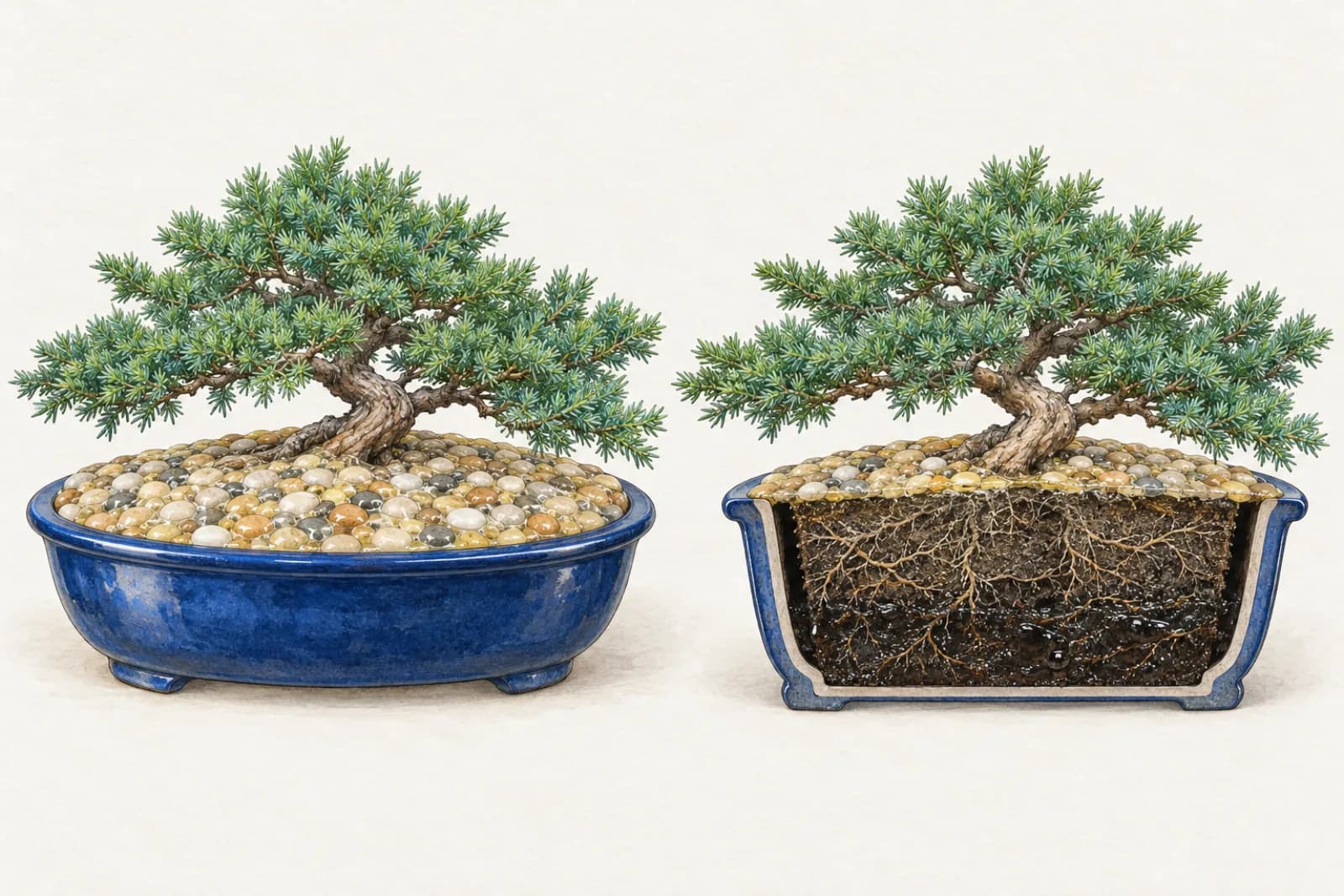
What a container has to do
Whatever it looks like, a container has three jobs to do for the roots: let extra water out, let air back into the substrateThe material that fills a container and surrounds a tree's roots, such as a mix of mineral grit, bark, or soil. Its job is to anchor the roots and to hold water, mineral nutrients, and air in a balance the roots can use.Open the glossary, and let you see and reach the surface. The place where it stands has jobs too, which come later in this lesson.
A way out for extra water
After a thorough watering, the substrate holds what it can in thin films around its particles and in its smallest pores. Gravity pulls the rest down, and a drainage hole lets it leave; without one, every watering adds to the water already in the bottom. The hole also needs somewhere to drain to. A pot standing flat on a tray or smooth concrete drains slowly, while feet, a slatted shelf, or a grid let water drip clear.
Large holes are covered on the inside with drainage meshA small square of plastic or metal mesh laid over a drainage hole on the inside of a pot. It keeps the substrate from washing out while letting water drain freely, which matters most in training pots and bonsai pots with large holes.Open the glossary, a small square of plastic or metal screen that keeps the substrate in while water runs out. Three kinds of container drain well:
- Nursery pots, the plain plastic pots most garden-center trees grow in.
- A training potA plain, inexpensive container, usually plastic, used while a tree grows and develops rather than for display. It drains well and is roomier than a bonsai pot, which makes it a practical next home for a tree whose current pot does not drain.Open the glossary, a plain, inexpensive container, usually plastic, used while a tree grows and develops rather than for display. Roomier than a bonsai pot, it is the practical next home for a tree whose pot will not drain.
- A bonsai potA shallow container made for bonsai, usually ceramic, with large drainage holes, small holes for wire that ties the tree in, and feet that lift it so water can leave. Moving a tree into one usually means reducing its roots, so it is a later step, not a first fix.Open the glossary, a shallow container, usually ceramic, with large drainage holes, small holes for the wire that ties a tree in, and feet. Moving a tree into one usually means reducing its roots to fit, so it comes later (Course 11, Repotting and Root Development, and Course 16, Pots, Composition, and Display). The gift juniper's glazed pot looks like one, but a bonsai pot always has drainage holes.
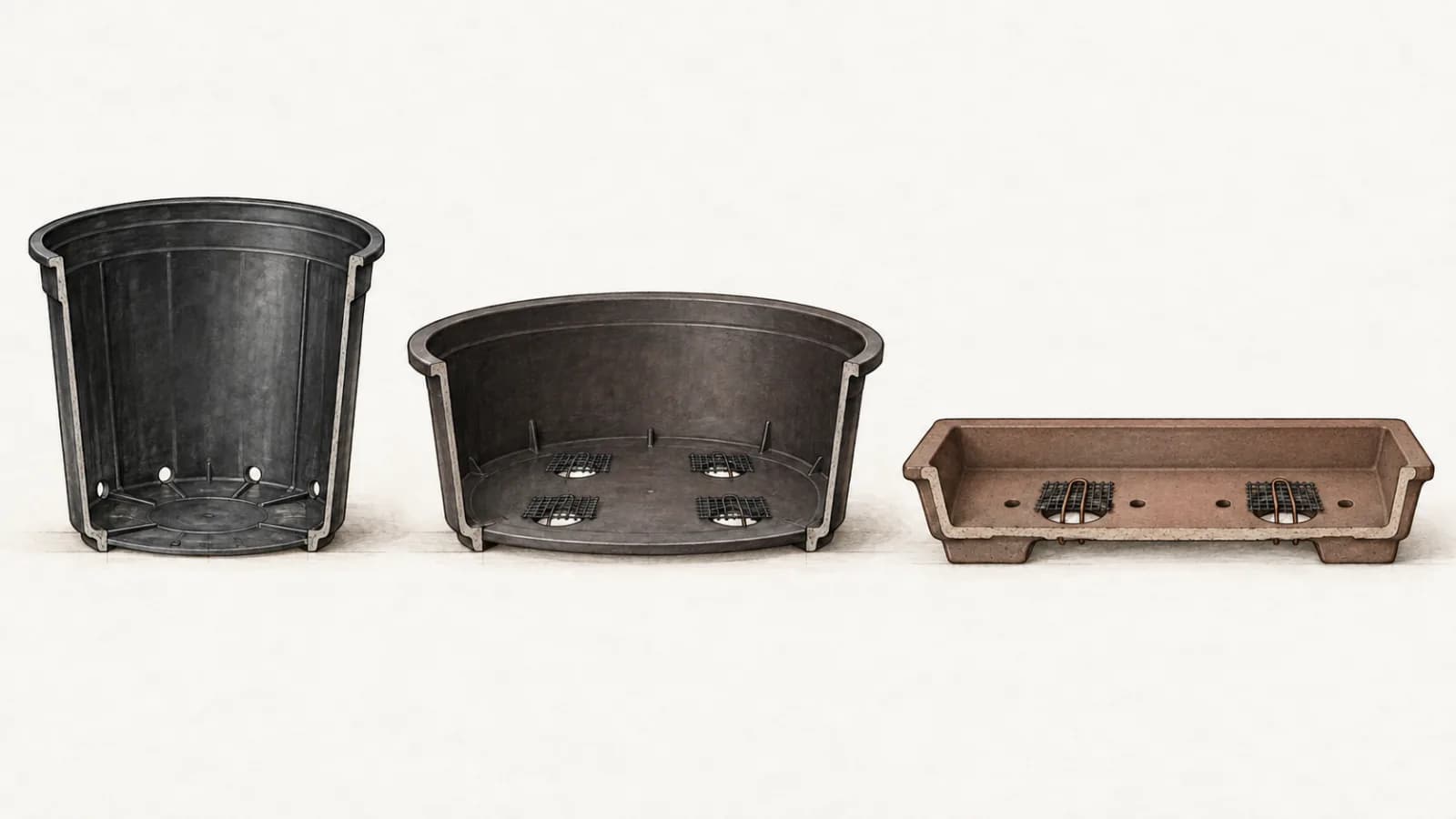
Air back in the pores
Draining matters because of what comes in behind the water. As the extra water drains, air is drawn into the larger pore spaceThe gaps between particles in soil or substrate, which hold water, air, or both. Large pores usually drain and refill with air after watering while small pores hold water, so the mix of pore sizes sets how wet and how airy a root zone stays.Open the glossary (Course 01, Lesson 2), and roots need that air: their living cells respire constantly, using oxygen (Course 01, Lesson 7). This supply is called aerationThe supply of air, especially oxygen, to roots through air-filled pore spaces, and the exchange of gases between those spaces and the open air. Roots need good aeration because their living cells use oxygen constantly.Open the glossary.
In a pot that drains, the substrate is saturatedDescribes soil or substrate whose pore spaces are completely filled with water, leaving little or no air. Brief saturation right after watering is normal in a pot that drains; saturation that lasts starves roots of oxygen.Open the glossary, every pore full of water, only briefly after each watering. In a pot that cannot drain, the bottom stays saturated. Within hours to a day or so, sooner in warm weather, the roots there run short of oxygen, a state called hypoxiaAn oxygen supply too low for cells to respire normally. In containers it most often affects roots when the substrate stays saturated, because oxygen moves through water roughly ten thousand times more slowly than through air.Open the glossary, and if it goes on, their tips die back while the foliage still looks fine. A juniper, a coniferA tree or shrub that bears seeds in cones, which are berrylike in junipers, instead of in flowers and fruits, and usually has needle-like or scale-like leaves. Most conifers are evergreen, but larches and a few others drop their needles each autumn.Open the glossary whose needles lose water slowly, can stay green for weeks while its roots fail (Course 01, Lesson 14).
Winter slows the harm, because cool roots use oxygen more slowly, but a cool pot also dries more slowly, so its wet bottom stays wet longer. And a glazed pot full of water can crack in a hard freeze.
A surface you can see and reach
The surface is where water goes in and where you check what is happening below. Water should soak in across all of it, and you need to see and touch it: to push in a chopstick and to spot weeds, pests, or roots.
Many mass-market trees arrive with pebbles glued over the surface to hold the tree and its mix in place while they are shipped and sold (Lesson 6). The glue sets into a crust that sheds water and hides the mix. That mix is often rich in peat, which shrinks as it dries and then repels water for a while, so a drying root ball can pull away from the pot wall and leave a gap where water slips past.
Watch where the water goes
Predict first
Not necessarily. Water that cannot soak into the crust can run to its edge, slip down the gap between a shrunken root ball and the pot wall, and leave through the holes, wetting only the outside of the root ball. Water at the bottom shows only that water reached the bottom. Watch container D below.
In Where does the water go?, the same small juniper grows in the same mix in four containers: Draining pot on a slatted shelf (A), Nursery pot in a cover pot (B), Glazed pot, no hole (C), and Glued stone crust (D). B stands inside a cachepotA decorative outer pot, usually without a drainage hole, that holds a plainer pot inside it. Water that drains from the inner pot collects in it, so it has to be emptied after every watering or rain, or the bottom of the root ball sits in water.Open the glossary, or cover pot: a decorative outer pot with no hole. On a phone, pick a container with Container.
- Press Water, then Water again for the 2nd and 3rd waterings, a few days apart, and read the status under each drawing. What builds up, and where? Back, Next, and Pause hold a moment for a closer look.
- Under Choose a correction, pick a fix for B, C, and D. When you find the proportionate one, press Water to test the fix.
Animation
Where does the water go?
A. Draining pot on a slatted shelf
Moist, air in the pores
Water films cling to the particles, and the larger pores between them hold air.
B. Nursery pot in a cover pot
Moist, cover pot empty
The nursery pot drains well. The decorative cover pot around it has no hole, and it is empty for now.
C. Glazed pot, no hole
Water at the bottom
There is no drainage hole. Water left from earlier waterings already fills every pore at the bottom of the pot.
D. Glued stone crust
Core drying, surface hidden
The pot drains, but the surface is a hard crust of glued pebbles. The root ball has shrunk a little from the pot wall, leaving a gap.
Before watering. A: Moist, air in the pores. B: Moist, cover pot empty. C: Water at the bottom. D: Core drying, surface hidden.
Choose a correction
Each of B, C, and D has one fix that solves its problem with the least disturbance to the roots. C and D are the gift juniper's two problems: a glazed pot with no drainage hole, and a crust of glued pebbles.
B. Nursery pot in a cover pot
Water drains out of the nursery pot but stands in the cover pot. What is the proportionate fix?
C. Glazed pot, no hole
Water collects at the bottom because there is no hole. Say this is the gift juniper in mid-December, after weeks in a warm room. What is the proportionate fix?
D. Glued stone crust
Water runs off the crust and down the edge, and the crust hides the surface. What is the proportionate fix?
Text description
Four containers drawn in cross-section, side by side, each holding a small juniper with its roots in a potting mix. In the drawings, water filling every pore is a deep blue zone with a solid blue line at its top; water soaking down through the mix is a lighter blue band; air in the pores is dotted circles; and a dry mix is pale. Moving water shows as blue drops, or blue arrows when the drawing is still.
- A, draining pot on a slatted shelf: A pot with drainage holes covered by mesh, raised on a slatted shelf.
- B, nursery pot in a cover pot: A plastic nursery pot with holes, set inside a decorative cover pot that has none.
- C, glazed pot, no hole: A glazed ceramic pot with no drainage hole.
- D, glued stone crust: A pot with drainage holes, its surface sealed by pebbles glued into a hard crust.
The Water button waters all four, three times a few days apart, and shows each one during watering and the next day. You can also step through the moments with Back and Next, or jump to one on the track.
- A: water soaks in across the whole surface, fills the pores on its way down, and runs out of the holes and between the slats. By the next day the extra water has drained, only a thin wet layer stays at the very bottom, and air is back in the pores. Every watering repeats this.
- B: water runs through the nursery pot as in A, but drains into the cover pot and pools around the bottom of the root ball, where the mix stays saturated with no air. Only a little soaks back up or dries off between waterings, so each watering makes the pool deeper. From above, nothing looks wrong.
- C: water soaks down but cannot leave. It collects at the bottom, where every pore is full of water, and the saturated zone rises with each watering until most of the root ball sits in it.
- D: water beads on the crust, runs to the edge, and slips down the gap between the root ball and the pot wall, then out of the holes, so the pot looks watered. Only the edges get wet. The core of the root ball stays dry and keeps shrinking, which widens the gap, and the crust hides the surface, so you cannot see or feel how moist the mix is.
Then choose a correction for B, C, and D. C and D are the gift juniper's two problems. The options:
- B: Water drains out of the nursery pot but stands in the cover pot. What is the proportionate fix? Leave the water there; the roots will drink it back up; Tip out the cover pot each time the dripping stops; Water less often, so that less water collects in it; Repot it into bonsai soil and a bonsai pot right away.
- C: Water collects at the bottom because there is no hole. Say this is the gift juniper in mid-December, after weeks in a warm room. What is the proportionate fix? Lift it out, put a layer of gravel in the bottom of the pot, and put it back; Keep it in this pot and give it only small sips of water from now on; Wash off the old soil, trim the roots, and repot into bonsai soil; Slide the intact root ball into a draining pot with fresh mix around it.
- D: Water runs off the crust and down the edge, and the crust hides the surface. What is the proportionate fix? Soak it until the glue softens, then lift the crust off in pieces; Water more often, so that more of it soaks through the crust; Poke a few holes through the crust with a skewer to let water in; Pry the whole crust off in one piece, right away, while it is dry.
Each choice gets feedback. Once you choose the fix that solves the problem with the least disturbance, the drawing shows the corrected container, and you can water it again to test the fix.
Only A behaved the same way at every watering: water ran through and out, and by the next day air was back in the pores, with a thin wet layer at the very bottom (Course 04, Soil, Substrates, and the Root Environment, explains why every pot keeps one). B drained like A, but into a pool that deepened with each watering. In C, the saturated zone rose every time while the surface dried and looked ready for more. In D, water ran out of the holes every time, yet the core grew drier. None of them looked wrong from above.
Each proportionate correction changed only what blocked the water, the air, or your view. The gift juniper has both C's problem and D's, and together they hide each other: water that runs off its crust collects in a pot that cannot drain, so the root ball can be dry in the middle and waterlogged at the bottom, with no surface to check.
Three problems, three proportionate fixes
A proportionate correction is the smallest change that solves the problem. The biggest change, repotting with root work, costs the tree the most: loosening or cutting roots destroys many of the fine rootOne of the many thin, branching roots, often pale when young, that do most of a tree's absorbing of water and mineral nutrients. Fine roots live a relatively short time and are constantly replaced, so they depend on a root zone that holds both water and air.Open the glossary and root hairA tiny, hairlike outgrowth of a single cell on a root's surface, a short way behind the growing tip, that greatly increases the area for absorbing water and minerals. Some trees, such as pines, grow few and rely more on fungal partners. Root hairs are fragile and short-lived, so disturbing roots destroys many of them and temporarily reduces uptake.Open the glossary that do most of the absorbing (Course 01, Lesson 2). None of these three problems needs it.
A cover pot that holds water
Gift plants are often sold as a plain nursery pot dropped into a decorative one, and the foil sleeve around many supermarket plants does the same job. The inner pot drains; the trouble is where the water ends up. So water at the sink and let the inner pot drain before it goes back, or tip out the cover pot once the dripping stops, and tear a foil sleeve open at the bottom. A spacer such as pot feet keeps the inner pot above a little water, but the cover pot still needs emptying. Outdoors, rain fills a cover pot too, so take it off or check it after every rain.
Practice check · not scored
A pot with no drainage hole
No watering routine makes up for a missing hole (Course 01, Lesson 7). Watering less leaves the top dry while the bottom stays wet, and small sips still collect out of sight; following the tag's “Water twice a week” is exactly how water builds up unseen. Drilling the glazed base is possible with the right bit, but the tree has to come out first anyway, and the glaze can crack.
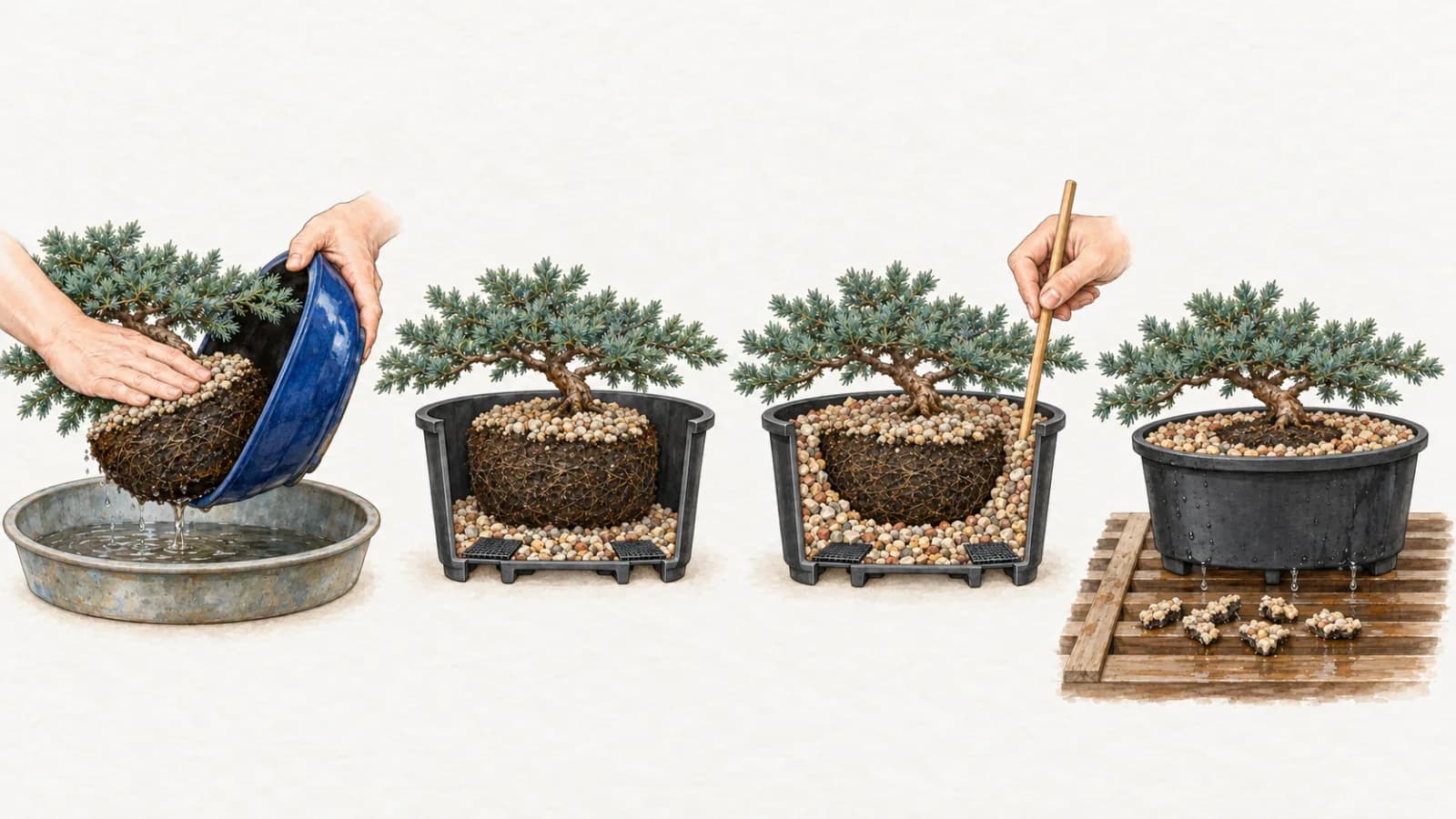
The proportionate fix is slip-pottingMoving a plant's root ball, whole, into a slightly larger container and filling only the gap around it with fresh substrate, without loosening, washing, or cutting the roots. Because the roots are barely disturbed, it can fix a pot that does not drain outside the usual repotting season.Open the glossary: moving the root ball, whole, into a slightly larger pot that drains, and filling only the gap around it with fresh, free-draining substrate. The roots are not loosened, washed, or cut, so the tree has almost nothing to recover from, and the job does not have to wait for the repotting season. For the gift juniper in December, it is the right move now.
- Choose the pot. A plastic training pot with drainage mesh over its holes, a finger's width or two wider than the root ball all round and a little deeper. Bigger is not kinder: mix the roots cannot reach yet stays wet for a long time.
- Ease the root ball out. Over a sink, turn the old pot on its side, spread one hand across the surface on either side of the trunk, and let the root ball slide out whole. Never pull on the trunk.
- Set it at the same height, on a thin layer of fresh mix, so its top sits where it did before, a little below the rim.
- Fill the gap with fresh mix, working it down gently at the edge with a chopstick until the tree sits steady. If it still rocks, ask an experienced grower to show you how to tie it in (Course 11 covers anchorageThe way roots hold a tree firmly in place against wind, gravity, and its own weight, mainly through the spread and grip of its structural roots. A shallow bonsai pot offers little anchorage, which is one reason newly potted trees are often secured with wire or ties.Open the glossary after repotting).
Go deeper · optional, not assessedWhy water lingers above a coarse layer
Water in a pot is pulled down by gravity and held in narrow spaces by capillary attraction, the pull that draws water into a paper towel. Narrow pores hold water more tightly than wide ones. Where a fine mix sits on gravel, the gravel's wide pores pull on the water far less, so water does not cross into the gravel until the mix just above it is nearly saturated, and the wet zone forms there instead of at the bottom. Course 04 examines this with a model often called the perched water table. A thin layer of slightly coarser grit under a bonsai mix that is already coarse has a much smaller effect, and growers disagree about whether it helps.
Glued stones over the surface
The crust has to come off, but the pebbles can be glued to the bark at the base of the trunk and to roots that have grown into the glue, so prying the crust off in one piece pulls on the trunk and tears roots.
Soften it first. Once the tree is in a pot that drains, stand the pot in a basin of water that comes up to the crust until the glue softens; some glues soften within an hour or two, others barely at all. Take the pot out after a few hours at most, softened or not, because roots left standing in water run short of air. Lift the stones away in small pieces, from the edge toward the trunk, then let the pot drain fully. The soak also wets the dry core through and settles the fresh mix. If the crust will not soften, chip it away from the edge a piece at a time, and leave any stone stuck fast to bark or a root for later.
Doing the pot first and the crust second lets the soaking water drain away instead of adding to the water trapped in the old pot.
Practice check · not scored
A workable space
A container also stands somewhere, and that place has to be safe and make daily checks easy: a tree you can see and reach is a tree you check.
Stable, secure, and easy to reach
On the fourth-floor west balcony, wind is strongest at the open south end, and a small tree in a light plastic pot is top-heavy. Give it a sturdy slatted shelf that cannot tip: broad and heavy enough to stay put, or fixed in place where building rules allow (Lesson 1). Tie a light pot to it with soft cord through the slats. Set the shelf just inside the railing, with its top no higher than the top rail, and never stand a pot on the railing itself, so that nothing can tip over the edge onto the balconies and people below.
At bench height, about 80 cm (about 2.5 ft) or a little higher, you can see the foliage, check the surface, and water without stooping, and a slatted top keeps the pot draining and off concrete that gets very hot on summer afternoons (Lesson 5). For a sun-loving juniper on this balcony, the best place for that shelf is at railing height in the open middle, set just inside the railing, in the afternoon sun: it beats the dim back wall under the overhang and the spot beside the condenser in the north corner. On winter nights, though, that open shelf is also the coldest spot (Lesson 5), so a pot there needs its roots protected from hard freezes (Course 06, Seasonal Care and Timing). The cases are in the Northern Hemisphere, where the midday sun is to the south; in the Southern Hemisphere, swap north and south.
Water you can carry, and runoff you can catch
The balcony has no outdoor tap, so every watering is carried from the kitchen, in a can small enough to carry when full. On its spout, a fine watering roseThe cap pierced with many small holes on the end of a watering can's spout, which breaks the flow into a gentle shower. A fine rose wets a pot's whole surface evenly without washing the substrate away or cutting channels through it.Open the glossary, a cap pierced with many small holes, breaks the flow into a gentle shower that wets the whole surface evenly without washing out the mix or cutting a channel through it. Course 03, Watering and Daily Observation, covers technique.
Water that drips off this balcony lands on the neighbors' balcony below, and many buildings have rules about it. Pour slowly, stop once water runs from the holes, and catch it in a shallow tray under the shelf, or under the pot with a grid that keeps the pot above the water. Empty the tray after every watering so that it never becomes a cover pot. While the gift juniper is still indoors, water it at the sink instead.
Simple tools for observing
The first tools to own are for watching the tree, and most are cheap or already at home:
- A notebook or phone camera for dated notes and photos from the same angles (Lesson 8 shows what to record).
- A min/max thermometer at pot height, out of direct sun, to learn what the spot really does on frosty nights and hot afternoons (Lesson 5).
- A plain wooden chopstick, pushed into the root zone for a few minutes, which comes out darker and cool where the mix is moist (Course 01, Lesson 2). With the weight of the pot, it tells you far more than the surface.
- A hand lens, about 10×, for checking a new arrival for pests (Lesson 8); a zoomed-in phone camera can stand in.
Cheap probe moisture meters respond to soluble saltsDissolved minerals, from fertilizer and from tap water, that can accumulate in a container's substrate as water evaporates. A high concentration makes it harder for roots to take up water and can damage them. Buildup can leave a white crust on the pot or surface, though hard tap water alone can leave a similar crust, so a crust by itself does not show that roots are harmed.Open the glossary in the water and to how well the probe touches the particles, not only to the water itself, so in coarse mixes their readings are often unreliable.
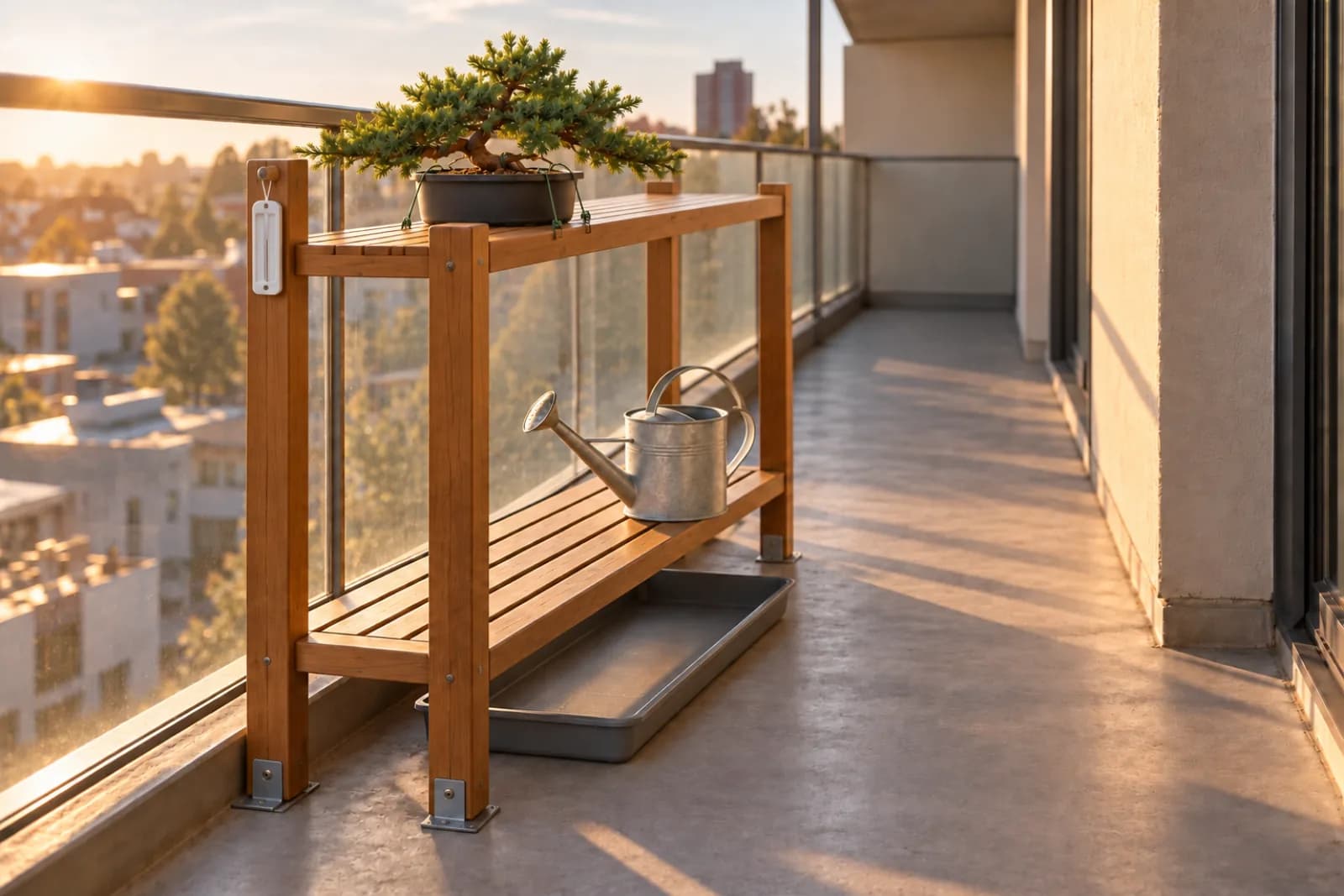
What to buy now, and what can wait
Buy now, later, or skip for now? asks you to sort 14 items for one stated case: the gift juniper, heading for the west balcony in December. Read the case panel, then for each card choose Now, Later, or Skip for now and read why. Your kit so far fills as you go; once all 14 are sorted, Kit sorted shows the pattern, and Worth another look: links back to any card that differs from the stated answer.
Exercise
Buy now, later, or skip for now?
The case · Instructional example
The gift juniper, heading for the west balcony
- Bought in mid-December. Green and looks healthy so far, but used to a warm room, not to cold.
- A glazed ceramic pot with no drainage hole, and a surface of pebbles glued into a hard crust.
- A fourth-floor balcony facing west: windy at the open south end, with a concrete floor.
- No outdoor tap, so water is carried from the kitchen. Runoff drips onto the balcony below.
Watering can with a fine rose
A can whose spout ends in a rose: a cap pierced with many small holes.
A 12-piece bonsai tool kit
A roll-up case of cutters, scissors, tweezers, a rake, and other specialist tools.
Training pot and drainage mesh
A plain plastic pot with drainage holes, a little wider than the root ball, and squares of plastic mesh to cover the holes.
Sharp scissors or small pruners
One good pair of small, sharp garden scissors or pruners.
Min/max thermometer
Records the lowest and highest temperature since you last reset it.
Humidity tray
A shallow tray of water and pebbles, meant to stand under the pot.
Wooden chopstick
Pushed into the mix and left for a few minutes, it shows whether the root zone is moist below the surface.
Concave branch cutter
A specialist cutter with rounded jaws for removing a branch close to the trunk.
Small bag of free-draining bonsai substrate
A coarse, gritty mix: enough to fill around the gift juniper's root ball when it moves into a draining pot.
Probe moisture meter
A dial on a metal probe that you push into the pot to read how wet it is.
Stable shelf or bench
A sturdy stand you can secure, at a height where you can see and reach the tree.
Wire and wire cutters
Soft aluminum or copper training wire, and cutters that snip it close.
Notebook or phone camera for records
Dated notes and photos of the tree, taken from the same angles each time.
Grow light
An LED lamp made to give plants strong light indoors.
Depends on the tree. The answer here is for the gift juniper on the west balcony.
Text description
An exercise in proportionate first purchases. Every card assumes one case: the gift juniper (most likely Juniperus procumbens 'Nana', not yet confirmed), bought in mid-December. It sits in a glazed ceramic pot with no drainage hole, its surface sealed with pebbles glued into a hard crust, and it is used to a warm room. It belongs outdoors and will live on the west balcony: a windy fourth-floor balcony with a concrete floor, no outdoor tap, and runoff that drips onto the balcony below.
Sort each of the fourteen items into one of three lists. Now means the tree needs it in this place this week, or you will use it from the first day. Later means it becomes useful once a later course teaches the technique it serves. Skip for now means it adds little for this tree, or something simpler does the same job.
- Watering can with a fine rose: A can whose spout ends in a rose: a cap pierced with many small holes.
- A 12-piece bonsai tool kit: A roll-up case of cutters, scissors, tweezers, a rake, and other specialist tools.
- Training pot and drainage mesh: A plain plastic pot with drainage holes, a little wider than the root ball, and squares of plastic mesh to cover the holes.
- Sharp scissors or small pruners: One good pair of small, sharp garden scissors or pruners.
- Min/max thermometer: Records the lowest and highest temperature since you last reset it.
- Humidity tray: A shallow tray of water and pebbles, meant to stand under the pot.
- Wooden chopstick: Pushed into the mix and left for a few minutes, it shows whether the root zone is moist below the surface.
- Concave branch cutter: A specialist cutter with rounded jaws for removing a branch close to the trunk.
- Small bag of free-draining bonsai substrate: A coarse, gritty mix: enough to fill around the gift juniper's root ball when it moves into a draining pot.
- Probe moisture meter: A dial on a metal probe that you push into the pot to read how wet it is.
- Stable shelf or bench: A sturdy stand you can secure, at a height where you can see and reach the tree.
- Wire and wire cutters: Soft aluminum or copper training wire, and cutters that snip it close.
- Notebook or phone camera for records: Dated notes and photos of the tree, taken from the same angles each time.
- Grow light: An LED lamp made to give plants strong light indoors. Depends on the tree. The answer here is for the gift juniper on the west balcony.
Each choice gets feedback explaining why, and a right choice also says when the item becomes useful. The kit panel lists your choices in three groups and marks any worth another look. You can change any answer. When every card is sorted, a summary states the pattern.
The seven Now items all came up earlier in this lesson: a training pot with drainage mesh and a small bag of free-draining substrate for slip-potting, a can with a fine rose, a stable shelf, a min/max thermometer, a chopstick, and a notebook or phone. Most are cheap or already at home, and the pot is the most urgent. Scissors, a concave cutter, and wire wait for the courses that teach their use (Course 09, Pruning and Managing Growth, and Course 10, Wiring and First Styling). The tool kit, humidity tray, probe meter, and grow light add little for this tree. Only the grow light carried a note that it depends on the tree, but every answer depends on the case: change the tree, the place, or the season, and some items move.
Practice check · not scored
The gift juniper's first setup
The bonsai decision
A minimal setup and a first correction for the gift juniper
Starting point
This week, while the gift juniper adjusts in a cool, bright, frost-free place (Lesson 3):
- Check before you water until the pot is fixed, not on the tag's schedule. A heavy pot, or water trickling from under the crust when you tilt it over the sink, means water is already standing in the bottom, so add no more.
- Slip-pot it into a training pot a finger's width or two wider, with mesh over the holes, at the same height as before, filling only the gap with fresh free-draining mix. Do not loosen, wash, or cut the roots.
- Soak off the crust once it is in the new pot, lifting the stones away in small pieces, and let the pot drain fully.
- Prepare its outdoor spot before it moves out: a secured slatted shelf at railing height in the open middle, set just inside the railing, a min/max thermometer at pot height, a can with a fine rose, and a tray for runoff.
- Start the record with the date, photos, and what you found under the crust and at the bottom of the root ball (Lesson 8).
Leave repotting into bonsai substrate, a bonsai pot, pruning, wiring, and feeding for later.
This assumes
- It is December in the example climate, and the tree stays in a frost-free place while it adjusts.
- The tree is green and firm, and the pot has no sour smell: no sign yet that its roots are badly damaged.
- The root ball holds together and can slide out of the old pot.
Change course if
- A sour or rotten smell, a black and slimy bottom to the root ball, or foliage that dulls, yellows, or browns. The roots may already be damaged. Slip-pot today, add no water, and ask a local bonsai club or an experienced nursery for help (Course 07, Tree Health and Diagnosis).
- The root ball will not slide out, or starts to crumble. Stop, do not pull on the trunk, and get an experienced grower's help. Keeping the roots together matters more than keeping the pot.
- The old root ball dries much faster or much more slowly than the fresh mix around it. Check moisture in the old root ball itself, partway between trunk and rim (Course 03).
- Spring brings strong new growth on a tree you have identified. Repotting into bonsai substrate can be considered then, on its own evidence (Course 11, Repotting and Root Development).
Back to the question
What does a new tree's container and setup need to do, and what can wait?
A container has to let extra water out, let air back into the pores, and let you see and reach the surface, and its place has to hold it steady where you can see and water it, with somewhere for the runoff to go. When one of those fails, remove only what blocks it: empty a cover pot, slip-pot a root ball whole out of a pot with no hole, or soak a glued crust off in pieces. Repotting, a bonsai pot, and pruning and wiring tools can wait for the courses, and the season, that call for them.
Key takeaways
- A container must let extra water out, let air back into the pores, and let you see and reach the surface. One that fails can look fine from above.
- Empty a cover pot after every watering or rain; replace a pot with no drainage hole, because no watering routine fixes it; soak a glued crust off in pieces.
- Slip-potting moves a root ball whole into a draining pot without root work, so it does not have to wait for the repotting season.
- Gravel at the bottom of a pot does not improve drainage. With no hole it fills with water; with holes it tends to keep the mix above it wetter.
- A workable space is stable, at a working height, easy to water, and safe for the people below. Buy now only what this tree needs now; pruning and wiring tools wait for their courses.
Optional · not required for completion
Check a container and its spot
If you have a tree, tilt its pot and look underneath: how many holes, are any blocked, and does it sit flat or on feet? Lift it before and after its next watering to feel the change in weight, and water it slowly at the sink: does the water soak in across the whole surface, or run to the edge? Then, where it lives: what stops it tipping over in a gust, how far away is the water, and where does the runoff land?
No tree? Fill a plastic cup that has holes in its base with peat-based potting mix, wet it, and let it dry out completely for a week or two, until the mix shrinks from the wall. Over a sink, pour a little water on top, note how quickly it runs out of the holes, then cut the cup open: how far in did the water go? Dry a second cup the same way, stand it in a bowl of water for half an hour, drain it, and cut it open to compare.