Course 02 · Lesson 2 of 8 · Matching a tree to a place
What to find out about a tree
A shop tag is a first clue, not a care plan. Learn why a scientific name matters, which facts to look up for any tree, why broadleaf, conifer, evergreen, and deciduous don't settle where a tree can live, and how to get an identification you can trust.
The question
What must you find out about a tree before you can look after it?
By the end of this lesson, you will be able to:
- Explain why a scientific name identifies a tree more reliably than a common or trade name, and what its genus, species, and cultivar parts tell you.
- Identify the facts to verify for any tree (light needs, cold and heat tolerance, seasonal needs, and growth habit) and explain why leaf type, leaf habit, and climate labels alone do not settle its placement.
- Choose reliable ways to identify a tree whose label is missing or unreliable, and judge which lines on a plant tag to trust, check, or set aside.
About 15 minutes to read and explore
Instructional example: in mid-December, you are given a small juniper bought at a supermarket. It is green and looks healthy, in a glazed blue ceramic pot with no drainage hole, its surface covered with pebbles glued into a hard crust. Its tag reads “INDOOR BONSAI · Juniper · Water twice a week · Bright indirect light · Keep away from drafts · Easy care,” so it goes onto a warm windowsill above a radiator, out of the frosty nights that have begun outside in the course's example climate.
Followed line by line, that tag would keep a temperate conifer in a warm room all winter, short of light, watered by the calendar in a pot that cannot drain. None of it would show at first: a juniper can stay green for weeks or months while it weakens (Course 01, Lesson 14). Only knowing what the tree is tells you the tag is wrong.
Call it the gift juniper. The most useful word on its tag, “Juniper,” names a group of dozens of species, not one tree. This lesson covers what to find out about a tree before you can look after it, why some familiar labels settle less than they seem to, and how to get an answer you can trust when the label is missing or unreliable.
A name you can look up
Most plants have several names. A common nameAn everyday name for a plant, such as juniper, Chinese elm, or Fukien tea. Common names vary between regions and sellers, one name can cover several species, and one plant can have several names, so check the scientific name before relying on care advice.Open the glossary is the everyday name, such as juniper, trident maple, or Fukien tea. No one controls common names: they vary between regions and sellers, one name can cover several plants, and one plant can have several names. A trade nameA name used to sell a plant rather than to identify it, such as a trademarked selling name for a cultivar, or “ficus ginseng” for a ficus grown with a swollen root base. A trade name may stand for one cultivar, a plant grown in a particular form, or a loose group of plants, so look for the scientific name behind it.Open the glossary is a name used to sell a plant rather than to identify it: a trademarked selling name for one cultivar, or a shop name such as “ficus ginseng” for a plant grown in a particular form. Sales labels such as “indoor bonsai” go further and point to no one kind of plant at all.
A scientific nameA plant's formal name, used worldwide: the genus followed by the species, written in italics, as in Acer buergerianum for the trident maple, with any cultivar name after it in single quotes. Because it points to one kind of plant, it is the name to look up care by.Open the glossary, also called the botanical or Latin name, is given under international rules and used worldwide, and each kind of plant has one accepted scientific name. Reference books, botanic gardens, and extension services file their information under it, so it is the key to everything else you need to look up.
How a scientific name is built
Course 01, Lesson 1 introduced species and cultivars. A full name has one more part, the genus. Take the nursery juniper, Juniperus procumbens ‘Nana’:
- Juniperus is the genusA group of closely related species that share the first word of their scientific names, such as Juniperus for the junipers or Acer for the maples (plural genera). The genus tells you a tree's close relatives, but species in one genus can need very different care: Ficus includes frost-tender tropical figs and the deciduous common fig, which survives moderate frost.Open the glossary, a group of closely related species. It is always capitalized.
- procumbens names the speciesA group of closely related plants or animals that share distinctive features and usually breed with one another, given a two-part scientific name such as Acer buergerianum for the trident maple. Knowing a tree's species tells you much about its growth and care.Open the glossary within that genus. Genus and species together, in italics, make the species name: Juniperus procumbens, the Japanese garden juniper.
- ‘Nana’ is the cultivarA cultivated variety: a plant selected for particular traits, such as compact growth, small leaves, or unusual color, and kept consistent through propagation, often by cuttings or grafting. Cultivar names appear in single quotes, as in Juniperus procumbens ‘Nana’.Open the glossary, a selection kept consistent through propagation, written in single quotes without italics. It is a compact form of the species.
Many names describe the plant: procumbens means lying along the ground, nana means dwarf, and the ficus's microcarpa means small-fruited.
Each level tells you more. The genus gives a tree's close relatives and some shared features: every juniper is a conifer with needle-like or scale-like leaves and berrylike cones. But a genus does not settle care. The ficus, Ficus microcarpa, is a tropical evergreen that frost damages or kills, while the common fig, Ficus carica, is deciduous and survives moderate frost, so in many temperate gardens it winters outdoors. Light needs, hardiness, and seasonal needs are usually settled at the species level; the cultivar adds size, shape, foliage color, and sometimes a difference in hardiness.
When names mislead
Common and trade names go wrong in a few predictable ways:
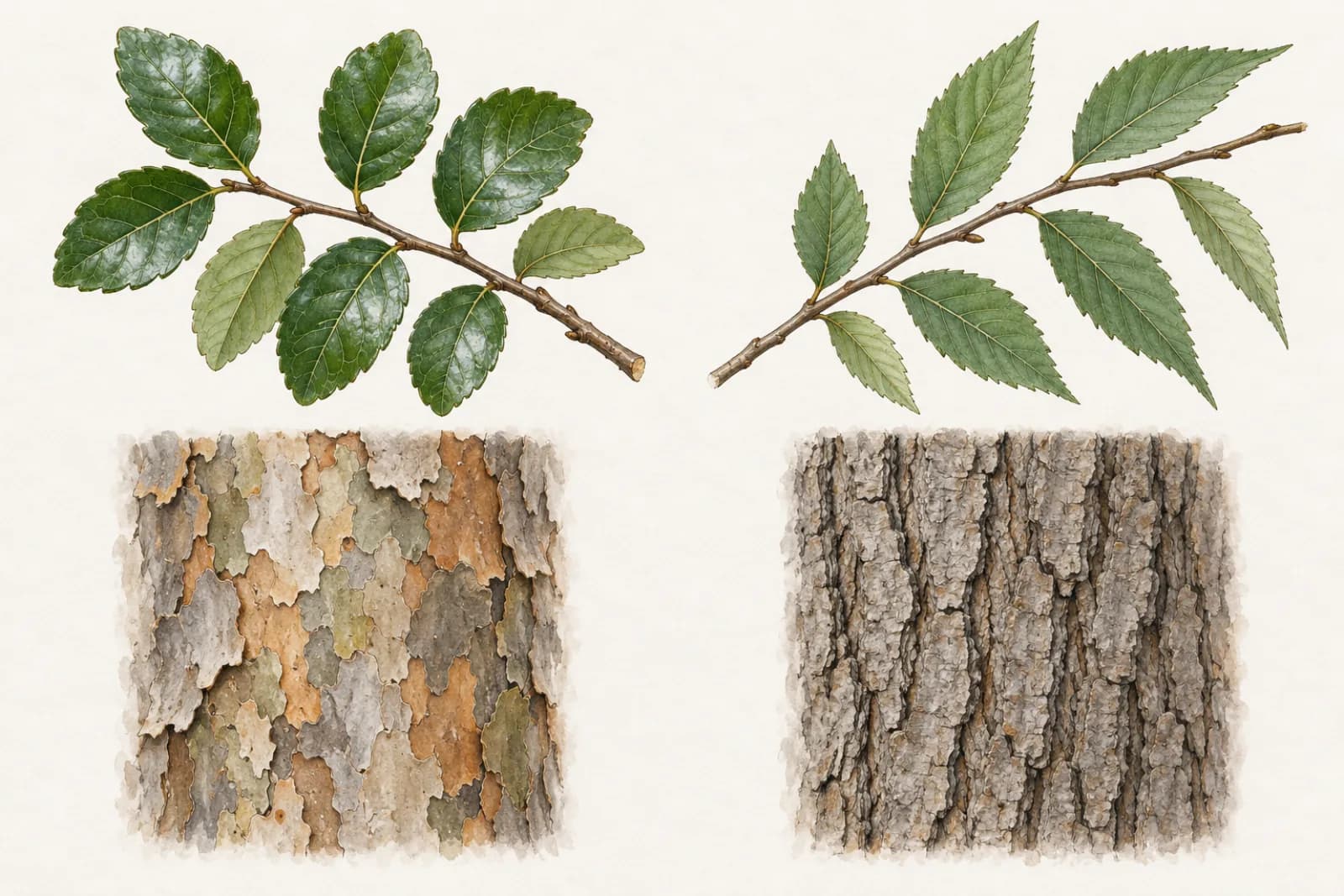
- One common name, two species. Chinese elm is Ulmus parvifolia. Siberian elm, Ulmus pumila, is a different species that is sometimes sold as Chinese elm. The two differ in their leaves, their bark, and even the season they flower, and advice written for one may not fit the other.
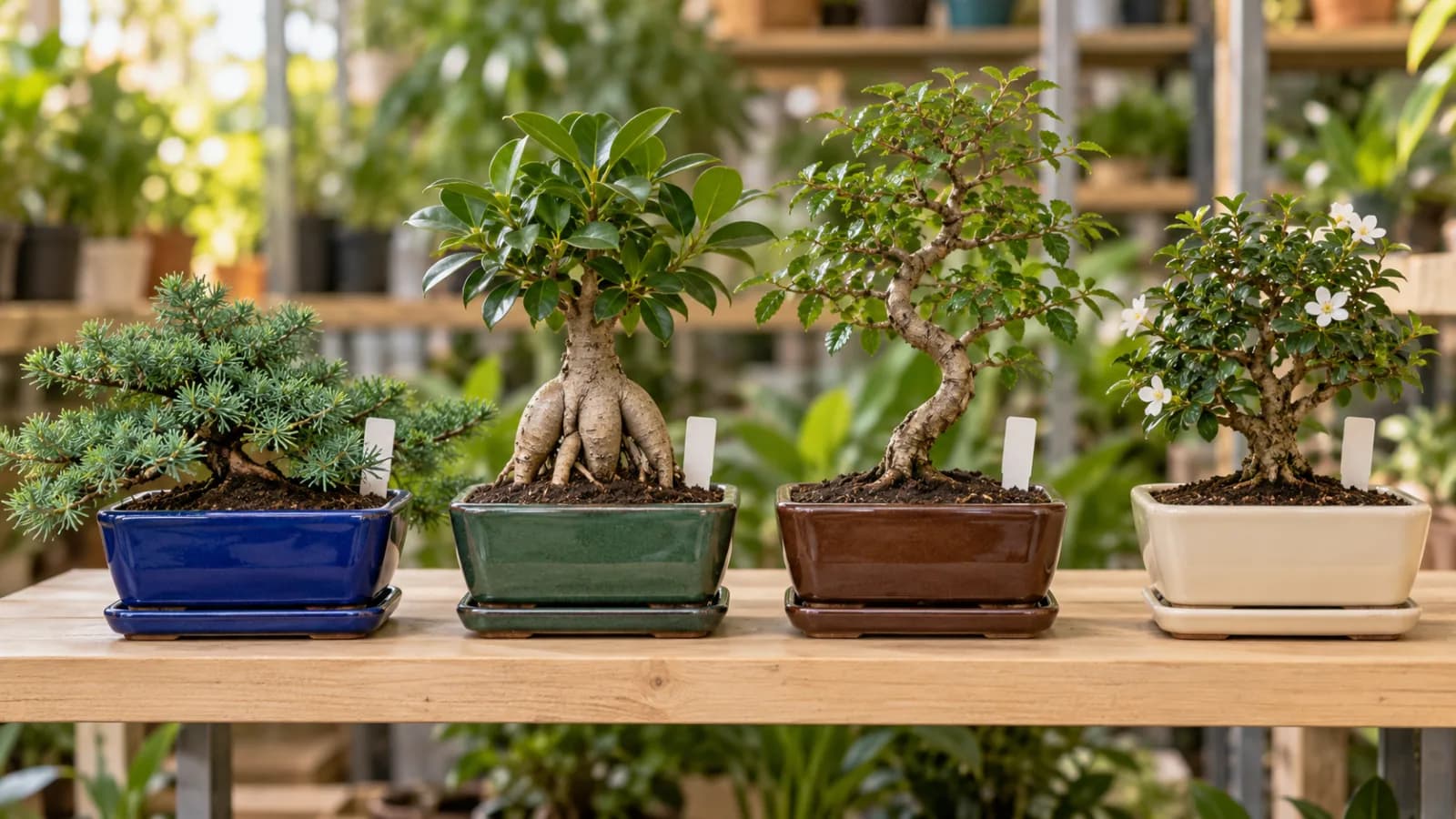
- A trade name instead of a plant name. “Ficus ginseng” is Ficus microcarpa grown with a thick, swollen base of roots raised above the soil; it has nothing to do with ginseng. “Indoor bonsai” names no plant at all.
- Misleading relatives. The Norfolk Island pine, Araucaria heterophylla, is a conifer but not a true pine, and Fukien tea is not closely related to the tea plant.
- A group name. “Juniper bonsai” could be any of several junipers, such as the Japanese garden juniper or the Chinese juniper, Juniperus chinensis.
- A changed name. Botanists sometimes move a species to another genus as they learn how plants are related. Fukien tea is now usually Ehretia microphylla but is still often sold as Carmona. Good references list old names as synonyms, so a search for either finds the same plant.
Practice check · not scored
Leaf type, leaf habit, and climate
Course 01 gave you three ways to describe a tree. Leaf type: a broadleafA flowering tree or shrub with flat, typically broad leaves, such as a maple, elm, oak, or ficus, as distinct from a conifer. Broadleaves can be evergreen or deciduous, tropical or temperate, so the label alone does not tell you how to care for one.Open the glossary has flat leaves and bears seeds in flowers and fruits; a coniferA tree or shrub that bears seeds in cones, which are berrylike in junipers, instead of in flowers and fruits, and usually has needle-like or scale-like leaves. Most conifers are evergreen, but larches and a few others drop their needles each autumn.Open the glossary has needle-like or scale-like leaves and bears seeds in cones (Course 01, Lesson 4). Leaf habit: an evergreenDescribes a tree that keeps living foliage all year, replacing old leaves or needles gradually instead of all at once. Keeping foliage does not mean a tree grows all year: temperate evergreens such as junipers still go dormant in winter.Open the glossary keeps living foliage all year; a deciduousDescribes a tree that drops all its leaves for part of each year, usually before winter or a dry season, and grows new ones when growth resumes. Most deciduous trees are broadleaves, like the trident maple, but a few conifers, such as larches, are deciduous too.Open the glossary tree drops all its leaves for part of each year. Climate of origin: temperateDescribes regions with distinct warm and cold seasons, and the trees adapted to them, which typically need a cool winter rest. Trident maples and the junipers commonly grown as bonsai are temperate trees and need seasonal outdoor conditions rather than a warm room all year.Open the glossary trees are adapted to warm summers and cold winters, tropicalDescribes warm regions near the equator without a cold winter, and the trees adapted to them. Tropical trees such as ficus have no chilling requirement and can be damaged or killed by frost; their growth slows when light or warmth drops.Open the glossary trees to warmth all year, and subtropicalDescribes regions bordering the tropics, with hot summers and mild winters that bring occasional cool spells or light frost, and the plants adapted to them. Subtropical trees typically have little or no chilling requirement but may tolerate cooler weather than tropical ones.Open the glossary trees to mild winters with rare, light frost (Course 01, Lesson 13).
These descriptions help you recognize a tree and read a reference. The question is how much they tell you about where it can live.
Predict first
No. The juniper is a temperate tree that needs a winter rest outdoors, with its pot's roots protected from hard freezes. The Norfolk Island pine comes from a subtropical island in the South Pacific and is frost-tender, so here it winters indoors in bright light; it is often sold as a houseplant. Sharing a leaf type and a leaf habit told you nothing about winter.
Test that on eight trees. In Four labels that don’t settle it, read each card's Foliage and In January clues, then choose its Leaf type (Broadleaf or Conifer) and Leaf habit (Evergreen or Deciduous). Each tree drops into The leaf grid once both are answered (beside the cards on a wide screen, after them on a narrow one). When all eight are in the right boxes, switch on Show where each comes from and compare the trees that share a box.
Exercise
Four labels that don’t settle it
Step 1
Sort the trees by their leaves
Each tree lands in the leaf grid below the cards once you answer both questions.
Nursery juniper
Juniperus procumbens 'Nana'
- Foliage
- Short, prickly, needle-like leaves in threes, crowded along the shoots.
- In January
- Still green, tinged purple in hard cold.
Trident maple
Acer buergerianum
- Foliage
- Three-lobed leaves in opposite pairs. Seeds grow in winged pairs.
- In January
- Bare twigs with pointed buds.
Ficus
Ficus microcarpa
- Foliage
- Glossy, oval, leathery leaves, one at a time along the stem. Seeds form inside tiny figs.
- In January
- Green and glossy; an old leaf drops now and then.
Japanese larch
Larix kaempferi
- Foliage
- Soft needles in tufts on short spur shoots. Small, upright cones.
- In January
- Bare twigs dotted with knobby spur shoots.
Boxwood
Buxus
- Foliage
- Small, oval, leathery leaves in opposite pairs. Tiny pale flowers in spring.
- In January
- Green, sometimes bronzed by cold wind.
Norfolk Island pine
Araucaria heterophylla
- Foliage
- Short, curved needles crowded around the shoots, on branches in neat tiers. Large round cones on old trees.
- In January
- Green; old needles drop gradually.
Bald cypress
Taxodium distichum
- Foliage
- Flat, soft needles in two rows along slender sprigs, like a feather. Round cones.
- In January
- Bare; the needles fell with their sprigs.
Fukien tea
Ehretia microphylla, also sold as Carmona
- Foliage
- Small, dark, glossy leaves in clusters, often toothed near the tip. Tiny white flowers, then small berries.
- In January
- Green and glossy, as in summer.
The leaf grid
0 of 8 placed
| EvergreenKeeps living leaves all year | DeciduousBare for part of each year | |
|---|---|---|
| Broadleaf (flat leaves; seeds from flowers) | Empty | Empty |
| Conifer (needles or scales; seeds in cones) | Empty | Empty |
Step 2
Show where each comes from
Unlocks when all eight trees are in the right boxes (0 of 8 so far).
Text description
Eight trees, each on a card with a drawing of its foliage, a short description of its leaves and seeds, and what it looks like in January. For each tree you answer two questions. Leaf type: a broadleaf has flat leaves and bears its seeds from flowers; a conifer has needle-like or scale-like leaves and bears its seeds in cones. Leaf habit: an evergreen keeps living leaves all year; a deciduous tree drops all of them for part of each year.
- Nursery juniper (Juniperus procumbens 'Nana'). Foliage: Short, prickly, needle-like leaves in threes, crowded along the shoots. In January: Still green, tinged purple in hard cold.
- Trident maple (Acer buergerianum). Foliage: Three-lobed leaves in opposite pairs. Seeds grow in winged pairs. In January: Bare twigs with pointed buds.
- Ficus (Ficus microcarpa). Foliage: Glossy, oval, leathery leaves, one at a time along the stem. Seeds form inside tiny figs. In January: Green and glossy; an old leaf drops now and then.
- Japanese larch (Larix kaempferi). Foliage: Soft needles in tufts on short spur shoots. Small, upright cones. In January: Bare twigs dotted with knobby spur shoots.
- Boxwood (Buxus). Foliage: Small, oval, leathery leaves in opposite pairs. Tiny pale flowers in spring. In January: Green, sometimes bronzed by cold wind.
- Norfolk Island pine (Araucaria heterophylla). Foliage: Short, curved needles crowded around the shoots, on branches in neat tiers. Large round cones on old trees. In January: Green; old needles drop gradually.
- Bald cypress (Taxodium distichum). Foliage: Flat, soft needles in two rows along slender sprigs, like a feather. Round cones. In January: Bare; the needles fell with their sprigs.
- Fukien tea (Ehretia microphylla, also sold as Carmona). Foliage: Small, dark, glossy leaves in clusters, often toothed near the tip. Tiny white flowers, then small berries. In January: Green and glossy, as in summer.
Each choice gets feedback, and you can change any answer. Once both questions for a tree are answered, it appears in a two-by-two grid with rows for broadleaf and conifer and columns for evergreen and deciduous, marked as in the right box or the wrong one.
When all eight trees are in the right boxes, a second step, Show where each comes from, adds each tree’s climate of origin (temperate, subtropical, or tropical) and where it spends winter in the course’s example climate, which has cold winters:
- Nursery juniper: temperate. The species comes from Japan; 'Nana' is a compact garden selection. Winters outdoors. Outdoors all year in full sun. It needs a winter rest outdoors, with its pot's roots protected from hard freezes.
- Trident maple: temperate. Eastern China and Taiwan, long grown in Japan. Winters outdoors. Outdoors all year, in full sun to part shade, with shelter from hot afternoon sun and wind. It needs a winter rest and chilling outdoors; protect potted roots from hard freezes.
- Ficus: tropical. Tropical and subtropical Asia to northern Australia. Winters indoors. Warmth and the strongest light you can give. Frost damages or kills it, so it winters indoors in strong light (often a bright window plus a grow light). It can summer outdoors once nights stay above about 10 °C (50 °F).
- Japanese larch: temperate. Mountains of central Japan. Winters outdoors. Outdoors all year in full sun. It needs its winter rest outdoors; protect potted roots from hard freezes.
- Boxwood: temperate. Europe and East Asia (the common hardy boxwoods). Winters outdoors. Outdoors all year in sun or part shade. It rests outdoors in winter; shelter it from drying winter wind and protect its roots. A few boxwoods from warmer regions are less hardy, so check the species.
- Norfolk Island pine: subtropical. Norfolk Island, a small subtropical island in the South Pacific. Winters indoors. Frost-tender, so here it winters indoors in bright light; it is often sold as a houseplant. It can summer outdoors once nights are mild. Despite its name, it is not a true pine.
- Bald cypress: temperate. Swamps and riverbanks of the southeastern United States. Winters outdoors. Outdoors all year in full sun, and it likes plenty of water. It needs its winter rest outdoors; protect potted roots from hard freezes.
- Fukien tea: tropical. Southern China to Southeast Asia (Fukien is an old spelling of Fujian). Winters indoors. Warmth and strong light all year: it winters indoors, away from cold glass and drafts. Chilly nights set it back and frost kills it. It can summer outdoors in warm weather.
Comparing the trees that share a box shows whether sharing both descriptors means sharing the same placement.
Two boxes often surprise beginners. The Japanese larch and the bald cypress are conifers that go bare every winter, and the boxwood's small leaves are still flat blades, so it is a broadleaf. Winter color can mislead too: the juniper's purple tint and the boxwood's bronzing are color changes, not leaf drop.
The climate view then split both evergreen boxes. The boxwood rests outdoors in winter, while the ficus and the Fukien tea need frost-free warmth and strong light; the juniper needs a cold winter outdoors, while the Norfolk Island pine must not freeze. The deciduous boxes held only temperate trees, but that is true of these eight, not a rule: some tropical trees drop their leaves in a dry season instead. Even the descriptions blur. A Chinese elm keeps some of its leaves through a mild winter and drops most or all of them in a cold one, so it is called semi-evergreenDescribes a tree that keeps some of its leaves through a mild winter but drops most or all of them in a cold one, so it can look evergreen in one climate and deciduous in another. The Chinese elm is a familiar example; going bare in a cold winter is normal for it, not a sign of trouble.Open the glossary; in the example climate, expect it bare or nearly bare by midwinter, which is normal. What settles placement is the tree's identity, and with it the climate it comes from.
What to find out about any tree
Once you have a name, four groups of facts decide where a tree can live and how to look after it. Look them up in a reliable reference, not on a tag.
Light needs
How much direct sun the tree needs or tolerates outdoors (full sun, part sun or part shade, or shade), and whether it can grow indoors at all, which only some tropical and subtropical trees can, and only in strong light. The nursery juniper needs full sun outdoors all year; the trident maple takes full sun to part shade, though in hot summers its leaves can scorch in strong afternoon sun and wind; the ficus wants the strongest light you can give, indoors often a bright window plus a grow light. Indoor light is far weaker than it looks (Course 01, Lesson 6); Lesson 4 shows how to measure it.
Cold and heat tolerance
hardinessA plant's ability to survive the conditions of a place, most often its cold hardiness: the coldest winter temperatures it can survive once it has acclimated to cold. Ratings such as hardiness zones describe plants growing in the ground; roots in a pot are more exposed, so a potted tree needs more protection than its rating suggests.Open the glossary is a plant's ability to survive the conditions of a place, most often its cold hardiness: the coldest winter temperatures it can survive. References often give it as a range of hardiness zoneAn area on a map defined by how cold its winters get, usually measured as the average of the coldest temperature reached each winter. In the USDA system each zone spans 10 °F (about 5.6 °C), split into halves a and b, and plant labels name the zones where a plant survives winter in the ground. Roots in a pot are more exposed, so a tree in a pot needs hardiness to spare.Open the glossary, such as the USDA zones from Lesson 1. The nursery juniper's cultivar is hardy roughly in zones 4 to 9 and the trident maple to roughly zone 5, while frost damages or kills the ficus, and many growers keep it above about 10 °C (50 °F).
Every rating comes with two cautions. First, it describes a plant in the ground. Roots are generally less cold hardy than branches, and in a pot they are exposed on every side, so a potted tree needs more protection than its rating suggests (Lesson 5 and Course 06, Seasonal Care and Timing). Second, it assumes a tree that has built up its cold acclimationThe gradual process, triggered by shortening days and falling temperatures, in which a tree's tissues become able to survive freezing. A tree moved suddenly from a warm room into frost has not acclimated and can be badly damaged. It is not the same as shoots hardening, or turning woody, though the two often happen around the same time.Open the glossary through autumn outdoors (Course 01, Lesson 13). The gift juniper is very likely hardy enough to winter outdoors in the example climate, zone 7a, but after weeks in a heated shop and home it is not ready for frost yet.
Heat matters too: trees from cool mountain or northern climates can struggle through long, hot summers like the example climate's. Fewer references rate heat tolerance than cold hardiness, so look for phrases such as “prefers cool summers” or “tolerates heat.”
Practice check · not scored
Seasonal needs
Whether the tree needs a winter rest, with enough time in the cold to meet its chilling requirementThe amount of time a temperate tree's buds must spend in cool weather before endodormancy ends and normal bud break can follow. Temperatures a few degrees above freezing count most, and hard cold counts for less. Requirements vary widely among trees; without enough chilling, bud break is often delayed, uneven, and weak.Open the glossary, or grows whenever it is warm and bright enough. Temperate trees such as the trident maple and, very likely, junipers need that rest. In a warm room they miss it, and the harm shows the next spring as late, weak bud break and, over several winters, decline (Course 01, Lesson 13). Tropical trees such as the ficus and the Fukien tea have no chilling requirement. Subtropical trees vary; many do best in winter in a cool, bright, frost-free place. A good reference also says when the tree usually leafs out, flowers, and rests, so you know what normal looks like.
Growth habit
A tree's growth habitThe shape a plant naturally grows into and the way it grows: upright, spreading, weeping, or low and creeping, fast or slow. A tree's habit tells you what it tends to become and which bonsai designs come easily; the nursery juniper's cultivar, for example, is low and spreading.Open the glossary is the shape it naturally grows into and the way it grows: upright, spreading, weeping, or low and creeping, fast or slow. The nursery juniper's cultivar is low, spreading, and modest in its yearly growth; a trident maple in good conditions grows fast and upright. Habit tells you what a tree tends to become. Later courses add behavior such as how a tree responds to pruning (Course 09, Pruning and Managing Growth) and whether it buds from old, bare wood, which many junipers do not (Course 01, Lesson 5).
This tree's history
One more fact belongs to the particular tree rather than its kind: where and how it was grown before it reached you. A tree from a local outdoor nursery has lived through your weather. One from a heated greenhouse or shop has not, and needs time to adjust to strong sun and cold (Lesson 3). Lesson 6 returns to this when you buy a tree.
Reading a shop tag
Tags usually get the common name roughly right, sometimes the genus, and occasionally the full scientific name. A label from a nursery that grows its plants outdoors often adds the cultivar, a hardiness zone, and the sun exposure the plant wants.
Care lines are another matter, especially on mass-market bonsai. One tag is often printed for a whole shelf of different trees, so its advice suits an average houseplant rather than the tree it is attached to. “Indoor bonsai” goes on temperate and tropical trees alike. Watering comes as a fixed schedule, although how fast a pot dries changes with the weather, the light, the pot, and the roots (Course 03, Watering and Daily Observation). And tags rarely say where or how the tree was grown.
Now read the gift juniper's tag as evidence. In Read the tag like a detective, Step 1 is Judge each line on the tag: for each of the six lines, choose Useful as given, Check it first, or Wrong for this tree, and look at the clue that lights up in the picture. In Step 2, What do you still need to find out?, tick the facts you still need (the step says how many), then press Check my list.
Exercise
Read the tag like a detective
Case file · Instructional example
The gift juniper
Bought at a supermarket in mid-December as a gift. It sits on a warm windowsill above a radiator, in a glazed pot with no drainage hole and a crust of glued pebbles. Green and healthy so far.
The shop tag reads: INDOOR BONSAI · Juniper · Water twice a week · Bright indirect light · Keep away from drafts · Easy care.
Step 1 of 2
Judge each line on the tag
- Useful as given · True, and fine to act on as written.
- Check it first · Might be right, but too vague or unconfirmed to act on yet.
- Wrong for this tree · Following it would harm or misplace this juniper.
Step 2 of 2
What do you still need to find out?
Choose 5 · 0 chosen
Text description
An instructional example. A small juniper bought from a supermarket in mid-December as a gift sits on a warm windowsill above a radiator. Warm, dry air rises from the radiator past the sill, and outside the window it is winter. The tree is in a glazed blue ceramic pot with no drainage hole, and its surface is covered with pebbles glued into a hard crust. Its foliage is short, prickly, and needle-like, in threes crowded along the shoots. It is green and looks healthy so far. Nobody has confirmed exactly which juniper it is.
The shop tag reads: INDOOR BONSAI · Juniper · Water twice a week · Bright indirect light · Keep away from drafts · Easy care.
Step 1: judge each of the six lines on the tag. The three choices are:
- Useful as given: true, and fine to act on as written.
- Check it first: might be right, but too vague or unconfirmed to act on yet.
- Wrong for this tree: following it would harm or misplace this juniper.
Each choice gets feedback, and the picture highlights a clue linked to that line. You can change any answer.
Step 2: from the nine facts below, choose the 5 you still need to find out before you can look after this tree. Checking your list marks each fact and explains why it does or does not matter.
- Its scientific name, down to the species and cultivar
- What it cost
- The color of its pot
- The lowest temperature it can take, and how its roots cope in a pot
- Whether it needs a winter rest
- How many times a week to water it
- How old the shop says it is
- How much light it needs
- Where and how it was grown before the shop
When both steps are done, a case file lists what to look up and where to ask: the seller, photographs of the tree, a plant identification app as a first suggestion, and people with local knowledge.
Only “Keep away from drafts” is fine as printed, and it is a minor point. Three lines would mislead you: “Indoor bonsai” and “Bright indirect light” describe a houseplant, not a temperate conifer that needs full sun outdoors and a cold winter rest, and “Water twice a week” sets a schedule for a pot that cannot drain. “Easy care” depends on where the tree lives, and “Juniper,” the most useful word on the tag, names a genus, not a tree. The five facts on your list are the ones this lesson has built; the price, the pot's color, the shop's guess at its age, and a watering count would change nothing about what the tree needs.
Getting a reliable identification
Its foliage and tag make “a juniper” a safe working assumption for the gift juniper, and the likeliest candidate is Juniperus procumbens ‘Nana’, but nobody has confirmed it. To turn a likely guess into a name you can rely on, for this tree or any other:
- Ask the seller for the botanical name, and where and how the tree was grown. A supermarket may not know, but the tag or pot may name a grower or supplier who does.
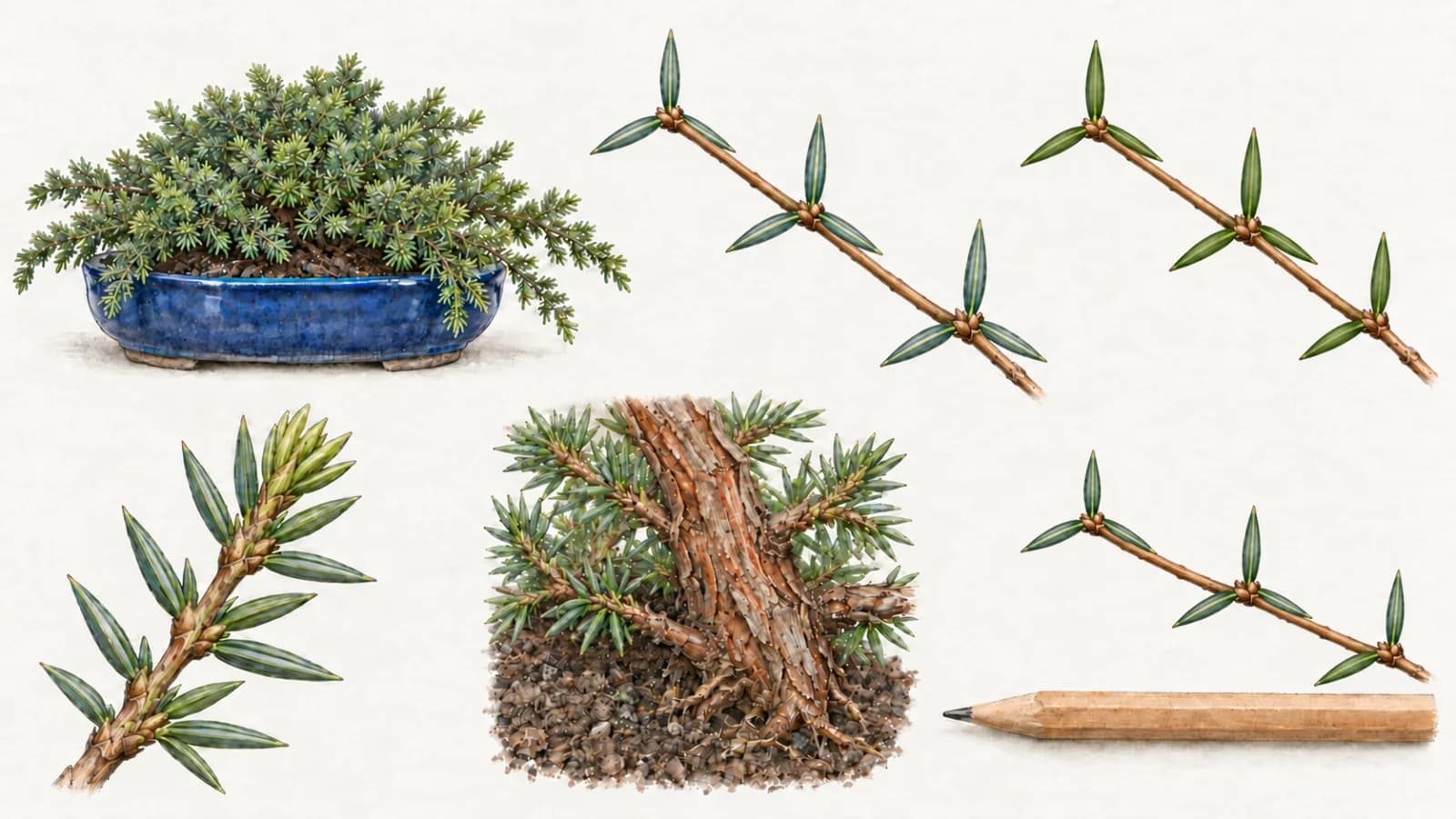
- Take good photographs in daylight: the whole tree, the leaves or needles close up from above and from below, a twig tip with its buds, the bark, and any flowers, fruit, or cones, with something of known size beside the close-ups.
- Treat a plant identification app as a first suggestion. Apps often recognize common plants in their usual form, but a small, pruned bonsai with reduced leaves or juvenile foliage can fool them. Check the suggestion feature by feature against a reliable description: leaf shape and arrangement, foliage, bark, and any flowers or cones.
- Ask people who know. A local bonsai club can usually name common bonsai trees from a photo, and specialist nurseries, botanic gardens, and extension services also identify plants.
Aim for two sources that agree, such as an app's suggestion confirmed by a club member, or a seller's name that matches a reliable description. Until then, treat the name as likely, not settled.
Practice check · not scored
Before you know what it is
An identification can take days or weeks, and the gift juniper is on a radiator in December, so some decisions cannot wait for it.
The bonsai decision
While you find out what it is
Starting point
Make no change you cannot undo until you know what the tree is and it has settled in: no pruning, wiring, repotting into new soil, or fertilizing. Note where and when it was bought and exactly what the tag says, and take the identification photos now (Lesson 8 builds this into an arrival record). Then place the tree by the most you can say about it with confidence:
- Clearly a juniper, like the gift juniper. It is temperate but not ready for frost. Move it off the radiator to a bright, cool spot that stays frost-free, such as an unheated room or an enclosed porch. Water only when the pot feels clearly lighter, because nothing can drain out of it. Do not settle it into a warm room for the winter; Lesson 3 plans the move outdoors.
- Not yet known to be temperate or tropical. Keep it bright, away from heaters, and above about 10 °C (50 °F) while you wait. That suits a tropical tree, and a stay of a week or two does a temperate tree little harm.
The missing drainage hole and the glued crust are container problems, not identity problems; Lesson 7 shows a proportionate fix.
This assumes
- The tree is green and firm, with no wilting, browning, or sour smell from the root zone.
- It is winter in a climate like the course's example, with frost outdoors.
- You have a bright place that stays cool but frost-free, and you can expect an answer within a week or two.
Change course if
- The name comes back as a temperate tree, as it will for any juniper: plan its gradual move outdoors with Lesson 3, and protect its potted roots from hard freezes.
- A tree of unknown kind turns out to be tropical, such as a ficus or a Fukien tea: a cool room is wrong for it. Give it warmth and the strongest light you can, and keep a ficus above about 10 °C (50 °F) at night.
- Your sources disagree, or no one can say: keep the placement that suits the likeliest answer, take the tree or its photos to a local bonsai club, and keep watching its new growth.
- Water stands in the pot, the root zone smells sour, or the foliage dulls or browns: do not wait for a name. Deal with the drainage first (Lesson 7) and look at the root zone; such symptoms have many possible causes (Course 07, Tree Health and Diagnosis).
Back to the question
What must you find out about a tree before you can look after it?
Its identity, ideally its scientific name down to species and cultivar, because the name lets you look up what decides its care: its light needs, its cold and heat tolerance (and how its roots fare in a pot), whether it needs a winter rest, and how it grows. Add where and how it was grown, which tells you what it is used to now. Leaf type, leaf habit, and shop tags are only starting clues. When the label is missing or unreliable, ask the seller, take good photos, treat an app's answer as a lead, and confirm the name with people who know.
Key takeaways
- A scientific name (genus, species, and any cultivar) points to one kind of plant. Common and trade names vary, overlap, and sometimes name no plant at all.
- For any tree, find out its light needs, cold and heat tolerance, whether it needs a winter rest, and its growth habit, plus where and how this tree was grown.
- Hardiness ratings describe acclimated plants in the ground. Roots in a pot are more exposed, and a tree from a warm room is not ready for frost.
- Broadleaf or conifer, evergreen or deciduous, and temperate, subtropical, or tropical are separate descriptions; trees that share a leaf type and leaf habit can need opposite winters.
- A shop tag is a starting clue, not a care plan. Confirm the identity with two sources that agree, and make no irreversible changes until you have.
Optional · not required for completion
Check a label against a reference
Find a labeled tree or shrub at a garden center, on a supermarket's plant shelf, or at home, and note exactly what the label says. Look up its scientific name in a reliable reference, such as a plant database run by a botanic garden or a university extension service. Which lines on the label match, which need checking, and which are wrong for that plant? If the label gives no scientific name, take the photos from this lesson and check an app's suggestion against a description.
No tree? Pick two trees from the grid exercise and look each one up by its scientific name. Note its hardiness range, its light needs, and whether it needs a winter rest, then decide where each could spend the winter where you live.
Go deeper · optional, not assessedReading scientific names on tags and in references
A few conventions turn up often:
- sp. after a genus, as in Juniperus sp., means one species that has not been identified; spp. means several. A tag reading Juniperus sp. is honest: the seller knows the genus and no more.
- var. (variety) and subsp. (subspecies) name natural groups within a species. They follow the species name, and the name after them is in italics, as in Juniperus chinensis var. sargentii.
- × marks a hybrid between species, as in Juniperus × pfitzeriana, the Pfitzer juniper, a hybrid of the Chinese juniper and the savin juniper.
- Some cultivars are sold under a trademarked selling name instead of their cultivar name; the cultivar name, in single quotes, is often somewhere in smaller print.
When botanists reclassify a plant, its old name becomes a synonym. The nursery juniper's species, for example, was first described as a variety of the Chinese juniper, Juniperus chinensis var. procumbens, and some references still list that name as a synonym.