Course 02 · Lesson 4 of 8 · Matching a tree to a place
Light: exposure, duration, and measurement
A spot can be sunny at noon in June and shaded all day in December, and a room can look bright while giving a tree a tiny share of outdoor light. Learn to map direct sun, read exposure labels, measure light at the foliage, and judge when a grow light helps.
The question
How much light would a tree really get in this spot?
By the end of this lesson, you will be able to:
- Map the direct sun a spot receives at foliage height through the day and across the seasons, and describe it as full sun, part sun or part shade, or shade.
- Explain why eyes and phone apps mislead about light, and compare spots using a light meter and the day's total light (DLI).
- Interpret signs that a tree is short of light or has had more than it is used to, and judge when a grow light can help.
About 16 minutes to read and explore
Two of this course's growing places look sunny to their owners. Both are instructional examples, like every case in this course.
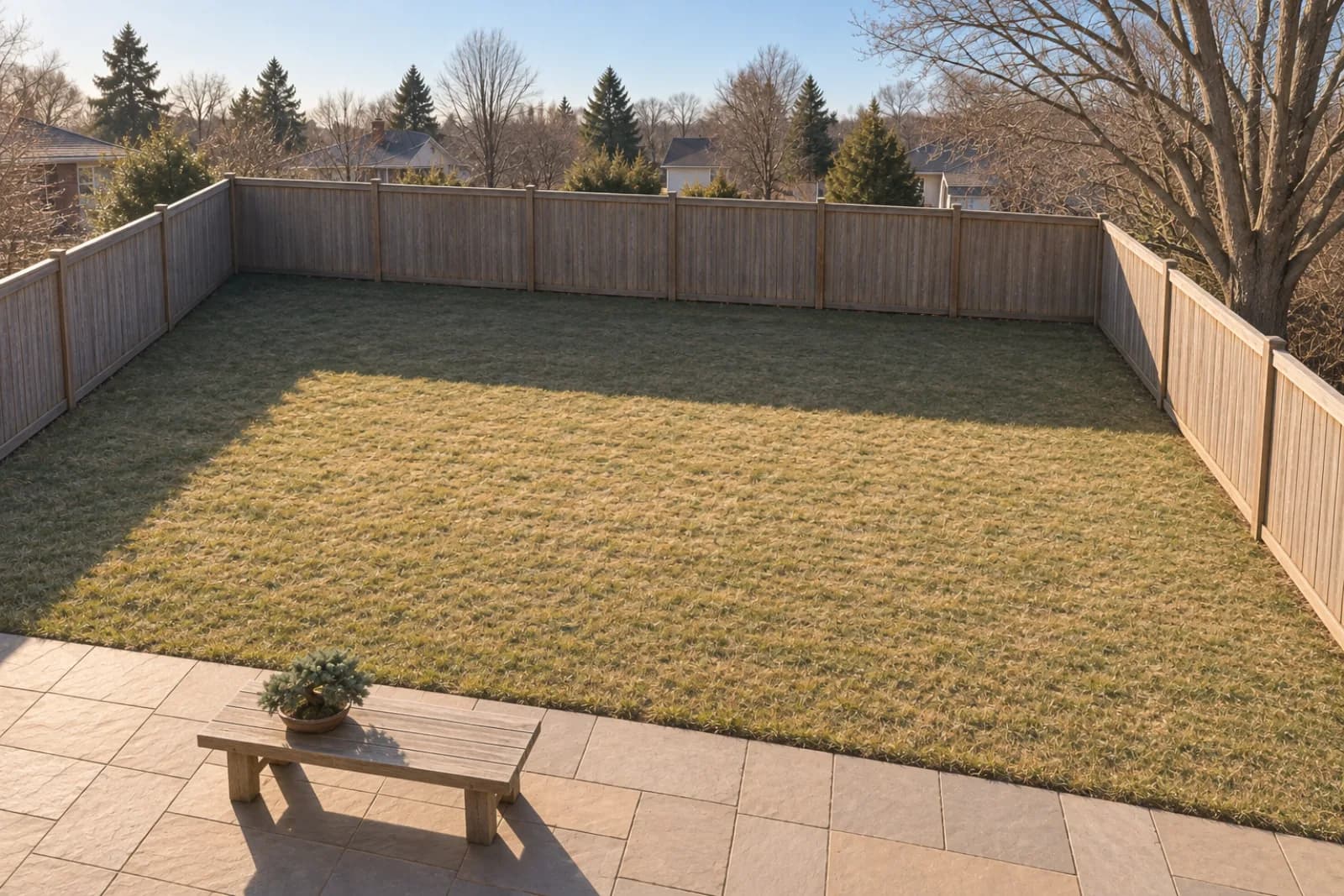
At noon on a clear June day, the small backyard looks sunny from fence to fence, and its owners decide that anywhere would suit the nursery juniper, which wants full sun all year. At noon in December, the south fence's shadow reaches far across the lawn, and the low southeast corner gets no sun at all.
Across town, the bright window's living room glows with daylight on a winter afternoon, and the sideboard 4 m (13 ft) from the window looks bright enough to read by. For a ficus on that sideboard, it is a dim place, with less than one percent of the light on the sidewalk outside.
A glance at noon misses how sun and shade move through the day and the year, and eyes make a living room and a sunny street look alike. This lesson replaces the glance with a method: map the direct sun, count it in hours, and measure light where the leaves will be.
Light at the foliage: how strong and how long
Leaves build sugars with light energy, and indoors, light is usually a bonsai's limiting factorWhichever necessary resource or condition, such as light, water, carbon dioxide, temperature, or a mineral nutrient, is in shortest supply and so caps how fast a process like photosynthesis can go. Adding more of anything else brings little benefit until it is addressed.Open the glossary (Course 01, Lesson 6). Each leaf works only with the light that reaches it (Course 01, Lesson 4), so what counts is the light at the foliageA tree's leaves or needles considered together: the living surfaces where light is captured, carbohydrates are made, and gases and water vapor pass to and from the air. The amount, health, and light exposure of the foliage largely set how much carbohydrate a tree can make, one of the main limits on its growth.Open the glossary, not at your eye level or a step away.
Two things set a leaf's light for the day. One is how strong the light is: direct sun is by far the strongest, open sky alone (shade with a wide view of the sky) is weaker but still substantial, and light deep in a room or under a dense canopy is much weaker. The other is how long it lasts: two hours of direct sun and eight hours of it are different days for a leaf, even when both spots look equally sunny at noon. This lesson counts hours of direct sun outdoors first, then measures strength indoors, then combines the two in one number.
Map the direct sun outdoors
The most useful outdoor observation needs no equipment: when direct sun reaches the spot, at the height where the foliage will be. A pot's leaves sit about 30 cm (1 ft) up on the ground and nearer 1 m (3 ft) on a bench, and a fence can shade the first and miss the second. On a clear day, check the spot every hour or two from morning to evening, or photograph it from the same place each time, then add up the hours of direct sun and note when they come. Shade moves with the seasons, so repeat the check in two or three of them.
The shadow test
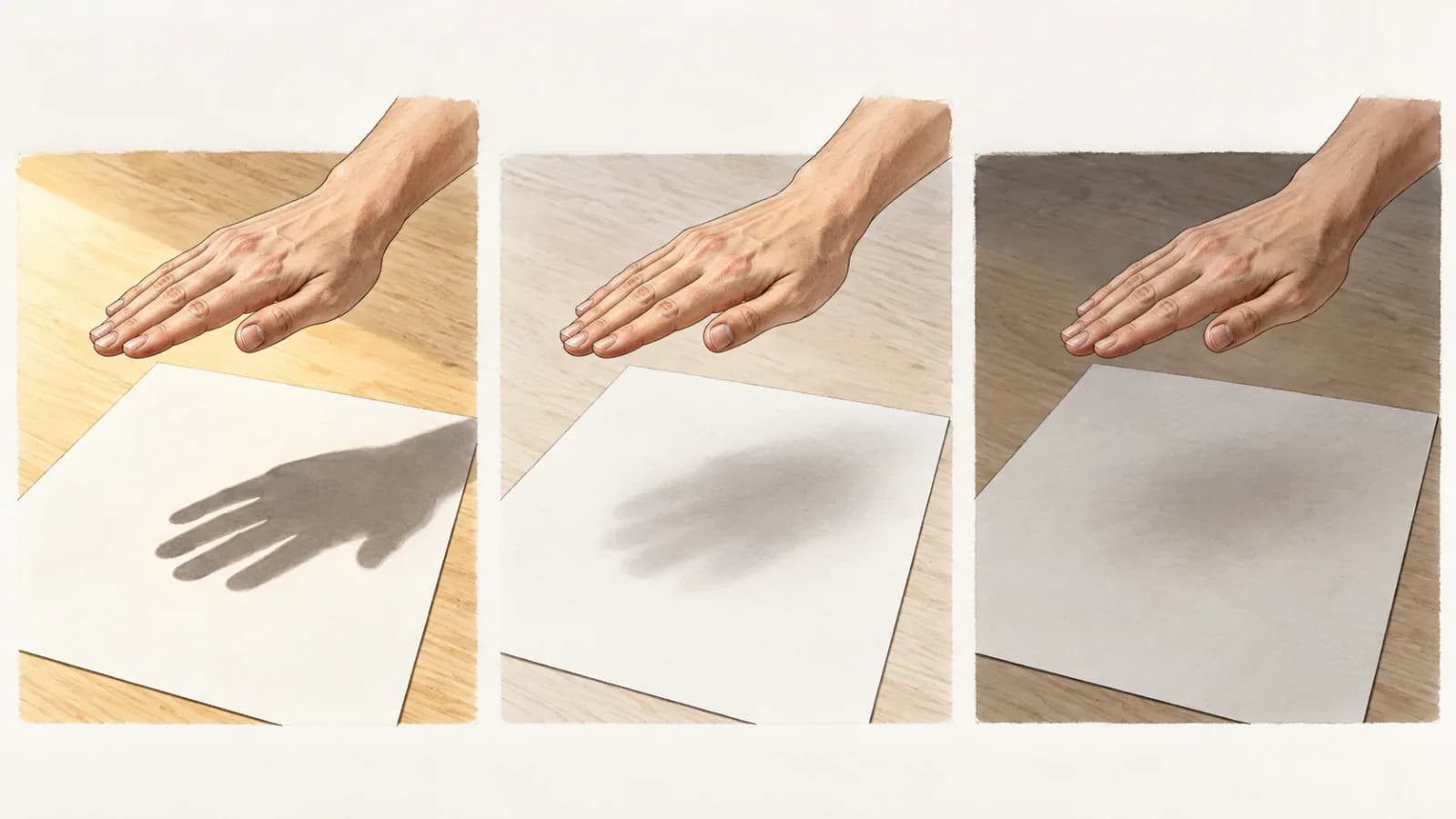
To tell direct sun from bright shade, hold your hand about 30 cm (1 ft) above a sheet of white paper at foliage height:
- A crisp, dark shadow with sharp edges means direct sun.
- A soft, blurred shadow means bright indirect light, such as open shade with plenty of sky in view.
- A faint shadow, or none, means low light.
The test sorts light into rough classes; it does not measure it, and under heavy cloud every shadow is soft. It works indoors too: on the bright window's sill, the shadow is crisp while the sun is on the sill and turns soft once the sun moves off.
The sun's path changes with the seasons
This course's cases are in the Northern Hemisphere, around 40° N, where the sun crosses the southern sky and south-facing walls and windows are the sunny side. In the Southern Hemisphere, swap north and south.
At noon in midsummer, the sun stands about 73° above the horizon; at noon in midwinter, only about 27°, and a low sun throws long shadows. The day's length changes too. In midsummer the sun rises in the northeast before 5 am (sun time) and sets in the northwest after 7 pm, about 15 hours later, so even a north-facing wall catches some early and late sun. At the equinoxes in March and September, it rises due east and sets due west 12 hours later. In midwinter it stays low in the southern sky for about 9 hours.
Predict first
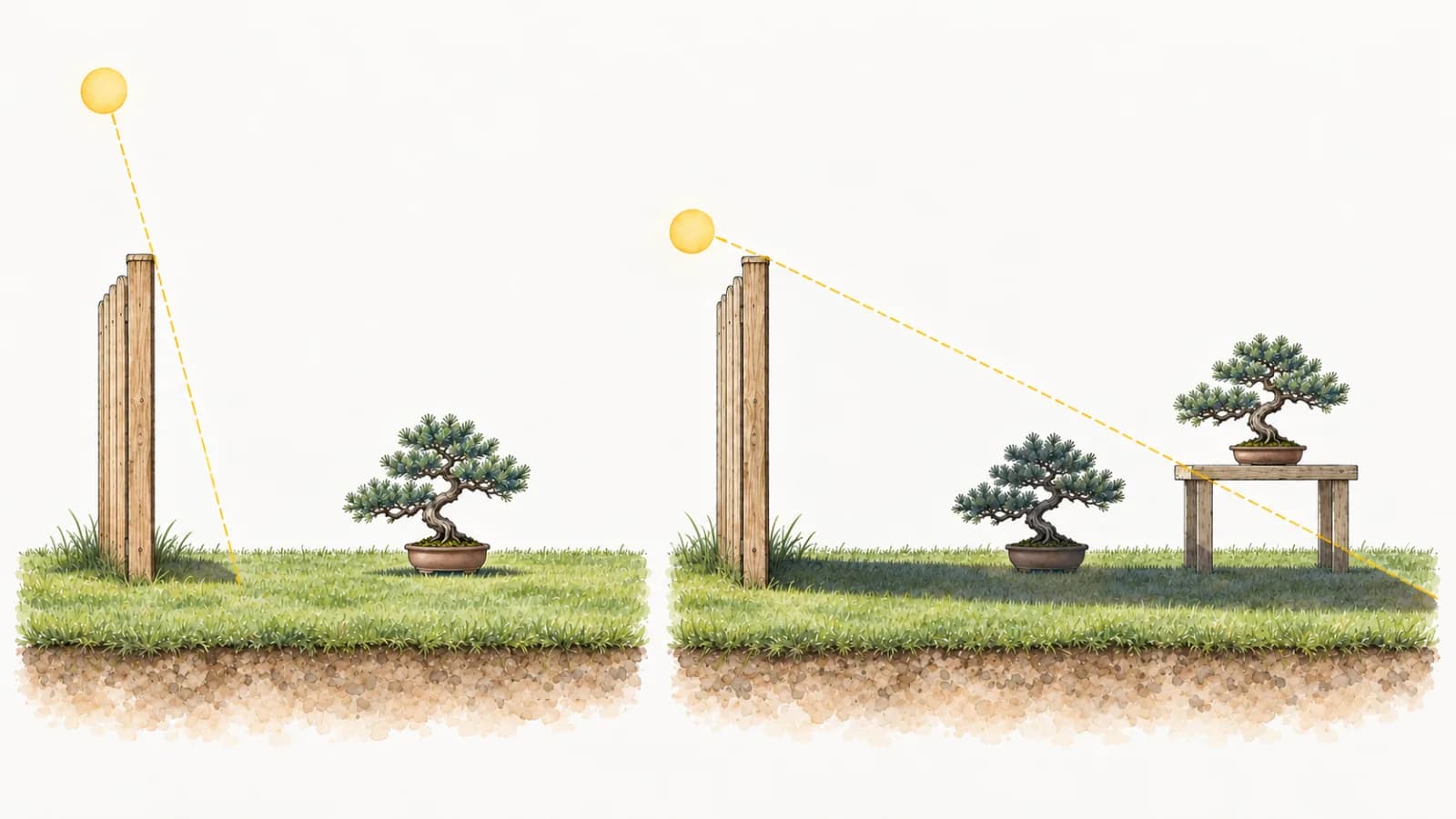
In midsummer, with the noon sun about 73° up, the shadow reaches only about half a meter (under 2 ft), so the pot is in sun. In midwinter, with the sun about 27° up, it reaches about 3.5 m (12 ft), twice the fence's height, and longer still in the morning and afternoon: the pot sits in shade all day. The map below shows what a bench would do.
What casts shade, and when
Anything between a spot and the sun shades it, but only while the sun is behind it:
- Buildings, walls, and fences shade the side away from the sun, a strip that is narrow in summer and wide in winter. The ground in front of a south-facing wall gets sun most of the day, all year.
- deciduousDescribes a tree that drops all its leaves for part of each year, usually before winter or a dry season, and grows new ones when growth resumes. Most deciduous trees are broadleaves, like the trident maple, but a few conifers, such as larches, are deciduous too.Open the glossary trees cast dense shade in leaf and only thin shade when bare, and a tall tree's shadow can land well away from its trunk.
- Evergreen trees and hedges shade much the same way all year.
The small backyard has all of them: the house along the north side, with its south-facing wall and a paved patio facing the yard; a wooden fence 1.8 m (6 ft) tall on the other three sides; and a neighbor's large deciduous maple just beyond the west fence. In Where does the sun fall in the backyard?, start with Midsummer and Ground, press Play or move the Time of day slider, and watch the shade cross the yard. Beside the map, Direct sun at each spot adds up each spot's hours for the whole day and names its exposure. Then switch Season to Midwinter, try Bench, and compare Spring equinox with Autumn equinox. Finish with the four Challenges; each Set the map button chooses the season and height for you. Times are sun time: a summer clock reads about an hour later.
Animation
Where does the sun fall in the backyard?
Direct sun at each spot
Midsummer · Ground · about 15 hours of daylight
Spot A: Patio, against the house wallFull sun
About 7 hours, early morning to early afternoon · Now: in sun
Spot B: Middle of the lawnFull sun
About 9 hours, early morning to early afternoon · Now: in sun
Spot C: West fence, under the maplePart sun or part shade
About 5 hours, in the morning · Now: in sun
Spot D: Near the south fenceFull sun
About 9 hours, early morning to mid-afternoon · Now: in sun
Spot E: East fencePart sun or part shade
About 5 hours, late morning to mid-afternoon · Now: in shade
Spot F: Southeast corner, the low spotFull sun
About 6 hours, late morning to mid-afternoon · Now: in shade
- Full sun
- 6 hours or more of direct sun
- Part sun or part shade
- About 3 to 6 hours
- Shade
- Less than about 3 hours
Challenges
0 of 4 solved
Full sun in every season
The nursery juniper stays outdoors all year and wants full sun. On the ground, which spot gets full sun at both equinoxes, in midsummer, and in midwinter?
Morning sun, afternoon shade
A trident maple's leaves can scorch in hot afternoon sun. In midsummer, on the ground, which spot gets its sun in the morning and is shaded from about midday on?
Lift it out of the fence's shadow
In midwinter, which spot gets no direct sun on the ground but a few hours of sun on a bench?
Same sun, different shade
The sun takes the same path across the sky at both equinoxes, but the maple is bare in March and in leaf in September. On the ground, which spot gets much more sun in March?
Text description
A plan of the small backyard seen from above, with north at the top. The house fills the north side: its south-facing wall and a paved patio run along the yard's north edge. A wooden fence 1.8 m (6 ft) tall closes the east, south, and west sides. A neighbor's large maple stands just beyond the west fence, and its crown, about 11 m (36 ft) across, overhangs the western part of the yard. Lawn fills the rest. The yard is about 12 m (40 ft) wide and 9 m (30 ft) deep.
Six spots where a pot could stand:
- A, patio, against the house wall: on the paved patio, against the house's south-facing wall, a little east of center.
- B, middle of the lawn: in the open, in the middle of the lawn.
- C, west fence, under the maple: about 1 m (3 ft) from the west fence, under the edge of the maple's crown.
- D, near the south fence: on the lawn, under 2 m (about 6 ft) north of the south fence.
- E, east fence: against the middle of the east fence.
- F, southeast corner, the low spot: tucked into the southeast corner, where the east and south fences meet.
The plan sits inside a band that stands for the horizon, with the compass points around it. The sun is drawn on that band in the direction its light comes from, with a faint beam toward the yard. A pale arc with a dotted line marks the directions the sun passes through on the chosen day, with a dot at each hour. How high the sun stands is shown above the map in words (low, part way up, high, or very high) and by a small post whose shadow grows long when the sun is low.
- Spring and autumn equinox: the sun rises due east around 6 am, climbs about halfway up the southern sky by noon, and sets due west around 6 pm, about 12 hours later. The sun takes the same path on both days, but the maple is bare in March and in leaf in September.
- Midsummer: the sun rises in the northeast before 5 am, climbs very high in the south by noon, and sets in the northwest after 7 pm, about 15 hours later. The maple is in leaf.
- Midwinter: the sun rises in the southeast after 7 am, stays low in the southern sky, and sets in the southwest before 5 pm, about 9 hours later. The maple is bare.
Shade is drawn on the surface at the chosen height: the ground, or a bench top about 80 cm (2.6 ft) up. Shadows point away from the sun and grow long when the sun is low. A fence casts a shorter shadow at bench height, because less of the fence stands above the foliage. The house can shade the patio only when the sun is north of due east or due west, early and late on summer days. The maple casts dense shade when in leaf; bare, its branches cast only thin shade, which counts as direct sun here.
Each spot's marker turns yellow with rays while it is in direct sun, dark while it is in shade, and dappled with broken rays while the sun reaches it through bare branches. The table lists, for the chosen season and height, each spot's hours of direct sun, when in the day they come, and the label a nursery tag would use: full sun (6 hours or more), part sun or part shade (about 3 to 6 hours), or shade (less than about 3 hours).
Controls: Season, Height, a Time of day slider from sunrise to sunset, Play or Pause to run the day, Back and Next to move by the hour, and Replay. Four challenges each ask you to pick a spot, with feedback for every choice.
The patio against the house wall had full sun in every season. Fence shadows grew long in winter: near the south fence, a pot on the ground got no direct sun in midwinter but about 5 hours on a bench, and the southeast corner stayed in shade at both equinoxes and in midwinter. Under the maple, the low winter sun shone in beneath the crown at midday, while in midsummer the leafy crown shaded that spot from late morning on. And the maple reached well beyond its own corner: by mid-afternoon in midsummer, its shadow covered the patio and the east fence spot.
Two patterns are easy to miss. In midsummer, the west fence and east fence spots each got about 5 hours and the same label, but the west fence spot got its hours in the morning and the east fence spot from late morning into the hot afternoon. And at the equinoxes, when the sun takes the same path, the patio got nearly three more hours in March than in September: sun through the maple's bare branches that its leaves blocked in September.
Full sun, part sun, shade: reading the labels
Nursery labels and plant references sum up hours of direct sun in the growing season in a few words:
- full sunA label for a spot that gets about six hours or more of direct sun a day in the growing season. Trees sold as needing full sun, such as junipers, grow weakly and thin out with much less, but the label does not say when the hours come, and hot afternoon hours are harder on leaves than morning ones.Open the glossary: about six hours or more of direct sun a day.
- partial shadeA label for a spot that gets about three to six hours of direct sun a day, or light, broken shade for much of it. Some labels use part sun for the sunnier end of this range and part shade for the shadier end. Trees whose leaves scorch in hot afternoon sun, such as the trident maple, often do well with morning sun and afternoon shade.Open the glossary: about three to six hours, or light, broken shade much of the day.
- Shade: less than about three hours.
These are conventions, not measurements, and sources vary: some use “part sun” for the sunnier end of the middle range and “part shade” for the shadier end. Labels also leave out when the hours come. Afternoon sun lands on leaves and pots that have been warming since morning, when the air is hottest and evaporative demandHow strongly the surrounding air draws water vapor from leaves, rising with sun, heat, dry air, and wind. High evaporative demand can make a tree lose water faster than reduced or damaged roots can replace it.Open the glossary is highest (Course 01, Lesson 8), so six afternoon hours are harder on leaves that can scorch than six morning ones.
Match the label to the tree (Lesson 2). The nursery juniper wants full sun outdoors all year. The trident maple grows in full sun to part shade, and in a hot summer like the example climate's it often does best with morning sun and afternoon shade. The ficus wants the strongest light you can give it, and indoors even the best spot gets far less light than open sky outdoors, as the rest of this lesson shows.
Practice check · not scored
Indoors, light fades fast
Indoors, most of a tree's light is skylight through the glass, and the share of sky a leaf can “see” sets how much it gets:
- Distance from the glass. A step back, the window frame narrows the sky to a small patch; across the room, a leaf sees mostly walls and ceiling. A few steps back often leaves only 1 to 5 percent of the light outdoors.
- Which way the window faces. In the Northern Hemisphere, south-facing windows get the most direct sun, especially in winter; east-facing windows get morning sun, west-facing windows hot afternoon sun, and north-facing windows mostly skylight.
- What is in the way. Buildings and trees outside, overhangs, screens, tinted glass, and sheer curtains all take a share, often more than they seem to.
- The season. The low winter sun reaches deep into a south-facing room; the high summer sun shines in only a short way, if at all.
The bright window shows that last point. It faces south, with a sill 25 cm (10 in) deep, a radiator below, a sheer curtain, and low buildings across the street. On clear winter days, direct sun lands on the sill from late morning to mid-afternoon; in summer the high sun barely reaches inside, so the sill gets bright indirect light most of the day and can get less light in June than in January.
Why your eyes are poor light meters
Course 01, Lesson 6 ended with a test: carry white paper from a few steps inside a sunny window out into open sky, and notice how quickly both places come to look bright. Your pupils and retinas adjust within seconds to minutes, so a scene looks normally lit across an enormous range of light, and eyes judge brightness against the surroundings. That is excellent for seeing and poor for measuring. A leaf gets no such correction: its chloroplastA tiny green structure inside leaf cells and other green cells where light energy is used to make sugars from carbon dioxide and water. It holds chlorophyll, the pigment that captures that light.Open the glossary can use only the light that actually arrives.
Measuring light: lux, PPFD, and the day's total
A light meter does not adjust to the room. Three measures are worth knowing:
- luxThe metric unit for how bright light is on a surface, weighted by how sensitive human eyes are to each color; one foot-candle is about 10.8 lux. A lux meter is a simple way to compare spots lit by daylight, but it does not measure the light plants use directly, especially under grow lights.Open the glossary measures brightness on a surface, weighted by how sensitive human eyes are to each color; some meters show foot-candles (one is about 10.8 lux). An inexpensive lux meter is the simplest way to compare spots. But eyes are most sensitive to green-yellow light and much less to the red and blue that photosynthesis uses well, so lux is only a stand-in for plant light: fine for comparing daylit spots, misleading under grow lights.
- PPFDPhotosynthetic photon flux density: how many photons of the light photosynthesis uses, wavelengths from 400 to 700 nanometers, land on a square meter each second, in micromoles per square meter per second (µmol/m²/s). It is measured with a quantum sensor, and grow-light makers publish it in a light map.Open the glossary, photosynthetic photon flux density, counts the photons of photosynthetic light (wavelengths from 400 to 700 nanometers) landing on a square meter each second, in micromoles per square meter per second (µmol/m²/s). A quantum sensor, sometimes sold as a PAR meter, measures it.
- The daily light integralThe total photosynthetic light that lands on a square meter over a whole day, in moles per square meter per day (mol/m²/day). Because it combines how strong the light is with how long it lasts, it is the most useful single number for comparing spots: summer sun outdoors gives tens, a windowsill a few, and the middle of a room under one.Open the glossary (DLI) totals that light over a whole day, in moles per square meter per day (mol/m²/day). Because it combines strength and duration, it is the most useful single number for growth.
Ballpark values, all rough:
| Place | Light at midday |
|---|---|
| Full summer sun, open sky | About 100,000 lux (about 2,000 µmol/m²/s) |
| Bright open shade outdoors | About 10,000 to 25,000 lux |
| A sill in direct winter sun, through glass | A few tens of thousands of lux, while the sun is on it |
| A few steps back from a window | Often only 1 to 5 percent of outdoors |
| Typical room lighting | About 300 to 500 lux |
Over a whole day, full sun outdoors in summer often gives a DLI of 30 to 60 mol/m²/day, an indoor windowsill a few up to about 10, and the middle of a room under 1. To measure, hold the sensor flat at foliage height, keep your shadow off it, and compare spots read at about the same time on the same kind of day.
Your eyes versus a light meter shows the bright window's living room and the street outside it. For each of the six spots, read its “Looks dazzling” or “Looks bright” note and choose a level from Very high to Very low. Then press Show the light record, an example record from one clear late-winter day. Switch View between To your eyes and To a light meter, set Bar scale to Even steps, and turn on Phone app reading and Add a grow light.
Exercise
Your eyes versus a light meter
As your eyes see it
Midday, clear late-winter day · side view, south to the left · not to scale
Outdoors, across the street
Indoors, the living room
Step 1 · Predict
How much light would a tree's leaves get at each spot?
Each level compares a spot with full sun in open sky.
- Very higha third of open sky or more
- Highabout 1/10 to 1/3
- Moderateabout 1/30 to 1/10
- Lowabout 1/100 to 1/30
- Very lowunder about 1/100
Spot 1: Outdoors in open sky
Out in the sun on the sidewalk, with the whole sky overhead
Looks dazzlingYou squint at first, then your eyes settle and it just looks bright.
Spot 2: Outdoors in open shade
In the shadow of the low shop across the street, open sky above
Looks brightComfortable and easy on the eyes after the sun.
Spot 3: On the sill in direct sun
The window sill while the sun is on it, from late morning to mid-afternoon
Looks dazzlingA warm, glaring patch of sun. It feels as bright as outdoors.
Spot 4: On the sill without direct sun
The same sill while the sun is off it
Looks brightThe window glows, and the sill looks well lit.
Spot 5: 1 m back from the window
On a plant stand about one step from the glass, out of the sun
Looks brightThe room feels full of daylight.
Spot 6: Across the room
On a sideboard about 4 m (13 ft) from the window
Looks brightPleasant and easy to see. You could read here without a lamp.
0 of 6 predicted · predict all six for the best comparison, or look now
Text description
Two side views, with south to the left. Outdoors: a sidewalk across the street from an apartment, with the sun high in the south on a clear late-winter day and a low shop casting a shadow. Indoors: the living room behind a large south-facing window, with a 25 cm (10 in) deep sill, a radiator below it, and a sheer curtain pushed open. A beam of midday sun crosses the sill and lands on the floor. Ficus bonsai stand on the sill, on a plant stand 1 m back, and on a sideboard across the room.
Six numbered spots, each with how bright it looks to a person:
- Outdoors in open sky: out in the sun on the sidewalk, with the whole sky overhead. Looks dazzling: You squint at first, then your eyes settle and it just looks bright.
- Outdoors in open shade: in the shadow of the low shop across the street, open sky above. Looks bright: Comfortable and easy on the eyes after the sun.
- On the sill in direct sun: the window sill while the sun is on it, from late morning to mid-afternoon. Looks dazzling: A warm, glaring patch of sun. It feels as bright as outdoors.
- On the sill without direct sun: the same sill while the sun is off it. Looks bright: The window glows, and the sill looks well lit.
- 1 m back from the window: on a plant stand about one step from the glass, out of the sun. Looks bright: The room feels full of daylight.
- Across the room: on a sideboard about 4 m (13 ft) from the window. Looks bright: Pleasant and easy to see. You could read here without a lamp.
For each spot you predict the light level for a tree's leaves, compared with full sun in open sky: Very high (a third of open sky or more), High (about 1/10 to 1/3), Moderate (about 1/30 to 1/10), Low (about 1/100 to 1/30), Very low (under about 1/100). Then Show the light record opens an example record from one clear late-winter day: rounded lux-meter readings at the height of the foliage, each spot's share of open sky, and a rough day total, the daily light integral (DLI) in mol/m²/day. Every prediction then gets feedback on its card, and the record explains each reading.
What the record shows, in general terms: eyes adjust within moments to the light around them, so they make big differences look small. A light meter does not adjust, and neither does a leaf. Daylight fades quickly as you move back from a window, because each step back leaves less sky in view through the glass. Direct sun through clear glass is strong, but only for the hours it falls on a spot, so a spot's day total depends on both how bright it is and for how long.
The bars can use a scale where each step is ten times the last, which spreads out small readings, or even steps, which show true proportions. After the record opens, the drawing can switch between how the room looks to your eyes and how a light meter reads it, where the room darkens with distance from the window.
Two switches add more. Phone app reading compares three phone readings with the light meter at spot 5: phone light sensors are not calibrated, camera-based apps adjust themselves, and tilting a phone changes its reading, so a phone is useful only for comparing spots with the same phone held the same way. Add a grow light puts an LED grow light 30 cm above the plant at spot 5 on a 13-hour timer and compares its light and day total with daylight alone. A lux meter weights light by how bright it looks to human eyes, while photosynthesis uses photons from 400 to 700 nm, measured as PPFD with a quantum sensor, so converting lux to PPFD depends on the light source.
Four spots looked bright, yet the meter spread them across four levels: about 15,000 lux in open shade outdoors, 4,500 on the sill once the sun moved off, 1,500 one step back, and 300 across the room, a fiftieth of the open shade. Most people rate the indoor spots too high. The sunny sill read about 45,000 lux, half of open sky, but for only about four hours. Day totals: about 40 mol/m²/day in open sky, about 10 on the sunny sill (about 2 without its sunny hours), under 1 one step back, and about 0.1 across the room.
Phone apps: one phone, held the same way
Light-meter apps read the phone's ambient light sensor or its camera, which keeps adjusting its own exposure, and neither is calibrated. In the record's teaching example, two phones at the plant stand read about 900 and 2,000 lux where the meter read 1,500, and tilting one raised it to 2,400. Yet phone A read three times higher on the sill, out of the sun, than on the stand, the same ratio the meter found. So use one phone, held the same way, flat at foliage height, to compare spots with each other, never with a number from a book or another phone.
Practice check · not scored
Go deeper · optional, not assessedFrom a lux reading to a day's total
In daylight, each µmol/m²/s of photosynthetic light reads about 54 lux, so full summer sun at about 100,000 lux is roughly 1,850 to 2,000 µmol/m²/s. Other sources differ: the record's white LED reads about 67 lux per µmol/m²/s, and pink-purple LEDs far fewer.
For a steady PPFD, DLI is PPFD × hours × 3,600 seconds ÷ 1,000,000. The record's grow light: 200 × 13 × 3,600 ÷ 1,000,000 ≈ 9 mol/m²/day. Daylight rises and falls through the day, so for a spot lit only by sky, the day's average is roughly 0.64 (2/π) of the midday value. For the plant stand: 1,500 lux ÷ 54 ≈ 28 µmol/m²/s, and 28 × 11.5 hours × 3,600 ÷ 1,000,000 × 0.64 ≈ 0.7 mol/m²/day.
Adding light with a grow light
When the best window is not enough for a tree that can live indoors, a grow lightAn electric lamp made to supply light for photosynthesis, today usually an LED fixture. Mounted at the distance its maker's light map gives and run on a timer, it can make a tropical tree such as a ficus workable indoors, but it cannot give a temperate tree its outdoor seasons.Open the glossary adds light. A full-spectrum LED, giving white light, is the practical choice: it is efficient, gives off less heat than older lamps for the same light, and shows the leaves' true color.
- Mount it close, at the distance the maker's light map gives. Lamp light fades quickly with distance; the map shows the PPFD at several heights.
- Run it on a timer, often 12 to 14 hours a day, so the tree gets a steady day and a dark night.
- Watch the response. New growth with shorter internodeThe stretch of stem between two neighboring nodes. Internodes tend to be longer in vigorous or shaded growth and shorter in slow growth or strong light, and short internodes help a bonsai's branches look finer and more compact.Open the glossary and full-size leaves of normal color suggests it is helping; bleached patches on the top leaves suggest it hangs too close.
In the record, an LED 30 cm (1 ft) above the plant stand gives about 200 µmol/m²/s for 13 hours: about 9 mol/m²/day, about 10 with the daylight, roughly the sunny sill's clear-day total, delivered on cloudy days too.
A grow light can make a tropicalDescribes warm regions near the equator without a cold winter, and the trees adapted to them. Tropical trees such as ficus have no chilling requirement and can be damaged or killed by frost; their growth slows when light or warmth drops.Open the glossary tree such as the ficus workable indoors. It cannot make a temperateDescribes regions with distinct warm and cold seasons, and the trees adapted to them, which typically need a cool winter rest. Trident maples and the junipers commonly grown as bonsai are temperate trees and need seasonal outdoor conditions rather than a warm room all year.Open the glossary tree an indoor one: the nursery juniper and the trident maple need the outdoor seasons, with autumn cold and a winter rest (Course 01, Lesson 13), and no lamp supplies those (Lesson 3).
Signs from the tree
A light check shows what a spot offers; the tree's growth over the following weeks shows whether it is enough. Read these as signs, not diagnoses.
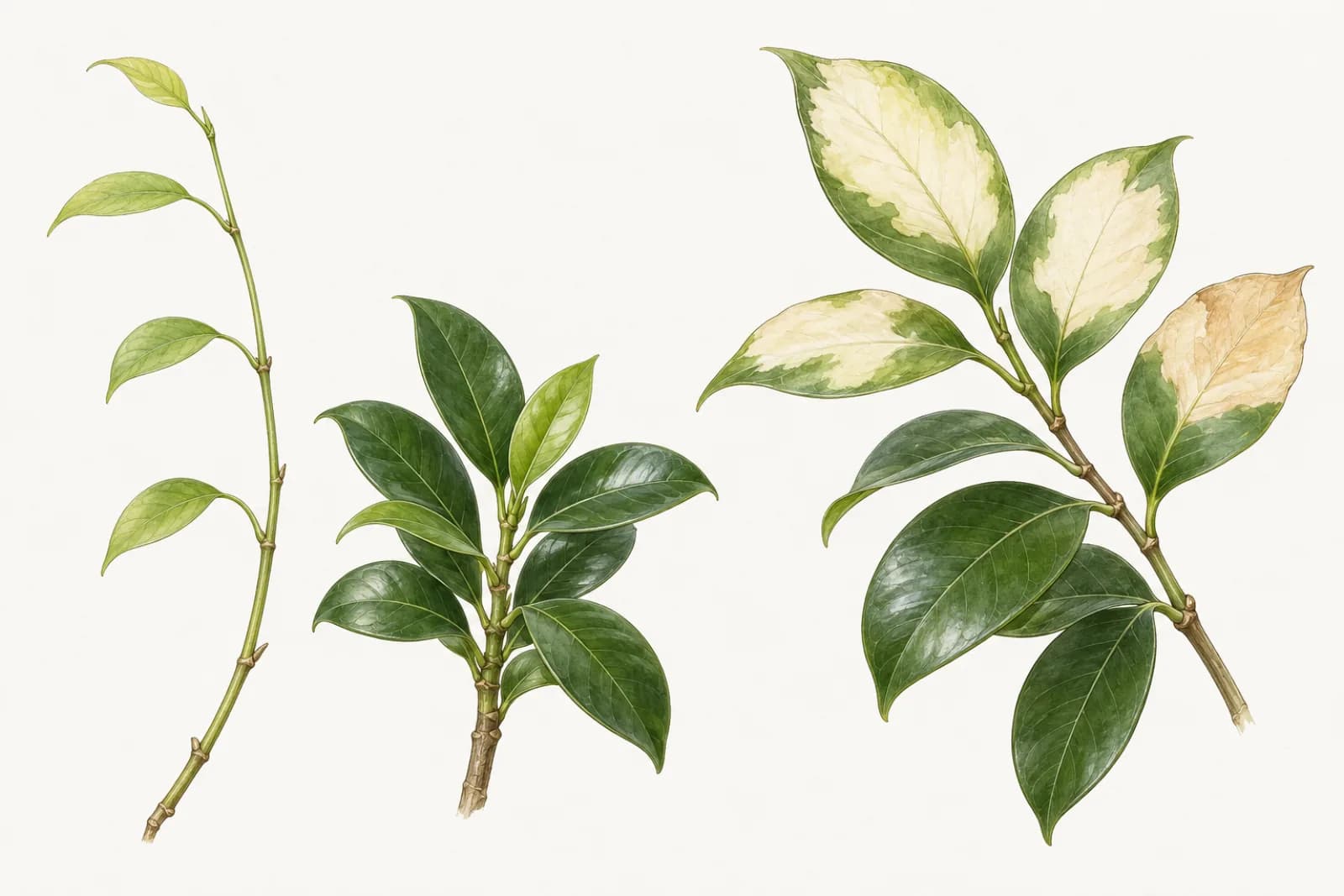
Too little light. etiolationGrowth stretched by too little light: long, thin, soft shoots with long gaps between leaves and small, often pale leaves. Strictly the word describes shoots grown in near darkness, but growers also use it for the leggy growth of dim indoor spots, a common sign, though not proof, that a tree needs more light.Open the glossary is growth stretched by low light: long, thin, soft shoots with long internodes and small, widely spaced, often pale leaves. The tree may lean toward the window, and shaded inner leaves may yellow and drop; a juniper kept indoors may only thin and slowly decline. Each sign has other possible causes, from a recent move to root trouble, so check the light and the root zone together (Course 07, Tree Health and Diagnosis).
More light than the leaves are used to. Leaves that grew in dim light are thinner shade leafA leaf that grew in dim light, such as in a window, under greenhouse glass, or deep inside a canopy. It is thinner and often larger than a leaf grown in sun, with a thinner cuticle and fewer layers of light-catching cells, so it uses weak light well but bleaches or scorches if moved suddenly into strong sun.Open the glossary (Lesson 3). Moved suddenly into strong sun, or under a grow light hung too close, they can show bleached, whitish, or brown patches within days on the side facing the light. For a tree that wants strong light, that usually means the change came too fast, not that the spot is wrong: step exposure up over a week or two or more. Heat, drying wind, and a dry root ball can brown leaves too, as leaf scorchBrowning and drying of leaf edges, tips, and the tissue between the veins when leaves lose water faster than the roots can replace it, as in hot sun, wind, or dry air. Thin shade leaves moved suddenly into strong sun scorch the same way, often after pale, bleached patches. It is a symptom, not a diagnosis: a dried-out root ball, damaged roots, or salt buildup can cause the same browning.Open the glossary (Lesson 5), so look at where and when the damage appeared.
Practice check · not scored
A one-week light check
The bonsai decision
Check a spot's light before a tree depends on it
Starting point
Before you place a tree, or choose one for a spot, check the light at foliage height for about a week:
- Outdoors: on at least two clear days, note sun or shade every hour or two with the shadow test, or photograph the spot from the same place. Add up the hours of direct sun, note when they come, and name the exposure.
- Indoors: note when direct sun reaches the spot, then take readings around midday with one meter or one phone held flat, on the spot and a step to either side.
- Compare with the tree's needs: full sun outdoors for the nursery juniper; full sun with afternoon protection in hot summers for the trident maple; the strongest light you can give for the ficus.
- Record it in your site profile (Lesson 1), and repeat the check as the seasons change, at least near midsummer and midwinter.
This assumes
You check on clear days, so the record shows what the spot can give, and at the height where the foliage will actually sit. You know roughly what light the tree needs, or are finding out (Lesson 2). Nothing nearby is about to change, such as a growing hedge or a new building.
Change course if
- The week is mostly cloudy. Check again on clear days. For a tree indoors, long cloudy spells are when a grow light earns its place.
- The season turns. Shadows lengthen toward midwinter, and nearby deciduous trees leaf out and drop their leaves. Check again before moving a tree to its summer or winter spot.
- The hours come at the wrong time. For leaves that scorch in hot afternoon sun, such as the trident maple's, look for morning sun and afternoon shade, or plan afternoon protection (Lesson 5).
- The tree disagrees with the readings. Stretched, pale growth or inner leaf drop over several weeks, while the root zone seems fine: give more light, or for a temperate tree, a place outdoors. Bleached patches soon after a move: give partial shade for a while, then step exposure up gradually.
- Indoors, the best spot still reads low. For a tropical tree, add a grow light. For a temperate tree, the answer is outdoors, not more lamps.
Back to the question
How much light would a tree really get in this spot?
Count and measure instead of glancing. Outdoors, a spot's light is mostly its hours of direct sun at foliage height, which change with the time of day, the season, the pot's height, and what stands between the spot and the sun; the labels sum them up as full sun (about six hours or more), part sun or part shade (about three to six), or shade (less than about three). Indoors, light falls steeply with distance from the glass and eyes hide it, so measure at the foliage with one instrument held the same way and compare day totals: tens of mol/m²/day outdoors in summer, a few on a windowsill, under 1 across a room. Then let the tree's new growth confirm the answer.
Key takeaways
- What counts is the light at the foliage, and a day's light depends on both how strong it is and how long it lasts.
- Map direct sun at foliage height through the day and across the seasons: the sun is higher and up longer in summer, and buildings, fences, and deciduous trees cast shade that changes with the seasons.
- Full sun means about six hours or more of direct sun, part sun or part shade about three to six, and shade less than about three. Hot afternoon hours are harder on leaves than morning ones.
- Eyes adapt and phones are uncalibrated, so measure with one instrument held the same way. Lux compares daylit spots, PPFD measures the light photosynthesis uses, and DLI totals the day.
- A grow light can make a tropical tree workable indoors but cannot replace a temperate tree's outdoor seasons. Stretched shoots often signal too little light; bleached patches soon after a move often mean the extra light came too fast.
Optional · not required for completion
Map one spot for a day
Choose one spot where a tree could stand. On a clear day, at foliage height, do the shadow test every hour or two from morning to evening and note sun or shade with the time. Add up the hours of direct sun. Which label fits, and when do the hours come? If you have a light meter or a phone app, compare a midday reading there with one a few steps away, using the same instrument held flat.
No tree? You don't need one. If you have no outdoor space, run the same check at your brightest window: on the sill, one step back, and across the room.