Course 06 · Lesson 5 of 7 · Rest, climate, and the year's plan
Cold, frost, and winter protection
A pot leaves roots exposed to cold that the ground would keep away from them, and roots are less cold hardy than the branches above. Learn to plan winter protection from what your tree tolerates, how cold it gets, and for how long, and to keep checking moisture all winter.
The question
Why can a tree that is hardy in the ground die in a pot over winter?
By the end of this lesson, you will be able to:
- Explain why roots in a container are at more risk from cold than the shoots above them or the same roots in the ground.
- Plan winter protection from a tree's verified tolerance, its acclimation, the site's exposure, and how long the cold lasts.
- Keep checking moisture through winter, and recognize a shelter that fails by being too cold, too dry, or too warm.
About 18 minutes to read and explore
January on the west balcony. Like every case in this course, it is an instructional example, set in one temperate Northern Hemisphere city at about 40° N (USDA zone 7a), where the coldest night of a typical winter is about −15 to −17 °C (0 to 5 °F). On the afternoon of January 12 the owner is packing for a work week, and the forecast shows a cold snap on the way: six nights of −12 to −16 °C (3 to 10 °F) on a northwest wind, with afternoons that stay below freezing. The trident maple (Acer buergerianum) in its 25 cm (10 in) terracotta training pot has been bare since late November, and the two Japanese garden junipers (Juniperus procumbens ‘Nana’), the gift juniper and the nursery juniper, in black plastic pots of 22 and 20 cm (9 and 8 in), have taken on their dull bronze winter color.
On paper, all three have cold to spare. The trident is rated hardy to about zone 5 and the junipers to about zone 4, about two and three zones colder than the city (Course 02, Lesson 1). They have even lived through nights like these. Last January, just before the warm February that brought the spring on early, a cold snap came while the owner was away, the friend who waters had no instructions for cold, and the junipers spent four nights of about −13 °C (9 °F) on the open slatted shelf, the coldest spot on the balcony on a winter night (Course 02, Lesson 5). Both came through, although by March the gift juniper's foliage had browned along its south side. So does “hardy here, with zones to spare” mean the pots could simply stay in the open?
In October, working with the club member, the owner decided that it does not. Since the last week of November all three pots have stood sunk to their rims in a crate of bark against the back wall, the least cold spot on the balcony, with a blanket folded beside it and a card that tells the friend what to do when the forecast turns this cold.
This lesson explains why the roots are the part of a potted tree that winter threatens, and why a pot leaves them far colder than the ground would. It shows how to protect them while the tree itself stays cold and resting, how each kind of protection can fail, and how to keep checking moisture until spring.
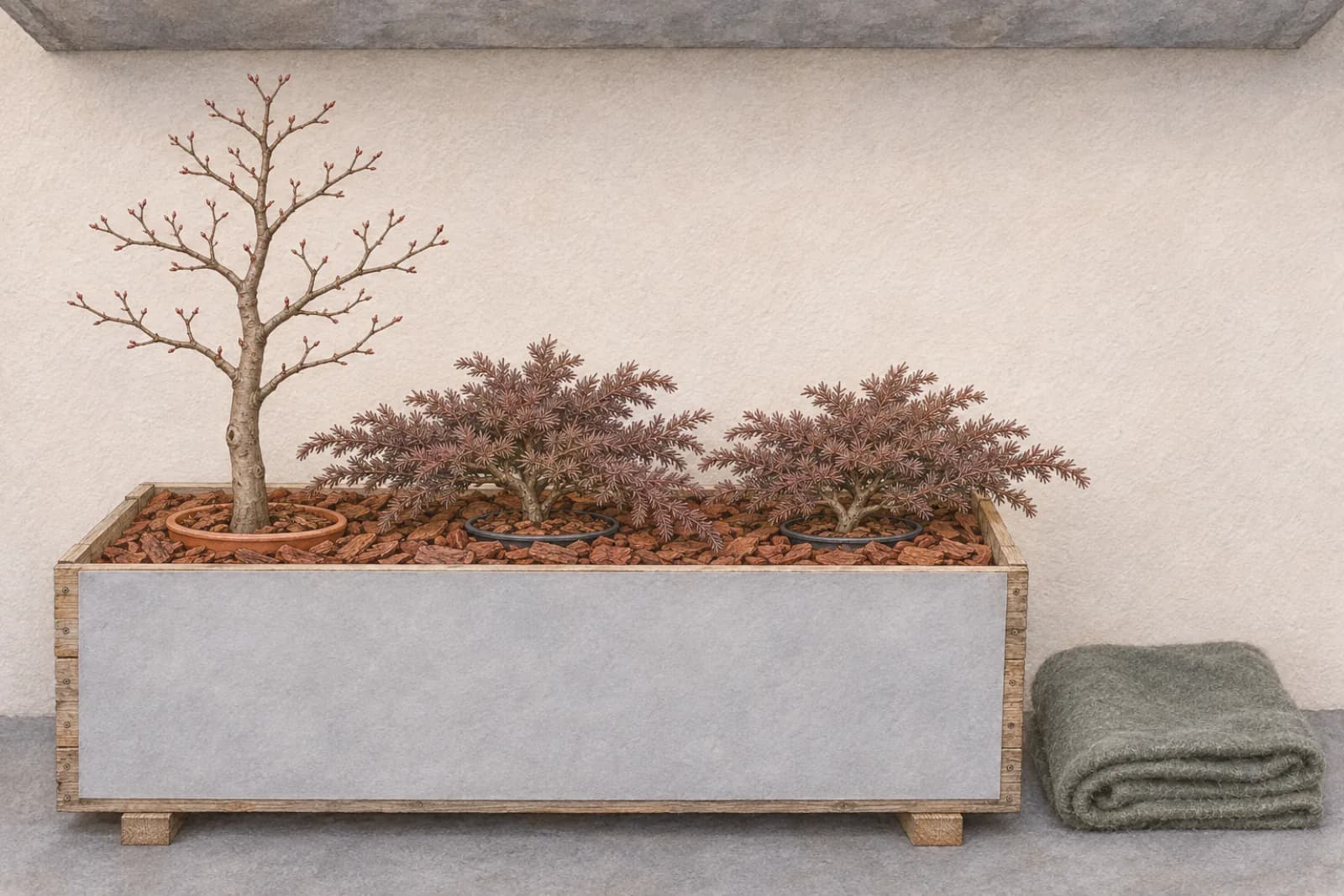
Predict first
The roots. Once a juniper is ready for cold, its foliage survives nights far colder than this city's coldest, but its roots are generally less cold hardy than its shoots. In the ground they would sit in soil that freezes only near its surface; in a small pot on an open shelf, with afternoons that never thaw, the root ball freezes through and follows the air down over six nights. The foliage's risk is drying: on sunny or windy days it loses water that frozen roots cannot replace.
The roots are the weak point
A tree's roots are generally less cold hardy than its branches, and in a pot they face colder temperatures than roots in the ground (Course 01, Lesson 13). In autumn, shortening days and then cooling nights bring on cold acclimationThe gradual process, triggered by shortening days and falling temperatures, in which a tree's tissues become able to survive freezing. A tree moved suddenly from a warm room into frost has not acclimated and can be badly damaged. It is not the same as shoots hardening, or turning woody, though the two often happen around the same time.Open the glossary in buds, twigs, and bark over several weeks (Lesson 4), and roots build much less of it, so a tree's root hardinessHow much cold a tree's roots survive. Roots are generally less cold hardy than the branches above them and gain less hardiness in autumn, and young roots are more tender than older ones. That is why a tree that is hardy in the ground can lose its roots in a pot, where they are far more exposed to the cold.Open the glossary, how much cold its roots survive, stays far below the hardinessA plant's ability to survive the conditions of a place, most often its cold hardiness: the coldest winter temperatures it can survive once it has acclimated to cold. Ratings such as hardiness zones describe plants growing in the ground; roots in a pot are more exposed, so a potted tree needs more protection than its rating suggests.Open the glossary of its branches in midwinter. NC State Extension's guide for nurseries, Preparing Nursery Plants for Winter, says so plainly: roots are generally less hardy than shoots and die at much milder temperatures.
The same guide prints a table of average root-killing temperatures, drawn from experiments on nursery plants grown in containers. UMass Extension, which prints the same data in Overwintering Container-Grown Ornamentals, defines each value as the temperature at the roots that killed more than half of the root system. A few rows show the range: about −5 °C (23 °F) for a saucer magnolia, −10 °C (14 °F) for a red-leaved Japanese maple, −18 °C (0 °F) for creeping juniper, and −23 °C (−10 °F) for white spruce. NC State's own summary is that plants whose branches come through freezing winters in the landscape may have roots that would normally be killed at about −7 to −4 °C (20 to 25 °F).
Set beside the far colder nights these plants' branches come through, the table shows the size of the gap, and the roots' limits differ from one kind of tree to another by more than 10 °C (18 °F). Young roots are hurt at milder temperatures than older ones, and in a pot many fine rootOne of the many thin, branching roots, often pale when young, that do most of a tree's absorbing of water and mineral nutrients. Fine roots live a relatively short time and are constantly replaced, so they depend on a root zone that holds both water and air.Open the glossary grow at the wall, where the freezing starts (Course 02, Lesson 5). So the damage is graded: a root ball can lose its young outer roots and keep its older core, and the tree may then leaf out late and weakly rather than not at all. That is why last January proves less than it seems: four nights near −13 °C (9 °F) are not six down to −16 °C (3 °F), and the junipers may have lost young roots that nobody saw. It is also the third reason Lesson 2 gave for sheltering the freshly repotted courtyard maple from frost: the part of a tree that cold harms first is the part a repot has just cut back, so the tree has less to spare.
What the table cannot do is speak for your tree, or tell you when to act. Each value is a temperature at the roots, not the air temperature in a forecast, and the point where more than half the roots died in an experiment, not a safe line: damage begins at milder temperatures. Nor does a relative's row carry over. The red-leaved Japanese maple is a relative of the trident maple, and creeping juniper of the Japanese garden juniper, but the table has no row for the trident maple, the Japanese garden juniper, the Chinese elm, the Japanese larch, or a Satsuki azalea, and no relative's number can stand in for them. No single temperature exists at which bonsai need protection.
Hardiness also moves through the year: built through autumn, at its most in midwinter, and lost quickly once the buds swell, the deacclimationThe loss of cold hardiness as a tree leaves its winter rest and begins to grow, while its buds swell and open and its first leaves come out. It happens faster than hardiness was built in autumn, and what a warm spell takes away is only partly regained if cold returns. It is the reverse of cold acclimation.Open the glossary of Lesson 2. A rating describes a tree at its midwinter best. A tree that spent the autumn in a warm room, or came from a heated greenhouse, has hardly begun, and needs a cool, bright, frost-free place, never a warm one, while it adjusts (Course 02, Lesson 3).
A hardiness rating describes a tree in the ground
A plant label's zone comes from the same map as the city's (Course 02, Lesson 1). The USDA map sorts places into hardiness zoneAn area on a map defined by how cold its winters get, usually measured as the average of the coldest temperature reached each winter. In the USDA system each zone spans 10 °F (about 5.6 °C), split into halves a and b, and plant labels name the zones where a plant survives winter in the ground. Roots in a pot are more exposed, so a tree in a pot needs hardiness to spare.Open the glossary by the average, over the winters from 1991 to 2020, of each winter's coldest night, and a plant's rating names the zones where it survives that night planted in the ground. The map's own guidance lists what the number leaves out, among them how long the cold lasts, when in the winter it comes, whether snow covers the ground, and the microclimateThe climate of a small area, such as one corner of a balcony or the strip of ground along a wall, where it differs from the general weather around it in temperature, sun, wind, rain, or humidity. A tree responds to the microclimate of its own spot, not to the forecast for the city.Open the glossary of a particular spot (USDA: How to Use the Maps). It says nothing about pots.
So a rating describes the branches of a tree in the ground, and NC State's guide says outright that plants in containers need more protection than the zone map suggests. How much more protection than its rating suggests is not something you can read off a label. Course 02 gave the common rule of thumb of one or two zones to spare for a tree that winters in a pot, and Illinois Extension advises two for potted plants left outdoors (Overwintering potted plants). That is a useful first screen when you choose a tree, never a guarantee: the trident and the junipers pass it, and the balcony still needed a plan. Plan winter protection instead from four things, the same for any tree in any place:
- The tree's verified tolerance. What its kind is known to survive, from a named source where one exists, read as an example with a margin, plus what experienced local growers have seen. For most bonsai trees no published figure exists for the roots, and local experience is the evidence.
- Its acclimation. Whether it spent the autumn outdoors and is ready for cold, or is early in the winter, or late with its buds moving.
- The pot's exposure. Its size and depth, what it stands on, and how open its spot is to the sky and the wind.
- How long the cold lasts. A single frosty night, a run of frosty nights with mild afternoons, or days on end below freezing.
The owner and a club member from the local bonsai club worked through the four in October. With no published root figure for a trident or a Japanese garden juniper, the club's local experience stood in; the trees would be fully ready for cold by midwinter; the pots are small, four floors up, with no ground; and the city's winters bring a cold snap or two. So the roots needed protecting, and the branches could stay out in the cold.
Why a pot gets colder than the ground
In the ground, a tree's roots sit in a great mass of soil that loses heat slowly, is warmed from below by the earth beneath it, and is covered by leaf litter, grass, or snow. Cold has to work its way down from the surface, and in this city it rarely gets far: in most winters the ground freezes only a hand's depth or so, and under a thick mulch it stays close to freezing through a cold snap. Most of a planted tree's roots spend the coldest night of the winter in soil that has not frozen at all.
A pot has none of that. Its root ball is small and open to the air on every side, and on a bench or a slatted shelf cold air moves underneath it too. A small mass loses heat quickly for its size, so a pot cools fast and freezes from the outside in, starting at the wall; NC State's guide says the same of nursery containers, which lose the insulation the soil would give them. The smaller and shallower the pot, the faster it follows the air, so a shallow display pot freezes through sooner than a deeper training pot beside it. These sources describe nursery containers; no one has published measurements of bonsai pots, which are usually smaller still, so expect them to follow the air at least as fast.
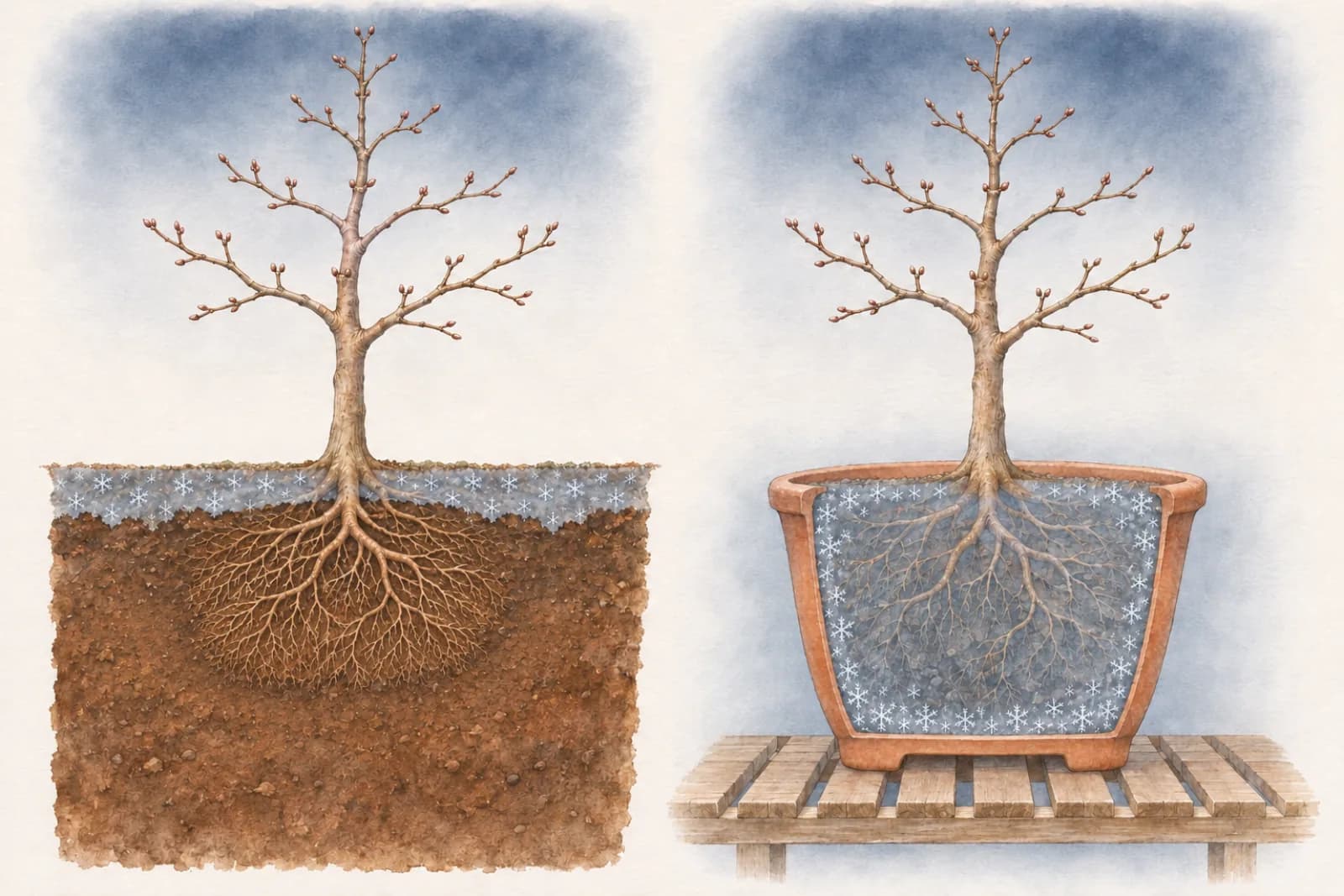
How cold, and for how long
A pot does not jump to the night's temperature: a few hours of light frost may freeze only its surface and wall. What freezes a root ball through is time below freezing with no warm afternoon in between, which is why two winters with the same coldest night can do very different things to a pot.
This course uses Course 02's tags for a night's low: a frostA night when the temperature at the tree falls to 0 °C (32 °F) or below. A light frost is just below freezing for a few hours, usually on a clear, still night; a hard frost is −4 °C (25 °F) or below, the tag Course 02's planner uses. Frost matters most to growth that is tender, such as swelling buds and new leaves, and a frost on a still night and a freeze on the wind call for different shelter.Open the glossary at 0 °C (32 °F) or below, and a hard frost at −4 °C (25 °F) or below (Lesson 2). This winter brought two kinds of hard cold. In the week before Christmas the nights fell to −6 to −9 °C (16 to 21 °F), but every afternoon rose above freezing, so pots on an open bench froze at the wall by night and thawed by day: a run of hard frosts, but not the kind of cold that freezes a root ball through. On January 13 came a cold snapSeveral days in a row when even the afternoons stay below freezing and the nights fall far below a hard frost, often arriving on a dry, gusty wind. It lasts long enough to freeze an exposed pot through, so the roots follow the air down: the hard freeze that calls for protecting a potted tree's roots. A run of frosty nights with afternoons above freezing is not a cold snap, because the pots thaw by day.Open the glossary on a dry, gusty northwest wind: six nights of −12 to −16 °C (3 to 10 °F), the coldest on January 15, with afternoons between −7 and −3 °C (19 and 27 °F) for five days. A pot exposed to that freezes through and follows the air, and it stays frozen until the weather breaks. This is the hard freeze that Courses 01 and 02 name as the time to protect a potted tree's roots. Most winters here bring one or two cold snaps, and between them pots thaw on the milder days.
Snow insulates pots on the ground as mulch does, but here it seldom lies more than a few days, so it cannot be part of the plan. Which shelter suits which kind of frosty night is Lesson 2's question for a tree in new leaf. For a resting tree the question is how long the cold lasts. Once it stands in a winter place that buffers its roots, a run of hard frosts with mild afternoons is Leave it where it is. A cold snap is Protect the roots: the blanket over the crate, or the pots into an unheated shelter that stays cold. When it ends, Put it back.
Protection that keeps the tree cold
Every way of protecting a potted tree in winter does the same job: it gives the roots something to share the cold with, the ground, a mass of mulch, or a shelter's still air, so that the root zone changes slowly and stays out of the depths the air reaches. NC State's guide describes working protection in just those terms: it moderates the root zone's temperature and keeps the pots within reach for watering. It never makes the tree warm. The branches stay in the cold, and the tree stays resting: its dormancyA period when a tree, bud, or seed is alive but not growing, held back by its own internal controls, by outside conditions such as cold, or, for a bud, by an actively growing shoot tip above it. Dormant trees still respire and still need moisture, protection, and attention.Open the glossary goes on, its cold readiness holds, and its buds keep gathering the cool weather that their chilling requirementThe amount of time a temperate tree's buds must spend in cool weather before endodormancy ends and normal bud break can follow. Temperatures a few degrees above freezing count most, and hard cold counts for less. Requirements vary widely among trees; without enough chilling, bud break is often delayed, uneven, and weak.Open the glossary asks for (Course 01, Lesson 13). Weather a few degrees above freezing counts most toward that, so a shelter that stays cold without freezing does not cheat the buds. A heated room takes all of it away, and it is far too dark (Course 02, Lesson 3).
That is how a temperate bonsai's overwinteringHow a plant is kept through winter. A temperate bonsai usually overwinters cold, outdoors or in an unheated shelter, with its roots protected from hard freezes; a tropical one overwinters indoors in warmth and strong light. Course 06, Seasonal Care and Timing, covers the details.Open the glossary works, and why Course 02 named two options for a potted tree in a hard freeze: a sheltered spot outdoors, or an unheated space. Judge either kind of place on four tests, always in this order:
- Cold enough: the tree keeps resting.
- Not too cold at the roots: the root zone is buffered enough for the tree's tolerance and the length of the cold.
- Moist: the pot drains, and you can check it and water it.
- Light enough for what the tree is doing: a bare tree at rest needs little, an evergreen needs some, and anything in growth needs a lot.
The three places in this course pass those tests in three different ways, using the kinds of place in this plate.
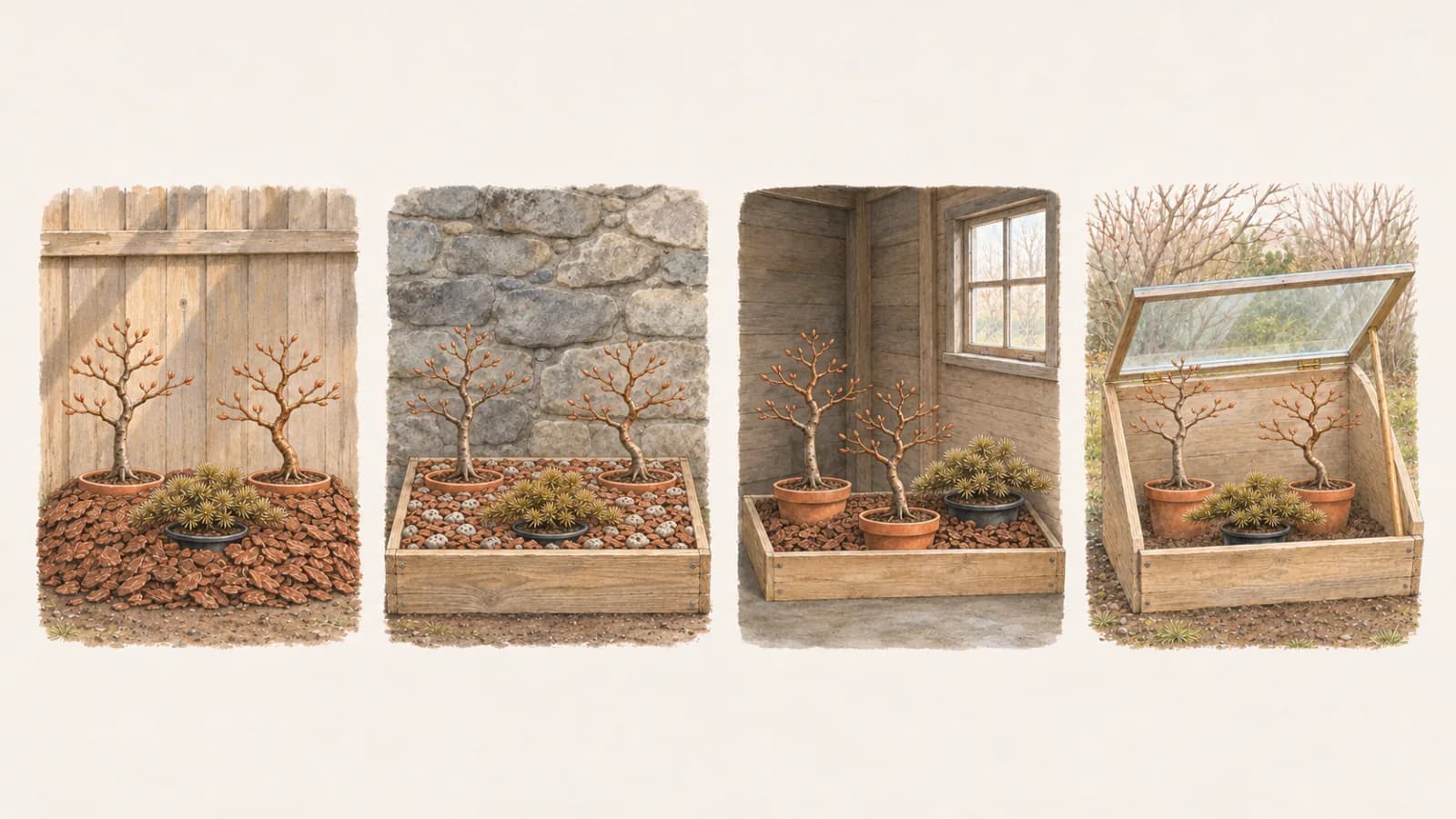
On the ground, grouped, and mulched
The simplest protection uses the ground itself. Set the pots on the soil, close together, and heap mulchA loose layer of material such as bark, leaves, or straw. Heaped around and between pots in winter, it slows the loss of heat from the root zone and keeps the wind off the pot walls, but it adds no heat of its own. On the ground it lets the pots share the ground's warmth; over a balcony floor or a bench it only slows the cold.Open the glossary such as bark, leaves, or straw around and between them up to their rims, leaving the trees' tops in the open, as nurseries do with whole blocks of containers and Illinois Extension advises for potted shrubs. Grouped pots shelter one another, the mulch slows the loss of heat and keeps the wind off the pot walls, and the ground beneath keeps the root zones close to freezing instead of letting them follow the air down.
Where the pots go matters as much as the mulch. From the first hard frost, on November 29, the small backyard's trident maple, Chinese elm, larch, and new juniper stand grouped on the ground along the south fence, toward its west end, mulched to their rims. The fence shades that strip all winter, so the pots stay steadily cold, without a thaw every afternoon, and the juniper's foliage is out of the winter sun. The west fence and the house act as a windbreakAnything that slows the wind over the area behind it, such as a fence, screen, hedge, or panel of netting. A screen that lets some air through slows the wind over a longer stretch, with less swirling, than a solid wall, and keeps the air moving.Open the glossary against the northwest wind that brings the coldest spells. And the spot is well away from the low southeast corner, the yard's frost pocketA low spot where cold air collects on clear, still nights, because cold air is denser than warm air and drains downhill as water would. Frost comes earlier in autumn, later in spring, and harder there than in spots a little higher up.Open the glossary.
They did not choose the patio. Its warm south wall makes it the mildest spot in the yard on a clear, cold night, and Course 02 left its trade open: what the wall gives at night it takes back by day (Course 02, Lesson 5). On a sunny winter day the wall's sun and warmth dry an evergreen's foliage while its roots are frozen, and they thaw the pots each afternoon to freeze again each night. In late winter the same warmth wakes buds early: in the warm spring the larch, on its bench by the wall, opened its needle tufts in the first days of March, and the frost of March 5 and 6 singed them (Lesson 2). So the household chose steady cold and keeps the wall for nothing in winter. The same reasoning places any evergreen: steady cold, its roots buffered, its foliage out of the winter sun and the wind. A sunny wall gives it the opposite of each.
Mulch fails quietly. Mice and voles nest in it and gnaw bark and roots, as NC State's guide warns, so look under its edges now and then; it sheds rain away from the pots, so they can dry while the ground beside them is wet; and the ground under a mulched row should drain.
The plunge bed
Course 03 described a plunge bedA shaded, free-draining bed of sand, bark, or gravel, kept moist but never waterlogged, into which pots are sunk up to their rims to slow drying and even out root temperature, often while an owner is away. Roots can grow out through the drainage holes into it, so the pots are lifted or turned now and then. Course 06, Seasonal Care and Timing, covers its use in winter.Open the glossary as a way to slow drying in summer and left its winter use to this course (Course 03, Lesson 6). In winter it is mulch on the ground made permanent: a free-draining bed with the pots sunk to their rims, so that each root ball sits in a mass that evens out root temperature and is joined to the ground beneath.
In October the courtyard's owner built one at the foot of the north-facing wall, where the winter sun does not reach: a timber frame filled with coarse bark and pumice that drains freely. The display trident went in first: its shallow glazed pot was the most exposed in the courtyard, and sunk to its rim it is no more exposed than its neighbors. The Chinese elm and the hornbeam followed, and the young trident's wooden training box stands mulched on the ground beside the bed. In the wall's shade the bed stays steadily cold, with no daily thaw.
Course 03's rules for the bed still apply. It is kept moist but never waterlogged, or the pots stand all winter in cold, wet material with their roots short of air. Roots grow out through the drainage holes into the bed, so the pots are lifted or turned now and then, on a day when the bed has thawed. Sunk pots are still checked every day or two, like any others. And since a glazed pot left standing full of water can crack in a hard freeze (Course 02, Lesson 7), a bed that drains matters twice over for a display pot.
An unheated garage or shed, and a cold frame
The other option is an unheated space: a garage, a shed, or a cold frameA low, unheated box with a clear lid that opens, used to shelter plants in winter. It keeps off the wind and slows the cold but adds no heat, and it warms quickly in sun, so its lid is propped open on mild or sunny days and closed again before a cold night.Open the glossary, a low, unheated box with a clear lid that opens. Each keeps off the wind and slows the cold, and none of them heats: NC State's guide notes that on a cold night an unheated nursery house falls to within a few degrees of the air outside. What such a shelter buys is a smaller, slower drop, and for the few nights of a cold snap, with the pots grouped in bark inside, that is often enough. As for how cold such a place should be, Illinois Extension suggests about −7 to 7 °C (20 to 45 °F) for potted plants wintered in a garage or shed, and the Arnold Arboretum in Boston winters its bonsai collection, once the trees are fully at rest, in a dark building held at about 1 to 2 °C (33 to 36 °F) (Arnold Arboretum: Bonsai and Penjing Collection Care). Those are examples from named places, not targets for your tree, and they agree on the principle: cold, but buffered.
The small backyard's garage is the household's shelter for a cold snap, not for the whole winter. It is unheated, with one east-facing window; it stays frost-free on nights of light frost and falls below freezing in a hard winter (Course 02, Lesson 3), and a min/max thermometer hangs by the window. The household's plan answers what Course 02 left open. When in: when a cold snap is forecast, by their own cautious line, a night of −10 °C (14 °F) or below with afternoons below freezing. What the trees need there: a shallow box of bark on the floor by the window, the pots grouped in it so their root zones run less cold than the garage air, the evergreens nearest the glass, and the same check every day or two. When out: as soon as the cold snap ends, because the garage is dim and warms in winter sun. The azalea, the household's least cold hardy outdoor tree and an evergreen, is the exception: it goes in first whenever hard frosts are forecast and stays by the window through the coldest weeks.
Course 03 called a garage too dark for a juniper in July (Course 03, Lesson 5), and it is; the same garage can be right for a bare, resting tree in a January cold snap. A resting tree makes no sugar and uses little, and dark storage of fully resting trees is established practice only while the storage stays cold. An evergreen still works on bright winter days, so it stands by the window, and any tree comes out once the garage starts to warm or the tree starts to grow.
A cold frame does the same job for a few pots on the ground, under a clear lid that keeps off the wind and lets in the light an evergreen can use. That lid is its danger on a sunny day: shut, a cold frame warms far above the air outside, so it is propped open on mild, sunny days and closed before a cold night. Close it over the trees only once they are ready for cold: shut early, it keeps trees that are still growing from the cool weeks that ready them, and NC State and UMass both tell nurseries to cover as late as they can.
A balcony with no ground
A balcony has no ground to share the cold with, which is why Course 02 left the west balcony's winter shelter in its site profileA short written record of a growing place: its sun through the day and the seasons, shelter, winter lows and summer highs, water and runoff, access, and the time its keeper can give. Each fact is turned into a criterion for choosing a tree and its setup, and the record is updated as seasons and circumstances change.Open the glossary as a question for the local bonsai club (Course 02, Lesson 1). The club member's answer is the mulch crate: a wooden crate on two battens that keep it off the concrete, against the back wall, where the balcony above roofs the back half and the heated building warms the wall a little. The three pots stand inside with coarse bark packed around them to their rims, rigid foam covers the crate's outer side, and the branches and foliage stay in the open air.
When the forecast shows a night of −10 °C (14 °F) or below with afternoons below freezing, an old blanket goes over the whole crate at dusk and comes off in the morning. That line is the owner's own, chosen with the club member's local experience and cautious on purpose, since no published figure gives what these trees' roots tolerate; it is not a rule for any other tree or place. The blanket adds no warmth. It slows the night's loss of heat from the bark, and it comes off by day because the junipers' foliage needs its light.
The owner travels for work, so the steps are on a card for the friend. Course 03's card for August named checks, not days (Course 03, Lesson 6), and the winter card adds three lines the August card never needed:
- Do not water a frozen pot: the chopstick will not go in.
- On the first day the chopstick goes in, water any pot that reads Drying.
- Blanket on at dusk, off in the morning, when the forecast shows −10 °C (14 °F) or colder with afternoons below freezing.
Two min/max thermometers keep the record, one with its probe in the bark between the pots and one on the shelf (Course 02, Lesson 7), because nobody can say in advance how many degrees a crate, mulch, or a cover will give: measure your own place. The crate is the balcony's best answer, not a perfect one. With cold air under its battens and nothing warming it from below, it buffers less than mulch on the ground, and in a long enough cold its pots would freeze through too.
The back wall is also in the balcony's rain shadowAn area that rain does not reach because something blocks it, such as the ground under an overhang or eave, beside a wall on the side away from wind-driven rain, or under a dense canopy. Pots in a rain shadow can stay dry through a day of rain, so they need checking and watering by hand.Open the glossary, so the pots get no rain or snow all winter. The crate comes apart in spring, as the trident's buds swell.
What wrapping can and cannot do
Wrapping a pot in bubble wrap, fleece, or burlap is the protection most people try first, and the one that most often disappoints. Insulation slows the flow of heat; it supplies none. A wrapped pot on an open shelf loses heat more slowly than a bare one and is out of the wind, so through a single hard frost its roots may never freeze. Through a run of nights with afternoons below freezing it has nothing to draw on, no ground beneath, no mass of mulch, no warm wall, and it follows the air down only a little behind an unwrapped pot. Nurseries that wrap do it to whole blocks of pots, and for long cold they rely on grouping, mulch, or the ground. So wrapping helps most in short frosts, and best as part of something bigger: a wrapped pot grouped with others on the ground, or packed in mulch against a wall. The balcony's blanket is wrapping in that sense, over a crate of bark, on the nights of a cold snap only.
Practice check · not scored
When protection comes off
Protection can also fail by its timing. Taken off for good in a February warm spell, it leaves the roots open to the cold that often follows, and buds woken early in a warm shelter meet a late frostA frost that comes after a tree's buds have begun to open in spring. New leaves and shoots have little cold tolerance, so a late frost can blacken or kill them on a tree that stood through far colder nights in midwinter. How many late frosts a tree meets depends as much on when its buds open as on when the frosts end.Open the glossary with their hardiness gone (Lesson 2). So Put it back goes by the tree's growth stageA step in a tree's yearly cycle that you can see on the tree, such as buds swelling, bud break, shoots extending, or leaf fall. Care is timed to the stage a tree has reached, not to a date, because the same stage falls on different dates in different years, places, and kinds of tree.Open the glossary and the forecast: the protection comes off as its buds swell and the hard frosts end, in steps where the light increases, and the frost plan for new leaves takes over.
Water in winter
A resting tree is alive. Its roots respirationThe process in which living cells break down sugars using oxygen to release energy they can use, giving off carbon dioxide and water. It runs in every living cell of a tree, in leaves, stems, buds, and roots, both day and night. Without oxygen, cells fall back on fermentation.Open the glossary day and night (Course 01, Lesson 7), its buds and bark lose a little water even when it is bare, and the foliage of an evergreenDescribes a tree that keeps living foliage all year, replacing old leaves or needles gradually instead of all at once. Keeping foliage does not mean a tree grows all year: temperate evergreens such as junipers still go dormant in winter.Open the glossary loses water on every sunny or windy day. So the checks never stop: every day or two for trees resting outdoors (Course 03, Lesson 6), because a root ball left to dry for weeks can kill a resting tree (Course 03, Lesson 1).
Course 03 left one question open: what the check should say before a resting tree is watered. The answer is the same check and the same words as in summer:
- Check every day or two, with the chopstick in the core and the lift (Course 03, Lesson 2).
- Give a thorough wateringWater applied evenly across the whole surface, slowly enough to soak in, until it runs from the drainage holes, and then confirmed by a check that the root ball wetted through. It usually takes two or three passes a minute or two apart. Water at the holes alone shows only that water reached the bottom, not that the roots got it.Open the glossary when the check reads Drying or drier and the root ball is not frozen, which you know because the chopstick goes in all the way.
- Water on a mild morning, so that the pot has drained before the night's frost.
- When a freeze is forecast, check the day before, and water a pot that reads Drying so that it goes into the freeze moist, never saturated. That is Course 03's frost reminder; when the forecast is a cold snap, add Protect the roots (Course 03, Lesson 6).
- While the root ball is frozen, the look goes on and the watering waits for a thaw.
A resting tree simply reaches Drying far less often. A bare trident's pot that stays heavy for days in December is normal; Course 03's warning about a pot that stays wet belongs to warm weather (Course 03, Lesson 7). “Keep it on the dry side in winter” gets the rule backward: the tree needs less water, and the check finds that out, while a root ball kept dry on purpose loses fine roots and goes into each freeze dry.
Sheltered pots dry while the open ground is soaked. The crate stands in the rain shadow, mulch sheds rain, and nothing falls on a pot in a garage or a cold frame, so check them as if it had not rained (Course 03, Lesson 5). Plan the water, too: the small backyard's hose tap is shut off once hard frosts set in, so the household keeps filled jugs in the basement, and the balcony waters from indoors. No feed goes into that water: a tree resting outdoors gets none until its spring flush is growing (Course 05, Lesson 4).
Keep the watering logA dated record of each check of a tree's root zone, usually one short line per pot: the weather, what each check found, the decision, and the reason for it. Read over weeks, it shows how fast each pot dries in different weather, whether the decisions worked, and patterns no single check can show, such as a pot that keeps drying fast even as the weather cools.Open the glossary going through winter, when its lines get fewer (Course 03, Lesson 7). A winter line needs only the date, the night's low and the spot's own low from the min/max thermometer, whether each pot was frozen, what the check read, and any watering or move. By spring it is the record of your own winter, and next October's plan starts from it.
Frozen pots
A frozen root ball cannot take up water, and water poured onto it cannot soak in (Course 03, Lesson 5). You can tell a pot is frozen when the chopstick will not push into the mix and the surface is hard under a fingertip, and in a cold snap a pot in the open can stay that way for a week or more. Frozen is not the same as dry, and it is no reason to stop looking: the look goes on every day or two, so that you know the day the chopstick goes in again.
A bare tree loses very little water while its root ball is frozen, and an evergreen sheltered from sun and wind little more, so the watering waits for the weather; once the chopstick goes in, water a pot that reads Drying that mild morning, early enough to drain before night.
Going into a freeze moist helps, modestly. A moist root ball holds more heat than a dry one and freezes more slowly, as NC State's and UMass's guides both note for nursery pots, and the tree has more water in hand before its foliage runs short. But water is not a heater: the delay is small in a small pot and gone in a long freeze. A saturatedDescribes soil or substrate whose pore spaces are completely filled with water, leaving little or no air. Brief saturation right after watering is normal in a pot that drains; saturation that lasts starves roots of oxygen.Open the glossary pot gains nothing from the extra water and keeps its roots short of air. Moist, neither dry nor saturated, and then protection for the roots: the one does not stand in for the other.
Practice check · not scored
Evergreens lose water all winter
A juniper in winter color is resting, but its foliage still loses water through its stomata and its waxy surface, most of all on sunny and windy days, and when its root ball is frozen nothing replaces that water. The result is winter desiccationDrying and browning of evergreen foliage in winter, when sun and wind draw water from the leaves while frozen roots or a frozen root ball cannot replace it. The damage usually shows on the sunny or windward side, often not until late winter or spring.Open the glossary, or winter burn: foliage on the sunny or windward side dries and browns, usually noticed in late winter or spring, when it stays brown while the rest of the tree greens (Course 02, Lesson 5). Last January's nights on the open shelf, with wind and low sun coming in at the balcony's open south end, are the likely story behind the gift juniper's browned south side, although browning is a symptom, not a diagnosis.
The defenses are the ones Course 02 named: shelter from winter wind, and a root ball that goes into each freeze moist rather than dry. Add shade from the winter sun, and a spot where the pot does not thaw and refreeze every day. That is why the crate stands at the back wall, out of the wind from the open south end. Minnesota Extension's guide, Protecting trees and shrubs in winter, names winter sun and wind as the cause of this browning and calls anti-desiccant sprays, sold to coat foliage against it, not effective; other extension services, such as UMass Extension, call their results variable. This course does not recommend them. A juniper's even, dull bronze or purplish tone over the whole plant is something else: its normal winter color, which greens again in spring (Course 01, Lesson 13). Winter burn is patchy, dry, and one-sided, and Course 02, Lesson 5 shows the two side by side.
Winter sun can also harm thin bark: sunscaldWinter injury to bark, when the sun warms the bark on a cold day and the living tissue beneath is then killed as the temperature drops quickly. It shows later as dry, sunken, or split patches, usually on the sunny side of a thin-barked trunk. It is a different injury from sunburn, which is warm-season sun damage.Open the glossary kills the living tissue under bark that the sun warmed on a cold day when the temperature drops quickly at sunset, a different injury from sunburnInjury from more sun than leaves or bark are used to, often after a sudden change: a tree moved from shade into full sun, shade cloth taken off at once, or inner leaves and bark newly exposed by pruning. On leaves it shows first as bleached or silvery patches, then as the browning called leaf scorch; on bark, as dry, sunken patches. It is a warm-season injury; sunscald is the winter one.Open the glossary, the warm-season damage of Lesson 3, and the steady, shaded winter spot guards bark against it too.
Practice check · not scored
Two tridents through one winter
Where does it spend the winter? follows two young trident maples, bare and resting, through one winter in the small backyard, and opens their pots so you can watch the cold reach the roots. Tree A, drawn in ink, stays on the open bench all winter, checked every day or two and watered when it is not frozen and the check says so. Tree B, drawn in red, gets one change.
First set The winter, for both: A mild winter, with nights down to about −8 °C (18 °F) and afternoons above freezing, or A winter with a cold snap, with six nights far below freezing in January. Then choose B's one change: Pot sunk in mulch (on the ground along the shaded fence), In the garage for cold snaps, In the garage until April, In the garage, never checked, or Pot in bubble wrap (on the bench). On a phone, pick both under Change. Under Your call, choose A, B, or About the same for the tree that will leaf out better in spring, or press Skip. Press Run the winter to follow both trees from late November to April, and use Pause, Back, Next, Replay, or Skip to the end to stop on any night. A cutaway of each pot shows the frost moving in from the wall over the moisture beneath, and the readouts Root zone, Moisture, and The top follow each tree in words, with In April at the end. Find all five challenges to finish. Try these:
- The simulation opens on A winter with a cold snap and Pot sunk in mulch. Make your call, press Run the winter, and compare the two cutaways and their Root zone on the coldest night.
- Change B to Pot in bubble wrap, make your call, and follow both trees' Root zone night by night through January.
- Run In the garage for cold snaps, then In the garage until April, and follow The top and Moisture on both trees from December to April.
- Run In the garage, never checked, and read all three readouts on both trees at each stop.
- Switch to A mild winter, and run the bench tree against two of B's changes.
Simulation
Where does it spend the winter?
Tree AStays as it isOn the open bench all winter. Checked every day or two, and watered when it is not frozen and the check says so.On the open bench all winter, checked every day or two.
Calls: none yet
Tree AStays as it isOn the open bench all winter
White root tips
- Root zone
- ColdWithin their limit
- Moisture
- Moist
- The top
- Bare, at rest
Tree BYour changeSunk in mulch by the fence
White root tips
- Root zone
- CoolWithin their limit
- Moisture
- Moist
- The top
- Bare, at rest
| Reading | Tree A | Tree B |
|---|---|---|
| Root zone | ColdWithin their limit | CoolWithin their limit |
| Moisture | Moist | Moist |
| The top | Bare, at rest | Bare, at rest |
- Cool
- Cold
- Frozen at the wall
- Frozen through
- Thawing
The winter, stop by stop
- Late Nov: Not reached yet
- Mid Dec: Not reached yet
- Early Jan: Not reached yet
- Jan 13: Not reached yet
- Jan 14: Not reached yet
- Jan 15: Not reached yet
- Jan 16: Not reached yet
- Jan 17: Not reached yet
- Jan 18: Not reached yet
- Late Jan: Not reached yet
- Mid Feb: Not reached yet
- Early Mar: Not reached yet
- April: Not reached yet
Result
Which tree will leaf out better in spring?
Press Run the winter. In April the result compares how cold each tree's roots got, how dry its pot got, and how it leafs out.
Challenges
0 of 5 found
Find all five to finish.
Bring the bench tree through a winter unharmed, not found yet.
Change the winter, not the tree.
Find protection that only delays the freeze, not found yet.
Count the nights before each pot freezes through.
Find a shelter that fails without ever getting too cold, not found yet.
What else does a resting tree need?
Find a shelter that fails by being too kind, not found yet.
Watch the garage in February.
Bring a tree through the cold snap with its roots to spare, not found yet.
Give the roots something bigger than a pot to share the cold with.
Text description
The household's small backyard in winter: the board fence along the far side, with a strip of ground at its foot that it shades all winter; a plank bench in front; the neighbor's bare maple beyond the fence; and the unheated garage at the right, drawn open in section, with its east window and a low box of bark on the floor, whenever a tree is inside. On a winter day the low sun throws the fence's shadow and long, soft shadows from the pots toward you. Two young trident maples (Acer buergerianum), bare and resting, stand in matching black plastic nursery pots. The sky, the light, frost, snow, and a dry wind show each stop's weather, by day or by night, and chips give the night's low (and the afternoon's high on a day) in both scales, and on a frosty night whether the afternoons around it stayed below freezing. When a tree is inside the garage, a chip describes the garage in words, and on two days gives the household thermometer's reading there.
Under the scene, each tree's pot is drawn large and cut open: the mix, its roots, and their white or browned tips, inside whatever the pot stands in. Cold is drawn in slate and white crystals, never as water: a slate cast for cold; a ragged frost front with crystals behind it moving in from the faces the cold reaches for frozen at the wall; crystals through the whole root zone for frozen through; and, for thawing, the frozen part melting back: a rim toward the wall, or a frozen core toward the middle. The moisture colors stay readable under the cold, so a frozen pot that is moist looks different from one that is dry.
Tree A stays as it is: On the open bench all winter. Checked every day or two, and watered when it is not frozen and the check says so.
The controls:
- The winter, for both: A mild winter (Nights down to about −8 °C (18 °F); afternoons above freezing); A winter with a cold snap (Six nights far below freezing in January, with afternoons below freezing too).
- B's one change: Pot sunk in mulch (On the ground, sunk in bark, along the shaded fence); In the garage for cold snaps (Checked, and out again after); In the garage until April (Checked); In the garage, never checked (In until April, never watered); Pot in bubble wrap (On the bench).
What each of B's places does:
- Pot sunk in mulch: A pot sunk to its rim in bark on the ground shares the cold with the ground beneath it, which in this city freezes only a hand's depth or so and stays close to freezing under a thick mulch. A crate of bark on a balcony, against the building's wall, buffers less, because it has no ground beneath it.
- In the garage for cold snaps: An unheated garage buffers the cold; it does not heat. Its still air and the box of bark the pots stand in slow the cold, and the tree comes back out when the cold snap ends.
- In the garage until April: The garage stays colder than a heated room but is dim, and its window lets in the winter sun.
- In the garage, never checked: The garage keeps off rain and snow, so its pots get water only from the can.
- Pot in bubble wrap: Bubble wrap around a pot slows the exchange of heat. It adds none of its own.
Before each run, an optional prediction asks: Which tree will leaf out better in spring? The options are A, B, About the same, or Skip. Run the winter plays the winter in thirteen stops: late November, mid-December, early January, six nights in mid-January, late January, mid-February, early March, and April, when the buds break or do not. It rests longer where something happens. Play, Pause, Back, Next, and Replay control it, and Skip to the end jumps to April.
Beside each pot, Root zone names the root zone's temperature in words (Cool, Cold, Frozen at the wall, Frozen through, Thawing) and judges it against what the roots tolerate (Within their limit, Near their limit, Past their limit). Moisture gives Course 03's moisture words, or that a frozen pot must wait for a thaw, and says when a check leads to watering. The top says what the branches are doing (Bare, at rest, Buds swelling early, Pale shoots in the dark, Bud break, Buds not opening), and in April, In April gives the spring that follows (Strong, even flush, Late, patchy flush, Does not leaf out). Under each pot, the root tips are named: White root tips, Some root tips browned, Many root tips browned, Most root tips browned.
The winter, stop by stop fills in as the run reaches each stop: a row of weather for both trees (with Frost, Hard frost, and Cold snap marks), then a row for each tree's root zone, marked where the roots were past their limit, with the six January nights labelled as nights. On wider screens each column is a button that shows that stop, one stop for the Tab key, with the arrow keys, Home, and End moving between stops. At the end, the result compares the two trees and stamps a prediction Called it or Surprise. The challenges tick themselves off when a run achieves them; find all five to finish.
- Bring the bench tree through a winter unharmed
- Find protection that only delays the freeze
- Find a shelter that fails without ever getting too cold
- Find a shelter that fails by being too kind
- Bring a tree through the cold snap with its roots to spare
In the winter with a cold snap, the bench tree's Root zone froze at the wall on December's frosty nights and thawed by day, read Frozen through on the first night of the cold snap, and was Past their limit from the coldest night on: its branches were never in danger, but it lost many roots and made a Late, patchy flush. Pot sunk in mulch and In the garage for cold snaps never went past Frozen at the wall, with the garage at −10 °C (14 °F) while the yard fell to −16 °C (3 °F), and both leafed out in a Strong, even flush. Pot in bubble wrap froze through one night after A and lost its roots as well. Two garage runs failed without ever getting too cold: In the garage until April woke in February's sunny spell and had Pale shoots in the dark by April, and In the garage, never checked dried to Bone dry and did not leaf out. In the mild winter the bench tree came through, which shows that the winter was mild, not that the bench is safe.
This winter's cold snap tested the balcony's and the backyard's own arrangements. On the balcony the owner was away from January 12 to 17, and the friend followed the card: blanket on at dusk and off in the morning, and no water on a frozen pot. On the night of January 15 the shelf's thermometer read −16 °C (3 °F), while the probe in the bark stayed well above the shelf's reading all week, its lows coming a day later. The backyard's five trees spent the week in the garage's box of bark, where the thermometer read −10 °C (14 °F) that night: the garage buffered the cold and did not heat. In the thaw of January 23 the chopstick went into the crate's pots again, and the trident's pot, which no rain or snow reaches at the back wall, read Drying and was watered that morning. On February 13, after a morning of sun through its east window, the garage read 14 °C (57 °F) by early afternoon, warmer than the yard's 12 °C (54 °F); by then the trees were back along the fence, and only the azalea was inside, by the window: the one tree the household judges too tender for the nights outside, so a warm week in the garage is the cost of keeping it there, and its buds are the ones to watch.
Go deeper · optional, not assessedWhat a root-hardiness table measured
The numbers in NC State's table come from experiments on container-grown nursery plants, published in the 1970s and gathered in a bulletin for nursery growers in the 1980s. Two sets of results sit side by side, and some plants appear in both with different values; the guide puts the differences down mostly to how mature the roots were and how each experiment was run. One set splits young roots from mature ones, and the gap can be large: for flowering dogwood, about −6 °C (21 °F) for young roots against about −12 °C (11 °F) for mature ones. UMass Extension's copy defines each value as the highest temperature that killed more than half of the root system.
The conditions behind each value, such as how long the cold lasted, how large the pots were, and how ready the plants were for cold, are not printed beside it. The copies also differ on small details, such as which column a value sits in, so a number is best credited to the table that prints it. None of that makes the table useless: it shows, from measurements, how much tenderer roots are than branches and how much kinds of tree differ.
Protect the roots, keep the tree cold
The bonsai decision
Buffer the roots, keep the tree cold, and keep checking the pot
Starting point
For a healthy temperate tree in a pot, outdoors in a cold-winter climate like the example city's, from late autumn until its buds swell:
- From the first hard frosts until the buds swell, stand the pot where its roots are buffered: on the ground, grouped and mulched; in a plunge bed; or in a crate of bark against a building.
- Keep it out of the wind and the winter sun, with its top in the open cold: a spot that stays steadily cold, not a sunny wall (Course 02, Lesson 5).
- Add an unheated shelter for cold snaps, by a line you have chosen from the tree's verified tolerance and local experience, and bring the tree out again when the cold snap ends.
- Check moisture every day or two, and give a thorough watering at Drying when the root ball is not frozen, on a mild morning. Keep the log going (Course 03, Lesson 6).
This assumes
- The tree is healthy, spent the autumn outdoors, and is ready for cold, and it is hardy in the ground in your climate with room to spare (Course 02, Lesson 1).
- The shelter you use stays cold, and someone can check the pots every day or two all winter.
- If your tree lives indoors all year, read this lesson for the reasoning and use Lesson 6's decision.
- The months in this lesson belong to the course's Northern Hemisphere example climate. In the Southern Hemisphere, swap north and south, and shift the months by half a year.
Change course if
- The tree is not ready for cold, as a new arrival from a warm shop is, or the freeze comes early: give it a cool, bright, frost-free place, never a warm one, and let it adjust (Course 02, Lesson 3).
- An evergreen stands in wind or winter sun: shelter it from the wind and shade it from the winter sun, and see that its root ball goes into each freeze moist.
- The shelter warms in a sunny spell: move the trees out of a garage that warms, and prop a cold frame's lid. Buds that begin to swell in there need light and a frost plan (Lesson 2).
- You cannot verify what a tree tolerates, or your winters are colder than its rating allows for: give it more shelter, and ask experienced local growers what comes through their winters.
- Foliage browns or a tree fails to leaf out, and neither cold nor drying explains it: this is not a seasonal problem: investigate (Course 07, Tree Health and Diagnosis).
Back to the question
Why can a tree that is hardy in the ground die in a pot over winter?
Because a hardiness rating describes the tree's branches in the ground, and in a pot its roots are both the least hardy part and the most exposed. Roots are generally less cold hardy than shoots and build less cold readiness in autumn. In the ground they sit in soil that freezes only near the surface; in a pot above ground, cold reaches them from every side, and over days below freezing a small root ball freezes through and follows the air. The balcony's trees have zones to spare in their branches, but a cold snap on the open shelf could cost them many roots. Protection gives the roots the ground, mulch, a crate of bark, or a shelter's still air to share the cold with, while the tree stays cold and resting and the checks go on all winter.
Key takeaways
- Roots are generally less cold hardy than shoots and build less cold readiness in autumn. A hardiness rating describes branches in the ground at their midwinter best, so a tree with zones to spare can still lose its roots in a pot.
- In the ground, roots sit in soil that freezes only near its surface. In a pot above ground, cold reaches them from every side, and over days below freezing a small root ball freezes through, starting at the wall where young roots grow.
- There is no single temperature at which bonsai need protection. Plan it from the tree's verified tolerance, its acclimation, the pot's exposure, and how long the cold will last, and read any published root figure as an example, never a line.
- Good protection buffers the roots and keeps the tree cold: pots grouped and mulched on the ground, a plunge bed, a crate of bark against a wall, an unheated shelter for cold snaps. Wrapping only delays the cold, and a warm room ends the tree's rest.
- A resting tree is checked every day or two and watered thoroughly at Drying on a day its root ball is not frozen. A frozen pot waits for a thaw, every root ball goes into a freeze moist, and evergreens need shelter from winter wind and sun.
Optional · not required for completion
Measure your own winter spot
Hang a min/max thermometer at pot height in the place where your trees will spend the winter, out of direct sun, and reset it at dusk before a clear, cold night. Read it in the morning. Then hang it in the open, on a bench or a shelf where a pot might otherwise stand, for another night of similar weather, and compare the two lows. How much colder was the open spot? Write the readings in your log; they start your own winter record.
No tree? Find your hardiness zone and, from a weather service's records for your town, last winter's coldest night. Count the nights that fell below −4 °C (25 °F), and note the longest run of days when even the afternoon stayed below freezing. Which of the two would a tree in a pot on an open bench have found harder, and why?