Course 03 · Lesson 5 of 7 · Hard cases and a lasting routine
Rain, water quality, and unusual conditions
Rain, the water in the can, and the weather can each change a watering plan, but none of them replaces a check below the surface. Learn to tell whether rain reached the roots, when hard or softened water matters, and how to adjust checks for heat, wind, and fast drying.
The question
Did the rain water the tree, and when does the water itself or the weather change the plan?
By the end of this lesson, you will be able to:
- Judge whether rain reached a pot's root zone, and identify the pots it missed or barely wetted, such as those under an overhang or a dense canopy.
- Recognize water-quality concerns, such as hard or alkaline water, softened water, and salt buildup, and decide when a water test or another source is worth it.
- Choose how to adjust checks and watering for heat waves, strong wind, and pots that dry unexpectedly fast.
About 18 minutes to read and explore
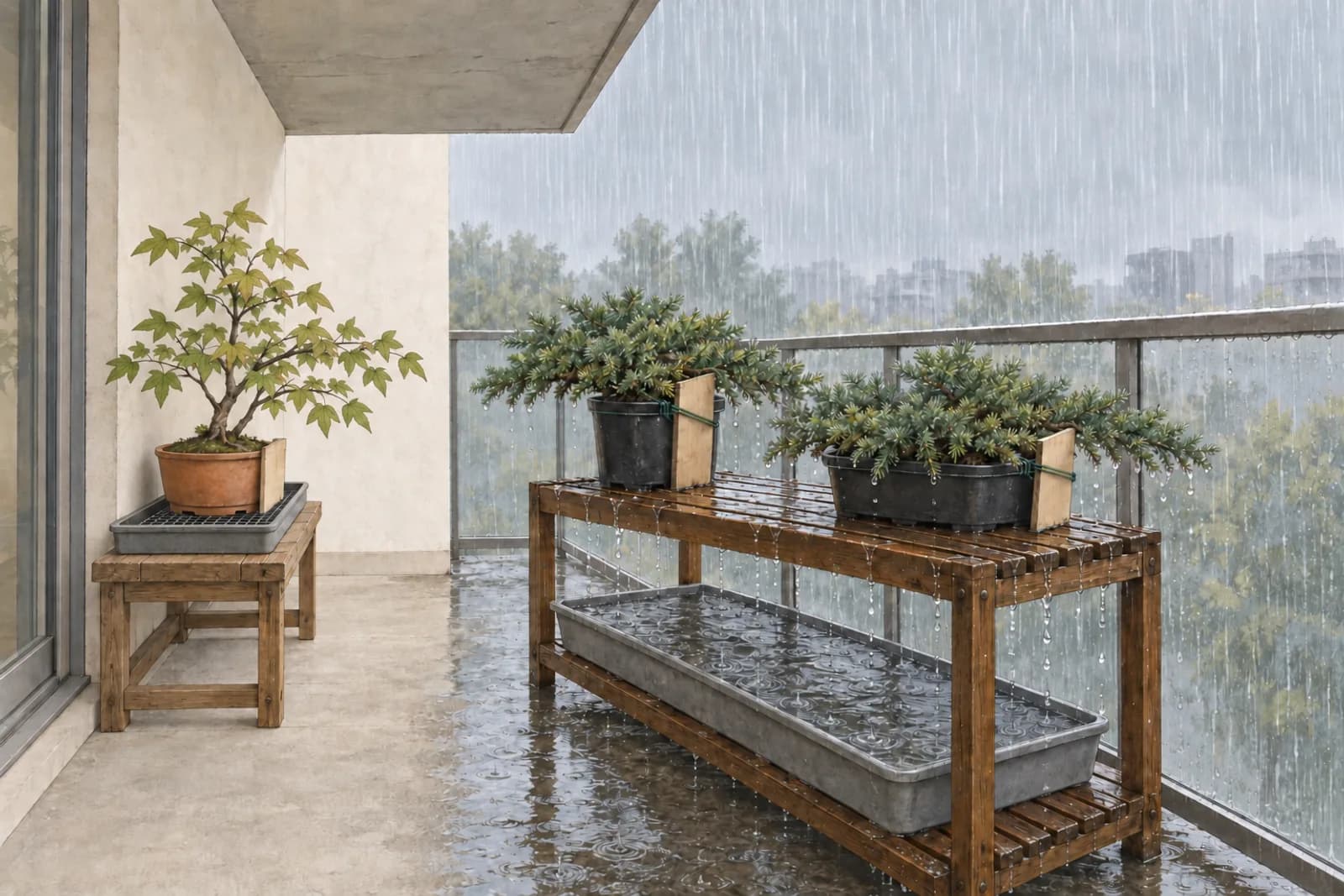
Mid-June on the west balcony, the instructional example this course returns to. At four in the afternoon a downpour arrives with almost no wind, and for most of an hour the rain falls straight down on the open front half of the balcony. The concrete there darkens and puddles, water streams off the slatted shelf just inside the railing, and the shallow tray under the shelf fills to the brim. Under the balcony above, the floor along the back wall stays dry, and so does the trident maple on its bench against the wall.
On the shelf, the two junipers glisten. But each spreading canopy, about 30 cm (12 in) across, covers most of its pot, and much of the rain that lands on it drips off the outer needles, past the rim, into the tray. This morning, a day after their last thorough wateringWater applied evenly across the whole surface, slowly enough to soak in, until it runs from the drainage holes, and then confirmed by a check that the root ball wetted through. It usually takes two or three passes a minute or two apart. Water at the holes alone shows only that water reached the bottom, not that the roots got it.Open the glossary, all three pots checked Moist. Tomorrow is forecast hot and sunny, and with the whole balcony dripping, skipping tomorrow's check looks reasonable.
This lesson takes the three things that most often tempt an owner to change the plan without checking: rain, the water itself, and unusual weather such as heat waves and strong wind. Every case is set in the course's example city, a temperate Northern Hemisphere city at about 40° N (USDA zone 7a); in the Southern Hemisphere, swap north and south, and shift the months by half a year.
Did the rain reach the roots?
A drenched balcony is not a watered pot. What counts is how much water reached each root zone, and only a check below the surface shows that (Lesson 2).
Predict first
Less than the downpour suggests, and you cannot tell how much from the door. The trident's pot, under the balcony above, got none of the still rain. In full leaf, in terracotta, it has had a day and a night of drying since its last check, so expect the pot lighter, and quite possibly ready for water before the heat. The junipers stood in the open, but their canopies shed much of the rain past their rims. Their pots may be only a little heavier, damp near the top and wherever a gap in the foliage let rain through, and only the chopstick shows whether any of it reached the root zone. The soaked floor and the full tray say nothing about the root zones, so this is a morning to check every pot, not to skip the round. The sections below show why, and Did the rain reach the roots? lets you check each pot after four kinds of rain.
A pot catches only the rain that falls on it
A pot is a small target. It catches only the rain that falls on its own surface, usually a fraction of a thorough watering. One centimeter (0.4 in) of rain puts about 0.3 L (10 fl oz) into a 20 cm (8 in) pot, less than a sixth of the west balcony's 2 L (about half a gallon) can, and less still under foliage. Rain falls in every season in the example climate, and it rarely waters a pot reliably (Course 02, Lesson 1).
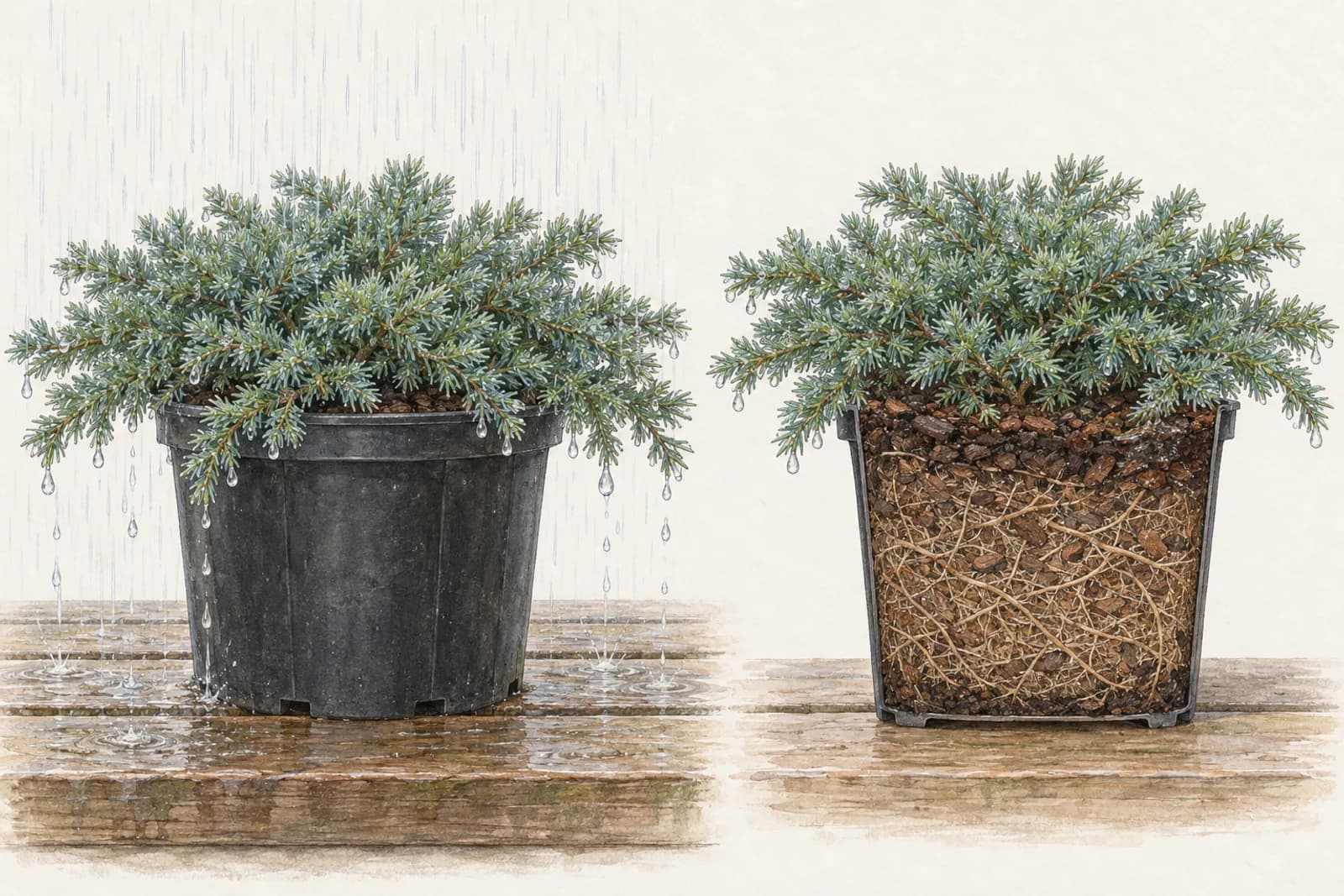
How the rain falls matters as much as how much. A light shower wets the surface and the top layer and stops there, so the surface looks dark and a fingertip finds damp mix while the root zone below stays as dry as before. A downpour delivers more, but fast: on a dried-out root ball, above all a peat-rich one with water repellencyThe way some organic mixes, especially peat-rich ones, shed water after drying out: water beads on them and runs off or past instead of soaking in, until they slowly rewet. Small, slow amounts aimed at the dry part, or immersion, rewet them, while a fast pour runs straight past.Open the glossary, much of it runs down the easy paths and out of the holes, the same channelingWater running down a few easy paths, such as a gap at the pot wall, a crack, or the edges of a dry, water-repellent core, and out of the drainage holes without wetting most of the root ball. First drips within seconds from a pot that was light suggest it; a pot still barely heavier afterward, or a core that is still dry, confirms it.Open the glossary a fast pour from a can causes (Lesson 3). The rain that does most good is long and steady, on a pot whose surface is open to the sky. A steady day of it can wet such a pot right through, and rinse some dissolved salts out on the way.
Overhangs, foliage, and wind
Some pots get almost none. A rain shadowAn area that rain does not reach because something blocks it, such as the ground under an overhang or eave, beside a wall on the side away from wind-driven rain, or under a dense canopy. Pots in a rain shadow can stay dry through a day of rain, so they need checking and watering by hand.Open the glossary is an area that rain does not reach because something blocks it (Course 02, Lesson 5). On the west balcony, still rain never reaches the back wall under the balcony above, where the trident stands, and the corner by the air-conditioner condenser gets almost none in any weather. Summer storms in the example city often come on a west wind, though, which slants rain in under the overhang. It usually wets only the top layer of the trident's pot, but it can fill the tray under its grid. Empty that tray too, even though the grid keeps the pot above the water.
A tree's own foliage can shelter its pot the same way. interceptionRain caught on foliage before it reaches the pot. Some evaporates from the leaves, and a canopy wider than its pot drips much of the rest off its edges, past the rim, so the root ball under a dense, spreading canopy can stay much drier than the rain suggests.Open the glossary is rain caught on foliage before it reaches the pot: some evaporates from the leaves, and a canopy wider than its pot drips much of the rest off its edges, past the rim. Both junipers are low and spreading, about 30 cm (12 in) across over pots of 20 and 22 cm (8 and 9 in), so their canopies cover most of the surface. Watering them means lifting the foliage pad aside, and rain cannot do that.
Trays and cover pots fill too
Rain fills a tray far more reliably than a pot, because the tray catches rain over its whole area along with the drips the foliage sheds, so a full tray under the shelf says nothing about the root zones above it. Empty it after rain, as after every watering (Course 02, Lesson 7). A tray or cachepotA decorative outer pot, usually without a drainage hole, that holds a plainer pot inside it. Water that drains from the inner pot collects in it, so it has to be emptied after every watering or rain, or the bottom of the root ball sits in water.Open the glossary that a pot stands in matters more: rain fills it just as a watering does, and the bottom of the root ball sits in that water until someone tips it out (Course 02, Lesson 7). The worked example in Lesson 4, the small backyard's Chinese elm forgotten in a cover pot through a week of rain, shows what follows.
After rain, check as if it had not rained
After any rain, check each pot below the surface at the next routine check, as if it had not rained: the lift testJudging how much water a pot holds by lifting it and comparing its weight with how it felt right after a thorough watering and when it was dry enough to need water. It has to be learned for each pot, works best where water is a large share of the weight, and shows how much water the pot holds, not where it is.Open the glossary, then the chopstick, partway between trunk and rim (Course 01, Lesson 2). Start with the pots most likely to have been missed, in rain shadows and under dense foliage, and keep doing it in winter.
The check can also find that the rain did the job. After a steady day of still rain, a pot open to the sky, under a light canopy that leaves most of its surface showing, can be heavy the next morning, with the chopstick damp and cool on the lower half. Then the call is Not yet: check again tomorrow morning, even if the pot was due for water before the rain.
Rain on the balcony, pot by pot
Did the rain reach the roots? shows the west balcony in side section, with its three pots in their summer spots: the nursery juniper and the gift juniper on the open shelf, and the trident maple on its bench against the back wall, under the overhang. Under Rain, choose Light shower, Steady day of still rain, Storm on a west wind, or A downpour after a hot, dry week. Each rain opens with a line on when the pots were last watered. While it falls you see only what the owner would see from the door: the angle of the rain, the overhang, the junipers' canopies, and the tray. Then:
- Press Start the rain and watch where it falls. Back, Pause, and Next hold a moment for a closer look.
- When the rain is over, answer Which pot would you check first?, or press Skip.
- Press Check below the surface to open all three pots, and read what the rain did in each one and what the chopstick shows. On a phone, pick a pot with Pot.
- For each pot, choose Water thoroughly now or Not yet: check again later, and read why. If the tray filled, press Empty the tray.
- Press the button for the next rain, such as Next rain: Steady day of still rain, and repeat until all four rains are checked.
Simulation
Did the rain reach the roots?
0 of 4 rains checked0 of 12 right calls
Rain 1 of 4 · A June morning
Light shower
A light shower passes over at breakfast time, just before your morning check. There is no wind, so it falls straight down. All three pots were watered thoroughly yesterday morning.
- Watch the rain
- Predict
- Check below the surface
- Make the calls
- Rain
- Edge of the rain shadow
- Drips off the canopy
- Wet floor and dry floor
Watch the rain first. Then say which pot you would check first.
The three pots
The nursery juniper
Top tier of the shelf, in the open
Not checked yet.
The gift juniper
Top tier of the shelf, beside the nursery juniper
Not checked yet.
The trident maple
Back wall, under the overhang
Not checked yet.
Text description
A side section of the west balcony on the fourth floor, looking north. The open west side, with a glass railing, is on the left; the back wall is on the right, about 1.8 m (6 ft) from the railing. The balcony above roofs the back half, about 1 m (3 ft) deep, so its front edge is about halfway across. A slatted shelf stands in the open front half, just inside the railing, with a tray on the floor under it. A thin board stands against the west side of each pot, shading it from the afternoon sun. Across the balcony the drawing is to scale; the heights are squeezed to fit, so it is not to scale overall.
The three pots:
- 1. The nursery juniper: a round black plastic nursery pot about 20 cm (8 in) across, in dark bark-based nursery mix; a low, dense, spreading canopy about 30 cm (12 in) across that hides the surface and overhangs the rim. Where it stands: top tier of the shelf, in the open.
- 2. The gift juniper: a round black plastic training pot about 22 cm (9 in) across, wider than deep, with the old peat-rich root ball (the core) inside a ring of coarse fresh mix; the same kind of dense, spreading canopy, about 30 cm (12 in) across, over the whole surface. Where it stands: top tier of the shelf, beside the nursery juniper.
- 3. The trident maple: a plain unglazed terracotta training pot about 25 cm (10 in) across, in free-draining mix, on a grid over a tray on a low bench; a leafy crown in layered pads, a little wider than its pot, held above the rim rather than over it. Where it stands: back wall, under the overhang.
The four rains:
- Light shower (a June morning): it falls straight down, with no wind; light, for about an hour and a half, from 7 am to 8:30 am.
- Steady day of still rain (a cool June day): it falls straight down, with no wind; steady, all day, from 6 am to 6 pm.
- Storm on a west wind (a hot June afternoon): it falls slanting in from the west, driven by strong wind; heavy, for about two and a half hours, from 4 pm to 6:30 pm.
- A downpour after a hot, dry week (a June afternoon): it falls straight down, with little wind; very heavy, for about an hour and a half, from 3 pm to 4:30 pm.
During a rain the drawing shows only the outside of the pots: pale rain streaks at the rain's angle, a dashed line from the front edge of the overhang where the rain shadow begins, a darker floor where the rain lands, blue drops falling from the edges of the canopies (in some rains, water also runs from a pot's drainage holes), and water rising in the tray under the shelf.
Choose a rain, then press Start the rain; Back, Next, Play or Pause, and Replay move between Before the rain, Raining, and Rain over. After the rain you can say which pot you would check first (one of the three, or Skip); after the check, a stamp says Called it when that pot needs water now and Surprise when it can wait. Check below the surface opens all three pots in cutaway. Each check reports what the rain did, in one of these words: Wet through, Wet partway down, Wet in the top layer only, Barely touched, Not reached; the root-zone moisture on the six-level scale; and the chopstick reading partway between trunk and rim (in the gift juniper, in the old core, which decides). Where the rain soaked into the top layer, the chopstick is also damp near the top, and the reading says what lies below that. In the cutaways the six moisture levels look like this: Bone dry: pale, with crack lines; Dry: pale; Drying: pale over a faint damp band at the bottom; Moist: light blue with air dots; Wet: blue with sparse air dots; Saturated: deep blue under a solid water line, no air dots. A pale blue band with a dashed lower edge shows how far rain soaked in. For each pot you then choose Water thoroughly now or Not yet: check again later, and each call gets feedback. When the tray under the shelf is full, press Empty the tray. A rain is checked when all three calls are made and a full tray is emptied; the exercise finishes when all four rains are checked.
From the door, the balcony looked wet after every rain, and the tray under the shelf caught water every time, filling to the brim in all but the light shower. Below the surface, the rains differed. The Light shower barely touched the nursery juniper, dampened only the top of the gift juniper's coarse ring, and never reached the trident. The Steady day of still rain lasted longest, yet it never reached the trident at the back wall either, so after a whole day of rain its pot still needed water, and in the junipers' pots only the check could say how far down it went. The Storm on a west wind reached the trident but wetted only the top layer of its pot. A downpour after a hot, dry week ran down the gift juniper's coarse ring and out of the holes, past its dried core, the channeling of Lesson 3: the tray filled, and the core stayed Dry. In every rain, the junipers' canopies shed much of the water past their rims. Rain counts only as far as a check below the surface finds it, and the check decided every call: a pot it found Moist could wait, and a pot it found Drying or Dry needed a thorough watering now, however wet the balcony looked.
Practice check · not scored
What is in the water you pour
Most tap water suits most trees. City water is treated to be safe to drink, and the trees in this course's cases grow well on it. It is disinfected with chlorine or with chloramine, a longer-lasting compound of chlorine and ammonia, and at tap levels neither is generally a problem for established trees. Three other things can change a decision: how hard and alkaline the water is, whether a softener has treated it, and how much dissolved salt builds up in the pot, from the water or from feeding.
Hard water and its white crust
The example city's tap water is moderately hard. water hardnessThe amount of dissolved calcium and magnesium in water. Hard water leaves limescale in kettles when it is heated, and a white crust on pots as it evaporates; the crust itself does no harm. Hard water usually carries alkalinity too, which can slowly raise a substrate's pH.Open the glossary is the amount of dissolved calcium and magnesium in water. When the water is heated, they come out as limescale in kettles, and when it evaporates, they stay behind as a white crust. Over months, unglazed terracotta shows the crust most, because water seeps through its walls and dries on the outside. By midsummer, the balcony trident's pot, watered from the kitchen tap every time, has a faint white bloom along its rim and upper wall.
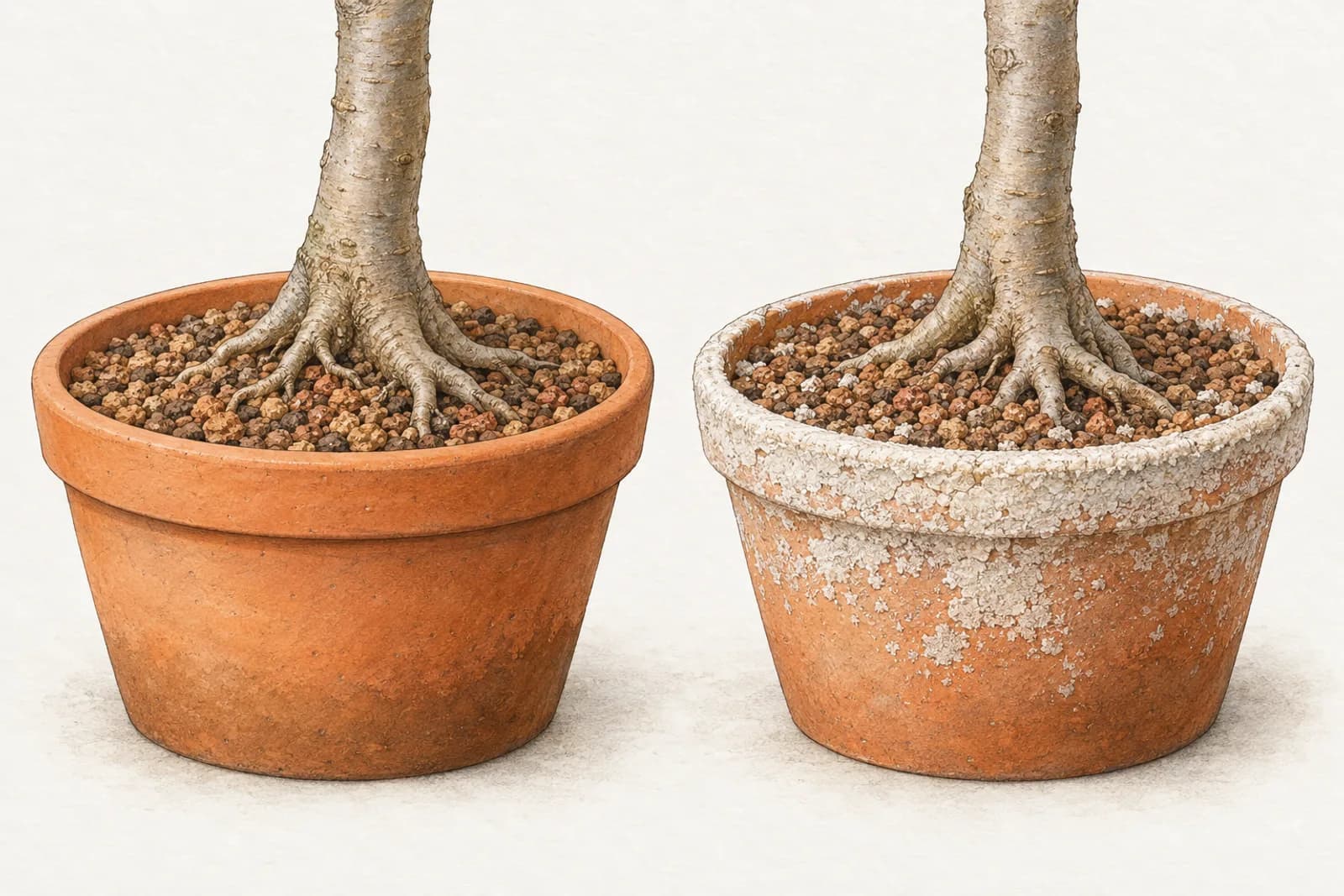
The crust itself does no harm, and on a tree growing well it mostly shows minerals building up, so keep watching (Course 01, Lesson 10). Fertilizer leaves a similar crust of soluble saltsDissolved minerals, from fertilizer and from tap water, that can accumulate in a container's substrate as water evaporates. A high concentration makes it harder for roots to take up water and can damage them. Buildup can leave a white crust on the pot or surface, though hard tap water alone can leave a similar crust, so a crust by itself does not show that roots are harmed.Open the glossary, and the tree's history is the most practical way to tell them apart: how hard the water is, and how much the tree has been fed. A crust that comes with browning leaf edges, or with wilting in a moist pot, after regular or heavy feeding points to salts building up in the root zone, which calls for leaching (below) and a look at the feeding (Course 05, Mineral Nutrition and Fertilizing). The balcony trident shows neither sign: it has had moderately hard water at every watering and is growing well, so its crust is one to watch, not treat.
Alkalinity and acid-loving trees
Limescale is mostly calcium carbonate, so water that leaves it is also carrying dissolved carbonates and bicarbonates, which neutralize acid. That is alkalinityThe dissolved carbonates and bicarbonates in water that neutralize acid. It is not the same as pH: pH says how acidic or alkaline water is, and alkalinity how much acid it can neutralize. Hard water is usually high in it, softening does not remove it, and with repeated watering it slowly raises a substrate's pH, which matters most for acid-loving trees such as azaleas.Open the glossary. It is not the same as pHA scale, usually 0 to 14, that measures how acidic or alkaline a solution or substrate is: 7 is neutral, lower numbers are acidic, and higher numbers are alkaline. It affects which mineral nutrients stay dissolved and available to roots.Open the glossary, which measures how acidic or alkaline the water is; alkalinity measures how much acid it can neutralize. Each watering adds a little, and over many waterings it slowly raises the substrateThe material that fills a container and surrounds a tree's roots, such as a mix of mineral grit, bark, or soil. Its job is to anchor the roots and to hold water, mineral nutrients, and air in a balance the roots can use.Open the glossary's pH (Course 01, Lesson 10). Hard water is usually high in alkalinity, which is why limescale in the kettle is a fair first sign.
For the junipers, the trident maple, and the ficus, the drift is usually slow enough to watch rather than treat. It matters most for acid-loving trees, such as azaleas, and for small pots watered often. On moderately hard water, an azalea's newest leaves may begin to pale between green veins late in a season or the next year, sooner in a small pot watered daily, and later or not at all when plenty of rainwater is mixed in. That pattern, chlorosisYellowing of leaves that should be green, caused by too little chlorophyll. It is a symptom, not a diagnosis: nutrient shortages, damaged or waterlogged roots, high pH, and other problems can all cause it.Open the glossary between the veins of the newest leaves, is a clue to iron locked away by a high pH, not a diagnosis. Mixing in rainwater is a safe first step, but find out the substrate's pH before acidifying, feeding, or changing the mix (Course 04, Soil, Substrates, and the Root Environment).
Go deeper · optional, not assessedWhy hard water is usually alkaline too
Water that seeps through limestone dissolves calcium carbonate, which travels as calcium and bicarbonate together, so that water is both hard and alkaline, and the limescale it leaves in a kettle is calcium carbonate again. The two can part company. Water hardened by gypsum, which is calcium sulfate, carries little alkalinity, and a softener removes the calcium and magnesium but leaves the bicarbonate, so softened water can be soft and still alkaline. In the pot, bicarbonate neutralizes the acid that roots and decaying organic matter release, so the pH creeps up with each watering; rain dilutes it, and a fresh mix resists the change for a while (Course 04). Water reports often give hardness and alkalinity in milligrams per liter “as calcium carbonate”, so the two figures can be compared directly.
Softened water
The small backyard's house has a water softener on its indoor supply, and the outdoor hose tap bypasses it. A softener swaps the calcium and magnesium for sodium (or, in some units, potassium). softened waterWater passed through an ion-exchange softener, which swaps the calcium and magnesium for sodium (or, in some units, potassium). Sodium can build up in a pot and harm the tree, so softened water is not used for routine watering. Softening leaves the alkalinity in place, so it does not help an acid-loving tree on hard water either.Open the glossary leaves no limescale, but sodium builds up in a pot as the water evaporates, where it can harm roots and brown leaf edges, so softened water is not used for routine watering. Softening does not remove the alkalinity either, so it does nothing for an acid-loving tree on hard water. The answer is water the softener does not treat: the household's trees outdoors get the hose, and its ficus, indoors from about early October to late May, gets water carried in from the hose tap or the rain barrel, never from the softened kitchen tap. In midwinter, if the hose tap is shut off against frost and the barrel drained, fill jugs at the hose tap before the freeze and keep them indoors, or have an indoor tap fitted that bypasses the softener. Water carried in from outside should reach room temperature before it goes on the ficus.
Rainwater and reverse-osmosis water
Rainwater is soft, low in dissolved salts, and slightly acidic, so it leaves no crust and adds no alkalinity. The small backyard keeps it in a covered barrel fed by the garage downspout: a screen at the inlet keeps out leaves and mosquitoes, and the lid keeps out the light algae need. Roof water carries some dust and debris, so it is for the trees, not for drinking. Lesson 6 returns to the barrel as a store for dry spells.
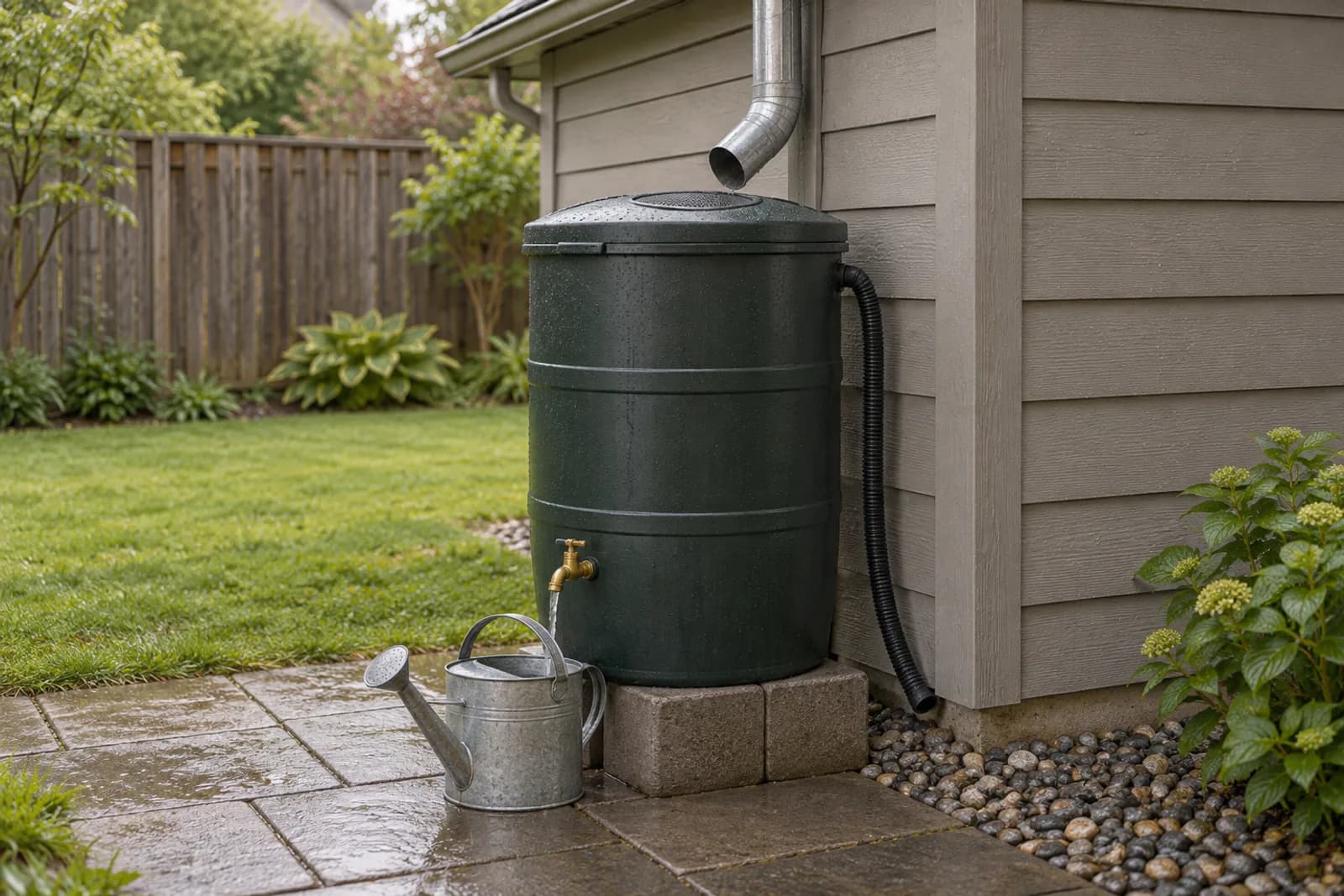
Reverse-osmosis water, from a filter that forces water through a very fine membrane, is much like rain: very low in salts and alkalinity, and carrying almost none of the calcium and magnesium that tap water supplies in small amounts. A tree watered only with rainwater or reverse-osmosis water depends on feeding for them (Course 05). Neither is needed on ordinary city water. They earn their place where the tap is softened, and for an acid-loving tree on hard water, where mixing in rainwater slows the drift in pH.
Practice check · not scored
When a water test is worth it
You rarely need to test city water yourself, and most of the answers are cheap:
- The water utility's annual report, usually online, gives the city water's pH and dissolved salts, and often its hardness, alkalinity, and sodium. For most owners on city water, with trees growing well, it is enough.
- Test strips, sold for aquariums and pools, read hardness, alkalinity, and pH. A hardness strip also shows which taps a softener treats, because softened water reads close to zero. For sodium, use the report for unsoftened city water, or a lab.
- A conductivity meter gives dissolved salts as electrical conductivityA measure of how well water or a solution conducts electricity, which rises with the amount of dissolved salts in it. It is read with a conductivity meter or found in a water report. Course 03 uses it to screen a water source; Course 04, Soil, Substrates, and the Root Environment, and Course 05, Mineral Nutrition and Fertilizing, apply it to the substrate and to feeding.Open the glossary (EC): the higher the reading, the more salt. A report may give EC or total dissolved solids, which rise and fall together. A probe moisture meterA meter with a probe that is pushed into the mix; its needle or display shows an electrical property of the mix, not water directly. Dissolved salts and how well the probe touches the particles sway the reading as well as moisture, so cheap meters are often unreliable, especially in coarse bonsai mixes, and a chopstick and the pot's weight tell you more.Open the glossary is not one, because it responds to salts and water at once (Lesson 2).
Testing earns its cost when the answer would change what you do. That means an acid-loving tree on hard water, a house with a softener (to find which taps it treats), and a crust with browning leaf edges on a tree that has hardly been fed, where the salts may be coming from the water itself. Above all it means a private well, about which nothing is known until a lab tests it.
Leaching salts out of a pot
When salts are suspected, rinse them out with plenty of plain water (Course 01, Lesson 10). That is leachingWatering heavily enough that plenty of water runs through the root zone and carries dissolved salts out with it: a thorough watering, a pause of a few minutes, and a second watering, with water that has not been softened. It answers suspected salt buildup and is not a routine, because it rinses out nutrients too.Open the glossary, sometimes called flushing, which has nothing to do with a growth flushA burst of new shoot growth, with leaves expanding together, that happens once or several times a year depending on the tree and conditions. Between flushes, shoots stop extending and mature.Open the glossary (Lesson 1). Water thoroughly until water runs from the holes, wait a few minutes, then water again, so that plenty runs through the root zone and carries dissolved salts out. Use water that has not been softened: rainwater is ideal, and ordinary tap water is fine. On the west balcony, leach at the sink, or with the pot on a grid in a basin, so that none of the water reaches the balcony below.
Leaching is a response, not a routine: it rinses out nutrients too, and every thorough watering already carries some salts out. Pause feeding while you find out why the salts built up (Course 05), and if the browning, or wilting in a moist pot, continues afterward, look beyond the water (Course 07, Tree Health and Diagnosis).
Proportionate answers to water problems
What is in your water? begins as a sandbox and ends with five cases to judge. Choose a Source and a Tree, and under Pot, a Training pot or a Small pot; for tap and softened water you can also switch on Mix in rainwater. Before a run, you can answer After a season of this water, what builds up in the pot?, or press Skip. Then press Run a season to watch months of watering pass in seconds, from early spring to the next spring: what builds up on the pot and in the root zone, and how the tree responds. Back, Next, and Replay return to any stop. What a test would show gives the readings a test would find for that source, and where each would come from. Then:
- Run City tap, moderately hard with the Trident maple, then with the Azalea, acid-loving. Run the azalea again in the Small pot, and once more with Mix in rainwater on. Then switch Source to Water from a softener, Rain barrel, Reverse-osmosis filter, and Private well, untested, and compare What a test would show.
- Work through the five cases. For each, answer What do you do about the water? with the response that fits the evidence, and read why; a wrong choice can be changed. Solving all five finishes the exercise.
Exercise
What is in your water?
Part 1 · The water lab
Run a season of watering
- Water
- Calcium and magnesium
- Sodium
Season readoutEarly spring
Lab notes0 of 5 found · optional
- Not found yet. Run a season of city tap water.
- Not found yet. Try the water from a softener.
- Not found yet. Water the azalea from the city tap.
- Not found yet. Give the azalea some rainwater.
- Not found yet. Run a season on the private well.
What a test would show
City tap, moderately hard
- Hardness
- Moderately hardTest strips
- Alkalinity
- ModerateTest strips
- pH
- Slightly alkalineTest strips
- Dissolved salts (EC)
- ModerateConductivity meter or water report
- Sodium
- LowWater report or lab
The example city's tap water. It leaves limescale in kettles and, over months, a white crust on terracotta. It suits most trees.
Tap water also carries chlorine or chloramine. At tap levels, neither is generally a problem for established trees, so there is no need to let it stand overnight. Standing lets chlorine escape, but not chloramine.
Part 2 · Five cases
What do you do about the water?
0 of 5 solved
Case 1 of 5 · The small backyard
Softened water for the ficus
In October the household's ficus comes indoors for the winter, to a bright window. Its first few waterings indoors came from the kitchen tap, a few steps away, before anyone remembered that this tap runs through the house's water softener. The hose tap on the house wall bypasses the softener.
Text description
Part 1 is a water lab. On the left of the drawing stands the chosen water source; a red watering can fills there, carries the water to a terracotta pot on a slatted bench, and pours it over the mix in a fine shower. The pot stands in a tray. Its left half is seen from outside and its right half is cut open to show the mix and roots. The tree grows above it. White six-sided crystals stand for the calcium and magnesium that hard water leaves behind as it evaporates; they build into a white crust on the rim, the wall, and the surface. Violet diamonds stand for sodium in the mix. Falling water is blue, and it carries the same crystals or diamonds when the water holds them. When the newest leaves change, a magnifier shows one up close: pale between green veins, or brown at the edges. Once a white crust has built up, a second magnifier shows the rim up close. For a source nobody has tested, the cut-open half is frosted over with a question mark. The light warms through summer and cools in winter. On narrow screens the drawing crops to the pot and the tree: the can goes off to the left to fill, and a label names the source.
The controls:
- Source: City tap, moderately hard; Water from a softener; Rain barrel; Reverse-osmosis filter; Private well, untested.
- Tree: Trident maple; Juniper; Azalea, acid-loving; Ficus.
- Pot: Training pot, watered when it needs it; Small pot, watered every day. The small pot is drawn smaller, at true relative size.
- Mix in rainwater: an on and off switch for city tap water and softened water.
- An optional prediction before the run: After a season of this water, what builds up in the pot? The choices are A crust on the pot; Sodium in the mix; Very little; No way to tell yet, or Skip.
- Run a season plays the stops in order: Early spring, Late spring, Midsummer, Late summer, Autumn, The next spring. Back, Play or Pause, Next, and Replay control it, and a track of the stops jumps to any one.
A season readout beside the drawing gives, in words, the crust on the pot (None, A faint film, A thin crust, A white crust, A thick white crust), the substrate pH on a dial from acidic to alkaline (Slightly acidic, Edging toward neutral, Near neutral, Slightly alkaline), sodium in the mix (Very low, Low, Building up, High), and the newest growth. A panel shows what a test of the chosen water would show for each of Hardness (test strips); Alkalinity (test strips); pH (test strips); Dissolved salts (EC) (conductivity meter or water report); Sodium (water report or lab). A result card closes each run, and five optional lab notes collect what the runs reveal.
Part 2 has five cases. Each asks: What do you do about the water? The same five choices apply to every case: Keep using it; Leach now and then; Mix with rainwater; Use a tap that bypasses the softener; Get a water report or test it first. Each choice gets feedback, and a wrong choice can be changed.
- The small backyard, softened water for the ficus. In October the household's ficus comes indoors for the winter, to a bright window. Its first few waterings indoors came from the kitchen tap, a few steps away, before anyone remembered that this tap runs through the house's water softener. The hose tap on the house wall bypasses the softener.
- The west balcony, a white crust on the trident's pot. Since spring, every watering for the trident maple has been carried from the kitchen tap. The city's water is moderately hard, and a white crust now rims the unglazed terracotta pot and speckles the surface. The tree has not been fed heavily. Its leaves are green and firm, and it is growing well.
- A neighbor's patio, a crust and browning leaf edges. A neighbor's potted boxwood on a sunny patio has been fed at full strength every week since spring. A white crust rims its pot, and the edges of its leaves are browning. Its root zone checks moist, not wet, and the pot drains freely. It is watered from the outdoor tap, with the city's moderately hard water.
- Outside the city, a private well, never tested. A friend outside the city has started watering a newly bought juniper from the house's private well. Nobody has ever tested the well, and there is no water report for it. The juniper looks healthy so far.
- A sunny doorstep, pale new leaves on an azalea. An azalea, an acid-loving tree, has been watered from the city tap every day this summer in its small pot. The tap water is moderately hard and alkaline. Now its newest leaves are yellowing between green veins. Its root zone checks moist, not wet, and it drains freely. A covered rain barrel stands nearby.
Solving all five opens a summary card with what each case shows.
On city tap water, a white crust built up on the pot and the substrate's pH drifted slowly toward alkaline, but only the acid-loving azalea showed it in its leaves. Its newest leaves paled between the veins the next spring in the Training pot, sooner, in late summer, in the Small pot watered every day, and not at all with Mix in rainwater on. Softened water left almost no crust, but sodium built up in the mix, and without rainwater mixed in, the leaf edges, or the juniper's needle tips, browned. Its pH still drifted, because a softener leaves the alkalinity in place. Rainwater and reverse-osmosis water left almost nothing behind, and the well stayed unknown until tested.
Each case called for the smallest change its evidence supported:
- Use a tap that bypasses the softener for the household's ficus, whose first waterings indoors came from the softened kitchen tap.
- Keep using it, the city tap, for the balcony trident growing well under its white crust, and keep watching the leaves.
- Leach now and then for a neighbor's boxwood, fed at full strength every week, with a crust and browning leaf edges, and pause feeding (Course 05).
- Get a water report or test it first for a friend's private well that nobody has tested, before relying on it.
- Mix with rainwater for the azalea whose newest leaves yellowed between green veins on hard tap water, and find out the substrate's pH (Course 04).
Heat waves: check morning and afternoon
A heat wave changes the pace, not the decision. In the example city, July afternoons are often 30 to 33 °C (86 to 91 °F), and in a heat wave they stay near 36 °C (97 °F) for days. The west balcony's sun arrives with the hottest, driest air of the day, so evaporative demandHow strongly the surrounding air draws water vapor from leaves, rising with sun, heat, dry air, and wind. High evaporative demand can make a tree lose water faster than reduced or damaged roots can replace it.Open the glossary peaks while the pots are in the sun (Course 02, Lesson 5), and a pot that checked Moist in the morning can be dry by late afternoon. While the heat lasts, the summer plan from Course 02, Lesson 5 holds, and the checks double:
- Check every pot morning and afternoon, with the lift and the chopstick, and water thoroughly whenever a check says so. When the morning check says water, water then, so the tree starts the hottest hours with a full root zone. The afternoon check often finds a pot that needs water again, and watering in sunshine rarely harms the leaves (Lesson 3).
- Keep the pot walls shaded, and keep the two junipers side by side on the shelf, so their pots shade each other's walls, because a sunlit pot wall can heat the roots far above the air (Course 02, Lesson 5). The trident stays in its spot at the back wall; moving all three there is for time away, when no one can check every day (Lesson 6).
- Put shade cloth over the trident on the hottest afternoons to protect its leaves from leaf scorchBrowning and drying of leaf edges, tips, and the tissue between the veins when leaves lose water faster than the roots can replace it, as in hot sun, wind, or dry air. Thin shade leaves moved suddenly into strong sun scorch the same way, often after pale, bleached patches. It is a symptom, not a diagnosis: a dried-out root ball, damaged roots, or salt buildup can cause the same browning.Open the glossary. The sun-loving junipers stay in the sun.
Judge a drooping trident by its root zone: limp at 6 pm over a moist root zone and firm by dusk is temporary wiltingDrooping of leaves or soft shoots on a hot, bright, or windy afternoon, over a moist root zone, that recovers by evening as demand falls and uptake catches up. Wilting that lasts overnight is a different matter, and wilting that returns most afternoons still costs growth (Course 01, Lesson 8).Open the glossary, not a call for water (Lesson 4). A juniper barely droops, so judge it by its pot.
Very small pots need more than extra checks. A cutting in a 9 cm (3.5 in) pot, or a tree in a bonsai pot 5 cm (2 in) deep, can dry out in hours, between a morning check and an afternoon one. For the days of a heat wave, move such a pot into bright shade, out of the wind, and check it more often. This is not the myth in Course 02, Lesson 5 coming back: the myth moves a tree into shade instead of fixing what is overheating, while here the trouble is a reserve too small to last between checks.
Three days of heat on the balcony
Three days of heat runs the west balcony through a heat wave near 36 °C (97 °F), windy on the second day, with the pot walls shaded and a thorough watering whenever a check finds a root zone Drying or drier. For each day, set Checks to Morning only, Morning and afternoon, or Morning, afternoon, and evening. Two switches hold for the whole wave: Group the pots, which brings the two junipers close together on the shelf and leaves the trident at the back wall, and Shade cloth over the trident on the hottest afternoons. A third, Move the junipers under the overhang, is there to test. Before each run, you can answer Which pot runs out first on day 2?, or press Skip. Then press Run the heat wave, and use Pause, Back, Next, Replay, or Skip to the end to look closely at any moment. Find both challenges to finish. Try these:
- Run the wave with Checks set to Morning only every day, and watch each pot's moisture line fall toward Dry. Note where a line crossed into Dry between checks.
- Switch days to Morning and afternoon until all three pots come through, for the challenge Bring all three through.
- For the challenge Find the day the afternoon check mattered most, answer Which day did the afternoon check matter most? after a run. To test a day first, press Day 1, Day 2, or Day 3 at the bottom of the challenge, which loads a plan with afternoon checks on every day but that one, and run it.
- Then try Move the junipers under the overhang, and see how it is graded.
Simulation
Three days of heat
Your heat-wave plan
The west balcony in July, three days near 36 °C (97 °F) in the afternoon.
Every check reads the chopstick and the lift, and waters thoroughly only when the root zone is Drying or drier.
Predictions are optional
The three potsDay 1, early morning
The nursery juniper
Root-zone moisture: Drying
Leaves: Fresh
The gift juniper
Root-zone moisture · Core: Moist
Root-zone moisture · Ring: Moist
Leaves: Fresh
The trident maple
Root-zone moisture: Moist
Leaves: Fresh
Key
- WaterA check found it Drying or drier: watered thoroughly.
- Not yetMoist or wetter: no water now.
- DryA miss: it dried out between checks.
- Your checks, on the day dial and under the chart.
- In a run: still to come, watered at least one pot, every pot fine.
- The hours the sun is on the balcony.
Root-zone moisture, hour by hour
- Nursery juniper
- Gift juniper
- Trident maple
- Your checks
Result
No run yet
Set your plan, make your call, and press Run the heat wave.
Challenges
Find both to finish.
To findBring all three through
To findFind the day the afternoon check mattered most
Run the heat wave first, then compare the days.
Test it: load a plan with afternoon checks on every day but one.
0 of 2 found
Text description
The west balcony on the fourth floor, drawn in side section looking north along it toward the privacy screen at its north end, during an invented three-day heat wave near 36 °C (97 °F) each afternoon, with a light breeze on day 1, wind on day 2, and still air on day 3. The open west side with its glass railing is on the left; the back wall is on the right, where the balcony above roofs the back half and the air-conditioner condenser stands in the corner. The morning is in shade. Direct sun comes in from the left in the early afternoon and stays until sunset, reaching under the overhang only late in the day. A thermometer in the shade on the screen shows the heat rising each afternoon.
The three pots, each with its sunny side shaded by a board:
- The nursery juniper (N): Round black plastic nursery pot about 20 cm (8 in) across, dark bark-based nursery mix. Top tier of the slatted shelf in the open middle, just inside the railing, the pot's sunny side shaded by a board.
- The gift juniper (G): Round black plastic training pot about 22 cm (9 in) across, wider than deep: the old peat-rich root ball (the core) in a ring of fresh coarse mix, with new roots now grown into the ring. Beside the nursery juniper on the shelf, the pot's sunny side shaded.
- The trident maple (T): Plain unglazed terracotta training pot about 25 cm (10 in) across, free-draining mix. Against the back wall under the overhang on a low bench, on a grid over a tray: shaded until about mid-afternoon, then the late sun reaches under the overhang until sunset. The pot's sunny side shaded.
Each pot is cut away to show its root zone in the course's six moisture words, from driest to wettest, each with its own pattern so color is never the only cue: Bone dry: pale, with crack lines; Dry: pale; Drying: pale over a faint damp band at the bottom; Moist: light blue with air dots; Wet: blue with sparse air dots; Saturated: deep blue under a solid water line, no air dots. In the gift juniper the old core and the ring of fresh mix are drawn separately, and the chopstick goes into the core, which decides the watering. Under the drawing, a chart gives each pot one line, lettered N, G, and T, falling hour by hour through the six moisture bands; the two bands below Drying are hatched in red, and the moment a line crosses into Dry is marked as a miss. Nights are drawn narrow. The planned checks stand as pins along the bottom of each day and on a round day dial, whose dark arc is night and whose yellow arc is the hours the sun is on the balcony; just under the drawing, beside the day and time in words, the dial's hand shows the hour as the run plays. A pin is red while it is only planned, hollow while it is still to come in a run, blue with a white drop once that check has watered at least one pot, and black with a white tick when every pot was fine. After a second run, the previous run's lines stay on the chart, faint and dotted, labeled Last run.
At every check the junipers' pads are lifted aside, a chopstick goes in partway between trunk and rim and comes out to be read, and a sticker over each pot shows the reading in the six words and the decision. When a check says water, a can with a fine rose pours, the water soaks down through the root zone, the line jumps up, a drop marks the line, and drips run from the holes. Leaves are drawn as they look: the trident's pads can sag and its leaves hang in the late sun, wilt, or brown at the edges, and a juniper under stress turns dull and gray rather than drooping. Shade cloth, when it is up, is a dark mesh over the trident; grouped pots stand close together on the shelf; with the junipers moved, their two pots stand on the floor under the balcony above, beside the trident's bench.
Controls: for each day, Checks: Morning only; Morning and afternoon; Morning, afternoon, and evening. Two switches for the whole heat wave: Group the pots and Shade cloth over the trident on the hottest afternoons. An optional placement switch: Move the junipers under the overhang, which is graded. At every check the pot is read with the chopstick and the lift, and watered thoroughly when the check says so. Before each run you may answer Which pot runs out first on day 2? with one of the three pots, or skip it. Run the heat wave plays the three days; Play and Pause, Back and Next (stepping between the checks and any misses), Replay, and Skip to the end control it. Each pot's card gives its root-zone moisture, its leaves, and its last check in words. The result after each run gives every pot's outcome, which pot needed water first on day 2, and a short ledger of what each day's afternoon check did.
Two challenges: Bring all three through; Find the day the afternoon check mattered most. The second is answered with one of the three days after a run; once you answer, three small charts show what skipping each day's afternoon check does with your switches. Three buttons load a plan that skips one day's afternoon check, so you can run it. Finding both finishes the exercise.
The moisture lines fell fastest in the afternoons, while the sun was on the balcony, and fastest of all on the windy second day. With Morning only, a pot could check Moist in the morning and cross into Dry by mid-afternoon, hours before anyone looked again; an afternoon check caught it while it was still Drying, in time for a thorough watering, and each check watered only the pots that needed it. With afternoon checks on the other two days, skipping the afternoon check cost the most on day 2: with no switches on, all three pots went dry, against two on day 1 and one on day 3. Group the pots and Shade cloth over the trident on the hottest afternoons slowed the drying, but with the junipers in the sun, no plan brought all three through without an afternoon check every day, so they are additions to that check, not substitutes for it. Move the junipers under the overhang slowed their drying too, but it was graded Not needed: it keeps the sun-loving junipers out of the sun they need, and shading the pot walls already protects the roots.
The leaves were no guide to the root zones. The junipers never drooped; they turned dull and grayish only after their pots had gone dry. Without shade cloth, the trident drooped in the late sun even over a moist root zone, and recovered by evening.
Practice check · not scored
Wind, fast drying, and frozen pots
Strong wind
Strong wind dries foliage and pots fast. It thins the boundary layerA thin layer of slow-moving, more humid air next to the surface of a leaf or needle, which slows the escape of water vapor into the open air. Wind thins this layer, increasing water loss.Open the glossary, the still, damp air around each leaf, so water loss climbs, most sharply in sun and heat, and it dries the pot too, above all unglazed terracotta (Course 02, Lesson 5). Add an afternoon check on any windy day, in spring and autumn as well as summer, starting with the pots on the open shelf, and make sure every pot is still tied on: four floors up, a falling pot endangers people below.
A pot that dries faster than expected
Sometimes a pot dries far faster than the weather explains: light by noon on an ordinary day, or dry at the morning check after a mild night. Confirm it with the lift and the chopstick, not the surface. In the gift juniper's two-zone root ball, the coarse ring dries ahead of the old core in summer, so a lighter pot or a dry ring is expected; the chopstick in the core decides (Lesson 2). When the checks confirm it, water it thoroughly now, in slow passes, or by immersion wateringStanding a pot in a basin of water up to the surface of the mix until the root ball is wet through, then lifting it out to drain fully. Rising bubbles show air leaving; when they stop, check the core with a chopstick, because a water-repellent core can stop bubbling before it is wet. Allow 10 to 30 minutes, up to an hour for a bone-dry, peat-rich root ball, and never more than a few hours: it is never a way to leave a pot standing in water.Open the glossary if the root ball has shrunk from the wall or water runs straight through (Lesson 3). Only then look for the cause, before you change the routine:
- Channeling. Water out of the holes within seconds, and a pot barely heavier afterward, mean the water ran past the root ball. Watering more often in the same way will not fix it.
- Roots filling the pot. A pot full of roots holds less water and dries faster. Roots matting at the holes and circling the wall are the sign that a tree may be root-boundDescribes a container plant whose roots fill the pot, circling the walls and matting at the bottom. A mildly root-bound nursery tree is common and often healthy. A badly root-bound one dries out quickly, and circling roots are dealt with at repotting.Open the glossary, a question for the next suitable time to repot (Course 11, Repotting and Root Development).
- A hotter or windier spot. A move, a shade board that has fallen, or the condenser running beside a pot all raise the pace.
- A growth flush. A burst of new leaves adds leaf area week by week, and the pot keeps drying faster from then on (Lesson 1).
Note what you found, with the date and the weather, in a watering logA dated record of each check of a tree's root zone, usually one short line per pot: the weather, what each check found, the decision, and the reason for it. Read over weeks, it shows how fast each pot dries in different weather, whether the decisions worked, and patterns no single check can show, such as a pot that keeps drying fast even as the weather cools.Open the glossary: one odd day is not a pattern, and the log shows which it was (Lesson 7).
Frozen pots in winter
Winter brings the opposite problem. A frozen root ball cannot take up water, and water poured onto it cannot soak in. Check pots on milder days, once they have thawed, and water a dry one then, so that it goes into the next freeze moist rather than dry (Course 06, Seasonal Care and Timing). Evergreens also lose water to winter sun and wind while their roots are frozen, which is winter desiccationDrying and browning of evergreen foliage in winter, when sun and wind draw water from the leaves while frozen roots or a frozen root ball cannot replace it. The damage usually shows on the sunny or windward side, often not until late winter or spring.Open the glossary (Course 02, Lesson 5). The rain shadow lasts all winter too, so pots under an overhang still need checking after winter rain.
Checks for rain, heat, and water
The bonsai decision
After rain and in heat, check rather than assume
Starting point
Keep the morning check of every pot, and let the check decide every watering. Rain changes which pot you check first, heat and wind change how often you check, and the water itself changes, at most, which source you use. On the west balcony:
- After any rain: at the next routine check, check every pot below the surface as if it had not rained, the trident at the back wall first, since still rain never reaches it, then the two junipers under their canopies. Water thoroughly any pot the check says needs it, and empty the trays.
- The water: keep using the kitchen tap. Read the water utility's report once, and watch the white crust on the trident's terracotta rather than treat it (Course 01, Lesson 10).
- In a heat wave: check every pot morning and afternoon, and water thoroughly whenever a check says so. Keep the pot walls shaded, keep the junipers side by side on the shelf, and put shade cloth over the trident on the hottest afternoons.
- On a windy day: add an afternoon check, and make sure every pot is tied on.
This assumes
- The trees are established and actively growing, in pots that drain, in their summer spots with their pot walls shaded.
- The tap water is the example city's: moderately hard, and not softened.
- The weather is the example climate's: rain in every season, summer storms often on a west wind, and July heat waves near 36 °C (97 °F). The months belong to the course's Northern Hemisphere example climate.
- Someone can check the pots twice a day while a heat wave lasts.
Change course if
- The water comes through a softener: use a tap that bypasses it, or rainwater, for every watering. A tree watered only with rainwater gets its calcium and magnesium from feeding (Course 05).
- An acid-loving tree on hard water puts out new leaves that yellow between green veins: mix rainwater into its waterings, and find out the substrate's pH before changing the feeding or the mix (Course 04).
- A white crust comes with browning leaf edges after heavy feeding: suspect salts. Leach the pot with plain, unsoftened water, and pause feeding (Course 05).
- A pot runs dry between checks: water it thoroughly now, in passes or by immersion. In a heat wave, check it more often while the heat lasts, and move a very small or shallow pot into bright shade for those days. If it happens on ordinary days, find the cause before changing the routine (Lesson 7).
- A tree droops in a wet pot after days of rain: this is not a watering problem. Investigate before watering: empty any standing water, check the drainage and the smell of the mix, and add no water (Lesson 4).
Back to the question
Did the rain water the tree, and when does the water itself or the weather change the plan?
Often less than it seems, and only a check below the surface can tell. A pot catches just the rain on its own surface, past its foliage: a light shower wets the top layer, a downpour can run past a dried core, and pots under an overhang or a dense canopy may get almost none, while trays and cover pots fill regardless. So after rain, check each pot as if it had not rained, let the check decide, and empty whatever filled. The water changes the plan only for softened water, an acid-loving tree on hard water, or salts building up; a water report, a test, or the feeding history settles each one. The weather changes how often you check, not how you decide: in heat and wind, check morning and afternoon, and water thoroughly whenever a check says so.
Key takeaways
- A pot catches only the rain that falls on its own surface, past its foliage, so pots under an overhang or a dense canopy may get almost none. Check below the surface after rain, in winter too, and let the check decide either way.
- Rain fills trays and cover pots far more reliably than it wets root balls; empty them after every rain, as after every watering.
- Most tap water suits most trees. Hard water's white crust does no harm by itself, but the water's alkalinity slowly raises the substrate's pH, which matters most for acid-loving trees and small pots watered often.
- Softened water adds sodium, which builds up in the pot, so use a tap that bypasses the softener, or rainwater. Test, or read the water report, when a decision depends on it, and leach with plain water when salts are suspected.
- Heat waves, strong wind, and pots that dry unexpectedly fast change how often you check, not how you decide. Find the cause of fast drying before changing the routine.
Optional · not required for completion
Measure the next rain
Before the next rain, stand a straight-sided cup or jar in the open beside one of your pots. Afterward, measure the depth of water in it: each centimeter (0.4 in) is about 0.3 L (10 fl oz) on the surface of a 20 cm (8 in) pot, and less wherever foliage covers it. For another pot, scale by its area: a 10 cm (4 in) pot gets about a quarter as much, about 0.08 L (2.7 fl oz) per centimeter, and a 30 cm (12 in) pot a little over twice as much, about 0.7 L (24 fl oz). Compare that with what you pour at a thorough watering of the same pot. Then check the pot below the surface, with the lift and a chopstick. How far down did the rain reach, and would you have skipped a watering if you had gone by the cup, or by the wet paving?
No tree? Stand one cup in the open and another under an overhang, such as a balcony, an eave, or the crown of a tree, and compare them after the next rain. Which spots near you would leave a pot dry through a rainy day?