Course 03 · Lesson 1 of 7 · Check, then water well
Why water demand changes
The same tree can draw its pot down in a day one week and barely touch it the next. Learn how the leaves, the weather, the spot, the pot, the mix, and the roots set the pace, and why a routine of morning checks keeps up when a fixed schedule cannot.
The question
Why does the same tree need water every day one week and hardly at all the next?
By the end of this lesson, you will be able to:
- Explain how foliage, growth, the weather, and the spot set how fast a tree draws water from its pot.
- Explain how the container, the substrate, and how full of roots the pot is change how fast it dries.
- Contrast checking regularly with watering automatically, and explain why any fixed schedule fails in both directions.
About 18 minutes to read and explore
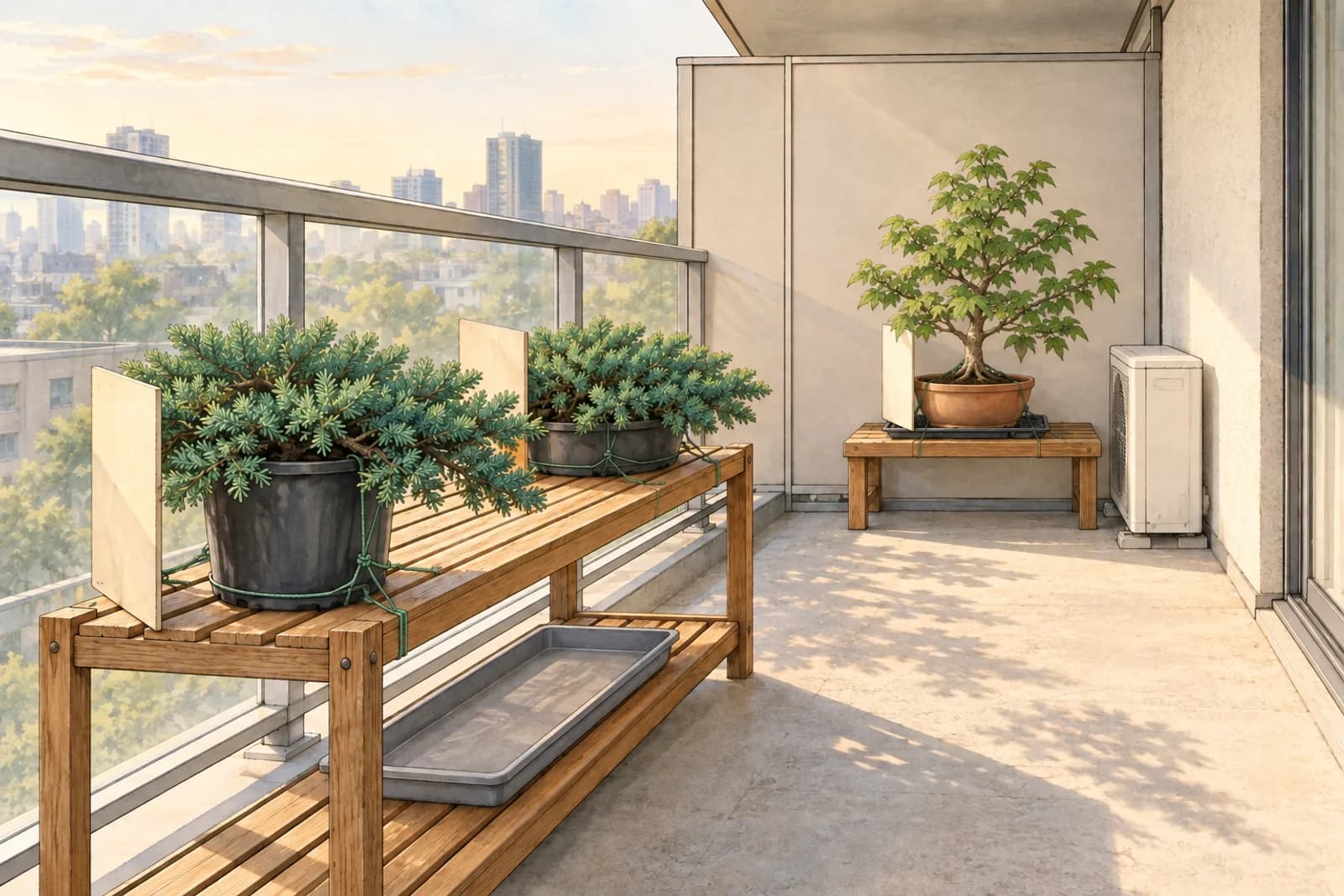
The west balcony, an instructional example that runs through this course, holds three trees this summer. The nursery juniper and the gift juniper stand side by side on the slatted shelf in the open middle, in the afternoon sun and wind. The trident maple stands in its unglazed terracotta pot on a low bench against the back wall, under the balcony above. Like every case in this course, the balcony is in one temperate Northern Hemisphere city, at about 40° N in USDA zone 7a (Course 02, Lesson 1).
On a Monday morning in late June, after a cool, rainy weekend, the morning check finds that none of the three pots needs water. The junipers were watered thoroughly on Friday, and in the cool, damp air their pots still feel heavy. Their dense foliage sheds much of any rain past the rims, so it is the lift, not the weekend's rain, that says they can wait (Lesson 5). The trident, in the back wall's rain shadowAn area that rain does not reach because something blocks it, such as the ground under an overhang or eave, beside a wall on the side away from wind-driven rain, or under a dense canopy. Pots in a rain shadow can stay dry through a day of rain, so they need checking and watering by hand.Open the glossary, was watered by hand on Saturday and has barely dried since.
By Thursday it is hot, sunny, and windy, about 31 °C (88 °F) in the afternoon. Late that afternoon the nursery juniper's pot is light, and so is the trident's: a tree in full leaf draws water fast, and terracotta loses water through its walls. Both are watered thoroughly. In the gift juniper's pot, a chopstick near the rim comes out dry, with only the tip faintly damp, but one pushed into the old core comes out damp and cool on the lower half. Friday is just as hot, and by evening the nursery juniper's pot is light again.
The gift juniper's old tag said “Water twice a week.” Kept on Mondays and Thursdays, that schedule would have watered the gift juniper's pot on Monday, still heavy, and again on Thursday, with its core still moist, while the nursery juniper, light again on Friday evening, would have waited until Monday. In a cool, gray week in late November, with the trident bare, the same three pots go most of the week on one thorough watering. This lesson explains where a pot's water goes, what sets the pace at which it goes, and why a routine of checks keeps up with that pace when a calendar cannot.
Where the water goes
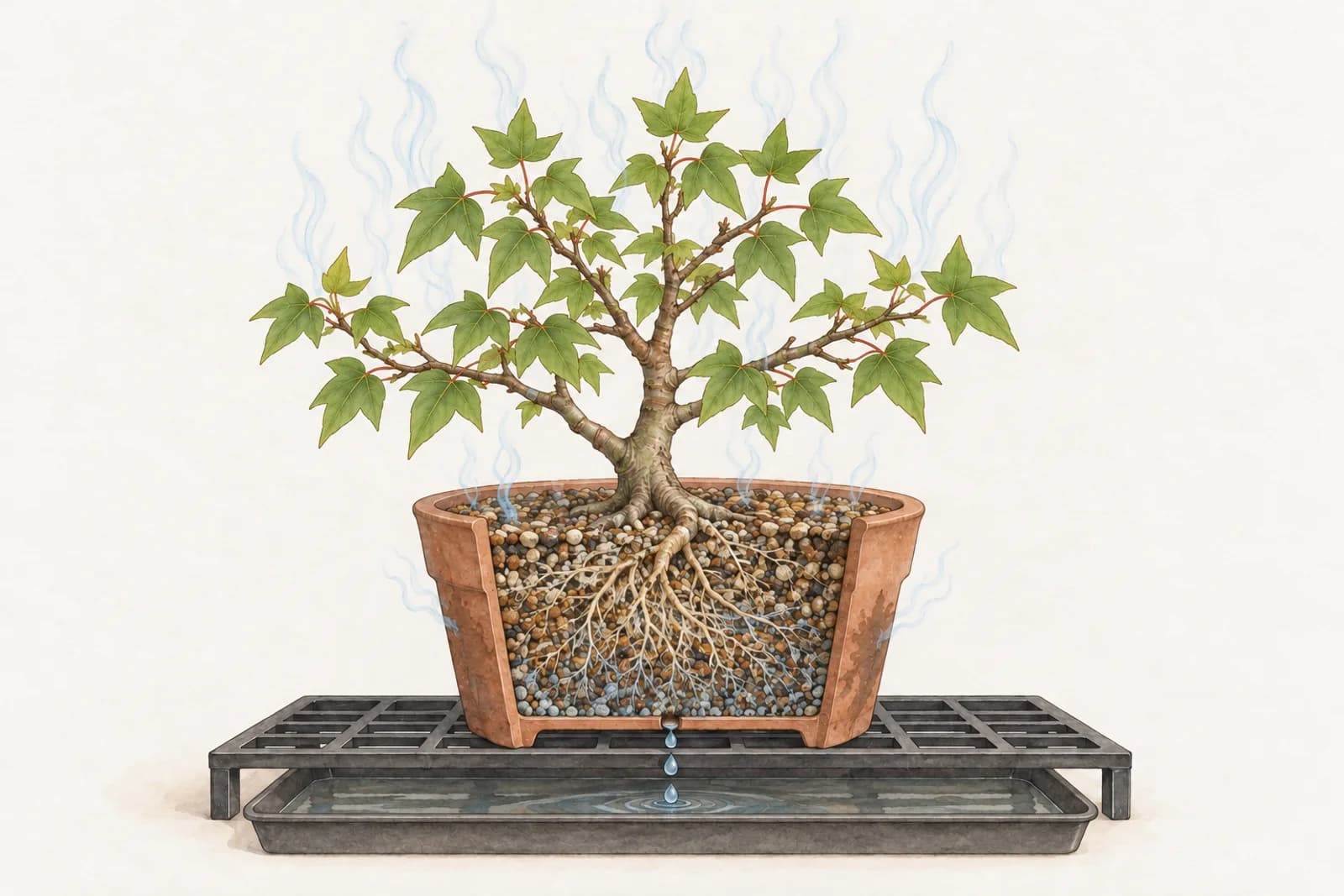
Water poured into a pot that drains leaves it in three ways. The extra runs out of the drainage holeAn opening in the bottom of a container that lets extra water run out after watering. Without one, water collects at the bottom and the substrate there stays saturated, so roots run short of air; every pot a bonsai lives in needs at least one.Open the glossary within minutes, and as it drains, fresh air is drawn into the pore spaceThe gaps between particles in soil or substrate, which hold water, air, or both. Large pores usually drain and refill with air after watering while small pores hold water, so the mix of pore sizes sets how wet and how airy a root zone stays.Open the glossary behind it (Course 01, Lesson 7). For a tree in leaf, most of the water the pot holds on to is drawn up through the roots and lost from the leaves as vapor, by transpirationThe evaporation of water from inside a plant and its escape as vapor, mostly through the stomata of leaves. As water evaporates, more is pulled up from the roots through the xylem; most of the water a tree absorbs is lost this way.Open the glossary: of all the water a tree absorbs, often well over nine-tenths goes this way (Course 01, Lesson 8). The rest evaporates straight from the surface of the mix and, in an unglazed pot such as the trident's terracotta, through the pot wall as well.
After the runoff stops, the leaves, the surface, and the wall spend what the pot held on to. So how soon a pot needs water again depends on two things: the store, how much water the pot held, and the pull, how hard that water is drawn out. Together they set the pace at which the pot dries: a big store under a gentle pull can last a week, and a small store under a strong pull can be gone in a day.
Six words for the root zone
As the store runs down, the root zone passes through stages. This course names them with six words, from driest to wettest, and uses them the same way in every lesson and interactive, under the label Root-zone moisture:
| Root-zone moisture | What it means |
|---|---|
| Bone dry | Pale and loose, or shrunk from the pot wall. Fine roots are dying, and a peat-rich mix sheds water. |
| Dry | Dry all the way down. Late: water now. |
| Drying | Dry through most of its depth, with only the bottom still faintly damp, and the pot feels light. For most trees in active growth, the usual moment a check says water. |
| Moist | Damp from partway down to the bottom, with water in the small pores and air in the large ones: the healthy middle. |
| Wet | Just watered and draining. Normal for a short time. |
| Saturated | Every pore full of water, with no air. Normal only briefly, right after watering in a pot that drains; harmful when it lasts. |
A pot that drains is saturatedDescribes soil or substrate whose pore spaces are completely filled with water, leaving little or no air. Brief saturation right after watering is normal in a pot that drains; saturation that lasts starves roots of oxygen.Open the glossary only briefly after a thorough watering, Wet for a short while, and Moist for most of the time between waterings. Drying is the stage to catch. Dry is late, and Bone dry costs fine rootOne of the many thin, branching roots, often pale when young, that do most of a tree's absorbing of water and mineral nutrients. Fine roots live a relatively short time and are constantly replaced, so they depend on a root zone that holds both water and air.Open the glossary and root hairs, which do not revive (Course 01, Lesson 2). Telling the stages apart from outside the pot is the work of Lesson 2.
What sets the pace
Six things set the pace at which a pot dries. Some change the pull, how hard water is drawn out; some change the store, how much the pot holds; a few change both:
- The tree: how much leaf it has and how fast it is growing (pull).
- The weather: sun, heat, dry air, and wind (pull).
- The spot: how much of that weather reaches the tree (pull).
- The pot: its size and shape (store), and its wall and color (pull).
- The substrateThe material that fills a container and surrounds a tree's roots, such as a mix of mineral grit, bark, or soil. Its job is to anchor the roots and to hold water, mineral nutrients, and air in a balance the roots can use.Open the glossary: how much water it holds once drained (store).
- How full of roots the pot is: roots take up room (store) and draw the water out (pull).
Comparing two pots
Predict first
The shallow bonsai pot, in both seasons. It holds far less water, and for the water it holds, it has more surface open to sun and wind, so the same pull from the leaves spends its store sooner. In November both trees draw slowly and both pots last for days, so the gap matters much less: a daily check catches either one in time.
What makes a pot dry faster? runs the same comparison with the small backyard's trident maple in two pots side by side on the bench in the western third, with morning sun and afternoon shade from the neighbor's maple. Both trees are established and in full summer leaf, and both pots were watered thoroughly at dawn; neither is watered again during the run. Pot A stays as it is, in a medium nursery pot; Pot B starts in a Small, shallow bonsai pot.
- Choose a kind of day under The day.
- Make the one-tap call, Which pot will say water first? (A, B, or About the same), or press Skip.
- Press Start the day. Watch each pot's Root-zone moisture until its flag, Check says water, goes up, and watch for Dried out. Pause, Back, Next, and Replay step through the stops, and Skip to the end jumps to the result. When the run ends, See the result takes you to the result card.
- Change one of B's settings at a time under Foliage, Pot, Wall, Mix, or Roots (on a phone, pick the setting under Change), then press Start the day again.
Four challenges tick themselves off as you find them, and finding all four finishes the race: make B say water before A by evening (your first run may find this one), make B last longer than A, find a change that matters more on a hot day than a cool one (run the same pot B under Cool and cloudy and then on a hot day), and show why a pot full of roots dries faster.
Simulation
What makes a pot dry faster?
Pot B's settings1 of 5 differ from pot A
Calls: none yet
Full leaf · Small, shallow pot · Plastic · Nursery mix · Established
Pot AStays as it is
Full leafMedium potPlasticNursery mixEstablished
Root-zone moisture: Wet
Not yet: check again later
- Chopstick
- Dark, cool, and wet along its whole length
- Lift
- Heavy, as if just watered
Pot BYour changes
Full leafSmall, shallow potPlasticNursery mixEstablished
Root-zone moisture: Wet
Not yet: check again later
- Chopstick
- Dark, cool, and wet along its whole length
- Lift
- Heavy, as if just watered
Root-zone moisture through the run
Water leaving the pot
- Leaves
- Surface
- Pot wall
- Thicker arrows: faster loss
- Wet
- Moist
- Drying
- Dry
- Bone dry
Result
Which pot says water first?
Press Start the day. When both checks have said water, the result shows when, how far apart, and why. Neither pot is watered again during the run.
Challenges
0 of 4 found
Find all four challenges to finish.
Make B say water before A by evening, not found yet.
B's check has to say water by the first evening, ahead of A's.
Make B last longer than A, not found yet.
Look for a bigger store of water, or less pull on it.
Find a change that matters more on a hot day than a cool one, not found yet.
Compare the same pot B on two very different days.
Show why a pot full of roots dries faster, not found yet.
Which setting changes how much room the mix has?
Text description
A scene on the bench in the western third of the small backyard, looking south: sunrise on the left, sunset on the right, where the neighbor's maple beyond the west fence shades the bench through the afternoon. Two pots stand side by side, pot A on the left and pot B on the right, each holding the backyard trident maple (Acer buergerianum), established and in full summer leaf, and both watered thoroughly at dawn on day 1. Neither pot is watered again during the run. The pots are cut away and drawn at true relative size. Each root zone is drawn in three layers, top, middle, and bottom, on the course's six-level moisture scale: Bone dry: pale, with crack lines; Dry: pale; Drying: pale over a faint damp band at the bottom; Moist: light blue with air dots; Wet: blue with sparse air dots; Saturated: deep blue under a solid water line, no air dots. The bottom layer stays the wettest in every pot.
Dotted blue arrows show water leaving: rising from the leaves, rising from the surface of the mix, and, for an unglazed terracotta pot, out through the pot wall. Each arrow thickens as the pull grows (sun, heat, wind, and more leaves) and thins at night, in the afternoon shade, and where the mix has little water left to give. A tree with bare branches has no leaf arrows. The sky shows the sun's path, clouds, and wind for the kind of day chosen, and it darkens at night. The canopy of a tree whose pot has dried out turns dull.
Pot A is the reference and never changes: Full summer leaf, Medium nursery pot, Plastic or glazed, Nursery mix, Established. Pot B starts the same except for one setting: Small, shallow bonsai pot.
The controls:
- The day, shared by both pots: Cool and cloudy; Mild and bright; Hot and sunny; Hot, sunny, and windy.
- Pot B's Foliage: Bare branches; Light; Full summer leaf.
- Pot B's Pot: Large, deep nursery pot; Medium nursery pot; Small, shallow bonsai pot.
- Pot B's Wall: Plastic or glazed; Unglazed terracotta.
- Pot B's Mix: Nursery mix; Coarse bonsai mix.
- Pot B's Roots: Few roots in the mix yet; Established; Pot full of roots.
- On a phone, Change chooses which of pot B's settings to show, and a line above the scene sums up pot B.
Before each run, an optional prediction asks: Which pot will say water first? The options are A, B, About the same, or Skip. Start the day runs a time-lapse from dawn through up to seven days. It stops at Dawn, Midday, Evening, Day 2 morning, and so on, and at each moment a pot's check changes; a change in the night is told at the next morning's stop, when the check would find it. Play, Pause, Back, Next, and Replay control it, a row of buttons under them jumps to any stop (on a narrow screen, to the start of any day), and Skip to the end jumps to the result. Each pot shows its Root-zone moisture, what a chopstick and a lift would find, and its status: Not yet: check again later, then Check says water when the root zone reaches Drying, then Dried out when it reaches Dry. A flag goes up on the pot when its check says water, and a red tag hangs from the flag when it dries out. A chart under the scene draws each pot's Root-zone moisture over the run on the same scale, with a flag where its check says water and a red mark where it dries out.
At the end, a line under the controls gives the headline and any challenge found, with a button that goes to the result. The result card says when each pot's check said water, how much sooner or later pot B dried, whether either pot dried out before the next morning's check and what extra check would have found it, and the main reasons, and it stamps a prediction Called it or Surprise.
The challenges tick themselves off when a run achieves them. Find all four challenges to finish. A finish card then sums up the pattern.
- Make B say water before A by evening
- Make B last longer than A
- Find a change that matters more on a hot day than a cool one
- Show why a pot full of roots dries faster
The small, shallow pot ran short first on every kind of day. It started with a much smaller store, and for the water it held it had more surface open to the air, while the same tree in full leaf pulled on it just as hard. What the day changed was what that cost. On Cool and cloudy, B's check said water on the first afternoon, but a morning check would still have caught it before it dried out, and A's check did not say water until day 4. On the mild day B dried out that afternoon, and on the hot days before midday, long before the next morning's check.
Every setting moved B the way the subsections below explain. Unglazed terracotta, Coarse bonsai mix, and Pot full of roots brought B's check forward; Bare branches, Light foliage, a Large, deep nursery pot, and Few roots in the mix yet pushed it back, sometimes past the whole week. A pot full of roots dried faster because the roots took up room that mix and its water would have filled, and more of them drew on what was left.
A change cost far more on a hot day than on a cool one. Counted in hours, the gap between the pots was shorter on the hot day, but it fell between two morning checks, so B dried out before the next morning's check. The factors multiply rather than add: B in the small, shallow pot with Unglazed terracotta, Coarse bonsai mix, and Pot full of roots said water within a few hours of dawn on Hot, sunny, and windy, while B in a Large, deep nursery pot did not say water within the week on Cool and cloudy. And the pots dried almost entirely in daylight, barely at all overnight.
Go deeper · optional, not assessedStore and pull: why the factors multiply
The time until a pot needs water again is roughly the size of its store divided by how hard that store is drawn on. Halve the store, with a pot that holds half as much, and the time halves; double the pull as well, on a day that draws twice as hard, and it halves again, so that pot can need water about four times as often. That is why the factors combine so strongly. Real pots are less tidy: the pull eases as the mix dries, because a drying substrate holds its last water more tightly (Course 01, Lesson 8) and the leaves narrow their stomata as water runs short.
The tree
A tree's water use rises and falls with its leaves. A tree in full summer leaf has the most stomaA microscopic pore (plural: stomata), mostly on leaves and needles, through which gases pass in and out, chiefly carbon dioxide entering and water vapor leaving. A pair of guard cells widens or narrows each pore in response to light, the water supply, and the surrounding air.Open the glossary open to the air and draws hardest: a trident maple in full leaf can draw its pot down within a day of summer heat. During a spring flushA burst of new shoot growth, with leaves expanding together, that happens once or several times a year depending on the tree and conditions. Between flushes, shoots stop extending and mature.Open the glossary, when many shoots extend and unfold new leaves together (Course 01, Lesson 12), the pull grows week by week. A deciduousDescribes a tree that drops all its leaves for part of each year, usually before winter or a dry season, and grows new ones when growth resumes. Most deciduous trees are broadleaves, like the trident maple, but a few conifers, such as larches, are deciduous too.Open the glossary tree that has dropped its leaves draws very little, and an evergreenDescribes a tree that keeps living foliage all year, replacing old leaves or needles gradually instead of all at once. Keeping foliage does not mean a tree grows all year: temperate evergreens such as junipers still go dormant in winter.Open the glossary such as a juniper keeps losing some water all year, slowly in cool weather.
The roots matter too. Water enters mostly through young fine roots, so a tree whose roots were recently cut or disturbed draws less, and its pot can stay damp for longer even while its leaves go short, like the repotted maple in Course 01, Lesson 8. Lesson 4 returns to watering such a tree; Course 11, Repotting and Root Development, covers its aftercare.
Trees also show a shortage differently. A trident maple's leaves leaf scorchBrowning and drying of leaf edges, tips, and the tissue between the veins when leaves lose water faster than the roots can replace it, as in hot sun, wind, or dry air. Thin shade leaves moved suddenly into strong sun scorch the same way, often after pale, bleached patches. It is a symptom, not a diagnosis: a dried-out root ball, damaged roots, or salt buildup can cause the same browning.Open the glossary if its pot dries out, so check it first on a hot day. Junipers tolerate drying better but show stress late and quietly, perhaps only as dull or grayish foliage, so check their root zone rather than wait for the foliage (Course 01, Lesson 8).
The weather and the spot
Sun, heat, dry air, and wind all raise evaporative demandHow strongly the surrounding air draws water vapor from leaves, rising with sun, heat, dry air, and wind. High evaporative demand can make a tree lose water faster than reduced or damaged roots can replace it.Open the glossary, the strength with which the air draws water vapor from the leaves. They speed evaporation from the pot's surface and wall as well. At the same relative humidity, and other things being equal, air at 30 °C (86 °F) draws water from leaves roughly three times as fast as air at 10 °C (50 °F) (Course 02, Lesson 5), and wind speeds the loss further.
The forecast describes the city; a tree lives in its spot, its microclimateThe climate of a small area, such as one corner of a balcony or the strip of ground along a wall, where it differs from the general weather around it in temperature, sun, wind, rain, or humidity. A tree responds to the microclimate of its own spot, not to the forecast for the city.Open the glossary (Course 02, Lesson 5). On the west balcony, the shelf in the open middle takes every hour of afternoon sun and the wind from the open south end, while the back wall is shaded through the early afternoon and sheltered from the breeze, one reason the trident stands there. In the small backyard, the patio along the house's south wall adds reflected heatExtra heat a tree receives from sunlit surfaces nearby, such as paving, walls, and glass: sunlight bounced off them, plus the heat they give off once warm, which can continue after sunset. It makes spots beside hard surfaces hotter and drier than the air temperature suggests.Open the glossary on summer afternoons, while the western third gets afternoon shade from the neighbor's maple.
Indoors, the year can run the other way round. At the bright window, the heating runs from about October to April and dries the room's air; a board keeps the ficus's pot out of the radiator's hotter, drier rising air. On clear winter days direct sun reaches the sill from late morning to mid-afternoon, and a grow light adds more, while in summer the high sun barely reaches inside. So the ficus can dry sooner in winter than in summer, the opposite of what a calendar suggests.
Every move changes the pace
A move puts a tree in a new microclimate, and its pot starts drying at a new pace (Course 02, Lesson 8). Each hardening offGetting a plant that grew indoors or under glass used to outdoor sun, wind, and temperatures gradually, by moving it from bright shade toward full exposure over one to two weeks or more. For bonsai, it protects soft leaves from scorch when a tree goes outdoors for the season or arrives from a greenhouse. It is not the same as shoots hardening, or turning woody, in late summer.Open the glossary step into more sun and wind dries the pot faster, so check more often after each step (Course 02, Lesson 3); when the small backyard's ficus moves out for the summer in late May, its pot dries much faster than indoors, so its checks become daily. A move into a cool room does the opposite: in the cool bedroom where the gift juniper spent part of December, its pot dried more slowly, so each check before watering started with the weight of the pot (Course 02, Lesson 3). After a move into more sun or wind, check twice a day for the first few days, until you know the new pace; after a move somewhere cooler or shadier, expect the waterings to come further apart.
Practice check · not scored
The pot
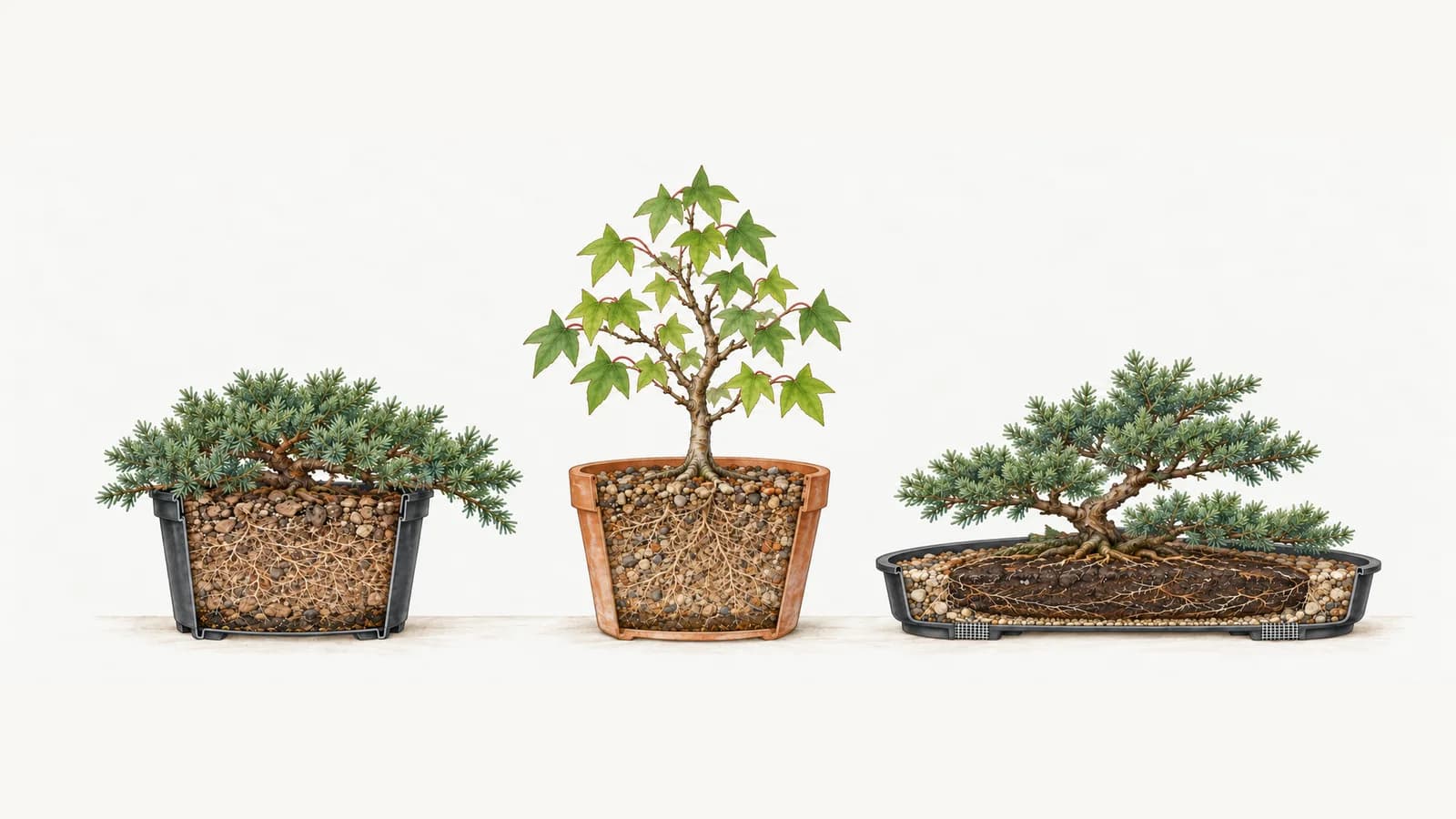
Size and shape set the store. A small pot holds less, and a shallow one, wide for its depth, spreads its water under a large surface open to sun and wind, so either runs short sooner; in summer heat a small pot can dry out in a single day (Course 02, Lesson 1). A small pot is a small reserve that needs closer watching, not less care (Course 01, Lesson 1).
The wall matters too. Plastic and glazed walls let no water through, but unglazed terracotta is porous: water moves into the clay and evaporates from its outer face, so the trident's pot dries faster than a plastic pot of the same size. A dark pot whose wall takes direct sun heats up, which warms the root zone and adds to the drying. Shading each pot's sunny side, as the balcony's owner does, protects the roots and slows the pace (Course 02, Lesson 5).
The substrate
The mix sets how much water the pot holds once it has drained, and how readily it gives it up. Coarse mineral bonsai mixes drain fast and hold less, so they dry sooner; fine, peat-rich mixes hold much more and stay moist much longer, sometimes too long; most nursery mixes, like the nursery juniper's dark, bark-based one, fall between. Why each behaves as it does belongs to Course 04, Soil, Substrates, and the Root Environment. For watering, a pot of coarse mix simply needs checking more often.
How full of roots the pot is
Roots take up room that mix would otherwise fill, and they are what draws the water out. A pot packed with roots holds less and empties faster, and a badly root-boundDescribes a container plant whose roots fill the pot, circling the walls and matting at the bottom. A mildly root-bound nursery tree is common and often healthy. A badly root-bound one dries out quickly, and circling roots are dealt with at repotting.Open the glossary tree can dry out quickly (Course 01, Lesson 2). Fresh mix that no roots have reached works the other way: nothing draws on it from inside, so it loses water only from its surface and stays damp longer than you expect.
The gift juniper has both in one pot. In December its old root ball was moved whole into a plastic training potA plain, inexpensive container, usually plastic, used while a tree grows and develops rather than for display. It drains well and is roomier than a bonsai pot, which makes it a practical next home for a tree whose current pot does not drain.Open the glossary, a correction called slip-pottingMoving a plant's root ball, whole, into a slightly larger container and filling only the gap around it with fresh substrate, without loosening, washing, or cutting the roots. Because the roots are barely disturbed, it can fix a pot that does not drain outside the usual repotting season.Open the glossary (Course 02, Lesson 7), so a dark, fine, peat-rich core sits inside a ring of coarse fresh mix a finger's width or two wide. Since spring, new roots have grown out into the ring. They now draw on its small store first, so the ring dries ahead of the core, while the core's much larger store keeps it moist longer, most of all in cool weather. That is what Thursday's check found.
For watering, the chopstick goes into the old core, partway between trunk and rim, and the core's reading decides. A ring that dries ahead of a still-moist core is expected and is no reason to water. Earlier in the year, before roots reached the ring, the pattern ran the other way, which Lesson 2 takes up. One even mix throughout is the lasting fix, at a suitable time (Course 11).
Practice check · not scored
The seasons in brief
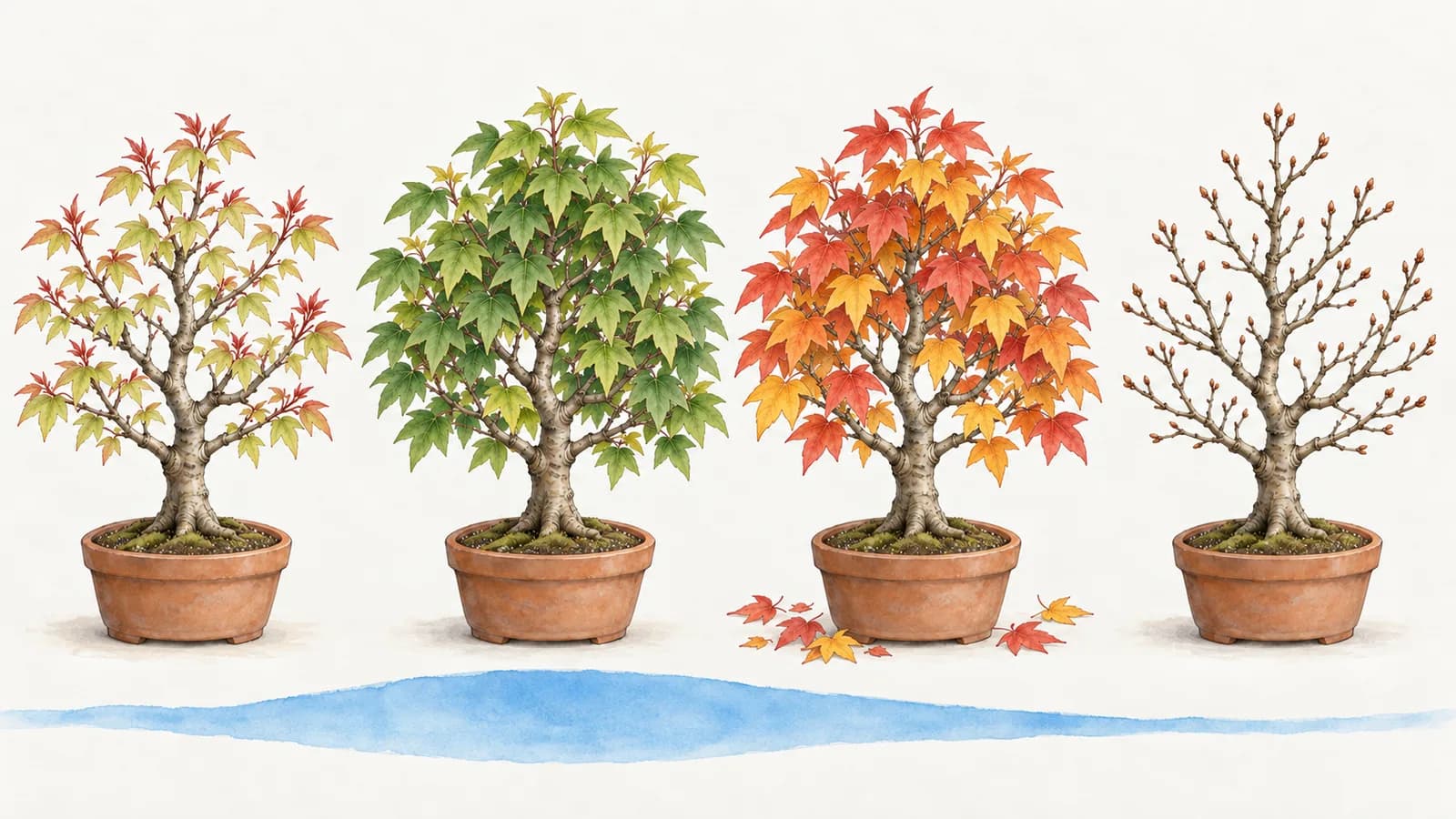
Over a year, the same tree's water use follows its leaves and the weather. It climbs quickly in spring, as buds break, leaves unfold in a flush, and the days lengthen and warm. It peaks in summer, in full leaf through long, hot days. It drops away in autumn, as the days shorten and cool and a deciduous tree's leaves color and fall. In winter it is lowest, but not zero: a bare tree still loses a little water through its twigs and buds, the pot's surface and an unglazed wall keep drying, and an evergreen still loses water on sunny, windy winter days (Course 02, Lesson 5). The roots are alive, respiring slowly, and still need moisture and air during dormancyA period when a tree, bud, or seed is alive but not growing, held back by its own internal controls, by outside conditions such as cold, or, for a bud, by an actively growing shoot tip above it. Dormant trees still respire and still need moisture, protection, and attention.Open the glossary (Course 01, Lesson 13).
Pots dry more slowly in cool weather too, so in November one thorough watering can last the west balcony's pots most of a week, and in midwinter longer. Longer is not never: a root ball left to dry for weeks can kill a resting tree, so checks go on all winter, less often, and a dry pot is watered on a day when its root ball is not frozen (Course 06, Seasonal Care and Timing).
These months and directions belong to the course's Northern Hemisphere example climate. In the Southern Hemisphere, swap north and south and shift the months by half a year, and in any climate, go by the stage you can see on the tree rather than by the date (Course 01, Lesson 13).
Checking regularly versus watering automatically
There are two ways to decide when to water. Watering automatically means deciding in advance: every Monday and Thursday, every third day, or every morning, by habit, by a timer, or by a tag. Checking regularly means looking at the root zone on a routine and letting what you find decide. The gift juniper's tag chose the first: “Water twice a week,” a fixed schedule printed for every buyer's home and every week of the year (Course 02, Lesson 2).
Why any fixed schedule fails in both directions
A schedule is set for one pace, and the pace keeps changing. In a cool, rainy spell, a schedule waters pots that are still moist. A pot that drains copes with an extra watering, because the excess drains away and air returns to the large pores. But in cool, wet weather it dries slowly, so a run of extra waterings keeps the lower root zone wet day after day, and the roots there get little air. That is overwateringKeeping a root zone wet so constantly, or letting it drain so poorly, that air never gets back into its pores and the roots run short of oxygen. It is about how often a pot is watered and how well it drains, not how much is poured at once: a thorough watering of a pot that drains, given when the root zone is drying, is not overwatering.Open the glossary: not how much is poured at once, but a root zone kept wet so constantly, or draining so poorly, that air never gets back in (Course 01, Lesson 7).
In heat, the same schedule falls behind. The pot dries out between waterings, the stomata narrow and growth slows well before any leaf shows wiltingDrooping of leaves or soft shoots when their cells lose turgor because water loss has outpaced uptake. It can come from a dry root zone, but also from damaged or reduced roots, very high demand, or blocked xylem, even when the substrate is wet.Open the glossary (Course 01, Lesson 4), and a juniper may show nothing until the damage is done.
Moving the schedule does not fix it: more waterings keep up in the heat but make the cool spells worse, and fewer do the reverse. The opening week showed both: two waterings the gift juniper did not need, and a nursery juniper light again on Friday evening with the next scheduled watering not until Monday. Only a look at the pot itself follows the pace. A timer is no exception, because it waters by the clock; it can cover days away only once it has been tested at home, and only while someone checks the pots and adjusts it (Lesson 6).
Twice a week, or when it needs it? follows the nursery juniper on its shelf through an invented two weeks from a Monday in late June, not the week this lesson opened with: a cool, rainy start, mild days and a warm one, three hot, windy days, a thunderstorm, and a cool, cloudy end. The same pot runs in two lanes side by side. Twice a week waters it on Mondays and Thursdays, like the tag; A morning check waters thoroughly only when the root zone is Drying or drier.
- Make the prediction, Which lane will leave the roots short of water more often? (Twice a week, A morning check, or About the same), or press Skip the prediction. Then press Run it.
- Watch each morning: the schedule lane reads its calendar, and the check lane reads a chopstick. Compare each lane's tallies as the days go by: Days short of water, Days kept too wet, and Waterings. Pause, Back, and Next let you study a day (on a phone, the day slider too), and Skip to day 14 jumps to the result.
- Then take on the goal, Find a fixed schedule that matches the morning check. Under Water on these days, tick the weekdays to water on, or tick Every day, and press Run this schedule. Answer What will this schedule get wrong? or press Skip the prediction, then press Run it.
- Each schedule you run stays pinned under Schedules run so far with its tallies. Three different schedules of your own, other than the tag's Mondays and Thursdays, finish the exercise.
Simulation
Twice a week, or when it needs it?
Day 1, Monday
Cool, with steady rain
Twice a week
Mondays and Thursdays, like the gift juniper's old tag
The calendar
Day 1, 7:00
The calendar never looks at the pot.
Root-zone moisture: Moist
Not run yet
- Days short of water0
- Days kept too wet0
- Waterings0
A morning check
Check every morning; water thoroughly only when the check says Drying or drier
The morning check
Day 1, 7:00
Root-zone moisture: Moist
Not run yet
- Days short of water0
- Days kept too wet0
- Waterings0
A day counts as short of water when the root zone reaches Dry, and as kept too wet when it stays Wet all day for a second day running.
- Just watered
- Moist, air in the pores
- Drying: water at the next check
- Dry: roots short of water
- Wet for days: roots short of air
- Bone dry
- Dry
- Drying
- Moist
- Wet
- Saturated
Goal
Find a fixed schedule that matches the morning check
A match means no days short of water and no days kept too wet. Tick the days, run it, and see. Three tries finish the exercise.
0 of 3 tries
Text description
A simulation with two lanes, side by side: the same nursery juniper twice, on the top tier of the slatted shelf in the open middle of the west balcony, over the same invented two weeks in late June and early July (not the week the lesson opens with). Day 1 is a Monday. The juniper's dense, spreading canopy hides the surface, so every check and every watering starts by lifting the foliage pad aside. A slim board stands behind the pot on its sunny side, shading the black pot wall. Each lane draws the pot in cutaway, with the root zone in bands from the surface down to the drainage holes. The drawing encodes moisture by color and pattern: Bone dry: pale, with crack lines; Dry: pale; Drying: pale over a faint damp band at the bottom; Moist: light blue with air dots; Wet: blue with sparse air dots; Saturated: deep blue under a solid water line, no air dots. A watering can pours on watering mornings, and runoff drips into the tray under the shelf. On a day the root zone reaches Dry, the canopy turns a little dull and grayish; junipers show stress late, so the foliage is never the check.
The first lane waters on a fixed schedule: at first Mondays and Thursdays, like the gift juniper's old tag that said “Water twice a week.” The second lane, a morning check, pushes a chopstick into the root zone partway between trunk and rim every morning at 7:00 and waters thoroughly only when the check says Drying or drier. Each lane shows the root-zone moisture, a status line for each day (one of: Just watered; Moist, air in the pores; Drying: water at the next check; Dry: roots short of water; Wet for days: roots short of air), and three tallies: Days short of water, Days kept too wet, Waterings. A day counts as short of water when the root zone reaches Dry, and as kept too wet when it stays Wet all day for a second day running. A watered day that is drying again by evening says so under its status.
The two weeks, with what the morning check finds each day:
- Day 1, Monday: Cool, with steady rain all day. Rain reaches the open shelf, but the dense juniper canopy sheds much of it past the rim. At 7:00, the morning check finds the root zone Moist and waits.
- Day 2, Tuesday: Cool and dim, with drizzle on and off. At 7:00, the morning check finds the root zone Moist and waits.
- Day 3, Wednesday: Cool and gray, with a few light showers in the afternoon. At 7:00, the morning check finds the root zone Moist and waits.
- Day 4, Thursday: Cool and cloudy, dry. At 7:00, the morning check finds the root zone Moist and waits.
- Day 5, Friday: Mild, with sun and a light breeze. At 7:00, the morning check finds the root zone Moist and waits.
- Day 6, Saturday: Mild and bright again. At 7:00, the morning check finds the root zone Drying and waters thoroughly.
- Day 7, Sunday: Warm and sunny, still air. At 7:00, the morning check finds the root zone Moist and waits.
- Day 8, Monday: Hot, sunny, and windy: the first day of a hot spell. At 7:00, the morning check finds the root zone Drying and waters thoroughly.
- Day 9, Tuesday: Hot, sunny, and windy again. At 7:00, the morning check finds the root zone Drying and waters thoroughly.
- Day 10, Wednesday: Hot, sunny, and windy: the last day of the hot spell. At 7:00, the morning check finds the root zone Drying and waters thoroughly.
- Day 11, Thursday: A hot morning, then a short thunderstorm on a west wind in the afternoon. At 7:00, the morning check finds the root zone Drying and waters thoroughly.
- Day 12, Friday: Cool and cloudy after the storm. At 7:00, the morning check finds the root zone Moist and waits.
- Day 13, Saturday: Cool and cloudy. At 7:00, the morning check finds the root zone Moist and waits.
- Day 14, Sunday: Cool and cloudy to the end. At 7:00, the morning check finds the root zone Moist and waits.
Controls: before each run you can make one prediction, or skip it. For the first run: which lane will leave the roots short of water more often (the schedule lane, the morning check, or about the same). For a schedule of your own: what it will get wrong (days short of water, days kept too wet, both, or neither). Play, Pause, Back, Next, and Replay move through the days; a board of the 14 days (a day slider on narrow screens) jumps to any day; Skip to day 14 shows the end. The schedule editor has a checkbox for each weekday and one for every day, and Run this schedule plays your schedule against the same morning check.
The goal: find a fixed schedule that matches the morning check, with no days short of water and no days kept too wet. Each schedule you run to the end is pinned as a row with its tallies. After three schedules of your own, the exercise finishes with a summary card.
The two lanes had the same pot and the same weather; only the rule changed. Twice a week went wrong in both directions. On day 1, in steady rain, it watered a pot that was still Moist, and with the tree and the air taking up little water, the pot stayed Wet for days, its roots short of air. In the warm and hot days it fell behind: the pot dried out before Monday's watering and again between Monday and Thursday. Each schedule you tried traded days short of water for days kept too wet, or got both, and Every day kept up with the heat only by keeping the pot wet through the cool days at both ends.
No set of weekdays can match the morning check, because the check was never a count of waterings. It watered five times, each on a morning when the root zone was Drying: not at all in the cool, rainy start or the cool end, once before the hot spell, every morning through it, and once after. On the hot days its pot was Drying again by evening, which is why heat calls for an afternoon check as well. Any set of weekdays that covers the hot spell also waters on the same weekdays in the rainy start.
A routine is a schedule of checks
A routine fixes when you look, not when you water. Each morning, lift each pot and compare its weight with how it felt right after a thorough watering and when it was dry: the lift testJudging how much water a pot holds by lifting it and comparing its weight with how it felt right after a thorough watering and when it was dry enough to need water. It has to be learned for each pot, works best where water is a large share of the weight, and shows how much water the pot holds, not where it is.Open the glossary. Then push an unvarnished wooden chopstick deep into the root zone, partway between trunk and rim (on the junipers, lift the foliage pad aside), leave it a few minutes, and read it along its length (Course 01, Lesson 2). Lesson 2 teaches each check and its blind spots. Each check ends in one of three decisions:
- Water thoroughly now when the root zone is drying: the pot feels light, and the chopstick comes out dry, with only the tip faintly damp. Dry and pale along its whole length means you are late. A thorough wateringWater applied evenly across the whole surface, slowly enough to soak in, until it runs from the drainage holes, and then confirmed by a check that the root ball wetted through. It usually takes two or three passes a minute or two apart. Water at the holes alone shows only that water reached the bottom, not that the roots got it.Open the glossary wets the whole root ball, slowly, until water runs from the holes, and a check afterward confirms it wetted through (Lesson 3).
- Not yet: check again tomorrow morning when the chopstick comes out damp and cool on the lower half, or wetter, and the pot is still heavy. On a hot, windy day, check again that afternoon as well.
- Investigate before watering when the tree and the root zone disagree, such as drooping, dulling, or yellowing in a pot that checks Moist or wetter, when a pot has been standing in water, or when it stays Wet far longer than the weather explains. That means looking closer at the core, the holes, underneath the pot, the smell, and recent changes first, never watering by default (Lesson 4).
When two checks disagree, add one before you decide; in a two-zone root ball, the chopstick in the old core decides. What a bonsai needs every morning in the growing season is a check, and the watering follows only when the check says so: in a hot week perhaps every day, sometimes twice, and in a cool one once or twice.
Practice check · not scored
Start with a morning check
The bonsai decision
A daily check, not a daily watering
Starting point
For an established tree in active growth, the default is a morning check, with a watering only when the check says the root zone needs it. On the west balcony in late June:
- Check each pot every morning: lift it, then read a chopstick left a few minutes partway between trunk and rim, in the old core for the gift juniper. On hot days, start with the trident.
- Water thoroughly now when the pot feels light and the chopstick comes out dry, with only the tip faintly damp, or drier: slowly, with a fine watering roseThe cap pierced with many small holes on the end of a watering can's spout, which breaks the flow into a gentle shower. A fine rose wets a pot's whole surface evenly without washing the substrate away or cutting channels through it.Open the glossary, over the whole surface until water runs from the holes. Confirm that the root ball wetted through (Lesson 3), and empty the tray.
- Not yet: check again tomorrow morning when the chopstick comes out damp and cool on the lower half, or wetter, and the pot is still heavy.
- When the lift and the chopstick disagree, add a check, such as a second chopstick spot or a look at the drainage holes, before you decide. For the gift juniper, the chopstick in the old core decides.
The routine stays the same all summer; the waterings change with the weather.
This assumes
- The trees are established and in active growth, in pots that drain freely, and none has had root work recently; a tree with reduced roots is a special case (Lesson 4).
- It is early summer in the course's example climate, and the months belong to its Northern Hemisphere year.
- Someone checks every morning: you, or a helper you have shown how (Course 02, Lesson 1). When no one can, Lesson 6 plans for the days between.
- Each pot's lift has been learned on that pot, right after a thorough watering and when dry: the activity at the end of this lesson, “Lift one pot morning and evening,” starts this, and Lesson 2 finishes it.
Change course if
- Heat, wind, a small or shallow pot, or a spring flush: add an afternoon check, and water thoroughly again if it says so (Course 02, Lesson 5).
- A move to a new spot or a hardening-off step: check twice a day for the first few days, until you know the new pace (Course 02, Lesson 3).
- Cool, cloudy weather, bare branches, or a resting tree: still check every day or two. Waterings will be fewer, but the checks never stop, in winter too (Course 06).
- A pot stays wet for days in warm weather while the tree is in leaf: this is not a watering problem. Investigate before watering, starting with the core, the drainage holes, and what has changed (Lesson 4 and Lesson 7).
- The tree droops or dulls while its pot checks Moist or wetter: do not water by reflex. Investigate before watering, starting with the root zone (Lesson 4).
Back to the question
Why does the same tree need water every day one week and hardly at all the next?
Because the pace at which a pot dries is set by things that change from week to week. For a tree in leaf, most of the water is lost through the leaves, so the pull rises with leaf area, a spring flush, sun, heat, dry air, and wind, and every move resets it. How long the store lasts depends on the pot's size, shape, and wall, on the mix, and on how full of roots it is, and these multiply with the weather: a tree in full leaf in a small pot on a hot, windy day can run short within a day, while the same tree goes most of a week in November. A fixed schedule is set for one pace and fails in both directions. A morning check reads the pace each day, and the watering follows it.
Key takeaways
- For a tree in leaf, most of a pot's water is lost through the leaves by transpiration; some evaporates from the surface and an unglazed wall, and the extra drains out after each watering.
- How hard water is pulled out depends on the tree's foliage and growth and on the sun, heat, dry air, and wind in its spot, so every move, including each hardening-off step, changes the pace.
- How long a pot lasts also depends on its store: small or shallow pots, coarse mixes, and pots full of roots run short sooner, while fresh mix that no roots have reached stays damp longer.
- Water use climbs through spring, peaks in summer, falls in autumn, and stays low but never zero through winter, so checks continue all year.
- A fixed schedule overwaters in cool spells and underwaters in heat. A routine of morning checks, with a thorough watering whenever the root zone is drying, fits every week.
Optional · not required for completion
Lift one pot morning and evening
The next time a check says a pot needs water, water it thoroughly and lift it once it stops dripping, to feel how heavy it is when full. Then lift it each morning and evening for three days, the same way each time (tilt it up by one edge if it is too heavy to lift), and note each lift in words, as “Heavy, as if just watered,” “Heavy,” “Lighter than after watering,” or “Light,” with the day's high, sun, wind, and any rain. Keep checking and watering as usual: if the pot needs water, water it thoroughly, note it, and lift it again right after. Did it lose more by day or overnight, and did a hot or windy day show? Keep the notes for Lesson 2, which turns them into a lift test you can trust.
No tree? Fill two plastic cups that have holes in their bases with the same damp potting mix, and stand each on a plate to catch drips, one in a sunny window and one in shade. Lift both each day for a few days, or weigh them on a kitchen scale. Which one lightens faster, and what would that mean for a pot on a sunny shelf compared with one beside a shaded wall?