Course 03 · Lesson 6 of 7 · Hard cases and a lasting routine
Building a routine that survives real life
A routine is a schedule of checks, not of waterings, and it has to keep working through busy weeks, changing weather, and time away. Learn to tie checks to your day, add them when the weather turns, brief a helper with a card, and test equipment before you rely on it.
The question
How do you keep a tree watered through busy weeks, changing weather, and time away?
By the end of this lesson, you will be able to:
- Plan a checking routine with reminders, and identify the weather and changes that call for extra checks.
- Plan care for time away, with a briefed helper or tested equipment and a backup.
- Write instructions that let another person water by the root zone, not by the calendar.
About 18 minutes to read and explore
Three households from this course's cases, all instructional examples in its temperate Northern Hemisphere city at about 40° N (USDA zone 7a), face the same summer in different ways (south of the equator, swap north and south and shift this lesson's months by half a year). At the bright window, the owner has checked the ficus every morning since winter, watering at the sink when the checks said so. Now the heating is off, the high sun barely reaches the sill, and the pot often stays moist for days. The owner, who works from home, is tempted to stop deciding and simply water it every morning, because that would be easy.
The small backyard's household leaves for two weeks in July, usually the hottest month, when afternoons are often 30 to 33 °C (86 to 91 °F). A neighbor can come every day, and in July heat any of their pots can dry out within a day.
On the west balcony, the owner will be away for two weeks in August, and the friend who waters can come only every second day, daily during a heat wave. In June, coming every second day through a work week, the friend found the nursery juniper dull and grayish, its pot light and the chopstick dry and pale along its whole length (Lesson 4).
Each household needs a routine that keeps working through busy weeks, changing weather, and time away. This lesson builds one in two parts: a schedule of checks, not of waterings, and a plan for the days when someone or something else has to do them.
A routine is a schedule of checks
Earlier lessons built the parts: why drying speeds up and slows down (Lesson 1), the checks (Lesson 2), and a thorough wateringWater applied evenly across the whole surface, slowly enough to soak in, until it runs from the drainage holes, and then confirmed by a check that the root ball wetted through. It usually takes two or three passes a minute or two apart. Water at the holes alone shows only that water reached the bottom, not that the roots got it.Open the glossary (Lesson 3). A routine puts them on a timetable, and what it schedules is the checking: every morning through the growing seasonThe part of the year warm enough for plants to grow, often counted as the frost-free days between the last spring frost and the first autumn frost. Its length shapes how long trees grow each year, and it is the most time a frost-tender tree could spend outdoors.Open the glossary, whatever the weather, with the watering only when the check says so. That lets one routine fit both a rainy week and a heat wave, where a tag's “Water twice a week” fits neither.
Tie the check to something you already do
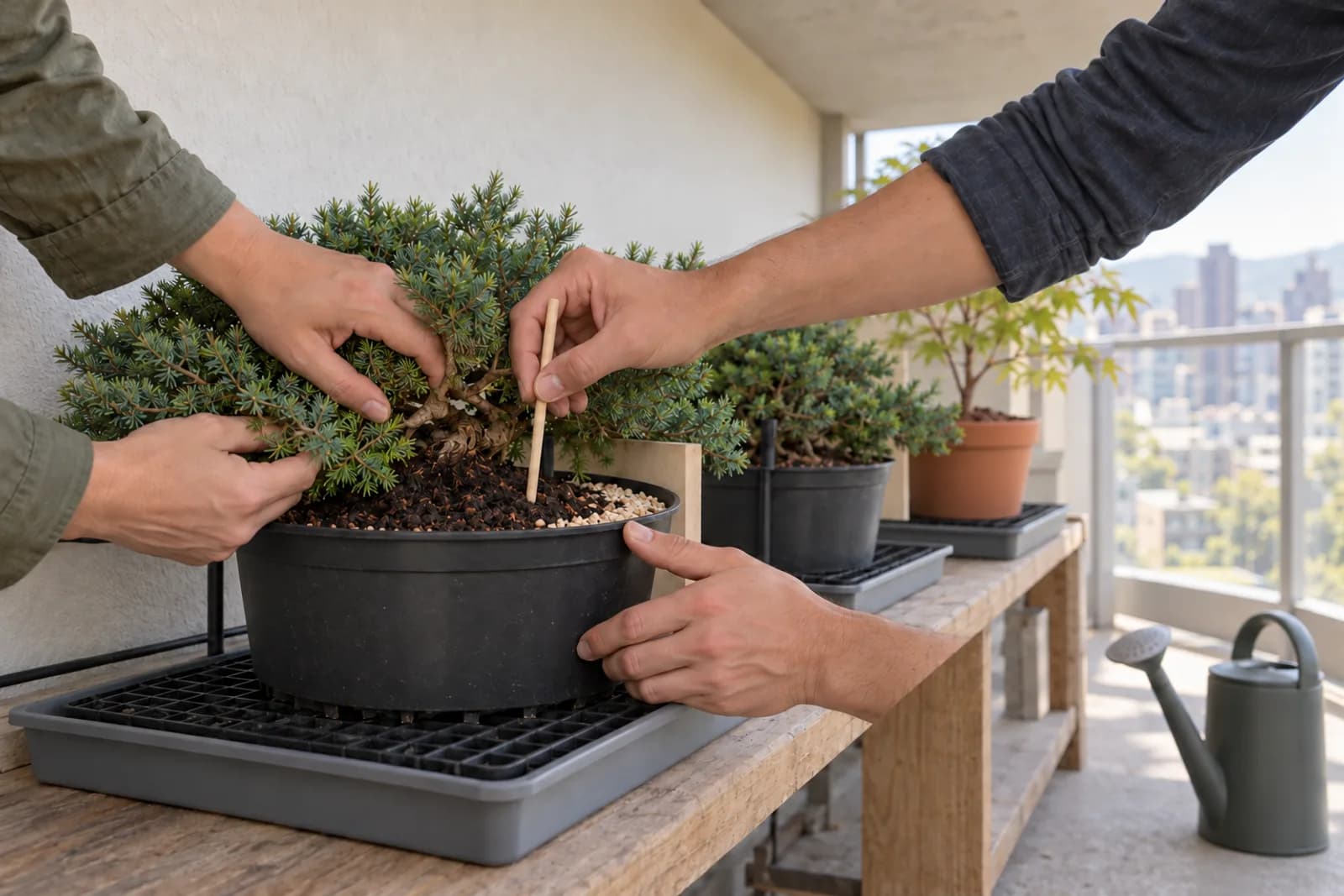
A routine survives a busy week when it costs little and rides on a habit you already have: at the bright window, the check fits between drawing the curtain aside and the first coffee; on the west balcony, the owner checks the three pots before leaving for work.
Use the one-minute round from Lesson 2 for every pot: look at the leaves and the surface, lifting any foliage aside; lift the pot (the lift testJudging how much water a pot holds by lifting it and comparing its weight with how it felt right after a thorough watering and when it was dry enough to need water. It has to be learned for each pot, works best where water is a large share of the weight, and shows how much water the pot holds, not where it is.Open the glossary); push the chopstick in partway between trunk and rim, into the old core in the gift juniper, and leave it a few minutes; then read it along its length. Choose one of the three decisions, Water thoroughly now, Not yet: check again later, or Investigate before watering, and write one line in your watering logA dated record of each check of a tree's root zone, usually one short line per pot: the weather, what each check found, the decision, and the reason for it. Read over weeks, it shows how fast each pot dries in different weather, whether the decisions worked, and patterns no single check can show, such as a pot that keeps drying fast even as the weather cools.Open the glossary (Lesson 7).
On a rushed morning, keep both checks. Go along the pots once, looking, lifting, and pushing in each chopstick, then go back and read the chopsticks in the same order: every pot still gets two checks, in a few minutes. Morning is the best time, because the check shows what the day will need and a tree watered then starts the hot afternoon full.
Reminders for the days that change
A phone alarm at the time of the check carries the habit through its first weeks. After that, the reminders that matter are for the days that change the pace: a weather app's alerts for heat, strong wind, frost, and storms, and calendar notes for trips and for the heating going on or off. Give each one an action:
- Heat or strong wind: add an afternoon check. Both raise evaporative demandHow strongly the surrounding air draws water vapor from leaves, rising with sun, heat, dry air, and wind. High evaporative demand can make a tree lose water faster than reduced or damaged roots can replace it.Open the glossary, so a pot moist at breakfast can be dry by late afternoon (Course 01, Lesson 8).
- A storm: tie or move tall pots first. Afterward, check every pot below the surface and empty the trays, because rain rarely waters a pot well (Lesson 5).
- Frost: make sure each root ball goes into the freeze moist rather than dry, and protect the roots (Course 06, Seasonal Care and Timing).
- The heating goes on or off: an indoor pot dries at a new pace from that week, sooner once the heating runs (Lesson 1). Keep the same morning check, and let it find the new pace.
- A trip: two weeks ahead, start testing any equipment; about a week ahead, show your helper the checks.
How often to check
How often follows the pace, so it changes with the season and the weather, not the calendar. Through the growing season, the morning check is the base:
| When | How often to check |
|---|---|
| An ordinary day in the growing season | Every morning |
| Hot or windy days, and heat waves | Morning and afternoon |
| The first few days after any move, such as a hardening offGetting a plant that grew indoors or under glass used to outdoor sun, wind, and temperatures gradually, by moving it from bright shade toward full exposure over one to two weeks or more. For bonsai, it protects soft leaves from scorch when a tree goes outdoors for the season or arrives from a greenhouse. It is not the same as shoots hardening, or turning woody, in late summer.Open the glossary step | Twice a day |
| Late autumn and winter, for trees resting outdoors | Every day or two, never stopping |
After a move, the pot dries at a pace you have not learned yet, so it gets two checks a day until you have (Course 02, Lesson 3). Winter slows the pace without stopping it: resting trees still use some water, and evergreenDescribes a tree that keeps living foliage all year, replacing old leaves or needles gradually instead of all at once. Keeping foliage does not mean a tree grows all year: temperate evergreens such as junipers still go dormant in winter.Open the glossary foliage loses water on sunny, windy days (Course 06). An indoor tree such as the ficus keeps its daily check through winter, because the heating dries it sooner. These are starting points for established trees in pots that drain, not a schedule; a very small pot, a hot spot, or a spring flushA burst of new shoot growth, with leaves expanding together, that happens once or several times a year depending on the tree and conditions. Between flushes, shoots stop extending and mature.Open the glossary can call for more.
A daily check is not a daily watering
Checking every day costs a minute and harms nothing. Watering every day without checking is a schedule like the gift juniper's old tag, only more frequent, and it fails the same way (Lesson 1). In a week when a pot dries slowly, each watering lands on a root zone that is still moist, so the bottom of the root zone never dries back and air never gets back in. That is overwateringKeeping a root zone wet so constantly, or letting it drain so poorly, that air never gets back into its pores and the roots run short of oxygen. It is about how often a pot is watered and how well it drains, not how much is poured at once: a thorough watering of a pot that drains, given when the root zone is drying, is not overwatering.Open the glossary. In a hot week the check may call for water every morning, as it can for the west balcony's trident in July, and then the watering is daily too. Keep the habit daily and fixed in time, and let the checks decide whether the watering is daily as well.
Practice check · not scored
Make watering easy
A routine also lasts when watering itself is easy, because a chore you dread becomes a check you skip:
- Fewer, larger pots. A larger pot holds a bigger reserve, forgives a late check, and is easier to leave in someone else's care (Course 02, Lesson 1), as long as the tree's roots fill it: a small tree in an oversized pot leaves unused mix that stays wet (Course 02, Lesson 7).
- Pots where you pass them, among the spots that suit each tree, in sight of the door or window you use most.
- Water close by: on the west balcony, the can with its fine watering roseThe cap pierced with many small holes on the end of a watering can's spout, which breaks the flow into a gentle shower. A fine rose wets a pot's whole surface evenly without washing the substrate away or cutting channels through it.Open the glossary by the balcony door; in the small backyard, the hose coiled at the tap with its shower wand on.
- Somewhere for the runoff: a tray, with the pot held above it on slats or a grid, emptied after every watering so it never becomes a cachepotA decorative outer pot, usually without a drainage hole, that holds a plainer pot inside it. Water that drains from the inner pot collects in it, so it has to be emptied after every watering or rain, or the bottom of the root ball sits in water.Open the glossary (Course 02, Lesson 7).
- Pots grouped in summer, so they shade each other's walls, with the sunny side of the outer pots shaded too (Course 02, Lesson 5).
Water you do not waste
Watering by checks uses less water than a schedule frequent enough to cover the hot weeks, because no can goes into a pot that did not need it. Two habits save more, and one that looks thrifty does not:
- Slow passes, not one fast pour. A fast pour pools, runs to the edge, and can channelingWater running down a few easy paths, such as a gap at the pot wall, a crack, or the edges of a dry, water-repellent core, and out of the drainage holes without wetting most of the root ball. First drips within seconds from a pot that was light suggest it; a pot still barely heavier afterward, or a core that is still dry, confirms it.Open the glossary past the root ball and out of the holes; slow passes soak in, so less water wets more of the root ball (Lesson 3).
- A covered rain barrel. The small backyard's barrel, screened and fed by the garage downspout, stores soft water for dry spells and for hose bans in a drought (Lesson 5).
- Tray water poured away, not back. It carries the dissolved salts the watering rinsed out. On the west balcony, carry it to the kitchen sink, never over the railing; in the backyard, tip it onto the lawn.
A day or two away
For a night away, or a weekend in mild weather, most trees manage without a helper if you set them up for it:
- Check, then water before you go. In summer, water each pot thoroughly that morning unless a check finds it heavy, as if just watered; in cool weather, water only what the checks say. This is the one time to water a pot that checks Moist: a pot that drains copes with one extra watering, and no one will check it again until you return.
- Group the pots out of the strongest sun and the wind, with their walls shaded. On the west balcony, that is along the back wall, away from the condenser corner, shaded by the balcony above until about midafternoon and sheltered from the breeze; in the small backyard, it is the western third, in the afternoon shade of the neighbor's maple. A day or two of less sun costs a sun-loving juniper little, while water lost in full sun cannot be replaced until you return.
- Empty every tray, and stand nothing in water.
A thorough watering can carry a pot through several days of cool, cloudy weather, but through a day or two at most in July heat. A small pot can dry out in a single day (Course 02, Lesson 1), and a very small or shallow one in hours (Lesson 5). So in summer, a hot weekend, any small pot, or any trip longer than a weekend needs someone to check.
A helper who waters by the root zone
For a longer trip in summer, someone has to check. Course 02 counted who can water while you are away as part of your time (Course 02, Lesson 1) and asked for a helper shown the chopstick check, so they water by the root zone, not by the calendar (Course 02, Lesson 8). Briefing one well takes a demonstration, a practice round, and a card.
Show them, then watch them do it
Show the helper on the trees themselves about a week before you leave, so there is time for a second practice round if the first one shows gaps:
- The lift. Have them lift each pot right after you water it and again before its next watering, so they feel heavy and light on that pot.
- The chopstick. Leave it a few minutes, then read it together along its length: dry, with only the tip faintly damp, or drier, means water; damp and cool on the lower half means not yet. In the gift juniper, it goes into the old core.
- A thorough watering. Let them water once with the can and its fine rose, in slow passes under the lifted foliage until water runs from the holes, then lift the pot again.
- The tray. Empty it at every visit.
- The kit, if there is one. Show them each emitter, the reservoir's level and how to top it up, and how to push a loose line back on or straighten a kink. A pot whose line has failed gets the lift and the chopstick at that visit, and a thorough watering by hand if it is drying.
Then watch a practice round in silence: the helper checks every pot, decides, and says why. Every place they hesitate is a line the card needs. Agree that they will send a photo of each tree from the same spot at every visit, with the chopstick result in words (Course 01, Lesson 14); the messages become part of your watering log. And tell them what is normal, what to act on, and what to report:
- Normal: the gift juniper's coarse ring drying ahead of its still-moist core; the trident drooping late on a hot afternoon over a moist root zone and firm again by evening, which is temporary wiltingDrooping of leaves or soft shoots on a hot, bright, or windy afternoon, over a moist root zone, that recovers by evening as demand falls and uptake catches up. Wilting that lasts overnight is a different matter, and wilting that returns most afternoons still costs growth (Course 01, Lesson 8).Open the glossary (Lesson 4); a little water in the trays while a drip kit runs.
- Water thoroughly now, then report: a chopstick dry and pale along its whole length, or a juniper gone dull and grayish over a light pot.
- Report before adding any water: a pot still wet days after watering in warm weather, drooping or dulling over a wet root ball, or a sour smell.
- Set it right, then report: anything toppled, kinked, or leaking. Stand the pot up or refit the line, then check that pot below the surface and water it by hand if it is drying.
A card that works when you cannot answer
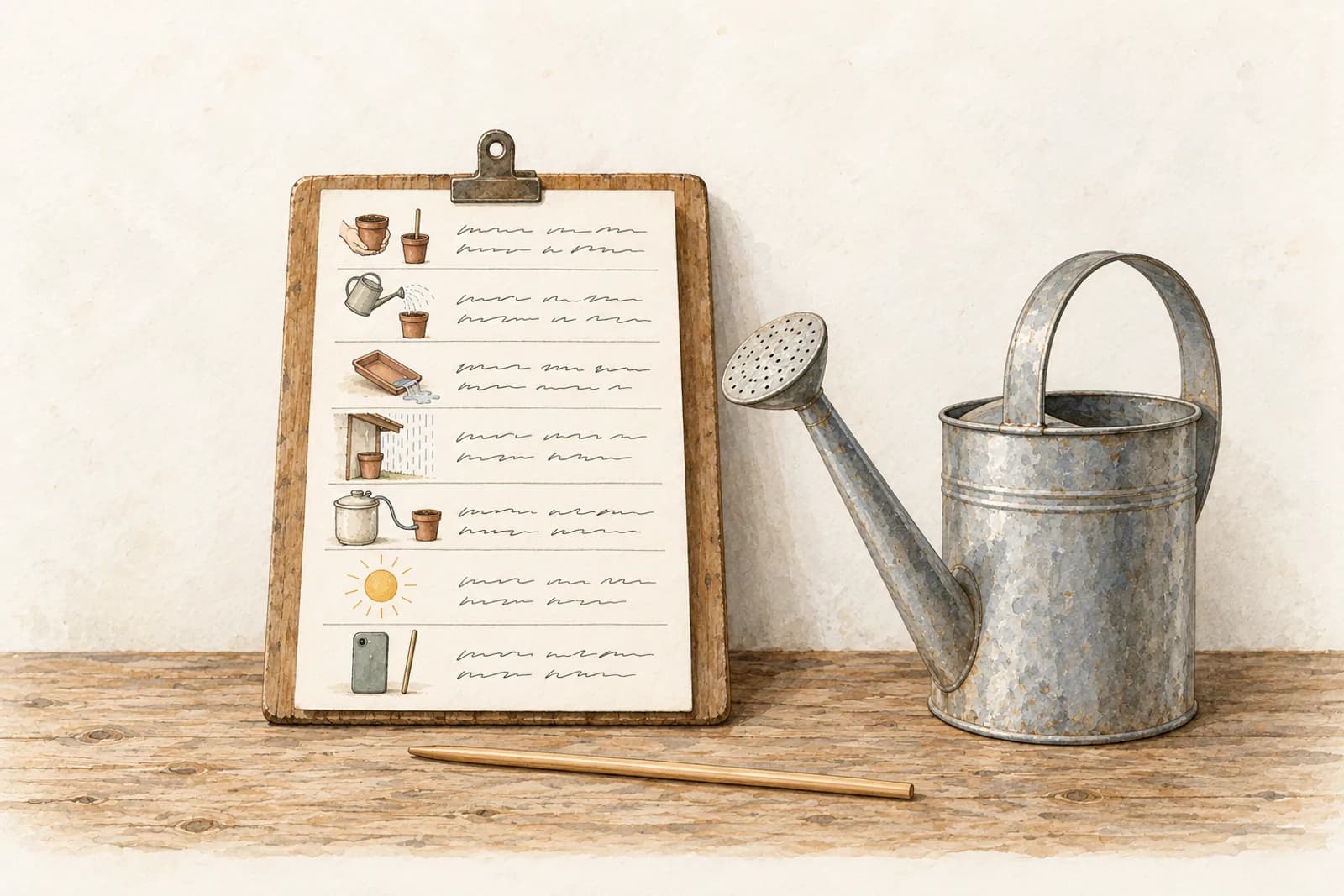
The card is the briefing that stays behind. The helper reads it with no one to ask, so each line needs a check, the reading that means act, and the action. A line that names a day, such as “Water every second day,” cannot tell a heat wave from a rainy week.
For the small backyard, “Water the elm every morning” becomes “Each morning, lift the elm and push the chopstick in partway between trunk and rim. If the pot feels light and the chopstick comes out dry, with only the tip faintly damp, or drier, water it with the wand in slow passes until water runs from the holes. If the chopstick is damp and cool on the lower half, leave it until tomorrow.” Add a line for anything one pot needs that the others do not, such as the gift juniper's chopstick going into its old core, and one for what the helper may fix. Keep the card short enough to read standing up, and leave it with the can.
Predict first
Both times, the card works by the calendar instead of by the pots. In the heat wave the gaps are too long: the nursery juniper's pot can dry within a day in August heat and then wait, dry, for the next visit. After the storm, the card says nothing about the trays the storm filled or about which pots the rain reached. If the friend decides the rain did the watering, they skip the pots it barely wetted: the trident at the back wall, which wind-driven rain usually wets only on top, and the junipers, whose canopies shed much of it past their rims. A card that names a check gets both days right.
In Write the watering card, you write the card the friend will follow in August, coming every second day while the drip kit tested in July gives every pot a drink at dawn. On this trip the pots stay in their summer spots, the two junipers on the shelf in the open middle and the trident at the back wall, a layout that a tested kit can also carry through (Two weeks away, below). For each of the seven lines, from How to tell if it needs water to If something looks wrong, choose the instruction you would leave; on a phone, the lines come one at a time, with Previous and Next. Then:
- Press Test the card. Before the friend sets off, answer Will this card get the friend through all six scenes? with Yes, all six or No, something will go wrong, and press Run the test, or press Skip.
- Watch the friend, who follows the card to the letter, work through six scenes from the trip. The line they are following lights up, and a line that lets the trees down gets a stamp with the day it missed. Skip to results jumps to the end.
- Press Revise the card, change each stamped line, and press Test again. The card is done when all six scenes pass.
- Then Copy the card gives you its text to start the activity at the end of this lesson.
Exercise
Write the watering card
The case · Instructional example
The west balcony, two weeks in August
- You are away for two weeks in August, in the summer heat.
- A friend comes every second day, every day during a heat wave, and the morning after a storm. In late July, a week before the trip, you show them the checks on the trees themselves.
- A reservoir drip kit, tested for two weeks in July, gives every pot a drink each dawn. It cannot judge the weather.
- For the trip, all three pots stand together along the back wall, under the balcony above, each on a grid over its own tray, sunny sides shaded, as through the July test.
- Trays catch the runoff, because drips land on the neighbors' balcony below.
- The card is all the friend has. They follow it word for word and cannot ask you.
Choose each line
0 of 7 chosen
Text description
An exercise in writing instructions that work without you. The case is the west balcony in August: you are away for two weeks, a friend comes every second day, every day during a heat wave, and the morning after a storm, and a reservoir drip kit, tested for two weeks in July, gives every pot a drink each dawn. In late July, a week before the trip, you show the friend the checks on the trees themselves. For the trip, the trident maple, the gift juniper, and the nursery juniper stand together on a low bench along the back wall, under the balcony above, each on a grid over its own tray, sunny sides shaded, as through the July test. Drips from the balcony land on the neighbors' balcony below.
The card has seven lines. For each, you choose one of three options, as radio buttons under the line's heading; the card beside the editor shows the lines you have chosen. The lines and their options, in the order shown:
- Line 1, How to tell if it needs water. The friend decides at every pot, on every visit. Option 1: Feel the surface near the rim with a fingertip; water whenever the top feels dry to the touch, since the top of a pot is where it dries out first. Option 2: Lift the pot, then leave the chopstick a few minutes partway between trunk and rim; water if the pot feels light and it comes out dry, with only the tip faintly damp, or drier. Option 3: Give each pot a full can of water on every single visit, whatever the weather has been doing since your last visit, so that not one of the three pots can ever run short of water.
- Line 2, How to water. What the friend does once a pot needs water. Option 1: Lift any foliage aside and pour slowly over the whole surface in two or three passes, until water runs from the holes. Option 2: Give the top a quick, generous splash right over the foliage, so the needles and the surface look fresh and dark again. Option 3: Fill the tray underneath right up to the brim, so that each pot can draw up what it needs through its drainage holes.
- Line 3, After watering. Drips from the balcony land on the neighbors' balcony below. Option 1: Mist the foliage all over with the spray bottle, so the leaves and needles stay cool and fresh until your next visit. Option 2: Leave the water standing in the trays, as a reserve the pots can draw on until your next visit. Option 3: Empty every tray into a bucket once the dripping stops, and pour it down the sink, never over the railing.
- Line 4, The trident at the back wall. It stands under the balcony above, against the back wall. Option 1: Skip it on a visit after rain; a good storm soaks every pot on the balcony, wherever it stands. Option 2: Check it on every visit, even after rain, since the balcony above keeps most rain off it. Option 3: Water it only when its leaves start to droop; until then it still has enough to drink.
- Line 5, The drip kit. It gives every pot a drink each dawn, whatever the weather. Option 1: Leave it running as it is; it waters every pot on its own each dawn, so you can skip the checks. Option 2: Switch it off for the whole trip, so nothing can go wrong with it, and water every pot by hand on each of your visits. Option 3: Top up the reservoir on every visit, look over the lines and emitters, and still check every pot below the surface.
- Line 6, If a heat wave is forecast. A heat wave can dry a pot within a day. Option 1: Come every day while it lasts, and check again in the afternoon if you can. Option 2: Come on your usual days, and give each pot a lot of extra water to carry it through. Option 3: Carry the pots indoors, out of the sun and wind, until the heat has passed.
- Line 7, If something looks wrong. The friend cannot ask you what a sign means. Option 1: Give it more water than usual, since drooping leaves always mean that the tree is thirsty. Option 2: Send me a photo and the chopstick result, and add no water to a pot that is still wet. Option 3: Move it into deeper shade under the overhang and wait for it to recover.
Test the card sends a friend through six scenes from the trip. Before each test you can make a call on whether the card will get through all six, or skip it. The friend follows the card word for word, and each scene tests one or two lines. A scene passes, passes by luck, or misses; a miss stamps the line that caused it, and the card shows the stamp. What the friend finds in each scene is told during the test, in the text under the drawing and in an announcement. The scenes, in the order of the trip:
- Day 3, morning. Trays full on arrival. It tests line 3, After watering.
- Day 6, afternoon. A hot, windy afternoon. It tests line 6, If a heat wave is forecast, then line 2, How to water.
- Day 7, morning. The drip line has kinked. It tests line 5, The drip kit, then line 2, How to water.
- Day 10, morning. The back-wall trident after rain. It tests line 4, The trident at the back wall.
- Day 11, morning. Two days after the storm. It tests line 1, How to tell if it needs water.
- Day 13, morning. A heavy pot with drooping leaves. It tests line 1, How to tell if it needs water, then line 7, If something looks wrong.
The drawing is a side view looking south along the balcony toward its open end: the back wall and the balcony above on the left, with the three pots on their bench under it, the open floor in the middle, and the glass railing on the right. The drip kit's reservoir stands on the floor at the end of the bench, with a line to each pot; the wide trident pot has two emitters, one on each side of the trunk. Each pot is cut away to show its root zone, with the gift juniper's old core outlined inside its coarse ring. Root-zone moisture is shown as levels with a color and a pattern each (Bone dry: pale, with crack lines; Dry: pale; Drying: pale over a faint damp band at the bottom; Moist: light blue with air dots; Wet: blue with sparse air dots; Saturated: deep blue under a solid water line, no air dots). Water in the trays and the reservoir is blue; drops show water moving, and still arrows replace them when the animation is paused or motion is reduced. The friend appears as hands with a watering can, a chopstick, a jug, a phone, or a spray bottle, and a dusk wash marks time passing. Under the drawing, each scene is told in words: the line the friend follows, what happens, the lift and chopstick readings where the friend checks, and the pot's root-zone moisture afterward.
Play, Pause, Back, Next, and Replay control the test, a button for each day replays that scene, and Skip to results shows every stamp at once. The card is done when all six scenes pass. Copy the card copies its text, so you can adapt it for your own helper.
The friend did exactly what the card said, so every missed scene traced back to one line that leaned on the surface, a habit, or a rule of thumb instead of a check. The fingertip line even passed two days after the storm, by luck, because the damp surface happened to agree with the root zone, and then on day 13 it watered the trident's pot, which was already wet. The card that passed answered each question the friend could not ask you:
- How to tell if it needs water: lift the pot, then leave the chopstick a few minutes partway between trunk and rim, and water if the pot feels light and it comes out dry, with only the tip faintly damp, or drier.
- How to water: lift any foliage aside and pour slowly over the whole surface in two or three passes, until water runs from the holes.
- After watering: empty every tray once the dripping stops, down the sink and never over the railing. A full tray is no reserve, because the pots stand above the water on slats or a grid.
- The trident at the back wall: check it on every visit, even after rain, since the balcony above keeps most rain off it and leaves it in a rain shadowAn area that rain does not reach because something blocks it, such as the ground under an overhang or eave, beside a wall on the side away from wind-driven rain, or under a dense canopy. Pots in a rain shadow can stay dry through a day of rain, so they need checking and watering by hand.Open the glossary (Course 02, Lesson 5).
- The drip kit: top up the reservoir on every visit, look over the lines and emitters, and still check every pot below the surface. On day 7, only this wording sent the friend to the kinked drip line behind the bench.
- If a heat wave is forecast: come every day while it lasts, and check again in the afternoon if you can.
- If something looks wrong: send a photo and the chopstick result, and add no water to a pot that is still wet.
Equipment that waters while you are away
When a helper cannot come as often as the pots need, equipment can supply water between visits.
Drip irrigation and a timer
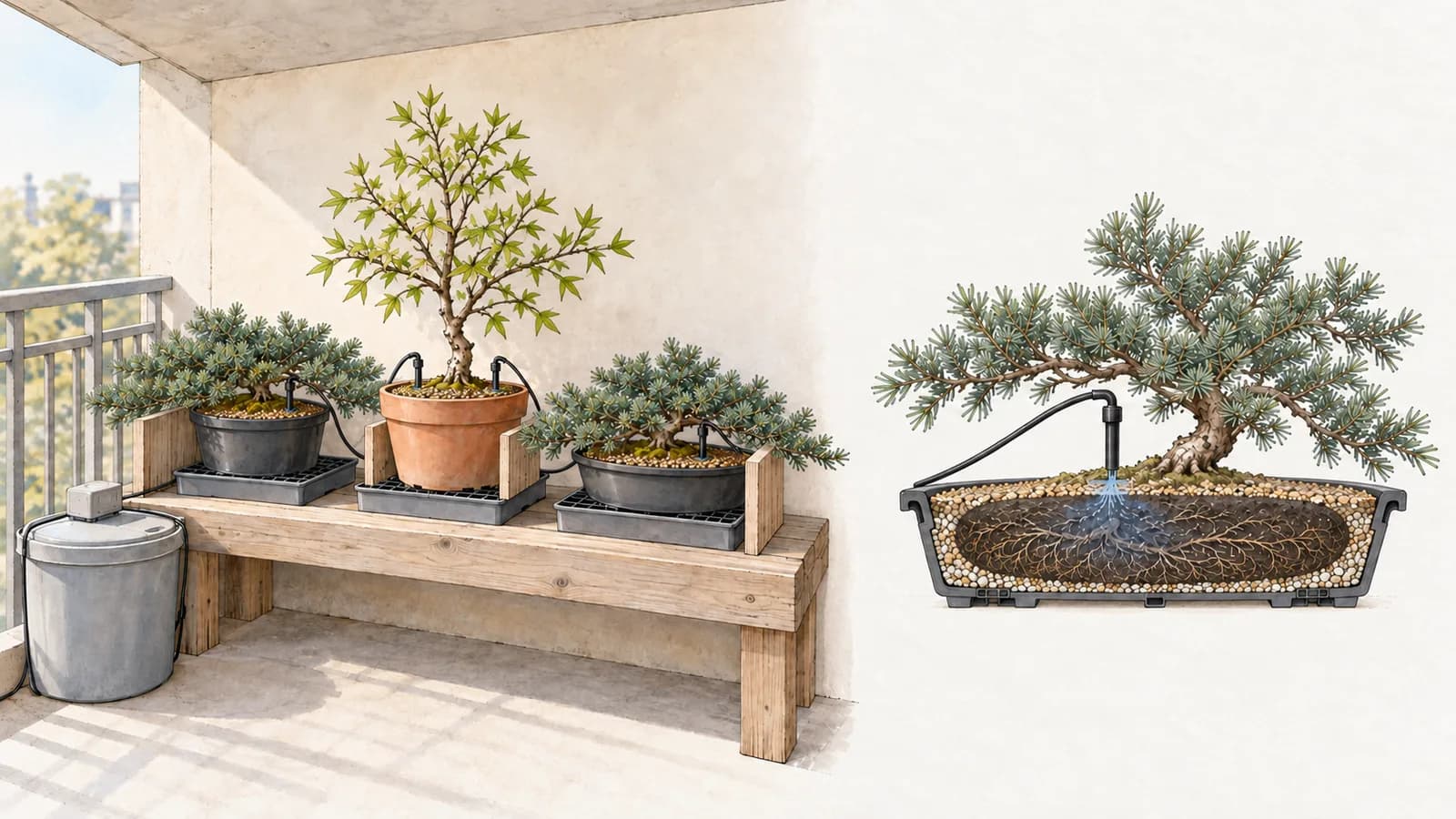
A drip system, or drip irrigationA watering system of narrow tubing and small emitters that delivers water to each pot, fed from a tap or from a reservoir with a small pump, and usually run by a timer. Each emitter wets mainly the part of the root ball beneath it, spreading less in a coarse mix than in a fine one, so a wide pot may need two, and every pot has to be checked to see that it wets through.Open the glossary, delivers water to each pot through narrow tubing and small emitters, from a tap or, on a balcony with no tap, from a reservoir with a small pump. An irrigation timerA clock that turns a drip system or a hose on and off on a schedule. It waters by the clock, not by the pots, giving the same water on a cool, rainy day as on a hot one, so it has to be tested at home, checked by someone while you are away, and adjusted to the weather.Open the glossary turns it on and off. Three details decide whether it works for bonsai pots:
- Each emitter wets mainly the part of the root ball beneath it, spreading less in a coarse mix than in a fine one, so a wide pot of coarse mix needs two, on opposite sides of the trunk, each partway between trunk and rim. In a root ball with two zones, the emitter goes over the old core: a drip on the coarse ring runs straight down it and out.
- Each run gives about what brings the first drips from the drainage holeAn opening in the bottom of a container that lets extra water run out after watering. Without one, water collects at the bottom and the substrate there stays saturated, so roots run short of air; every pot a bonsai lives in needs at least one.Open the glossary, with little left over to drain into the tray. First drips show only that water reached the bottom. During the test, confirm with the lift, and a chopstick pushed in away from the emitter or between two, that each root ball wets through; if it does not, add an emitter or lengthen the run.
- The reservoir stands below the pots, with a lid. A water level above the emitters can siphon out through the line between runs, and the lid keeps out leaves and grit that would clog the emitters.
Test it at home first
A kit that runs is not yet a kit you can trust. Run it for at least a week or two while you are home, in the layout the trip will use, and check every pot below the surface each morning. The test shows what no instructions can: whether each pot wets through, whether a wide pot needs its second emitter, whether a pot stays too wet, and whether anything leaks or clogs. It also shows how each pot reads at a morning check while the kit runs, so the helper knows what normal looks like.
Kits fail in familiar ways: a flat battery, a clogged emitter, a kinked or loose line, a timer reset, an empty reservoir. Testing finds the setup faults, but it cannot stop a battery from dying in the second week, so fit fresh batteries before you leave and always have a backup: a person who checks the pots and can water by hand.
Go deeper · optional, not assessedSizing the reservoir from the test
Mark the reservoir's level each morning of the test. A simple timer gives the same amount every day, so the drop barely changes with the weather; the reservoir has to hold that daily use until the next top-up, plus a day in case a visit slips, which with visits every second day means three days' worth or more. Size it after the last adjustment, since a longer run or a second emitter raises the daily use.
Practice check · not scored
Wicks, plunge beds, and self-watering pots
Other aids suit some pots and not others:
- wick wateringDrawing water up from a reservoir into a pot through an absorbent cord or a capillary mat, by the same pull that draws water into a paper towel. It suits fine, moisture-holding mixes far better than coarse bonsai mixes, which take up little through a wick, so it has to be tested before it is trusted.Open the glossary draws water up from a reservoir through an absorbent cord or a capillary mat, by the pull that draws water into a paper towel. It works in fine, moisture-holding mixes, but a coarse bonsai substrateThe material that fills a container and surrounds a tree's roots, such as a mix of mineral grit, bark, or soil. Its job is to anchor the roots and to hold water, mineral nutrients, and air in a balance the roots can use.Open the glossary takes up little through a wick, so test it before you trust it.
- A plunge bedA shaded, free-draining bed of sand, bark, or gravel, kept moist but never waterlogged, into which pots are sunk up to their rims to slow drying and even out root temperature, often while an owner is away. Roots can grow out through the drainage holes into it, so the pots are lifted or turned now and then. Course 06, Seasonal Care and Timing, covers its use in winter.Open the glossary is a shaded, free-draining bed of sand, bark, or gravel, kept moist but never waterlogged, with the pots sunk to their rims. It slows drying and keeps the pot walls cool. Roots can grow out through the holes into it, so lift or turn the pots now and then.
- Self-watering pots, with a reservoir in the base, keep the bottom of the root zone constantly wet, so they do not suit trees grown as bonsai.
Two plans worked through
The two trips use the same parts in different amounts: a helper who checks, a placement that slows drying, and, where the helper cannot come every day, tested equipment for the days between.
The small backyard in July
With a neighbor who can come every day, the plan needs no equipment:
- Brief the neighbor in person about a week before you leave: the lift and the chopstick on each pot, and a practice round. A thorough watering here uses the hose's shower wand on a low flow, run first until the water comes out cool. The hose tap bypasses the house's softener, and softened waterWater passed through an ion-exchange softener, which swaps the calcium and magnesium for sodium (or, in some units, potassium). Sodium can build up in a pot and harm the tree, so softened water is not used for routine watering. Softening leaves the alkalinity in place, so it does not help an acid-loving tree on hard water either.Open the glossary from the kitchen is not used (Lesson 5).
- Group the pots in the western third, where the neighbor's maple shades the afternoon, with the pot walls shaded: the new juniper and the ficus join the trident maple and the Chinese elm on their bench there. Move them a few days before you leave, so you see the new pace before the neighbor takes over. With one visit a day, slower drying is worth two weeks of morning sun only, and the juniper goes back to full sun when the owners return. A plunge bed there slows drying further.
- Plan for a heat wave: the neighbor checks morning and afternoon, and waters thoroughly whenever a check says so.
- Leave a card, and agree on photos.
- Equipment is optional. A drip line from the hose tap could add a margin on the hottest days, but only after a week or two of testing, and never in place of the daily check.
The west balcony in August
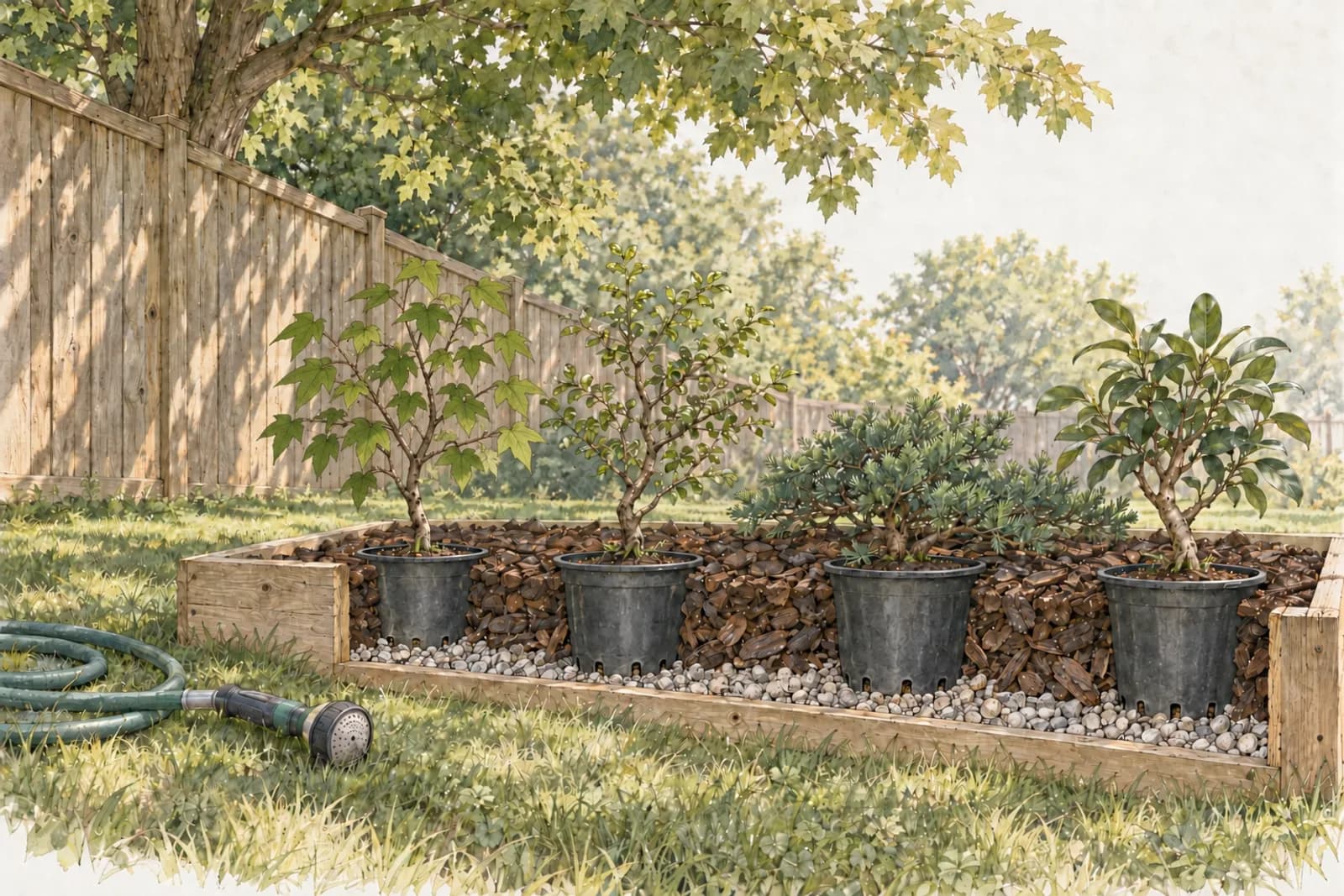
Course 02 planned this balcony's summer on the assumption that someone checks the pots every day, including a friend while the owner is away in August (Course 02, Lesson 5). This friend can come only every second day, daily during a heat wave, and that alone is not enough: in August heat the nursery juniper's pot can dry within a day, as the friend found in June (Lesson 4). So something tested has to supply the days between: here, a reservoir drip kit, tested for two weeks in July while the owner is home. Course 02's daily-check assumption changes only because tested equipment fills the gaps.
- The tested drip kit is the daily water. Two emitters go in the trident's 25 cm (10 in) terracotta pot of free-draining mix, on opposite sides of the trunk, and one in each juniper's pot. In the gift juniper's training potA plain, inexpensive container, usually plastic, used while a tree grows and develops rather than for display. It drains well and is roomier than a bonsai pot, which makes it a practical next home for a tree whose current pot does not drain.Open the glossary, the emitter sits over the old core, since a drip on the coarse ring would run straight down and out. That peat core already holds water longest in summer, so its emitter gets a smaller flow, and the fine peat spreads one emitter's water outward. The July test confirms both: the core wets through, and each morning its chopstick reads damp and cool on the lower half, not dark, cool, and wet along its whole length.
- The pots are grouped along the back wall, away from the condenser corner, shaded until about midafternoon and sheltered from the breeze, each pot's sunny side shaded. Each stands on a grid over a tray deep enough to hold two days of drip runoff, with the pot above the water: the one exception to emptying trays after every watering. They move there when the July test starts, so the kit is tested in this layout. While someone checks every day, the junipers stay in the sun with only their pots shaded (Course 02, Lesson 5; Lesson 5). With visits every second day, slower drying is worth a few weeks of less sun, and the junipers go back to the shelf when the owner returns.
- The friend checks every pot at each morning visit, the gift juniper by the chopstick in its core. With the kit running, every pot should read moist or wet, so a heavy pot is expected. A pot that reads dry was missed by the drip and gets a thorough watering by hand at once. Drooping or dulling over a wet root ball, or a sour smell, is reported before anyone adds water. The friend also empties every tray, tops up the reservoir, and comes every day in a heat wave.
- The friend notes the reservoir's level at each visit, before topping it up. If it has not dropped since the last visit, the timer did not run: the friend waters by hand any pot the checks say is drying, and comes again the next day. After a storm on a west wind, the friend comes the next morning to empty the trays the storm filled (Lesson 5).
- A second person, shown the same round, can stand in if the friend cannot come. The kit's backup needs a backup too.
Try a plan before you trust it
Two weeks away runs the whole trip for either household, with a heat wave on days 5 to 7 and a storm on day 9. In the backyard it follows the three trees on the benches; the ficus goes where they go but is left out of the run. Choose a Place, then build a plan from Helper visits, Helper briefed, Equipment, and Placement (on a phone, pick each part with Change). Answer Will this plan bring all three through? with Yes, all three or No, not all three, or press Skip, then press Run the two weeks; Back and Next step through the days, and Skip to the end jumps to the result. The result rates each tree and the whole plan and lists What made the difference, and Change the plan keeps the last run beside the next one. A plan that brings all three through earns a Robust plan sticker for that place; you are finished when both places have one. Try these:
- Choose The west balcony in August, with Every second day, Shown in person with a practice round, None under Equipment, and Leave them in their summer spots. Then change Equipment to Drip kit with a timer, untested, and then to Drip kit with a timer, tested for two weeks.
- Choose The small backyard in July, and compare Every third day with Daily. Then try Plunge bed in shade.
- Find a plan for each place that brings every tree through, then change one part, such as Move them indoors, or Wicks from a reservoir on the balcony, and see what breaks.
Simulation
Two weeks away
Instructional example · August
The west balcony in August
Fourth floor, facing west, with no outdoor tap: every watering is carried from the kitchen, and trays catch the drips. The owner is away for two weeks in August. A friend can come every second day, and daily during a heat wave.
Your plan
- Helper visitsEvery second day
- Helper briefedShown in person with a practice round
- EquipmentNone
- PlacementLeave them in their summer spots
Before the trip
On the morning they leave, the owner waters each pot thoroughly. Set the plan, then press Run the two weeks to see how the three trees fare.
The nursery juniper
Root-zone moisture: Wet
Condition: Fresh and green
The gift juniper
Root-zone moisture: Wet
Condition: Fresh and green
The trident maple
Root-zone moisture: Wet
Condition: Leaves firm
The two weeks
- Helper visits
- Went short of water
- Driest root-zone moisture that day
- Nursery juniper
- Gift juniper
- Trident maple
Week 1
- Day 1, hot and sunny. Day 1
- Day 2, hot and sunny. Day 2
- Day 3, mild and bright, visit. Day 3
- Day 4, hot, sunny, and windy. Day 4
- Day 5, heat wave, visit. Day 5
- Day 6, heat wave. Day 6
- Day 7, heat wave, visit. Day 7
Week 2
- Day 8, hot and sunny. Day 8
- Day 9, storm on a west wind, visit. Day 9
- Day 10, mild and bright. Day 10
- Day 11, hot and sunny, visit. Day 11
- Day 12, hot and sunny. Day 12
- Day 13, hot, sunny, and windy, visit. Day 13
- Day 14, hot and sunny. Day 14
Text description
A planning simulation in two instructional-example places in one temperate Northern Hemisphere city. In each, the owners are away for two weeks in summer and three trees must come through. You set a plan with four choices, then run fourteen invented days, hour by hour, with the course's shared drying model. The goal: find a plan that brings all three trees through in each place. Finding one for both places finishes the exercise.
The west balcony in August. Fourth floor, facing west, with no outdoor tap: every watering is carried from the kitchen, and trays catch the drips. The owner is away for two weeks in August. A friend can come every second day, and daily during a heat wave.
- The nursery juniper: a round black plastic nursery pot about 20 cm (8 in) across with dark nursery mix, on the top tier of the slatted shelf in the open middle of the balcony, its sunny side shaded by a board.
- The gift juniper: a black plastic training pot about 22 cm (9 in) across, wider than deep, its old peat-rich root ball in a ring of coarse mix, with roots now grown into the ring; beside the nursery juniper on the same shelf.
- The trident maple: an unglazed terracotta training pot about 25 cm (10 in) across with free-draining mix, on a low bench against the back wall under the overhang, on a grid over a tray, in the rain shadow.
The days, in order: day 1, hot and sunny; day 2, hot and sunny; day 3, mild and bright; day 4, hot, sunny, and windy; day 5, heat wave; day 6, heat wave; day 7, heat wave; day 8, hot and sunny; day 9, storm on a west wind; day 10, mild and bright; day 11, hot and sunny; day 12, hot and sunny; day 13, hot, sunny, and windy; day 14, hot and sunny.
The small backyard in July. A fenced yard on the south side of the house, with a hose tap on the house wall and a neighbor's large maple shading the western third on summer afternoons. The household is away for two weeks in July, usually the hottest month. A neighbor can water, and can come daily. The household's ficus, out on the lawn for the summer, goes where the others go; the plan here follows the three trees on the benches.
- The trident maple: a black plastic nursery pot about 18 cm (7 in) across, on a bench in the western third with morning sun and afternoon shade.
- The new juniper: a 4 L (1 gallon) black nursery pot on a slatted bench at the patio's lawn edge, in full sun, its sunny side shaded.
- The Chinese elm: a plastic nursery pot about 15 cm (6 in) across, on the same bench as the trident.
The days, in order: day 1, hot and sunny; day 2, mild and bright; day 3, hot and sunny; day 4, hot, sunny, and windy; day 5, heat wave; day 6, heat wave; day 7, heat wave; day 8, hot and sunny; day 9, storm on a west wind; day 10, mild and bright; day 11, hot and sunny; day 12, hot, sunny, and windy; day 13, hot and sunny; day 14, mild and bright.
The plan. Helper visits: on the balcony, every second day (days 3, 5, 7, 9, 11, and 13), every second day and daily during the heat wave, or none; in the backyard, daily, every second day, every third day (days 4, 7, 10, and 13), or none. A helper shown in person who comes daily through the heat wave also checks again in the afternoon on those days. Helper briefed: shown in person with a practice round, or sent a text; this choice is unavailable when nobody visits. Equipment: none, a drip kit with a timer tested for two weeks, a drip kit with a timer that is untested, wicks from a reservoir, or, in the backyard only, a plunge bed in shade. Placement: leave them in their summer spots, group them with pot walls shaded and out of the wind, or move them indoors; a plunge bed sets the placement itself. Grouped on the balcony, the two junipers leave the shelf for a low bench along the back wall beside the trident, in the overhang's shade and out of the breeze; in the backyard, all three go to the bench in the western third. Before each run you may predict whether the plan will bring all three through, or skip the prediction.
What every plan meets: a heat wave near 36 °C (97 °F) on days 5 to 7, a storm on a west wind on day 9, and, in every plan with a drip kit, the timer's battery dying on day 10. The untested kit also has two faults that testing at home would have found: an emitter that clogs from day 4, and one emitter that wets only one side of the trident's pot. The drip kit runs at dawn, from a reservoir with a small pump on the balcony and from the hose tap in the backyard; a helper comes at about 8 in the morning.
What you see. A picture of the place shows each pot cut in half, with its tree; the sky, the sun, and the shade change through each day. The mix in each pot is drawn by its root-zone moisture level: Bone dry: pale, with crack lines; Dry: pale; Drying: pale over a faint damp band at the bottom; Moist: light blue with air dots; Wet: blue with sparse air dots; Saturated: deep blue under a solid water line, no air dots. Visits show a watering can or a chopstick check over the pots; the drip kit shows drops at its emitters (the tested kit has two in the trident's pot, one each side of the trunk) and a red timer when its battery is dead. On the storm day, rain slants in on the wind and splashes on the ground. Under the picture, a few sentences say what happened that day (the drip, the visit and what the helper did, the weather, and which trees went short of water). While the run plays, a one-line summary is announced as each day ends; Back, Next, or a day in the calendar announces that day in full. Below, a card for each tree gives its root-zone moisture and condition, and a calendar of the fourteen days fills in as they play: each day's weather, visits, the drip, each tree's driest moisture level, and a red mark when a tree went short of water.
Controls. Run the two weeks starts the days. Play and Pause, Back and Next (a day at a time), Replay, and Skip to the end control the run, and any played day in the calendar can be shown again. After day 14, a result card gives each tree's result (Came through, Stressed but recovered, Lost growth, or Badly damaged) and the overall result, what made the difference, whether your prediction was right, and the last run in that place for comparison. A plan that brings all three through earns a Robust plan sticker for that place.
With Every second day and no equipment, the balcony's three never all came through. Outdoors, the trident maple in terracotta dried out between visits, worst in the heat wave, and ended Badly damaged; in their summer spots, the nursery juniper went short in the heat wave too. In the backyard, Every third day was too far apart for July heat, whatever else the plan did. Move them indoors kept the pots out of the heat but left trees that live outdoors too dark, and all three lost growth. Wicks from a reservoir fell short where the mix was coarse. Group them, pot walls shaded, out of the wind and Plunge bed in shade both slowed drying, buying time between visits.
Testing and checking turned out to be different jobs. Drip kit with a timer, untested had faults that two weeks at home would have found: an emitter clogged from day 4, and one emitter wetted only one side of the trident's pot. The timer's battery died on day 10 in every drip plan, and only a helper Shown in person with a practice round, who checked the kit as well as the pots, caught it: they put in fresh batteries and ran the kit once to see every emitter drip. A helper Sent a text judged by the surface, gave each pot a quick drink over the top, and never checked the kit. Every plan that held up had a helper shown in person. In the backyard, that meant Daily visits with the pots grouped in the western third's shade or sunk in the plunge bed; on the balcony, Every second day, daily during the heat wave plus Drip kit with a timer, tested for two weeks, with the pots in their summer spots or grouped along the back wall.
Practice check · not scored
A routine and a plan for time away
The bonsai decision
A routine of checks, with a plan for time away
Starting point
For established trees through the growing season:
- Every morning: check every pot, tied to something you already do, and water thoroughly only when the checks say so (Lesson 2, Lesson 3).
- On hot or windy days: check again in the afternoon, prompted by weather alerts.
- Before a day or two away: check every pot that morning. In summer, water thoroughly any pot not still heavy, as if just watered; in cool weather, water only the pots the checks call for. Group the pots out of the wind and the strongest sun, walls shaded, and stand none of them in water.
- Before a longer trip: brief a helper in person, with a practice round and a card that names checks, not days. In summer, ask for a visit every day. If the helper can come only every second day, let equipment tested at home for a week or two supply the days between, and ask for daily visits in a heat wave. Fit fresh batteries before you leave, and keep a second person on call.
This assumes
- The trees are established and growing, in pots that drain, and you have learned the checks on each pot.
- The summer is typical of the example climate: July afternoons often 30 to 33 °C (86 to 91 °F), with occasional heat waves near 36 °C (97 °F).
- A helper can be shown the checks in person before you leave, and any equipment can run at home first.
Change course if
- A heat wave is forecast while you are away: ask the helper to come every day while it lasts, and to check morning and afternoon if they can.
- A tree is new or has just been moved: check it twice a day for the first few days, then every morning, and leave it under no arrangement you have not tested.
- The equipment is untested: do not rely on it; plan as if there were none, which in summer means a helper who checks every day.
- Winter arrives: for trees resting outdoors, check every day or two, but never stop, because resting trees still need moisture (Course 06). An indoor tree in a heated room, like the ficus, keeps its daily check.
- The helper reports a pot still wet days after watering, or drooping or dulling leaves over a wet root ball: this is not a reason to add water. While a drip kit runs, every pot reads moist or wet, so the leaves are the signal to watch. Ask for a photo and the chopstick result, have them check that the pot drains and is not standing in water, and investigate before watering (Lesson 4).
Back to the question
How do you keep a tree watered through busy weeks, changing weather, and time away?
By making the routine about checks, not waterings, and by planning for the days you cannot check yourself. A morning check of every pot, tied to something you already do, survives busy weeks; weather alerts add an afternoon check in heat or wind, and outdoors the checks go on through winter, every day or two. The check can be daily because the watering follows what it finds. For time away, someone still has to check: a helper shown in person, with a card that names checks rather than days. Where the helper cannot come daily in summer, equipment tested at home supplies the days between, and the helper's visits catch what it misses.
Key takeaways
- A routine is a schedule of checks, not of waterings: every pot each morning in the growing season, an afternoon check in heat and wind, twice a day for a few days after a move, and fewer checks, never none, for trees resting outdoors in winter.
- Tie the check to something you already do, and let weather alerts tell you when to add one. Water only on the days the check says so, which in July heat may be every day.
- Brief a helper on the trees themselves, watch a practice round, and leave a card that names each check and what its readings mean. A card that names days fails in heat and after rain.
- A timer waters by the clock, so test any equipment at home for a week or two, and keep a person who checks the pots as its backup.
- Never leave pots standing in water while you are away. Group and shade them, or sink them in a free-draining plunge bed, and when a helper can come only every second day, let tested equipment supply the days between.
Optional · not required for completion
Write a card and run a practice round
Write a watering card for your own trees, or start from the one you built in Write the watering card with Copy the card. For each pot, give the check and the reading that means water, how to water, what to do with the tray, anything that pot needs that the others do not, and what to report. Then give it to the person who would help, and watch them follow it through one real check without prompting. Where did they hesitate, and which line did they need that the card did not give them?
No tree? Write a card for a friend's houseplant, then watch the friend follow it once while you stay quiet. Where did the card leave them guessing?