Course 03 · Lesson 4 of 7 · Hard cases and a lasting routine
Drying, saturation, and root oxygen
A drooping tree can be short of water or short of air at its roots, and from above the two look alike. Learn how drying and lasting saturation each harm roots, how to investigate wilting in a wet pot before you water, and which habits leave roots short of water or air.
The question
Why can a tree wilt in a wet pot, and what should you do when it does?
By the end of this lesson, you will be able to:
- Explain how a root zone that dries out and a root zone that stays saturated can both make foliage droop, dull, yellow, or brown.
- Investigate a drooping tree by checking the root zone and its recent history before deciding whether to water.
- Identify watering patterns and setups that keep roots short of water or air, and choose a better one.
About 18 minutes to read and explore
The west balcony in July. Like every case in this course, it is an instructional example, set in one temperate Northern Hemisphere city at about 40° N (USDA zone 7a). At 6 pm, after a day of 32 °C (90 °F), the sinking western sun has been reaching under the balcony above since midafternoon, onto the trident maple by the back wall. Its leaves hang limp, and its soft shoot tips bend over. Before watering, the owner checks: the terracotta pot is heavy, and a chopstick left a few minutes in the root zone comes out damp and cool on the lower half.
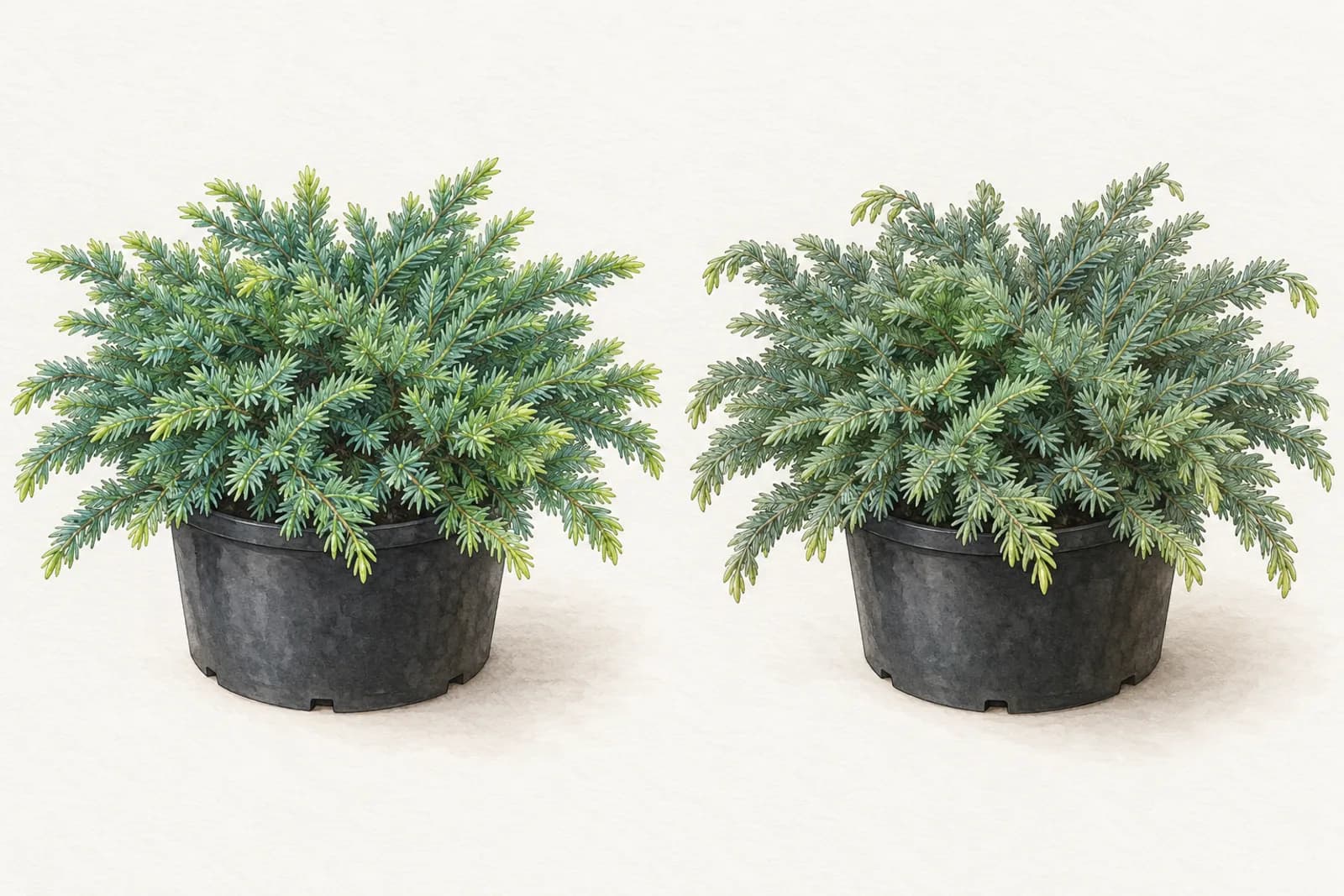
In June, while the owner was away for a work week, a friend came every second day to check the pots and water any that needed it. On one visit, the nursery juniper looked dull and grayish, though nothing on it drooped. Its pot was light, and the chopstick came out dry and pale along its whole length.
At the bright window, there is last winter to look back on. In the ficus's first months on the sill, its owner took to giving it a little water every morning where it stood, skipping the walk to the sink and the look into its outer pot an hour later. After a few weeks, its lower leaves began to yellow and drop, though the surface was damp every day. The sill, the curtain, and the grow light were as they had been since October.
Three trees and three different signs, and none of them, on its own, says what is happening at the roots. A tree can droop, dull, or yellow because its roots are short of water, because they are short of air, or because a hot afternoon has briefly outrun roots that are fine. The first two have opposite remedies, and the third needs none. This lesson shows how each happens, how to investigate a droop before you water, and which watering habits leave roots short of water or air.
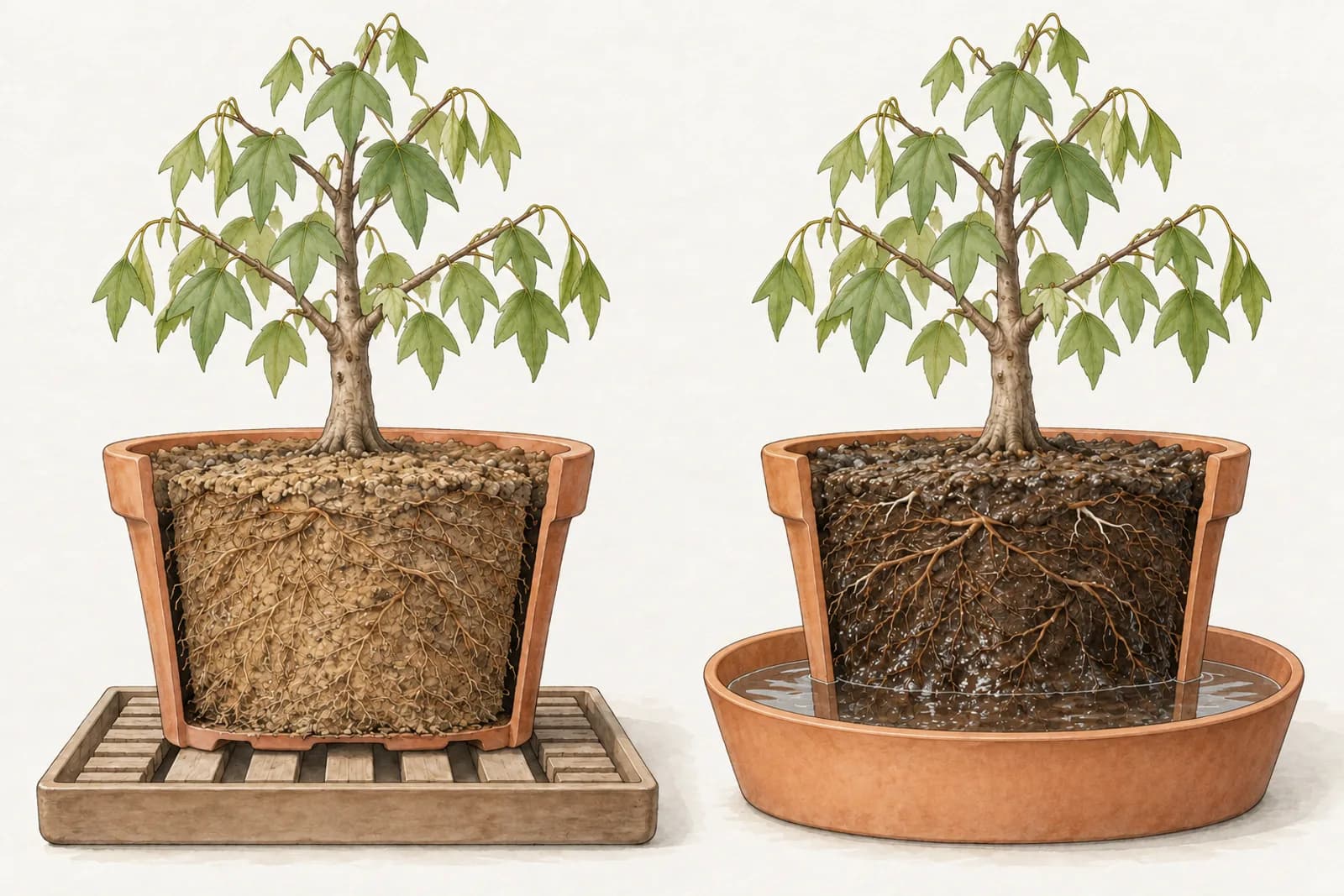
Two problems, one look
Leaves stay firm only while the roots replace the water they lose. When loss outruns supply for long enough, the leaf cells go limp: wiltingDrooping of leaves or soft shoots when their cells lose turgor because water loss has outpaced uptake. It can come from a dry root zone, but also from damaged or reduced roots, very high demand, or blocked xylem, even when the substrate is wet.Open the glossary (Course 01, Lesson 8). A root zone that has dried out has too little water left to take up. One that stays saturatedDescribes soil or substrate whose pore spaces are completely filled with water, leaving little or no air. Brief saturation right after watering is normal in a pot that drains; saturation that lasts starves roots of oxygen.Open the glossary has plenty, but its roots are short of oxygen. Roots respirationThe process in which living cells break down sugars using oxygen to release energy they can use, giving off carbon dioxide and water. It runs in every living cell of a tree, in leaves, stems, buds, and roots, both day and night. Without oxygen, cells fall back on fermentation.Open the glossary day and night, and when air cannot get back into the pores, their tips stop growing and die back, so the tree takes up less of the water around them (Course 01, Lesson 7). Either way, the leaves droop, dull, yellow, or brown at the edges.
Of the five ways Course 01 lists for loss to outrun supply, four matter to a watering decision: a dry root zone, roots that cannot take up enough (short of air, reduced by root work, or overheated in a sunny pot), salty root-zone water, and very high demand. The first two call for opposite remedies, water for one and none for the other, and only a check below the surface tells you which you have (Lesson 2).
Junipers, like most coniferA tree or shrub that bears seeds in cones, which are berrylike in junipers, instead of in flowers and fruits, and usually has needle-like or scale-like leaves. Most conifers are evergreen, but larches and a few others drop their needles each autumn.Open the glossary, have stiff needles or scale leaves that barely sag. A thirsty juniper turns dull and grayish before parts of it brown, and one whose roots are short of air can stay green for weeks while they fail (Course 02, Lesson 7), so check its root zone rather than wait for its foliage. Thin-leaved broadleafA flowering tree or shrub with flat, typically broad leaves, such as a maple, elm, oak, or ficus, as distinct from a conifer. Broadleaves can be evergreen or deciduous, tropical or temperate, so the label alone does not tell you how to care for one.Open the glossary trees such as the trident maple and the Chinese elm droop clearly, which makes them easier to read, and easier to misread. A ficus's thick, leathery leaves droop less; it more often yellows and drops leaves.
Predict first
No, and by 9 pm they should be firm again. Two checks agree that the root zone is moist. In the heat and the late sun, the leaves were losing water faster than even well-supplied roots could move it up; as the sun sets and the air cools, that pull eases and uptake catches up. Watering now would only keep the pot wetter.
A droop that passes by evening
The trident was showing temporary wiltingDrooping of leaves or soft shoots on a hot, bright, or windy afternoon, over a moist root zone, that recovers by evening as demand falls and uptake catches up. Wilting that lasts overnight is a different matter, and wilting that returns most afternoons still costs growth (Course 01, Lesson 8).Open the glossary: a droop on a hot, bright, or windy afternoon that recovers by evening in a moist root zone. In late afternoon, evaporative demandHow strongly the surrounding air draws water vapor from leaves, rising with sun, heat, dry air, and wind. High evaporative demand can make a tree lose water faster than reduced or damaged roots can replace it.Open the glossary, the air's pull on the water in leaves, is still near its peak just as the sinking western sun reaches under the overhang (Course 02, Lesson 5), and for an hour or two loss outruns uptake. More water cannot speed the roots up. So when a broadleaf droops late on a hot afternoon over a moist root zone, with nothing else changed and no water standing under it, the decision is Not yet: check again this evening. Leaves that have firmed by dusk need nothing more.
Temporary is not the same as harmless. Limp leaves make little sugar, so a tree that droops most afternoons grows less and needs shade through the hottest hours (Course 02, Lesson 5). A droop over a dry root zone is never temporary wilting: water thoroughly now. And a droop in the morning or on a cool day, one that comes with dulling or yellowing, or one still there at dusk calls for Investigate before watering.
When a root zone dries
This lesson uses Lesson 2's six moisture levels: Bone dry, Dry, Drying, Moist, Wet, and Saturated. As the mix dries beyond Drying toward Dry, the last water is held more and more tightly in the thinnest films, and the roots find it harder to take up (Course 01, Lesson 8). A hormone signal narrows the stomaA microscopic pore (plural: stomata), mostly on leaves and needles, through which gases pass in and out, chiefly carbon dioxide entering and water vapor leaving. A pair of guard cells widens or narrows each pore in response to light, the water supply, and the surrounding air.Open the glossary, which saves water but lets in less carbon dioxide, so the leaves make less sugar (Course 01, Lesson 4). That is drought stressStress from a root zone too dry to supply the water the leaves lose. The stomata narrow and growth slows before any wilting shows, and a juniper may only turn dull and grayish. Roots that cannot take up water from a wet pot cause similar signs, but that is a different problem.Open the glossary, and it begins before any leaf droops: a tree that often runs a little dry makes less to grow with (Course 01, Lesson 6).
If the drying goes on, a broadleaf droops, and the trident maple's leaf edges brown and crisp, a kind of leaf scorchBrowning and drying of leaf edges, tips, and the tissue between the veins when leaves lose water faster than the roots can replace it, as in hot sun, wind, or dry air. Thin shade leaves moved suddenly into strong sun scorch the same way, often after pale, bleached patches. It is a symptom, not a diagnosis: a dried-out root ball, damaged roots, or salt buildup can cause the same browning.Open the glossary; a juniper turns dull and grayish. Below the surface, root hairA tiny, hairlike outgrowth of a single cell on a root's surface, a short way behind the growing tip, that greatly increases the area for absorbing water and minerals. Some trees, such as pines, grow few and rely more on fungal partners. Root hairs are fragile and short-lived, so disturbing roots destroys many of them and temporarily reduces uptake.Open the glossary shrivel first, then the young fine rootOne of the many thin, branching roots, often pale when young, that do most of a tree's absorbing of water and mineral nutrients. Fine roots live a relatively short time and are constantly replaced, so they depend on a root zone that holds both water and air.Open the glossary and their root tipThe growing end of a root, made up of the root cap, the dividing cells behind it, and short zones where new cells lengthen and mature. Active tips are usually pale or white and show where a root is extending into fresh substrate.Open the glossary in the driest layers die. Watering brings the water back, but not those roots: they do not revive, and the tree must grow new ones, which takes time and sugar (Course 01, Lesson 2).
At Bone dry, a peat-rich or bark-rich mix shrinks from the pot wall and turns water repellencyThe way some organic mixes, especially peat-rich ones, shed water after drying out: water beads on them and runs off or past instead of soaking in, until they slowly rewet. Small, slow amounts aimed at the dry part, or immersion, rewet them, while a fast pour runs straight past.Open the glossary for a while (Lesson 3). Water poured on top then runs down the gap or a few easy paths and out of the holes, leaving the core dry: channelingWater running down a few easy paths, such as a gap at the pot wall, a crack, or the edges of a dry, water-repellent core, and out of the drainage holes without wetting most of the root ball. First drips within seconds from a pot that was light suggest it; a pot still barely heavier afterward, or a core that is still dry, confirms it.Open the glossary. By then many fine roots have probably died (Course 02, Lesson 6).
Four habits leave roots short of water:
- Waiting for the leaves to droop. By the time a broadleaf droops from drying, drought stress has already cost it growth, and a juniper may never droop.
- Checks too far apart for the weather. In summer heat, a small pot can dry within a day.
- Small sips in heat. They wet only the top few centimeters, and the rest dries.
- Counting on rain. An overhang or a dense canopy keeps most of it off the pot (Lesson 5).
What to do when it is dry
A dry root zone needs urgent care, whatever the time of day and whatever else is going on with the tree (Course 01, Lesson 14):
- Water thoroughly now. Give a thorough wateringWater applied evenly across the whole surface, slowly enough to soak in, until it runs from the drainage holes, and then confirmed by a check that the root ball wetted through. It usually takes two or three passes a minute or two apart. Water at the holes alone shows only that water reached the bottom, not that the roots got it.Open the glossary, in slow, even passes across the whole surface until water runs from the holes. If it runs straight through, water again slowly, aiming at the dry part; if the root ball has shrunk from the wall, or passes do not wet it, use immersion wateringStanding a pot in a basin of water up to the surface of the mix until the root ball is wet through, then lifting it out to drain fully. Rising bubbles show air leaving; when they stop, check the core with a chopstick, because a water-repellent core can stop bubbling before it is wet. Allow 10 to 30 minutes, up to an hour for a bone-dry, peat-rich root ball, and never more than a few hours: it is never a way to leave a pot standing in water.Open the glossary (Lesson 3). Once it drains, confirm with the lift testJudging how much water a pot holds by lifting it and comparing its weight with how it felt right after a thorough watering and when it was dry enough to need water. It has to be learned for each pot, works best where water is a large share of the weight, and shows how much water the pot holds, not where it is.Open the glossary and a chopstick in the core that it wetted through.
- Check more often for a week or two. A tree that lost fine roots draws water more slowly, and a root ball that dried out once can rewet unevenly.
- Expect some lost growth. New shoots may stall while roots regrow, and a juniper can stay green for weeks, then brown in patches (Course 01, Lesson 14).
- Do not feed. Fertilizer cannot replace roots, and salts concentrate in a mix that has dried, adding stress to the roots that are left (Course 01, Lesson 10). When and how to feed again is Course 05, Mineral Nutrition and Fertilizing.
That is what the friend did in June: three slow passes until water ran into the tray under the shelf, then the lift and the chopstick to confirm that the juniper had wetted through, and the tray emptied. Its color came back by the next visit, but a dry spell like that is one reason the August plan does not rely on visits every second day alone (Lesson 6).
Practice check · not scored
When a root zone stays wet
Wet is not the problem. A thorough watering fills most of a pot's pores, and for a short time the root zone is Wet. In a pot that drains, the extra water runs out within the hour and draws air back into the larger pore spaceThe gaps between particles in soil or substrate, which hold water, air, or both. Large pores usually drain and refill with air after watering while small pores hold water, so the mix of pore sizes sets how wet and how airy a root zone stays.Open the glossary (Course 01, Lesson 7). That supply of air, aerationThe supply of air, especially oxygen, to roots through air-filled pore spaces, and the exchange of gases between those spaces and the open air. Roots need good aeration because their living cells use oxygen constantly.Open the glossary, is what roots live on between waterings. A thin, wetter layer always lingers at the very bottom (Course 04, Soil, Substrates, and the Root Environment, explains why), but above it, a free-draining pot holds water in its small pores and air in its large ones.
The harm comes when saturation lasts. Roots and soil microbes use up the dissolved oxygen within hours to a day or so, sooner in warm weather, and the root zone falls into hypoxiaAn oxygen supply too low for cells to respire normally. In containers it most often affects roots when the substrate stays saturated, because oxygen moves through water roughly ten thousand times more slowly than through air.Open the glossary. Root tips die back, then the fine roots behind them, and days later the foliage can droop, yellow, or drop in a pot full of water. Some root-rot organisms thrive in waterlogged mix and attack weakened roots, a matter for Course 07, Tree Health and Diagnosis.
So overwateringKeeping a root zone wet so constantly, or letting it drain so poorly, that air never gets back into its pores and the roots run short of oxygen. It is about how often a pot is watered and how well it drains, not how much is poured at once: a thorough watering of a pot that drains, given when the root zone is drying, is not overwatering.Open the glossary is a root zone kept wet so constantly, or draining so poorly, that air never gets back in (Course 01, Lesson 7). It is about how often a pot is watered and how well it drains, not how much is poured at once: one thorough watering of a pot that drains cannot overwater it, but a little every day into a pot that never dries back can.
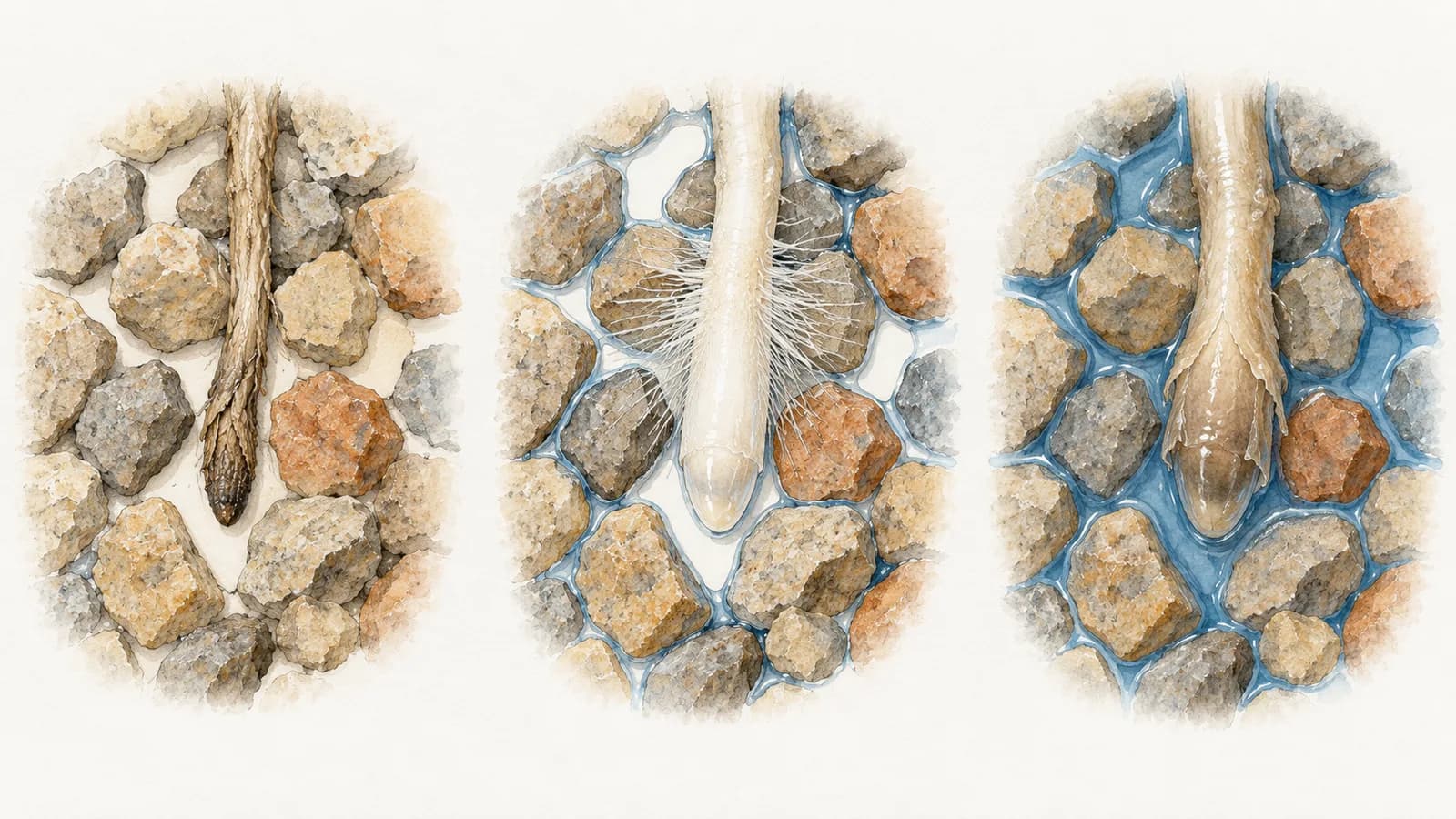
Setups that keep air out
Lasting wetness often comes from the setup or the watering habit, which you can change today. A mix that is too fine or has broken down holds too much water as well; that is Course 04's subject, and Lesson 7 shows how a log reveals it. The common setups:
- Standing water under the pot. A tray, a saucer, or a cachepotA decorative outer pot, usually without a drainage hole, that holds a plainer pot inside it. Water that drains from the inner pot collects in it, so it has to be emptied after every watering or rain, or the bottom of the root ball sits in water.Open the glossary that holds drained water keeps the bottom of the root ball saturated, however well the pot drains (Course 02, Lesson 7). Empty it after every watering and every rain; a grid, like the one under the balcony trident's pot, keeps the pot above any water until you do.
- A pot much bigger than its roots. Mix the roots have not reached stays wet long after each watering (Course 02, Lesson 7).
- Watering a pot that is still moist. In cool weather, in shade, while a deciduousDescribes a tree that drops all its leaves for part of each year, usually before winter or a dry season, and grows new ones when growth resumes. Most deciduous trees are broadleaves, like the trident maple, but a few conifers, such as larches, are deciduous too.Open the glossary tree is bare, or after roots have been reduced, a pot dries slowly, and a schedule tops it up before it has dried back (Lesson 1).
- Small sips into a pot that drains poorly. In a slow-draining pot, or one standing in an outer pot or a saucer, what the tree does not use collects at the bottom, out of sight, while the surface looks freshly watered.
The bright window's ficus spent its first winter in two of these setups at once: standing water under the pot, and watering a pot that was still moist. In winter's low light it grew slowly, and even with the heating on it used far less water than a daily watering gave it. Each morning's water drained into its outer pot, where nobody looked. The light had not changed, and the yellowing began weeks after the habit did, so the habit was the first suspect.
Two weeks of watering, seen from the roots
Four ways to water for two weeks opens the pot that Lesson 1's comparison kept closed. It follows the balcony trident from late May into a June warm spell: cool and cloudy, then warm, then hot, starting the morning after a thorough watering. The trident stands in the rain shadowAn area that rain does not reach because something blocks it, such as the ground under an overhang or eave, beside a wall on the side away from wind-driven rain, or under a dense canopy. Pots in a rain shadow can stay dry through a day of rain, so they need checking and watering by hand.Open the glossary, and the fortnight's rain falls still, so rainy days slow its drying but add no water.
The cutaway shows moisture and air in the top, middle, and bottom zones. Beside it, Root-zone moisture reads the root zone, Root tips by zone, magnified shows each zone's root tips, and Leaves shows the canopy; on a phone they stack under the drawing, and a Day slider takes the place of the day buttons. Try these:
- Under Watering pattern, start with Check, then water thoroughly. Under Your call, pick the pattern you think will leave the fewest new root tips, or press Skip. Your call locks when you run, and it is stamped Called it or Surprise once the runs settle it.
- Press Run the fortnight. Use Pause, Back, Next, the day buttons, or Skip to the end to stop on any day. At each check, watch the chopstick come out and be read beside the pot, and watch how the three zones move between waterings.
- Read the report card: Days roots short of water, Days the bottom stayed wet, New root tips, Foliage, and Waterings, beside your previous run. Then press the button under it, which names a pattern you have not run yet, and run that one.
- In A little every morning and A full can every day, where do the white tips end up, and which zone never dries back? In A full can every day, watch the day strip: a marker drops when a zone loses its white tips, and a dotted line joins it to the day the leaves change.
- In Only when the leaves droop, compare the day the leaves droop with the day the roots are hurt. Once all four patterns have run, the Pattern report sums them up.
Simulation
Four ways to water for two weeks
0 of 4 patterns run · No call yet
Check, then water thoroughly
Day 1 · 6 amCool and cloudy
Root-zone moisture: Wet
Root tips by zone, magnified
- TopMoisture: MoistRoot tips: White, growing tips
- MiddleMoisture: WetRoot tips: White, growing tips
- BottomMoisture: WetRoot tips: White, growing tips
Leaves
- Firm
- Dull
- Drooping
- Scorched edges
- Yellowing
What is happening
Day 1 · 6 amThe pot was watered thoroughly last evening. Cool and cloudy: the tree draws water slowly.
Root zone
- Bone dry
- Dry
- Drying
- Moist
- Wet
- Saturated
Root tips
- White, growing root tip
- Dying, browned tip
Day strip
- Watered thoroughly
- A full can
- A little water
- Roots short of water
- Bottom stayed wet
- Roots hurt
- Leaves changed
Text description
A side view of the back half of the west balcony: the back wall on the left, the balcony above as a roof, and open sky beyond its edge on the right. Against the back wall, the trident maple stands in its unglazed terracotta training pot, about 25 cm (10 in) across, on a grid over a tray on a low bench, with a board shading the pot's sunny side. The pot is drawn in cutaway in three zones, top, middle, and bottom, and each zone shows its moisture by color and pattern: Bone dry: pale, with crack lines; Dry: pale; Drying: pale over a faint damp band at the bottom; Moist: light blue with air dots; Wet: blue with sparse air dots; Saturated: deep blue under a solid water line, no air dots. Roots run through the mix; white dots at their ends are new, growing root tips, and dark brown ones are dying. Above the pot, the leaves show one of five looks: Firm, Dull, Drooping, Scorched edges, Yellowing. The sky shows the weather and the time of day, and rain falls only beyond the overhang. Late on clear days, the low western sun reaches under the overhang and lights the wall. The drawing is not to scale.
The fortnight runs from late May into a June warm spell, starting at 6 am on day 1, the morning after a thorough watering:
- Day 1: Cool and cloudy
- Day 2: Steady rain
- Day 3: Cool and cloudy
- Day 4: Steady rain
- Day 5: Cool and cloudy
- Day 6: Warm and bright
- Day 7: Warm and bright
- Day 8: Warm and bright
- Day 9: Warm and bright
- Day 10: Hot and sunny
- Day 11: Hot and sunny
- Day 12: Hot, sunny, and windy
- Day 13: Hot and sunny
- Day 14: Hot, sunny, and windy
Choose one of four watering patterns:
- Check, then water thoroughly. Two checks, the chopstick and a lift, each morning, and each afternoon once it turns warm. Water thoroughly only when they find the root zone drying.
- A little every morning. A small splash every morning, just until the surface looks dark, whatever the weather.
- A full can every day. A whole can poured on every morning, whatever the pot needs.
- Only when the leaves droop. No checks. Look at the leaves in the evening, and water thoroughly only if they droop.
Before a run you may make one call, which is optional: Which pattern will leave the fewest new root tips? The choices are the four patterns, and a Skip button closes the question until the next run. Run the fortnight plays the two weeks hour by hour, pausing for each check and each watering. In a check, a chopstick slides into the mix partway between trunk and rim, the pot is lifted, and the chopstick comes out and is held up beside the pot, with its reading and the decision in words. In a watering, a can pours and the water soaks down. Play, Pause, Back, Next, and Replay control the run; Back and Next move a day at a time to each late afternoon. Day buttons, or a Day slider on narrow screens, jump to any day, and Skip to the end jumps to day 14.
Beside the drawing, text gives the day and time, Root-zone moisture for the whole root zone, each zone's moisture and root tips in words, the leaves' look, and what is happening. On the day strip under the drawing, each day shows its waterings, a mark when the roots ran short of water, and a mark when the bottom stayed wet. When the roots are first hurt, a marker drops on that day and the hurt zone is outlined in red in the drawing; when the leaves first change, a second marker drops, a dotted line joins the two when they fall on different days, and a sentence says how many days apart they were.
At the end of each run, a report card lists Days roots short of water, Days the bottom stayed wet, New root tips, Foliage, Waterings, beside the previous run. New root tips is Plenty (white tips in all three zones), Some (white tips in two zones), Few (white tips in one zone), None (no white tips left). Once the runs settle the call, it is stamped Called it when it matches and Surprise when it does not. When all four patterns have run, a pattern report compares them.
Only Check, then water thoroughly kept every zone healthy. It watered eight times, rarely in the cool start and more often in the heat, each time when the chopstick came out dry with only the tip faintly damp. The root zone cycled from Wet through Moist to Drying, white tips grew in all three zones, and the leaves stayed firm. A little every morning kept the surface looking freshly watered, but its splash never got past the top few centimeters. Once the warm days came, the middle and bottom dried out and the roots crowded toward the top, and in the hot days even the top dried by afternoon. The leaves drooped on nine afternoons and scorched at the edges, no water ran through to carry salts out (Lesson 5 returns to that), and by day 14 no white tips were left: the fewest of any pattern.
A full can every day suited the hot days, but in the cool start its bottom zone never dried back. Its root tips stopped growing and browned on day 3, while the leaves only dulled on day 7 and yellowed later: on the day strip, a dotted line joined the two markers. Only when the leaves droop let the root zone dry out again and again, killing fine roots in the top and middle each time, so only the bottom kept white tips, and weaker growth is still to come. In both runs that dried out, the leaves showed it the same day the roots were hurt, but by then the fine roots were already dying. Harm from lasting wetness reached the leaves days later. Either way, the harm built below the surface first, so water by the root zone, not by the clock or the leaves.
Practice check · not scored
The wet-but-wilting investigation
When the leaves and the root zone disagree, the decision is Investigate before watering: a tree that droops, dulls, or yellows in a pot that checks Moist or wetter, a pot that has been standing in water, or a pot that stays Wet far longer than the weather explains. It means finding out why first, never watering by default. Temporary wilting is the one expected exception: it gets Not yet: check again this evening, and the investigation starts only if the leaves have not firmed by dusk. Work in this order, because an early finding can settle it:
- Confirm the moisture below the surface, with the chopstick in the core, the lift, and the mix at the drainage holes. In a two-zone root ball like the gift juniper's, read the old core (Lesson 2). If the root zone is dry after all, water thoroughly now.
- Ask what changed in the last days or weeks: root work, a move, a heat wave, strong wind, a new tray or cover pot, a change in who waters, or a pot wall left in the sun, which can injure roots even in a moist pot (Course 02, Lesson 5).
- Look underneath for water standing in a tray, a saucer, or a cover pot, and check that water can leave the holes.
- Smell the mix at the surface and at the holes. Earthy is normal; sour or rotten suggests roots that have been short of air.
- Consider salts if the tree has been fed often or heavily, especially if the rim is crusted white. soluble saltsDissolved minerals, from fertilizer and from tap water, that can accumulate in a container's substrate as water evaporates. A high concentration makes it harder for roots to take up water and can damage them. Buildup can leave a white crust on the pot or surface, though hard tap water alone can leave a similar crust, so a crust by itself does not show that roots are harmed.Open the glossary make water harder for roots to draw in, so a tree can wilt in a moist pot (Course 01, Lesson 10). On moderately hard tap water a crust forms anyway, so a crust without heavy feeding points elsewhere.
- Look again at dusk. Leaves that firm by evening over a moist root zone point to a passing peak in demand; leaves still limp at dawn point to the roots.
Then act on what you found. A wet root zone gets no water, however the leaves look. Reduced roots get less exposure: bright, but sheltered from wind and hot afternoon sun. A sun-baked pot wall gets shaded, and standing water gets emptied and its cause fixed. Suspected salts are the one exception to adding no water: pause feeding, and run plenty of plain water through the pot to carry the salts out. In a pot that drains, that water runs straight through and air follows it back in (Lesson 5 shows how). A tree still wilted the next morning, or declining while its root zone stays moist, needs a diagnosis from an experienced grower, a local bonsai club, or a good nursery (Course 07).
Worked example: the Chinese elm in a cover pot
The small backyard's Chinese elm (Ulmus parvifolia) lives in a plastic nursery pot about 15 cm (6 in) across, on the bench in the western third of the yard, with morning sun and afternoon shade. In June, the household set it in a glazed cover pot on the patio for a family party, and it stayed there, forgotten, through a week of rain. On the first hot, sunny afternoon after the rain, its soft shoots hang limp. The household works through the sequence:
- Moisture below the surface. The pot is heavy, as if just watered, and the chopstick comes out dark, cool, and wet along its whole length.
- What changed. A move into full sun and the heat off the paving and the house wall, and a week of rain into a pot standing inside another.
- Underneath. Lifted out, the nursery pot drips, and water stands in the cover pot deep enough to have reached the bottom of the root ball.
- Smell. Faintly sour at the drainage holes: part of the root zone has gone short of air.
- Salts. No fertilizer this year, and no crust on the rim.
- Dusk. The decision cannot wait for it, because the roots go on running short of air while the water stands.
So the household tips out the cover pot and leaves it off, adds no water, and moves the nursery pot back to its bench to drain: there it is bright, but shaded through the hot afternoon and sheltered by the fence. Some lower roots may have died, so for the next few weeks the elm is treated as a tree with reduced roots. If its leaves have firmed by the next morning and the root zone dries back toward Moist over a day or two, watering resumes by the check. If it droops at dawn on any of the next few mornings, or is getting worse while the pot stays moist, get help with a diagnosis (Course 07). One of the case files below finds the elm drooping at dawn two days later.
Watering a tree with reduced roots
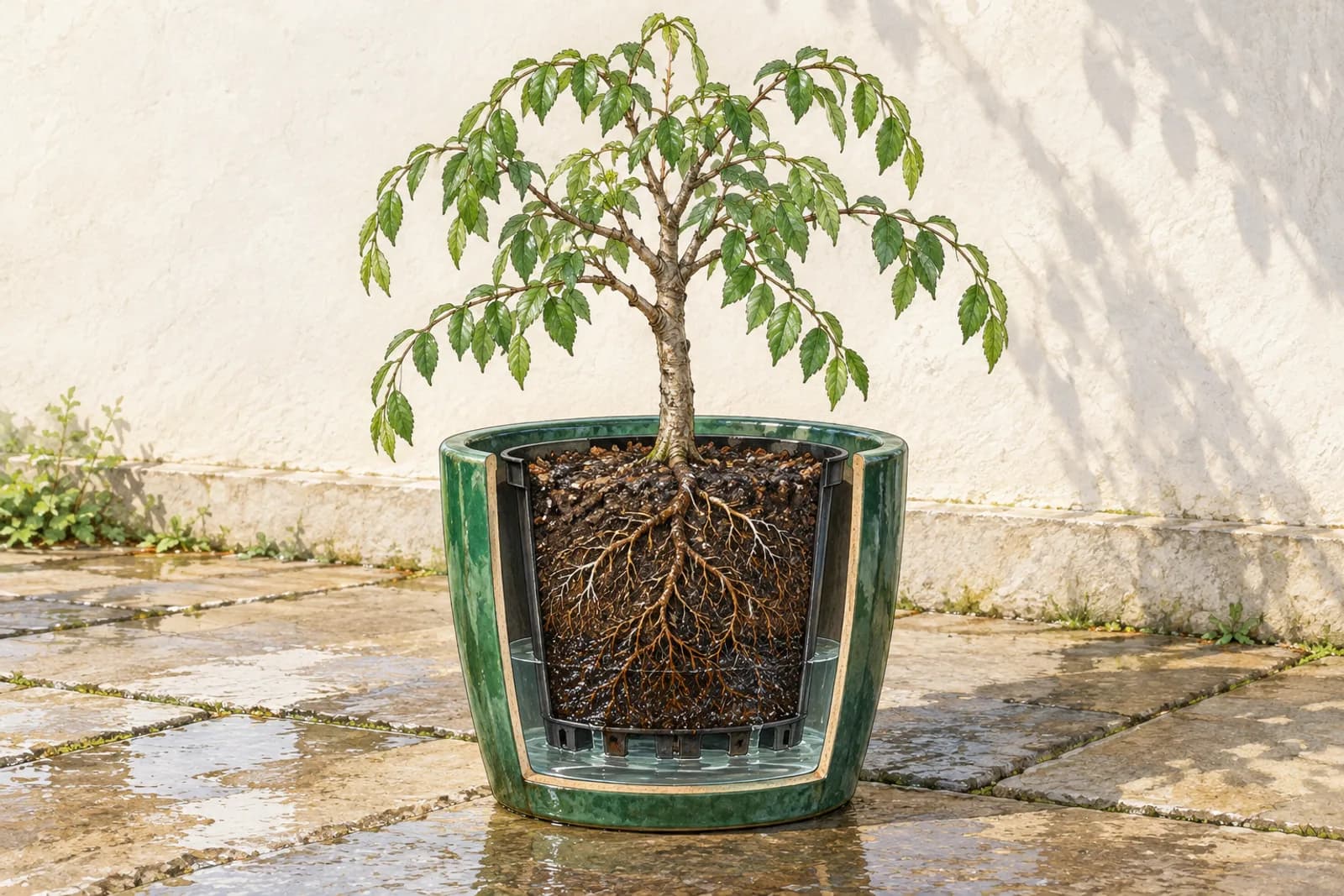
A tree has reduced roots whenever it has fewer working fine roots than its foliage needs: after root work, like Course 01's trident maple two weeks after its roots were trimmed (Course 01, Lesson 8), or after a dry spell or standing water has killed fine roots. Fewer roots draw water, so the pot dries more slowly than before, yet the leaves can droop on a sunny, windy afternoon while it is still moist. Full aftercare belongs to Course 11, Repotting and Root Development; for watering:
- Check below the surface every day, rather than assuming the pot dries as it used to.
- Water thoroughly only when the root zone is drying, never because the leaves droop. More water cannot raise what the remaining roots take up, and a pot kept wet slows the new roots the tree needs.
- Keep it bright but sheltered from wind and hot afternoon sun, not in a dark room or deep shade, because new roots are built from sugar the leaves make in light (Course 01, Lesson 8). Make sure nothing stands under it.
- Return it to its usual spot in steps as new growth extends and the leaves stay firm.
Six trees that look unwell, case by case
Why is it drooping? puts the investigation to work on six case files, each a tree with a one-line report: Trident, 6 pm, Repotted trident, Window ficus, Nursery juniper, Patio larch, and Backyard elm. Choose a case and read its report under the scene. Open the evidence cards in any order: Chopstick in the core, Lift, Drainage holes, Look under the pot, Smell the mix, Recent history, Weather now, and Look again at dusk, which moves the scene ahead to evening. Under What do you do now?, choose Water thoroughly now, Not yet: check again this evening, or Investigate before watering, then press Make the call; choosing an option only selects it. After Investigate before watering, What first? asks for the first action: Do not water: reduce sun and wind exposure, Empty the standing water and let it drain, Pause feeding and rinse the salts out with plenty of plain water, or Get help with a diagnosis (Course 07). Choose one and press Choose this first step. The feedback names the evidence that settles each case, and the Detective's notebook writes up each case you close. Try these:
- Start with Trident, 6 pm, the balcony trident from the prediction above. Open Chopstick in the core and Look again at dusk before you make the call.
- In each of the other cases, open at least one card that reads below the surface and one about what changed, such as Recent history, before you make the call.
- When a case closes, read The evidence that settles it, and open any card it marks as not opened. Then press the button that names the next case, and keep going until all six are closed and the 6 cases closed card appears.
Exercise
Why is it drooping?
0 of 6 cases closed
Case 1 of 6 · Instructional example
The balcony trident at 6 pm
Acer buergerianum
The west balcony on a hot day in July. The trident maple's terracotta pot stands on a grid over a tray, on a low bench against the back wall under the overhang.
What you see6 pm: the trident's leaves hang limp.
Evidence
0 of 8 opened
Your call
Open a card or two first, or decide from the report alone and see what you missed.
Choose a call, then press the button.
Detective's notebook
0 of 6 closed
Case 1: The balcony trident at 6 pm
Not started.
Case 2: The repotted trident
Not started.
Case 3: The window ficus in winter
Not started.
Case 4: The nursery juniper
Not started.
Case 5: The patio larch
Not started.
Case 6: The backyard elm
Not started.
Text description
A case-file game with six instructional-example cases of a tree that droops, dulls, or yellows. Each case shows the tree in its place and a one-line report. In the drawings, firm leaves are held out from their stalks and limp leaves hang down; the nursery juniper is drawn dull and grayish, the ficus with some yellow lower leaves, and the larch with browned needle tips. Eight evidence cards open in any order, each with a small animation and the case's finding: Chopstick in the core, Lift, Drainage holes, Look under the pot, Smell the mix, Recent history, Weather now, Look again at dusk. Opening Look again at dusk skips the scene ahead to dusk: the sky turns amber, the time steps forward, and the leaves firm up or stay as they are. A switch then moves the scene between the time of the report and dusk.
For each case, choose one of three calls: Water thoroughly now; Not yet: check again this evening; Investigate before watering, then press Make the call. Choosing an option only selects it; pressing the button makes the call. After Investigate before watering, choose what to do first and press Choose this first step: Do not water: reduce sun and wind exposure; Empty the standing water and let it drain; Pause feeding and rinse the salts out with plenty of plain water; Get help with a diagnosis (Course 07). Each call gets feedback, and a note says how many cards were open and which evidence settles the case. A closed case opens the pot into a cutaway of its root zone, where moisture is shown by color and pattern (Bone dry: pale, with crack lines; Dry: pale; Drying: pale over a faint damp band at the bottom; Moist: light blue with air dots; Wet: blue with sparse air dots; Saturated: deep blue under a solid water line, no air dots), with a Root-zone moisture readout, and writes a conclusion in the detective's notebook. When the call is to water, the cutaway then shows that watering: the foliage pad lifts aside, a can pours, a wetting front soaks down to the holes, and a second readout gives the root zone after watering. Closing all six shows a 6 cases closed card with how many were right on the first call.
- Case 1, The balcony trident at 6 pm (Acer buergerianum). The west balcony on a hot day in July. The trident maple's terracotta pot stands on a grid over a tray, on a low bench against the back wall under the overhang. What you see: 6 pm: the trident's leaves hang limp. The cards: Chopstick in the core: Damp and cool on the lower half. Pushed in partway between trunk and rim, left a few minutes. Lift: Heavy. Still heavy, though a little lighter than this morning. Drainage holes: Damp and cool at the holes. No drips, and nothing around the holes. Look under the pot: The grid and its tray. The tray is dry. It was emptied after this morning's watering. Smell the mix: Earthy and fresh, like a forest floor. Nothing sour. Recent history: Watered thoroughly this morning, when the check said so, as on most July mornings. No root work this year, no move, no feeding this week. Weather now: Hot, bright, and still. The balcony above shades it until midafternoon; since then the late sun has reached under the overhang. Look again at dusk: By dusk the leaves are firm again, held out flat. The sun has gone and the air is cooling.
- Case 2, The repotted trident (Acer buergerianum). Course 01's trident maple, two weeks after a repot, in a shallow bonsai pot on a slatted bench on a high, open balcony in full sun. What you see: A sunny, windy afternoon: the leaves hang limp, the soft tips of the new shoots bent over. The cards: Chopstick in the core: Dark, cool, and wet along its whole length. Pushed in partway between trunk and rim, left a few minutes. Lift: Heavy. Heavier than you would expect a day after watering, on a sunny, windy day. Drainage holes: Dark and wet at the holes. Fresh mix, with no roots showing there yet. Look under the pot: It stands on the bench's open slats. Nothing collects under it; it drains freely. Smell the mix: Fresh mix, earthy. Nothing sour. Recent history: Repotted two weeks ago, and some of its roots were trimmed to fit the new pot. Watered thoroughly then, and since only when checks said so, most recently yesterday morning. Back in its usual sunny spot since the repot. Weather now: Sunny and windy all afternoon. Full sun on a high, open balcony, with nothing to break the wind. Look again at dusk: By dusk, with the wind dropped, the older leaves are a little firmer. The soft shoot tips still hang.
- Case 3, The window ficus in winter (Ficus microcarpa). The bright window, the ficus's first winter. Its plastic growing pot sits inside a glazed outer pot with no hole, on the sill above the radiator. What you see: Every few days another lower leaf turns yellow, and some have dropped. The cards: Chopstick in the core: Dark, cool, and wet along its whole length. Pushed in partway between trunk and rim, left a few minutes. Lift: Heavy, as if just watered. The growing pot, lifted out, is as heavy as just after a watering. Drainage holes: Soggy at the holes. Water runs out as soon as the pot tilts. Look under the pot: Lift the growing pot out of the outer pot: water is standing in the bottom. Deep enough to soak the bottom of the root ball. Smell the mix: A faint sour smell from the mix. Recent history: For a few weeks, a little water every morning, poured in place on the sill. Not drained at the sink, and the outer pot never checked. Weather now: A bright winter morning indoors, with the heating on. Sill, curtain, and grow light unchanged since October; the board keeps the pot out of the radiator's rising air. Look again at dusk: By dusk nothing has changed. The yellow leaves stay yellow. This is not an afternoon droop.
- Case 4, The nursery juniper (Juniperus procumbens ‘Nana’). The west balcony in June, during the owner's work trip. The black nursery pot stands on the top tier of the slatted shelf; a friend comes every second day. The friend's message: The nursery juniper looks dull and grayish. It is not drooping. The cards: Chopstick in the core: Dry and pale along its whole length. Pushed in partway between trunk and rim, under the lifted foliage. Lift: Light. It comes up easily. Drainage holes: Dry, pale, and loose at the holes. Look under the pot: The slatted shelf. The tray below it is dry. Nothing standing anywhere. Smell the mix: Dry and dusty. Nothing sour. Recent history: The friend watered it thoroughly two days ago, as shown. Daily checks by the owner before the trip; every second day since. Weather now: The second hot, windy day in a row. Full afternoon sun on the open shelf; the board shades only the pot. Look again at dusk: By dusk it is just as dull and gray. Junipers barely droop, so the color is the sign.
- Case 5, The patio larch (Larix kaempferi). The small backyard in June. The Japanese larch's black nursery pot stands on the patio bench by the sunny south wall. What you see: A warm afternoon: needle tips are browning and the new shoots droop. There is a white crust on the rim. The cards: Chopstick in the core: Damp and cool on the lower half. Pushed in partway between trunk and rim, left a few minutes. Lift: Heavy. Still heavy from its last watering. Drainage holes: A white crust around the holes and on the base of the pot. The mix at the holes is damp. Look under the pot: Nothing standing under it. The bench is dry. Smell the mix: Earthy. Nothing sour. Recent history: Fed every week at full strength since spring. Watered from the outdoor hose tap when checks said so. Weather now: A warm afternoon with a light breeze. Nothing extreme for June. Look again at dusk: By dusk the new shoots still droop. The brown needle tips are unchanged.
- Case 6, The backyard elm (Ulmus parvifolia). The small backyard, two days after the Chinese elm was found in a cover pot full of rainwater. Its plastic nursery pot is back on the bench in the western third. What you see: Dawn: the elm's leaves still droop. The cards: Chopstick in the core: Dark, cool, and wet along its whole length. Pushed in partway between trunk and rim, left a few minutes. Lift: Heavy, as if just watered. Two days after draining, still as heavy as just after a watering. Drainage holes: Dark and wet at the holes. Look under the pot: Nothing standing now. The cover pot was emptied and put away two days ago. Smell the mix: Sour, and no better than two days ago. Recent history: A week of rain in a glazed cover pot on the patio, set there for a family party and forgotten. Two days ago it was lifted out, drained, given no water, and kept bright but out of hot sun and wind. Weather now: A cool, calm dawn. The tree's water use is at its lowest of the day. Look again at dusk: By dusk, after a mild day in bright shade, the leaves still hang.
Two of the six cases did not call for Investigate before watering. The balcony trident checked moist, nothing else was wrong, and it firmed by dusk: Not yet: check again this evening. The nursery juniper was light, with the chopstick dry along its whole length: Water thoroughly now. It was the one tree that did not droop; its dull, grayish color was the warning.
The other four drooped, yellowed, or browned over a moist or wet root zone, and each needed a different first step. The trident trimmed two weeks earlier needed less sun and wind, not water. The ficus, with water standing in its outer pot and a faint sour smell, needed that water emptied, and then watering at the sink only when a check said the root zone was drying. The Japanese larch (Larix kaempferi), fed at full strength every week, needed feeding paused and the salts rinsed out; its crust alone could have been hard water. The Chinese elm, still drooping at dawn and smelling sour two days after its cover pot was emptied, needed help with a diagnosis. In all four, the chopstick and the lift ruled out water, and the first step came from what had changed or what stood under the pot: Recent history for the repotted trident, Look under the pot and Smell the mix for the ficus, Recent history and the crust at the Drainage holes for the larch, and Smell the mix and Recent history for the elm.
Practice check · not scored
Between too dry and too wet
Together, the two halves of this lesson describe a cycle. After a thorough watering, a pot that drains is Wet for a short time, then settles at Moist as its large pores drain and fill with air. Over hours or days the tree draws it down to Drying, the moment to water thoroughly again.
Roots work best at Moist and keep working as it dries toward Drying, with water films to draw on and air in the pores; Course 01's slider shows it particle by particle (Course 01, Lesson 2). The cycle overshoots into Dry when checks are too far apart for the weather, and stalls at Wet or Saturated when water cannot leave or keeps arriving too soon.
| Level | Water for the roots | Air for the roots | What it calls for |
|---|---|---|---|
| Bone dry | Almost none, held tight | Plenty, but fine roots are dying | Water thoroughly now, slowly or by immersion if it has shrunk |
| Dry | Very little, all the way down | Plenty | Water thoroughly now; you are late |
| Drying | Shrinking; only the bottom faintly damp | Plenty | Water thoroughly now: the usual moment in active growth |
| Moist | Held in the small pores | In the large pores | Not yet: check again later |
| Wet | Plenty, and draining | Coming back as it drains | Not yet: check again later; normal for a short time after watering |
| Saturated | Every pore full | None | Normal only briefly; if it lasts or the tree droops: Investigate before watering |
What to do when a tree droops
The bonsai decision
Check the root zone before you treat a droop
Starting point
When a tree's foliage droops, dulls, or yellows, check below the surface before you do anything else: the chopstick in the core, the lift, and the drainage holes (Lesson 2). Then:
- Drying or drier: if the chopstick comes out dry, with only the tip faintly damp, or dry and pale along its whole length, and the pot is light, water thoroughly now, in slow passes (Lesson 3). If water runs straight through, water again, aimed at the dry part, or immerse the pot. Once it drains, confirm with the lift and a chopstick in the core that it wetted through, and check again the next morning.
- Moist, late on a hot afternoon, with nothing changed: add no water, and look again at dusk (Not yet: check again this evening). Leaves that have firmed by then were temporary wilting.
- Wet, or moist at any other time, or still limp at dusk: do not water. Investigate before watering: ask what changed, look underneath, smell the mix, consider salts, and look again at dusk and the next morning.
- Either way, note the date, what you found, and what you did (Lesson 7).
This assumes
- The pot drains freely, and the tree is established, with no recent root work and normal growth before it drooped.
- It is the growing season. The months in this lesson belong to the course's Northern Hemisphere example climate. In the Southern Hemisphere, swap north and south, and shift the months by half a year.
- You can look again at dusk and the next morning, or someone you have shown can.
Change course if
- The roots were recently trimmed or disturbed: water only when the root zone is drying, and keep the tree bright but sheltered from wind and hot afternoon sun (Course 11 covers aftercare).
- Water stands under the pot, or the mix smells sour: empty the tray or cover pot, let the pot drain, add no water, and fix the cause. If the tree keeps declining, get help with a diagnosis (Course 07).
- The leaves firm by evening over a moist root zone: that was temporary wilting. If it happens most hot afternoons, shade the tree through the hottest hours (Course 02, Lesson 5).
- The tree has been fed often or heavily and droops, or its leaf edges brown, in a moist pot: suspect salts, all the more if the rim is crusted white. Pause feeding and rinse them out with plenty of plain water (Lesson 5). A crust on a tree that has hardly been fed is more likely the hard tap water.
- It is still wilted the next morning, or keeps declining while the root zone stays moist: this is not a watering problem. Get experienced help with the roots (Course 07).
Back to the question
Why can a tree wilt in a wet pot, and what should you do when it does?
Because leaves stay firm only while the roots replace what they lose, and roots can fail at that in a wet pot as surely as in a dry one. In a root zone that stays saturated, roots run short of oxygen, their tips die back, and the tree takes up less water from a pot full of it. A droop alone cannot tell you which problem you have, and the remedies are opposite, so check below the surface first. A dry root zone needs a thorough watering now. A moist one late on a hot afternoon needs only a second look at dusk. Otherwise a moist or wet root zone needs no water: find out what changed, look underneath, smell the mix, and consider salts. Get help if the tree is still wilted the next morning.
Key takeaways
- A root zone that dries out and one that stays saturated both cut the water reaching the leaves, so both can make foliage droop, dull, yellow, or brown, and the remedies are opposite.
- Check below the surface before you treat a droop. Dry means water thoroughly now, at any hour. Moist late on a hot afternoon means look again at dusk. Wet, moist at any other time, or a droop still there at dusk means do not water: investigate.
- Drying harms before it shows: stomata narrow and growth slows before any wilting, junipers barely droop, and fine roots that dry out do not revive.
- Overwatering is about how often a pot is watered and how well it drains, not how much is poured. Standing water, a pot far bigger than its roots, and watering a pot that is still moist all keep air out.
- An investigation checks the core and the holes, what changed, what stands under the pot, the smell, the feeding history, and the leaves at dusk. A tree still wilted the next morning needs a diagnosis, not more water.
Optional · not required for completion
Watch a droop come and go
On the next hot afternoon, choose one thin-leaved broadleaf tree, such as a maple or an elm. In the late afternoon and again at dusk, note how its leaves hang, lift the pot, and leave a chopstick in the core for a few minutes. If the leaves droop over a moist root zone and firm by dusk, you have watched temporary wilting; if the root zone is dry, water thoroughly at once. What would you have done from the leaves alone?
No tree? Watch a garden plant with large, soft leaves, such as a hydrangea or a squash, or a young street tree, in the morning, mid-afternoon, and evening of a hot day. When do its leaves hang lowest, and when do they firm again?
Go deeper · optional, not assessedWhat a sour smell tells you
A moist, airy root zone smells earthy, largely from geosmin, made by soil microbes that need air. When the pores stay full of water and the oxygen runs out, microbes that need none take over, making organic acids that smell sour and, where the mix stays waterlogged longest, hydrogen sulfide, which smells of rotten eggs. Roots short of oxygen add products of their own fermentationA way of releasing energy from sugar without oxygen, which yields far less usable energy than respiration with oxygen and produces byproducts that can harm cells as they accumulate. Roots in persistently saturated media fall back on it and can run short of energy.Open the glossary. So a sour smell shows that part of the root zone has gone without air for some time, but it cannot tell you how many roots are damaged (Course 07).