Course 03 · Lesson 7 of 7 · Hard cases and a lasting routine
Reading the response and improving decisions
A watering log turns a summer of quick checks into evidence about each pot, its spot, and its roots. Learn what to record, how to read intervals against the weather, and which patterns call for a change in the routine or for help that watering cannot give.
The question
What do your records tell you, and when is a watering problem really a different problem?
By the end of this lesson, you will be able to:
- Interpret a watering log of checks, weather, and decisions to judge whether the decisions worked.
- Identify patterns in a log that call for a change in the routine, and tell them apart from the expected swing with the weather and the season.
- Recognize when repeated wetting problems, persistent saturation, or decline call for help with the substrate, the roots, or the tree's health rather than a watering change.
About 18 minutes to read and explore
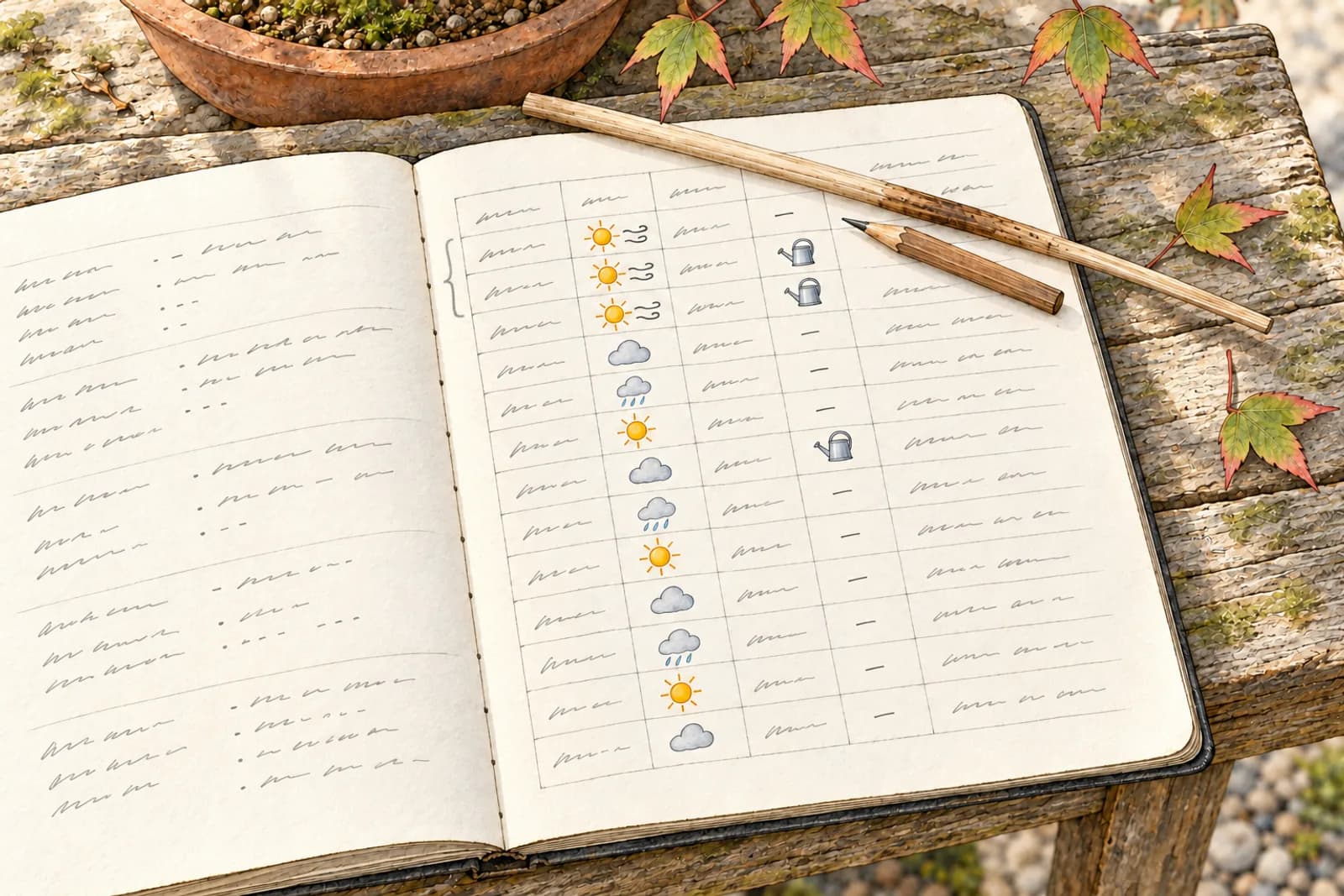
September on the west balcony, the instructional example this course has followed since spring. Like every case here, it is set in one temperate Northern Hemisphere city at about 40° N (USDA zone 7a). The afternoons have cooled from July's 30 to 33 °C (86 to 91 °F) to about 24 °C (75 °F), and the owner sits down with the summer's watering logA dated record of each check of a tree's root zone, usually one short line per pot: the weather, what each check found, the decision, and the reason for it. Read over weeks, it shows how fast each pot dries in different weather, whether the decisions worked, and patterns no single check can show, such as a pot that keeps drying fast even as the weather cools.Open the glossary: one short line per pot at every check, with the weather, what the checks found, and the decision.
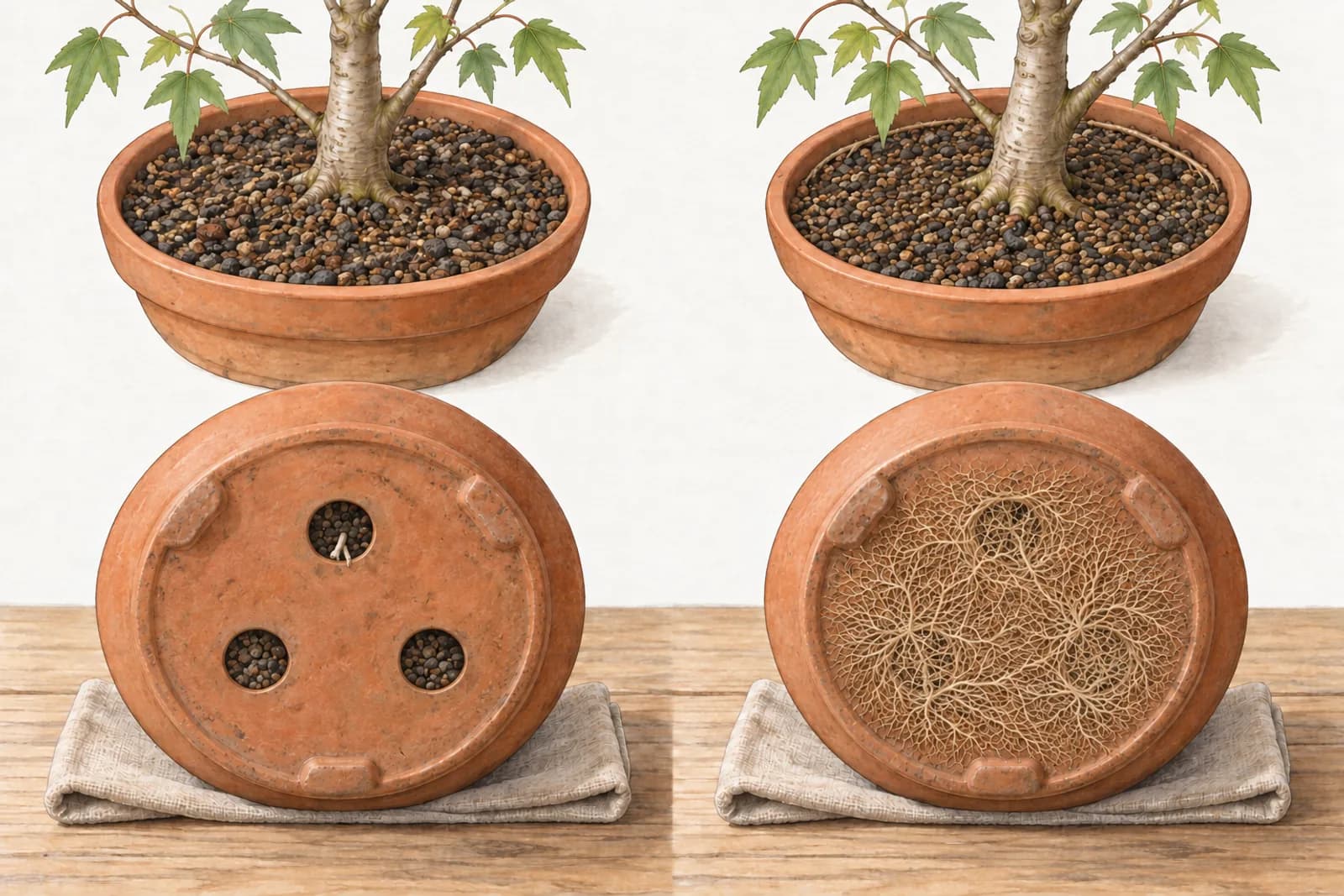
The trident maple's lines are the first surprise. It needed water about every second day in June and every morning in July, which matched the heat. Weeks into cooler weather, it still needs water daily: the pot is light again by the next morning, and the first drips come sooner than they did in spring. Tipped back on its grid, the terracotta pot shows a mat of roots over the drainage holes, and a few roots run around just inside the rim.
The gift juniper's lines show something else. Since midsummer, a fingertip near the rim has found the coarse ring of fresh mix dry by the next afternoon after each watering, while the chopstick in the old core comes out damp and cool on its lower half days later, longest in cool spells. In October, the bright window's owner, who checks the ficus every morning, sees a third pattern in their own log: its waterings have come closer together since the heating came on.
Three records, three patterns. For each, the question is whether it calls for different watering, different checks, or nothing new. This lesson is about reading a record that way, and telling when a watering problem is really a different problem.
What to record
A watering log is a dated line for each pot at each check, in a notebook kept with the watering can or a note on your phone. What makes a line useful later is what it holds:
- When: the date and time. Checks at about the same time each day give lines you can compare.
- Weather: the day's high, the wind, and any rain, including whether it reached the pot. A min/max thermometer at pot height, out of direct sun, gives the spot's own high and low (Course 02, Lesson 5).
- Each check, in words: what the chopstick and the lift testJudging how much water a pot holds by lifting it and comparing its weight with how it felt right after a thorough watering and when it was dry enough to need water. It has to be learned for each pot, works best where water is a large share of the weight, and shows how much water the pot holds, not where it is.Open the glossary found, in the same phrases every time, such as “Damp and cool on the lower half,” and where the chopstick went if the root ball has two zones (Lesson 2). “OK” cannot be compared with anything.
- The decision, and why: which of the three decisions you made, and the check or the weather that settled it.
- How the watering went: after a thorough wateringWater applied evenly across the whole surface, slowly enough to soak in, until it runs from the drainage holes, and then confirmed by a check that the root ball wetted through. It usually takes two or three passes a minute or two apart. Water at the holes alone shows only that water reached the bottom, not that the roots got it.Open the glossary, how soon the first drips came, whether the pot felt heavier after, and that the tray was emptied (Lesson 3).
- How the tree looks: the leaves, new shoots, and any white root tipThe growing end of a root, made up of the root cap, the dividing cells behind it, and short zones where new cells lengthen and mature. Active tips are usually pale or white and show where a root is extending into fresh substrate.Open the glossary at the holes (Course 01, Lesson 14).
- Anything that changed: a move, shade cloth, a helper's visit, root work, a trip.
A line can be as short as this: “Tue 8 am · 33 °C (91 °F) forecast, windy · Lift: lighter than after watering · Chopstick: damp and cool on the lower half · Not yet: check again this afternoon (5 pm), hot wind · Leaves firm.” Kept that short, in your own shorthand with the same words each time, it is easy to keep doing. Write a line even when nothing needs water: the “Not yet” lines show how long each pot lasts. Keep going through the winter, when the lines get fewer (Course 06, Seasonal Care and Timing).
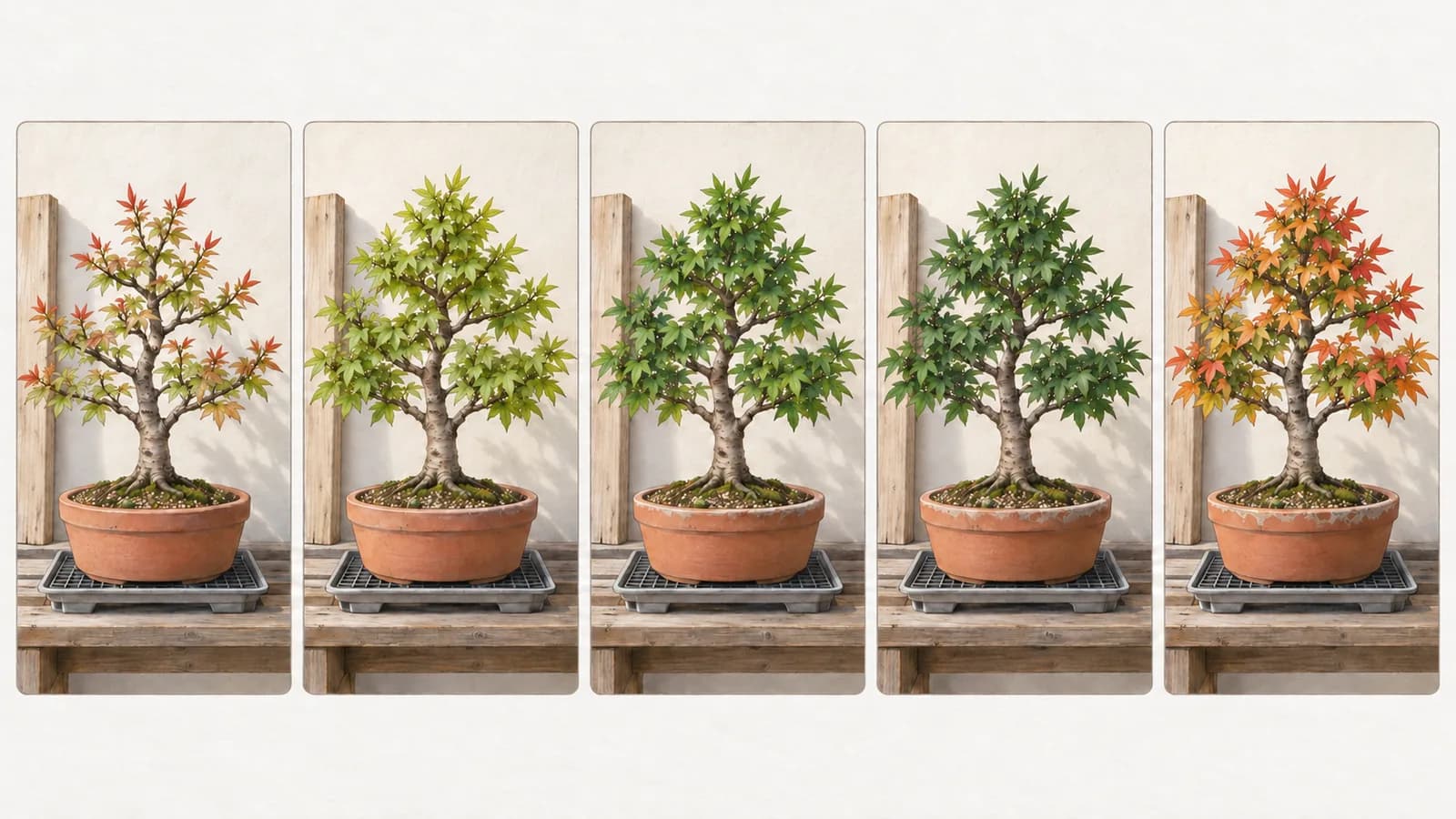
Once a week, photograph each tree from the same spot and height, as for its arrival recordA dated note made the day a tree arrives: where it came from and how it was grown, the price, its tag or label copied word for word, its identity and how sure you are, what an inspection found, and photos from every side with close-ups. It is the baseline that later checks are compared against, and it helps anyone asked to identify the tree or explain a later problem.Open the glossary (Course 02, Lesson 8). Slow changes, such as shoots a little shorter than last month, show only when dated photos sit side by side.
Seven mornings on the west balcony
A week of mornings puts the course's habit of check, decide, record to work: seven mornings of early September on the west balcony, with all three trees and a forecast card each morning. As on a real balcony, you cannot see inside the pots until the evening, so each call rests on your checks.
- On the first morning, predict which tree will need water most often (Trident maple, Nursery juniper, or Gift juniper), or press Skip. The week's report says whether you called it.
- Each morning, read the forecast card; on a hot or windy morning, you can switch on Add an afternoon check. For each tree, run any of the checks (Surface, Chopstick, Lift, Drainage holes, and Leaves) and read each result. A decision made on at least two checks earns a Two checks tick. Decide the gift juniper by its chopstick, which goes into the old core, as in Lesson 2. On a phone, pick the tree with Tree.
- For each tree, choose Water thoroughly now, Not yet: check again tomorrow morning (it reads Not yet: check again this afternoon when the afternoon check is on), or Investigate before watering. The morning after a storm, press Empty the tray on the trident's card first.
- When all three trees have a decision, press End the day. The pots open to show the root zone from morning to evening (Skip to the evening jumps ahead), and the evening card grades each call and marks any pot that went short. Press Next morning to go on.
- After the seventh evening, press Go to your week's report, read the report and the watering log the exercise wrote, then try Replay with another week.
Exercise
A week of mornings
- 1 September: today.
- 2 September: to come.
- 3 September: to come.
- 4 September: to come.
- 5 September: to come.
- 6 September: to come.
- 7 September: to come.
Morning 1 of 7 · Instructional example
1 September, 7 am
Warm and sunny. Warm sun on the balcony from early afternoon, and little wind.
Trident maple Acer buergerianum
Terracotta training pot, about 25 cm (10 in), on a low bench against the back wall, on a grid over a tray
- No checks yet. Each check adds evidence; two or more earn the Two checks tick.
Nursery juniper Juniperus procumbens ‘Nana’
Black plastic nursery pot, about 20 cm (8 in), on the top tier of the slatted shelf, its sunny side shaded by a board
- No checks yet. Each check adds evidence; two or more earn the Two checks tick.
Gift juniper probably Juniperus procumbens ‘Nana’
Wide black training pot, about 22 cm (9 in), beside the nursery juniper on the shelf; the old peat-rich core sits in a ring of coarse mix
- No checks yet. Each check adds evidence; two or more earn the Two checks tick.
0 of 3 decided · Two checks on 0 of 3
Choose a decision for all three trees to end the day.
Watering log
One line per pot, written at each evening: the start of a seven-day journal.
Empty so far. Each evening adds a line for each tree: date, weather, checks, decision, and outcome.
Text description
An exercise in seven invented mornings on the west balcony in early September, an instructional example in the course's example city. The drawing shows the balcony from the side: the back wall and the balcony above's overhang on the left, the glass railing and the western sky on the right. The trident maple stands on a low bench against the back wall, under the overhang, in a terracotta pot on a grid over a tray. The nursery juniper and the gift juniper stand side by side on the top tier of a slatted shelf in the open middle, their spreading foliage over their pots, each pot's sunny side shaded by a board. In the morning the pots are drawn closed: you learn what is inside only from the checks.
- The trident maple: Terracotta training pot, about 25 cm (10 in), on a low bench against the back wall, on a grid over a tray.
- The nursery juniper: Black plastic nursery pot, about 20 cm (8 in), on the top tier of the slatted shelf, its sunny side shaded by a board.
- The gift juniper: Wide black training pot, about 22 cm (9 in), beside the nursery juniper on the shelf; the old peat-rich core sits in a ring of coarse mix.
Each morning has a forecast card, and some mornings an overnight event. For each tree you may run any of five checks, in this order: Surface (color and texture of the top layer); Chopstick (an unvarnished wooden chopstick pushed deep into the root zone, partway between trunk and rim, left a few minutes, read along its length); Lift (the pot's weight compared with how it felt right after a thorough watering and when dry); Drainage holes (tilt the pot and look at and touch the mix at the holes); Leaves (droop, dullness, color). Each result appears in words beside the tree, using the course's fixed phrases for the chopstick and the lift, and a close-up appears on the drawing. Running two or more checks on a tree earns its Two checks tick. Then choose one of the three decisions for each tree: Water thoroughly now; Not yet: check again later; Investigate before watering. On hot or windy mornings an Add an afternoon check switch adds a check at 4 pm that waters any pot that checks Drying or drier. The second decision reads Not yet: check again tomorrow morning, or this afternoon when the afternoon check is on. The morning after a storm, the trident's card offers an Empty the tray button.
The seven forecasts of each week:
Week 1, 1 to 7 September:
- 1 September: Warm and sunny.
- 2 September: Warm, then a storm on a west wind.
- 3 September: Cool and cloudy.
- 4 September: Mild and bright.
- 5 September: Hot and sunny.
- 6 September: Cool, bright, and breezy.
- 7 September: Cool, bright, and breezy.
Week 2, 8 to 14 September:
- 8 September: Cool, bright, and breezy.
- 9 September: Steady, still rain.
- 10 September: Mild and bright.
- 11 September: Hot, sunny, and windy.
- 12 September: Warm and sunny.
- 13 September: Warm, then a storm on a west wind.
- 14 September: Hot and sunny.
Week 3, 15 to 21 September:
- 15 September: Warm, then a storm on a west wind.
- 16 September: Warm and sunny.
- 17 September: Hot and sunny.
- 18 September: Cool and cloudy.
- 19 September: Mild and bright.
- 20 September: Hot, sunny, and windy.
- 21 September: Mild and bright.
End the day plays the day from 7 am to 7 pm, with Play, Pause, Back, Next, and Replay and stops at Morning, Afternoon, and Evening. The pots open as cutaways showing root-zone moisture in layers on one scale of six levels, each with its own pattern: Bone dry: pale, with crack lines; Dry: pale; Drying: pale over a faint damp band at the bottom; Moist: light blue with air dots; Wet: blue with sparse air dots; Saturated: deep blue under a solid water line, no air dots. The watering can pours on each pot watered, and the late sun reaches under the overhang in the afternoon. The evening card then says, for each tree, whether the call was good, whether the pot went short of water after noon, the right call and why, the root-zone moisture in the morning and evening, what happened through the day, and what any closer look found. After a storm, watering into the full tray spills over the bench and drips onto the balcony below. A line for each tree is added to the watering log table (date, weather, checks, decision, outcome), which can be copied as plain text.
After the seventh evening a report gives four numbers (good calls, waterings the pots did not need, times a pot went short, and decisions on one check), a short review of each tree, and buttons to start the week over or replay with another week. An optional prediction before the first morning asks which tree will need water most often.
The three pots behaved differently all week. The trident still needed water on most mornings, even as September cooled; the junipers needed it less often, and in the gift juniper's pot the core's chopstick decided while the ring dried. More than once, a tree that looked fine was already drying and needed water now; the leaves, least of all the junipers', were never the signal to wait for. When a tree and its pot disagreed, the right call was to investigate before adding any water. A decision made on one check, or on none, got a note naming what that check could not see, and the report counted those decisions on their own.
The weather set the rest. On hot or windy days, a pot that could wait at 7 am could be drying by 4 pm: the afternoon check watered it in time, and without that check the evening card marked it Went short. The trident's droop in the late-afternoon sun came over a root zone still moist and was gone by evening: temporary wiltingDrooping of leaves or soft shoots on a hot, bright, or windy afternoon, over a moist root zone, that recovers by evening as demand falls and uptake catches up. Wilting that lasts overnight is a different matter, and wilting that returns most afternoons still costs growth (Course 01, Lesson 8).Open the glossary, which needed no water (Lesson 4). After the storm, emptying the trident's full tray came first; watering into it sent the overflow onto the balcony below. The log the exercise wrote, one line per pot each day with the weather, the checks, the decision, and the outcome, is a seven-day watering log, and the rest of this lesson reads logs like it.
Reading a log
Did each decision work?
Read each decision against the line after it. A decision worked when the next check finds the pot moist, or drying and ready for water, but not dry. A watering also needs its line to show that it wetted through: slow passes, and a pot clearly heavier after; a pot that barely gained weight means the water ran past the root ball (more below). Two other kinds of line show a miss. A chopstick dry and pale along its whole length, or a juniper gone dull and grayish, means the decision before it waited too long. A watering made on the surface alone, or over a lower half still damp, was one the pot did not need. The report in A week of mornings counted the same misses: waterings the pots did not need, times a pot went short, and decisions on one check.
Intervals, the weather, and the season
Next, read the intervals: the days between waterings, pot by pot. When each watering follows a check that found the root zone drying, the intervals show how fast that pot empties in that weather: shorter in hot, sunny, windy spells, when evaporative demandHow strongly the surrounding air draws water vapor from leaves, rising with sun, heat, dry air, and wind. High evaporative demand can make a tree lose water faster than reduced or damaged roots can replace it.Open the glossary is high, and longer in cool, cloudy, still ones (Course 01, Lesson 8). So read them against the weather column: three waterings in a week means little until you know whether it was the week of the storm or the week of the hot wind.
Over a season, the intervals swing with the tree and the weather together (Lesson 1). In the example climate, they shorten through spring as new leaves open and the spring flushA burst of new shoot growth, with leaves expanding together, that happens once or several times a year depending on the tree and conditions. Between flushes, shoots stop extending and mature.Open the glossary grows, are shortest around July, and lengthen again from September as the days shorten and the nights cool. Winter waterings are fewer, but evergreens still lose water on sunny, windy days. These months belong to the course's Northern Hemisphere example climate; in the Southern Hemisphere, swap north and south, and shift them by half a year.
Within a season, compare a week with a week of similar weather. If a pot needs water sooner than it did in similar weather a month ago, something about the tree, its pot, or its spot has changed: its roots, its foliage, its sun or shade, or the way water goes in. If it lasts much longer than it used to, its roots may be taking up less. Pots that share a place share its weather too: when the two junipers, side by side on one shelf, dry at very different rates, the difference lies in the trees, their pots, and their roots.
When the pattern is expected
Some changes in a record are the routine doing its job. At the bright window, the heating comes on in October, and the room's air turns very dry, the air rising off the radiator drier still (Course 02, Lesson 3). Air with such low relative humidityThe amount of water vapor in the air, as a percentage of the most the air could hold at its current temperature. Warm air can hold more vapor, so heating cold winter air indoors lowers its relative humidity sharply, and drier air draws water from leaves and pots faster.Open the glossary draws water from the leaves and the pot's surface faster, and the lower autumn sun reaches farther onto the sill on clear days, so the ficus dries sooner each week. Its owner already checks every morning, and every watering followed a check that found it drying. That is expected: the routine stays as it is, and the waterings come closer together.
A move into more sun or wind, a hardening offGetting a plant that grew indoors or under glass used to outdoor sun, wind, and temperatures gradually, by moving it from bright shade toward full exposure over one to two weeks or more. For bonsai, it protects soft leaves from scorch when a tree goes outdoors for the season or arrives from a greenhouse. It is not the same as shoots hardening, or turning woody, in late summer.Open the glossary step, a growth flush, and a heat wave shift the intervals the same way. The test is whether you can name what changed. If you can, and you already check daily, let the checks set the waterings; if you were checking less often, check daily until the log settles.
Practice check · not scored
When a check is in the wrong place
Sometimes a pattern says which check should decide, not how to water. Since spring, roots from the gift juniper's old root ball have grown out into the ring of coarse fresh mix around it and draw on the ring's small store first. So the ring dries by the next afternoon, while the peat-rich core's larger store keeps it moist for days. The log shows the gap line after line: ring dry, core damp and cool on its lower half. Judged at the rim, this pot would be watered every day or two.
The chopstick in the old core, partway between trunk and rim, decides (Lesson 2; Course 02, Lesson 7), and a ring that dries ahead of a still-moist core is no reason to water. Other patterns call for other changes to the checks: a second chopstick spot when two checks keep disagreeing, an afternoon check on hot, windy days, or a better time for one (below).
A supplied week to practice on
Here is a week to read before you have a summer of your own: the west balcony's nursery juniper in the first full week of July, with two hot, windy days, a storm, and a cool day. Its black plastic nursery pot, about 20 cm (8 in) across, stands on the top tier of the slatted shelf, its sunny side shaded. The owner checks at 8 am, and again at 5 pm on hot, windy days.
| When | Weather | What the checks found |
|---|---|---|
| Mon 8 am | 29 °C (84 °F), light breeze, dry | Lift: Light. Chopstick: Dry, with only the tip faintly damp. |
| Tue 8 am | 33 °C (91 °F), windy, dry | Lift: Lighter than after watering. Chopstick: Damp and cool on the lower half. |
| Tue 5 pm | Hot wind all afternoon | Lift: Light. Chopstick: Dry, with only the tip faintly damp. Leaves: normal color. |
| Wed 8 am | 34 °C (93 °F), windy, dry | Lift: Heavy. Chopstick: Damp and cool on the lower half. |
| Wed 5 pm | Hot wind all afternoon | Lift: Light. Chopstick: Dry, with only the tip faintly damp. |
| Thu 8 am | Storm overnight on a west wind; today 25 °C (77 °F), cloudy | Tray under the shelf full of water. Surface: dark and wet. Lift: Heavy. Chopstick: Damp and cool on the lower half. |
| Fri 8 am | 21 °C (70 °F), cloudy, still | Lift: Heavy. Chopstick: Damp and cool on the lower half. |
| Sat 8 am | 24 °C (75 °F), sunny, light breeze | Surface: pale and dry-looking. |
| Sun 8 am | 28 °C (82 °F), breezy, dry | Lift: Lighter than after watering. Chopstick: Damp and cool on the lower half. |
Before you read on, decide each line's call, one of the three decisions or another check first, and write its reason in a few words.
The owner's calls, annotated
| When | The owner's call | The owner's reason |
|---|---|---|
| Mon 8 am | Water thoroughly now | Light, chopstick dry but for the tip. Hot day ahead. |
| Tue 8 am | Not yet: check again this afternoon | Damp on lower half. Hot wind forecast. |
| Tue 5 pm | Water thoroughly now | Light, chopstick dry but for the tip. |
| Wed 8 am | Not yet: check again this afternoon | Heavy, damp on lower half. Hot and windy again. |
| Wed 5 pm | Water thoroughly now | Light, chopstick dry but for the tip; 34 °C (93 °F) on the thermometer, hot wind all afternoon. Three slow passes until it ran from the holes. Heavy after. Tray emptied. Next check 8 am. |
| Thu 8 am | Not yet: check again tomorrow morning | Heavy, damp on lower half; storm wet the surface. Tray emptied. |
| Fri 8 am | Not yet: check again tomorrow morning | Heavy, damp on lower half. Cool. |
| Sat 8 am | Water thoroughly now | Looked dry. |
| Sun 8 am | Not yet: check again later | None written. |
A strong entry: Wednesday, 5 pm. Everything a later reader needs is in one line: two checks in words, the weather that explains them, the decision, how the watering went (slow passes, water from the holes, a heavier pot), the tray, and when to look next.
No reason: Sunday. The call was right, since the lower half was still damp, but the line does not say so. A reason such as “damp on lower half, breezy, check again 5 pm” would also have set up the afternoon check. A line with no reason cannot be checked later, and a helper learns nothing from it.
One check: Saturday. The decision rested on the surface, the layer that dries first; the right call was the lift and the chopstick. After the storm and two cloudy days since Wednesday evening's watering, they would probably have found the lower half still damp: a watering the pot did not need. One extra watering of a free-draining pot in July does little harm; the habit does. In cool weather, watering whenever the surface looks dry keeps topping up a pot whose lower half never dries back, and a root zone kept wet that constantly is what overwateringKeeping a root zone wet so constantly, or letting it drain so poorly, that air never gets back into its pores and the roots run short of oxygen. It is about how often a pot is watered and how well it drains, not how much is poured at once: a thorough watering of a pot that drains, given when the root zone is drying, is not overwatering.Open the glossary means.
The other calls were sound: water on Monday morning and both hot afternoons, when the pot was light and the chopstick dry but for its tip; otherwise not yet, with an afternoon check on the hot, windy days. After the storm, emptying the tray came first, and the chopstick, not the storm-darkened surface, decided: a dense juniper canopy sheds much of the rain past its rim, a loss called interceptionRain caught on foliage before it reaches the pot. Some evaporates from the leaves, and a canopy wider than its pot drips much of the rest off its edges, past the rim, so the root ball under a dense, spreading canopy can stay much drier than the rain suggests.Open the glossary (Lesson 5). Read down the waterings, and the intervals follow the weather: about one a day in the hot wind, then none through the storm and the cool day.
Patterns that point beyond watering
Predict first
Something else, most likely in the pot. Each check found the root zone drying, and each thorough watering wetted it, so the watering is doing its job. As the weather cools, a tree in leaf draws water more slowly, and its intervals should lengthen. When they stay short, with first drips sooner each month and roots at the holes, the likely cause is a pot filling with roots, which holds less water. Keep watering by the check; the roots are a question for later, not for the watering can.
Sooner and sooner as the weather cools
Intervals that stay short, or shrink, while the weather cools run against the weather, the biggest pace-setter. First rule out a change in the spot: the lower autumn sun reaches farther under the overhang, so a pot by the back wall can get more sun in September than in July. Then add first drips that come sooner each month, a pot light again by the next morning, and roots matting at the holes or circling under the rim, and the likely cause is a pot filling with roots. Roots take up room where mix once held water, and more roots draw on what is left (Course 01, Lesson 2). A pot so full that roots circle the wall and mat at the bottom is root-boundDescribes a container plant whose roots fill the pot, circling the walls and matting at the bottom. A mildly root-bound nursery tree is common and often healthy. A badly root-bound one dries out quickly, and circling roots are dealt with at repotting.Open the glossary: common and often healthy when mild, but a badly root-bound tree dries out fast (Course 02, Lesson 6).
What to do now does not change: keep checking every morning and watering thoroughly whenever the check says the root zone is drying. Have the roots assessed at the next suitable time, which for the trident means next spring (Course 11, Repotting and Root Development). A few white root tips at a hole on their own are normal, a sign of growing roots, and no reason to repot; it is the combination with the record that matters.
Water that will not soak in, or will not stay
Some logs show a wetting problem that keeps coming back: water pools on the surface at every watering and takes a long while to reach the holes; or the first drips come within seconds and the pot barely gains weight, a sign of channelingWater running down a few easy paths, such as a gap at the pot wall, a crack, or the edges of a dry, water-repellent core, and out of the drainage holes without wetting most of the root ball. First drips within seconds from a pot that was light suggest it; a pot still barely heavier afterward, or a core that is still dry, confirms it.Open the glossary; or the root ball will not rewet after slow passes and immersion wateringStanding a pot in a basin of water up to the surface of the mix until the root ball is wet through, then lifting it out to drain fully. Rising bubbles show air leaving; when they stop, check the core with a chopstick, because a water-repellent core can stop bubbling before it is wet. Allow 10 to 30 minutes, up to an hour for a bone-dry, peat-rich root ball, and never more than a few hours: it is never a way to leave a pot standing in water.Open the glossary. The first time, treat it as technique (Lesson 3): slow passes, immersion for a dry or water repellencyThe way some organic mixes, especially peat-rich ones, shed water after drying out: water beads on them and runs off or past instead of soaking in, until they slowly rewet. Small, slow amounts aimed at the dry part, or immersion, rewet them, while a fast pour runs straight past.Open the glossary root ball, and a chopstick to confirm. If a peat-rich root ball turns water-repellent again each time it dries out, change the routine next: check it more often, with an afternoon check on hot days, so it gets water while it is drying, before it is dry all the way down. If water still pools or channels after all that, the substrate itself is the likely cause: a mix that has broken down or packed tight, or one that sheds water even when it has not dried out. Course 04, Soil, Substrates, and the Root Environment, explains why, and replacing a mix is part of repotting (Course 11).
Tell this apart from a root-filled pot by the weight. A thorough watering still leaves a pot full of roots heavier, with the chopstick damp; water that channels past a dry core leaves the pot barely heavier and the core dry.
Practice check · not scored
A pot that stays wet in warm weather
In warm weather, a free-draining pot with working roots and a tree in leaf dries within days. When the log shows a pot heavy and the chopstick wet along its whole length day after warm day, something is keeping the water in: blocked holes, water standing underneath, a mix that holds too much (Course 04), or roots that have stopped taking water up. The root zone stays saturatedDescribes soil or substrate whose pore spaces are completely filled with water, leaving little or no air. Brief saturation right after watering is normal in a pot that drains; saturation that lasts starves roots of oxygen.Open the glossary, and roots short of air take up less, so it dries more slowly still. Changing the watering alone will not fix this. Investigate before watering (Lesson 4): add no water, check the holes and underneath the pot, smell the mix, and think back over recent root work, moves, and standing water. If the tree droops, dulls, or yellows as well, get help (Course 07, Tree Health and Diagnosis).
Keep the season in mind: even a sound pot dries slowly in cool weather, in shade, or while a deciduous tree is bare (Course 01, Lesson 7). A bare trident that stays heavy for days in November is not this pattern.
Practice check · not scored
Decline despite a sound record
Sometimes the record is good: two checks every morning, waterings only when the root zone was drying, each one confirmed, trays emptied, no long wet or dry spells. Yet over weeks and months the tree does worse than the season explains: shoots stall, new leaves come out smaller or paler, foliage thins, or tips die back. That is declineA gradual loss of health and growth over months or years, usually from several stresses acting together, such as poor light, root problems, or a missing winter rest. Early signs are subtle, so comparing dated records over time helps catch it.Open the glossary. A sound record makes recent watering an unlikely cause. Read further back in the log for an earlier dry or wet spell, because old root damage can surface weeks or months later (Course 01, Lesson 14). Then look beyond the moisture: light, pests, root disease, soluble saltsDissolved minerals, from fertilizer and from tap water, that can accumulate in a container's substrate as water evaporates. A high concentration makes it harder for roots to take up water and can damage them. Buildup can leave a white crust on the pot or surface, though hard tap water alone can leave a similar crust, so a crust by itself does not show that roots are harmed.Open the glossary, or what is in the water itself (Lesson 5). Finding the cause belongs to Course 07, and the log is the first thing anyone helping will want to see.
Five records to read
Read the record gives you five short watering logs from the course's cases. Each is a table of checks, decisions, and notes, beside a strip chart of the days between waterings and a picture of the pot, cut away to show the root zone.
- Choose a record, A to E. Before you mark anything, read its strip chart against the weather in its rows, and ask whether the intervals follow it. Press Previous and Next under the picture to see what each row's checks found inside the pot and, where the notes give it, when the first drips came.
- Press Mark this row on every row that shows the record's pattern. On a phone, each row is a card, and Choose your conclusion at the end of the log takes you to the answers.
- Under Your conclusion, choose what your marked rows support: Expected: keep the routine, Adjust the checks, Look into the substrate (Course 04), Investigate the tree's health (Course 07), or Have the roots assessed (Course 11). Each conclusion fits exactly one record.
- Press File this record. A record is filed only when the conclusion is right and at least one of your marked rows shows its pattern, and the feedback tells you how many of the rows that show it you found. After a miss, change your marks or your conclusion and file it again.
- File all five, then press See the summary. If two records seem to fit one conclusion, reread the rows you marked in both.
Exercise
Read the record
0 of 5 filed
Record A · West balcony, back wall
The trident maple, June to September
Plain unglazed terracotta training pot about 25 cm (10 in) across, on a grid over a tray against the back wall, under the overhang. Watered in three slow passes with the can; after each watering the chopstick comes out wet along its whole length. One line for a typical week in each part of the summer, from checks at 8 am.
Root-zone moisture: Drying
First drips: After the second pass
Strip chart for record A: Mid-June, 2 days between waterings, Drying; Mid-July, 1 day between waterings, Drying; Mid-August, 1 day between waterings, Drying; Early September, 1 day between waterings, Drying; Mid-September, 1 day between waterings, Drying; Late September, 1 day between waterings, Drying.
- Mid-June Warm, with sunny afternoons
- Lift: Light
- Chopstick: Dry, with only the tip faintly damp
Decision: Water thoroughly now
About every second day. First drips after the second pass.
- Mid-JulyHot and sunny, hot afternoons
- Lift: Light
- Chopstick: Dry, with only the tip faintly damp
Decision: Water thoroughly now
Every morning. First drips early in the second pass.
- Mid-AugustHot, sunny, and breezy
- Lift: Light
- Chopstick: Dry, with only the tip faintly damp
Decision: Water thoroughly now
Every morning. First drips during the first pass, sooner than in July.
- Early SeptemberMild and bright, cooler nights
- Lift: Light
- Chopstick: Dry, with only the tip faintly damp
Decision: Water thoroughly now
Still every morning, and light again by the next morning. First drips during the first pass; chopstick wet along its whole length after.
- Mid-SeptemberMild, with cloudy spells
- Lift: Light
- Chopstick: Dry, with only the tip faintly damp
Decision: Water thoroughly now
Every morning. First drips within moments of the first pass, sooner than ever; chopstick wet along its whole length after.
- Late SeptemberCool mornings, mild afternoons
- Lift: Light
- Chopstick: Dry, with only the tip faintly damp
- Drainage holes: A mat of roots across the holes, and roots circling just under the rim
Decision: Water thoroughly now
Tipped back on its grid to look at the holes. First drips within moments of the first pass.
Text description
Five supplied watering logs from the course's instructional examples, one per record, A to E. Each log is a list of rows: when the check was made and the weather in words; what each check found, in the course's exact phrases; the decision; and notes on how a watering went and how the tree looked.
Beside each log, a strip chart has one column per row: a bar for the days since the last watering at that check, solid blue with a can when the pot was watered after the check and hatched pale blue when it was not, a weather icon above, and the root-zone moisture word below (for the gift juniper, one word for the old core and one for the ring). A picture shows the tree in its place, with the pot cut away to show what one row's checks found, drawn as bone dry: pale, with crack lines; dry: pale; drying: pale over a faint damp band at the bottom; moist: light blue with air dots; wet: blue with sparse air dots; saturated: deep blue under a solid water line, no air dots. A chopstick partway between trunk and rim shows its reading; in the gift juniper's pot, tags name the old core and the ring. For the balcony trident, the back wall takes on a warm cast in the summer heat and a cool one in late September, a thermometer on the wall stands higher or lower with the season, and roots drawn along the pot's wall and floor grow denser from row to row, with a magnifying loupe on the drainage hole in the last row. Under the picture, when the log notes when the first drips came at a watering, a track of three passes marks that moment in words. Previous and Next move the picture from row to row; marking a row also shows it.
Marked rows are highlighted in yellow in the log and in the chart. After a record is filed, the columns of the rows that show its pattern are outlined in green, and every row is tagged (shows it, missed, sets it up, or ordinary) and explained.
- Record A: The trident maple, June to September (West balcony, back wall). Plain unglazed terracotta training pot about 25 cm (10 in) across, on a grid over a tray against the back wall, under the overhang. Watered in three slow passes with the can; after each watering the chopstick comes out wet along its whole length. One line for a typical week in each part of the summer, from checks at 8 am. 6 rows. Strip chart for record A: Mid-June, 2 days between waterings, Drying; Mid-July, 1 day between waterings, Drying; Mid-August, 1 day between waterings, Drying; Early September, 1 day between waterings, Drying; Mid-September, 1 day between waterings, Drying; Late September, 1 day between waterings, Drying.
- Record B: The gift juniper, a week in September (West balcony, slatted shelf). Round black plastic training pot about 22 cm (9 in) across, wider than deep, on the slatted shelf. The old peat-rich root ball sits in a ring of coarse fresh mix, and since spring its roots have grown out into the ring. Checks at 8 am, with one afternoon check. 6 rows. Strip chart for record B: Mon 8 am, 2 days since the last watering, watered, old core Moist, ring Dry; Tue 5 pm, 1 day since the last watering, not watered, old core Moist, ring Dry; Wed 8 am, 2 days since the last watering, watered, old core Moist, ring Dry; Thu 8 am, 1 day since the last watering, not watered, old core Moist, ring Moist; Fri 8 am, 2 days since the last watering, watered, old core Moist, ring Dry; Sat 8 am, 1 day since the last watering, not watered, old core Moist, ring Moist.
- Record C: The ficus at the bright window, as the heating comes on (Bright window, south-facing sill). Plastic growing pot about 15 cm (6 in) across, in a glazed outer pot, on a board on the sill above the radiator. Checked every morning; watered at the sink and drained before it goes back. 6 rows. Strip chart for record C: Week 1, Mon, 5 days since the last watering, watered, Drying; Week 2, Mon, 2 days since the last watering, not watered, Moist; Week 2, Wed, 4 days since the last watering, watered, Drying; Week 3, Tue, 3 days since the last watering, watered, Drying; Week 4, Tue, 2 days since the last watering, watered, Drying; Week 4, Wed, 1 day since the last watering, not watered, Moist.
- Record D: A friend's trident maple, early July (A friend's yard, a bench in afternoon shade). Black plastic nursery pot about 18 cm (7 in) across, on a bench with morning sun and afternoon shade. A dry week with no rain; runoff drains into the lawn below the bench. Checks at 8 am. 6 rows. Strip chart for record D: Sat 8 am, 2 days since the last watering, watered, Drying; Sun 8 am, 1 day since the last watering, not watered, Wet; Mon 8 am, 2 days since the last watering, not watered, Wet; Tue 8 am, 3 days since the last watering, not watered, Wet; Wed 8 am, 4 days since the last watering, not watered, Wet; Thu 8 am, 5 days since the last watering, not watered, Wet.
- Record E: The Chinese elm, a week in early August (Small backyard, western third). Plastic nursery pot about 15 cm (6 in) across, on the bench in the western third. Watered with the hose's shower-head wand in slow passes a few minutes apart. Last week the household also rewetted it by immersion. Checks at 8 am. 7 rows. Strip chart for record E: Mon 8 am, 2 days since the last watering, watered, Drying; Tue 8 am, 1 day since the last watering, not watered, Moist; Wed 8 am, 2 days since the last watering, watered, Drying; Thu 8 am, 1 day since the last watering, not watered, Moist; Fri 8 am, 2 days since the last watering, watered, Drying; Sat 8 am, 1 day since the last watering, not watered, Moist; Sun 8 am, 2 days since the last watering, not watered, Moist.
For each record, press Mark this row on every row that shows its pattern, choose a conclusion, and press File this record. The same five conclusions are offered for every record: Expected: keep the routine; Adjust the checks; Look into the substrate (Course 04); Investigate the tree's health (Course 07); Have the roots assessed (Course 11). Each fits exactly one record. Filing grades the conclusion and says how many of the rows that show the pattern you found. A right conclusion, with at least one of those rows marked, files the record, stamps it Filed, and explains every row; after a miss, the last feedback stays in view while you change your marks or your conclusion and file it again. When all five are filed, a summary card lists them.
In every record, the pattern showed in three rows, not one. The balcony trident's waterings stayed daily into a cooler September. Its first drips came sooner each month, although every watering still wetted the pot through, and roots matted at the holes: a pot that may be filling with roots, to be assessed next spring while the morning check carries on. The gift juniper's ring dried by the next afternoon while its old core stayed damp, and each watering had been decided at the rim, so the checks change: the chopstick in the core decides, not the fingertip at the rim. The ficus dried sooner each week as the heating came on, and its daily check was already catching it: expected, so the routine stays. A pot that stayed wet all the way down for five hot, dry days in early July, with nothing standing under it, while its new leaves yellowed, was a question about the roots and the tree's health. A pot whose water pooled on the surface and took a long while to reach the holes at every watering, even with slow passes and after an immersion the week before, was a question about the substrate. In each, the record named where to look next, not what was wrong.
What a log cannot tell you
A log records what happened together, not why. If a pot moves to a sunnier spot in the week a heat wave arrives and dries faster, the log cannot say which did it. So change one thing at a time, and judge it against a week of comparable weather. For the same reason, a record sends you to look somewhere, not to a verdict: roots matting at the holes make a full pot likely, not certain.
One odd day is not a pattern. A pot that dried by noon on one gusty day shows the weather, not the pot. Wait until the same thing shows in several lines in comparable weather before you change the routine.
Nor is an interval a forecast. One learned in July would water far too often in a cool, wet week, and one learned in a cool week would leave the same pot dry in a heat wave. The log tells you when to look closely; the check decides each watering.
Go deeper · optional, not assessedFrom a log to a simple chart
A log turns easily into a chart. For each pot, plot the days between waterings week by week beside each week's highest temperature from the min/max thermometer. In a routine that is working, the two lines move in opposite directions: the intervals shorten as the highs climb and lengthen as they fall. Weeks where they stop, such as intervals that stay short while the highs fall, stand out at a glance; read those line by line. The strip charts in the five records above show the first half of this chart: the days between waterings.
Improving decisions
A log does more than catch problems: read week by week, it makes every check a little better.
Predict, then check, then compare. Before each check, guess what you will find from yesterday's weather and the last few lines, then check. The mornings the guess is wrong show what you have not yet learned about a pot, so note them. The guess never replaces the check; it is how the check teaches you.
Move a check, or add one. Look at what the later checks find. If the 5 pm check on hot days keeps finding a pot dry and pale along the chopstick's whole length, the pot has already gone short, and that check comes too late: move it to mid-afternoon, so it finds the pot drying rather than dry (Lesson 5). In the supplied week, both 5 pm checks found the nursery juniper drying, light with the chopstick dry but for its tip, so 5 pm was on time for that pot. Keep the morning check at the same time, so its lines stay comparable.
Hand the log to your helper. Your log shows what normal looks like: which pot dries first, how long each lasts in hot and in cool weather, and where the chopstick goes in the gift juniper's pot. Copy that onto the helper's card (Lesson 6), and ask for one line per pot at each visit, so the record has no gap.
Review the log once a week
The bonsai decision
Let the log steer the routine
Starting point
Make the log part of every check, and let a weekly review decide what changes:
- Log every check in one line per pot: the time, the weather, each check in the same words, the decision, and why. After a watering, add how soon the first drips came and whether the pot felt heavier.
- Review once a week, pot by pot. Do the intervals follow the weather? Did any decision come too late, or water a pot that did not need it? Which lines surprised you?
- Change one thing at a time, such as where a chopstick goes, when a check happens, or shade for a pot wall, and give it a week of comparable weather before you judge it.
The log changes how and when you check, never the rule itself: water thoroughly when a check shows the root zone drying, whatever the last interval was (Lesson 1).
This assumes
- You use the same checks at about the same time each day, and write one line per pot.
- The trees are established and in active growth, in pots that drain.
- The record covers a season of weather in the course's example climate. The months are examples; read your own record against your own weather.
Change course if
- Intervals stay short or shrink while the weather cools, first drips come sooner, and roots mat at the holes: keep watering by the check, and have the roots assessed at the next suitable time (Course 11). A few roots at the holes on their own are normal.
- A pot stays wet for days in warm weather while the tree is in leaf: this is not a watering problem. Investigate before watering: add no water, check the holes and underneath, smell the mix, and look into the drainage and the roots (Course 04 and Course 07).
- Water pools on the surface at every watering even when poured slowly, or the root ball will not rewet after slow passes and immersion: look into the substrate (Course 04); replacing the mix is part of repotting (Course 11).
- The tree declines although the record shows sound watering: recent watering is the least likely cause, so get help finding the cause, and bring the whole record (Course 07).
- One odd day: it is not a pattern. Note it, keep logging, and wait to see whether it happens again in comparable weather.
Back to the question
What do your records tell you, and when is a watering problem really a different problem?
A record tells you what one check cannot: how fast each pot dries in each kind of weather, whether each decision worked, and how that changes through a season. When the intervals follow the weather, as the ficus's did once the heating came on, the routine is working. When a check keeps disagreeing with the rest of the record, as a fingertip in the gift juniper's ring would, move the check: there, the core's chopstick decides. A watering problem is really a different problem when the pattern survives sound watering: daily waterings as the weather cools, with roots at the holes; a pot wet for days in warm weather; water that will not soak in; or decline despite a good record. Those call for help with the roots, the tree's health, or the substrate.
Key takeaways
- A watering log is one dated line per pot at each check: the weather, what each check found in words, the decision, and why. Read each decision against the next line to see whether it worked.
- Intervals between waterings should follow the weather and the season. When they do, the routine is working, even as waterings come closer together.
- A check that disagrees with the rest of the record may be in the wrong place. In a two-zone root ball, the chopstick in the old core decides, not a ring that dries first.
- Some patterns survive sound watering and point elsewhere: short intervals as the weather cools, with roots at the holes; a pot wet for days in warm weather; water that will not soak in; decline despite a good record.
- A log shows patterns, not causes. Wait for a pattern rather than act on one odd day, change one thing at a time, and never turn a logged interval into a schedule.
Optional · not required for completion
Review a week of your own log
Keep, or finish, the seven-day log of one pot that you started in Lesson 2, then read it back the way this lesson did. Does each line record the checks in words, the weather, the decision, and why? Do the intervals follow the weather? Which line has no reason, and which decision rested on one check? Which decision would you change now, and what will you check differently next week?
No tree? Use the supplied week in this lesson: write your own call and reason for each line before you read the annotations. Or play A week of mornings, then review the log it writes with the same questions.
This lesson completes Watering and Daily Observation: checks below the surface in place of a schedule, waterings that wet the whole root ball and drain, hard cases told apart from simple thirst, a routine that holds up through busy weeks and time away, and a record that shows whether it all worked. Quiz 2 brings the whole course together in a final case. After it, Course 04, Soil, Substrates, and the Root Environment, now being prepared, will explain why pots dry the way they do.