Course 06 · Lesson 2 of 7 · Reading the growing season
Resuming growth
As buds swell and open, a tree gives up its winter hardiness, uses more water each week, and spends what it stored last year. Learn what to watch, what to protect, and how to get ready for spring work without one procedure for every tree.
The question
What changes for a tree as its buds open?
By the end of this lesson, you will be able to:
- Describe what changes between bud swell and the first hardened leaves: water use, new foliage, and how much cold the tree can take.
- Protect new growth from a late frost, and move a tree out of winter shelter in step with its stage.
- Prepare for spring work by the tree's stage and condition instead of a date.
About 18 minutes to read and explore
March 4 this year, in the courtyard. Like every case in this course, it is an instructional example, set in one temperate Northern Hemisphere city at about 40° N (USDA zone 7a), where the last spring frost usually comes in late April. Four days ago the courtyard maple, the trident maple (Acer buergerianum) in development, whose long, free low branch is thickening its trunk (Course 05, Lesson 4), was repotted with a club member's help into fresh akadama, pumice, and lava in its terracotta training pot. Its owner went ahead three weeks before the club's repotting day because the buds said so (Lesson 1): they are fatter and longer than in January, their scales parted to show pale bands, with no green yet. The forecast shows a cold front arriving tomorrow on a northwest wind: a night of −6 °C (21 °F), a day that barely rises above freezing, then a second night of −4 °C (25 °F).
In January the same tree stood through nights of −13 °C (9 °F) with its pot mulched on the ground, and nobody worried about its buds. Its owner is worried now. The buds have been moving since the warm second half of February, and the tree has fewer roots than it had a week ago. Does a tree that shrugged off January need protecting from a much milder night, and if it does, where should it spend the night?
Across the city the same week, two other trees show two other changes. In the small backyard, the Chinese elm (Ulmus parvifolia) that spent the winter's cold spells in the unheated garage is still in there: after the last cold spell, in early February, nobody carried it back out, and in the garage's dim light it has opened pale, stretched shoots. On the west balcony, the trident maple's terracotta pot by the back wall, which went most of a week on one thorough wateringWater applied evenly across the whole surface, slowly enough to soak in, until it runs from the drainage holes, and then confirmed by a check that the root ball wetted through. It usually takes two or three passes a minute or two apart. Water at the holes alone shows only that water reached the bottom, not that the roots got it.Open the glossary through February, is drying a little sooner each week.
Three things are changing at once as growth resumes: how much cold a tree can take, how much light it needs, and how much water it uses. Care that suited a resting tree stops working within weeks, each part in its own week. This lesson shows how a tree gives up its winter hardiness as its buds open, how to plan for the weeks of frost on new growth rather than for one night, why a tree in growth needs full light, how water use climbs as the leaves open, and how to get ready for spring work without one spring procedure for every tree.
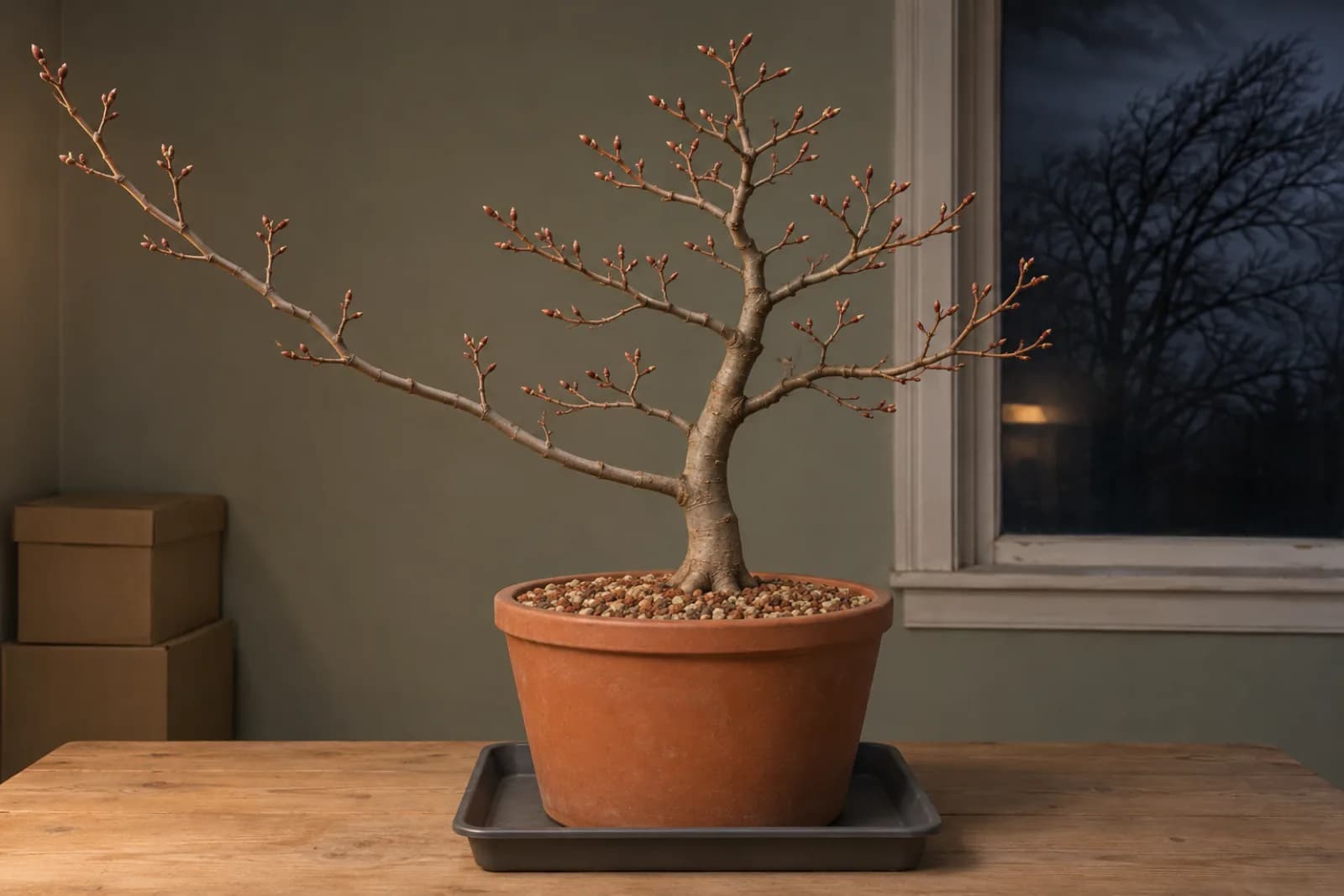
A tree gives up its winter hardiness as it starts to grow
Through autumn, a temperateDescribes regions with distinct warm and cold seasons, and the trees adapted to them, which typically need a cool winter rest. Trident maples and the junipers commonly grown as bonsai are temperate trees and need seasonal outdoor conditions rather than a warm room all year.Open the glossary tree builds cold acclimationThe gradual process, triggered by shortening days and falling temperatures, in which a tree's tissues become able to survive freezing. A tree moved suddenly from a warm room into frost has not acclimated and can be badly damaged. It is not the same as shoots hardening, or turning woody, though the two often happen around the same time.Open the glossary, the cold readiness of Course 02: over weeks of shortening days, cooling nights, and the first frosts, its living cells change so that they can survive freezing, and by midwinter they are at their hardiest (Course 01, Lesson 13). That is how the courtyard maple's buds came through January. Its hardinessA plant's ability to survive the conditions of a place, most often its cold hardiness: the coldest winter temperatures it can survive once it has acclimated to cold. Ratings such as hardiness zones describe plants growing in the ground; roots in a pot are more exposed, so a potted tree needs more protection than its rating suggests.Open the glossary was never a fixed property of the tree, though. It is a state, built for the winter, and in late winter it starts to run the other way.
Once a tree's buds have met their chilling requirementThe amount of time a temperate tree's buds must spend in cool weather before endodormancy ends and normal bud break can follow. Temperatures a few degrees above freezing count most, and hard cold counts for less. Requirements vary widely among trees; without enough chilling, bud break is often delayed, uneven, and weak.Open the glossary, they are only waiting for warmth, the phase Course 01 calls ecodormancyThe phase of dormancy after the chilling requirement has been met, when buds are able to grow but cold or other outside conditions still hold them back. Rising warmth then brings bud break.Open the glossary (Course 01, Lesson 13). Warm days start them moving, and the hardiness goes as they move. That loss is deacclimationThe loss of cold hardiness as a tree leaves its winter rest and begins to grow, while its buds swell and open and its first leaves come out. It happens faster than hardiness was built in autumn, and what a warm spell takes away is only partly regained if cold returns. It is the reverse of cold acclimation.Open the glossary. A review of freezing tolerance in temperate deciduousDescribes a tree that drops all its leaves for part of each year, usually before winter or a dry season, and grows new ones when growth resumes. Most deciduous trees are broadleaves, like the trident maple, but a few conifers, such as larches, are deciduous too.Open the glossary trees found that it runs much faster in late winter and spring than acclimation did in autumn, and that buds grow more tender as they swell and take up water again, with the most tender stage at bud breakThe stage when buds swell and open and new leaves or shoots begin to emerge, marking the start of a growth period. In deciduous temperate trees it is fueled at first largely by stored reserves.Open the glossary and as the first leaves come out, when their cells are most active (Vitasse, Lenz, and Körner, Frontiers in Plant Science, 2014). Hardiness that took the autumn to build can be gone in a few weeks of spring.
Swelling buds, open leaves, and frost
Each step a bud takes toward leaf gives up more of its tolerance. In the stage words of Lesson 1, a tree at Winter buds in midwinter is at its hardiest. At bud swellThe stage before bud break when a resting bud grows fatter and longer and its scales pull apart, showing paler bands between them, but no green tip shows yet. It is the first visible sign that a tree is leaving its winter rest, and it can come weeks earlier in a warm year than in a cold one.Open the glossary, as the buds fatten and their scales part, it has already lost part of that, and by bud break and the first extending shoots, its soft new leaves have little left. The same review gives ranges across temperate deciduous trees, each the temperature at which half of the tissue was killed in freezing tests, a measure scientists call LT50: about −25 to below −35 °C (below −31 to −13 °F) for resting buds in winter, and about −2 to −8 °C (18 to 28 °F) at bud break and leaf emergence. Those numbers come from many kinds of tree, none of them a bonsai, and damage starts at milder temperatures than the ones that kill half the tissue, so none of them is a safe line for your tree. What they show is the size of the change: from deep winter cold to a few degrees below freezing, in the weeks between tight buds and first leaves.
So the frosts that matter most in spring are not the coldest ones. A night that a trident's tight buds would not notice in January can brown the pale inner scales of swelling buds, and a lighter one can blacken leaves that unfolded a few days before. Course 02, Lesson 3 put it plainly: new leaves are tender, whatever the tree. Buds on one tree also open days apart (Lesson 1), so a frost in the first days after bud break may mark some of them and miss others. The roots are a separate matter: they are generally less cold hardy than the shoots all winter, and a pot leaves them exposed, which Lesson 5 explains.
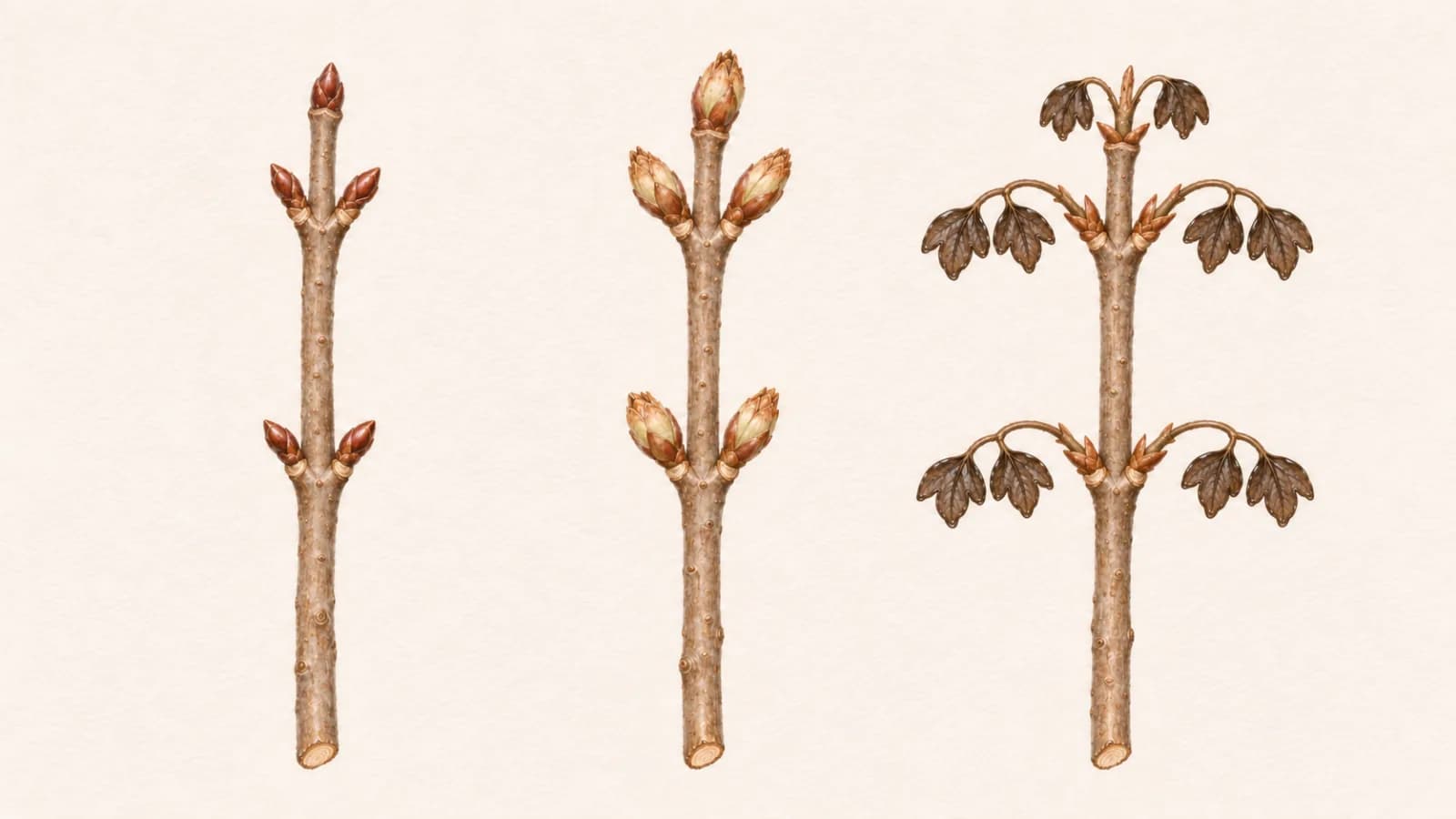
A warm spell is not a free gift
A warm spell in late winter does two things. It brings the stages forward, as Lesson 1 showed with this year's warm February: from about February 12, two weeks of afternoons at 10 to 14 °C (50 to 57 °F) had the courtyard maple's buds swelling by February 24, about a month ahead of an ordinary year. And it spends hardiness that cold weather gives back only in part. When cold returns after a warm spell, a tree regains some of its tolerance but not all of it, the closer its buds are to opening the less comes back, and once growth has started, the loss cannot be reversed (the same review found all three). Course 02 made the first half of this point about a tree kept in a heated shop: warmth undoes cold readiness, and cool nights rebuild it only over weeks (Course 02, Lesson 3). A warm February does the undoing outdoors, with no weeks to spare.
A warm place does the same on a smaller scale. The larch against the small backyard's sunny south wall, a microclimateThe climate of a small area, such as one corner of a balcony or the strip of ground along a wall, where it differs from the general weather around it in temperature, sun, wind, rain, or humidity. A tree responds to the microclimate of its own spot, not to the forecast for the city.Open the glossary that can wake buds early, opened its needle tufts in the first days of March (Lesson 1), and days later the cold front of March 5 reached them. A shelter that warms in the sun, such as a garage with a window, can do it too, as the elm shows below.
Late frost: plan for the weeks, not the night
Predict first
Yes, for both nights, and in the coolest room of the house. Its swelling buds have already given up part of the hardiness that carried them through January, and two cold days will not give it back. A roof would do little: this cold arrives on the wind, so the air under the roofed passage by the gate is nearly as cold as the air in the open, and only a closed space keeps it off. The coolest room, never a warm one, shelters the tree without warming it into growth. Its freshly cut roots in a small pot are a third reason, which Lesson 5 explains. The sections below show how the kind of night decides the shelter.
A frostA night when the temperature at the tree falls to 0 °C (32 °F) or below. A light frost is just below freezing for a few hours, usually on a clear, still night; a hard frost is −4 °C (25 °F) or below, the tag Course 02's planner uses. Frost matters most to growth that is tender, such as swelling buds and new leaves, and a frost on a still night and a freeze on the wind call for different shelter.Open the glossary, in this course, is a night when the temperature at the tree falls to 0 °C (32 °F) or below. A light frost is just below freezing for a few hours, usually on a clear, still night. A hard frost is −4 °C (25 °F) or below, the tag Course 02's planner used (Course 02, Lesson 3). A late frostA frost that comes after a tree's buds have begun to open in spring. New leaves and shoots have little cold tolerance, so a late frost can blacken or kill them on a tree that stood through far colder nights in midwinter. How many late frosts a tree meets depends as much on when its buds open as on when the frosts end.Open the glossary is a frost that comes after a tree's buds have begun to open.
In this city the last spring frost usually comes in late April, and some springs bring one a week or two later (Course 02, Lesson 1). A trident maple's buds usually break in April, so in most years new leaves and frost overlap for two to four weeks. The frost dateThe average date of the last frost in spring or the first frost in autumn at a place, worked out from many years of weather records. It is an average, not a promise: some years bring frost later in spring or earlier in autumn, so check the forecast before trusting tender trees or new growth to the night air.Open the glossary is an average, and the length of the overlap depends as much on when the buds open as on when the frosts stop. This year, with the buds a month early and the frosts at their usual time, the courtyard maple's new growth met one hard frost on swelling buds and then four light frosts on open leaves: −1 °C (30 °F) on March 27, −2 °C (28 °F) on April 3 and again on April 11, and −1 °C (30 °F) on April 24. That is about six weeks of frost on new growth. Course 02 chose a shelter for one frost night on new leaves (Course 02, Lesson 5); a run of them needs a plan.
Two kinds of frosty night
Frosty nights come in two kinds, and they call for different shelter. The FAO's guide to frost protection describes both (Frost Protection: Fundamentals, Practice, and Economics):
- A radiation frostA frost on a clear, still night, when the ground, pots, and leaves lose heat to the open sky and the coldest air settles near the ground, so leaves can fall below the temperature a forecast gives. Anything overhead, such as a roof, an eave, or a cover, lessens it, and low ground where cold air collects makes it worse.Open the glossary comes on a clear, still night. The ground, pots, and leaves lose heat to the open sky, and with no wind to stir the air, the coldest air settles near the ground. Leaves can end up colder than the forecast's low, which describes the air at about head height in a shaded, ventilated shelter over open grass.
- An advective freezeFreezing weather that arrives as a mass of cold air on the wind, often behind a cold front. The whole air is cold, so a roof overhead does little: tender growth needs a closed, unheated shelter or a cool room for the night. A frost on a clear, still night is the other kind, and a roof lessens that one.Open the glossary arrives on the wind: a mass of cold air blows in, often behind a cold front, and replaces the warmer air. The whole air is cold, under cloud or clear sky alike.
What follows for a potted tree is reasoning from those definitions rather than a measured result, and it is how growers choose a shelter. On a radiation frost, anything between the tree and the open sky slows its loss of heat: a roof, an eave, the balcony above, or a cover (Course 02, Lesson 5 showed how overhangs slow it). Low ground makes it worse, so a frost pocketA low spot where cold air collects on clear, still nights, because cold air is denser than warm air and drains downhill as water would. Frost comes earlier in autumn, later in spring, and harder there than in spots a little higher up.Open the glossary such as the small backyard's southeast corner is the wrong place for a tree in new leaf. On a freeze that arrives on the wind, a roof does little, because the cold air flows in under it. What helps is a closed space that keeps the moving air off and cools slowly: an unheated garage, or, for tender growth on a night of hard frost, the coolest room of the house.
Read the forecast for the kind of night as well as the low. A low near freezing with a clear sky and light wind is a radiation frost, and the tree may be colder than the number. A low well below freezing on a strong wind, especially behind a cold front, is a freeze on wind. In this city the coldest spells often arrive on a dry, gusty northwest wind and end in clear, still nights, so one kind of night often follows the other, and the shelter changes with them.
The plan
A frost plan is made once, as the buds swell, and followed every evening until the frosts end. It has five parts:
- A shelter for each kind of night, chosen in advance. For a clear, still night, somewhere under a roof: the courtyard's roofed passage by the gate, the house eaves in the small backyard, or on the west balcony the back wall under the balcony above, the least cold spot there on a clear night (Course 02, Lesson 5). For a freeze on wind, a closed space: the unheated garage or the coolest room of the house, or on the balcony, the coolest room of the apartment. Never a warm room: days of warmth and dim light push soft growth, as the elm shows below.
- An evening look at the forecast, from the day the buds swell until frosts end. The check starts with the buds, not the calendar; this year it started in late February. It ends when the forecasts stop showing frost, not on the average date: in this city some springs bring a frost a week or two after it.
- Someone to carry the tree. Name who does it each evening, and who does it on nights you are away. A helper needs the plan in writing, with both shelters named (Course 03, Lesson 6).
- Back out in the morning. A tree in growth needs light, so the shelter is for the night, and the tree returns to its place once the frost has lifted (Course 02, Lesson 3).
- A line in the log for each frost night: the date, the low, the kind of night, where the tree spent it, and what its new growth looked like the next morning, in the same watering logA dated record of each check of a tree's root zone, usually one short line per pot: the weather, what each check found, the decision, and the reason for it. Read over weeks, it shows how fast each pot dries in different weather, whether the decisions worked, and patterns no single check can show, such as a pot that keeps drying fast even as the weather cools.Open the glossary as everything else.
On a frost night with tender growth out, the decision is Protect it tonight: under a roof for a still night, into the unheated garage or the coolest room for a freeze on wind, and back out in the morning. On a night with no frost forecast, it is Leave it where it is.
The courtyard maple's spring was the plan worked through. On March 5 and 6, with its buds swelling and its roots cut five days before, it spent both nights of the freeze on wind in the coolest room of the house. Its buds broke from about March 12, and its leaves were unfolding by March 21. Through the four light frosts on clear, still nights between March 27 and April 24, it spent each night in the roofed passage and each day back on its bench in the light, out of the wind, as a tree with reduced roots should be (Course 01, Lesson 8). Its new leaves came through the spring intact.
Three shortcuts look easier and fail for reasons this lesson has already met. A fleece left over the tree day and night for weeks takes light from the new leaves, warms them under it on sunny days, and does little against a freeze on wind; a cover is for a still night and comes off in the morning. Moving the tree into the house until the frosts are over keeps it warm and dim for weeks, so its new shoots stretch and pale and its leaves scorch when it finally goes out. And trusting the average last-frost date leaves the tree unguarded twice: in an early spring, through the weeks of open leaves before that date, and in a late one, on the frosts that come after it.
Practice check · not scored
What a frost on new leaves costs
A healthy tree whose first leaves are killed by a frost usually leafs again, from buds held in reserve beside and below the ones that opened. It pays for that second set the way it paid for the first, from reservesCarbohydrates, mostly starch, stored in living cells of the roots, trunk, branches, and bark for later use. Reserves fuel early spring growth before new leaves can supply sugar, and they help a tree recover after losing foliage or roots. A seed carries reserves of its own, such as starch, oils, and proteins, that fuel the embryo's first growth.Open the glossary stored last year, because the leaves that would have started repaying them are dead. Spring growth runs on stored starch until the new leaves can pay their own way, and in a deciduous tree reserves are often lowest soon after the spring flushA burst of new shoot growth, with leaves expanding together, that happens once or several times a year depending on the tree and conditions. Between flushes, shoots stop extending and mature.Open the glossary (Course 01, Lesson 9). A frost on new leaves makes the tree spend them twice, at the point in its year when it has least to spare. The second leaves often come smaller, and the season's growth starts weeks late.
The larch was this spring's example. The frost of March 5 and 6 singed the needle tufts that had opened on the side away from the wall, where the larch had stayed out on its bench. It made new needles from later buds and looked fine by May, but it had drawn on its reserves to do it. A tree that has just lost its first leaves needs light to make new ones and water by the check. It does not need a feed, which cannot replace reserves, and it has no room for major workA job that removes or disturbs a large share of a tree's roots, foliage, or branches, such as repotting with root reduction, structural pruning, or a first styling with heavy wiring. Each one spends the tree's reserves and takes away part of what refills them, so a common starting point is one major job at a time, with the tree's recovery read before the next.Open the glossary in that growth cycle (Lesson 7 builds the year around that).
Roots keep no fixed timetable alongside the buds: a survey of field studies found the peak of root growth usually offset from the peak of shoot growth, in a pattern that differed between kinds of tree (Abramoff and Finzi, New Phytologist, 2015), so buds opening say nothing yet about whether new roots have started. When a frost comes on top of root work, the two stressAny condition that pushes a tree's functioning outside its normal range and limits growth or survival, such as drought, waterlogging, heat, cold, poor light, root loss, pests, or heavy pruning. Several stresses at once can add up to more than the tree can support.Open the glossary add up. Course 01, Lesson 14 asked what a late frost three weeks after a heavy repot would do, and the answer was a slower recoveryA tree's return toward normal growth and function after stress or work such as repotting or heavy pruning, drawing on its remaining leaves, roots, and reserves. It takes time that cannot be guaranteed, and fertilizer cannot speed it beyond what roots and light allow.Open the glossary than from either alone, with costs that can show the next spring. That is why the courtyard maple's frost plan mattered more than most: its reduced roots, its spring reserves, and its new leaves were all being drawn on at once.
A tree in growth needs light
A resting tree needs little light. A bare tree in winter rest makes no sugar and spends little, which is why a dim, unheated garage can be sound shelter for one through a cold spell in January (Lesson 5). A tree in growth needs a great deal: every new leaf is built from reserves until it can make sugar in light, and the leaves it makes take their form from the light they grow in (Course 02, Lesson 3). So a shelter that was right in January can be wrong by March, and what changes it is the tree's growth stageA step in a tree's yearly cycle that you can see on the tree, such as buds swelling, bud break, shoots extending, or leaf fall. Care is timed to the stage a tree has reached, not to a date, because the same stage falls on different dates in different years, places, and kinds of tree.Open the glossary, not the date.
Leaves made in the dark
The small backyard's Chinese elm shows how. Its shallow terracotta training pot is more exposed in a freeze than most, so through the winter it spent the cold spells in the unheated garage, by the household's long-standing rule. After the last cold spell, in early February, nobody carried it back out. Its buds, their chilling met, were waiting only for warmth, and the warm second half of February warmed the garage too. By early March the elm had opened shoots in the dim light of the garage's one window, and they were pale and stretched: long, thin, and soft, with small, pale leaves set far apart. That is etiolationGrowth stretched by too little light: long, thin, soft shoots with long gaps between leaves and small, often pale leaves. Strictly the word describes shoots grown in near darkness, but growers also use it for the leggy growth of dim indoor spots, a common sign, though not proof, that a tree needs more light.Open the glossary, growth stretched by too little light, with long internodeThe stretch of stem between two neighboring nodes. Internodes tend to be longer in vigorous or shaded growth and shorter in slow growth or strong light, and short internodes help a bonsai's branches look finer and more compact.Open the glossary between the leaves (Course 02, Lesson 4). Every leaf on those shoots is a shade leafA leaf that grew in dim light, such as in a window, under greenhouse glass, or deep inside a canopy. It is thinner and often larger than a leaf grown in sun, with a thinner cuticle and fewer layers of light-catching cells, so it uses weak light well but bleaches or scorches if moved suddenly into strong sun.Open the glossary, thin and built for dim light, and the elm spent reserves on them that a sunny bench would have turned into short, firm shoots.
Such leaves cannot simply be carried into the sun. Thin leaves grown in dim light suffer sunburnInjury from more sun than leaves or bark are used to, often after a sudden change: a tree moved from shade into full sun, shade cloth taken off at once, or inner leaves and bark newly exposed by pruning. On leaves it shows first as bleached or silvery patches, then as the browning called leaf scorch; on bark, as dry, sunken patches. It is a warm-season injury; sunscald is the winter one.Open the glossary in sudden strong sun (Lesson 3): they bleach, then brown in the leaf scorchBrowning and drying of leaf edges, tips, and the tissue between the veins when leaves lose water faster than the roots can replace it, as in hot sun, wind, or dry air. Thin shade leaves moved suddenly into strong sun scorch the same way, often after pale, bleached patches. It is a symptom, not a diagnosis: a dried-out root ball, damaged roots, or salt buildup can cause the same browning.Open the glossary Course 02 described. And soft new shoots are as tender to frost as any other new growth.
Practice check · not scored
The household moved it out by hardening offGetting a plant that grew indoors or under glass used to outdoor sun, wind, and temperatures gradually, by moving it from bright shade toward full exposure over one to two weeks or more. For bonsai, it protects soft leaves from scorch when a tree goes outdoors for the season or arrives from a greenhouse. It is not the same as shoots hardening, or turning woody, in late summer.Open the glossary, as Course 02, Lesson 3 set out: bright shade first, open sky above but no direct sun, then part sun, then its bench in the western third, sunny in early spring under the neighbor's bare maple, with the frost plan covering its soft shoots from the first night out. It grew on, and the stretched shoots stayed as a record of three weeks in the wrong place.
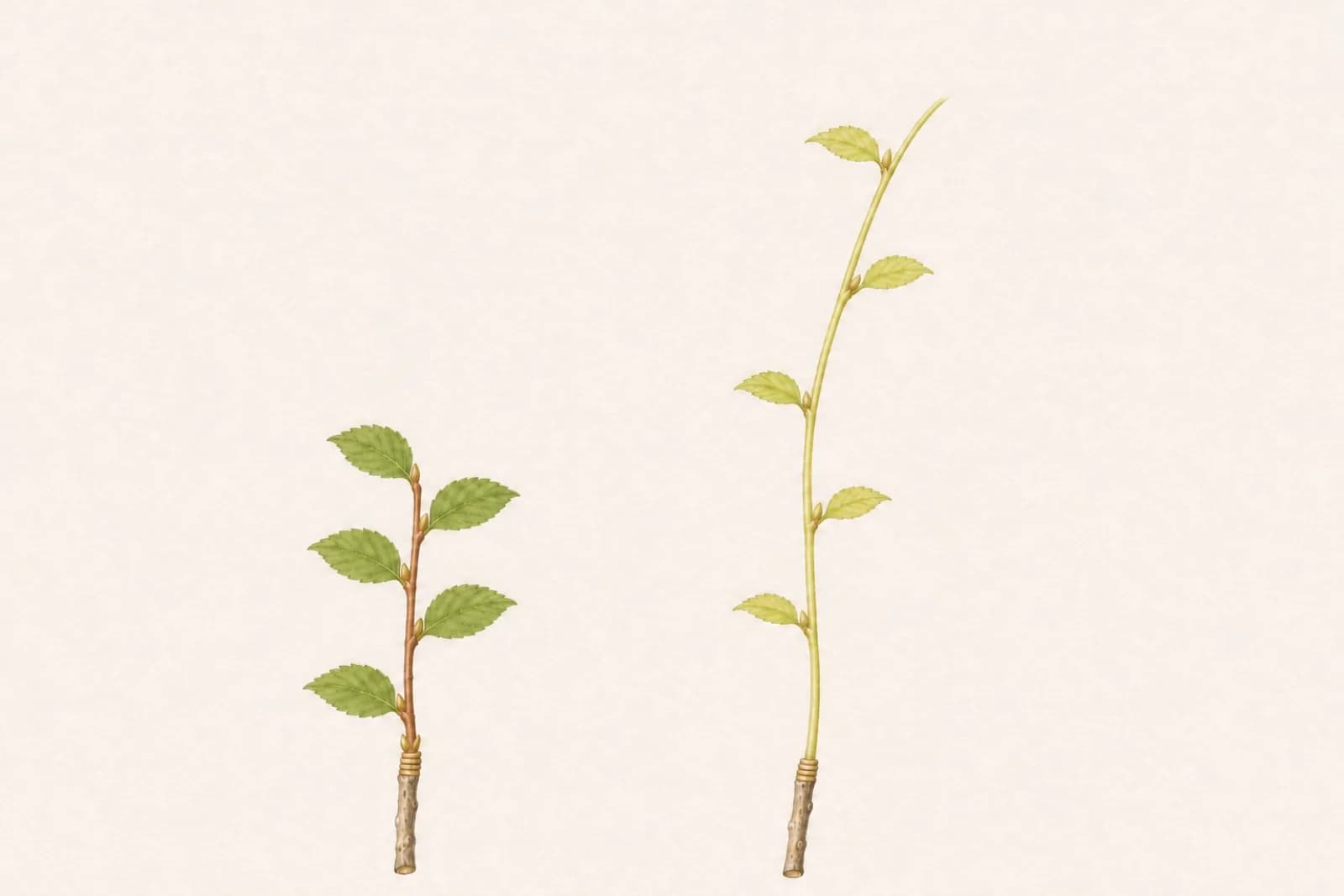
Winter quarters are for a resting tree, and a tree's overwinteringHow a plant is kept through winter. A temperate bonsai usually overwinters cold, outdoors or in an unheated shelter, with its roots protected from hard freezes; a tropical one overwinters indoors in warmth and strong light. Course 06, Seasonal Care and Timing, covers the details.Open the glossary ends with a stage, not a date: the buds beginning to swell (Lesson 5 sets out the winter places). Coming out is a step into more light, sun, and wind, and the pot dries faster for it (Course 03, Lesson 1). A bare tree whose buds are still closed needs no steps: its leaves have not formed yet, and they will grow for the light they will live in. A tree that has already opened leaves in a dim place needs the steps, as the elm did.
New leaves are soft
Even leaves grown in full light are tender while they are new. Until the first flush has hardened, the shoot hardeningThe firming of new growth after it stops extending: the leaves reach full size, darken, and turn firm, and the new stem turns woody from its base. It is not the same as cold acclimation, which makes tissues able to survive freezing, or hardening off, which is moving a tree into sun and wind in steps.Open the glossary of Lesson 1, with leaves at full size, darker, and firm to the touch, they are soft and thin-skinned. Frost blackens them, gusty wind tatters and browns their edges (Course 02, Lesson 5), and the first warm, dry, windy days can wilt them faster than the roots resupply them. The frost plan, a place out of strong wind, and a closer watch on the water all belong to the weeks between bud break and the first hardened leaves. After that, the tree is into its summer, which Lesson 3 takes up.
Water use climbs as the leaves open
The west balcony's trident maple stands on its grid at the back wall, in the rain shadowAn area that rain does not reach because something blocks it, such as the ground under an overhang or eave, beside a wall on the side away from wind-driven rain, or under a dense canopy. Pots in a rain shadow can stay dry through a day of rain, so they need checking and watering by hand.Open the glossary of the balcony above, so whatever the spring rain does, its water comes from the 2 L can. Its owner checks it every morning, as Course 03, Lesson 1 set out, and this spring the checks told the story of its leaves. Through February and early March, with its buds tight and then swelling, one thorough watering lasted most of a week. Its buds broke about March 16. By early April, with its leaves unfolding, a watering lasted about three days. By late May, with its shoots extending in warm weather, the check said water every second day. In summer the pace climbs further, to every morning in a hot July, as Course 03 recorded on the same balcony.
Course 03 said that a tree's water use “climbs quickly in spring”, and this is what that looks like (Course 03, Lesson 1). A bare tree loses a little water through its twigs and buds, and its pot dries slowly from the surface and the wall. Every leaf that opens adds a surface for transpirationThe evaporation of water from inside a plant and its escape as vapor, mostly through the stomata of leaves. As water evaporates, more is pulled up from the roots through the xylem; most of the water a tree absorbs is lost this way.Open the glossary, and the days that open them are growing longer, warmer, and brighter, so the air draws harder on every leaf, the rising evaporative demandHow strongly the surrounding air draws water vapor from leaves, rising with sun, heat, dry air, and wind. High evaporative demand can make a tree lose water faster than reduced or damaged roots can replace it.Open the glossary Course 01 described.
The check does not change; the interval does. The same chopstick and the same lift say when, and the answer comes sooner each week. A warm, windy day in the flush can draw a small pot down between morning and evening, so on those days add an afternoon check, as Course 03's decision already says for a spring flush. A note written for a helper in March, when the tree was bare, is out of date by April: it should say how to check, not which day to water (Course 03, Lesson 6).
Before the leaves open, the opposite error is waiting. A bare tree in a cool March uses little, and watering it more because it is spring keeps its pot wet and short of air: overwateringKeeping a root zone wet so constantly, or letting it drain so poorly, that air never gets back into its pores and the roots run short of oxygen. It is about how often a pot is watered and how well it drains, not how much is poured at once: a thorough watering of a pot that drains, given when the root zone is drying, is not overwatering.Open the glossary by habit (Course 03, Lesson 4). A tree with reduced roots needs the same restraint for a different reason. The courtyard maple's pot, its roots cut on February 28, dries more slowly than an established tree's even as its leaves open, because fewer roots are drawing on it, and on a sunny, windy afternoon its leaves can droop over a pot that is still moist (Course 03, Lesson 4). In both cases the check, not the season, says when to water.
Practice check · not scored
Feeding waits for the flush
Spring also tempts an early feed. At bud break a tree has no working leaves, its first flush runs largely on reserves, and its roots are only waking in a cool pot, so a feed poured as the buds swell mostly waits in the mix while waterings wash it through. Course 05 set the signal: start once the spring flush is growing, with shoots extending and new leaves expanding, and write that stage, not a date, into the feeding planA written plan for feeding one tree, short enough to fit on a card: the product and its label line, the amount for your can, the interval, when to start, taper, and stop in growth stages, when to water first or hold, who feeds, where it is logged, and when to review it. It turns a label's directions into decisions already made, so that anyone who helps can follow them.Open the glossary (Course 05, Lesson 4). After root work the feed waits longer, until new growth shows the roots working: Not now: wait for new roots (Course 05, Lesson 4). Swelling buds and a first flush show only that the tree had reserves, not that its roots are working (Course 01, Lesson 14). The courtyard maple's first feed waited for exactly that, and by late May its shoots were extending and white root tipThe growing end of a root, made up of the root cap, the dividing cells behind it, and short zones where new cells lengthen and mature. Active tips are usually pale or white and show where a root is extending into fresh substrate.Open the glossary showed at the drainage holes.
Two tridents on a winter routine
When does winter care stop working? puts all three changes on one bench. It follows two young trident maples of the same age, which wintered side by side in the small backyard, through one invented spring of eight weeks from bud swell, the same spring in every run: a hard frost on a northwest wind in week 2, bud break in week 3, a frost on a clear, still night in week 4 as the leaves unfold, a warm, windy spell in week 6, a last light frost in week 7, and the first leaves at full size in week 8. Each week has a day, and each frost week a night as well, with the garage at one side of the yard. Two chips on the week strip follow both trees: Cold readiness, which goes from Fading to Gone: leaves are out, and Water use, which goes from Low to Rising to High.
Tree A, drawn in ink, keeps the spring routine this lesson has built: out on the bench by day, under cover on frost nights (the garage for a freeze on wind, under the house eaves for a still night), and checked every morning. Tree B, in red, is still on its winter routine in one way, and you choose which under B's one change: Left out on frost nights, Kept in the garage, or Checked once a week. Under Your call, choose when B's leaves will first brown or blacken, Week 4, Week 6, or Week 8, or press Skip. Press Run eight weeks, and use Pause, Back, Next, Replay, or Skip to the end to stop on any day or night. Under each tree, one close-up follows its card: the growing tip for the frost and garage cards, the pot in section for the weekly check. The readouts New growth, Where it is, Root zone (for the weekly card), and What is happening follow each tree in words; on a phone, the yard is seen through a window that follows the trees. Find all three challenges to finish. Try these:
- The simulation opens on Left out on frost nights. Make your call, press Run eight weeks, and stop on each frosty morning to compare B's growing tip with A's.
- Choose Kept in the garage, make your call, and compare New growth on the two trees from bud break to the end of the run.
- Choose Checked once a week, make your call, and follow Root zone and the Water use chip week by week.
- Use Back to return to any week and read Cold readiness beside each tree's new growth.
Simulation
When does winter care stop working?
Tree AStays as it isOut on the bench by day; under cover on frost nights (the garage for a freeze on wind, under the house eaves for a still night); checked every morning.
Both trees: young trident maples of the same age that wintered side by side, in matching black nursery pots. One invented spring of eight weeks, from bud swell to the first full-size leaves.
Calls: none yet
- Week 1: Not reached yet
- Week 2: Not reached yet
- Week 3: Not reached yet
- Week 4: Not reached yet
- Week 5: Not reached yet
- Week 6: Not reached yet
- Week 7: Not reached yet
- Week 8: Not reached yet
Both treesCold readiness and water use show here as the weeks run.
Tree AFollows the buds
- New growth
- Tight in bud
- Where it is
- On the bench
What is happening · Week 1 · Day
Buds swelling on a mild day. A stands on the bench in full light, and its pot is checked every morning.
Tree BLeft out on frost nights
- New growth
- Tight in bud
- Where it is
- On the bench
What is happening · Week 1 · Day
B stands beside A by day. At night it stays out, as it did all winter.
| Reading | Tree A | Tree B |
|---|---|---|
| New growth | Tight in bud | Tight in bud |
| Where it is | On the bench | On the bench |
What is happening · Week 1 · Day
B stands beside A by day. At night it stays out, as it did all winter.
Buds swelling on a mild day. A stands on the bench in full light, and its pot is checked every morning.
Result
When did B's leaves first brown or blacken?
Press Run eight weeks. When the eight weeks are up, the result says when B's leaves were first hurt, what A's routine did differently, and why.
Challenges
0 of 3 found
Find all three to finish.
Find care that was right at bud swell and wrong once the leaves were out, not found yet
Something about the tree changes faster than the routine does.
Find the tree that had to leaf out twice, not found yet
Compare what a hard frost does to swelling buds with what a lighter one does to open leaves.
Find a tree kept from every frost that still ends with damaged leaves, not found yet
Follow one tree that never meets a frost.
Text description
Two young trident maples come out of the same winter. As their buds open, three things change at once: how much cold the tree can take, how much light it needs, and how much water it uses. Care that suited a resting tree can go wrong within weeks.
The scene is the small backyard by day and by night: the board fence, a bench with the two trees in black nursery pots, the corner of the house at the left with its eaves, and the unheated garage at the right, drawn open in section when a tree is inside. Nights are dark blue with stars; frost is drawn as white sparkles on whatever stands in the open, never as water.
Tree A stays as it is: out on the bench by day; under cover on frost nights (the garage for a freeze on wind, under the house eaves for a still night); checked every morning. Under the scene, one magnified inset per tree shows its growing tip (the bud, then this year's shoot), or, when B's change is the weekly check, its pot cut open with the root zone in Course 03's six moisture levels, a chopstick at each check, and a loupe above the rim with one of the tree's new leaves. Beside them, each tree's readouts give its new growth, where it is, its root zone (for the weekly check), and what is happening.
B is still on its winter routine, in one way. B's one change is one of three:
- Left out on frost nights: On the bench, night and day.
- Kept in the garage: Until the frosts are over.
- Checked once a week: A watering lasted all week in winter.
The spring is the same in every run, and the run reveals it a week at a time: a strip above the scene fills in with each week's weather, and two chips name what both trees share that week, their cold readiness and their water use. In order, the weeks bring:
- Buds swelling; mild. Cold readiness reads Fading; water use reads Low.
- Buds swelling; hard frost; a night of −6 °C (21 °F), on a northwest wind. Cold readiness reads Fading; water use reads Low.
- Bud break; mild. Cold readiness reads Fading; water use reads Rising.
- Leaves unfolding; frost; a night of −3 °C (27 °F), clear and still. Cold readiness reads Gone: leaves are out; water use reads Rising.
- Leaves expanding; warm. Cold readiness reads Gone: leaves are out; water use reads Rising.
- Leaves expanding; warm; windy. Cold readiness reads Gone: leaves are out; water use reads High.
- Shoots extending; frost; a night of −1 °C (30 °F), clear and still. Cold readiness reads Gone: leaves are out; water use reads High.
- First leaves at full size; mild. Cold readiness reads Gone: leaves are out; water use reads High.
Run eight weeks plays the eight weeks in about half a minute: a day beat each week and, on frost weeks, dusk, the night, and the dawn after it, when A is carried under cover and anything left out stands in the frost. Pause, Back, Next, Replay, Skip to the end, and the week cells on the strip move through it. Before the run you can make a call on the week B's leaves will first brown or blacken.
When the eight weeks are up, the result names when B's leaves were first hurt, how many frost nights it spent in the open, and its new growth at the end, with A's beside it and the reasons. Three challenges ask for care that was right at bud swell and wrong once the leaves were out, a tree that had to leaf out twice, and a tree kept from every frost that still ends with damaged leaves.
Tree A ended every run the same way. It spent every frost night under cover, its root zone cycled between Moist and Drying and was watered at Drying, and by week 8 its first leaves read Full size, firming, with no damage. Each of B's winter habits failed, and each failed in its own week.
Left out on frost nights, B met the hard frost of week 2 with swelling buds, and the morning showed Bud scales browned: “The pale inner scales browned: marked, not killed. In January this night would have left no mark.” In week 4 the still, clear frost found its leaves just unfolded, and they read New leaves blackened: on a clear night, new leaves can fall below the temperature of the air around them. By week 6 B was leafing again from buds held in reserve, with smaller leaves, and week 7's light frost left them Tips singed. It ended the eight weeks with far less healthy leaf than A, because “It has spent its stored reserves twice.” Its leaves first blackened in week 4.
Kept in the garage, B was safe from every frost. Its buds broke a few days before A's in the garage's shelter, and from week 3 its growth was Pale and stretched in the dim light. In week 8 it went straight out into full sun, and within days its leaves showed Leaf scorch: “Sunburn: leaves grown in dim light scorched in sudden sun.” Checked once a week, B was fine through week 3. Its check read Drying through week 4 and Dry in weeks 5 and 6, and it was watered each time, but late in week 6, in the warm, windy spell, its root zone reached Bone dry between checks, its new leaves wilted, and their edges browned; watered at the next check, it kept only part of its leaf. A's routine of shelter on frost nights, light by day, and a check every morning was the one that kept pace with the buds.
Getting ready for spring work
Earlier courses used a phrase they never explained. Course 02 said a slip-pot does not have to wait for “the repotting season” (Course 02, Lesson 7), and Course 01 named the one timing it would give: repotting many deciduous trees as their buds swell (Course 01, Lesson 14). This section says what that season is, what it is not, and what has to be ready before it opens.
What the repotting season is
For many temperate deciduous trees, such as the trident maple, the work windowThe growth stage, with suitable weather, at which a job such as repotting or structural pruning is commonly done, for stated reasons: growers tie each job to a stage because the tree is expected to recover well from it then. A window opens and closes with the stage, not with the date, and it is a starting point that a tree's kind, its health, and the technique itself can move.Open the glossary growers favor for repotting is the stage when the buds swell, for four stated reasons. A leafless tree loses little water while its roots are reduced. The root zone is warming, so cut roots can begin to grow again soon. The tree's reserves are still in it, not yet spent on leaves. And roots cut at the very end of the rest spend the shortest time waiting in cold, wet mix before they can grow. The courtyard maple was repotted on February 28 for those reasons, at the stage its owner read on the buds, three weeks before the date on the calendar.
The window has costs and limits, and they belong in the plan with it. Swelling buds are already losing their hardiness, so a tree repotted then meets the weeks of frost on new growth with fewer roots: a repot at bud swell commits you to the frost plan above, and to shelter from drying wind, for weeks afterward. The controlled evidence, from landscape trees, is mixed, as the Go deeper below sets out. And it is practice for one group of trees, not a rule for all. A Japanese garden juniper, which has no resting bud to swell, is commonly repotted as its tips begin to pale and growth resumes. A ficus is repotted while it is growing strongly in warm months (Course 11, Repotting and Root Development). In a climate with mild winters or none, the stages fall differently again (Lesson 6).
The stage is only half of the decision. The other half is a tree ready for the work, which is Course 01, Lesson 14's test: for work done before shoots can extend, judge from how the tree grew last season and how its buds look now. A tree whose vigorA tree's observed growth performance relative to its expected seasonal behavior, meaning what a tree of its kind should be doing at that point in the season. It is judged from shoot extension, bud development, foliage condition, and root activity when visible, across several observations over time, not from one large leaf or green color. A vigorous tree is growing at or above that expected pace.Open the glossary last year was poor, or that was set back by drought or frost, can reach the stage without the readiness. Neither half is a date.
Go deeper · optional, not assessedWhat a study of transplanted trees found, and why growers still repot as buds swell
Bonsai growers have long repotted many temperate deciduous trees as their buds swell. The Royal Horticultural Society's bonsai guide, a United Kingdom source, advises repotting in spring, ideally before new growth starts, and in autumn only in mild, sheltered places (RHS: Bonsai). Its reasons, the four above, come from practice refined over many years, not from experiments.
One controlled study points the other way for landscape trees. Researchers who moved Norway maple, green ash, and ginkgo at intervals through one season in Illinois found that new roots grew mainly from the cut root ends, and that root regrowth was poorest after moving the trees just before bud break, when the expanding shoots were drawing on the stored carbohydrate; they advised against transplanting then (Watson and Himelick, Arboriculture & Urban Forestry, 1982). Their trees were field trees moved from one spot in the ground to another. A repotted bonsai is checked every day, watered by the check, and can be sheltered from frost, wind, and sun, which may be why practice and the study disagree; it has not been tested on bonsai. So this course treats the bud-swell window as a labeled starting point for many temperate deciduous trees, with its reasons and its costs, not as proven best. How to repot belongs to Course 11.
What to have ready before the buds move
Because the window opens with the buds, and in an early spring the buds move weeks ahead of the calendar, everything the job needs has to be ready before they do:
- The materials: the pot and the mix, ready to use, and whatever else the job needs (Course 11 sets out what).
- A frost shelter for each kind of night, and someone to carry the tree on frost nights for the weeks after the job.
- A place for the weeks after: bright, out of strong wind and harsh afternoon sun, and close enough to check every day.
- Your own time: the day of the job and the weeks after it, checked against work and trips. A job that falls just before a week away is a job without its aftercareThe care a tree needs after major work until it shows it has recovered: a suitable place, shelter from frost, strong wind, and harsh sun, watering by the check, and no further demands. It is arranged before the job and ends when new growth shows recovery, not after a set number of weeks. Course 11, Repotting and Root Development, gives the aftercare for repotting in detail.Open the glossary.
- Help, if you need it, arranged for a stage rather than a date. The club member who helped with the courtyard maple came when the buds said, not on the club's repotting day.
Two errors sit on either side of the window. The first is waiting for it when a tree is in trouble: the window is for elective work, and a tree whose roots are failing, or whose pot will not drain, does not wait for a stage. Urgent care never waits for a stage (Lesson 1). Finding out what such a tree needs is a diagnosis (Course 07, Tree Health and Diagnosis). The second is forcing the job after the window has passed. When the buds run ahead of your plans and the stage is gone before you can act, the job waits for the next growth cycle, as the household's trident's first repot did this year (Lesson 1). Lesson 7 builds both into a year's plan.
Follow the buds through the frosts
The bonsai decision
Shelter new growth by night, give it light by day, and water by the check
Starting point
For a healthy, established temperate tree outdoors, from the day its buds swell until its first leaves have hardened:
- From the day the buds swell, check the forecast each evening. On a frost night, shelter tender growth for the kind of night, under a roof for a clear, still night, and bring it back out in the morning. Keep this up until the forecasts stop showing frost, not until the average last-frost date (Course 02, Lesson 1).
- Give a tree in growth full outdoor light. Bring it out of any dim winter shelter as its buds swell, and step it up through bright shade and part sun if it has already made leaves in the dim (Course 02, Lesson 3).
- Check the root zone every day, and expect the interval to shrink. Water thoroughly when the check reads Drying, add an afternoon check on warm, windy days in the flush, and rewrite any helper's note as the leaves open (Course 03, Lesson 1).
- Hold the feed until the flush is growing, and after root work until new growth shows the roots working (Course 05, Lesson 4).
This assumes
- The tree is a healthy, established temperate tree that spent the winter outdoors, in a pot that drains, and it stands outdoors for the growing season.
- You have a frost shelter within reach for each kind of night, and someone to carry the tree on frost nights, including nights you are away.
- If your tree lives indoors all year, read this lesson for the reasoning and use Lesson 6's decision.
- The months in this lesson belong to the course's Northern Hemisphere example climate. In the Southern Hemisphere, swap north and south, and shift the months by half a year.
Change course if
- Its roots were reduced this spring: shelter it from every frost, even a light one, and from drying wind, in bright light rather than shade (Course 01, Lesson 8). Water only when the check says so, and hold the feed until new growth shows the roots working (Course 05).
- A freeze on wind is forecast: a roof is not enough, because the cold arrives in the moving air. Tender growth spends the night in the unheated garage, or in the coolest room of the house if its leaves are open and the freeze is hard, never a warm room, and comes back out in the morning.
- A warm spell arrives in late winter: look at the buds, start the evening frost check as soon as they swell, and move trees out of any dim shelter that has warmed before they grow there.
- A frost has caught the new leaves: leave the tree in its light, water by the check, hold the feed until new leaves are growing again, and add no major work this growth cycle (Lesson 7). A healthy tree usually leafs again from buds held in reserve.
- Weeks after a frost, the tree has not leafed again, or has leafed on one side only: this is not a seasonal problem: investigate before changing its care (Course 07).
Back to the question
What changes for a tree as its buds open?
Three things at once: how much cold it can take, how much light it needs, and how much water it uses. As its buds swell and open, a tree gives up its winter hardiness, faster than it built it, so a light frost can blacken new leaves on a tree that came through January's hardest nights. Its new growth runs on last year's reserves and needs full light, so a dim winter shelter becomes a place where it grows pale and stretched. And each opening leaf draws more water, so the interval between waterings shrinks week by week. So follow the buds: an evening frost check and a shelter for each kind of night from bud swell until frosts end, full light by day, a check every morning, and no feed until the flush is growing.
Key takeaways
- A tree gives up its winter hardiness as its buds swell and open, faster than it built it, and cold after a warm spell gives back only part. A light frost can kill new leaves on a tree that stood through midwinter's coldest nights.
- New leaves and frost overlap for weeks in most years, longer in an early spring. Plan for the weeks: an evening look at the forecast from bud swell until frosts end, a shelter for each kind of night, and someone to carry the tree.
- A roof or a cover lessens a radiation frost on a clear, still night. A freeze on the wind chills the air under a roof too, so tender growth goes into an unheated garage or a cool room, never a warm one, and back out in the morning.
- A tree in growth needs full light. A dim shelter that suited a resting tree turns new growth pale and stretched, and leaves grown there scorch in sudden sun.
- Water use climbs as the leaves open, while the check stays the same: water at Drying and expect the interval to shrink. Feeding waits until the flush is growing, and after root work until new growth shows the roots working.
Optional · not required for completion
Count the frost nights on new leaves
Next spring, choose one tree you can see every day. From the day its buds begin to swell, write the date, then each evening note the forecast low and whether the night will be clear and still or windy. Shelter it as your plan says, and on each morning after a frost, write its stage and look at its newest growth for browned scale tips, blackened leaves, or no mark at all. Keep going until the forecasts stop showing frost. How many frost nights fell after its buds had opened, and how many of them came on the wind? Which shelter would each have needed? If you keep a stage recordA dated note, for one tree, of whether each growth stage has been reached: the date, then a yes or a no for the stage, on each day you look, with a word on the weather and where the tree stood. Kept over several years, with the no entries that bracket each first yes, it shows how far the tree's dates move with the weather.Open the glossary from Lesson 1, these notes belong in it.
No tree? Find last spring's nightly lows for your town in a weather service's records, mark every night at or below freezing, and compare the last of them with your town's average last-frost date. How many frosts came after that date? If a tree near you had opened its leaves three weeks before the average date, how many of those frost nights would have fallen on its new leaves?