Course 04 · Lesson 6 of 7 · Choose, prepare, and observe
Choosing and preparing a workable mix
Start from a documented example, prepare a consistent small batch, and compare adjustments for the tree, container, climate, and care available.
The question
How do you turn substrate knowledge into a practical, testable plan?
By the end of this lesson, you will be able to:
- Justify a starting mix for a fully specified teaching case and identify when to change it.
- Prepare and document a consistent batch with appropriate screening and dust control.
- Design an unplanted wetting-and-drying comparison and explain its limitations.
About 12 minutes to read and explore
Give a recipe a job and an address
“What is the best bonsai soil?” leaves out most of the information needed to answer. A useful plan names the tree, its condition and goal, the container, the site, the actual materials, and the care available. It also says how you will notice a mismatch.
Here is our documented teaching starting point, not a report of a real experiment:
| Part of the plan | Stated assumption |
|---|---|
| Tree and goal | Healthy, established trident maple, Acer buergerianum, in development; maintain dependable root function during growth |
| Site | Outdoor humid temperate courtyard around 40° N; morning sun and afternoon shade; seasonal outdoor care appropriate to the species |
| Container | Moderate-depth training pot with open drainage, adequate root volume, and stable placement |
| Available care | Morning and evening checks, with extra checking or help available during unusual heat |
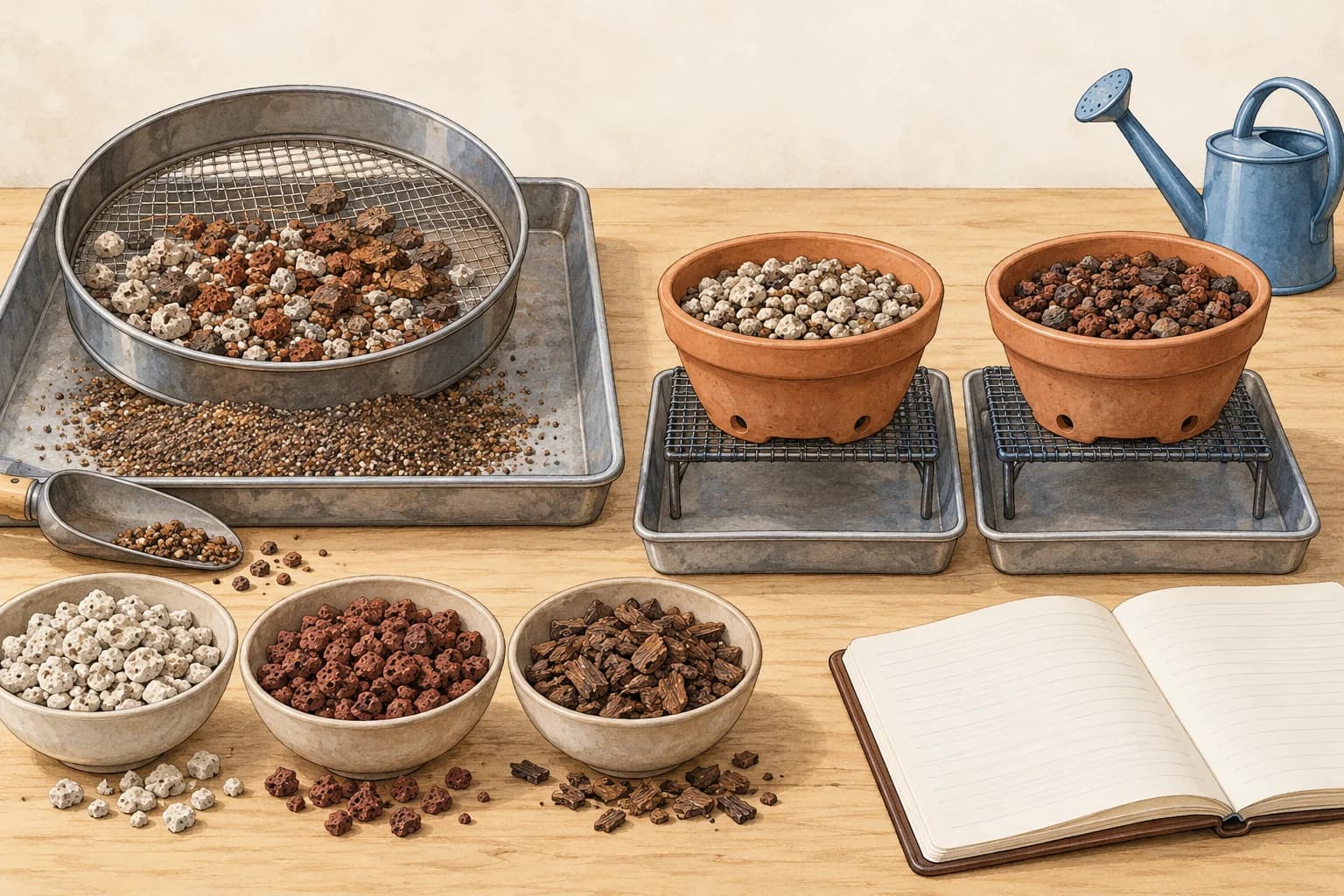
| Starting batch | Equal loose volumes of horticultural pumice, lava, and akadama, consistently graded; for this trial most particles are approximately 2–5 mm |
| Timing | Compare empty samples now; use a successful candidate only when repotting is otherwise justified and appropriately timed |
Jonas Dupuich describes his use of a roughly equal-part akadama, pumice, and lava mix in a firsthand account. That establishes a documented working approach, not a universal recipe or validation of our invented maple case. Our case uses it as a simple comparison baseline; it does not inherit every additive or technique mentioned in the source. Bonsai Tonight: Bonsai soil.
The 2–5 mm band makes this particular test repeatable. It is not a prescription for seedlings, tiny bonsai, every species, or every container. Even equal volumes of three differently graded products can produce a very different pore network.
Explain the starting choice
Pumice contributes porous particles, lava contributes relatively durable structure, and akadama adds a granular water-retaining component. All three still require scrutiny of the actual grade and source. The ratio is easy to record and compare; it is not mathematically optimal.
Start with one coherent mix rather than adding a separate fine layer and coarse “drainage layer.” Choose sufficient stable root contact without crushing particles or packing out air spaces. Root arrangement and anchoring during an actual repotting are taught in Course 11; preparing ingredients does not authorize disturbing this maple today.
Change the conditions before changing the ratio
Move the same proposed maple to a hot, exposed balcony where wind accelerates water loss and nobody can check at midday. A more water-retentive candidate may be worth comparing, but the care gap cannot be solved by making the entire pot stay saturated. Reduce excessive exposure where appropriate, arrange reliable checking, or choose a container and growing arrangement with a more manageable reserve. If no plan keeps the tree supplied through the unattended period, the site-and-care combination needs changing.
Now imagine a cooler, sheltered site with frequent rain and slow drying. Check actual root-zone moisture and whether rain reaches the pot. More consistently open structure or less of a particularly retentive fraction might help in a future mix, but unnecessary extra watering and obstructed outlets must be corrected first. “Wet climate” is not proof that every pot is wet.
The workbench explores those tendencies. It cannot calculate a perfect recipe or guarantee a watering interval.
Simulation
A small batch before a big decision
The substrate workbench
Write down the starting conditions
Change one thing in a small batch, then observe what actually changes.
Named case · trident maple
Acer buergerianum, healthy and established
Humid temperate courtyard around 40° N. Moderate-depth training container with open drainage. Morning and evening checks available.
Starting trial: equal volumes pumice, lava, and akadama; mostly 2–5 mm particles for this example, with excess dust removed. Test unplanted first; any later root work needs suitable timing.
Humid temperate garden; morning sun, sheltered afternoon; morning and evening moisture checks, with extra checks or backup care in hot weather.
Build a fair comparison 0 / 4 recorded
Make a prediction
Equal volumes akadama, pumice, and lava; consistent particle grade; excess dust removed.
Same ingredients, with a coarser, narrower particle distribution. It is a comparison, not a prescribed grade.
Same particle grade, with a modestly larger share of a tested water-retentive component. Confirm the actual batch.
Fill an empty test pot to the intended depth. Keep container, fill amount, location, and watering method the same.
Observation 1 of 4
Prepare matched test pots
Reduced motion: Play advances one still observation. Back, Next, and the slider are always available.
Prepare matched test pots
Start by testing the documented batch in the intended container. It is a candidate, not a guaranteed fit.
Make a reasoned choice
Text description
A healthy established trident maple in a moderate-depth training pot is the named teaching case. The baseline site is a humid temperate courtyard with morning sun and afternoon shade; the grower can check morning and evening. The starting batch uses equal volumes of pumice, lava, and akadama, with a consistent approximately 2–5 mm grade for this example.
Three empty matching pots compare the starting batch, a coarser particle distribution, and a larger share of a tested water-retentive component. They proceed through preparation, watering, free drainage, and a later observation. The drawing shows qualitative tendencies and no elapsed times. Site choices alter the hypothetical drying conditions. A live root system is deliberately absent from the trial.
Make a plan for each site, then name what evidence would cause you to revise it. A strong answer includes both a material choice and a care response. “Add more akadama” is incomplete unless you explain the intended effect, confirm the batch's properties, and check whether the change provides enough reserve without persistent saturation.
Prepare for consistency, not ritual
- Identify and label ingredients. Record supplier, product, grade, and batch if available. Read handling information and check for unwanted additives.
- Control dust. Work in ventilation away from people and pets, pour close to the tray, and avoid making airborne clouds. Use suitable respiratory and eye protection when the product's handling instructions call for it. Dampening a material can reduce dust if that preparation suits it; do not wet-screen a soft material into paste.
- Screen where it serves a purpose. screeningSeparating a batch into particle-size fractions using mesh screens. It can improve consistency or remove excessive dust, but the target size and method must suit the material and application.Open the glossary separates size fractions. Remove excessive dust or unsuitable oversize pieces when useful, and record the screens used. A pregraded product may need little work. “Remove every small grain” is not a universal rule.
- Measure consistently. Use loose volumes of similarly prepared ingredients; do not measure one compacted and another fluffy. Mix gently and thoroughly so early and late scoops have comparable proportions.
- Keep a batch record. Your batch recordA record of ingredients, sources, grades, proportions, preparation, and observations for one prepared mix. It makes comparisons repeatable and prevents a familiar recipe from hiding a changed ingredient.Open the glossary connects the recipe with its actual ingredients and preparation. Retain a small labeled sample if useful, and store remaining material cleanly under suitable conditions.
Kusamura Bonsai Club's firsthand preparation guide shows screening as part of producing a repeatable mix. Its local recipes are examples of practice rather than requirements for this course. Soil basics.
Run a comparison without a tree
Use two equal unplanted containers at the intended depth, with the same open outlets and comparable initial moisture. Label the baseline A and a single changed candidate B. Fill to the same level using the same gentle settling method. Apply water evenly and slowly until the samples wet through and discharge; record the water applied and drainage observations. Let both drain for the same observation period before comparing them.
Record evenness of wetting, runoff pathways, the post-drain weight of each pot, and later changes under the same exposure. Compare each pot's change in weight, rather than interpreting a heavier mineral mix as automatically wetter. Raw weight includes the pot and solids. For a more controlled water-retention comparison, record the separate starting masses and method; neither approach tells you plant-available water directly.
Repeat if the result is surprising. Swap positions to check for an exposure effect. An empty pot has no roots removing water and no canopy intercepting light or rain, so its drying curve is not a watering timetable for a tree. It screens for obvious mismatches and provides a reproducible starting point.
The bonsai decision
Commit to a testable plan
Starting point
For the courtyard maple, compare the documented equal-volume baseline with one justified alternative in empty containers at the intended depth.
This assumes
The tree is healthy, ingredients are known, and reliable checks are available. Actual root work waits for an appropriate assessment, time, and aftercare plan.
Change course if
Revise the material or care plan if wetting is uneven, persistent wetness restricts air, or drying exceeds the available checking and watering support.
Practice check · not scored
Optional · not required for completion
Write your one-page mix plan
Use the table above as a template and add your predicted benefit, the comparison method, and two adjustment signals. No-tree alternative: choose either the exposed balcony or the cool courtyard case in the lab. No purchases, soil handling, or tree work are needed to produce a complete plan.
Back to the question
How do you turn substrate knowledge into a practical, testable plan?
A practical plan connects a documented starting mix to a specific tree, site, container, and care routine. Consistent preparation and a small unplanted comparison make it testable; observations tell you when the plan needs to change.
Key takeaways
- A working recipe includes its assumptions and adjustment signals.
- Change one feature at a time and document actual products and preparation.
- Manage dust and use screening to improve useful consistency.
- Empty-pot experiments cannot reproduce roots or predict exact watering intervals.