Course 04 · Lesson 3 of 7 · Air, water, and container physics
Comparing common components
Compare pumice, lava, akadama, processed clays, bark, and local alternatives by their function, consistency, durability, and practical cost.
The question
How can you compare ingredients without turning a trade name into a promise?
By the end of this lesson, you will be able to:
- Describe useful differences among common mineral and organic components.
- Ask for the grade, processing, and source information needed to compare batches.
- Evaluate a locally available substitute by function and total usable cost.
About 11 minutes to read and explore
Shop for properties you can describe
Two growers recommend different ingredients, and both grow healthy trees. That does not make substrate choice arbitrary. It means more than one combination can provide the required functions, and the growers may have different pots, climates, budgets, and watering arrangements.
Begin with what you want a component to contribute: accessible water storage, persistent larger pores, weight, chemical behavior, or a locally repeatable supply. Then ask whether the particular product provides it. A familiar name is a useful introduction, not a specification.
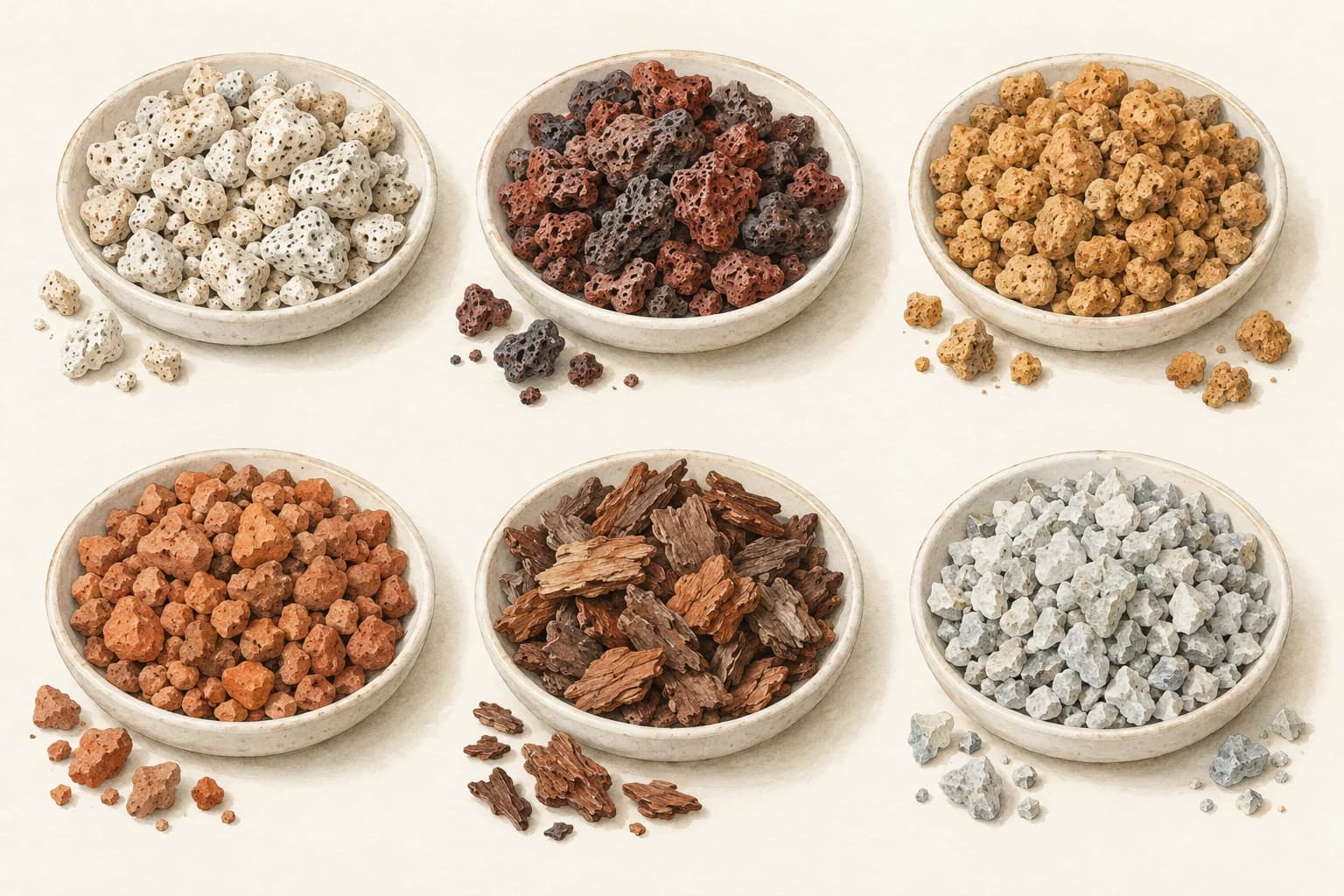
Mineral components are not interchangeable
pumiceA lightweight, porous volcanic rock used as a growing-medium component. Connected internal pores can hold water while gaps between suitably graded particles allow air; density, grading, and porosity vary by source.Open the glossary is porous volcanic rock. A graded horticultural product can offer internal water storage while helping preserve gaps between particles. It is often relatively light. Source differences matter: one batch may contain more dense particles, fines, or very large pieces than another. Ask what remains after preparation, not only how large the bag is.
lava rockIn bonsai trade, usually a vesicular volcanic rock sold in crushed grades. Often relatively durable and heavier than pumice, it can provide stable structure, but its water retention and chemistry vary with the source.Open the glossary, often sold as scoria, is another volcanic material, usually denser and relatively durable. Graded particles can contribute lasting structure and weight. Their pores and mineral composition vary, so “lava” does not mean zero water storage, chemically identical stone, or the same performance in every region.
akadamaA Japanese granular clay-like growing-medium material. Grades differ in particle size and hardness; its water retention and gradual breakdown must be evaluated for the container, climate, and intended maintenance interval.Open the glossary is a Japanese granular clay-like material. It is valued for water-related properties and how roots develop through a granular medium. Grades and hardness differ. Some batches break down sooner under repeated wetting, root activity, or local weather. Budget for usable volume and future maintenance, not merely the purchase price. Its usefulness does not make it compulsory.
calcined clayClay processed by heating to change its physical properties. Products differ in firing, porosity, particle size, and wet durability; a product name alone does not establish suitability for bonsai.Open the glossary has been processed by heating. Other fired or expanded clay products differ in manufacture, hardness, pore structure, and size. A horticultural clay granule, an industrial absorbent, and a clumping pet product are not equivalents because all mention “clay.” Verify intended use, additives, particle grade, and wet stability before considering a substitute. Unknown additives or particles that turn to paste are reasons to reject a batch.
The Arnold Arboretum's published account of its bonsai collection describes a specific use of akadama and calcined clay. It is evidence of a collection's practice, not proof that the same ingredients or proportions suit every site. Arnoldia's account of the collection.
Organic materials have useful roles and limits
Horticultural bark is not the same product as fresh wood chips scraped from a woodworking bench. Aged or composted barkBark conditioned through controlled decomposition for horticultural use. Its particle size and degree of processing affect water retention, aeration, stability, and interactions with nutrients; it is different from fresh wood chips.Open the glossary can contribute water retention, particle structure, and chemical exchange sites. Fine bark behaves differently from chunky bark. Processing and further decomposition change its behavior over time.
coirMaterial from coconut husks, supplied as pith, fibers, or chips. These forms behave differently, and processing determines salt content and other properties. Use horticultural specifications rather than assuming all coir is interchangeable.Open the glossary comes from coconut husks and can be sold as fine pith, fiber, or chips. Those forms are not physically interchangeable. Processing also matters: a horticultural product should have appropriate salt specifications. Peat and coir can hold substantial water, but adding a finely textured fraction to a coarse mix changes the spaces between particles as well as the ingredient list. UMass describes these distinctions in its discussion of media components. Effects of growing media on water and nutrient management.
Compare the tradeoffs, not a leaderboard
The tendencies below assume suitable horticultural material in a comparable particle grade. They are questions to verify for a batch, not laboratory ratings.
| Component | Potential contribution | What to verify | Cost and sourcing question |
|---|---|---|---|
| Pumice | Internal water storage and an open granular structure | Grade, density, dust, consistent wetting | Is a regional supply available, and how much usable material remains? |
| Lava or scoria | Persistent particles and added weight | Pore structure, grade, mineral source | Does shipping heavy material erase a low bag price? |
| Akadama | Water retention in granular clay-like particles | Hardness, breakdown, consistency | Can you obtain the same grade again, and afford renewal when needed? |
| Processed clay | Potentially porous, repeatable granules | Manufacturing, additives, wet stability | Is the exact horticultural product reliably available? |
| Horticultural bark | Organic water storage and structure | Particle size, maturity, decomposition | Is there a consistent local by-product source? |
| Regional mineral grit | Weight and durable particle structure | Rock identity, size, dust, chemistry | Is it suitable and accessible without substituting an unknown material? |
Exercise
The component comparison bench
The substrate workbench
Compare function before reputation
A material can hold water inside its grains while leaving air between them.
Look inside the pale particles: internal pores matter as well as the gaps between grains.
- Water
- Water can enter connected internal pores.
- Air space
- Spaces between appropriately sized particles can reopen after drainage.
- Durability
- Usually durable; crushing and fines still vary by batch.
Trade names and hardness grades describe products, not a single fixed pore system.
- Water
- Often useful water retention within and around the granules.
- Air space
- Intact screened granules create gaps; fines and breakdown can change them.
- Durability
- Grade, handling, roots, and conditions affect how quickly granules soften or break.
Observation 1 of 4
Inspect dry grains
Reduced motion: Play advances one still observation. Back, Next, and the slider are always available.
Inspect dry grains
Make a prediction
Text description
Two trays show selected substrate components, with an enlarged example grain. Choose from pumice, lava, akadama, other clay products, prepared pine bark, and regional alternatives. Water is solid blue; intact particle surfaces and internal cavities remain visible after free drainage.
Advance through dry inspection, wetting, drainage, and comparison. Each sample has a complete observation and property card. A final question asks which evidence can support a component choice. No material receives an overall best score.
Choose two materials in the workbench. Explain one reason to include each and one uncertainty you would check. If you cannot name a function, the ingredient may be present only because a recipe said so. Likewise, excluding a material needs a contextual reason, not a slogan about “organic” or “inorganic.”
Price per usable batch
A cheap bag with a large discarded fraction may cost more per usable liter than a cleaner graded bag. Add transport, preparation, storage, and repeatability to the comparison. Do not assign a fixed global price ranking: pumice can be economical near a source and expensive where it must be imported.
Sourcing also includes extraction, processing, transport, and the use of regional by-products. Local does not automatically mean suitable or environmentally superior; imported does not automatically mean better. Favor a known, consistent supply that meets the required functions and avoids unnecessary waste. A small test is cheaper than discovering an unknown product changes character inside a valuable tree's pot.
The bonsai decision
Evaluate a replacement ingredient
Starting point
When a familiar material is unavailable, identify its job in the mix and compare a documented horticultural substitute in a small unplanted trial.
This assumes
You know the substitute's source, additives, grade, and intended use; you are preparing for future work rather than improvising during root exposure.
Change course if
Reject unsuitable additives or wet disintegration. Reassess proportions if retention, wetting, or usable volume differs from the original ingredient.
Practice check · not scored
Optional · not required for completion
Write an ingredient specification
Choose one material and record its source, grade, processing, claimed properties, and unanswered questions. Do not collect material from protected land or assume unknown construction waste is horticulturally suitable. No-tree alternative: use the table and the workbench to write a three-question message you would ask a supplier; sending it or buying material is optional.
Back to the question
How can you compare ingredients without turning a trade name into a promise?
Compare the actual product by water storage, pore structure, durability, chemistry, consistency, and usable cost. Trade names help identify candidates; the batch and the growing situation determine whether they work.
Key takeaways
- Pumice, lava, akadama, and processed clays have different possible roles.
- Bark, peat, and coir must be described by form and processing, not only origin.
- A material's grade and wet stability can matter as much as its name.
- Compare cost after preparation, transport, and expected maintenance.