Course 04 · Lesson 1 of 7 · Air, water, and container physics
What growing media must provide
Look beyond a bag's label: a useful root environment must offer support, water, air, and chemistry that can be managed together.
The question
What does a tree need from the material in its pot?
By the end of this lesson, you will be able to:
- Explain four functions of a growing medium in a bonsai container.
- Explain why successful garden soil may behave poorly in a shallow pot.
- Choose observations that reveal root-environment function rather than relying on a product name.
About 9 minutes to read and explore
Start with the roots, not the bag
A handful of dark earth grows vigorous shrubs in a garden. A bag of pale rock chips looks almost lifeless beside it. Which belongs in a bonsai pot? Appearance cannot answer. The useful question is what happens after watering, between waterings, and after months of roots growing through it.
This course uses invented teaching cases, not records of actual trees. Its diagrams and illustrations explain mechanisms; they are not photographs of measured results. You can complete every lesson and quiz without owning or disturbing a tree.
Practice check · not scored
Review root respiration and wilting with a wet root zone if needed.
The growing mediumThe material in which roots grow; the plural is growing media. In a container it must provide support and a manageable combination of water, air, and chemistry. A growing medium may contain little or no field soil.Open the glossary is the material surrounding roots. You have already met it as the substrateThe material that fills a container and surrounds a tree's roots, such as a mix of mineral grit, bark, or soil. Its job is to anchor the roots and to hold water, mineral nutrients, and air in a balance the roots can use.Open the glossary. It might be mostly porous mineral particles, an organic mix, or a combination. The word “soil” on a bonsai bag is often an informal label for any of these. A soilless mediumA growing medium made without ordinary mineral field soil, using materials such as porous rock, processed clay, bark, peat, or coir. Soilless does not mean sterile, nutrient-free, or suitable for every container.Open the glossary contains no ordinary field soil; it can still contain organic matter and support a living community.
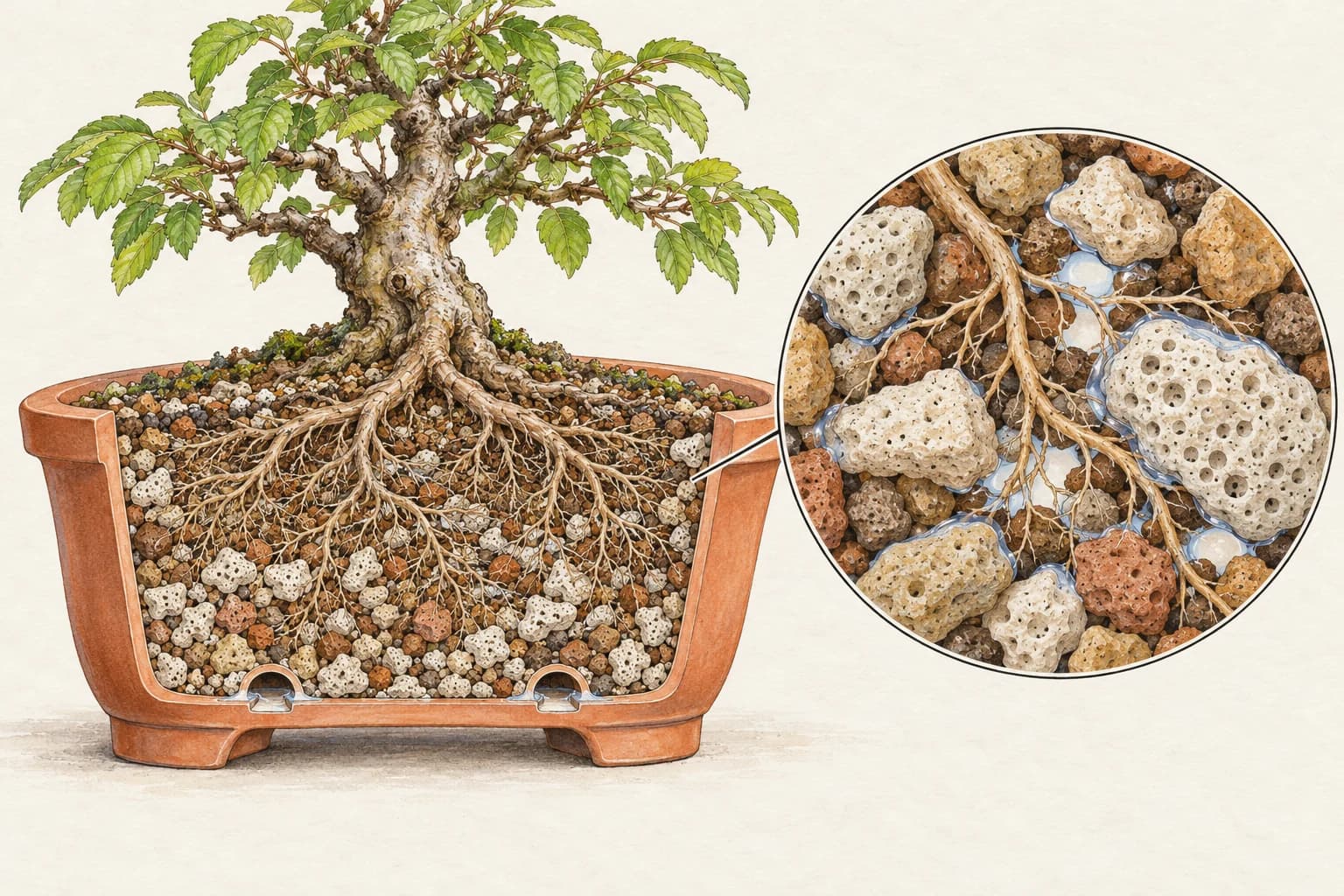
Four jobs that must work together
Support. The root system needs stable contact with the medium. A tree rocking in the wind can damage delicate new roots even if the ingredients are excellent. anchorageThe way roots hold a tree firmly in place against wind, gravity, and its own weight, mainly through the spread and grip of its structural roots. A shallow bonsai pot offers little anchorage, which is one reason newly potted trees are often secured with wire or ties.Open the glossary also depends on container stability and, when appropriate during repotting, secure attachment. Making the medium dense and heavy is not a substitute for a sound anchoring plan.
A usable water reserve. Water held between irrigations gives roots something to draw on. But “holds the most water” is an incomplete goal: some water is too tightly held or poorly connected to roots, and a larger reserve may occupy spaces that would otherwise contain air. Recall how water moves in Course 01's water-transport lesson.
Air exchange. Roots use oxygen in respiration. The relevant air is in connected pore spaceThe gaps between particles in soil or substrate, which hold water, air, or both. Large pores usually drain and refill with air after watering while small pores hold water, so the mix of pore sizes sets how wet and how airy a root zone stays.Open the glossary, not just above the pot. After watering, drainage and subsequent drying allow more pores to contain air. A bag described as “free draining” still needs a suitable pot, unobstructed outlets, and watering based on observation. Course 01's respiration lesson explains the biological reason.
Manageable chemistry. Roots take up dissolved minerals in a chemical environment affected by the ingredients, irrigation water, and feeding. A medium can be mechanically excellent and still present a salt or pH problem. Equally, attractive mineral content on a label does not show that nutrients are available in useful amounts. Lesson 5 separates those questions.
These functions interact. A material change that holds more water may also alter air space, weight, and chemistry. A choice that makes watering easy in one location may create a problem in another.
Explore a functioning root environment
Interactive
Four jobs, one root environment
A stable place for new roots
Particles support the root system, while suitable anchoring keeps a newly placed tree from rocking. Stability and useful pore space must coexist: pressing everything tightly together is not the goal.
Observe: Look for movement of the root ball, not just the weight of the pot.
Reduced motion is on. Play moves to the next still view; Replay returns to Anchorage.
Read the evidence
Four field observationsA recently potted tree rocks at its base whenever the canopy moves. The medium is moist and the holes are open.
Anchorage. A stable place for new roots
Text description
A cutaway bonsai pot contains particles, branching roots, and open drainage holes. Selecting Anchorage highlights the support and anchoring; Water highlights retained films and moving droplets; Air highlights connected dotted oxygen routes; Chemistry highlights dissolved mineral ions.
The four jobs are physical support, a usable water supply, gas exchange, and a manageable chemical environment. These jobs interact, so one observation is a starting point for investigation rather than a diagnosis. The case selector supplies the same observations as the visual exercise.
Explore each of the four function lenses, then use the case exercise to decide which function an observation calls into question. A simplified animation can show why connected air spaces matter; it cannot decide whether a real tree has root disease, calculate its next watering time, or prove a mix suitable from its color.
Why the garden and the pot differ
Garden roots have a much larger volume to explore, and field soil participates in a deeper drainage system. A pot ends abruptly at its base. The short column above that base, the pore network, and the container's exposure create a different environment. Digging up soil also changes the structure it had in the ground.
Fine garden soil in a small pot can settle into a poorly aerated mass. Mixing a few coarse stones into it does not guarantee a useful network of pores: small particles can occupy gaps between the stones. In contrast, a purpose-made container medium is selected for performance within those boundaries. University of Maryland recommends container growing media rather than assuming garden soil will function the same way in a pot. Its guidance applies to general container culture; bonsai choices still need testing in the actual geometry. Growing media for containers.
Choose evidence you can act on
In our first case, a healthy trident maple in a moderate-depth training pot wets evenly, drains from open holes, and becomes progressively lighter between checks. A neighbor suggests changing it immediately because it lacks a fashionable ingredient. There is no demonstrated problem to solve. Record its current function and revisit the choice when repotting is otherwise justified.
Now change one fact: the same tree stands in an outer pot full of runoff. That is an immediate environmental issue. Empty the standing water and ensure outlets can discharge; replacing the whole medium is not the first step. Compare this with Course 03's wet-root investigation.
The bonsai decision
Evaluate the environment before shopping
Starting point
For a healthy established tree, record how the whole root ball wets, how freely runoff leaves, and how moisture changes between checks. Keep a functional setup while gathering evidence.
This assumes
The tree is not showing an urgent decline, the container is stable, drainage is open, and the current watering method reaches the roots.
Change course if
Investigate persistent wetness, a dry core despite runoff, a rocking trunk, or a changing drying pattern. Correct an obvious external problem before planning root disturbance.
Practice check · not scored
Optional · not required for completion
Make a four-function note
For a tree you already care for, write one observation under support, water, air, and chemistry. Leave unknowns marked “unknown”; a careful question is more useful than an invented answer. Do not unpot it to complete the note. No-tree alternative: use the rocking-tree case above and list which two observations you would gather next, such as core moisture after slow watering and the source of movement.
Back to the question
What does a tree need from the material in its pot?
A tree needs a medium that supports stable roots, stores accessible water, permits air exchange, and offers manageable chemistry. Whether it does those jobs depends on the particles, container, site, tree, and care working together.
Key takeaways
- Judge function rather than color, price, or a “bonsai” label.
- Water retention and aeration have to coexist in the same root zone.
- Field soil and container media operate under different physical boundaries.
- Investigating the existing setup does not require disturbing healthy roots.